J. L. BELL is a Massachusetts writer who specializes in (among other things) the start of the American Revolution in and around Boston. He is particularly interested in the experiences of children in 1765-75. He has published scholarly papers and popular articles for both children and adults. He was consultant for an episode of History Detectives, and contributed to a display at Minute Man National Historic Park.

Subscribe thru Follow.it


•••••••••••••••••


Showing posts with label William Cushing. Show all posts

Saturday, February 24, 2024

Two Salaries for Chief Justice Peter Oliver

One of the Massachusetts Whigs’ complaint about Thomas Hutchinson in the 1760s is that he amassed too many offices for himself.

Hutchinson was simultaneously the lieutenant governor, as such a member of the Council, the chief justice of the superior court, and a probate judge.

When Gov. Francis Bernard went home to Britain and Hutchinson became the acting governor, he gave up his judicial posts. Benjamin Lynde seemed like a natural fit for that role—his father, also named Benjamin Lynde, had been chief justice from 1729 to 1745.

After less than two years, however, Lynde resigned. Hutchinson, now governor in his own right, looked for a new chief justice. But first, he appointed his brother Foster to the court.

(Lyndes and Hutchinsons weren’t the only judicial dynasties. In 1772, William Cushing became a third-generation justice.)

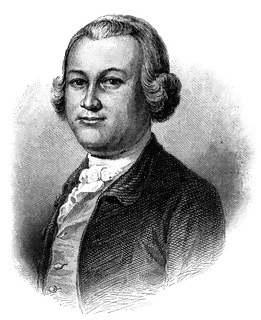
Gov. Hutchinson decided to recommend elevating associate justice Peter Oliver (shown above) to the chief position. Oliver had been on the court since 1756. He was a strong supporter of unpopular Crown officials, as he’d shown at the trials of Ebenezer Richardson, Capt. Thomas Preston, and the British soldiers in 1770.

Oliver was also related to Hutchinson by marriage in three different ways. And his own brother Andrew was lieutenant governor. For the Whigs, Hutchinson giving his old jobs to his in-laws didn’t really look like sharing power.

One aspect of royal rule that should seem foreign to us is that Crown officials could keep a lot more of their actions secret from the public. Since the people’s representatives weren’t involved in choosing governors and justices or paying their salaries under the Townshend Acts, why did they need to know?

In July 1772 the Massachusetts General Court demanded that Gov. Hutchinson tell them whether he was getting paid by the Crown. He said he was. Joseph Hawley, a lawyer and representative from Northampton, drafted resolutions condemning this arrangement, but the legislature couldn’t do anything more about it.

It took even more time for the assembly to confirm that the royal government had offered salaries to Chief Justice Oliver and his colleagues. And even then it wasn’t clear the justices would accept that money. That didn’t stop Samuel Adams and the new Boston committee of correspondence from making that their primary complaint to other towns in late 1772.

In early 1773 the General Court tested the system by appropriating £300 to pay Oliver for the previous judicial term and £200 for the associate justices. In June, the newly elected legislature (many of the representatives having been reelected) asked treasurer Harrison Gray if the justices had collected that money. They had taken only half, Gray reported.

Aha! said the legislators. That means the justices were living off the royal government’s tax revenue. At the end of June, the General Court demanded that those men renounce any pay except what it had voted on. This is one of the paradoxical moments in Revolutionary confrontations: Massachusetts politicians demanding to pay government officials they disliked instead of letting the royal government do it. But it was the principle of the thing, you see.

The associate justices agreed that they wouldn’t accept any more royal pay. Chief Justice Oliver didn’t. The next move was up to the Whigs. But according to the provincial charter, they had no role in picking judges. So what could they do?

TOMORROW: John Adams’s bright idea.

Friday, March 25, 2022

“Lifetime Tenure” When the Supreme Court Began

The U.S. senate is holding hearings on the nomination of a new Supreme Court justice. Some senators have come out against giving this nominee a “lifetime appointment” despite having previously approved her lifetime appointment as a federal judge at two levels.

Social-media discussions of this issue got me thinking of what a “lifetime appointment” meant when the U.S. Supreme Court first met.

Lifetime judicial appointments were common in the British and thus British-American legal systems. Although overall life expectancy was lower in the eighteenth century, that’s largely due to childhood mortality, so once a mature man was appointed to the bench he often served for many years.

(Colonial Rhode Island was an exception to that system of lifetime appointments. Under its eighteenth-century constitution, judges were elected for one-year terms, though they could be reelected. Which just shows how anomalous Rhode Island was.)

I decided to look at the Supreme Court justices appointed in the 1790s to see how long they stayed alive and stayed on the court.
  • John Jay / 6 years on the court / 40 more years of life after appointment 
  • John Rutledge / 1 one year on the court, then another stint of a few months four years later / 11 more years of life 
  • William Cushing / 20 / 20 
  • James Wilson / 9 / 9 
  • John Blair / 5 / 10 
  • James Iredell / 9 / 9 
  • Thomas Johnson / 2 / 28 
  • William Paterson / 13 / 13 
  • Samuel Chase / 15 / 15 
  • Oliver Ellsworth / 4 / 11 
  • Bushrod Washington / 31 / 31 
Thus, from early on we see Supreme Court justices serving for a decade or more. Six of these eleven men sat on the bench until they died, with an average tenure of over fifteen years. Three more justices nominated by the Presidents active in the Founding—John Marshall, William Johnson, and Joseph Story—also served more than thirty years.

That said, while the first generation of U.S. politicians could conceive of Supreme Court justices serving for decades, the number of jurists who actually do so has gone up. As of today the historical average tenure on the court stands at sixteen years, but no justice has left the bench before that time since the late 1960s.

The other career model we see these days, a justice serving for decades and then retiring, was less common in the 1790s. Indeed, the three early justices who resigned citing reasons of health—John Blair, Thomas Johnson, and Oliver Ellsworth—did so after only a handful of years. The job was more physically demanding when Supreme Court justices still rode the circuit to hear federal cases rather than staying in the capital.

One path we haven’t seen for a long time was a justice resigning from the top bench because he preferred a different government role. John Jay left the court to be governor of New York, having already run for that offce in 1792 and gone overseas as President George Washington’s treaty negotiator in 1794.

Finally, there’s a storyline we really don’t want to see repeated. John Rutledge (shown above) resigned from the U.S. bench to become chief justice in the home state of South Carolina. Then President George Washington put him back on the Supreme Court as chief justice, only for the senate to decline to confirm him. Rutledge attempted suicide, withdrew from public life, and died five years later.

Tuesday, December 21, 2021

Filling the New England Seat on the U.S. Supreme Court

For more than a century the U.S. Supreme Court had a seat reserved for New Englanders.

The early Presidents had two good reasons for that. First, by appointing justices equally from all regions of the country those Presidents—especially all those Virginians—avoided charges of favoring their home region.

Second, in its early years the Supreme Court justices also rode circuit, hearing federal cases in their districts. So a New Englander covering the northeastern states wasn’t so far away from home.

For the first two decades, that New Englander was William Cushing, formerly chief justice in Massachusetts. In 1795 President George Washington promoted him to be the chief justice, and the Senate confirmed him. But Cushing declined the commission. Being chief justice just wasn’t as prestigious and powerful as the job has become.

Justice Cushing remained on the bench longer than any of the other original court. He was also the last to wear the full judicial wig inherited from the British system. When Cushing died in 1810, President James Madison needed a replacement from New England. He also wanted someone from his own Republican party. Which was difficult because most New England lawyers were Federalists.

Madison’s first choice was Levi Lincoln of Hingham—former U.S. attorney general under Thomas Jefferson, former lieutenant and acting governor of Massachusetts (shown above). The Senate voted its approval. But Lincoln declined, citing bad eyes. Again, being a Supreme Court justice wasn’t that great.

Madison then nominated Alexander Wolcott of Connecticut, mentioned in yesterday’s posting. Wolcott had practiced law, but he was primarily known as the leader of his state’s Republicans. He engaged in harsh political disputes and oversaw patronage appointments. The closest he’d gotten to judicial experience was in his own patronage position as a Customs inspector. The Federalist Columbian Centinel called Wolcott’s nomination “abominable.”

Nonetheless, the Republicans were firmly in charge of the U.S. Senate, 28 votes to 6, and Supreme Court nominees usually got approved within a week. In Wolcott’s case, the Senators referred the court nomination to a committee for the first time. Then they didn’t take a vote until nine whole days later, on 14 Feb 1811.

The U.S. Senate rejected Alexander Wolcott’s nomination to the Supreme Court by a vote of 24 to 9. This was the largest percentage against any court nominee ever. Even Republican Senators voted against the nomination by a margin of at least 2:1.

Wolcott went back to Connecticut politics. President Madison looked around for another New Englander to nominate to the high Court. Again, he needed a prominent Republican—but one with a less partisan history.

Madison’s third choice was John Quincy Adams, former Federalist Senator from Massachusetts. Adams had bucked his party’s foreign policy on several issues under President Thomas Jefferson and ended up a politician without party backing. In 1809 Madison appointed him the U.S. minister to Russia, a country Adams had first visited as a teen-aged secretary for the Continental Congress’s envoy, Francis Dana.

As with Lincoln, the Senate gave their advice and consent in favor of President Madison’s nominee. And as with Lincoln, the nominee declined the job. Adams would go on to be U.S. Secretary of State, President, and a long-time Representative from Massachusetts.

Once again President Madison scanned the New England legal landscape. The best candidate he could find was a lawyer from Marblehead, only thirty-two years old, with one term in the U.S. House of Representatives under his belt. This was Joseph Story, still the youngest person ever nominated to the U.S. Supreme Court.

Story was confirmed and served thirty-three years. As an associate justice, law professor, and author, he exercised more influence over the U.S. legal system than anyone else in the early 1800s but Chief Justice John Marshall.

When Story died in 1845, President James K. Polk nominated Levi Woodbury of New Hampshire to succeed him. After Woodbury, the justices in that line were Benjamin Curtis of Watertown; Nathan Clifford of Maine; Horace Gray of Boston; and Oliver Wendell Holmes, Jr., of Boston. The replacement for Holmes was Benjamin Cardozo of New York, though by that time Louis Brandeis—a native of Kentucky who had established his legal career in Boston—was representing New England on the high bench.

Friday, July 09, 2021

How Did the 8th of July Become Quock Walker Day?

Back in 2006, while discussing a proposed Juneteenth holiday and how the Quock Walker cases had more relevance to Massachusetts, I wrote:
…despite the Walker decision, Massachusetts didn’t become a slavery-free zone right away. That case wasn’t reported or publicized, so only in retrospect did it become a landmark. We still don’t know the exact date of the decision (which makes it hard to observe its anniversary).
At this remove, I’m not sure where I read that scholars didn’t know the date of the decisions that confirmed Walker’s freedom, but I certainly didn’t find any.

When I read that in 2020 the Massachusetts General Court passed a law stating that the decision came out on July 8 and making that date Quock Walker Day in Massachusetts, I naturally became curious. Had new documentation come to light?

First I went back through the scholarly articles studying the case, from the 1960s to the 2000s, seeing if any of them cited a date or a newfound document. Nothing.

Then I looked for books stating the decision came on 8 July. Most of those have been published just in the last few years. The earliest I found was Charles M. Christian’s Black Saga: The African American Experience, published in 1995:
MASSACHUSETTS SUPREME COURT ABOLISHES SLAVERY

On JULY 8, the Massachusetts Supreme Court’s decision in the case of Commonwealth v. Jennison abolished slavery in the commonwealth by virtue of the Declaration of Rights of 1780.
A similarly organized book, Junius P. Rodriguez’s Chronology of World Slavery (ABC-Clio, 1999) said:
In a landmark judicial decision on July 8, slavery was abolished in Massachusetts by action of the Massachusetts Supreme Court in the case of Commonwealth v. Jennison, which involved the efforts of a slave, Quock Walker, to obtain his freedom. The decision was based upon an interpretation of the Massachusetts Declaration of Rights.
Neither of those books cited sources. Nor did any of the more recent books that echo the same date. This timeline from the Massachusetts Historical Society’s Case for Ending Slavery website, a teachers’ resource created in 2010, gives the 8 July date, based on the Chronology of World Slavery quoted above.

Massachusetts’s official guide to the constitutional cases that ended slavery in the state, the Long Road to Justice website, and Historical Digression’s narrative of the cases don’t state a specific date.

I took another look in my newspaper database, again finding nothing.

I decided to go to the expert on both state government records and the end of slavery in Massachusetts, John Hannigan of the Massachusetts Archives. I asked him, Do we know when the Massachusetts Supreme Court issued its decision in the commonwealth’s case against Nathaniel Jennison?

Hannigan swiftly replied:
Jennison appeared before the Supreme Judicial Court to answer the indictment during the April session, which opened on April 15 and adjourned on April 24, 1783. [Chief Justice William] Cushing issued his now-famous instructions and the jury found Jennison guilty at some point during the course of those ten days. I don’t think it’s possible to pinpoint a more accurate date, as none of the documents are specifically dated beyond the month and year of the session. Indictments were usually entered at the end of the record book for each session, possibly indicating that the justices reserved those for last, but there's no way to prove that.

Ironically, the SJC was not even in session on July 8, 1783. The justices adjourned the session for Cumberland county on July 5, 1783; they didn’t meet again until the Suffolk county session opened on August 26, 1783.
The image above is from the surviving record of the Jennison indictment. Clerk Charles Cushing (brother of the chief justice) wrote “April Term at Worcester A.D. 1783” with no further detail.

Thus, there appears to be not a scrap of historical documentation that the final decision in the Quock Walker cases happened on 8 July 1783, and some strong evidence that it couldn’t have. However, the 8th of July observance is now a matter of state law.

TOMORROW: What Nathaniel Jennison was doing in July 1783.

Thursday, July 08, 2021

Quock Walker Day and Juneteenth

Back in June 2006, just weeks after I launched Boston 1775, I shared my thoughts on whether Juneteenth should become a Massachusetts holiday.

Juneteenth would be a synecdoche for the end of slavery in the U.S., I wrote. The 19th of June was the date in 1865 when slavery ended in some parts of Texas, but it stood for the process of liberation over a broader range of space and time.

As Annette Gordon-Reed’s new book On Juneteenth relates, some African-American citizens have celebrated that date for generations.

Most of my 2006 posting focused on the end of slavery in Massachusetts, more than seventy-five years before the U.S. Civil War. I quoted state Chief Justice William Cushing‘s charge to the jury in one of the legal cases arising between Quock Walker and the man who claimed him, Nathaniel Jennison.

Publicizing the full history of slavery in Massachusetts was, I argued, more important for this state than observing Juneteenth, which shifted the problem to another corner of the country.

Last year the Massachusetts legislature voted to make the 8th of July Quock Walker Day, commemorating the end of legal slavery in this state. This is the first year to observe the holiday, and the Association of Black Citizens of Lexington is hosting a community celebration online this evening at 7:00 P.M.

In addition, last month the U.S. Congress voted to make Juneteenth the national celebration of the end of slavery. All too predictably, the far right opposed that. The only votes in Congress against the resolution were from fourteen Republican members of the House.

Many progressives also noted the irony that endorsement of the holiday was coinciding with a push in many states to make voting more difficult. The current U.S. Supreme Court said that state legislators can impose obstacles to voting even when they know those measures don’t solve serious problems and would affect African-American citizens most.

TOMORROW: A question of timing.

Monday, March 04, 2019

A Trial till Half Past One in the Morning

On 3 Mar 1785, the state of Massachusetts brought Thomas Archibald and William Scott to trial for burglarizing the home of James Lovell, a former Continental Congress delegate. Although the burglars took cash, it looks like Lovell was most upset about losing some Continental loan certificates.

The trial took place in the state’s top court. Chief Justice William Cushing, later a U.S. Supreme Court justice, presided. The prosecutor was attorney general Robert Treat Paine, another former Continental Congress delegate.

The court appointed lawyers for the defendants, who had few connections in town and little money. (Another early example of the tenet that people accused of serious crimes deserve strong legal representation, even if the job might be distasteful.)

It’s possible that each man had his own defense attorney. One was William Tudor, a former clerk of John Adams and the first judge advocate general of the Continental Army.

The other was John Silvester Gardiner (1737-1793), who had quite an interesting career. He was born in Boston, son of the prominent surgeon and apothecary Silvester Gardiner. He went to Scotland for schooling and then built a legal career in London, Wales, St. Kitts, and Paris before returning to Boston in 1783. His father was still exiled from Massachusetts as a Loyalist, but John S. Gardiner was fine with that since they didn’t get along.

Gardiner quickly became one of Boston’s leading attorneys, but he practiced for only a couple of years before souring on the local bar. In 1786 he moved again, to land he inherited in Maine. Soon he won a seat in the Massachusetts General Court and used that as his platform for advocating favorite causes: reforming state law, legalizing theater, making Maine a separate state. He was also influential in turning King’s Chapel Unitarian. In The Gardiners of Massachusetts, T. A. Milford summed up the man’s career (on page 1, yet) by writing, “Gardiner was a pest.”

At the trial, the prosecution’s witnesses told the story I summarized over the last two days. The crucial testimony came from Nero Faneuil, saying he was Archibald and Scott’s accomplice turned state’s evidence.

Then came witnesses for the prisoners—or rather for Scott. Archibald doesn’t seem to have put up much of a defense. Scott and his attorney tried to make the case that he was sleeping somewhere else during the crime. Hannah Nelson testified, “I have seen Scot the Tuesday night before thanksgiving he came to our house lodged all Night.” She recalled giving birth around that time, but couldn’t specify the day. Sarah Bond corroborated Scott’s visit, but then another witness, Abigail Willet, testified that “Sally Bond [had] bad Character.”

The result was a flimsy alibi. Imaginatively, one of the defense attorneys argued, “Mrs. Nelson might have Cook’d up a Story for both as well as one”—i.e., if she was just making up a thin story to save Scott from conviction, why didn’t she claim that both men had been at her house?

Another defense argument was “no part of the Property found on any but Nero,” and “Was it not strange that Nero should be trusted with the money”? In other words, Faneuil might be lying to cast blame on Archibald and Scott. Gardiner might have tried to make that personal; Paine’s notes on the case include the line, “I have known these blks., no credit to be given to them.”

In the end, both Tudor and Gardiner fell back on the position that any doubt in the prosecution’s case should lead the jury to acquit the two defendants, or at least lead the judges to spare them from the death penalty.

According to Paine’s diary, the “Trial ended 1/2 past 1 next morning.” The jury returned a verdict of guilty on capital counts for both Archibald and Scott.

On 9 March, the justices sentenced the two men to hang. The execution finally took place on 5 May. The Massachusetts Spy reported: “They had heretofore behaved in a manner unbecoming their unhappy condition, but on that morning appeared penitent, and suitably affected with their situation.”

What about Nero Faneuil, whose got me into this story? As described back here, he pled guilty to a different robbery and been bound to work for the victim for seven years, or until 1792. He may not have outlived that sentence. Town records show that on 29 July 1792, the Rev. Thomas Baldwin of the Second Baptist Meeting married Flora Fanniel to Magguam Eben.

Wednesday, February 06, 2019

Two Looks at Revolutionary New England

This week the Journal of the American Revolution published back-to-back articles about Revolutionary New England.

First, Derek W. Beck adapted material from his book The War Before Independence, 1775-1776 to discuss “Henry Knox’s ‘Noble Train of Artillery:’ No Ox for Knox.”

As Beck says, most of the pictures of the mission to bring cannon and mortars from Lake Champlain to the siege of Boston show men prodding oxen through snow. But the documentary record shows Knox renting horses for most of the trip.

The next day, Prof. Len Travers shared “Casualty Of Revolution: The Sad Case of Betty Smith.” Tracing a woman named Elizabeth Smith in eighteenth-century America is a formidable challenge, but this one made herself notorious. She first shows up in the diary of young Anna Green Winslow, as Travers explains:
Smith may have been a servant for the Winslow family at some time. That’s at least one way of explaining Anna’s reference in a letter to her mother on February 25, 1771: “Dear mamma,” she began, “I suppose that you would be glad to hear that Betty Smith, who has given you so much trouble, is well & behaves herself well. & I would be glad if I could write you so.” The next word, of course, was “but.”

For Betty had fallen into bad company—the very worst kind, some would have said. “But the truth is,” Anna continued, “no sooner was the 29th Regiment encamp’d upon the common [in 1768], but miss Betty took herself among them (as the Irish say) & there she stay’d with Bill Pinchion & awhile.”
Next Smith fell into crime, followed by stops at the whipping-post, the Castle, the workhouse, and back to jail. She tried to escape in the worst possible way, only to be convicted of theft again in March 1772 and sent to the gallows.

Betty Smith wasn’t sent off to be hanged, even though theft was still potentially a capital crime. Instead, she had to stand on the gallows with a noose around her neck and then be whipped again as a reminder to behave better.

Beside Smith stood a man named John Sennet, convicted of having sex with an animal on Boston Common. Again, earlier in the century other men and boys convicted of that crime had been executed (along with the unfortunate animals). Though still founded on painful corporal punishment, the colonial justice system became less harsh over time.

Travers’s short article doesn’t discuss another source on Betty Smith, a broadside poem probably sold on the day that she and Sennet stood on the gallows. Anthony Vaver shared that doggerel on Early American Crime. It includes this verse put into the mouth of John Sennet:
Though Murd’rers pass with crimes of deeper hue,
Thieves and house-breakers always have their due.
Cushing has eas’d the former from their fate,
But vengeance always does on Villains wait.
I suspect “Murd’rers…eas’d…from their fate” refers to Ebenezer Richardson, who had been convicted of murdering Christopher Seider in 1770 yet still not sentenced as Massachusetts’s royal judges awaited a pardon from London.

Those lines point to Judge William Cushing, and an earlier verse puns on the name of Judge Nathaniel Ropes. Both men had been appointed to the court after Richardson’s trial, but they weren’t helping to hang him. Boston’s Whigs wanted to keep that injustice in front of people’s eyes, and Betty Smith’s time on the gallows provided an opportunity.

Thursday, June 08, 2017

James Otis, Jr., and Slavery Revisited

Back in 2006, this blog’s first year, I wrote a couple of essays describing James Otis, Jr., as a slaveholder.

For those postings I relied on and quoted a passage from John J. Waters’s The Otis Family in Provincial and Revolutionary Massachusetts (1968):

Inconsistencies certainly marked most of James’s actions. He rejected both slavery and the belief in Negro inferiority, arguing [in Rights of the British Colonies] that as the “law of nature” made all men free it must be applied equally to “white or black.” Yet he never freed his own colored “boy.”
Waters didn’t provide a citation for that statement. However, his book was and remains the best study of Otis and his relatives, getting beyond the hagiographies of the nineteenth century. And anyone looking at Revolutionary America finds a lot of men who wrote about the blessings of liberty, the evils of the slave trade, and even the problems and immorality of slavery itself without actually detaching themselves from the slavery system.

Recently David Hurwitz asked about the evidence behind Waters’s statement because he’s looking into whether James’s sister Mercy and her husband, James Warren of Plymouth, owned slaves. So I went back to primary sources to see what evidence I could find on the question.

To begin with, it’s clear that James and Mercy’s father, James Otis, Sr., of Barnstable, did own slaves. The vital records of that town list the marriages of “Amaritta and Primus, servants to Col. Otis,” in 1748 and “London, servant to James Otis Esqr and Bathsheba Towardy, an Indian,” in 1760. What’s more, the elder James Otis had a number of Mashpee people indentured to him, as cited in detail by Waters; while legally that was a different situation, in practice it was a lot like slavery.

But what about James Otis, Jr., who left Barnstable to become a leading attorney in Boston? Some of the province’s 1771 tax records survive, and in the years since my original postings they’ve been digitized at Harvard. The entry for James Otis, Esq., of Boston doesn’t list any “Servants for Life” as taxable property. That was Massachusetts’s legal euphemism for slaves. (Likewise, James Warren’s 1771 tax valuation doesn’t list any “Servants for Life.”)

Another place to look for evidence of slaveholding is in people’s wills or estate inventories. David found Otis’s will transcribed in this book. That document is dated 31 Mar 1783, just a few weeks before Judge William Cushing began to declare in court that the new Massachusetts constitution had made slavery illegal. Therefore, if Otis did own slaves in March, he would still have considered them his legal property and could have bequeathed them to heirs. He didn’t.

However, the fact that Otis didn’t mention slaves in his will doesn’t mean he didn’t own any. He didn’t have to list all of his property. Otis devoted most of his will to criticizing his daughter Elizabeth for marrying a British army officer, Leonard Brown, bequeathing her only five shillings. (Here’s more about that couple.) Otis left almost his whole estate to his wife Ruth and daughter Mary, also making them his executrices in charge of dividing it as they chose. They could have dealt with any slaves in the estate without filing an inventory with the probate court—especially since Cushing would soon rule slavery null and void anyway.

This evidence still doesn’t prove that James Otis, Jr., never owned slaves. He could have done so as a young man, before 1771. He could even have inherited slaves from his father, who died in 1778. But historians don’t have the burden of proving a negative, given the gaps in the historic record. Rather, our responsibility is to assemble evidence for the statements we make.

And in this case, based on all I’ve seen, I now revise my 2006 remark. James Otis, Jr., and his siblings grew up in a slaveholding family, but I’ve seen no evidence that as an adult he owned slaves, and in 1771 he definitely didn’t.

Saturday, May 30, 2009

“We the People...in order to...Establish Justice”

The first U.S. Supreme Court consisted of six rich white men, three of them named John and two James. The sixth was Massachusetts’s own William Cushing (shown here, courtesy of the Supreme Court Historical Society). President George Washington chose those men not just for their judicial wisdom but for their diversity. In other words, they represented the rich white men of every region.

I think we can all agree that, despite their geographic breadth, those men shared unexamined assumptions and convictions on many legal, constitutional, and social questions of the day. Poor, black, Native, and female Americans had quite different experiences, and different outlooks. In fact, we might even agree that a poor, black, Native American, or female justice would have brought the first court a better sense of justice as we understand it than six men from the young nation’s elite.

The current debate over the nomination of Judge Sonia Sotomayor to that court is focusing in part on whether there’s still a difference of perspective between rich white men and other Americans. In 2001, Sotomayor delivered a public lecture that touched on this point. The whole text has been reprinted in the New York Times, though a lot of commentators have preferred to quote (or misquote) a single sentence. The passage starts this way:

Justice [Sandra Day] O’Connor has often been cited as saying that a wise old man and wise old woman will reach the same conclusion in deciding cases. I am not so sure Justice O’Connor is the author of that line since Professor [Judith] Resnik attributes that line to Supreme Court Justice Coyle.
Caring about the correct attribution of quotations! Already I like her.

Contra this transcript, the actual attribution should be to the late Minnesota Supreme Court Justice M. Jeanne Coyne. In her remarks on joining the Supreme Court in 1993, Justice Ruth Bader Ginsburg cited O’Connor quoting Coyne. Ginsburg repeated the line again this year, but she added: “But there are perceptions that we have because we are women. It’s a subtle influence. We can be sensitive to things that are said in draft opinions that (male justices) are not aware can be offensive.”

And O’Connor just told Publishers Weekly:
I was terribly disappointed when I retired in 2006 not to be replaced by a woman. We have to remember that slightly more than 50 percent of us in this country have two X chromosomes and I think it doesn’t hurt to look at our national institutions and see women represented. I don’t think two females on the Supreme Court is enough, but it is certainly better than one.
In sum, though Ginsburg and O’Connor quote Coyne, they don’t agree that American men and women share the same experiences, perceptions, or judgments. They don’t agree that a court consisting almost entirely of men can represent the whole country as well as if that group contained more than one woman.

In her speech, Sotomayor agreed with O’Connor and Ginsburg, and described her different perspective arising not just from being a woman, but also from being a Puerto Rican:
I am also not so sure that I agree with the statement. First, as Professor Martha Minow has noted, there can never be a universal definition of wise. Second, I would hope that a wise Latina woman with the richness of her experiences would more often than not reach a better conclusion than a white male who hasn’t lived that life.

Let us not forget that wise men like Oliver Wendell Holmes and Justice [Benjamin] Cardozo voted on cases which upheld both sex and race discrimination in our society. Until 1972, no Supreme Court case ever upheld the claim of a woman in a gender discrimination case. I, like Professor [Stephen L.] Carter, believe that we should not be so myopic as to believe that others of different experiences or backgrounds are incapable of understanding the values and needs of people from a different group. Many are so capable. As Judge [Miriam Goldman] Cedarbaum pointed out to me, nine white men on the Supreme Court in the past have done so on many occasions and on many issues including Brown.

However, to understand takes time and effort, something that not all people are willing to give. For others, their experiences limit their ability to understand the experiences of others. Other simply do not care. Hence, one must accept the proposition that a difference there will be by the presence of women and people of color on the bench. Personal experiences affect the facts that judges choose to see.
People seeking a reason to oppose Sotomayor’s nomination have jumped on the adjective “Latina” and ignored the adjective “wise.” Wisdom consists in large part of gaining perspective through experience and empathy, and that “takes time and effort.”

Let’s consider Chief Justice John Roberts, the youngest member of the current Supreme Court—also younger than Sotomayor by half a year. He grew up within the nation’s elite: his father an executive, his education at an all-male private school which he argued should remain all-male. Though he and Sotomayor (and the President who nominated her) went to Ivy League universities and law schools, thanks to our modern meritocracy, that was the first time Roberts’s life paralleled that of a poor Puerto Rican girl from the Bronx.

Does Roberts’s background reflect his judicial decisions? Earlier this month Jeffrey Toobin wrote in The New Yorker:
In every major case since he became the nation’s seventeenth Chief Justice, Roberts has sided with the prosecution over the defendant, the state over the condemned, the executive branch over the legislative, and the corporate defendant over the individual plaintiff.
Every major case. Roberts appears far more predictable, and his decisions, whatever their reasoning, far more reflective of his class background, than we can say for Sotomayor.

Demographically, except for being Catholic, Roberts would have fit right into the first Supreme Court—he even has the most popular first name. Sotomayor clearly wouldn’t have. But a non-British woman from a poor family would surely have broadened that court’s outlook. It would most likely have, as I argued above, given that court a stronger sense of true justice.

And why wouldn’t the same apply to today’s Supreme Court? The only way the justices’ backgrounds wouldn’t affect their perspectives would be if growing up non-white, female, and poor in twentieth-century America was much the same as growing up white, male, and rich. I’d like to see someone try to argue that case.