J. L. BELL is a Massachusetts writer who specializes in (among other things) the start of the American Revolution in and around Boston. He is particularly interested in the experiences of children in 1765-75. He has published scholarly papers and popular articles for both children and adults. He was consultant for an episode of History Detectives, and contributed to a display at Minute Man National Historic Park.

Subscribe thru Follow.it


•••••••••••••••••


Showing posts with label Peter Salem. Show all posts

Friday, February 06, 2026

Knox Trail Commemorations on 8–9 Feb.

Two hundred fifty years ago, the fifty-eight artillery pieces that Col. Henry Knox had convoyed from Fort Ticonderoga were in Framingham, being mounted on carriages and prepared for use.

The Sestercentennial celebrations of that event continue.

Sunday, 8 February, 2 to 4 P.M.
Knox Trail 250th Commemorative Program
Framingham History Center, Village Hall on the Common

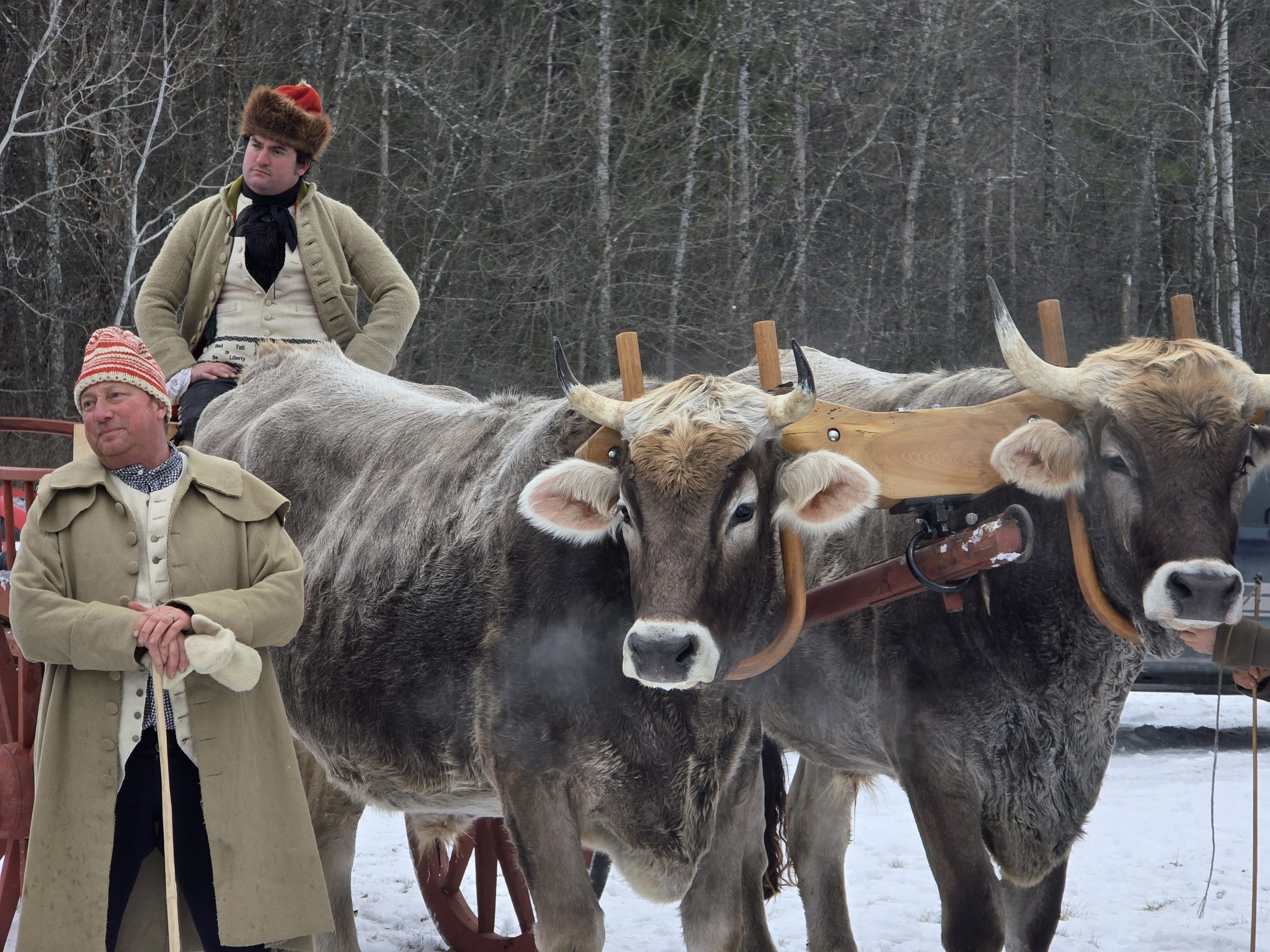
This free, family-friendly event is part of a four-community commemoration presented by Revolution250. The program is scheduled to begin at 2 P.M. with a winter procession across the Framingham Centre Common, featuring cannons mounted on draft-animal-pulled sleds, a fife and drum unit, and colonial reenactors portraying a welcoming party.

The event will continue inside with a commemorative program highlighting Framingham’s role and the shared history of nearby Knox Trail communities. Peter Salem will be portrayed alongside a display of the original muster roll that records his service. Another highlighted artifact will be one of only twelve known handwritten fife tune books from the era. The MA250-sponsored “Stitching Revolution in Massachusetts” quilt will be unveiled.

Because of frigid temperatures and snow, most of the program will take place indoors. Parking will be available at Plymouth Church (87 Edgell Road) and First Parish (24 Vernon Street). For more details, see this webpage.

Monday, 9 February, 7 to 8:30 P.M.
The Noble Train Arrives: Knox, Washington and the End of the Siege
Aeronaut Brewing Company, Somerville

As sponsored by the Somerville Museum, Dan Breen concludes his two-part saga by recounting how the cannon from Ticonderoga were hauled over the Berkshires, across the Connecticut River and finally to Dorchester Heights, where they would help to cue Gen. William Howe to abandon Boston. Learn more and reserve tickets through this page.

In addition, a video of my talk in Cambridge at the end of last month on “A Fine Train of Artillery” and how the siege ended is now online here.

Tuesday, November 06, 2018

The Mystery of “William Benson a Negro Man”

On 6 Nov 1775, the Boston Gazette, then being published in Watertown, ran this announcement from the keeper of the jail at Cambridge:
Cambridge, October 20, 1775.

BROKE out of the Goal in Cambridge, the following Prisoners, Thomas Smith, and William Benson a Negro Man. Said Smith is a very noted Thief, hath been in almost all the Goals on the Continent; had on when he broke Goal, a blue Jacket, a Pair of striped Trowsers, sandy coloured Hair about 5 Feet 4 Inches high.

Said Benson the Negro had on when he went away, a dark coloured old Coat, a Pair of old black knit Breeches, about 5 Feet 6 Inches high. Whoever will take up said Prisoners, and return them to said Goal, shall be handsomely rewarded, by

ISAAC BRADISH, Under Keeper.
The name of William Benson caught my eye. I wondered if this might be the black man of that name who appears in the records of the town of Framingham.

That William Benson was born in 1732. His parents, Nero Benson and Dido Dingo, had been kidnapped from Africa to New England. They married in 1721. Nero Benson served in Massachusetts army units around 1725 and died in 1757.

William Benson was sold to a man named Joseph Collins about 1762 but somehow gained his freedom shortly afterward—though he had to fight for it. Collins and two helpers tried to forcibly take Benson back into captivity and resell him. A Middlesex County grand jury indicted Collins in 1764. He formally acknowledged Benson’s freedom and refunded the buyer’s money (or, under another interpretation, bought Benson back and freed him). Under those circumstances, the court accepted Collins’s plea of no contest and let him off with a small fine.

By early 1762 William Benson was husband to Sarah Perry of Sudbury, born in 1747. Or as Shrewsbury warning-out records from 1762 said, “Perry, Sarah, alias Benson, white, called by William Benson, (colored) his wife.”

According to William Barry’s history of Framingham and the town’s published vital records, their children included:
  • Katy or Cate, born 8 Apr 1763, later the wife of Peter Salem.
  • Abel, born in 1766.
  • Polly, born in 1773.
  • Sally, born in 1782.
  • William, who died young.
Traditions in Framingham and Needham say that a black trumpeter helped to summon the militia in one part of the region on 19 Apr 1775. Various authors have named that military musician as Nero or Abel, both recorded in other documents as playing the trumpet. But Nero was dead by 1775, and Abel was no more than nine years old and didn’t mention such service in his military pension application. I’ve posited that William—Nero’s son and Abel’s father—is a candidate for being that trumpeter.

Was the same William Benson locked up in the Cambridge jail a few months later? Unfortunately, I’ve found no more detail on this escaped prisoner. On 9 October the besieging army’s general orders had said:
If any Negroe is found straggling after Taptoo beating about the Camp, or about any of the roads or Villages, near the encampments at Roxbury, or Cambridge, they are to be seized and confined until Sun-rise, in the Guard, nearest to the place where such Negroe is taken up.
That was confinement in a military stockade, not the town or county jail, but it reflects the general hostility toward blacks that Gen. George Washington’s army adopted in that season.

Of course, African-American soldiers were already serving in that army, and at the end of December Washington reversed course and decided they could continue to serve. William Benson’s son Abel became one of those Continental soldiers, signing up in 1780 at the age of fourteen (saying he was sixteen). He received a plot of Framingham land as payment. After Abel’s mother died, his father William came to live there.

Monday, June 18, 2018

EXTRA: Who Killed Pitcairn?

The Journal of the American Revolution has just published an article by me titled “Peter Salem? Salem Poor? Who Killed Major John Pitcairn?”

This exploration of one aspect of the Battle of Bunker Hill grew out of a series of postings here from 2009, which I then rewrote as an article for the first Journal of the American Revolution print collection. With that book no longer available, we’re sharing the full essay online.

Here’s a taste:
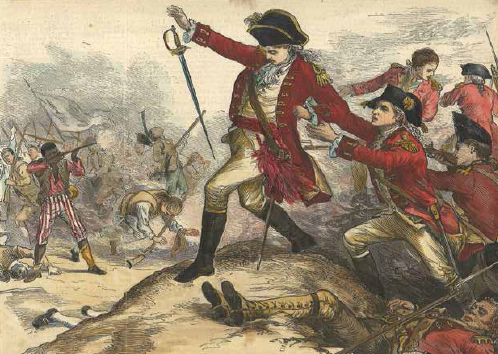
…after Lexington lots of New England men were gunning for the major. They wanted to see Pitcairn receive his just deserts for supposedly ordering his men to fire. They, and later generations of Americans, wanted his story to have meaning, and being brought low just when he thought he had triumphed — by a black man, of all soldiers — provided that satisfaction. A popular nineteenth-century engraving encapsulated that story in its caption: “The shooting of Major Pitcairn (who had shed the first blood at Lexington) by the Colored Soldier Salem.”
But the best evidence shows, I argue, that Maj. Pitcairn wasn’t killed by a black soldier as that print depicted, or by any of the other nineteenth-century claimants. Whatever Salem Poor did to merit extraordinary praise from Massachusetts officers, and whatever Peter Salem did in his Continental Army service, neither man shot Pitcairn as he mounted the edge of the Breed’s Hill redoubt.

Tuesday, April 26, 2016

Fears in Framingham and Elsewhere

Yesterday I quoted two Connecticut newspapers from March 1775 reporting on the detection of a slave conspiracy in Natick.

Such worries were nothing new. Back in September 1774, Abigail Adams had told her husband about a similar fear in Braintree:
There has been in Town a conspiracy of the Negroes. At present it is kept pretty private and was discoverd by one who endeavourd to diswaid them from it-he being threatned with his life, applied to justice [Josiah] Quincy for protection. They conducted in this way—got an Irishman to draw up a petition letting to the Govener telling him they would fight for him provided he would arm them and engage to liberate them if he conquerd, and it is said that he attended so much to it as to consult Pircy upon it, and one Liut. [?] Small [Maj. John Small?] has been very buisy and active. There is but little said, and what Steps they will take in consequence of it I know not.
Jason T. Sharples has found a deep tradition of such fears in British North America. The rumors would often take the same form: free blacks were tempting enslaved blacks, many masters and their families would be murdered all at once, blacks planned to burn the town…

The political and increasingly military tensions in Massachusetts in 1774 brought those fears to the surface again, alongside other, parallel rumors: that the British military planned to burn the town, that the provincial militia would raise 30,000 men and storm Boston, that the Crown would ship in thousands of French or Russian or Native soldiers. Most of those conspiracy theories were groundless.

People may have had their own doubts then, but they didn’t feel safe dismissing such dangers. Robert G. Parkinson just wrote about how such a worry affected people in Framingham as the war began:
Josiah Temple, a native of Framingham, Massachusetts (about fifteen miles south of Concord), published a book in 1887 on the town’s history. His recounting of what people remembered about the night of the Alarm was so different from the legend that he found it impossible to believe.

For four generations, the local story of the night of April 19, 1775, was that, as soon as the town’s militia marched north toward Lexington Green, a “strange panic” spread through Framingham. But that’s not what surprised the town historian, nor should it us. But what they said next certainly seems odd: “The Negroes were coming to massacre them all!” Some in the town, Temple noted, “brought the axes and pitchforks and clubs into the house, and securely bolted the doors, and passed the day and night in anxious suspense.”
More specifically, Temple wrote that the “women and children” in two Framingham districts felt this fear, particularly Mehetable, “wife of Capt. [Simon] Edgell,” a slaveholder. Temple also said, “Nobody stopped to ask where the hostile Negroes were coming from; for all our own colored people were patriots.” Peter Salem, for example, was marching with Capt. Edgell’s company. A black trumpeter reportedly roused the town militia. But Framingham is right next to Natick, where a free black man named Thomas Nichols had been arrested for fomenting unrest.

A similar fear affected women who gathered for safety from the regulars at a home in Menotomy, according to the Rev. Samuel A. Smith’s 1864 history:
The report was spread abroad that the slaves were intending to rise, and finish what the British had begun by murdering the defenceless women and children. It excited great consternation, therefore, among the women gathered at George Prentiss’s upon the hill, when they saw Ishmael, a negro slave belonging to Mr. [William] Cutler, approaching the house. They thought their time had come, but one, a little braver than the rest, summoned up courage to ask, “Are you going to kill us, Ishmael?”

“Lord-a-massy, no ma’am!” said the astonished black. “Is my missis here?”
Since Ishmael had stayed behind to save the Cutler tavern from burning, he had cause to be annoyed as well as astonished. In 1780, Ishmael Cutler, then thirty-six years old, enlisted as a soldier. The next year, he paid the town poll tax as a free man.

COMING UP: Who was Thomas Nichols?

Thursday, April 14, 2016

The Legend of Abel Benson

In Framingham, there’s a tradition that the militia alarm on 19 Apr 1775 was spread by an African-American playing a trumpet. Lately, in fact, that tradition has said the trumpeter was a young boy of African and English descent named Abel Benson.

That tradition has been published in Norman Castle’s The Minute Men (1977), David Hackett Fischer’s Paul Revere’s Ride (1994), Kenneth A. Daigler’s Spies, Patriots, and Traitors (2014), and various web articles and local talks.

It’s striking, however, that the first mention of that story didn’t appear in print until the early 20th century. As far as I can tell, Abel Benson’s connection to the Lexington alarm starts in 1908 in a compendium called Historic Homes and Places and Genealogical and Personal Memoirs Relating to the Families of Middlesex County, Massachusetts.

In an entry on the Bacon family, this series quotes a man named Austin Bacon describing how he understood his grandfather John Bacon, lieutenant from Needham, responded to that alarm:

In the night or near morning the alarm was given and he set off on horseback to join his company at the more eastern part of the town, and sent his horse back when they got nearly to the Lower Falls. Soon after he had gone a trumpet sounded and some Framingham men came along with one Nero Benson, a negro, for trumpeter, and every house they passed had a blast.
Since Lt. Bacon had left, another relative presumably saw how the “Framingham men came along” and passed down that description.

That lore also surfaced (independently or not?) in George Kuhn Clarke’s History of Needham, Massachusetts, published in 1911. Clarke was a longtime collector of local history, old enough to have met a woman who lived through the first day of the Revolutionary War. Here’s how Clarke described the alarm in Needham:
On the morning of April 19, 1775, the news that the British were on their way to Concord was brought to Bullard’s Tavern, and the alarm was given by Ephraim Bullard, the tavern-keeper, or by his son of the same name, who fired a gun on Bullard’s Hill. . . .

In “The Leg” [a section of Needham later traded to Natick] the alarm was sounded by the trumpet of Abel, or Nero, Benson, a negro.
Unfortunately, Clarke didn’t write out the basis for that statement.

Both Nero and Abel Benson had appeared more than half a century earlier in William Barry’s History of Framingham, published in 1847. Three times in that book, Barry identified Nero Benson as the “trumpeter in Capt. Clark’s company” from Framingham in 1725—fifty years before the Revolutionary War. Another page lists “Abel Benson, trumpeter” among that town’s Revolutionary veterans. And there’s a genealogy that shows Nero was Abel’s grandfather through a son named William.
(Note that Abel Benson was also a brother-in-law of Peter Salem, a soldier at Bunker Hill sometimes credited with shooting Maj. John Pitcairn—though I think that’s dubious.)

It’s significant that Barry wrote about the Bensons without describing either Nero or Abel as being an important part of the area’s militia response in April 1775.

TOMORROW: In fact, there’s strong evidence neither Nero nor Abel Benson sounded the alarm.

Tuesday, March 10, 2015

The Men of Drury’s Company

Looking for documents about African-Americans in the New England ranks before Gen. George Washington’s arrival, I checked the new Harvard database of Massachusetts Anti-Slavery Petitions. As I noted before, it contains many documents that don’t touch directly on slavery.

I found this petition to Gen. Artemas Ward signed on 5 June 1775 by more than two dozen men serving under Capt. Thomas Drury (1735-1790) of Framingham. They wrote:
the Subscribers, Soldiers in the Compy. Commanded by Capt. Drury, Humbly showeth—

that your Petitioners With the utmost Concern find themselves Shifted Out of Col. [John] Nixons Regt. into that of Col. [Thomas] Gardners, Contrary to Our Inclination and Repugnant to the promise made us at Our Inlisting

We theirfore Begg that your Excellency Would be Pleased to Continue us in the Regiment We Engaged to serve in—and not to be Removed for the Future Only to Serve the Malevolent Disposition of Our Captain.
New England soldiers viewed their enlistments as contracts to serve under particular officers. It appears that Capt. Drury had promised to serve under both Nixon and Gardner, but he was listed higher on the seniority list in Gardner’s regiment, so that’s the assignment he preferred.

Twenty-eight men didn’t want to make the switch. Maybe they trusted Col. Nixon, who was from their home town of Framingham, more than Col. Gardner from Cambridge. Those men were bold enough not only to go over Drury’s head but also to criticize his “Malevolent Disposition.”

In his Patriots of Color study, George Quintal identified three of the soldiers who signed this petition as men of color: later war records identify Blaney Grusha and Peter Salem as “Negro” and Joseph Paugenit as “Indian.” However, on this document there’s no indication that those soldiers were racially distinct from the other signers. (Salem and Grusha both signed with their marks, but none of the men had genteel, practiced signatures.)

In addition, Quintal’s study identified two more black men in the same company—Cato Hart and Jeffrey Hemenway. They didn’t sign this petition.

In fact, the Committee of Safety found that the company was split. On 14 June it determined:
A number of men belonging to the company of Capt. Drury, having petitioned that they might be permitted to join, some, the regiment commanded by Col. Gardner, and others, the regiment commanded by Col. Nixon; and the committee having considered their several requests, Voted, as the opinion of this committee, that said company be joined to such regiment as it shall appear the major part of said company are in favor of, when called upon for that purpose.
Three days later, Nixon’s and Gardner’s regiments both fought in the Battle of Bunker Hill. Both colonels were wounded, and Gardner died on 3 July. I don’t know if Drury’s men ever got around to voting, but the company remained in Nixon’s regiment.

Meanwhile, a new commander-in-chief arrived, and in his first report back to the Continental Congress he complained about “the Number of Boys, Deserters, & Negroes which have been listed in the Troops of this Province.” On Thursday I’ll talk about how Washington came to think differently.

Monday, September 27, 2010

The Problem with “Mark Codman”

Yesterday’s Boston Globe included an article by Francie Latour rounding up several books and a movie issued over the past decade about slavery in New England. It offers a good reading list on the subject, including Elisa Lemire’s Black Walden (and avoiding one unreliable recent title).

The article’s subhead says, “More than we like to think, the North was built on slavery”; a bunch of right-wing commenters confirmed that by showing that they’d prefer not to see such essays at all.

I have my own objection to how the article begins:

In the year 1755, a black slave named Mark Codman plotted to kill his abusive master.
The name “Mark Codman” pulled me up short because that’s not how the man was referred to in his lifetime.

John Codman called his slave “Mark,” with no surname. Massachusetts society and legal practices followed suit. Mark was tried, convicted, and executed under that single name. Referring to blacks by only a given name was undoubtedly a way to signal their lesser status in colonial society. But tacking on their owners’ surnames now strikes me as, in its small way, both a distortion of that history and another imposition on those individuals.

In many cases, we know that people who had been enslaved adopted the surnames of their former masters: Tony Vassall of Cambridge, Prince Estabrook of Lexington, Phillis Wheatley of Boston until her marriage to John Peters, and so on. But in other cases, enslaved people used surnames that differed from their owners’ or former owners’.

Crispus Attucks’s last name hints at a connection to the Natick Indians. Peter Salem also went by the name Salem Middlesex; he apparently took surnames from locations rather than from his one-time owners, Jeremiah Belknap and Lawson Buckminster.

In Framingham in 1721, two African-born slaves of the Rev. John Swift married. They are listed in church records as Nero Benson and Dido Dingo, the latter sounding more like an African name than an English one. Subsequent legal records usually refer to this couple by their first names only, but the surname “Benson” got passed down to their free descendants. (In Maryland later, Frederick Douglass was born Frederick Bailey, and never knew where his original surname came from—clearly not his or his mother’s owner. William S. McFeely’s biography suggests it might be a form of “Belali,” a common African name.)

Sally Hemings’s surname came from the ship’s captain who owned one of her ancestors and fathered another. The Hemings family retained that surname for generations despite owners like Thomas Jefferson usually referring to them only by given names. (Even today, one can often detect writers who want to dismiss Sally Hemings and her descendants’ link to Jefferson by how they refer to her only as “Sally,” or spell the name “Hemmings” as a white Jefferson biographer did.)

Being able to control their own names appears to have been significant for African-Americans. Gary Nash showed in a study of Philadelphia that emancipated black families quickly dropped the classical, geographic, and African day-names that colonial slave-owners liked—no more Pompey, Bristol, or Cuffee. Free blacks instead favored Biblical and common English names, like most of their neighbors.

Given those patterns, I always look for the name that an enslaved or formerly enslaved person appears to have freely chosen and preferred, and to try to use it in the same style as I would for white contemporaries: Attucks, Wheatley, Hemings, &c. (Olaudah Equiano presents a difficult case.) But when I can’t find a surname, I don’t add an owner’s surname because I’ve seen enough examples of individuals choosing otherwise. And recognizing people as individuals is what naming is all about.

I can therefore see the motive to give Mark a surname like most of his Massachusetts contemporaries. But he suffered at the hands of John Codman, and killed the man. Would he really want to be retroactively named “Mark Codman”? Enslavement constricted Mark’s life and treated him as less than fully human; the fact that he was called only “Mark” is a significant reflection of that history.


Tuesday, February 17, 2009

Making Meaning of Major Pitcairn

So what’s the right question about the story of Maj. John Pitcairn’s death in the Battle of Bunker Hill? I think it’s why so many stories—some quite dubious—have grown up around that fatally wounded Marine when he was only one of 226 British men killed that day (including nineteen officers).

We humans want stories with meaning. That instinct might be especially strong when it comes to boiling down big, chaotic events such as battles, and even stronger when they’re battles our side has lost—and, really, everybody lost the Battle of Bunker Hill.

Pitcairn was the officer in charge of the British troops that fired on the militia at Lexington. Though he didn’t order those soldiers to fire, many Americans in the early republic believed he did. Therefore, his death two months later was bound to be treated by American chroniclers as historic justice.

As a result, a lot of stories about killing British officers at Bunker Hill appear to have gravitated toward Pitcairn. So a man who shot an officer (such as Phinehas Whitney and Benjamin Webber) was eventually credited with shooting Pitcairn. Men who simply aimed at an officer (such as Joseph Spalding) were said to have shot Pitcairn.

And as the decades passed, that shooting became the battle in miniature. The proud British officer mounts the embattled redoubt, boasts too loudly (saying the provincials have fled, “The day is ours”), and is shot down. And shot not just by any soldier, but by a “boy” or “black,” the most common of common men. How republican is that! (It’s not surprising that people whose idea of a republic included equal rights for all citizens were most vigorous in promoting the story of an individual soldier shooting Pitcairn.)

For Pitcairn to have been shot as he moved forward in a body with his Marines—to have been shot by multiple soldiers, impossible to identify for certain—to have been shot without having a memorable verbal exchange with his killer—that just wasn’t meaningful enough. It might even get too close to the truth, which was that two groups of close to three thousand men were trying to kill each other, all in the name of British values, over a small peninsula that turned out to be virtually meaningless in the war.

(On the other side of the battle line, Pitcairn’s comrades also sought meaning in his death. Gen. John Burgoyne praised how Pitcairn’s son had carried him from the battlefield and bade farewell, saying the incident belonged “in the hands of a good painter or historian.” A story arose that many of Pitcairn’s Marines wailed with his son that they, too, had lost a father, demonstrating the loyalty of his men. And then there’s the legend of the major’s stoic death somewhere in the North End.)

So did any of the Massachusetts men who’ve been credited with killing Pitcairn have a hand in doing so? I suspect the most commonly named shooter, Peter Salem, got linked to Pitcairn’s death only because Emory Washburn read about that “black soldier named Salem” in Samuel Swett’s history, recalled a black veteran of the battle named Salem from Leicester, and put 2 and 2 together to make 5 for the glory of his home town. Washburn never cited any more specific evidence for his claim about Peter Salem.

I think Salem Poor is more likely the man whom John Winslow recalled as the “black soldier named Salem.” Salem Poor might also be the “negro man belonging to Groton” whom the Rev. Dr. Jeremy Belknap wrote about. He wasn’t from Groton, but Col. William Prescott—who tried to get Poor special recognition from the Massachusetts legislature—was from that town, and people might have assumed it was Poor’s home as well. Whether Winslow correctly reported what Poor did to be commended is another question, but I think the earliest sources put him on top of the list of Pitcairn’s likeliest killers.

As for the other guys, their stories imply that they killed other officers in different circumstances—somebody had to have done so, after all. However, some of those stories appeared in print so late, and were shaped by the growing legend of Maj. Pitcairn’s death, that they might not be reliable.

But when it comes to assigning credit, I think we have to remember Pitcairn died in a pitched battle which involved thousands of men. Most of the provincial soldiers probably never had a clear shot at the Marines major, but by staying in the redoubt and manning the rail fence they held off two British advances while inflicting the worst casualties that army would suffer in the entire war. In the middle of that chaos, Maj. John Pitcairn was fatally wounded—which isn’t that surprising. All the provincial soldiers at Bunker Hill helped to kill Maj. Pitcairn.

COMING UP: Sooner or later, what happened to Maj. John Pitcairn’s body? (But first, another break from CSI: Colonial Boston.)

Sunday, February 15, 2009

The Growing Memory of Peter Salem

As I noted a couple of days ago, the first history of Framingham published after Peter Salem died there said nothing about the town native fighting at Bunker Hill, much less shooting Maj. John Pitcairn. Elsewhere in New England, other men or families appear to have been making their own claims to having killed the British Marines commander.

Within a couple decades, however, histories were not only naming Salem as Pitcairn’s slayer, but they were illustrating his feat. The picture above first appeared in William Cooper Nell’s The Colored Patriots of the American Revolution (1855), though this version comes from Edward A. Johnson’s A School History of the Negro Race in America (1890). It’s clearly derived from John Trumbull’s painting The Death of General Warren, with the dramatic young white man standing in front of Salem on the canvas shooed out of sight.

Nell’s book was not only a pioneering work of African-American history; it was also part of the Abolitionist argument for emancipation and equal rights for black Americans. Nell and other authors used the story of Peter Salem as evidence of black contributions to the U.S. of A.

Abolitionists worked, against some indifference or hostility, to preserve the memory of that soldier. For example, Theodore Parker wrote to the historian George Bancroft on 16 Mar 1858:

In the engravings of the battle when I was a boy, the black man, Peter Salem, appears in the act of shooting Major Pitcairn; but now-a-days a white man is put in his place. Richard Frothingham, in his account of Bunker Hill battle, makes no mention of Peter. He appears, however, on some of the bills [i.e., currency] of the Monument, Freeman’s and Charlestown Banks.
Eventually, in the same way that Crispus Attucks became better known than other Boston Massacre victims, so Peter Salem became better known than most other veterans of Bunker Hill. They served as defiant symbols of African-American patriotism.

The engraving below, captioned “The shooting of Major Pitcairn (who had shed the first blood at Lexington),” was published by Benson J. Lossing in the late 1800s. Lossing was selling books, not promoting Abolitionism, but by that point he and his engraver had to depict the man who shot Pitcairn as black. It was part of standard American history.
Abolitionists also pointed to Salem Poor, an African-American recognized in 1775 as having fought especially well at Bunker Hill. But because it’s not clear what Poor had actually done to earn officers’ praise, his story never gained as much traction. (No doubt because of that vacuum, a story much like Peter Salem’s developed around Salem Poor, as I described back here.)

Those two men became symbols for many more non-white men who fought with the provincial forces early in the Revolutionary War—over a hundred documented in George Quintal’s report Patriots of Color. It’s easier for us to remember individuals with names than to remember large groups.

Finally, while researching this series of postings, I realized that a third name has become linked to the death of Maj. Pitcairn. In a footnote in The First Year of the American Revolution (1934), Allen French suggested that the American with the best claim to having killed Pitcairn was “Salem Prince, a negro.” That name appeared subsequently in Richard Ketchum’s Decisive Day, John Jakes’s Rebels, David H. Fischer’s Paul Revere’s Ride, and A. J. Langguth’s Patriots. Some websites now say that Salem Prince was, like Salem Middlesex, simply another name for Peter Salem.

However, Quintal found no record of any soldier named Salem Prince in the provincial army in 1775. And I can’t rouse any mention of a “Salem Prince” through Google Books before French’s footnote. I fear it was a simple error that’s now muddied the waters, which were never clear to begin with.

TOMORROW: My conclusions about who killed Maj. John Pitcairn.

Thursday, February 12, 2009

Salem Poor: “a Brave & gallant Soldier”

Starting in 1826, or more than half a century after the Battle of Bunker Hill, Peter Salem of Framingham and Leicester has been most often identified as the black soldier who killed Maj. John Pitcairn of the British Marines.

However, another African-American soldier named Salem was singled out for special commendation in the same year as the battle. This was Salem Poor of Andover, who had purchased his own freedom for £27 in 1769.

On 5 Dec 1775, thirteen Continental Army officers and a brigade surgeon sent the following petition to the Massachusetts General Court:

The Subscribers begg leave to Report to your Honble. House, (which wee do in Justice to the Character of So Brave a Man) that under Our Own observation, Wee declare that A Negro Man Called Salem Poor of Col. Fryes Regiment Capt. Ames. Company in the late Battle at Charlestown, behaved like an Experienced officer, as Well as an Excellent Soldier, to Set forth Particulars of his Conduct Would be Tedious, Wee Would Only begg leave to Say in the Person of this Sd. Negro Centers a Brave & gallant Soldier. The Reward due to so great and Distinguisht a Caracter, Wee Submit to the Congress—
Among the signers were Col. William Prescott, commander in the redoubt; Col. Jonathan Brewer; and Lt.-Col. Thomas Nixon, who had links to Peter Salem.

If only those men had “Set forth Particulars” of what Salem Poor had done! Because it’s absolutely extraordinary to see high-ranking white gentlemen in 1775 compare a black man to “an Experienced officer.”

This special recognition might have been what John Winslow was recalling when he told historian Samuel Swett that the black soldier who killed Pitcairn was presented to Gen. George Washington and given a financial prize by provincial officers. Or perhaps Poor had done something else entirely, also worthy of notice.

In any event, the legislature gave the men who submitted this petition “leave to withdraw it”—the period’s way of saying no. Salem Poor didn’t receive any special official recognition in his lifetime.

By 1880, the stories of Salem Poor and Peter Salem were converging. Sarah Loring Bailey then wrote in her Historical Sketches of Andover:
The story goes that “Salem Poor,” a slave, owned by Mr. John Poor, shot Lieutenant-colonel [James] Abercrombie. As that officer sprang on the redoubt, while our men were in retreat, and exclaimed, “The day is ours,” Salem turned and took aim and fired. He saw the officer fall.
This is the very same story, down to the words the British officer yelled, that other writers were telling about Peter Salem. (But of course the Andover tradition said Salem Poor shot a higher-ranking officer.)

What’s more, other men also claimed to have shot Maj. Pitcairn.

TOMORROW: Two more early identifications of Maj. Pitcairn’s killer.

Wednesday, February 11, 2009

Identifying the Soldier Named “Salem”

In 1819, Samuel Swett identified the American soldier who shot Maj. John Pitcairn of the British Marines as “a black soldier named Salem.” It didn’t take long for a local historian to claim that man for his town.

Gov. Emory Washburn (shown here) wrote this in his Topographical and Historical Sketches of the Town of Leicester, published in the Worcester Magazine in 1826:

There was residing here, till within a few years, a black man, who, we have good reason to believe, was the one who shot Maj. Pitcairn, whose death forms so affecting an incident in that bloody affray. History relates that he was shot by a negro, and from the story of the one we allude to, and many corroborating circumstances, we are led to conclude that he was the person who did the deed.

The person to whom we refer was named Peter Salem; he was a servant of Gen. [John] Nixon during the revolution, was a native of Framingham, and removed here a few years since, where he died. Major Pitcairn was shot as he was mounting the redoubt, and fell into the arms of his son.
William Barry followed up that lead with more information in his A History of Framingham, Massachusetts, published in 1847. He wrote:
Peter Salem—alias Salem Middlesex—was originally the slave of Capt. Jeremiah Belknap, and was sold by him to Maj. Lawson Buckminster. He married in 1783, Katy Benson, a grand daughter of Nero [Benson], and lived for a time, where is now a cellar hole on the farm of the late Mr. Richard Fiske, near the pond. He served in the war of the Revolution as waiter to Col. Thomas Nixon, of Framingham; and at the opening of the war was present at the battle of Bunker Hill.
Barry then quoted Washburn’s passage and concluded: “Peter died in Fram., Aug. 16, 1816.” Other sources say he died in Framingham’s poorhouse, having been forced to return to his native town when he could no longer support himself.

Washburn and Barry disagreed about which of the Nixon brothers Salem worked for—Gen. John of Sudbury or Col. Thomas of Framingham. But he could have worked for each in turn. More troubling about Washburn’s identification of Peter Salem as the soldier who shot Pitcairn is that he didn’t describe any of his evidence: no remarks about people having heard Salem describe the battle, for example. Washburn wrote at length about Salem as an older man in his 1860 Historical Sketches of the Town of Leicester, describing how he’d told his “stories of the war”—but again the only clear link from him to shooting Pitcairn is the name “Salem.”

A Sketch of the History of Framingham, published in 1827, says nothing about Peter Salem/Salem Middlesex being at Bunker Hill, though it does list the name of at least one other black private, Cato Hart. Salem is on the rolls of the Nixon regiment, and that unit was in the battle, so there’s no reason to doubt he was there. But somehow those earlier Framingham chroniclers didn’t find him significant enough to name.

By a strange coincidence, Peter Salem had been owned in youth by the father of the Rev. Dr. Jeremy Belknap, the historian who first recorded that Maj. Pitcairn had been shot by a black man. But Belknap didn’t write down anything about such a family connection, which he surely would have mentioned if he knew. He also believed the shooter had come from Groton. So either he and his sources didn’t know about Peter Salem’s past, or they were discussing another man named Salem.

TOMORROW: Another man named Salem.

Saturday, November 11, 2006

Talk on an African-American Veteran in Natick, 12 November

On Sunday, 12 November, at 2:00 P.M., Bruce Harris will present "Peter Salem—Fighting in the Hope of Freedom," the story of an African-American veteran of the Revolutionary War, at John Eliot Memorial Hall in Natick, Massachusetts. This is a free event sponsored by the Natick Historical Society.

Bruce is the Executive Director of the Literary Trail of New England. He combines the skills of a historical researcher, actor, and teacher. Last spring I had the pleasure of performing the Longfellow National Historic Site's presentation on George Washington and slavery with him; he, having worked at Mount Vernon, took the part of Washington.

As for Peter Salem, he was in arms during the Battle of Lexington & Concord. He fought in the Battle of Bunker Hill, and one tradition says that he killed Maj. John Pitcairn as the British Marine officer entered the provincial redoubt near the end of that battle. (Other traditions point to other shooters, and Pitcairn may of course have been hit multiple times.) There is indubitable evidence that Salem served steadily in the Continental Army from 1775 to 1780 in units that were at Saratoga, Valley Forge, Monmouth, and Stony Point.