J. L. BELL is a Massachusetts writer who specializes in (among other things) the start of the American Revolution in and around Boston. He is particularly interested in the experiences of children in 1765-75. He has published scholarly papers and popular articles for both children and adults. He was consultant for an episode of History Detectives, and contributed to a display at Minute Man National Historic Park.

Subscribe thru Follow.it


•••••••••••••••••


Showing posts with label Nicholas Boylston. Show all posts

Wednesday, December 28, 2022

Thomas Boylston Adams and His Relations

In 1772, John and Abigail Adams had a third son, whom they named Thomas Boylston Adams (shown here, some years later).

The following August, John Adams explained this baby’s name this way:
Sept. 15. 1772 Thomas Boylston Adams was born at Braintree and Christened the next Sunday by Mr. [Anthony] Wibert. The childs great, great Grandfather was of the name of Thomas Boylston and built the Old house at Brooklyne where my mother was born; My mother had also an Uncle of the same name The father of the late Nich. Boylston Esq. and the present Thomas Boylston. Merchant.
As discussed the last couple of days, Adams personally knew the brothers Nicholas and Thomas Boylston.

He also knew—heck, everyone knew—that Nicholas had died in 1771 without any children. He had left most of his huge fortune to a nephew, born Ward Nicholas Hallowell (1749–1828). In return, that young man had legally changed his name to Ward Nicholas Boylston in 1770.

Nicholas’s brother Thomas also had a large fortune. He also had no children. Was he also looking for an heir?

And might knowing there was a little boy in the extended family who already bore his name (albeit from a common ancestor) have caught Thomas’s attention? Did the Adamses consider the prospect of an inheritance, even a little bit? After all, “Thomas Boylston. Merchant” did get a mention in this genealogical note about the baby, despite being only a first cousin twice removed.

As it turned out, Thomas Boylston lost his money in the failure of a London mercantile firm in 1793. He even spent time in a British debtors’ prison before dying in 1798. So there was no fortune to inherit.

Tuesday, December 27, 2022

John Adams’s Dinner with the Hotspurs

As described yesterday, John Adams finally got to see the inside of his mother’s cousin Nicholas Boylston’s Boston mansion on 16 Jan 1766.

Adams had apparently heard stories of the witty analysis around Boylston’s dinner table, and he finally got to experience that.

Nicholas Boylston’s younger brother Thomas (1721–1798, shown here in another John Singleton Copley portrait) was on that night’s guest list. So was the Boylstons’ brother-in-law Benjamin Hallowell, already a high Customs officer. (Adams also noted the presence of two gentlemen named Smith, but he didn’t record them saying anything notable.)

Adams’s description of the banter in his diary began:
The Conversation of the two Boylstones and Hallowell is a Curiosity. Hotspurs all.—Tantivi.—
Samuel Johnson defined hotspurs as men “violent, passionate, precipitate and heady.” “Tantivy” was a hunting cry that for a century had been associated with British Tories.
Nick. is a warm Friend of the Lieutenant Governor [Thomas Hutchinson], and inclining towards the Governor [Francis Bernard]. Tom a firebrand against both. Tom is a perfect Viper—a Fiend—a Jew—a Devil—but is orthodox in Politicks however.
Adams wrestled with how to regard Thomas Boylston, who seemed to be on his side but was nastier than he then liked. Adams also revealed that he shared the nastiness of his society in using “Jew” to mean a betrayer.
Hallowell tells stories about [James] Otis and drops Hints about [Samuel] Adams, &c., and about Mr. Dudley Atkins of Newbury. Otis told him, he says, that the Parliament had a Right to tax the Colonies and he was a d—d fool who deny’d it, and that this People never would be quiet till we had a Council from Home [i.e., appointed instead of elected], till our Charter was taken away, and till we had regular Troops quartered upon Us.
Those were the very measures that Parliament adopted in 1774. Did Otis really speak as Hallowell described? If so, was he warning about what the London government would do, or have to do, to quell resistance? As for defending the Crown’s right to tax, Otis did occasionally make such remarks, to the annoyance of his Whig colleagues. But Hallowell wasn’t an unbiased source.  

Returning to that royal appointee:
He says he saw Adams under the Tree of Liberty, when the Effigies hung there and asked him who they were and what. He said he did not know, he could not tell. He wanted to enquire.

He says Mr. Dudley Atkins was too well acquainted with the Secret of some riots there, to be entirely depended on, in his Account, &c.
Typically, Samuel Adams was careful not to incriminate himself. And in fact he was almost certainly not involved in planning the Loyall Nine’s anti-Stamp Act protest in August 1765. I’ll discuss Dudley Atkins in a separate posting.

Back to Adams’s host:
Nick Boylstone is full of Stories about Jemmy [Otis] and Solomon Davis. Solomon says, Country man I dont see what Occasion there is for a Governor and Council and House. You and the Town would do well enough.
Solomon Davis (1716–1791) was another of Boston’s Whig merchants, like Otis originally from Barnstable. If Boylston quoted him correctly, Davis saw merit in a more democratic government for the colony, akin to a town meeting. But he was much more interested in commerce than politics.

That meal gave John Adams plenty to think about.

Monday, December 26, 2022

How John Adams “Dined at Mr. Nick Boylstones”

John Adams finally got his invitation to dinner at Nicholas Boylston’s mansion in January 1766.

Adams’s mother was a Boylston, first cousin to this Boston merchant. However, Adams visited Boylston’s home only after becoming a rising young lawyer from Braintree, in Boston for court business and a whirl of political conversations.

On 14 January, for instance, Adams dined at town clerk William Cooper’s house with Thomas Cushing, speaker of the house; William Story, an Admiralty Court official; and John Boylston, yet another cousin on his mother’s side.

Adams recorded in his diary:
Boylstone, affecting a Phylosophical Indifference about Dress, Furniture, Entertainments &c., laughed at the affectation of nicely distinguishing Tastes, such as the several Degrees of Sweet till you come up to the first degree of bitter, laughed at the great Expences for Furniture, as Nick Boylstones Carpetts, Tables, Chairs, Glasses, Beds &c. which Cooper said were the richest in N. America.—The highest Taste and newest Fashion, would soon flatten and grow old.
The next evening, Adams met with “the Sons of Liberty, at their own Apartment in Hanover Square, near the Tree of Liberty.” This was the group also called the “Loyall Nine,” principal organizers of the protests that had negated the Stamp Act the year before. They were preparing to celebrate the law’s expected repeal.

Finally came this diary entry:
Thurdsday. Jany. 16th. 1766.

Dined at Mr. Nick Boylstones, with the two Mr. Boylstones [Nicholas and his brother Thomas, probably], two Mr. [James and Isaac?] Smiths, Mr. [Benjamin] Hallowell and the Ladies [the Boylstons’ sister Mary Hallowell and possibly James Smith’s wife, Elizabeth]. An elegant Dinner indeed!

Went over the House to view the Furniture, which alone cost a thousand Pounds sterling. A Seat it is for a noble Man, a Prince. The Turkey Carpets, the painted Hangings, the Marble Tables, the rich Beds with crimson Damask Curtains and Counterpins, the beautiful Chimny Clock, the Spacious Garden, are the most magnificent of any Thing I have ever seen.
Even though those luxurious furnishings might “soon flatten and grow old,” they awed the young country lawyer.

TOMORROW: Dinner conversation.

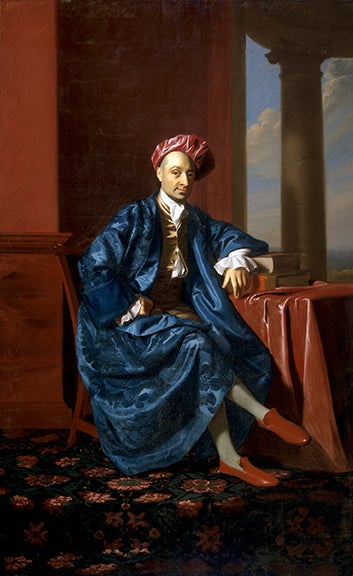
[The image above shows how John Singleton Copley remade his portrait of Nicholas Boylston, shown yesterday. Harvard College commissioned this copy in 1773, after the merchant had died and left money for a professorship. To match other paintings Copley had made for the college, he turned his original composition into a taller, full-figure portrait. As a result, Boylston was immortalized in honking big red slippers.]

Sunday, December 25, 2022

A “Christmas eve” in John Adams’s Imagination

On 23 July 1813, John Adams wrote to his son-in-law, William Stephens Smith, then serving in the U.S. House of Representatives.

That letter was about political affairs, with the war going badly for the U.S. of A., but another big theme was how no one appreciated John Adams.

In making that case, the former President drew up a picture, possibly conjectural, of a Christmastime tradition among certain Boston gentlemen of the mid-1700s:
Remember the fate of Cassandra. The prophet of ill ’tho’ as true as a goose’s bow is always detested. I also have been now and then reckoned among the minor prophets. Not a bone of any Goose ever picked by Jo Green, Nick Boylston, & Master Lovel on a Christmas eve, tho’ they had Nat Gardner for a guest, and exhausted all their wit, Gibes, & Jokes upon it, ever foretold an approaching winter, with more certainty that I have foreseen two or three small events in the course of my Life, such as the American Independence, & the result of the french revolution for example. But I was always execrated for it; & persecuted worse than the hebrew prophets, when they were set in the stocks.
“Jo Green” was Joseph Green (1706–1780), known for his biting literary wit. That seems to have manifest mostly in semi-anonymous verse poking at the Rev. Mather Byles, Sr., and anything new in town, like Freemasons. After a career as a merchant, Green took a post in the Customs service and then had to evacuate town as a Loyalist.

“Nick Boylston” was Nicholas Boylston (1716–1771), Green’s even more wealthy business partner. He and Green, both bachelors, owned houses near each other on School Street. Boylston is best known these days for his portraits by John Singleton Copley (one shown above). For those he posed as a wealthy man of learning, wearing a casual banyan and nightcap and leaning on a book. But I don’t recall any example of Boylston’s own writing or wit.

“Master Lovel” was John Lovell (1710–1778), master of the South Latin School for decades. He, too, was known for writing poetry, in his case serious verse and in various languages. Like Green and Boylston, Lovell’s surviving portrait shows him in a nightcap instead of a formal wig, signalling that he was concerned more with learning than with commerce. He, too, left Boston with the British troops in March 1776.

“Nat Gardner” was Nathaniel Gardner, Jr. (1719–1760), regarded in the 1750s as Boston’s leading poet, particularly in Latin. He was Lovell‘s usher, or assistant master, at the grammar school. Gardner died at forty-one and was soon largely forgotten. In 1989 David S. Shields wrote a study designed to bring him and his work back “from limbo.”

The appearance of Gardner at this Christmas Eve gathering shows that Adams was imagining a scene in the 1750s, when he himself was a university student, country schoolmaster, and legal trainee. He wouldn’t have been invited.

Nonetheless, Adams left a picture of how Boston’s small intellectual crowd spent their Christmas Eves, exchanging witticisms over a roasted goose.

Sunday, January 14, 2007

What Was Under Those White Wigs

In eighteenth-century America, most gentlemen wore carefully shaped white wigs, or powdered their hair to produce much the same look. I think only one hairstyle was more fashionably upper-class than wearing such a wig:

not wearing such a wig.

As Karin Calvert wrote in Of Consuming Interests:
In the privacy of his home or in an informal public setting, a gentleman removed his wig—which was hot, heavy, made the head itch, and could so cover the ears as seriously to impair hearing—and covered his shaved head with a soft nightcap. This was a cap commonly worn in the evenings and is not to be mistaken for a bedcap.
Furthermore, wearing a cap instead of a wig signaled to other people that one was more interested in the life of the mind than in worldly concerns like crafts, business, and politics. And since only wealthy and genteel men could afford not to be interested in business, showing up in a cap demonstrated that one had reached the pinnacle of gentility.

Several gentlemen of the time had their portraits painted in their banyans (flowing robes, like dressing-gowns), nightcaps, and shaved heads. The John S. Copley painting above shows Nicholas Boylston, a wealthy Boston merchant who tilted toward the Whigs. (A larger scan of this image appears in the Wikipedia entry on banyans.) Boylston had his head shaved in order to wear a wig, but didn't wear his wig in this expensive portrait. Instead, his pose signals, he's more interested in the books under his left arm.

Nicholas's brother Thomas Boylston chose a similar approach for his Copley portrait. And here are two other portraits of gentlemen with shaved heads. When we imagine John and Abigail Adams at home in the 1760s and 1770s, discussing their children, politics, and books, we might have to think of John with his head shaved as clean as Curly Howard's.