J. L. BELL is a Massachusetts writer who specializes in (among other things) the start of the American Revolution in and around Boston. He is particularly interested in the experiences of children in 1765-75. He has published scholarly papers and popular articles for both children and adults. He was consultant for an episode of History Detectives, and contributed to a display at Minute Man National Historic Park.

Subscribe thru Follow.it


•••••••••••••••••


Showing posts with label Lake George. Show all posts

Monday, July 28, 2025

A Hero of Lake George

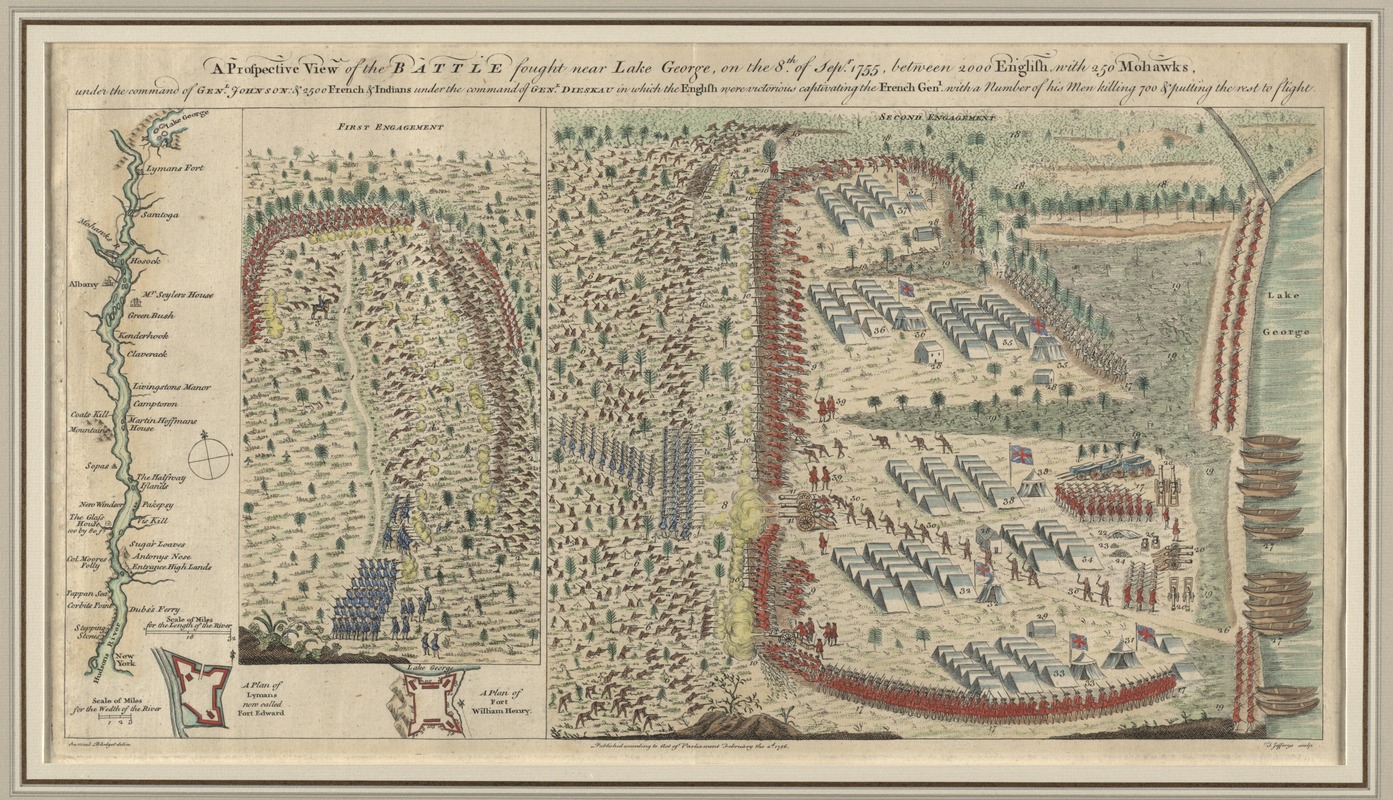
The Battle of Lake George on 8 Sept 1755 probably involved fewer than 3,500 men, a little more on the British side than the French. Each commander reported that his force had faced a much larger foe, however.

Each commander also reported inflicting more casualties than his force suffered, and more casualties than the rival commander reported. In fact, it seems impossible to pinpoint the number of dead and wounded.

Both sides lost leaders, however. On the French side, Baron Dieskau was wounded and captured, and Canadian commandant Jacques Legardeur de Saint-Pierre was killed. The British lost Col. Ephraim Williams and Mohawk ally Hendrick Theyanoguin. Among the provincial officers who died of their wounds was Capt. William Maginnis of New York.

Gen. William Johnson was wounded early in the fighting near Lake George and had to sit out the rest of the battle. Not that he mentioned the last detail in his report to the Crown. Nor did he name Col. Phineas Lyman as the officer who took over and completed that part of the fight. But of course Johnson portrayed the battle as a great victory for Britain.

It probably was a British victory, though limited and costly. Crown forces could now move safely from Fort Lyman to Lake George, and the lakefront was clear enough to build another fort there.

But that clash was an even bigger win for William Johnson, Britain’s liaison to the Iroquois and new provincial general. He was made a baronet, thus Sir William Johnson. Eventually Benjamin West painted Johnson nobly sparing a French officer from attack by a Native warrior, as shown above.

The new baronet returned the king’s favor, renaming the nearby landmarks for the royal family: Lac du Saint-Sacrement became Lake George after George II, Fort Lyman became Fort Edward after one of the king’s grandsons (another slight for Phineas Lyman), and the new fort was dubbed Fort William Henry after the king’s younger son and another grandson. Since the territory remained in British hands, those names prevail.

As the senior (and surviving) British captain in the last part of this battle, Nathaniel Folsom enjoyed some of that glory. He rose within the New Hampshire military establishment, ranked as a colonel within a couple of years. Folsom’s businesses in Exeter prospered.

In 1774 the province chose Nathaniel Folsom as a representative to the First Continental Congress, alongside John Sullivan. His son, Nathaniel, Jr., participated in the first raid on Fort William and Mary that December. Decades later a veteran named Gideon Lamson stated (using military titles the men acquired later):
At nine, Colonel [John] Langdon came to Stoodley’s and acquainted General Folsom and company with the success of the enterprise,—that General Sullivan was then passing up the river with the loaded boats of powder and cannon.
Folsom took charge of one barrel of gunpowder removed from the fort.

Given Nathaniel Folsom’s success in the last war, his support for the Patriot resistance, and his activity in the New Hampshire Provincial Congress, it’s no surprise that that body voted to make him commander of the province’s troops on 21 Apr 1775. The legislators reaffirmed that decision on 23 May.

The problem was that no one had checked with the officer who was actually leading the New Hampshire troops around Boston.

TOMORROW: Stark divide.

Sunday, July 27, 2025

“We march’d into the camp & told the army what we had done”

I’ve been quoting Capt. Nathaniel Folsom’s account of his New Hampshire troops’ fight against a French and Indian force south of Lake George in the late afternoon of 8 Aug 1755.

He continued with lively detail:
After being closely engaged for about three quarters of an hour, they kill’d two of our men & wounded several more on our left wing, where they had gain’d a great advantage of us.

Which, with our being very much tired and fatigued, ocсаsioned us to retreat a little way back; but finding by our retreat we were likely to give the enemy a greater advantage we rallied again in order to recover the ground we had lost, and thinking that if we quitted the ground we should loose our greatest advantage, about fifteen or twenty of us ran up the hill at all hazard. Which we had no sooner done but the enemy fired upon us vigorously; & then, seeing us coming upon them (we being charg’d & they discharg’d) they run & gave us the ground.

Whereupon we all shouted with one voice and were not a little encouraged. In this skirmish Ensign Jonathan Folsom [the writer’s brother] was shot through the shoulder & several others wounded. At every second or third discharge during the engagement we made huzzas as loud as we could but not to be compar’d to the yells of our enemies, which seem’d to be rather the yellings of devils than of men.

A little before sunsetting I was told that a party of the Yorkers were going to leave us, which surpris’d me. I look’d & saw them in the waggon road with packs on their backs. I went to them & asked where they were going. They said to Fort Edward. I told them they would sacrifice their own lives & ours too. They answer’d they would not stay there to be kill’d by the damn’d Indians after dark but would go off by daylight.

Capt. [John] Moore and Lieut. [Nathaniel] Abbott & myself try’d to perswade them to tarry, but to no purpose till I told them that the minit they attempted to march from us I would order our New Hampe. men to discharge upon them. Soon after which they throw’d off their packs & we went to our posts again.

Upon my return to my tree, where I had fought before, I found a neat’s tongue (as I tho’t) and a French loaf, which, happening in so good a season, I gave myself time to eat of; & seeing my lieut. at a little distance, much tired & beat out, I told him if he would venture to come to me, I would give him something to comfort him. He came to me & told me I was eating a horse’s tongue. I told him it was so good I tho’t he had never eat anything better in his life.

I presently saw some Yorkers handing about a cagg of brandy, which I took part of & distributed amongst the men. Which reviv’d us all to that degree that I imagin’d we fought better than ever we did before.

Between sunsett and the shutting in of daylight we call’d to our enemies: told them we had a thousand come to our assistance; that we should now have them imediately in our hands; and thereupon made a great shouting & beat our drums. Upon which they drew off upon the left wing, but stood it on the front & right wing till daylight was in & then retreated & run off.

Then we begun to get things ready to march to the lake, when Providence sent us three waggon horses upon which we carry’d in six wounded men; made a bier & carried one on, lead some & carry’d some on our backs. We found six of our men kill’d & mortally wounded so that they dyed in a few days, and fourteen others wounded & shot through their cloaths, hatts, &c. With much difficulty we persuaded the Yorkers to go with us to the lake.

In about an hour after the battle was over we march’d & sent two men forward to discover who were inhabitants at the lake. Who met us and told us all was well. Whereupon we march’d into the camp & told the army what we had done. As soon as they understood by us that we had drove the enemy off & made a clear passage for the English between forts, the whole army shouted for joy, like the shouting of a great host.
That was the third part of the Battle of Lake George. The French forces had won the first stage with their ambush of the British column heading south to Fort Lyman (Edward). But pressing that attack brought out the larger British force camped at Lake George, and the Crown won the second stage. Then Capt. Folsom, Capt. William Maginnis of New York, and other provincials came up behind the French fighters who had fallen back and started this third and smallest stage.

TOMORROW: Who won?

Saturday, July 26, 2025

“Ye most vilolent Fire Perhaps yt Ever was heard of in this Country”

Yesterday we left Capt. Nathaniel Folsom of New Hampshire and Capt. William Maginnis of New York leading their provincial companies north from Fort Lyman (soon renamed Fort Edward) on the afternoon of 8 Sept 1755. They were headed to Gen. William Johnson’s camp at Lake George, a distance of at least fifteen miles.

That morning, French forces had successfully ambushed a British column that had tried to come the other way. The column’s commanders were killed, leaving Lt. Col. Nathan Whiting of Connecticut and Lt. Col. Seth Pomeroy of Massachusetts in charge.

Pomeroy’s diary, published by the Society of Colonial Wars in New York in 1926, offers a vivid description of what happened:
we this Morning Sent out about 1200 men near 200 of them our Indians went Down ye Rhode toward ye Carrying pla[ce] got about 3 miles they ware ambush’d & Fir’d upon By ye Franch and Indians a number of ours yt war Forward Return’d ye Fre & fought bravely but many of our men toward hind Part Fled

ye others being over match’t ware oblig’d to fight upon a Retreet & a very hansom retreet they made by Continuing there fire & then retreeting a little & then rise and give them a brisk Fire So Continued till they Came within about 3/4 of a mile of our Camp

there was ye Last Fire our men gave our Enenies which kill’d grate numbers of them Sean to Drop as Pigons yt put ye Ennemy to a Little Stop

they very Soon Drove on with udanted Corage Doun to our Camp

ye Regulars Came rank & File about 6 abrest So reach’d near 20 rods In Length Close order the Canadans & Indians Took ye Left wing Hilter Scilter down along Toward the Camp

they had ye advantage of the ground Passing over a hollow & rising a note within gun Shot then took Trees & Logs & Places to hide them Selves-we made ye best Shift we Could for battrys to get behind but had but a few minuts to do It in

Soon they all Came within Shot ye regulars rank & file they Came towards yt Part of ye Camp whare we had Drew 3 or 4 Field Peaces ye others towards the west Part of ye Camp there I Placed my Self Part of Coll. [Timothy] Ruggles & of our Rigement a long togater

the Fire begun between 11 & 12 of ye Clock and Continued till near 5 afternoon ye most vilolent Fire Perhaps yt Ever was heard of in this Country In any Battle then we beat ’em of ye ground

we Took ye French General wounded
That general was Jean-Ardman, Baron Dieskau. He’d been shot four times and declared that the last wound was mortal. But in fact he survived as a prisoner of war in Britain until 1763 and then at home another four years.

Meanwhile, Folsom and Maginnis were moving north. According to Folsom’s March 1756 letter to the Rev. Samuel Langdon, published by the Massachusetts Historical Society in 1904, Capt. Maginnis neglected to send out “advance guards” to prevent an ambush and moved too slow besides.

(Maginnis might have countered that for all of Folsom’s claim that he and his officers were hungry to enter the fight, they’d managed to beat the Yorkers back to Fort Lyman and then lagged them in returning to face the enemy.)

Toward the late afternoon:
Captain McGennes and company started nine Indians, who run up the wagon road from us, upon which Captain McGennes stopt. I, seeing them halt (being on a plain) ordered our men to move forward and pass by them. As soon as I came up with McGennes, I asked the reason of his stopping, which he told me was the starting of the Indians.

I then moved forward and we ran about 80 rods and discovered a Frenchman running from us on the left. Some of us chased him about a gunshot, fired at him, but, fearing ambushments, we turned into the wagon road again and traveled a few rods, when we discovered a number of French and Indians about two or three gunshots from us.

Then we made a loud huzza and followed them up a rising ground and then met a large body of French and Indians, on whom we discharged our guns briskly, till we had exchanged shots about four or five times.

When I was called upon to bring up the Yorkers, who I thought had been up with us before but finding them two or three gunshots back, I ordered them up to our assistance. And though but a small number of them came up, we still continued the engagement and soon caught a French lieutenant and an Indian, who informed us that we had engaged upward of 800.
Folsom said his force consisted of “but 143 men”—leaving out the 90 Yorkers, of course.

TOMORROW: Endgame.

Friday, July 25, 2025

“We should go to the assistance of our friends at the lake”

Nathaniel Folsom (1726-1790) came from an old and prominent New Hampshire family. He was a merchant and owner of a sawmill and shipyard.

Early in the French and Indian War, Folsom became a captain in the New Hampshire provincial regiment. His company was stationed at Fort Lyman, soon to be renamed Fort Edward, on the Hudson River.

On the morning of 8 Sept 1755, having heard shots in the night, Col. Joseph Blanchard told Folsom to send out a scouting party. Folsom dispatched Lt. Jeremiah Gilman, a relative, with some troops. According to a letter the captain wrote in March 1756, those men “marched up between Hudson’s River & the waggon road that leads to Lake George about two miles and a half, where they discovered one [Jacob] Adams lying by the waggon road, dead & scalp’d, & several waggons almost burnt up.”

After hearing this news, Col. Blanchard sent out Capt. Folsom with fifty men. They found signs of a large force of Natives and French in the area. Furthermore, “while we were tying up the dead man to carry him into the fort we heard the discharge of a great gun at the lake & soon after the continual report of others.”

This was the start of the Battle of Lake George, specifically the attack by that French force later called the “Bloody Morning Scout.” Gen. William Johnson had sent troops and supplies from his camp at the lake south toward Fort Lyman with a warning about the enemy being in the area, but that enemy had set up an ambush. The Crown commanders, Col. Ephraim Williams of Stockbridge and Mohawk leader Hendrick Theyanoguin, were both killed. Their remaining men withdrew toward their camp, with the French forces in pursuit.

As William R. Griffith recreated events in The Battle of Lake George (2021), Capt. Folsom returned to Fort Lyman with news that a battle was under way to the north. Shortly after noon, Col. Blanchard sent him back out with a larger force of New Hampshire men, augmented by a company of New Yorkers under Capt. William Maginnis.

Folsom’s own account from 1756 presents himself and his men as acting more aggressively and independently than that:
I call’d together our officers to advise whether we should go to the assistance of our friends at the lake whom we suppos’d to be engaged in battle; upon which officers & souldiers unanimously manifested their willingness to go. At that instant I was told that there were more men coming, who were presently with us. They were a company of the York regiment, who, when detached at Fort Edward, were commanded by Capt. McGennes.

I told him our army was attack’d at the lake, that we had determined to go to their assistance & ask’d him to go with us. Upon which he answer’d that his orders were to come to that spot, make what discoveries he could, return & make report. I told him that was my orders, but that this being an extraordinary case I was not afraid of being blamed by our superr. officers for helping our friends in distress. Whereupon he turn’d & ordered his company to march back again.

I then told our officers that as our number was so small—but, as it were, a handfull—I tho’t it most adviseable to return to the fort and add to our number & then proceed to the lake. We march’d, soon overtook the Yorkers & ran by them a little distance, where we met near fifty of our own regiment running towards us.

I ask’d, “What tidings?” They said they tho’t we had been engag’d & that Coll. Blanchard had sent them to our assistance.

Whereupon we imediately concluded to go to the lake; but not having orders therefor, as before hinted, I despatch’d Lieut. [Richard] Emery with some few men with orders to go to the fort and to acquaint Coll. Blanchard with what we had discover’d and of our design to go to the lake.

Meanwhile Capt. McGennes marched forward. We followed for about two miles but as I tho’t they marched too slow & kept out no advance guard (by means of which we might be enclos’d in the ambushments of the Canadeans) I propos’d to our New Hampshire men to go by them. But one of our officers told me he tho’t it not best to go before the Yorkers for that he was more afraid of them than of the enemy.
We might presume that officer was afraid of being accidentally shot from behind, but clearly there was a rivalry between the two colonies’ forces.

TOMORROW: Engaging the enemy.