J. L. BELL is a Massachusetts writer who specializes in (among other things) the start of the American Revolution in and around Boston. He is particularly interested in the experiences of children in 1765-75. He has published scholarly papers and popular articles for both children and adults. He was consultant for an episode of History Detectives, and contributed to a display at Minute Man National Historic Park.

Subscribe thru Follow.it


•••••••••••••••••


Showing posts with label clothing. Show all posts

Friday, August 28, 2026

“I decided that I’d make clothing until something better came along”

After I started reading intently about the Revolution in New England, one of the first living historians I remember chatting with was Henry Cooke.

He was presenting the life of a tailor by, you know, tailoring clothes. He mentioned researching the career of a Boston tailor and militia officer named Thomas Marshall.

“Ah, the man with the shovel,” I said. Referring to Marshall’s role in the merchants’ confrontation with John Mein.

That’s when we knew we’d get along.

Cooke and I were part of the team that reenacted the Boston Massacre for several years leading up to its Sestercentennial. His face should also be familiar to anyone who attended the reenacted tea meetings at Old South Meeting-House in that period, and many other events.

Earlier this summer, the Tufts Now website shared Marc Chalufour and Alonso Nichols’s profile of Cooke as a university alumnus.

The interview reminds me how unruffled Cooke is, for a man who can make his own ruffles:
How did you get started doing historical reenactments?

When I was in high school, my guidance counselor said if I was going to go to college, I needed to have extracurricular activities. This is 1974, and he said there was this minuteman group starting in Randolph, Mass., and maybe I should join them. I have been doing living history in various forms ever since.

When did you start making your own costumes?

That happened very early. When I first got involved, the only clothing patterns that were available to us were from something called Sketchbook 76. But they were little more than sketches of pattern pieces and a drawing of what the finished object should look like.

When I was a college student, I started making historical clothing for myself. A lot of the guys in the unit would say, “Hey, I need an extra shirt, can you make me one?”

When I finished my master’s program, I was putting out résumés. I had done internships in archives, in museum collections, and assumed I would end up doing something like that, but I was competing with people with Ph.D.s for entry-level jobs. I decided that I’d make clothing until something better came along. That was 1984 and I’m still waiting.
At the same time, Henry Cooke takes his work quite seriously, learning from it and teaching others.
What have you learned from studying original 18th-century garments?

The clothing is a mold of the body that lived within it. I’ve studied Ben Franklin’s clothing, John Adams’s clothing, John Hancock’s clothing. You get an understanding and an appreciation of the humanity and the physicality of these people.

Franklin, I always thought, was this pudgy little guy. But he had a very muscular upper body because he was pulling on a printer’s beam throughout his career, and he loved to swim. He had the body of a swimmer.
For more, here’s a Journal of the American Revolution interview with Henry Cooke from a decade ago.

Saturday, August 22, 2026

Benjamin Davis, Baker?

The record of Benjamin Davis, Sr.’s appearance before the Loyalists Commission in Canada states of his time in New York:
He was then a Baker in Govert. Service.
That detail has gone into every profile of Davis written from that source. Articles have discussed Davis as an example of the baking profession.

That puzzles me because nothing in Davis’s past shows any connection to baking. (Gingerbread, yes. Running a bakery, no.)

In Boston, Davis was a general import merchant, usually dealing in dry goods. He also invested in distilling, whaling, and other enterprises. Whigs denigrated him as a “Huckster,” not a baker. The goods he lost at Boston included “Iron, Tea, Liquor, Stockings, Haberdashery…”

Later the same Loyalists Commission document quoted Davis as saying that when he was captured on his voyage to New York in 1776 “He was then going into Trade on advice of Sir W. How.” The term “Trade” meant general mercantile trading. The cargo Davis was bringing to the city? Wine, not flour or bread.

An advertisement in the 13 Dec 1777 Royal Gazette shows that Benjamin Davis had opened a store in New York “in Queen-Street, the corner of King-Street.” He offered Madeira wine, tea, candles, sugar, cloth, clothing, blankets, and “An assortment of childrens toys.”

On 23 May 1778 “Benjamin Davis, & Son,” advertised in the Royal Gazette from “their Store, No. 229, Queen-Street, the Corner of King-Street.“ They sold cloth, garments, notions, and wine.

In 1779 the father and son offered “A neat and elegant assortment of BOOKS.” In 1781 they had “Four hundred gallons choice fresh South Carolina ORANGE JUICE.” In 1782 they advertised “Garden SEEDS” shipped from London. Several of their newspaper ads offered the cloth and trimmings for military uniforms. But never bread.

That firm’s advertisements disappeared after August 1783 as the British military left New York. That’s why I’m confident these merchants were Benjamin Davis, Sr. and Jr., from Boston. (Because of course there were a bunch of men with that name in Revolutionary America.)

It’s conceivable that Benjamin Davis, Sr., provided some capital for a bakery that supplied the British military in New York, but there’s no sign he was involved in running that operation. And I wonder if the word “Baker” was correctly transcribed.

TOMORROW: Benjamin Davis, to the end.

Friday, August 14, 2026

“The 65th lost their Arms, Cloathing, and everything”

Yesterday I quoted the first newspaper account of the fire at the 65th Regiment’s barracks on the Town Dock, rented from the Loyalist merchant Benjamin Davis.

Here are some more accounts from the town, starting with Lt. John Barker’s journal entry for 18 May:
About 9 oclock last night a fire broke out in the Barracks of the 65th Regt. on a Wharf near the Market: every house on the Wharf, amounting to 41, was burnt to the Ground, and most of the things in them; the 65th lost their Arms, Cloathing, and everything; and the 47th has lost 4 Companies cloathing; the loss altogether is considerable as they were all stores on the Wharf and full of Goods. – A chest of Bullets was found in [John] Hancock’s store.

Coll. [James] Abercrombie Adjt. Genl., lately arrived from England, going up Cambridge river this morning in a Man of War’s Boat was fired upon by several of the Rebels from the Banks; several balls went thro’ the boat but nobody was hurt; they made the best of their way back, and I don’t hear that he has been as fond of reconnoitring since.

Detachments from the different Corps were sent to extinguish the fire, which had began to break out again; in 4 or 5 hours they effected it.
Merchant John Rowe put in his journal:
17 May … About Eight of Clock A Terrible Fire Broke Out in the Barracks on Treats Wharff Occupied by the 65th Regiment. it was Occasiond by Accident or rather from Great Carelessness — it destroyd 33 Stores on Dock Square — Mine was in Great Danger I thought it So & therefore removd Great part of my Effects — from thence. it continued untill half past One with Progress — The Officers Behavd Very Well

The Cloathing of 4 Companies belonging to the 47th. Regimt was burnt & Some Fire Arms Lost

18 May Thursday Warm Weather W So. W — The People in General very Busy in Collecting the Effects that were Sav'd Out of the Fire
Rumors were more dire, as usual. From Salem, Nathaniel Appelton wrote: “There has been a very great fire at Boston last night don’t yet learn the particulars but in generall that it broke out near draw-bridge & consumed many buildings; some say 30, some say 100, oh poor Boston!”

In fact, this fire appears to have been confined to a central business district. Although lots of warehouses and stores were destroyed, along with the goods inside them, no private homes were lost—just the 65th Regiment’s quarters.

TOMORROW: Newspaper coverage.

Saturday, July 25, 2026

“When at liberty very sociable and familiar”

Yesterday’s posting left Richard Steele in New Haven, Connecticut, in December 1770, being branded and cropped on his ear the second time in a few months.

(I presume his right ear was cropped first, then his left, but the newspaper accounts don’t specify that.)

You might think that punishment would have taught Steele the error of his ways, or at least made it harder for him to keep committing crimes.

But no, Steele managed to get in one more theft before the end of the year, according to the Connecticut Journal of 4 Jan 1771:
----Stop the Felons!----

A Goldsmith’s Shop, belonging to the Subscriber in Waterbury, was broken up, on the Night of the 27th Instant, and sundry Pair of Stone Ear Rings, one Pair Stone Buttons, one Pair Gold ditto, and one Gold Ring, with some Shillings in Coppers, and some other Money, and likely some other Articles of Goldsmith’s Ware, was taken away, supposed by one Richard Steele, (and his Partner unknown) who was lately punished for breaking open Mr. Marks’s House in Derby.

Said Steele is of middling Stature, about 21 Years of Age, has dark brown Hair, not much curl’d, black Eyes, and beautiful Complection, but much Pockbroken, both Ears crop’d, branded twice in the Forehead, wears a brownish Coat, check’d woollen Shirt, old leather Breeches, and Hat slop’d.

Whoever will take up said Steele, or his Accomplice, and secure him or them, and notify me, shall have Three Dollars Reward, and necessary Charges paid, by
JOSEPH HOPKINS.
Dec. 31, 1770.
The 8 January Connecticut Courant, published in Steele’s usual haunt of Hartford, summarized the news about him for local readers.

Then on 5 February the Connecticut Courant had good news:
The Thief is Caught!

And was last thursday bro’t to this town and again committed to goal. He is perhaps the most notorious one that ever infested this colony, was last September before the hon. Superior Court, held in this place, convicted of Burglary by the name of Richard Steele, and in consequence thereof crop’d and branded, not long after which he broke goal, and escaped but pursuing his trade, was again taken for Burglary committed in Derby, and indicted at New-Haven before the adjourn’d Superior Court in December last, for the second offence, and again crop’d and branded, and very soon after escaped from that goal, and has since (perhaps) committed more Burglary’s than ever the notorious [Isaac] Frasier who was hanged at Fairfield ever did in so short a time.

He is now put in irons in very close confinement but least he should again escape, would that the world might know him, observe that he is a young man of about 20 years old, rather of a slender make, and about or little more than middling for stature, his facce [sic] finely pitted with the small pox, has a keen black eye, wears his own hair, of a very dark colour, pretty well down on his forehead in order no doubt to hide his scars, is a very lively active man and I believe when at liberty very sociable and familiar.

He had on him now when taken a light coloured surtout, of a cloth call’d bearskin or coating, most probably stolen from Mr. Ingersol of Westfield; a strait bodyed coat, stolen from Dr. Hooker of this town, trim’d with silver buttons, one each of which was wrote at large Sept. 2d, Daniel Hooker 1764; also 2 summer jackets stolen out of Mr. Mattock’s shop a barber in this place from whom also it is supposed, he took at the same time 2 wiggs, not yet found; had also with him, two silver watches; one of which stolen from Mr. Jonah Gillot of Wintonbury, the other with a China face, seems to answer the description of one advertized to be stolen from somebody in Stratford; also 5 pair silver shoe buckles; 2 gold necklaces; 2 pair stone jewels set in gold; 2 small Rings with 3 stones set in each; 3 watch seals set in silver; one pair gold sleeve buttons; one chain ditto, marked within side B W; one worsted purse with a mill’d dollar, marked G R and sundry other pieces of silver money; 4 very good black Barcelona handkerchiefs, with a paper pin’d on one of them marked 9s; a hatt crape; one brass inker with penknife and case, marked D, a scale for a womans finger; a bodkin, and a small gimblet; said to be owned by Jonathan Burney of Union, where he has disposed of a considerable quantity of valuable goods—

The foregoing articles are now lodged with the Sheriff of this County, and may be seen by any claimers this week at the Court House in Hartford, and any time afterwards before the setting of the superior court, in March next at his own house in Weathersfield.

If the Printers should generally insert the foregoing in their papers, it might perhaps be of public service.
This was, by my count, the fourth time Sheriff Ezekiel Williams had Steele in his custody.

And it looks like this time Steele stayed in jail for nearly two months.

TOMORROW: A busy April.

Friday, July 24, 2026

“Punished at Hartford, for Burglary, by the Name of Richard Steele”

On 17 Sept 1770, the Connecticut Courant of Hartford reported on recent cases from “the Superior Court of Assize and General Goal Delivery.”

After trials on bestiality (acquitted) and rape (acquitted), the newspaper told readers:
Also, Richard Steele and John Galloway, both transient Persons, were convicted of Burglary, and sentenced to be whip’d 15 Stripes each, and to be crop’d and branded with the Letter B on their Forehead, which Punishments they accordingly received on Friday last.
That corporal punishment took place on 14 September. Then the felons were set free.

Several weeks later, the Connecticut Courant for 6 November advertised Steele, Galloway, and Charles Livingston as wanted men. They had evidently been arrested again and escaped because the paper said:
The two first are shrewdly suspected to be the same that on the next evening, broke open a shoe makers shop, in said Hartford, and stole a greatcoat suit of cloaths, and two pair of shoes, and also last night Mr. [Peter] Verstille’s shop at Weathersfield, carried off considerable money, and sundry goods, were poorly clad when they went away, but probably by this time are well cloathed.

Whoever shall take up either of the two first mentioned persons, and convey the said Galloway to New-Haven Goal or to this, and the said Steel to this, shall have 20s. lawful money reward for each, and, for the said Livingston, a reward of 10s.

per Ezekiel Williams, Sheriff.

N.B. The Thief stole from Mr. Verstille two dollars, the one a Cobb, the other a Mill’d Dollar, which were both counterfeit, & about a Doz. black Barcelona handkerchiefs, several pieces of ribbon, &c.
That advertisement included a physical description of Steele, but unfortunately the page is ripped in the newspaper database I use, so I can’t offer a word picture of him yet.

On 4 December, the Connecticut Courant offered some good news, datelined New Haven on 30 November:
Last Tuesday was committed to the Goal in this Town, a Person Charged with breaking open and robbing the Shop of Mr. Marks of Derby: he says his Name is Richard James, but by the Mark on his Forehead, and some other Circumstances, it appears he is the Person who was lately punished at Hartford, for Burglary, by the Name of Richard Steele.
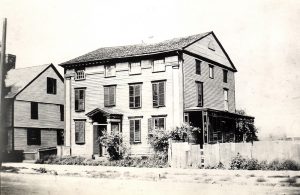
The authorities in New Haven sent the man back to Sheriff Williams in Hartford County. (The sheriff’s house in Wethersfield appears above, courtesy of Daniel Sterner’s Historic Buildings of Connecticut.)

On 24 December, the Boston Evening-Post ran this item from New London, dated 14 December:
Last Monday, one Richard Steele, was punished at Hartford, for the second offence of Burglary, by being whipt & branded, and having his left Ear cropt. He has since escaped from goal, but was yesterday taken and re-committed.
Thus, in the course of four months Richard Steele had been accused of burglary in Hartford, Wethersfield, and Derby; had been whipped, branded, and cropped on his ears twice; and had escaped jail twice—but was once again back in custody.

TOMORROW: On into 1771!

Monday, July 13, 2026

“Headquarters of a Revolution” in Cambridge, 19 July

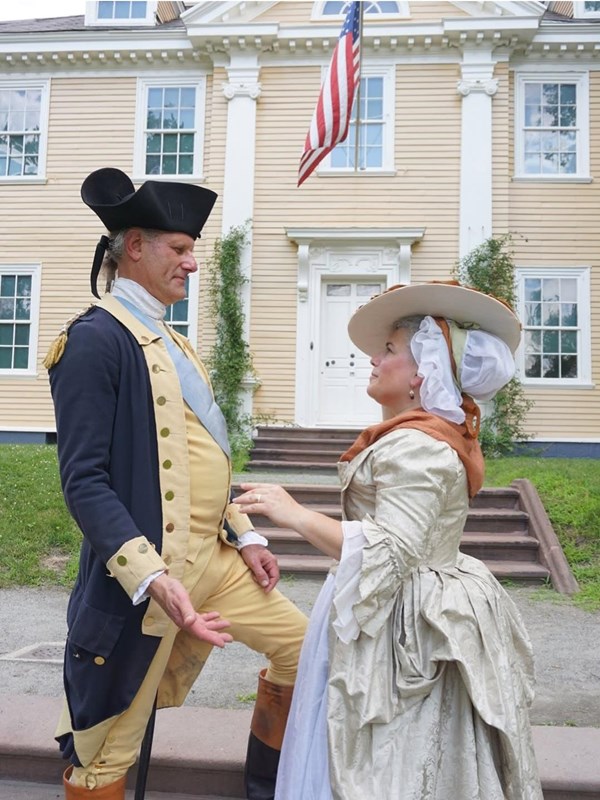
On Sunday, 19 July, the Longfellow House–Washington’s Headquarters National Historic Site in Cambridge will host a commemoration called “Headquarters of a Revolution: Washington’s Arrival in Cambridge,” coinciding with the 251st anniversary of the new commander-in-chief’s first week living in that mansion.

Here are the events scheduled for that day, including two from me.

10 A.M. to 3 P.M.
Living History
On the Lawn

Interact with living historians John Koopman (as George Washington) and Sandy Spector (as Martha Washington), including a noontime Q&A with Mrs. Washington. Free family activities and a story walk available all day.

10 and 11:30 A.M., 2:30 P.M.
House Tour: Headquarters of a Revolution
Starting in the Visitor Center

General George Washington’s Cambridge headquarters was a testing ground for many of the ideals, institutions, and questions that still define our nation. This conversational tour with an N.P.S. ranger explores Cambridge Headquarters as a hub of revolutionary activity, where generals, enslaved people, paid laborers, poets, Indigenous diplomats, politicians, and soldiers shaped history—and how later generations would shape its memory.

10:15 A.M.
Get Ready with Martha
Carriage House

Learn all about the clothing of 1775 as Mrs. Washington finishes dressing for her day. There will be some stories and some gossip, too! Sandy Spector is a Boston-based historian, researcher, and interpreter, and has been a Revolutionary War reenactor since 2000. She spends most of her time researching and interpreting Mrs. Washington and has been portraying Martha—alone or with George—in numerous states and venues for the past 10 years.

11:30 A.M. to 12:15 P.M.
The Last British Army to Come Through Cambridge
Carriage House

In November 1777, nearly 6,000 soldiers of the king arrived in Cambridge. With them came about a thousand women and children. These weren’t invaders but prisoners of war, British and German, captured at Saratoga. Top officers were housed in mansions along “Tory Row” while enlisted men went into the leftover barracks on Prospect and Winter Hills. Over the next few months Cambridge, Charlestown, and neighboring towns had to adjust to a new population under guard. J. L. Bell explores what we should remember about this “Convention Army” as we approach the 250th anniversary of its arrival.

12:30 to 1:15 P.M.
“Though Dwelling in a Land of Freedom”
Carriage House

Join poet, educator, and Darby Vassall descendant Denise Washington for an exploration of Revolutionary-era freedom struggles surrounding Washington’s Headquarters through the lens of Anthony, Cuba, and Darby Vassall, as well as Phillis Wheatley Peters.

1:30 to 3 P.M.
The Black Patriots of Lexington – Silas Burdoo
Carriage House

This film explores the role that third-generation Lexington resident Silas Burdoo played in the Revolutionary War, starting with the battle on 19 Apr 1775. Burdoo was a grandson of Ann and Philip Burdoo, who married in Medford in 1704 and then purchased 40 acres in Cambridge Farms, which became Lexington. This film screening will be followed by a discussion with Zine Magubane, professor of historical sociology at Boston College, and Sean D. Osborne, producer of the Black Patriots of Lexington YouTube series.

3 P.M.
What Washington Saw on Cambridge Common
Walking Tour starting at the gate at the southern tip of the common

What did the center of Cambridge look like in July 1775? Since April, the town had been the base of the New England army besieging Boston, with war transforming the community. On this walking tour J. L. Bell looks at sites in and around the common, including the first headquarters, buildings turned into barracks, and the Continental artillery’s lost laboratory. How well do the Washington Elm and the Revolutionary monuments that dot the common memorialize the men who were actually there?

All of these events are free, as organized by the National Park Service.

Thursday, May 28, 2026

“Specimens of Indian Insult”

I’ve quoted a couple of accounts of mock battles on Boston Common during militia musters, as reported proudly in the local newspapers. On those occasions, half the local unit provided an enemy by portraying the French.

Here’s a report from the 12 May 1774 Norwich Packet, describing a different scenario in Woodstock, Connecticut, a town on the border with Massachusetts:
NORWICH, May, 12.

A Correspondent from Woodstock informs us, that on Monday the 2d. Inst. the Three Military Companies of that Town met upon the Parade, in the First Society, where they performed the Manual Exercise with a Spirit and Activity that did Honour to their Officers and themselves.

At Eleven o’Clock a Troop of Horse, under the Command of Capt. Samuel McClellan, came upon the Parade; which, for elegance of Dress, goodness of the Horses, and suitable Furniture, were judged, by the numerous Spectators present, to be inferior to no Troop in America.

At Three o’Clock the Foot and Troop feigned a Skirmish with each other, which they conducted with Propriety and Order: Suddenly a Company of Aborigines appeared, who made Captives of some of the Children present, and gave other Specimens of Indian Insult to the Foot and Horse: Their Depredations roused the New-England Spirit in the Troop, who, with seem Fury, attacked and drove them yelling off the Field, to the great Joy of the Spectators.

The good Order that was observed, not only by the Troop and Foot Companies, but also by the Spectators, was remarkable.----No Injury was sustained by any One present. The Day and Evening Entertainments, were concluded with strict Sobriety and Decency.

The Captain of the Troop gave an elegant Dinner to his Company and a Number of Gentlemen, as also did Capt. [Benjamin?] Lyon, and the Colonel of the Regiment honoured the Day with his Presence.
I’ve found this event mentioned in a local history but not quoted in full. It offers an example of what Philip J. Deloria called “playing Indian” in American culture. This moment was a few months after the Boston Tea Party, a few months before the Patriot press began to share fearful speculations that the Crown government might recruit Natives and French Canadians to attack resistant colonies.

Ironically, the town of Woodstock contains the site of Wabaquasset, a Native American “praying town” from the mid-1600s. That community was split and depopulated by the King Philip’s War. Englishmen from Roxbury then settled the land. The town’s seal now depicts Native and English men standing on either side of a heraldic shield.

Monday, May 11, 2026

“Not playing cards but fondling and kissing each other”

In preparation for tomorrow’s talk about Benjamin Thompson’s early years, I’ve been reviewing the evidence of his affair with Mary (Dill) Thomas, wife of printer Isaiah Thomas.

When Isaiah moved to divorce Mary in 1777 by petitioning the Massachusetts Council, he submitted testimony from several people who had seen his wife traveling with the militia major from New Hampshire in February 1775, behaving like man and wife.

The printer’s file also offered an affidavit from Mary Fowle of Londonderry, New Hampshire, who had stayed with the Thomases in Boston from 20 Sept 1774 to 16 April 1775.

In Sex and the Scientist, Jane Merrill quotes Fowle describing how “Major Thompson [was] then a refugee in Boston who borded in a house opposite.” Mary Thomas started visiting him several times a day even though (or because) she had two children under the age of three.

One Saturday the printer’s wife “dressed herself, shifting her Linen, which I knew was not her custom,” said her house guest. Mary Thomas came home with “a small piece of parchment, on which a Lady’s face had been drawn with a black lead pencil. . . . the Major had taken much pains with it.”

Soon Mary Thomas visited Thompson’s ”bed-chamber, where they staid the whole afternoon and part of the evening.” Fowle stated, “I could not but think there was more intimacy between them than I before tho’t of.” She observed the couple “kissing each other, laying in each others laps, speaking fondly of each without regarding me.”

One day Isaiah came home from business after his wife had gone to play cards with Maj. Thompson. Mary Fowle and a household servant went across to fetch her. They found the couple “not playing cards but fondling and kissing each other, she often laying her head on the Major’s shoulder, and their arms round each other.”

As if that wasn’t clear enough, in February 1775 Mary Thomas insisted on taking that trip to Newbury with Maj. Thompson, first having her hair “in the greatest taste much powdered.” Later the printer gathered testimony from several innkeepers about that journey. At the time, however, he just seems to have felt trapped.

On one Sunday, Isaiah Thomas and Mary Fowle went to church. When they came home, his daughter Mary Ann, who turned three years old that March, showed them a “copper” that Maj. Thompson had given her to go into another room. Fowle stated the little girl said, “The major kissed her Mama and felt her bosom.” In response, little Mary Ann’s mother told her she was lying and threatened to whip her.

Isaiah finally demanded that Mary admit to what was going on. She acknowledged having a sexual affair. And when did it start? True to Benjamin Thompson’s character, he first got into Mary Thomas’s bed right after writing a letter to his own wife back in Concord, New Hampshire.

I won’t bother asking if these marriages can be saved.

TOMORROW: Who was Mary Fowle?

Friday, May 01, 2026

”No other Crime, but retaining their Allegiance to the King”

We left John Hill, his wife Elizabeth (?), and his daughter in the Boston jail in February 1777, suspected of “being Enemical to the States” and “attempting to Carry Intillegence to the Enemy.”

The next trace of Hill that I’ve found is from John Noble’s article “Some Massachusetts Tories” for the Colonial Society of Massachusetts in 1900:
At the July [court] Term, 1777, John Hill of Boston recovers judgment in a plea of the case against Crean Brush for £2.8s.10d lawful money, and costs.
Did Hill sue Brush, his employer during the evacuation from Boston, for some loss? Or was this another John Hill?

There’s firmer information from John Howe’s Newport Gazette, published in the British-occupied city on 20 Nov 1777:
By Mr. JOHN HILL, who left Boston the 15th of October, we learn, that Dr. [Benjamin] Church, Mr. John Dean Whitworth, of the Queen’s Rangers, and a Number of others, are yet confined in Boston; Dr. [Mather] Byles is confined in his own House; and upwards of 70 Persons, who can be charged with no other Crime, but retaining their Allegiance to the King, and Attachment to that happy Constitution under which they were born, and from which they have enjoyed the most solid and inestimable Blessings, are now confined on board a Prison Ship in that Harbour.—

He also adds, that almost every Goal in New England is filled with these unhappy People.

Mr. Hill has also favoured us with the current Prices, in Lawful Money, of the following Articles, at the Time he left it:
Beef, — — 0.1.3
Mutton, — — 0.1.6
Butter, — — 0.4.0
And so on through a list of other meats and foods, alcohols, sugars, teas, and cordwood to shoes for men (£2.2/pair) and women (£1.10/pair).

Presumably Howe was making the point about price inflation in Continental-governed areas, but we’d have to find pre-war costs for comparison.

Years later John Hill told the Loyalists Commission, as recorded by Todd Braisted:
That on the 17th of March 1776, he left Boston, with the Royal Army; but was taken at Sea, by the Rebels, . . . himself, his Wife, & Daughter was carried back to Boston, and he confined in Prison 19 months; they were all tried For their lives, but not Condemned.

In November 1777, they were Exchanged, went to Halifax, and afterwards to New York…
Hill’s memory was off by just a few weeks. It’s possible he didn’t remember the port his family came through, or that the Hills went from Newport to Halifax. Adding to the confusion on that point, on 16 Oct 1777 the Independent Chronicle reported that “a Cartel” ship “with upwards 130 Prisoners on board” had sailed the previous day from Boston for Halifax. 

By whatever route they left New England, John Hill, his wife, and his daughter eventually returned to New York, the city he’d been chased out of in the spring of 1775. But now it was held by the British military.

TOMORROW: Inspector Hill.

Friday, February 27, 2026

“Possibly not the best man to colonize a new country”

I’ve been analyzing a letter from the Thomas Gage Papers at the Clements Library, written by Jonathan Hastings, Jr., on 11 June 1775.

Hastings addressed his correspondent as “Friend Jacob.” Their families were known to each other, and Jacob probably had connections to Harvard College.

Another clue to Hastings’s correspondent is his comment “Am happy you had so safe a Passage & found your Friends well.” Jacob was obviously traveling. Hastings then offered basic information about the siege, meaning he knew Jacob was far from Massachusetts. Crown forces probably intercepted the letter at sea, not on land.

I looked at the entries in Sibley’s Harvard Graduates for Harvard students in this period named Jacob who might have gone abroad. Almost all were settled down as ministers by 1775, usually inside Massachusetts.

One remaining candidate is Jacob Welsh (1755–1822) from the class of 1774. He was the son of John Welsh (1730–1812), a Boston jeweler and member of the club that used the silver punch bowl now called the “Sons of Liberty Bowl.” This Jacob had one brother, John, Jr., born in 1757.

Sibley’s says nothing about Jacob Welsh’s whereabouts between graduating in July 1774 and entering the Continental Army as an ensign at the start of 1776. (He served until late 1778, first at Fort Ticonderoga and then in the artillery.) Did Welsh leave Massachusetts in that stretch, missing the start of the Revolutionary War because he was in Europe, the Caribbean, or the west?

Jacob Welsh did prove more peripatetic than most of his peers. In addition, Sibley’s says, he “looked for the main chance wherever it might present itself.” After the war he settled in Lunenburg briefly, serving as the town’s legislative representative. But then he sailed to England, smuggling home a “carding and spinning machine” in hopes of securing a state patent for himself. In 1791 Welsh went to Philadelphia and applied to President George Washington to help build the new national capital. He invested in lots of land, as far afield as Louisiana.

In 1807, it appears, Welsh wrote to Gen. Henry Burbeck, a fellow veteran of the Continental artillery corps. According to Heritage Auctions, he submitted “suggestions for the defense of Boston,” including “substitutions for round cannonballs.”

By 1809 Welsh faced a legal judgment of almost a thousand dollars owed to a merchant in Salem. The authorities began to seize his local property. Welsh lit out for Geauga County, Ohio, to manage land that his father had bought a decade before. A county history published in 1878 stated:
Jacob Welsh was a native of Boston, of an old family, and reared in luxury, possibly not the best man to colonize a new country. At the time he came to Ohio, he was a middle-aged man; a gentleman of the old school, of medium height, fair complexion, dressed in small-clothes, with long hose and buckles at the knee, and shoe-buckles over the instep, liberally educated, of imposing appearance and stately address, quite fitted to the aristocratic drawing-rooms of Boston, but not appearing to especial advantage in the woods, trails, and cabins of the Western Reserve. While he was a good conversationalist, he had little energy, small business capacity, and a large disposition to spend money.
After another decade, enough people had settled around Welsh’s land to form a township. He promised his neighbors to “give glass and nails for a meeting-house, and fifty acres of land, to settle a minister.” In return, the township was named after him. In April 1820 Welshfield Township had its first election, and Jacob Welsh was chosen to be a trustee.

According to that county history, after Welsh died in 1822 locals found that he had “forgot” his promised bequests. Twelve years later, the community changed its name to Troy Township. That township’s website offers a more compact version of the story while Sibley’s says Welsh did make his promised donation. The county histories from 1878 and 1880 seem best documented, so I’ve relied on them.

Jacob Welsh’s gravestone appears above, courtesy of Find-a-Grave. The central, unincorporated part of Troy Township is still called Welshfield.

Tuesday, January 06, 2026

“New Gate Prison was again broke open”

Three months and a day after he first reported a convict escaped from Connecticut’s New-Gate Prison, keeper John Viets wrote out a second notice for the newspapers.

Here’s the text as it appeared in Hartford’s Connecticut Courant on 3 May 1774:
Simsbury, April 11, 1774.

LAST Saturday night the prisoners in New Gate Prison in Simsbury opened a way that had been in part stop’d up, that led from the place of their confinement into an old deep shaft that was partly filled with rocks & stones;

William Johnson Crawford, and Daniel Humphry (sometimes called Daniel Collyer Humphry) being more bold than the rest, ventured to pull away the stones from over their heads, and to work upwards in the old shaft, and so these two in the shaft pulled down the stones and the other three prisoners be low removed them out of the way to keep a communication between them, and all promised themselves a speedy escape—

when (at about three o’clock in the morning) the rock, stones, &c. in the shaft all gave away, and sunk into the shaft, where Crawford and Humphry were at work, to the great consternation of the three other prisoners, who say they really believe that Crawford and Humphry are both buried under the stones, &c.—but whether they are buried there or by some means escaped appears uncertain to those who have viewed the place, but rather conjecture the latter.

Therefore, this is to give notice, that if any person or persons will take up said Crawford and Humphry, or either of them, and convey them to said New Gate, shall have Ten Dollars reward for each, paid by
JOHN VIETS, Keeper of said Prison.

N B Said Crawford is about twenty four years of age, five feet and eight inches high, black curled hair, black eyes had on a light brown broad cloth cost, red duffel trowsers. Humphry is about twenty years of age, five feet and eight inches high, had on a light brown sea jacket, and brown plush breeches, both well set, spry young men.
That advertisement ran for another week, indicating the two fugitives were unaccounted for a month after their disappearance.

The other three men were still in the prison—two horse thieves convicted alongside Humphry and a “Ruffian” who had mugged a man near Norwich for his rum.

Then the 26 April Connecticut Courant offered this notice:
Last Saturday night
New Gate Prison was again broke open, and the following persons made their escape, viz. Zephaniah Ramsdel about 27 years of age, about 5 feet 8 inches high, lightish yellow hair something short, grey eyes, thinish face; had on a black coat & vest, cloth coloured plush breeches, a blue duffel great coat, and new shoes.—

Also, John Roberts, about 40 years old, about 5 feet 9 inches high, grey eyes, and short black curled hair; had on a brownish or redish colour’d surtout, a pair leather breeches very black if not washed since, a pair old shoes.—

Also, James Williams, a short well set fellow, about 28 years old, with short black hair; had on a blue cap, a pair long nasty linnen trowsers, check shirt, and new shoes. Whoever will take up either or all of said fellows, and return them to said New Gate, shall have Fifteen Dollars reward for each, paid by
JOHN VIETS.

Simsbury, April 25, 1774.
Apparently John Roberts had recovered from falling down a shaft, as reported when he first arrived at the prison.

For those keeping score, in 1774 the colony sent six men to its new New-Gate Prison for sentences of two to ten years, and by the end of April all six of those men had disappeared. (Two of them possibly under rubble, or possibly free.)

COMING UP: A hardened criminal.

Saturday, December 20, 2025

“I can recollect something of their faces…”

As recounted yesterday, immediately after the Boston Massacre, town watchman Benjamin Burdick went up to the soldiers and examined their faces so he could identify them later.

That didn’t actually turn out to be helpful.

When he was called to testify at the soldiers’ trial in November, Burdick had this exchange:
Q. Did you see any of these prisoners in King street the night of the 5th of March?

A. Not that I can swear to as they are dressed. I can recollect something of their faces, but cannot swear to them.

When I came to King-street, I went immediately up to one of the soldiers, which I take to be that man who is bald on the head, (pointing to [Edward] Montgomery). I asked him if any of the soldiers were loaded, he said yes. I asked him if they were going to fire, he said yes, by the eternal God, and pushed at me with his bayonet, which I put by with what was in my hand.

Q. What was it?

A. A Highland broad sword.
John Adams’s notes on this exchange echo some details:
I went up to one that I take to be the bald man but cant swear to any. I askd him if he intended to fire. Yes by the eternal God. I had a Cutlass or high Land broad sword in my Hand.
In an earlier deposition Burdick said that the soldier he spoke to was “the fourth man from the corner, who stood in the gutter.”

However, multiple other witnesses agreed that Pvt. Montgomery was on the right end of the grenadiers’ arc (James Bailey, Jedediah Bass), and that the man in that position was the first to fire (Bailey, Bass, James Brewer, Thomas Wilkinson, Nathaniel Fosdick, Joseph Hiller). The watchman himself described the first shot coming from “the right hand man,” not the men closest to him. So the soldier Burdick spoke to wasn’t Montgomery, despite all his effort to memorize the men’s faces on King Street.

Burdick’s testimony does offer us some details about the soldiers in the courtroom. As defendants, those men were “dressed” differently from how they appeared on 5 March—differently enough for Burdick to say he could no longer recognize any of them with certainty. That suggests the soldiers were no longer wearing their full uniforms.

In addition, Montgomery wasn’t wearing a wig or hat since Burdick (who, incidentally, had been trained as a barber and peruke-maker) saw that he was “bald.”

Wednesday, December 03, 2025

“The said Short is a midling sized man”

During the siege of Boston, Benjamin Edes published the Boston Gazette out of Watertown. His main competition was the New-England Chronicle that Samuel Hall printed in Cambridge.

Geography put Edes’s print office closer to the Continental camp in Roxbury. On 13 Nov 1775, and for the next two weeks after, the Boston Gazette carried this advertisement:
DESETED [sic] from Capt. Earl Clap’s company in Col. Theophilus Cotton’s regiment, on the 12th of June last, and taken up on the 9th of this inst. [i.e., this month] at Cambridge, John Short, and in conveying him to Roxbury he ran-away again.

The said Short is a midling sized man, goes a little stooping, fresh looking, lately had the small pox, with a scarr on the right side of his face, and dark complection: Had on when he was last taken a blue coat, wash leather breeches, a surtout of a greyish colour, small brim’d hat with a white ribbon round the crown, and boots on.——

Whoever will take up said run-away, and secure or return him to the regiment he deserted from, shall receive four Dollars reward and all necessary charges paid by me.

Roxbury, Nov. 10, 1775. EARL CLAP.
“Wash leather” meant a form of chamois.

Short was evidently caught in late November or early December since the ad stopped appearing and he was court-martialed on 4 December, as recounted yesterday.

In addition to running away twice, as the ad described, Short’s trial record says he’d gotten Capt. Clapp to pay 36 shillings “for a former theft.” No wonder the army was ready to throw the book at him.

Part of Short’s sentence was to repay Clapp that sum plus £1.16s. for the “expense of advertising and apprehending him.” Most of that was probably the $4 reward, then pegged at £1.

TOMORROW: Witnessing the punishment.

Sunday, July 20, 2025

“There are always joys while going through manuscripts”

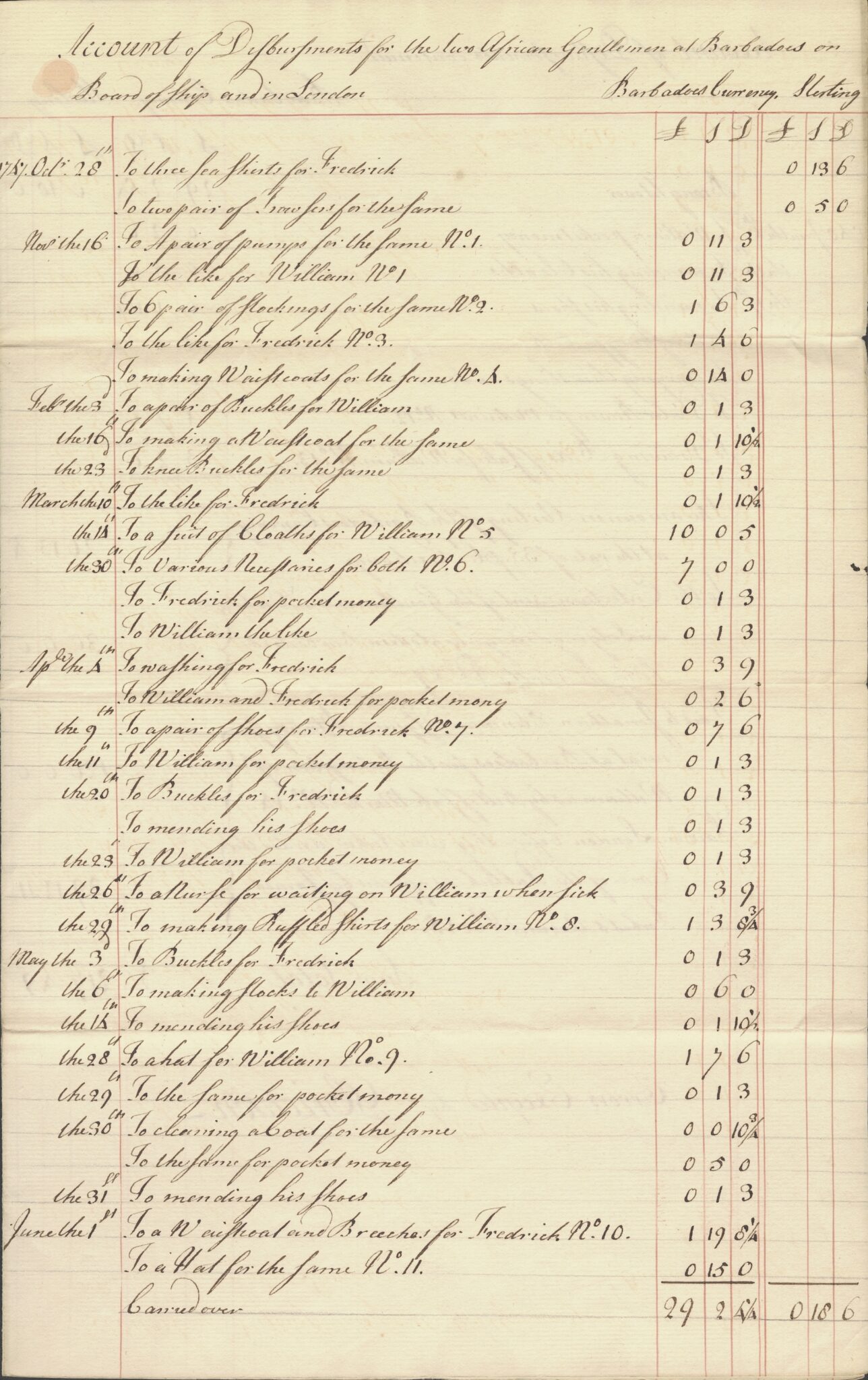
Last month, Commonplace published Jayne Ptolemy’s “The Record Scratch: Uncovering Documents Relating to William Ansah Sessarakoo,” and I recommend reading the whole article.

Ptolemy, who’s on the staff of the William L. Clements Library in Ann Arbor, wrote:
The Clements holds the papers of Charles Townshend (1725-1767), who served as Secretary of War during the Seven Years’ War and the Chancellor of the Exchequer in the decades leading up to the American Revolution. These days, he is mostly known as the straw man for incendiary British taxation policies due to his role in sponsoring the infamous Townshend Acts.

Internally at the library, however, we mostly grumbled about him under our breath because his papers were in a complicated arrangement, the finding aid was difficult to navigate, and the boxes even harder to pull for researchers. It needed someone to puzzle out what was in each box and add descriptive information to the finding aid to make it more manageable. Unfortunately, I don’t have a penchant for economic history, so figuring out how to describe the contents of “Miscellaneous Treasury Papers” meant trying to disambiguate a great many reports on tariffs, duties, and excises.

There are always joys while going through manuscripts—an unexpected doodle, a funny quote, beautiful papers—but most of what I was encountering was financial document after financial document–Until one stopped me right in my tracks. It referred to expenses “for the two African Gentlemen at Barbadoes.” Written in 1747, the use of “Gentlemen” to describe African peoples was eye-catching enough, but glancing down at the accounts, the entries for making waistcoats, providing pocket money, buying ruffled shirts, and more signaled something extraordinary. . . .

And then, a document written from Bridgetown, Barbados, laid it all out:
Whereas John Corrantee and the Caboceers of Annamabo are at present exceedingly well disposed towards the British Nation, and beg the resettlement of that place by the English, and the fort to be rebuilt

And whereas a Son of John Corrantee’s Named Ansah was sold here by Captain Hamilton who he (Corrantee) is very anxious to have redeemed

We hereby give it as our Opinion that the Redemption of the said Ansah will be very acceptable to John Corrantee (who is the leading man at Annamabo) . . . and will be a means to conciliate Corrantee to, and rivet him in the Interest of the British Nation in opposition to the French, who have been aiming for some Years past at the aforesaid settlement.
OH.

OH NO.
“The Record Scratch” is a fine metaphor for that moment, though I don’t think it gives a good sense of the rest of this article.

Monday, June 30, 2025

“Headquarters of a Revolution” in Cambridge, 5 July


On Saturday, 5 July, the Longfellow House–Washington’s Headquarters National Historic Site will host the Sestercentennial commemoration of Gen. George Washington taking command of the Continental Army.

Washington arrived in Cambridge on the afternoon of 2 July and assumed command from Gen. Artemas Ward. Nineteenth-century tradition held that 3 July was the crucial day, imagining the new commander reviewing all his troops on Cambridge common, but that was at best an exaggeration. The 4th is of course claimed by an event from 1776. So Saturday the 5th is the most convenient date for a celebration this year.

Here’s the “Headquarters of a Revolution” schedule. Unless stated otherwise, all of these events start at 105 Brattle Street, the Longfellow–Washington site. Some offerings overlap, so it’s not possible to see everything. The talks are about half an hour long, the house tours almost an hour, the walking tours more like ninety minutes. Folks who need air conditioning or shelter from rain will no doubt prefer the talks and house tours.

10:00 A.M. to 3:00 P.M.
The New Generalissimo
John Koopman and Quinton Castle

On the mansion’s lawn, visitors can meet and talk with living historians portraying Gen. George Washington (Koopman) and his body servant, William Lee (Castle), as they assess the siege, the Continental Army, the political situation, and living arrangements in Cambridge. Photo opportunities.

10:15 A.M. talk in the Longfellow Carriage House
Get Ready with Martha
Sandy Spector

Learn all about the clothing of 1775 as Mrs. Washington finishes dressing for her day. There will be some stories and some gossip, too! Spector is a Boston-based historian, researcher, and interpreter known for bringing emotional depth, humanity, and a sense of humor to her portrayal of Martha Washington.

10:30 A.M. walking tour
Children of the Revolution: Boys & Girls in Cambridge during the Siege of Boston
J. L. Bell

Meet at the mansion’s driveway for a walk around the Tory Row neighborhood and Harvard Square viewing sites and hearing stories of young people caught up in the opening of the Revolutionary War: Loyalists forced from their homes, soldiers in their teens or younger, war refugees, and enslaved children seizing their own liberty.

11:00 A.M. talk in the Longfellow Carriage House
The Revolutionary War Diary of Moses Sleeper
Kate Hanson Plass

An almost-anonymous journal in the Longfellow–Washington site’s collection provides a look at daily life in the Continental Army in Cambridge. Cpl. Moses Sleeper spent most of the Siege of Boston encamped and building barracks around Prospect Hill. Hanson Plass, the Longfellow House Archivist, explains how Sleeper’s perspective adds to our understanding of the experience of the soldiers under General Washington’s command.

11:30 A.M. house tour
Deep Dive: Headquarters of a Revolution
National Park Service staff

Explore Gen. George Washington’s first headquarters of the American Revolution. That mansion became a testing ground for many of the ideals, institutions, and questions that still define our nation. This conversational tour explores Cambridge Headquarters as a hub of revolutionary activity, where generals, enslaved people, paid laborers, poets, Indigenous diplomats, politicians, and soldiers shaped history—and how later generations would shape its memory.

12:30 P.M. talk in the Longfellow Carriage House
Washington in the Native Northeast
Dr. Ben Pokross

This talk describes George Washington’s interactions with Indigenous people while he lived in the Vassall House. After a look back on Washington’s experiences as a surveyor in the Ohio River Valley, the presentation will focus on his diplomatic encounters with Abenaki, Haudenosaunee, Passamaquody, and Maliseet peoples, among others, during the Siege of Boston. Ben Pokross was a Mellon Humanities Postdoctoral Fellow at the Longfellow–Washington site researching its Indigenous history. In the fall, he will be a Visiting Assistant Professor of English at Trinity College in Hartford.

1:15 P.M. talk in the Longfellow Carriage House
On Managing a Headquarters that is Also a Household
Sandy Spector

Martha Washington made her own arrival in Cambridge in December 1775 and stayed until April, setting the pattern she would follow throughout the Revolutionary War: she spent every winter with her husband and the army, and during campaign season usually remained as close as she safely could. Spector describes how the commander’s wife maintained a genteel household in the midst of war.

1:30 P.M. walking tour
Cambridge as a Seat of Civil War
J. L. Bell

Meet at the Washington Gate on Cambridge Common. This tour explores how the Cambridge community split on religious, political, and class lines between 1760 and 1775, culminating in a militia uprising in September 1774 and the outbreak of actual war in April 1775. Hear how the wealthy and congenial Tory Row neighborhood fell apart and became a stretch of military barracks and hospitals.

2:00 P.M. talk in the Longfellow Carriage House
Phillis and George: Thoughts on Letter-Writing, Power, and Self-Representation
Dr. Nicole Aljoe

One famous event during Washington’s time in Cambridge was his exchange of letters with Phillis Wheatley, the young poet who had been kidnapped into slavery. Aljoe, Professor of English and Africana Studies at Northeastern University, explores this encounter in context. She is co-Director of The Early Caribbean Digital Archive and Mapping Black London digital project, Director of the Early Black Boston Digital Almanac, and author of multiple books and articles. 

2:30 P.M. house tour
Deep Dive: Headquarters of a Revolution
National Park Service staff

See above.

2:45 P.M. talk in the Longfellow Carriage House
Cambridge’s Black Community, 1775
Dr. Caitlin DeAngelis Hopkins

The American Revolution was a time of both possibility and peril for Black residents of Cambridge. Enslaved people could pursue their liberty but faced the threats of family separation, deadly epidemics, and violence. Whether moving far away, taking jobs at Washington’s Headquarters, or making complex legal arguments to claim pieces of their enslavers’ estates, Black residents used their knowledge and networks to protect themselves and their families. Hopkins is working with the descendants of Cuba and Anthony Vassall to document the Black history of 105 Brattle. She holds a Ph.D. from Harvard and was formerly the head researcher for the Harvard and the Legacies of Slavery Project.

This commemoration is funded by Eastern National, a non-profit partner of the National Park Service. It’s supported by friendly organizations like History Cambridge and the Friends of Longfellow House–Washington’s Headquarters.


Saturday, June 14, 2025

“The said Inventory (A Very few Articles excepted)”

By 1787, Henry Howell Williams had been reestablished on Noddle’s Island for about three years.

Having stayed in Massachusetts throughout the war, Williams had also established his loyalty to the republic, which might have been in doubt back in 1774 and 1775.

Williams then decided to revive his effort to be compensated for the loss of his animals and the destruction of his farm and house back in May and June 1775.

Williams assembled a long list of the property he had lost twelve years before, including furniture, clothing, and food. A sampling of the items:
  • “24 very Eloquent Gilt Pictures, 1 small Carpet”
  • “1 Coat of Arms work'd on Satting with Silver & Gold thread”
  • “40 lb. of flax 2 Barrls Hops & 3 Quntal salt fish”
  • “3 Large Jarr’s Sweet meats never opened”
  • “1 Mahogy. Clock cost in England 25 £ Sterl. New”
  • “1 Silver Nipple & Bottle”
  • “60 bullets 30 lb. Lead. 6 Powdr horns. 2 Powdr flasks”
  • “1 Barrl. best hard Bread a large Quanty of Loaf Sugar”
  • “1 Large Bible & Several Other Books”
  • “3 Hogsheads New Rum Just got home from the W. Indies Quanty. 234 Gallons a 3/4–”
  • “6 Chissells 3 dung forks. Squares &c.”
  • “1 large Boat £32– 1 Moses do £14. 1 yall £10–”
  • “A New Black-Smiths Shop”
  • “333 Young Locust tree’s Cut down which were Set out by Mr. Williams & were to have been paid for by the Owners of the Island at 3/ Each”
As to livestock, Williams stated he had lost:
43 Elegant Horses...@ 30£ Each put into the Publick Stables … £1290:11:—
3 Cattle taken & used as Provisions for the Army … 30:11:—
220 Sheep used as Provisions as above @12/- … 132:11:—
4 fine Swine … 12:11:—
5 Dozn Fowls Turkys & Ducks … 6:11:—
The bottom line was £3645:6:2. That might or might not have been in debased local currency, but pound for pound that total was more than a third of what the East India Company had calculated as its loss in Boston harbor back in 1773.

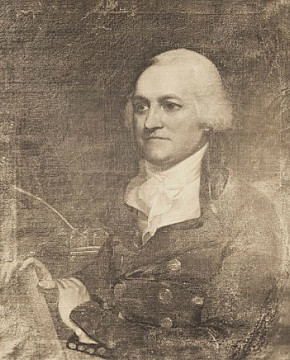
On 10 Mar 1787, Williams and his wife Elizabeth went before magistrate William Tudor (shown above) and swore
That the said Inventory (A Very few Articles excepted) was taken in the month of July following [the raids] & that according to my best Judgment and Recollection the Same is just and true
The whole document can be studied on the Massachusetts Historical Society’s website.

In addition, Williams had collected some evidence supporting his claim, or perhaps answering critics who had said back in 1775 and 1776 that he didn’t deserve financial support.

TOMORROW: Supporting documents.

Sunday, May 11, 2025

Thomas Newell’s Secret Notes

As discussed yesterday, Thomas Newell wrote several lines in his 1773–74 diary in cipher.

Since one of those lines coincides with Newell joining the effort to keep the East India Company tea from landing, one might hope the secret words would have political significance.

Barring that, they could be juicy personal gossip. Better than the weather reports that comprise the great majority of entries in this diary.

But no, these ciphered lines turn out to be far less juicy than other things Newell wrote about openly: political brouhahas, a duel between British military officers, the suicide of a British sailor.

Of eleven lines in cipher, four were Newell admitting to not going to a meetinghouse on a Sunday. Four times in two years!

Three expressed Newell’s worry for a woman named Hannah, who was suffering ill health:
  • 10 Oct 1773, Sunday: “Staid at home this day upon account of my dear Hannah being unwell with a breaking out on her hands and legs.”
  • 28 December: “My dear Hannah very unwell; out of her head most of this evening.”
  • 13 Mar 1774: “My Hannah [not in cipher:] went to meeting, after many months’ illness.”
This was presumably the Hannah he married and had two daughters with years later. I haven’t found a date for that marriage, but the Newells were members of the Brattle Street congregation, and the Rev. Dr. Samuel Cooper wasn’t known for scrupulous record-keeping. Hannah Newell died in 1807.

Two entries were about attending social events that would be standard for a young man of his class:
And one ciphered entry was about a holiday gift:
  • 2 Jan 1774: “Yesterday being New Year’s Day, my father gave me a new shirt, for which I was greatly obliged to him.”
Thomas Newell’s father had the same name; he was called captain because he had commanded a ship as a younger man, but in this period he was running a wharf.

Why would Thomas Newell feel the need to keep that information from posterity? Well, he probably didn’t care about us. In this period a diary was less private than we now expect, so Newell’s uncle Timothy or his father or his friends might have expected to be able to read it.

I suspect that Thomas Newell kept these little personal notes private because they were about his own personal life and not the weather or public events.

TOMORROW: Cannon.

Wednesday, April 30, 2025

Aritfacts Lost, Strayed, or Stolen

The Journal of the American Revolution regularly asks its contributors to share a short answer to an intriguing question—a favorite event or person, a what-if possibility, a little-known example.

Usually I get intrigued, think about possible answers, often type up something to edit down to the requisite length. And then other things land on top of the task pile and I end up never sending in an answer.

But I was able to muster a reply to the latest challenge for contributors: “an artifact from the 1765–1805 era known to have existed well into the nineteenth century, that has since been stolen or gone missing.”

The various answers include one painting and three medals stolen in the second half of the twentieth century, several items of clothing that have probably been tossed out or disintegrated, and an entire financial archive.

Plus, Elias Boudinot’s handwritten memoir (which was, thankfully, transcribed and published before disappearing from archive shelves), two cannon captured at Saratoga and recaptured one war later, and possibly an entire Hessian colonel.

Another example occurs to me now, but I’m not sure it meets the criterion of having “existed well into the nineteenth century.”

On 16 Feb 1836, the printer Peter Edes, son of Benjamin Edes of the Boston Gazette and the Loyall Nine, wrote to his grandson:
It is a little surprising that the names of the tea-party were never made public: my father, I believe, was the only person who had a list of them, and he always kept it locked up in his desk while living. After his death Benj. Austin called upon my mother, and told her there was in his possession when living some very important papers belonging to the Whig party, which he wished not to be publicly known, and asked her to let him have the keys of the desk to examine it, which she delivered to him; he then examined it, and took out several papers, among which it was supposed he took away the list of the names of the tea-party, and they have not been known since.
Benjamin Edes died in 1803, his widow Martha in 1809, and this encounter would have happened between those dates, probably earlier. There were two politically active Benjamin Austins in Boston, father and son; the first died in 1806, the second in 1820.

Did Benjamin Edes really keep such a list, and why? Did Benjamin Austin do away with that document? If so, did he act because of the names that were on it or the names that weren’t on it?

Sunday, March 30, 2025

“Some of which they themselves were witness to”

As described yesterday, an agent for the British government “pumped” Julien-Alexandre Achard de Bonvouloir and the Chevalier d’Amboise at their hotel in London in the summer of 1775.

The two Frenchmen had recently arrived from New England, and they had a lot to say about the rebel army there.

Some of the claims the agent set down were wildly false: “That there are at least 200 french amongst the Troops of the Rebels, who acted as Artillerists and Engineers, which numbers may be augmented since they came away.”

The British agent was particularly eager to report support from European powers: “Seven french Ships, masked under English Colours came into different ports with Ammunition &c.”; “the Americans expected French and Spanish Officers and Engineers, also Powder &c.” Perhaps Bonvouloir and D’Amboise told him what they sensed he wanted to hear.

On the other hand, other reported remarks from the Frenchmen matched the situation more closely, albeit filtered through aristocratic eyes:
6. That the Rebel Officers in general are perfectly ignorant of their business, and they esteem them men of very moderate, or rather mean parts,—but the private men are well trained to the handling of Arms, and remarkably well armed, particularly in the Articles of Firelocks and Bayonets.

7. That they saw the Fortifications on the Posts of Roxbury and Cambridge and also the Park of Artillery the Rebels have in the neighbourhood of the last place consisting of Canons, Mortars and Howitzers, concerning the quality of which they do not agree—Le Comte de Beauvouloir says,—they are equal in quality and Bore to those employed in Europe, and he only found them defective in the Article of the Carriages, which he said are of a bad Construction.—his friend the Engineer (whom I heard called Le Chevr d’Ambroise) held the Artillery rather cheap in general, but perticularly the Mortars which are small.—they both agreed that the Rebels were in want of Ammunition, particularly of powder, and insinuated that they might be greatly distressed by being Canonaded from Posts well chosen and properly fortified.
Bonvouloir reported the militant mood of the New England population in early 1775, though again he came up with a strange anecdote for it:
10. That the common people in America have been worked up to a pitch of enthusiastick phrensy that is beyond conception, and such was their Confidence (when they came away) that they were convinced His Majesty’s Troops would be entirely defeated, and driven on board the Ships in less than two Months, and indeed the Rebel Chiefs employed every Art to keep up their Spirit and enforce such Ideas, some of which they themselves were witness to, such as making their own people put on English Regimentals and come into the Camp in the Character of Officers and Soldiers deserting from His Majesty’s Troops, and one Man personated a Member of Parliament.
There’s no evidence from this side of the Atlantic to support those stories—no plans to impersonate British soldiers, no report of seeing a Member of Parliament on the ground.

In sum, like a lot of raw intelligence, this report was a mix of fact and fabulism.

TOMORROW: Bonvouloir makes his move.

Saturday, March 01, 2025

“He will do every Thing any Man can do towards a full Supply”

Philip Mortimer was not from an old New England family and he was Anglican, two traits that might have made him more likely to support the Crown in the pre-war political conflict.

Instead, Mortimer served on the Middletown, Connecticut, committee of correspondence. On 6 Mar 1775, the Connecticut Courant announced that he and George Philips would oversee the public sale of molasses and coffee brought in from Jamaica “agreeable to the 10th Article of said Association.”

That part of the Continental Congress’s boycott agreement said that goods landed between 1 Dec 1774 and 1 Feb 1775 could “be sold under the direction of the committee” covering that region, with “the profit, if any, to be applied towards relieving and employing such poor inhabitants of the town of Boston, as are immediate sufferers by the Boston port-bill.”

Mortimer was also a selectman for the first two years of the war and a justice of the peace.

In 1781, French troops on their way to Yorktown camped on Mortimer’s land in Middletown, according to an article by Allen Forbes for the Massachusetts Historical Society.

The young merchant who married Mortimer’s niece Ann Catharine Carnall, George Starr, was even more active in supporting the American cause. In 1778 Starr, who had the militia rank of captain, became a deputy commissary of hides for the Continental Army. On 26 October Gen. Samuel Holden Parsons wrote to the commander-in-chief from Middletown:
I find Capt. George Starr of this Town is appointed by the Board of War to take Charge of the Leather belonging to the Continent, purchase Shoes, Cartouch Bozes & other Military Accoutrements, by the inclosd Order you will find the Board have impowerd him to contract for those Articles in Exchange for raw Hides; I am fully Satisfied he will do all that any Man can do in that Department;

he informs me he Shall be able to send on about Twelve Hundred pair of Shoes within four Weeks about Seven Hundred of which are now On Hand & will be forwarded as soon as he can procure Buckles for about 300 or 400 Cartouch Bozes which are made and with the Shoes will compleat A Load for One Waggon; he Says he will take every Measure in his Power to procure a large Quantity of Shoes & thinks tis probable he Shall be able to furnish about 1000 or 1500 Pair a Month if the Leather can now be had in exchange for Hides as he is a Man very assiduous in his Business I have no Doubt he will do every Thing any Man can do towards a full Supply—

As to Caps he Says tis impossible to make an Estimate of the Quantity of Leather on Hand suitable for that Business which is not fit for Shoes or to be Usd for Accoutrements or in the Quarter Master’s Department as ’tis not in whole Sides, but part of most of the Leather in working is found unsuitable for other Business which will well Answer for this.
Starr did that job for three years. Even after stepping down he sent George Washington two pairs of boots for his personal use in 1783, though the general was unsatisfied.

TOMORROW: The new postwar order.

(The photo above shows Samuel Holden Parsons’s house in Middletown, now gone, from Damien Cregeau’s article “Top Ten Demolished Houses of Revolutionary War-Era Connecticut” for the Journal of the American Revolution.)