


J. L. BELL is a Massachusetts writer who specializes in (among other things) the start of the American Revolution in and around Boston. He is particularly interested in the experiences of children in 1765-75. He has published scholarly papers and popular articles for both children and adults. He was consultant for an episode of History Detectives, and contributed to a display at Minute Man National Historic Park.

Subscribe thru Follow.it


•••••••••••••••••


Showing posts with label John Barnard. Show all posts

Saturday, June 08, 2024

“Bruised and splintered by the bullets of the British soldiers”
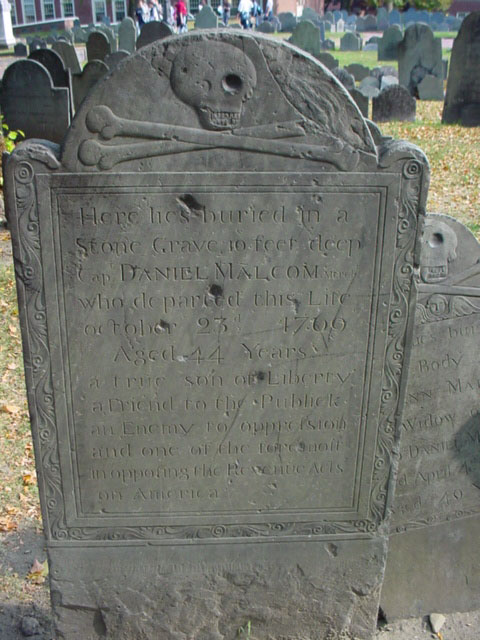
As shown yesterday, Capt. Daniel Malcom’s gravestone still stands in Copp’s Hill Burying Ground.

Indeed, it’s one of the featured attractions there, with signage pointing out how the stone is pitted, reportedly by British soldiers’ musket balls.

The uppermost round mark on the stone was produced by the carver, not by a musket. It’s the eye socket of the skull facing right. A very similar design appears on Ann Malcom’s stone nearby and on the Rev. John Barnard’s gravestone in Marblehead, both from 1770.

But there’s clearly other damage to the Daniel Malcom stone, divots in the middle of the text. I went looking for more information about those marks and was surprised by what I found.

The earliest printed mention was a note in the back of Urania: A Rhymed Lesson, a poem published by Oliver Wendell Holmes, Sr., in 1846, seventy years after the British military evacuated Boston. It quoted Malcom’s marker and added:
The gravestone from which I copied this inscription is bruised and splintered by the bullets of the British soldiers.
I’d be pleased to hear about earlier mentions. Unlike a quotation or phrase that one can search for exactly, this fact could be stated in many ways.

A couple of years after Holmes’s poem, the April 1848 issue of the New England Historical and Genealogical Register stated:
There are marks upon the stone, and tradition says that the British soldiers made use of it as a target during their occupation of Boston, at the commencement of the Revolution.
The 4 Aug 1849 Boston Statesman newspaper quoted this item from the reformist Boston Chronotype:
Mean Revenge.—During a stroll through Copp’s Hill burying ground, a few days ago, a gentleman directed our attention to the following inscription on a grave stone:— . . .

The stone exhibits marks of violence, and our informant—who is an antiquarian, versed in the genealogy of almost every family buried on Copp’s Hill—stated that Capt. Malcolm [sic] had rendered himself extremely obnoxious to the British troops, and that a short time after his death a file of soldiers was drawn up and discharged a volley of musketry at his grave stone. Our informant said that in his younger days he had heard several eye witnesses related the story. The marks of the balls are distinctly visible at the present day. We might search long to find a more despicable species of revenge than this.
That article was reprinted later that year in Scientific American.

Assuming this story was accurate, the next question is when such vandalism took place. Malcom died in 1769, when British regiments were in Boston and his defiance of royal authority was recent. Those soldiers (or officers) might have seen Malcom in action. But if people had seen redcoats shooting at his grave then, there would surely be complaints in the vigorous local press.

Vandalism would more likely have gone unreported during the siege of Boston, with no opposition newspapers in town and bigger stories to print. That would mean the soldiers (or officers supervising them) were angered by the “true Son of Liberty” phrase on the stone rather than direct knowledge of Daniel Malcom.

Yet another possibility is that the damage was produced by something other than British muskets, but saying that made for a better story. The unnamed “antiquarian” in 1849 referred to “several [unnamed] eye witnesses” to the actual shooting, however.

I’d also like to know when the plaque for Malcom, shown here, was put up inside Old North Church. It refers to him being “Safe from British Bullets.” Was that an allusion to the scars on his gravestone nearby?

COMING UP: John Malcom’s welcome to Newport.

Sunday, June 08, 2014

Talk on Philip Ashton, Castaway, in Boston, 19 June

On Thursday, 19 June, Gregory N. Flemming will speak at the Massachusetts Historical Society about his new book At the Point of a Cutlass: The Pirate Capture, Bold Escape, and Lonely Exile of Philip Ashton.

In an essay for the M.H.S. blog, Flemming wrote about his main source:
Tucked away in the archives of the Massachusetts Historical Society Library are two small, leather-bound volumes printed nearly 300 years ago. These small tracts, titled Ashton’s Memorial, reveal an incredible story—the first-hand account of a Massachusetts fisherman named Philip Ashton who was captured by pirates in 1722 and then escaped and lived as a castaway on an uninhabited Caribbean island for nearly two years. Ashton’s Memorial is a rare description of a voyage aboard a pirate ship during the peak of Atlantic piracy and it reveals rich new details about the crew, captures, and nearly-fatal mishaps.

The Society may hold the only surviving copy of the original 1725 printing of Ashton’s Memorial in Boston. There are original editions from a second printing of Ashton’s Memorial, published in London in 1726, at both the Massachusetts Historical Society and the British Library. The second printing is nearly identical to the first, except the title page uses the descriptor “An Authentick Account” instead of “An History” and includes three lines of text that were omitted from the Boston printing, apparently due to a typesetting error.

Ashton’s narrative was compiled by his minister, John Barnard of the First Church in Marblehead, Massachusetts. The fact that the book was published in London a year after it was printed in Boston speaks to the popularity of the story at the time. In fact, Ashton’s Memorial may have been read in London by Daniel Defoe, who had a lifelong interest in piracy, castaways, and the maritime world. A leading scholar of Defoe’s work, Manual Schonhorn, has compared Defoe’s writings before and after Ashton’s Memorial was published and concludes that Defoe incorporated new details from Ashton’s story—never published anywhere else—in his next novel.
That last part confused me, so I went hunting for buried bibliography. Defoe published the first edition of Robinson Crusoe in 1719, before Ashton’s misadventures. By 1720 Defoe had published the last two Crusoe adventures and his pirate novel Captain Singleton. So in what book did he draw on Ashton’s account?

Two possibilities are The Four Years Voyages of Capt. George Roberts (1726) and the second volume of A General History of the Robberies and Murders of the Most Notorious Pyrates (1728). Both books, published under different names, have been attributed to Defoe. In 1972 Manuel Schonhorn prepared an edition of Pyrates that credits Defoe as pseudonymous author.

However, other scholars dispute those attributions. In Republic of Pirates, the Maine author Colin Woodard reports that more recent researchers have argued that journalist Nathaniel Mist most likely wrote Pyrates. And the British Dictionary of National Biography deemed The Four Years Voyages as likely the product of “some humble and incompetent imitator of Defoe.” Still, Ashton’s details could have shown up in those books.

Flemming’s lecture will start at noon, and is free and open to the public.