J. L. BELL is a Massachusetts writer who specializes in (among other things) the start of the American Revolution in and around Boston. He is particularly interested in the experiences of children in 1765-75. He has published scholarly papers and popular articles for both children and adults. He was consultant for an episode of History Detectives, and contributed to a display at Minute Man National Historic Park.

Subscribe thru Follow.it


•••••••••••••••••


Showing posts with label Oney Judge. Show all posts

Thursday, July 16, 2026

New Signage Installed at the President’s House During the Night

Since September 2025 I’ve been following the dispute over displays at the President’s House, part of Independence National Historical Park in Philadelphia.

Reflecting its overall ideology, the Trump White House ordered the National Park Service to replace signs discussing how that site had been a site of enslavement when George and Martha Washington lived there in the 1790s.

Because the city of Philadelphia had participated in creating the exhibit, it claimed legal standing to sue for the signs to be restored. A district judge agreed. A higher judge stopped the restoration process. Over the last month the full circuit ruled that the federal government could control the site and remake the signage.

Yesterday WHYY reported: “Workers replaced the remaining exhibits overnight Tuesday.”
The new exhibit retains references to slavery and those enslaved by Washington while serving as president in Philadelphia, but it devotes significantly more space to the history of the executive mansion and the early presidency. A panel that had been titled “The Dirty Business of Slavery,” for example, has now been replaced by signage that reads, “Celebrating Independence Throughout the Years.”

It also softens Washington’s views on slavery compared to the previous display.

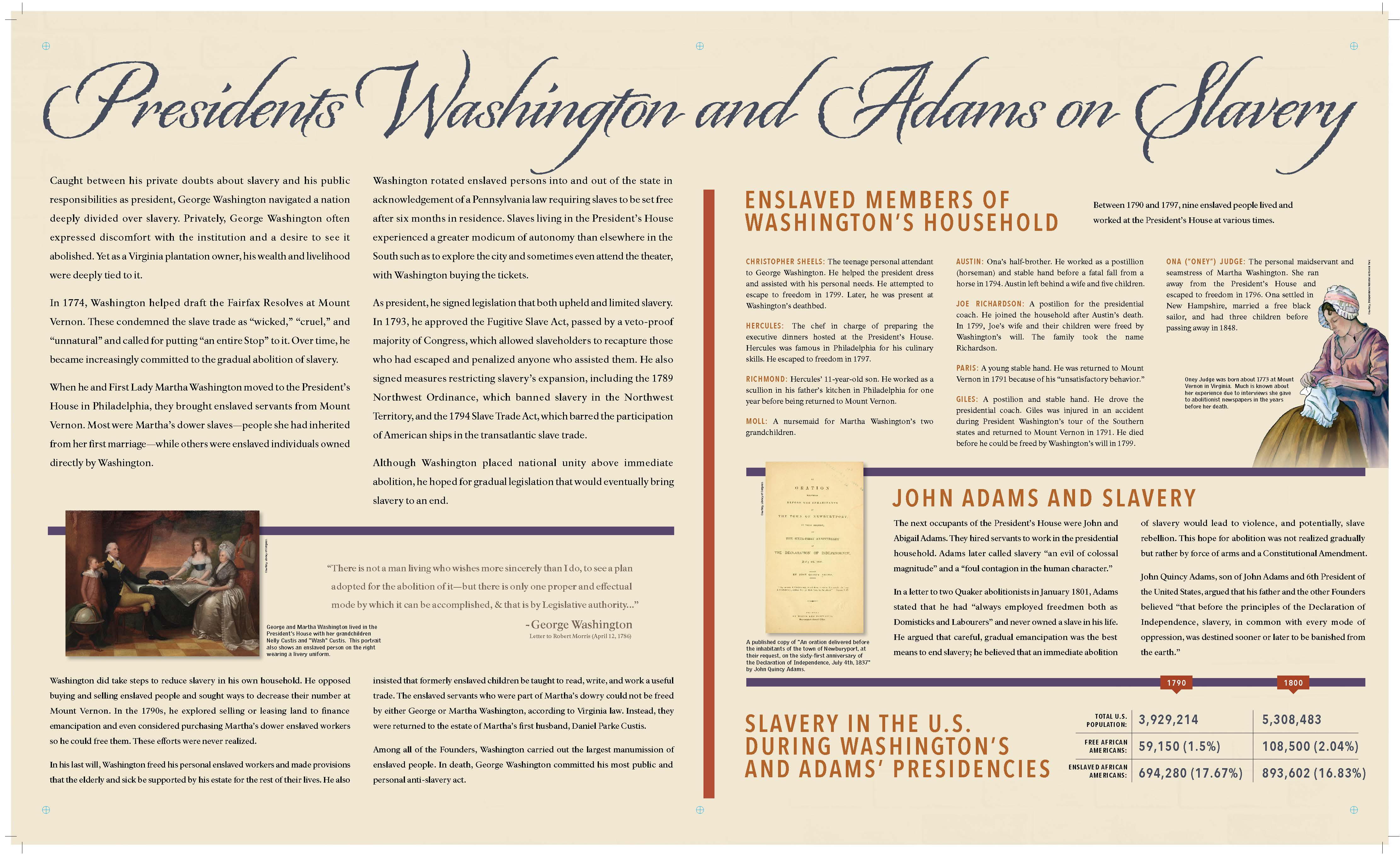
“In 1774, Washington helped draft the Fairfax Resolves at Mount Vernon,” one panel reads. “These condemned the slave trade as ‘wicked,’ ‘cruel,’ and ‘unnatural’ and called for putting ‘an entire Stop’ to it. Over time, he became increasingly committed to the gradual abolition of slavery.” . . .

on Wednesday, several armed members of the National Park Service Police were seen vigilantly watching over the site.

Park service officials stopped one activist, Dr. Sandra Shachar-Krasnoff of Philadelphia, after she briefly taped a piece of paper with “the excavation revealed a kitchen and a slave quarters below the president’s house site” to one of the walls.

She was fined $310.
The photo above, taken by Abraham Gutman for the Philadelphia Inquirer, shows a federal officer writing a citation for Dr. Shachar-Krasnoff. The Inquirer also reported that the N.P.S. installed security cameras at the outdoor site last week, ostensibly because the All-Star Game was about to be played in the city. So there’s no doubt the government will surveil the walls more tightly.

The park website displays eleven large new panels, but the Inquirer states there are also “more than a dozen smaller panels that detail governmental processes, the lives of various historical figures, and a panel dedicated to the escape of Ona Judge and Hercules [Posey], two people enslaved by Washington who fled to freedom.”

All told, says the Inquirer, “the new exhibits mostly offer a broad timeline of U.S. history that significantly strays from the original intent of the President’s House as outlined in the park’s foundation document in 2017: ‘It would explore the historic context of the site in the context of its ties to slavery and the lives of the enslaved who lived at the site.’”

There’s already an effort to have Philadelphia erect a historic marker about Hercules Posey outside of federal control, like one already up for Ona Judge.

Friday, May 08, 2026

“The only ‘emancipation’ relevant to this site was Ona Judge’s own”

On 21 April, the Philadelphia Inquirer shared an opinion piece about the President’s House exhibit by Sharon Ann Holt, a public historian recently retired from Penn State Abington.

Holt was previously director of education and interpretation at the Historical Society of Pennsylvania and director at the Sandy Spring Museum in Maryland. She’s the author of Freedom Pay: North Carolina Freedpeople Working for Themselves, 1865–1900.

The web headline for Holt’s essay is “We can’t give in to the Trump administration’s attempts to make the history of slavery invisible in Philadelphia.” I don’t know if it appeared in the newspaper’s print edition, and the webpage now behind a paywall unless one has a guest link. So here’s an extended extract:
The digital images posted on the Park Service’s website make it clear that, under Donald Trump, the first priority of the Park Service seems to be to make enslaved people and slavery itself as invisible as possible. Panels that discussed the lives of urban enslaved people, Philadelphia’s free Black community, the Washingtons’ enslaved “family,” fugitives from enslavement (and the laws Washington signed to reclaim them) have all disappeared. The rich biographies of Christopher Sheels, Hercules, Richmond, Austin, Giles, Ona Judge, Joe Richardson, Moll, and Paris have shrunk to single sentences. . . .

So what stories are they telling? George and Martha’s determination to flout Pennsylvania’s six-month limit on holding people in slavery is reframed as a lovely gift of theatre tickets rather than their cynical move to get enslaved people across the river to New Jersey, thus restarting the six-month residential countdown. I’m surprised the Park Service left out the Washingtons’ “kind” willingness to let enslaved workers visit their families left behind in Virginia, which worked the same trick.

If Park Service bureaucrats value relevance, I challenge them to explain the transformation of the story about 18th-century slavery at the President’s House into a puzzling evocation of the Emancipation Proclamation of the 19th century and the Civil Rights Movement of the 20th century. Is it that, to them, all stories having to do with African Americans belong in the same place? They must think so, because they have randomly added completely irrelevant references to Frederick Douglass, the Civil War, the Rev. Dr. Martin Luther King Jr., the Underground Railroad, and Abraham Lincoln to the history of the President’s House.

Worse, the Park Service has embraced sentimental claims that Washington, Thomas Jefferson, and James Madison all “had their doubts” about slavery from the beginning.

None of those “doubts” persuaded the Founders to end slavery when they could have, either in our founding documents or in their own personal lives. None of the 19th- and 20th-century stories that the Park Service has shoehorned into their new panels ever involved the President’s House at all. The only “emancipation” relevant to this site was Ona Judge’s own self-liberation — the very story the Park Service has all but erased.

Speaking of irrelevance, the opening panels are even more laughable. Park Service interpreters have decided to feature discussions of the 1876 Centennial, the 1926 Sesquicentennial, and the 1976 Bicentennial, all of which happened long after the President’s House had been remodeled into oblivion or entirely demolished. . . .

If the judges choose these new panels to replace the ones taken down earlier this year, they will disparage millions of Americans who have struggled since 1776 to improve on the shaky foundations the founders laid. The President’s House should honor those struggles, alongside the nine people enslaved there by George and Martha Washington.
While Holt directs her critique at the National Park Service, which produced this revised signage, it’s clear that agency was working under directives from the White House. Based on what sort of historical presentations the White House has produced on its own, N.P.S. historians undoubtedly worked hard to drag this material into the realm of historical fact, even if it’s far from complete and relevant.

Thursday, May 07, 2026

A Closeup Look at the President’s House in Philadelphia

I’ve been following the story of the President’s House site within Independence National Historical Park.

That structure marks the residence of George Washington and John Adams before the District of Columbia was built and also memorializes the people enslaved to the Washingtons who lived and worked there.

In September, we first learned that White House policy was putting pressure on the park to change the signage on that site. In January, the signs were taken down.

In February, after the city of Philadelphia filed a lawsuit, a judge ordered the signs be put back up. But then a higher judge halted that process while also requiring those signs already restored to remain. The U.S. Circuit Court has upheld that stasis.

Last month I traveled to Philadelphia for the Pursuit of History’s weekend examining the creation of the Declaration of Independence. One morning I walked through the President’s House.

Most of the frames for signs are empty; the few panels that have been restored appear to be almost random. In some of the blank spaces people had posted small images of the missing signs. While I was there, a local taped a large sheet of paper in another space along with two markers, inviting people to share their own thoughts on the controversy. I presume those unofficial displays are taken down each evening and replaced each day.

In April the National Park Service unveiled new draft signage, created (by people unknown) to please the White House. Those panels now appear on the webpage for the President’s House Site. WHYY reported:
The new panels include references to slavery, the Underground Railroad and figures like Frederick Douglass. Like the previous panels, they also make mention of the nine enslaved people held by Washington while he was president and living in Philadelphia.

However, they would have changed the overall tone of the site, softening and significantly reducing references to slavery, and shifting the focus toward the “anti-slavery sentiments” of the slave-owning Founding Fathers. For example, text on one notes that the U.S. Constitution did not contain the word “slavery,” and another one argues that Washington had “doubts” about the institution.
Local critics called that revision “whitewashing” and “maliciously outrageous.”

TOMORROW: A historian’s take.

Saturday, February 21, 2026

An Update from the President’s House in Philadelphia

Last month I noted the news reports that White House policy had pushed the National Park Service into removing signage in Independence National Historical Park which discussed people enslaved there in the 1790s.

Earlier this week the signs were restored under a court order while a lawsuit over them proceeds. The Trump administration is appealing that order and contesting the suit.

The lawsuit was filed by the city of Philadelphia, which participated in the creation of the President’s House Site and the signs, spending money on them. The city is therefore in the position to argue that it had a contract with the federal government. (The head of this administration is, of course, notorious for disregarding contracts.)

The administration has likewise pushed the removal of signage, books, photographs, flags, inconvenient scientific information, and other material from other national parks, as the press has documented. There’s even a grass-roots effort called “Save Our Signs,” aimed at collecting photographs of signage that might be affected by such trumpery. The legal situation in Philadelphia probably doesn’t apply in all those cases, meaning the damage will be harder to fix. 

The restoration at the President’s House was also made possible by the National Park Service’s careful storage of the signs. While they were gone, someone used a marker to improvise a replacement, as shown in the photo above. The cartoon President says:
I cannot tell a lie.
I, George Washington, “owned” human slaves on this very spot.
President Trump doesn’t want you to think about that.
Isn’t that great?!
A FURTHER UPDATE: On Friday another judge, acting on an appeal from the Trump administration, stayed the first judge’s order requiring all the signage to be restored. However, that order also stated that all the signage that had been restored so far must stay. So the site now has some of its dozens of signs visible and others back in storage.

Monday, January 26, 2026

Historical Signage Removed at Independence National Park

Back in September, I shared news reports of the Trump White House complaining about signs at the President’s House Site in Independence National Historical Park.

That mansion, now gone, was the home of Presidents George Washington and John Adams in the 1790s. During Washington’s time, it was a site of enslavement—and of self-liberation.

Two of the Washington’s staff, Oney Judge and Hercules Posey, escaped from bondage at that house and made their way to free lives in New Hampshire and New York, respectively. (Boston 1775 readers might recall this blog played a tiny part in documenting Posey’s presence in New York.)

In erecting brick walls to show the outline of the mansion, the National Park Service also developed detailed signage to interpret the history of that site for visitors. That’s standard N.P.S. procedure, with the material going through many reviews for accuracy.

Last week, the Philadelphia Inquirer reported that N.P.S. workers had acted under orders to remove all those signs. All that remains now is a list of the people documented as enslaved in President Washington’s household, etched in cement. (And I have no idea how long that list will remain visible.)

I first read complaints about commemorating slavery at Independence N.H.P. over twenty years ago on the Revlist discussion group. I pointed out that this was also a story of people gaining their liberty and independence, so what park could be more fitting?

The objector was unwilling to recognize that freedom for black Americans was more significant than comfort for white Americans. That same attitude is evident in the current trumpery from the White House.

This President’s respect for historical fact is evident in his June 2024 comment on Washington owning slaves: “Actually I think he probably didn’t.” Likewise his 4 July 2019 statement about how the Continental “Army manned the air, it rammed the ramparts, it took over the airports,…”

After years of complaints that any community’s removal or alteration of a statue or monument was tantamount to erasing history, this administration is literally erasing history from a public site. But only a particular sort of history. 

Thursday, September 18, 2025

“Officials plan to substantially alter an exhibit that memorializes nine people enslaved”

Back in July, the Philadelphia Inquirer reported on how pressure from the Trump White House was affecting signage at Independent National Historical Park.

Its article said:
More than a dozen displays at Independence National Historical Park that share historical information about slavery during the founding of United States have been flagged for a content review in connection with an executive order from President Donald Trump. . . .

The President’s House Site, where Presidents George Washington and John Adams once lived, came under particular scrutiny with six exhibits flagged for review. The exhibit focuses on the contradictory coexistence of liberty and slavery during the founding of America and memorializes the people Washington enslaved.
White House staff had written an executive order for Donald Trump to sign with his distinctive signature that singled out the Independence park for training interpretive rangers to be sensitive to racial issues.

This Wednesday was the administration’s initial deadline for removing content it might deem “inappropriate.” Early in the week more articles appeared. The New York Times reported: “At Independence National Historical Park in Philadelphia, officials plan to substantially alter an exhibit that memorializes nine people enslaved by George Washington.”

A day before, the Washington Post said:
That park includes the President’s House Site, where George Washington served as president before the capital moved to Washington, D.C. The house was demolished in the 1800s, but an exhibit opened there in 2010 based on archaeological excavations.

Local advocates had pushed for the exhibit to provide in-depth information on the lives of nine people who were enslaved by George Washington while he lived in the house as president. The exhibit includes their names carved into a granite wall.

“This is not just a handful of signs that tell the story of slavery,” said Ed Stierli, senior Mid-Atlantic regional director at the advocacy group National Parks Conservation Association. “This is a place that tells the complete story not just of slavery in America, but what it was like for those who were enslaved by George Washington.”

Trying to extricate slavery from the President’s House exhibit would fundamentally change the nature of the site, said Cindy MacLeod, who was superintendent of Independence National Historical Park for 15 years until 2023.

“This is just one of many exhibits at Independence National Historical Park,” MacLeod said. “And to me, it’s a vital one.”
Alerting the news media to this pressure from above is the first step to resisting it. Philadelphians quickly protested the prospect of erasing information about slavery in the park, the Inquirer reported on Tuesday.

Independence National Historical Park commemorates how Americans sought their liberties and political rights in the late 1700s. The lives and struggles of Americans born into literal slavery, some of whom managed to secure their freedom on that very site, fit right into that theme. The stories of Oney Judge, Hercules Posey, and others can be enlightening, even inspiring, for people who recognize them as fellow humans. But champions of trumpery would prefer to suppress that history.

Monday, September 25, 2023

“A Doll of the present mode”

The little stories I’ve told over the last two days about Benjamin Franklin’s and George Washington’s grandchildren raise the question: Did any Founders’ children not have to wait more than twelve months for toys to arrive from France?

Founders Online points me to one lucky child.

On 11 Sept 1785, American diplomat Thomas Jefferson wrote from Paris to John Langdon (1741–1819), president of the Confederation Congress, enclosing a gift:
I beg leave to renew my acquaintance with Miss Langdon by sending her a Doll of the present mode, dressed in Muslin, a mode which prevailing here to an almost total exclusion of silk, has literally and truly starved a great number of people. I add to it a box in which she will find a small gentleman who will teach her a short-handed and graceful manner of going down stairs.
Elizabeth Langdon was born in 1777 and thus about eight years old when Jefferson wrote. She was living in the house her father had commissioned in Portsmouth, New Hampshire (now preserved by Historic New England). 

Unlike the other cases I discussed, Jefferson lucked out in the choice of ship he sent the toys and that letter on. By 7 December, Langdon was able to write back:
Our dear Bets, begs leave to present you with her grateful thanks, for the great honor you have been pleased to conferr on her, in sending such an agreable present: all Companies who come into the house must be entertained with the sight of her doll, and tumbling Gentleman; and she does not fail to confess her obligations to Governor Jefferson.
I’d like to know more about this “tumbling Gentleman” with “a short-handed and graceful manner of going down stairs.”

I wonder if that toy was designed along the same lines as this tumbling man in the collection of the Longfellow House–Washington’s Headquarters National Historic Site. That plaything dates from the mid-1800s, but the design was reportedly around well before then.

(To my surprise, I found that Elizabeth Langdon already made an appearance on this blog. In 1796, eleven years after receiving her toys from Jefferson, she recognized the Washingtons’ escaped slave Oney Judge in Portsmouth.)

Monday, July 18, 2022

Discussing the Women in Washington’s World

In 2018, Mount Vernon hosted a symposium on the theme “‘A sensible woman can never be happy with a fool’: The Women of George Washington’s World.”

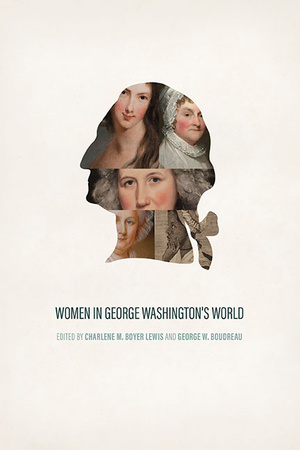
That has given rise to a collection of scholarly essays titled simply The Women of George Washington’s World, officially published later this month.

The women profiled include:
  • the first President’s mother, Mary Washington
  • his wife, Martha Washington
  • wives of significant colleagues like Margaret Arnold and Abigail Adams
  • friendly advisor Elizabeth Powel
  • poet Phillis Wheatley
  • enslaved servants Moll Judge, Ona Judge, and others
  • Ann Pamela Cunningham, the woman who preserved Mount Vernon with a nationwide fundraising campaign
The editors of this collection are Prof. Charlene M. Boyer Lewis of Kalamazoo College and George W. Boudreau of the McNeil Center for Early American Studies. The book’s publisher has shared a short interview with them.

For a longer interview, Roger S. Williams will host Boyer Lewis and Boudreau in the online History Author Talks series on Tuesday, 19 July, starting at 7:00 P.M. Register to listen to this convesation live here, or check back at History Author Talks in a few days for the video.

Friday, September 07, 2018

Symposium on Washington and Women at Mount Vernon, 2-3 Nov.

Last year I had the honor of speaking at the George Washington Symposium at Mount Vernon, organized by the Fred W. Smith National Library for the Study of George Washington.

This year’s symposium, to take place on 2-3 November, has the theme “‘A Sensible Woman Can Never be Happy with a Fool’: The Women of George Washington’s World.”

The event description:
“When the fire is beginning to kindle, and your heart growing warm, propound these questions to it… Is he a man of good character? A man of sense? for be assured a sensible woman can never be happy with a fool.”

Thus wrote George Washington in a heartfelt 1796 letter to his step-granddaughter Eleanor (Nelly) Parke Custis on the subjects of love and marriage. Although the Father of Our Country was a leader among leaders in a male-dominated world, we know that he enjoyed a number of complex and meaningful relationships with women from all stations of the socially-stratified eighteenth century. Join leading historians and academics for an enlightening look at a wide variety of women from the General’s personal orbit, including his often misunderstood mother, an admiring poet, social confidants, a traitor to the Revolution, and a defiant runaway slave. We will also examine the memory of Washington through the legacies of his adoring step-granddaughters and the Southern Matron who led the charge in the 1850s to rescue his home and final resting place.
The lineup of presentations is:
  • “Mary Ball Washington: Tales of Motherhood,” Martha Saxton
  • “A Rare Commitment: The Friendship of George Washington and Elizabeth Willing Powel,” George W. Boudreau
  • Roundtable on “Women” and “Mothers” across Eighteenth-Century America, moderated by Karin Wulf of the Omohundro Institute 
  • “True Republicans: The Relationship between George Washington and Mercy Otis Warren,” Rosemarie Zagarri
  • “George Washington and Phillis Wheatley: The Indispensable Man and the Poet Laureate of the Founding Era,” James G. Basker
  • “‘The tender Heart of the Chief could not support the Scene’: General Washington, Margaret Arnold, and the Treason at West Point,” Charlene Boyer Lewis
  • “‘She should rather suffer death than return to Slavery’: The Escape of Oney Judge,” Mary V. Thompson
  • “Daughters of the Pater Patriae: The Custis Step-Granddaughters’ Relationships with George Washington,” Cassandra Good
  • “Coming to the Rescue with Ann Pamela Cunningham,” Ann Bay Goddin
These symposiums are designed to bring the latest findings and analyses of historians to the community of Mount Vernon and its supporters. Attendees fill a large auditorium, reflecting the interest in all things Washington.

Monday, February 27, 2017

Dunbar on Ona Judge in Portsmouth, 5 March

On Sunday, 5 March, Erica Armstrong Dunbar will speak in Portsmouth, New Hampshire, about her new book Never Caught: The Washingtons’ Relentless Pursuit of Their Runaway Slave, Ona Judge.

I wrote about the first President using resources of the federal government to chase Judge (also called Oney Judge) here. There’s much more to her story. Shana L. Haines’s review of this book at the Junto states:
Judge’s story has long been an interesting footnote, paragraph, or article. Unlike many references to Judge, Dunbar’s comprehensive treatment presents Judge as a fully fleshed out human being grappling with the dehumanization of slavery and the complexities of freedom. For both scholars of Early American slavery and the general public, Judge is being reintroduced as an important figure in our understanding of Early American slavery and resistance. Through Dunbar’s empathetic and well-researched biography, the woman whose safety and freedom in eighteenth-century America depended upon remaining hidden, is finally given prominence in her own story rather than as aside to the Washingtons. . . .

Dunbar uses runaway slave notices, Washington’s own diaries and letters, and archival information about slave laws, politics, and abolitionist practices to weave a tense and suspenseful tale of Judge’s game of cat and mouse. Within this fugitive slave narrative is also embedded the emotional toll of separation from family and the physical and economic realities of day-to-day living for black women in the early republic. As America was wrestling with how to implement its Constitutional principles, Judge was forging marriage, motherhood, and community through resilience and courage.
Judge settled in Portsmouth, making her story local as well as national. The Portsmouth Historical Society is hosting Prof. Dunbar’s talk as part of a two-hour program:
  • 2:00 P.M.: Gwendolyn Quezaire-Presutti portrays Ona Judge in a living-history performance.
  • 2:30: Author presentation.
  • 3:15: Q. & A.
This event will take place at the Temple Israel Social Hall at 200 State Street from 2:00 to 4:00 P.M. It is free and open to the public.

Tuesday, December 06, 2016

Oney Judge and “the President’s Wishes”

As I reported yesterday, George Washington has been our richest President so far. Most of his property consisted of land, both plantations in Virginia and unsettled claims to the west, and slaves. A lot of those slaves had come to his wife Martha or her children, inherited from her first husband’s family, and George felt obliged to preserve that wealth.

When the federal government moved to Pennsylvania in 1791, that state’s law gradually ending slavery posed a problem for the Washingtons. If they brought their household servants to Philadelphia—and how could a rich couple live without their household servants?—then those people were entitled to be free after six months in the state.

On 24 April Washington’s plantation manager, Tobias Lear, wrote to him about what the U.S. Attorney General, Edmund Randolph, had said about that law:
But he observed, that if, before the expiration of six months, they could, upon any pretence whatever, be carried or sent out of the State, but for a single day, a new era would commence on their return, from whence the six months must be dated for it requires an entire six months for them to claim that right.
Lear then discussed the specific situations of several enslaved people, including: “Mrs Washington proposes in a short time to make an excursion as far as Trenton, and of course, she will take with her Oney & Christopher, which will carry them out of the State; so that in this way I think the matter may be managed very well.”

Oney Judge was Martha Washington’s personal maid. She had been born at Mount Vernon around 1774. Judge was part of Martha’s property, and the First Lady planned to bequeath her to a granddaughter. So the Washingtons made sure that she was never in Pennsylvania for six months at a stretch.

Five years after Lear’s letter, on 21 May 1796, Judge slipped away from the Presidential mansion. She later told an interviewer, “I had friends among the colored people of Philadelphia, had my things carried there beforehand, and left Washington’s house while they were eating dinner.” Frederick Kitt, the President’s steward in Philadelphia, placed an advertisement seeking Judge in the 24 May Philadelphia Gazette.

At the end of June, Thomas Lee, Jr., wrote from New York to President Washington in response to, as he wrote, “the desire you expressed that I should make enquiry about your runaway Woman.” Lee reported a cook saying that Judge had gone north to Boston, and he planned to make inquiries there. Washington knew multiple men named Thomas Lee, and I’m not sure which one this was, but he appears to have been pursuing Judge as a private favor.

Later that summer Elizabeth Langdon, daughter of Sen. John Langdon, recognized Oney Judge on the street in Portsmouth, New Hampshire. Slavery was already unenforceable in that state. According to Washington’s understanding, Langdon “was about to stop and speak to her, but she brushed quickly by, to avoid it.”

The President moved to track Judge down—but instead of continuing his efforts through private channels, he began to use the resources of the federal government. On 1 Sept 1796 he wrote to his Secretary of the Treasury, Oliver Wolcott:
Enclosed is the name, and description of the Girl I mentioned to you last night. She has been the particular attendent on Mrs Washington since she was ten years old; and was handy & useful to her, being perfect a Mistress of her needle. . . .

Whether she is Stationary at Portsmouth, or was there en passant only, is uncertain; but as it is the last we have heard of her, I would thank you for writing to the Collector of that Port, & him for his endeavours to recover, & send her back: What will be the best method to effect it, is difficult for me to say. If enquiries are made openly, her Seducer (for she is simple and inoffensive herself) would take the alarm, & adopt instant measures (if he is not tired of her) to secrete or remove her. To sieze, and put her on board a Vessel bound immediately to this place, or to Alexandria which I should like better, seems at first view to be the safest & least expensive. But if she is discovered, the Collector, I am persuaded, will pursue such measures as to him shall appear best, to effect those ends; and the cost shall be re-embursed & with thanks.
The “Collector” was Joseph Whipple (1738-1816, shown above), the head of the Customs service in Portsmouth and thus a federal employee who answered to Wolcott. He had held the same position for the state of New Hampshire until 1789, and the new President had reappointed him on John Langdon’s recommendation.

Whipple wrote back to the Treasury Secretary on 10 September, “I shall with great pleasure execute the President’s wishes in the matter.” The next month, on 4 October, he wrote again, telling Wolcott that Judge had expressed “a thirst for compleat freedom” as well as “great affection & reverence for her Master & Mistress”; she was (at least initially) willing to return to Mount Vernon if the Washingtons guaranteed her freedom on their deaths.

The President replied directly to Whipple on 28 November, rejecting those terms. He also told the Collector:
…you would oblige me, by pursuing such measures as are proper, to put her on board a Vessel bound either to Alexandria or the Federal City; Directed in either case, to my Manager at Mount Vernon, by the door of which the Vessel must pass; or to the care of Mr Lear at the last mentioned place, if it should not stop before it arrives at that Port.

I do not mean however, by this request, that such violent measures should be used as would excite a mob or riot, which might be the case if she has adherents, or even uneasy sensations in the minds of well disposed Citizens. rather than either of these shd happen, I would forego her services altogether; and the example also, which is of infinite more importance. The less is said before hand, and the more celerity is used in the act of Shipping her, when an opportunity presents, the better chance Mrs Washington (who is desirous of receiving her again) will have to be gratified.
Again, this wasn’t government business. Washington was asking Whipple to do him a big favor, one gentleman for another. But Whipple was a federal government employee, and he owed his position to Washington. Today that would strike us as a clear conflict of interest.

There’s more to Oney Judge’s story, and the Washingtons’ pursuit of her. Today I’m just looking at how having the resources of government presents a great temptation to a President with private interests.


Monday, October 03, 2016

“William Costin’s reputed father was white”

As I wrote yesterday, Martha Washington’s son John Parke Custis is believed to have had a child by an enslaved woman named Ann Dandridge around 1780 as well as children with his wife, Eleanor.

Jack Custis died in 1781 of a disease he contracted during the siege of Yorktown. His wife remarried. She continued raising their two eldest children while the two younger grew up at Mount Vernon with their grandmother Martha and her second husband, George.

Ann Dandridge was herself the daughter of an enslaved woman and John Dandridge, Martha’s father—which means she was also an aunt of Jack Custis. In An Imperfect God, Henry Wiencek reported that Ann Dandridge eventually married a man named Holmes, and the husband of Jack Custis’s oldest daughter, Eliza Custis Law, freed her in 1802.

What happened to the child of Jack Custis and Ann Dandridge? The answer became public in, of all places, The Special Report of the Commissioner of Education on the Condition and Improvement of Public Schools in the District of Columbia: Submitted to the Senate June, 1868, and to the House, with Additions, June 13, 1870. The federal government published that lengthy report in 1871. It contained a thorough discussion of schools in the District, including some for African-Americans started by a family named Costin.

Although this information wasn’t connected to the condition of the schools, the report stated:
This Costin family came from Mount Vernon immediately after the death of Martha Washington, in 1802. The father, William Costin, who died suddenly in his bed, May 31, 1842, was twenty-four years messenger for the Bank of Washington, in this city. His death was noticed at length in the columns of the National Intelligencer in more than one communication at the time. The obituary notice, written under the suggestions of the bank officers, who had previously passed a resolution expressing their respect for his memory, and appropriating fifty dollars towards the funeral expenses, says: “It is due to the deceased to say that his colored skin covered a benevolent heart,” . . .

John Quincy Adams also, a few days afterwards, in a discussion on the wrongs of slavery, alluded to the deceased in these words: “The late William Costin, though he was not white, was as much respected as any man in the District, and the large concourse of citizens that attended his remains to the grave, as well white as black, was an evidence of tho manner in which he was estimated by the citizens of Washington.” His portrait, taken by the direction of the bank authorities, still hangs in the directors’ room, and it may also be seen in the houses of more than one of the old and prominent residents of the city.

William Costin’s mother, Ann Dandridge, was the daughter of a half-breed, (Indian and and colored,) her grandfather being a Cherokee chief, and her reputed father was the father of Martha Dandridge, afterwards Mrs. Custis, who, in 1759, was married to General Washington. These daughters, Ann and Martha, grew up together, on the ancestral plantations. William Costin’s reputed father was white, and belonged to a prominent family in Virginia, but the mother, after his birth, married one of the Mount Vernon slaves by the name of Costin, and the son took the name of William Costin. His mother being of Indian descent, made him, under the laws of Virginia, a free born man. In 1800 he married Philadelphia Judge, (his cousin,) one of Martha Washington’s slaves, at Mount Vernon, where both were born in 1780. The wife was given by Martha Washington at her decease to her granddaughter, Eliza Parke Custis, who was the wife of Thomas Law, of Washington. Soon after William Costin and his wife came to this city the wife’s freedom was secured on kind and easy terms, and the children were all born free. This is the account which William Costin and his wife and his mother, Ann Dandridge, always gave of their ancestry, and they were persons of great precision in all matters of family history, as well as of the most marked scrupulousness in their statements.
That report didn’t come out and name William Costin’s father, but it linked him and his mother and his wife to Mount Vernon. That left no doubt about which “prominent family in Virginia” his father hailed from. Anyone who knew the Washington-Custis family tree could figure out the rest. Elizabeth Van Lew of Richmond certainly put the pieces together in her private papers, Wiencek found.

Though this account says Costin’s surname came from his mother marrying “one of the Mount Vernon slaves,” I can’t help but wonder if Costin was simply a safe variation on Custis. I can’t find any other mention of an enslaved man named Costin at Mount Vernon.

William Costin’s wife, Philadelphia or Delphy Judge, was a sister of Oney Judge, who escaped to New Hampshire in 1796. If Delphy Judge and William Costin were indeed first cousins, as this profile suggests, the Judge sisters’ mother, “Mulatto Betty,” must have been a sister or half-sister of Ann Dandridge.

The 1871 profile said that for William Costin “being of Indian descent, made him, under the laws of Virginia, a free born man.” In fact, the laws of Virginia assigned him the same status as his mother, who was enslaved. Wiencek suggests that the Custis-Washington family treated William as free simply because they preferred it that way. He and his family remained at Mount Vernon until Martha’s death, then went to the capital, the women and children becoming formally free in the next few years.

It’s notable that this federal government report discussing gentlemen in Martha Washington’s family having children with enslaved women appeared at almost the same time that a U.S. Census taker noted Madison Hemings’s statement about being a son of Thomas Jefferson and Sally Hemings. That was between the Civil War and the end of Reconstruction in 1877. In that narrow window, it appears, some black Americans felt more free to talk about their white ancestors and some white Americans openly acknowledged the realities of intertwined families.