J. L. BELL is a Massachusetts writer who specializes in (among other things) the start of the American Revolution in and around Boston. He is particularly interested in the experiences of children in 1765-75. He has published scholarly papers and popular articles for both children and adults. He was consultant for an episode of History Detectives, and contributed to a display at Minute Man National Historic Park.

Subscribe thru Follow.it


•••••••••••••••••


Showing posts with label John Hancock. Show all posts

Sunday, July 05, 2026

John Hancock’s Enclosures

The Continental Congress approved its edited text of the Declaration of Independence in the middle of the day on 4 July 1776.

The delegates moved on to other business while a clerk—most likely Timothy Matlack—wrote out the final text neatly.

John Hancock signed that document as Congress chairman. Charles Thomson signed as secretary. Then it went to printer John Dunlap.

Years later, a handful of Philadelphians recalled hearing the Declaration, or part of it, read to the crowd outside the Pennsylvania State House that afternoon. This wasn’t the official proclamation, just someone like Matlack sharing news.

Dunlap’s shop set the text in type and printed copies that evening and into the next day. Those broadsheets were to go to the delegates, the army, and the Patriot governments of the new states.

On 5 July, 250 years ago today, Hancock started to fulfill his duty of distributing copies. He wrote to the Pennsylvania Committee of Safety:
I do myself the Honour to enclose, in Obedience to the Commands of Congress, a Copy of the Declaration of Independence; which I am directed to request, you will have proclaimed, in your Colony, in the Way and Manner, you shall judge best.

The American States being now for ever divided from those who wished to destroy them, it has become absolutely necessary for their Security and Happiness to adopt some Government of their own. In this View of the Matter, the important Consequences, flowing from a Declaration of Independence, considered as the Ground & Foundation thereof, will naturally suggest the Propriety of proclaiming it in such a Mode, that the People may be universally informed of it.
On the same day Hancock put two of those three sentences into a letter to the New Jersey Convention that first discussed moving prisoners to York, Pennsylvania.

On 6 July, Hancock signed more letters. These went to the New York Convention, Gov. Jonathan Trumbull of Connecticut, Gov. Nicholas Cooke of Rhode Island, the Massachusetts General Court, and the New Hampshire Assembly:
Altho it is not possible to foresee the Consequences of Human Actions, yet it is nevertheless a Duty we owe ourselves and Posterity in all our public Counsels, to decide in the best Manner we are able, and to trust the Event to that Being who controuls both Causes and Events so as to bring about his own Determinations.

Impressed with this Sentiment, and at the same Time fully convinced that our Affairs may take a more favourable Turn, the Congress have judged it necessary to dissolve all Connection between Great Britain & the American Colonies, and to declare them free and independent States, as you will perceive by the enclosed Declaration, which I am directed by Congress to transmit to you, and to request you will have it proclaimed in your Colony in the Way you shall think most proper.

The important Consequences to the American States from this Declaration of Independence, considered as the Ground & Foundation of a future Government, will naturally suggest the Propriety of proclaiming it in such a Manner, that the People may be universally informed of it.
Hancock finished that task on 8 July, sending the Declaration to states to the south. His letter to Georgia has been sold a couple of times in the last decade.

TOMORROW: Publication.

Thursday, May 14, 2026

Twenty Years of Boston 1775

Twenty years ago today, on 14 May 2006, I posted my first item on this blog.

That post was a link to an article I’d written for the magazine then called New England Ancestors, now American Ancestors, published by the New England Historical and Genealogical Society.

The original link broke. A subsequent link from 2012 broke. But Boston 1775 is still here.

That article described how a message from Dr. John Homans to his mentor, Dr. Joseph Gardner, in the first days of the Revolutionary War was detoured by the duplicitous Dr. Benjamin Church, Jr.

Last August I revealed other messages that Dr. Church diverted into the files of Gen. Thomas Gage, from Boston magistrate Edmund Quincy to his daughter Dorothy and her fiancé, John Hancock.

Tonight I’m speaking in Stoneham about how Dr. Church managed to infiltrate Gen. George Washington’s network for sneaking intelligence out of besieged Boston before the Continentals realized their surgeon-general as a spy.

One way to look at this situation is that after twenty years of daily blogging I’m still working the same ground.

Another is that Dr. Benjamin Church’s treachery is an endless source of revelations and fun.

Saturday, May 09, 2026

Declarations of Independence around Boston—Collect Them All!

To commemorate the 250th anniversary of the Declaration of Independence, multiple institutions in greater Boston have collaborated to lay out a Declarations Trail—exhibits of different significant copies of that document.

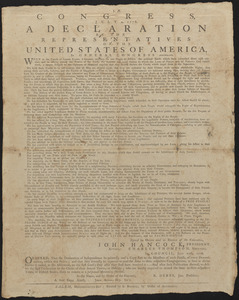
The Leventhal Map Center at the Boston Public Library has opened “Declarations: Printing a New Nation” with eight printings from broadsides and newspapers, along with maps showing the spread of that news. It will be up through 13 September. Shown here is the library’s copy of the Declaration as printed by Ezekiel Russell for the newly independent Massachusetts government.

The Boston Athenaeum exhibit “Imagined Nation” displays early printings in the context of such items as George Washington’s copy of Thomas Paine’s Common Sense, maps of the young republic, and World War II–era posters. That runs through November.

The Massachusetts Historical Society’s “1776: Declaring Independence” display, up through December, includes “handwritten copies of the Declaration by John Adams and Thomas Jefferson as well as multiple early printings, including a rare Dunlap broadside.” That was the first official presentation of the text, commissioned from printer John Dunlap by the Continental Congress in July 1776.

In Cambridge, three parts of the Harvard University library system are creating linked displays. The university archives is offering “Harvard and the American Revolution.” Next week the Harvard Map Collection will open “Charting Independence.” And starting on 18 May the Houghton Library will host “War of Words,” a display assembled by curator John Overholt to feature “the posters, pamphlets, newspapers, and images that brought news of the American Revolution to those who lived through it.”

In addition to the sites on the Declarations Trail, the Commonwealth Museum regularly displays Mary Katherine Goddard’s official reprinting of the Declaration signed by John Hancock and sent to the state in 1777.

And the “The Road to Revolution: Massachusetts and the Independence Movement” exhibit in Revolutionary Spaces’s Old State House, drawing on material from the M.H.S., includes a “rare 1776 Boston broadside printing of the Declaration of Independence.”

Most of those exhibits are free to the public. Many have special tours, talks, and workshops scheduled as well.

In a parallel initiative, five Revoloutionary-era institutions with admission fees—the Paul Revere House, Old State House, Old North Church, Old South Meeting-House, and King’s Chapel—have combined to offer visitors the Boston 250 Pass with a 10% on regular adult admission.

Friday, March 20, 2026

“Alarmed in Lexington” in Lexington, 21 Mar.

Evacuation Day over, so it’s time to look ahead to another Patriots Day season. 

On Saturday, 21 March, the Lexington History Museums will host two performances of Alarmed in Lexington, a series of three short plays by Debbie Wiess about events in the Hancock-Clarke House on 19 Apr 1775.

The audience will take in these three vignettes while moving through the house in small groups (including going up and down stairwells).

As the action begins, it’s shortly after midnight and Paul Revere and William Dawes have just left after bringing news of approaching British regulars. The vignettes dramatize the responses of the town minister, the Rev. Jonas Clarke, and his granddaughter Lucy; Massachusetts resistance leaders John Hancock and Samuel Adams; and Hancock’s fiancée, Dorothy Quincy, and his aunt, Lydia Hancock. Those conversations take place in the same rooms where those people were living in 1775.

The performances are scheduled for 4 and 7 P.M. Tickets are limited and cost $40, or $30 for Lexington History Museums members.

Tuesday, August 26, 2025

“Pray the God of Armies to restrain Man

John Hancock wasn’t the only person Edmund Quincy wrote to on 22 Apr 1775, just after the start of the Revolutionary War, as quoted yesterday.

Justice Quincy couldn’t very well write to Hancock and ignore the man’s fiancée, Dorothy Quincy, could he? After all, she was his daughter.

Thus, we have this second, shorter letter written inside “Boston (a Garison’d town)”:
Dear Dolly—

I’ve an opporty (unexpected) by Doctr. [Benjamin] Church, Just to tell you, that I’m kept from my intended Journey to L[exing]ton & [Lene’y?] by restraint of Princes—endeavors are using to obtain an opening but how soon, none know!

It’s ye. will of Heaven, that it should be thus—!—To His Will, let us learn Submission, thro’ all the Changing Scenes of a Short uncertain Life—I pray God we may all learn this profitable Lesson, that we may be reaping the advantage at all times, especially in a time of Sharp trials, to wch. we are in every State more or less liable

We are generally in good health—but as generally under great sorrow, for the loss of so many humane lives, Wednesday last: pray the God of Armies to restrain Man, from further Attempts of a Similar kind—

Your Bror. & family propose removal—to Providence—if the Gates are opened to us—your Trunk is here—if mine go, yours will also—

I condole with Madm. [Lydia] Hancock, & you, under present & late Circumstances of things—I hope to see you soon, if it please God

Interim recommending you to his protection, with. all your near-Connexions in this devoted Town—I am with my Sincere regards to Madm. H. Mr. [Jonas] Clark & Lady—, Dear Child, Your Affectionate Father & Friend
Edm: Quincy

[Postscript:] Your S[iste]r. [Esther] Sewall distress’d, with ye View she has of things

[Postscript vertical along left margin:] I hope Mr. H. is well on is Journey—you are happy in yo. being out of this town—tho’ ye. Govr. Speaks Fair He is much troubled himself
Esther Sewall was another of Edmund Quincy’s daughters, married to royal attorney general Jonathan Sewall. She evidently had a close-up “View” of the administration of Gen. Thomas Gage and was “distress’d” at what lay ahead.

TOMORROW: The letter carrier.

Monday, August 25, 2025

“No Carriage from L. & if there was—no permiso. to pass”

On 22 Apr 1775, three days after the Battle of Lexington and Concord, the Boston merchant and magistrate Edmund Quincy sat down to write a letter to John Hancock.

Quincy wasn’t just a colleague of Hancock in the Boston Patriot movement. He was also the father of Dorothy Quincy, Hancock’s fiancée (shown here).

Earlier that month, Dorothy had taken the family carriage out to Lexington and then used it to flee with Lydia Hancock from the regulars on 19 April. That left her father stuck inside Boston as the siege began.

Justice Quincy wrote to Hancock:

Dear Sir,

Referring you to a Ltr. wrote the 8th. currt: [i.e., of this month] I’m now to enclose you one I had this day out of [ship captain John] Callihan’s bag:—32 days fro. Lond: into Salem pr young Doct. [John] Sprague—who tells me [captain Nathaniel Byfield] Lyde sail’d 14 days before them wth. Jo. Quincy Esq & other passengers—that some of ye Men of War & transports sail’d also before Callihan. As to ye times [?] at home—ye Doctr. is little able to inform us—youl probably have Some papers via Salem.—————

As to my Scituation here ye unexpected extraordy. event of ye 19th: of wch. Ive wrote my thots—) now & for days past impedes my leaving town[.] No Carriage from L[exington]. & if there was—no permiso. to pass ye lines—The people will be distress’d for fresh provisions—in a Short time—

The Govr: & Genl.—is very much concern’d about ye Provl. troops without—wch. probably will be very numerous ’ere long if desired—Dorchester hill—I’m just now told, is possess’d by our provls—& I hope its true, for Ive reason to believe, ye Genl. had ye same thing in Contemplation——

Here they say & swear to it all round, in excuse of ye Regulars, proceeding at Lexinton—that they were attack’d first & I doubt not many oaths of Officers & men are taken before J. G—ley [Justice Benjamin Gridley], to confirm it—but among others who contradict ’em—Lt. [Thomas] Hawkshaw yesterday near expiring thro. his bad wounds——Call’d Several Credible persons to him & told ’em as a dying man—that he was obliged in Conscience to confess—that the first Action of ye Whole at L. was done by the Kings troops—wr. they killd & wounded eight men—but doubtless you have sufficient proof of ye Fact & every Circumstance attending near at hand—

my advice is that the Whole Matter—be forwarded at ye province expence or otherwise wth. the Greatest dispatch—that so your Advices may be in London as early as GG’s——

If the people of G:B: are not under a political Lethargy—The Account of ye late Memorable Event, will excite them to consider of their own Close Connexion wth. America; and to Suppose at length, that ye Americans especially N. Englanders will act as they’ve wrote, & engag’d—A Blessed Mistake our prudent G[ag]e has indeed made, & ye Sensible part of his Officers & Soldiers own it—& are vastly uneasie—

I had been at L— days to pay my real regards to yr. good Aunt & Dolly—but wn. we shall have ye passage clear I dont [know] we are in hopes of effecting soon. But ye Gl. is really intimidated & no wonder wn. he hears of 50.000 men &c.—Much is Confess’d of ye intripedity of ye provinls. Im much Surpriz’d to hear that the Regulars abt. 1700—were drove off & defeated by near an Equal Corps only.—

Capt. [John] Erving, at his house yesterday Gave me ye Account of Hawkshaws Confesso.-proved to him at ye No: End yesterday to be real, he also says that from all he can gather from ye Circumstances of the people of Gt. Bn. they are by this day in a State of fermentation—if we could be so happy, as to get speedily home, the necessary advices—I doubt not a Flame would soon appear—& ere its quench’d, may it burn up ye heads of the Accursed Faction fro. whence ye present British Evils spring

Genl. Gage is thrown himself into great perplexity—Ld. Percy is a thorn in his side & its said has menaced him Several times, for his late imprudence—a Good Omen

I cant nor ought I to add, but my best regards—& Love respectively & that I am
Dr. Sir Your most affecto: Friend
& H. Servt.
Ed. Quincy

youl excuse erro. for Ive not time to correct em
There are a lot of interesting bits of intelligence in this letter—Gen. Thomas Gage hoping to seize the heights of Dorchester, Col. Percy criticizing his Concord mission, Lt. Hawkshaw saying the British soldiers had fired first. Quincy urged Hancock and his colleagues to send the Patriot side of events to London as quickly as possible.

How did John Hancock respond to seeing this letter? In fact, he never saw it.

TOMORROW: Diverted mail.

Monday, August 04, 2025

“The most profitable Business he could at present Employ himself about”

Here’s another transcribed letter from the Papers of John Hancock.

Thomas Cushing, having been replaced as a Massachusetts delegate to the Continental Congress in favor of Elbridge Gerry, was back home in Massachusetts as a member of the Council.

On 4 Apr 1776, less than a month after the British military evacuated Boston, Cushing wrote to Hancock:
Some time before you wrote to me concerning Your Brother [Ebenezer Hancock], I had not been unmindful of him, I saw him at Watertown & he told me he should like to be Employed if possible in that town in writing for the Council or House, as he should in that Care be near his family & could often Visit them, I accordingly made Enquiry after some Employ of this Sort for him & sspoke to divers Members of the Council & it appeared to me that there would soon be an opening for him –

a few days ago I saw him at Boston and told him what you hard wrote me concerning him & what prospect I thought there was of his being Employed, he told me he was oblidged to me, but it would not suit him & tarry at Watertown now as the Town of Boston was again retured to its Inhabitants, that he had found all his goods & merchandize were safe and in good Condition, that he determined to return to Boston & that he apprehended that the most profitable Business he could at present Employ himself about was in attending to the Sale of his Goods, in which I think he judged wisely. I give you joy that his Goods are Safe
John eventually got Ebenezer the job of a deputy paymaster of the Continental Army. As a result, Ebenezer sometimes had huge sums of silver money from France under guard in his Boston home.

Ebenezer Hancock’s house in downtown Boston is now on the market. It’s being promoted as John Hancock’s house because the older brother owned it, but he’d inherited a lot of property in Boston. Ebenezer, who had received a smaller bequest from their uncle, ran into business reverses and went bankrupt in 1769. According to W. T. Baxter’s article on Ebenezer’s bankruptcy, John helped him out with “rent-free premises.”

Eventually, Baxter noted, the property flowed the other way. Gov. Hancock died intestate, so Ebenezer inherited a third of his fortune, including the stone mansion on Beacon Hill.

Sunday, August 03, 2025

John Hancock Sees a Chance to Do a Favor for Thomas Longman

My ears perked up at this announcement from the Colonial Society of Massachusetts:
The Colonial Society is publishing the Papers of John Hancock—which remarkably have never been published! Editor Jeffrey Griffith has been scouring archives and libraries to find copies of Hancock’s letters, and not only will the Colonial Society publish fully annotated editions of Hancock's letters, and make them available on our web-site, Jeffrey Griffith has created this collection of transcriptions, identifying each library which holds the originals.
For example, here’s a letter that the London publisher Thomas Longman sent to Hancock in July 1769:
Mr John Mein of Boston (Bookseller) is Indebted to me a very considerable sum of Money, the greatest part of which has been due near three Years, which upon my remonstrating to Him He has several times promised to make such Remittances as wld be satisfactory, but this He has yet neglected to do, nor now even so much as writes to me by way of appology.

I should therefore be greatly obliged to you if you could recommend a proper Person to me to whom it would be safe to send a power of Attorney & to Act for me in the most adviseable manner in this unfortunate affair. I know your time and attention is at present much taken up in Public Affairs, but as the recovery of this Debt is of great consequence to me, hope you will not deny my request but favour me with your answer by the first opportunity
At the time, Mein was using his Boston Chronicle to shame the Boston Whigs for bringing in goods they’d promised to boycott because of the Townshend duties. While merchants offered different excuses for their shipments (e.g., I didn’t import glass, I imported medicines in glass bottles), that coverage weakened support for non-importation and made Boston look bad to other American ports.

When Hancock received this letter asking who could be a local agent for the Longmans, sue Mein, and seize his property, he must have at least figuratively rubbed his hands in pleasure. He proceeded to do just that, using legal means to shut down the Boston Chronicle while other merchants physically chased Mein out of town.

Wednesday, June 18, 2025

“In full compensation of the damage he sustained”

For more than a week now I’ve traced Henry Howell Williams’s quest for compensation after the Battle of Chelsea Creek in May 1774 destroyed his estate on Noddle’s Island in Boston harbor.

In 1788, the Confederation Congress’s board of treasury sent him back to Massachusetts. After all, those commissioners said, his livestock had been taken and his farm burned before the Continental Army legally existed. This was a state matter.

I don’t have access to Massachusetts legislative journals from that period, but Williams must have submitted a petition during the session that started in May 1789.

On 23 June, Gov. John Hancock and state secretary John Avery signed off on this resolution passed by both houses of the General Court:
Resolved, that the Treasurer of this Commonwealth be and he hereby is directed to issue his note in behalf of the Commonwealth in favor of Henry Howell Williams, for the sum of two thousand pounds and interest thereon from date of the same in full compensation of the damage he sustained from having his stock and other property taken from him or destroyed in consequence of orders given by the commanding officer of the Massachusetts troops [Artemas Ward] in the month of May, 1775, and that the same be charged to the United States.
Williams would get £2,000. That wasn’t all he’d asked for, but it was more than half, and more than his own estimate of the value of the livestock he said the army had confiscated.

Massachusetts would supposedly try to get reimbursed for that payment from the federal government. I doubt it ever saw money back, but I don’t know how to track that now that Williams’s name was probably no longer attached to the request.

Williams had been seeking such compensation since the summer of 1775. He had asked each of these bodies for money:
  • Massachusetts Provincial Congress.
  • Massachusetts General Court under the provincial charter, seeking relief.
  • Massachusetts General Court, seeking a loan.
  • Congress of the U.S. of A. under the Articles of Confederation, through its agent.
  • Congress of the U.S. of A. by direct petition.
  • Massachusetts General Court under the constitution of 1780.
Some men might have been satisfied with £2,000. But not Williams.

Three years later he went back to Massachusetts legislators and asked if that “full compensation” from the state meant he couldn’t also ask the new federal government for money. Five members of the committees that had considered his claim in 1789 signed off on a document dated 14 Feb 1792 saying their resolution was
by no means and in no sense to preclude any further grant, Which The Federal Legislature, or any other government, May think proper to make said Williams.
So Williams sent yet another petition off to the new national capital of Philadelphia.

TOMORROW: In the room where it didn’t happen.

Tuesday, May 06, 2025

“The soldiers searched for them, for more than an hour”

On 27 Apr 1861, the Cambridge Chronicle published an article headlined “Revolutionary Incident.” and signed “C.F.O.”

The first paragraph listed its “authentic and reliable sources,” including “the Records of the Provincial Congress, Austin’s Life of Gerry, and the niece of Col. Gerry, daughter in law of Col. Orne, and the grand-daughter of Col. Lee.”

“C.F.O.” was Caroline Frances Orne (1818–1905, shown here), a poet, local historian, and Cambridge’s librarian for seventeen years.

She was a granddaughter of Sally (Gerry) Orne (d. 1846), who was “the niece of Col. [Elbridge] Gerry, [and] daughter in law of Col. [Azor] Orne.” I believe “the grand-daughter of Col. [Jeremiah] Lee” was most likely either Louise Lee Tracy (1787–1869) or Helen Tracy (1796–1865).

Thus, this article was based on family lore, not first-hand witnesses, and the author was herself a member of the intertwined family. She consulted books like the Journals of Each Provincial Congress of Massachusetts and James T. Austin’s biography of his father-in-law, but used those to fill out a story she’d undoubtedly heard from her grandmother.

Caroline Frances Orne wrote of the British army march in April 1775:
Among the objects of this march one was to seize the persons of some of the influential members of the Provincial Congress, to hold them as hostages, or send them to England for trial as traitors, and thus to terrify and dismay their associates and friends.

Among others, Col. [John] Hancock, Col. [Azor] Orne and Mr. Elbridge Gerry had been in session, on the day preceding the march of the troops, in the village of Menotomy, then part of the township of Cambridge, on the road to Lexington, at [Ethan] Wetherby’s Black-Horse Tavern.

Col. Hancock, Samuel Adams, and some others went over to Lexington to pass the night, while Messrs. Gerry, Lee, and Orne remained at the village. The appearance of some officers of the royal army who passed through the village just before dark, attracted the attention of these gentlemen, and a message of warning was at once despatched to Col. Hancock. Of their personal danger they did not entertain an idea, but retired quietly to rest, without taking the least precaution.

As the British advance came into view of the dwelling-house, they arose and looked out of the windows, and in the bright moonlight saw the glitter of the bayonets, and marked the regular march of the disciplined troops. The front had passed, and the centre was opposite the house, when a signal was given, and an officer and a file of men marched towards it. Then the apprehension of danger first struck them, and they hastened to escape.

Rushing down stairs, Col. Gerry in his perturbation, was about to open the door in the face of the British, when the agitated landlord exclaimed, “For God’s sake, gentlemen, don’t open that door[.]” He then hurried them out at the back door, into a cornfield, where the old stalks still remained. Hastening along, Col. Gerry soon fell. “Stop, Orne,” he called in low, urgent voice, “Stop for me till I can get up; I have hurt myself.”

“Lie still,” replied Col Orne, in the same low tone, “Throw yourself flat on the ground,” proceeding at once to do the same himself, in which he was imitated by Col Lee.

This manoeuvre saved them. The soldiers searched for them, for more than an hour. Every apartment of the house was searched “for the members of the Rebel Congress,” and even the beds in which they had lain. Mr. Gerry’s watch was under his pillow, but it was not disturbed, nor was any of their property taken. The troops finally left, and the gentlemen returned, suffering greatly from cold, for it was a cold frosty night, and they were but slightly clothed.

Col. Lee never recovered from the effects of the exposure. He was attacked, soon after, by a severe fever, and died, May 10th, 1775, universally lamented. The others lived to render most important services to their country.
Three years later, the Rev. Samuel Abbot Smith (1829-1865) put a shorter version of the same story into his West Cambridge on the Nineteenth of April, 1775. He credited “Miss Orne, who received this account from the lips of her grandmother, who was niece of Elbridge Gerry, and daughter-in-law of Col. Orne.”

TOMORROW: The watch under the pillow.

Monday, May 05, 2025

“Opposite to the house occupied by the committee”

On 18 Apr 1775, the Massachusetts Provincial Congress’s committee of safety met “at Mr. [Ethan] Wetherby’s, at the Black Horse” tavern in west Cambridge.

Among other business that day, the committee promised “the two brass two pounders, and two brass three pounders” that had been stolen out of Boston to Lemuel Robinson’s Suffolk County artillery company. Robinson had hidden those cannon at his tavern in Dorchester earlier in the year, before they were moved out to Concord.

The committee decided to continue meeting in the same tavern at 10 A.M. the next morning. Three important members from MarbleheadElbridge Gerry, Jeremiah Lee, and Azor Orne—chose to stay overnight since they were far from their own beds. Other members went home to Charlestown, Newton, and elsewhere. 

On the afternoon of the 18th people spotted Maj. Edward Mitchell and other army officers riding by that tavern on horseback. Gerry sent a warning note to John Hancock in Lexington, and Hancock replied. There was a widespread worry that troops might arrest leaders of the resistance. Of course, neither man’s message indicated that he was worried for himself, certainly not.

In 1828 James T. Austin published a two-volume Life of Elbridge Gerry, his father-in-law, which offered this story about what happened in the night that followed:
Mr. Gerry and colonel Orne retired to rest without taking the least precaution against personal exposure, and they remained quietly in their beds until the British advance were within view of the dwelling house. It was a fine moonlight night, and they quietly marked the glittering of its beams on the polished arms of the soldiers as the troops moved with the silence and regularity of accomplished discipline. The front passed on.

When the centre were opposite to the house occupied by the committee, an officer and file of men were detached by signal, and marched towards it. It was not until this moment they entertained any apprehension of danger.

While the officer was posting his files the gentlemen found means by their better knowledge of the premises to escape, half dressed as they were, into an adjoining corn-field, where they remained concealed for more than an hour, until the troops were withdrawn. Every apartment of the house was searched “for the members of the rebel congress”; even the beds in which they had lain were examined.

But their property, and among other things a valuable watch of Mr. Gerry’s, which was under his pillow, was not disturbed.
I can’t identify the source of the phrase in quotation marks, either in earlier books, period newspapers, or Gen. Thomas Gage’s orders. 

TOMORROW: Another family source.

Thursday, May 01, 2025

“Packed up his presses and types”

Back in 2011, I quoted Isaiah Thomas’s own account from October 1775 of how he’d slipped his printing press out of Boston just a couple of days before the outbreak of war.

For his 1810 History of Printing in America, Thomas wrote a bare-bones version of this event. The 1874 reissue of that book included a descendant’s longer telling, drawn mostly from family lore but also citing that 1775 letter.

According to this account, early in 1775 Timothy Bigelow invited Thomas to start a Whig newspaper in Worcester. That would have been an addition to the Massachusetts Spy in Boston.

It’s not clear whether that venture had gotten anywhere beyond the talking stage, but it meant that Thomas had already thought about moving a press and type to Worcester.

Actions in Boston sped up that process. A mysterious note and a parade by the 47th Regiment threatened the town’s radical printers. Rumors went around that the government in London had told Gov. Thomas Gage to start arresting people. (It had, but the ministers wanted him to start with politicians, not printers.)

According to the 1874 account, Thomas ”sent his family to Watertown to be safe from the perils to which he was daily exposed.” It doesn’t mention that at the time Thomas was breaking up with his wife Mary because she had had an affair with Benjamin Thompson.

The later version continued:
…his friends insisted upon his keeping himself secluded. He went to Concord to consult with Mr. [John] Hancock and other leading members of the Provincial Congress. He opened to them his situation, which indeed the Boston members well understood. Mr. Hancock and his other friends advised and urged him to remove from Boston immediately; in a few days, they said, it would be too late. They seemed to understand well what a few days would bring forth.

He came back to Boston, packed up his presses and types, and on the 16th of April, to use his own phrase, ”stole them out of town in the dead of night.” Thomas was aided in their removal by General [Joseph] Warren and Colonel Bigelow. They were carried across the ferry to Charlestown and thence put on their way to Worcester.

Two nights after, the royal troops were on their way to Lexington, and the next evening after, Boston was entirely shut up. Mr. Thomas did not go with his presses and types to Worcester. Having seen them on their way he returned to the city. The conversation at Concord, as well as his own observation, had satisfied him that important events were at hand.
Thomas was using his old master and partner Zechariah Fowle’s press, made in London in 1747. It remains today at the American Antiquarian Society, which recently celebrated the 250th anniversary of its flight from Boston.

TOMORROW: Important events.

Thursday, April 24, 2025

Esther Sewall and “the female Connections”

In the fall of 1774 and winter of 1775, Massachusetts attorney general Jonathan Sewall appears to have worked as an advisor to the royal governor, Thomas Gage.

With the courts closed by crowds and Gage’s authority confined to Boston, there wasn’t much else for Sewall to do.

There’s a renewed debate about whether Sewall wrote the “Massachusettensis” essays published in those months. Patriots of the time believed he did, but his former law trainee Ward Chipman described copying them out for another Loyalist lawyer, Daniel Leonard. In 2018 a team led by Colin Nicolson reported in the New England Quarterly that their linguistic analysis pointed the finger back at Sewall.

In early April 1775, a dispatch from Lord Dartmouth brought instructions to arrest the leaders of the Massachusetts Provincial Congress. Gen. Gage might well have discussed the legalities of such arrests with his attorney general.

The president of that congress was John Hancock. His fiancée, Dorothy Quincy, was the sister of Esther Sewall, the attorney general’s wife. On 7 April, James Warren wrote to his own wife:
The Inhabitants of Boston are on the move. H[ancock] and A[dams] go no more into that Garrison, the female Connections of the first come out early this morning and measures are taken relative to those of the last.
Dorothy Quincy was soon staying with Hancock and Samuel Adams at the parsonage in Lexington.

As discussed yesterday, though Esther Sewall was married to a leading Massachusetts Loyalist, she was still emotionally attached to her family, friends, and neighbors on the Patriot side. She might have heard her husband talk of Hancock and Adams being arrested. Any military operation to do that could put her sister in danger.

Esther Sewall therefore had a motive and possible means to be the “daughter of liberty, unequally yoked in point of politics,” who sent a warning that British soldiers might arrest Hancock and Adams, as the Rev. William Gordon later wrote. When I first discussed that question, I didn’t see how Esther would have had access to inside information. Jonathan’s work with Gov. Gage offers a possible answer. (And, we must remember, this “daughter of liberty” did not have information on Concord as Gage’s real target.)

A few months into the siege of Boston, Jonathan and Esther Sewall sailed for London. They remained yoked together for the rest of his life. But neither of them was happy. For most of those years Jonathan was seriously depressed, often confined to his bedroom. Esther was terribly homesick. Jonathan blamed Esther for his difficulties. Yet she stayed with him.

Esther Sewall made two trips back to Massachusetts, first in 1789 and then in 1797, the year after she became a widow. Her grown sons Jonathan and Stephen became important lawyers in Canada, and she settled in Montreal.

In 1809, Esther sued in Massachusetts court for her dower property, confiscated thirty years before as part of Jonathan’s assets. Though she didn’t live to hear about it, the state’s highest judges decided in her favor. Then the Massachusetts General Court passed a special law to compensate the man who’d bought that property for what he had to pay her estate. So the Massachusetts government ended up paying Esther Sewall money.

Wednesday, April 23, 2025

“Putting all matters of politicks out of view”?

Esther Quincy married Jonathan Sewall in January 1764, after a courtship of more than four years.

She was the daughter of the Boston merchant and magistrate Edmund Quincy, who had come back from bankruptcy a couple of years before.

He was a young lawyer of sharp wit and moderate means trying to establish himself, building up from the position of justice of the peace.

Jonathan Sewall didn’t enter the political debate over the Stamp Act, but in December 1766 he came out swinging on behalf of Gov. Francis Bernard and royal policy in newspaper essays signed “Philantrop.”

The governor rewarded Sewall with appointments as the province’s solicitor general and then attorney general. He later got to be a judge in the Vice Admiralty Court as well.

Esther’s father was on the other side of the political divide. He was one of the justices the Boston Whigs called on when they had a complaint about a royal official or soldier. He joined other magistrates in resisting Gov. Bernard’s call for barracks in 1768. He took the (conflicting) testimony of Charles Bourgate after the Boston Massacre. He issued the warrant to arrest John Malcolm for assault.

Most of Esther Sewall’s other male relatives were also Whigs. Uncle Josiah Quincy, Sr., in Braintree was on the Council, one of several thorns in the royal governors’ sides. Cousin Josiah, Jr., practiced law in Boston, wrote newspaper essays, counseled local activists, and traveled to meet fellow Whigs in the southern colonies and London. The major exception within the Quincy family was cousin Samuel Quincy, who followed in Jonathan’s wake as the province’s solicitor general.

Many of Jonathan’s old friends were Whigs, including John Adams, and that produced some awkward social moments. Jonathan prosecuted John Hancock on smuggling charges (eventually dropping the case for lack of solid evidence). But in 1772 the merchant wrote to him expressing
my inclination and wish (putting all matters of politicks out of view) that a perfect harmony and friendship may be kept up between us, and wish rather more familiarity than the common shew of friendship expresses, considering the connection I have formed with the sister of your Lady.
That was Esther’s sister Dorothy. She became Hancock’s fiancée, their engagement almost as long as the Sewalls’ had been.

By 1774 the Sewalls were living in Cambridge in a country mansion bought from Richard Lechmere. Their household included three small children, three young men studying the law, and at least one enslaved young man.

Early on 1 September, Gen. Thomas Gage’s soldiers seized militia gunpowder in Charlestown and cannon in Cambridge. Around noon, Jonathan Sewall suddenly left home and headed to Boston. The governor might have sent for him, or he might have feared how the neighbors would react to the army operation. Or he might have had a whim.

After dark, those neighbors came to the Sewalls’ house. They refused to take Esther’s word that Jonathan was out. Some men pushed into the house, and the young men inside beat them back. One of those boarders, Ward Chipman, fired a pistol inside the house—some sources say accidentally, some not. Either way, that noise got everyone’s attention. The two groups of men agreed not to do further violence as long as they could enjoy some of the Sewalls’ wine.

Soon afterward, Esther took the children into Boston to be with Jonathan. That might have been as early as 2 September when the “Powder Alarm” brought thousands of militiamen into the street outside.

Unlike some people threatened by crowd violence, Esther Sewall never renounced Massachusetts. Her family ties were too strong. In 1778 she wrote to her father: “I had not forgot my own Country, and Friends no, my D[ea]r Father, I should as soon forget myself.” But as of September 1774 she was stuck inside Boston with her unpopular husband.

TOMORROW: Can this marriage be saved?

Thursday, April 17, 2025

Counterfactual 2: If Capt. Parker Hadn’t Assembled His Company

Picking up the “what if” thread from yesterday, I turn to this question: What would have happened if neither Paul Revere nor William Dawes had arrived in Lexington in the wee hours of 19 Apr 1775?

The town would still have been at a heightened level of military alert. That afternoon a young local named Solomon Brown had ridden out from Boston—not as a messenger, but just coming home from business.

On the road Brown had spotted a bunch of other men on horseback. They looked or sounded British. When their cloaks flapped back, he saw they were carrying pistols. Brown began to suspect they were British army officers.

Everyone in Lexington knew two important politicians from Boston were staying in the Rev. Jonas Clarke’s house: John Hancock, president of the Massachusetts Provincial Congress, and Samuel Adams, delegate to the Continental Congress. Were those army officers coming out to arrest those men?

In fact, Maj. Edward Mitchell was leading about a dozen mounted officers out into the countryside to keep alarm riders from getting to Concord. That town was the only goal of Gen. Thomas Gage’s mission. Lexington was just along the way.

Not knowing that, Solomon Brown went to his militia sergeant, William Munroe (shown above). Munroe gathered “a guard of eight men, with their arms,” at the parsonage. So some Lexington militiamen were already on the alert well before hearing from Revere or Dawes.

In real life, after receiving the Bostonians’ post-midnight warning, Capt. John Parker assembled the rest of the Lexington militia company on the town common. Nothing happened, so he let the men disperse to nearby houses and taverns to catch some sleep.

But let’s imagine that Revere and Dawes never arrived. The town picked up news of the approaching column hours later from a few travelers, from hearing bells and warning shots from towns to the east.

In that case, the Lexington men might have assembled more hastily. They might have headed for where they thought they might be most needed: at the parsonage, strengthening Sgt. Munroe’s guard.

Hancock and Adams might not have had time to leave town—or Hancock might have refused to do so with more men watching. So an armed crowd would have gathered on what’s now Hancock Street, determined to prevent the troops from arresting those political leaders.

The expedition’s light infantry companies were the first to march into town. But in this scenario the men of the 10th Regiment wouldn’t have seen a body of armed men lined up on the common. They wouldn’t have felt any need to veer off to confront those men. They would have kept marching swiftly along the road to Concord, half a mile from the Hancock-Clarke house.

The two bodies of armed men might have spotted each other in the early dawn light. But they would have been too far apart for either to present any threat. The army column would probably have passed through Lexington without any incident.

Contrary to the scenario Jim Piecuch found described in Kostya Kennedy’s The Ride, Hancock and Adams would not ”have been captured or killed” because the regulars weren’t looking for them.

(Well, if Hancock had insisted on rushing to the common to confront the regulars, he might have been captured or killed. But even he wasn’t that reckless.)

TOMORROW: Alternative scenarios for Concord.

Wednesday, April 16, 2025

Counterfactual 1: If Revere Had Never Reached Lexington

For the Journal of the American Revolution, Jim Piecuch just reviewed The Ride: Paul Revere and the Night that Saved America by Kostya Kennedy.

Piecuch writes:
Kennedy begins his book by posing an intriguing question: What might have happened if Massachusetts militia had not been present at either Lexington or Concord when British troops arrived on April 19? He speculates that John Hancock and Samuel Adams could have been captured or killed, that the munitions at Concord could have been seized, and that such events might have put the American Revolution on a completely different, perhaps even unsuccessful, course.

In Kennedy’s view, the question that gives rise to this hypothetical scenario can also be stated as: What might have happened had Paul Revere not made his ride to warn the inhabitants of towns outside Boston that British regulars were coming? While it is impossible to answer such a question, Kennedy uses it to underscore the importance of Revere’s ride, declaring that “Perhaps no night was more critical to [America’s] fate” (page 4).
I’ve been cogitating along similar lines but not coming to the same firm conclusions.

Let’s start with the question of what would have happened if Paul Revere had been satisfied with arranging for the signals from the North Church steeple to his colleagues in Charlestown. The rider they sent west toward Lexington never made it, probably stopped by a British mounted patrol. We don’t even know who that man was. But let’s imagine Revere went to bed thinking he’d sent the warning as Dr. Joseph Warren had asked.

Or we can imagine Revere heading out of Boston as he did but being stopped by the H.M.S. Somerset, or by that same mounted patrol in west Charlestown. If Revere had never made it past Medford, how would that have affected events the following day?

In that case, Dr. Warren’s warning would have reached Lexington about half an hour later than it did, as soon as William Dawes arrived in town. Since it took hours for Adams and others to persuade Hancock to leave Lexington, and since the regulars didn’t arrive until hours after that, those thirty minutes probably wouldn’t have made a big difference.

TOMORROW: But what if neither Revere nor Dawes had reached Lexington? 

Friday, March 07, 2025

“Alarmed in Lexington” and More

The Lexington Historical Society is now the Lexington History Museums.

As the Sestercentennial of the start of the Revolutionary War approaches, the organization’s Buckman Tavern museum is open to visitors every day of the week but Wednesday, 10am–4pm.

Another of the museums, the Hancock-Clarke House, is about to host this special program.

Saturday, 8 March, 7 to 9 P.M.
Alarmed in Lexington
Hancock-Clarke House, 36 Hancock Street

Step back in time to experience the anxious hours before the start of the American Revolution. It’s past midnight on April 19th, 1775, and Paul Revere has just left the home of Lexington’s minister, Jonas Clarke, with news of an impending British attack. This leaves the home’s occupants to take in the news and prepare for what is to come.

In a series of three short plays by Debbie Wiess, see how John Hancock and Samuel Adams, leaders of the Revolution; Dorothy Quincy and Lydia Hancock, John’s family; and Jonas and Lucy Clarke, town leaders, process the impending crisis as they prepare for war in the very rooms in which these conversations took place 250 years ago.

Admission is $25, or $20 for museum members. This program has received funding from Kirkland and Shaw Plumbing and Heating and by a grant from the Lexington Council for the Arts, a local agency supported by the Massachusetts Cultural Council, which in turn receives funds from the National Endowment for the Arts.

[I hope those funds were received last year since the current administration has stopped many payments for work already done and contracts already awarded. The White House has also ordered future N.E.A. grants to conform to criteria not established by Congress; arts organizations just filed a lawsuit about the unconstitutionality of that order. Events like “Alarmed in Lexington” show how White House edicts can affect local endeavors that don’t have direct federal involvement.]

Next month, the Lexington History Museums will also reopen its Munroe Tavern for the season, and debut its new Depot museum covering all of Lexington history.

Thursday, December 12, 2024

“You found the money and Sam Adams the brains”

For the first years of the Revolutionary War, Massachusetts continued to operate on the basis of its provincial charter.

The General Court was elected each year, starting in the summer of 1775, when it took over from the Provincial Congress. Its members chose a Council.

That Council exercised executive power, as the charter had specified for times when the royally-appointed governor and lieutenant governor were absent from the province. Which they were, for obvious reasons.

It took years, and two tries, before the towns of Massachusetts ratified a new constitution in 1780. That provided for a governor again—to be elected by the people rather than appointed.

On 19 October, the Rev. William Gordon of Roxbury wrote to John Adams, then on a diplomatic mission in Europe, about that choice:
Mr. [John] Hancock will be governour, unless Death should prevent it. I was employed by a Boston representative under the rose, to plead with Mr. [James] Bowdoin that pro bono publico [for the good of the public] he would condescend to serve as Lt. Govr.: I urged that plea, and encourage the expectation from his not declaring off, that, if the Genl. Ct. are pritty well agreed, he will not decline. He will be a good poize, and prevent undue influence and eccentric motions.

Some time back several persons dined together with the above mentioned, the conversation turned upon old matters, a country booby of a representative said, “ay I remember we used to say that you found the money and Sam Adams the brains.” A pause commenced for some minutes before the conversation was renewed. The poor mortal, upon being afterwards spoken to upon the impropriety of his remark, apologized by pleading, it was the truth and he thought there could be no hurt in speaking it.
This was during a rift between Hancock and Samuel Adams, with Gordon on Adams’s side and relishing anecdotes that made Hancock look foolish.

Hancock did indeed become governor less than a week later, but his lieutenant governor was Thomas Cushing. Bowdoin was the next elected governor, serving two difficult terms before losing to Hancock, who had decided he was healthy again. Eventually Samuel Adams became lieutenant governor under Hancock, and then succeeded him in 1793.

Tuesday, November 26, 2024

“What says the psalm-singer and Johnny Dupe”?

I’ve been working through my thoughts on a page from the 8 May 1770 Nova Scotia Chronicle, lampooning the Boston Whigs in much the same way that John Mein’s Boston Chronicle had done the preceding October.

Mein got assailed on the street and then chased out of Boston for that, so he couldn’t have written similar items in the Boston Chronicle in early 1770 or this article published in Halifax.

The obvious candidate for carrying on Mein’s work in 1770 is his printing partner, John Fleeming.

Of course, Fleeming might have helped to compose the original character profiles in October 1769. But I sense a little more sloppiness in May 1770: references to characters never introduced, aliases too similar to each other.

One possible pointer to Fleeming is how in October 1769 the Boston Chronicle dubbed Dr. Benjamin Church, Jr., the “Lean Apothecary,” and Mein described him privately as:
One of the greatest miscreants that walks on the face of the Earth who has cheated & back bitten every Person with whom he ever had the least Connection—Father Mother & friend & more than once foxed his Wife &c &c &c.
In contrast, I can’t identify any of the characters in the May 1770 article as Church.

Three months after the Nova Scotia Chronicle publication, John Fleeming married Dr. Church’s sister Alice. Might the printer have held off on lambasting Dr. Church for the sake of his future wife?

Fleeming and Church joined the same new Freemason’s lodge in 1772. They were on friendly terms in 1775, corresponding across the siege lines (which was too friendly for the Patriot authorities). And in the letter that Church introduced as evidence at his inquiry before the Massachusetts General Court, Fleeming wrote:
What says the psalm-singer and Johnny Dupe to fighting British Troops now?
Those terms referred to Samuel Adams and John Hancock, and “John(ny) Dupe” appeared in both the October 1769 and May 1770 character profiles. While not proof that Fleeming created the Nova Scotia Chronicle item, that certainly points in his direction.

Back in the spring of 1770, Fleeming was under threat from the crowd and from Mein’s creditors, represented in Boston by Hancock. In June, the printer shut down the Boston Chronicle and took refuge in Castle William.

Sunday, November 24, 2024

“Rescued from the Tyrants by the real Friends of Liberty”

Most of the “Characters in high Life, some in lowin the 8 May 1770 Nova Scotia Chronicle were derogatory.

Even when I’m not sure what this newspaper item said about someone (“Private Inspector of Glass and Shoes for a neighbouring Province, and grand Inspector of the original Curiosities in Noah’s Ark”), the tone seems negative.

But three personas stand out for being sympathetic.

I’ve mentioned two already: “Maria—…a worthy virtuous good Woman,” almost certainly points to Ruth Otis, wife of James Otis.

“John Plain Dealer, a Bookseller flying the Country,” was Boston Chronicle publisher John Mein, driven out of Boston by a gang of merchants.

And right after that entry appears:
John Dipe, persecuted by his Enemies for the glorious Liberty of the Press, rescued from the Tyrants by the real Friends of Liberty.
That was most likely Mein’s printing-house partner, John Fleeming. At the time of this publication he was still putting out the Boston Chronicle, but he had to give up in June as John Hancock took legal action to seize Mein’s goods.

These character profiles echo those John Mein had published in October 1769 as “Outlines of the characters of…the Well-Disposed.” Mein explicated those in a document filed in the papers of Customs official Joseph Harrison and now at Harvard’s Houghton Library.

In early 1774 the Public Ledger in London published dozens of essays signed “Sagittarius” sprinkled with similar gossip about the Boston Whigs. Those letters have long been credited to John Mein.

These profiles are also like the brief, catty identifications of the Boston Patriots chosen to promote the Continental Association in late 1774 published by the Massachusetts Historical Society in 1898. There’s no evidence about who wrote those, but Mein is certainly a candidate.

So my first instinct on seeing this page in the Nova Scotia Chronicle was that John Mein wrote it, too. But the timing doesn’t work.

According to John E. Alden’s article ”John Mein: Scourge of Patriots”:
Mein sailed from Boston on November 17 [1769] aboard the schooner Hope, on which he had first taken refuge. The vessel arrived at Halifax the following Friday, November 21, and was reported off Spithead about the middle of the following month.
Letters from London in January 1770 confirm that he was there. In fact, the book publisher Thomas Longman arranged for him to be confined in that city because of a debt.

The Nova Scotia Chronicle article appears to refer to Henderson Inches’s marriage to Sarah Jackson on 22 Feb 1770, as discussed yesterday. Mein couldn’t have written about that and left the article with printer Anthony Henry as he passed through Nova Scotia the previous November.

But equally, since a typical Atlantic crossing was six weeks, Mein couldn’t have received that news from Boston, incorporated it into an article in London, and sent that paper to Henry in Halifax in time to be printed in early May.

The “Characters in high Life” must have been composed in North America.

TOMORROW: A string of articles.