J. L. BELL is a Massachusetts writer who specializes in (among other things) the start of the American Revolution in and around Boston. He is particularly interested in the experiences of children in 1765-75. He has published scholarly papers and popular articles for both children and adults. He was consultant for an episode of History Detectives, and contributed to a display at Minute Man National Historic Park.

Subscribe thru Follow.it


•••••••••••••••••


Showing posts with label Benjamin Lincoln. Show all posts

Sunday, May 24, 2026

“Acquainted with the conduct of Doctor Preserved Clap”

I lose track of Dr. Preserved Clap after 1776 until 5 Feb 1781, when the Continental Congress referred a petition from him to its board of war.

On 20 February, board members Richard Peters of Pennsylvania and Ezekiel Cornell of Rhode Island met and formulated a response to that petition:
The Board having considered the reference with which they were honored on the memorial of Preserved Clap, beg leave to observe, That it appears from his memorial and General [Henry] Knox’s letter that he hath been with the Army as a volunteer for eighteen months without pay or any emolument.

That it farther appears by General [Benjamin] Lincolns and Knox’s letters that Mr Clap was sole inventor of stocking the Cannon that were supposed to be rendered useless by the enemy at Boston, and in the vicinity, in the spring of 1776; from which the Continent at large received a real benefit; for which he received no emolument but barely day wages.

From the foregoing state of facts it may be proper for Congress to resolve,

Resolved, That the supreme executive of the State of Massachusetts examine into the merit and services of Preserved Clap, and order payment on the account of the United States, for such sum as they think he may justly deserve; provided it shall not exceed one thousand dollars in bills of the new emissions:

That Preserved Clap be informed, that Congress cannot employ him in public service, consistent with their arrangements.
The Congress approved that response the next day. Clap’s petition, which might include the letters from Knox and Lincoln, is preserved in the Congress’s files but not published.

There is, however, a second published letter from Henry Knox on the doctor. On 13 March, Gen. John Sullivan wrote to Knox about him, and on 22 March the artillery commander replied:
I received your favor of the 13th instant, requesting a certificate from me, & such of my officers who were best acquainted with the conduct of Doctor Preserved Clap, & how he employed himself in the Army.

The result of my knowledge & information is that the said Preserved has great mechanical abilities, & that he joined himself to the Army in ’79, as a volunteer, ready to do any kind of work in his power, either for officers or soldiers, sometimes with & sometimes without pay.

When the Continental troops were principally withdrawn from West Point last August, the Doctor attached himself to the Post, but he declined to the best of my remembrance to be enrolled as an artificer, & apply himself to public work entirely.

Sometime in November he applied to me for a letter to Mr. Hodgson [Samuel Hodgdon, shown above], D[eputy].C[ommissary].G[eneral].M[ilitary]. Stores, the intent of which he informed was to procure assistance or permission to work with the artificers’ tools at Philadelphia to execute some design of a machine to destroy shipping, which he intended to present to Congress or the Board of War.

But I had not the least idea of his intending to claim pay for the time he had been with the army.
This looks like the second time Dr. Clap threw himself into devising equipment for the army without arranging an official rank or contract, and without discussing pay. Not the wisest way to operate, especially when good money was scarce.

The Congress referred Clap’s case to Massachusetts, where the “supreme executive” was now Gov. John Hancock. The state archives might therefore contain more sources on Dr. Clap. However, I’ve found no evidence of pay for him on either state or national level.

TOMORROW: Last traces.

Saturday, December 07, 2024

How Lincoln Impressed Washington

In June 1775, the Massachusetts Provincial Congress commissioned its president, Dr. Joseph Warren, as a major general in the provincial army.

Under the tacit hierarchy of the New England generals, that would have put Warren under Artemas Ward (considered a captain general) and John Thomas (a lieutenant general), and by seniority at the bottom of all the other major generals in the New England forces.

Of course, Dr. Warren never took up that commission. He went onto the battlefield in Charlestown, fought as a volunteer, and died.

Despite that precedent, the clerk of the provincial congress, Benjamin Lincoln of Hingham, also wanted to be a general.

Lincoln had been a lieutenant colonel in the Suffolk County militia before the war. In January 1776, the General Court promoted him to militia major general. His main mission was coastal defense, and he reported on that situation to John Adams in August.

At the same time, Lincoln was positioning himself for a commission in the Continental Army. Gen. Ward wasn’t in the best of health and had lost the support of Gen. George Washington and other important figures. Even Joseph Ward, a relative and aide, told Adams that Gen. Ward was “under the great disadvantage of bad health” and couldn’t show his men that he was “superior to difficulties dangers or misfortunes” as the best generals did.

Joseph Ward wrote:
If a few old Colonels should resign it might be no disadvantage to the Service; very few of them take much pains to qualify themselves for higher command; they want education, knowledge of the World and genuine ambition to make them shine as Generals. I apprehend that Benjamin Lincoln Esqr. (now a Major General in the militia) is a good man for a Brigadire General; he has never been a Continental Officer nor had much experience, but he is a man of abilities and appears to me to have a good mind. I am well informed that he would like to engage in the Service.
That fall, the Massachusetts General Court raised short-term troops to defend New York. After James Warren declined command, Lincoln became the state major general in charge of that force. They weren’t involved in the big battles and came home in November.

That service was enough to impress Gen. Washington, however. When Massachusetts raised more troops for the winter of 1777 and put Lincoln in charge of them, the commander-in-chief wrote to him:
Give me leave Sir to assure you that this Appointment gives me the highest Satisfaction as the proofs you exhibited of your Zeal for the Service, in the preceding part of this Campaign convinces me, that the command could not have devolved upon a more deserving Officer.
Lincoln served under Gen. William Heath in that winter, besieging a British position near Kingsbridge. Heath’s push fizzled out, further lowering him in Washington’s eyes.

Back in July 1775, when Washington had arrived in Massachusetts, the province’s generals were Ward, Thomas, and Heath. Now Ward was about to resign, Thomas was dead, and Heath was doomed never to have a combat command again. Instead, Washington recommended the Continental Congress consider Benjamin Lincoln as “worthy of your Notice in the Continental Line.”

Lincoln thus became the newest major general in the Continental Army in March 1777. And he retained Washington’s esteem even after having to surrender Charleston to the Crown in May 1780. He also became the U.S. of A.’s first Secretary of War under the Confederation Congress.

On the afternoon of Sunday, 8 December, Robert J. Allison will speak to the Hingham Historical Society on “From Hingham to Yorktown: The Military Campaigns of General Benjamin Lincoln.” You can purchase tickets to attend that talk or view online through this page.

Friday, October 04, 2024

“Now resolve themselves into a Provincial Congress”

The ninety men assembled in Salem on Wednesday, 5 Oct 1774, as described yesterday, waited for Gen. Thomas Gage or another royal official to appear.

No one did.

So the next day they met under their own authority, and the day after that they approved their first resolves. These said, in part:
The members aforesaid so attending, having considered the measures which his excellency [the governor] has been pleased to take by his said proclamation, and finding them to be unconstitutional, unjust, and disrespectful to the province, think it their duty to pass the following resolves: . . .

2dly. That the constitutional government of the inhabitants of this province, being, by a considerable military force at this time attempted to be superseded and annulled: and the people, under the most alarming and just apprehensions of slavery, having, in their laudable endeavors to preserve themselves therefrom, discovered, upon all occasions, the greatest aversion to disorder and tumult, it must be evident to all attending to his excellency’s said proclamation, that his representations of the province as being in a tumultuous and disordered state, are reflections the inhabitants have by no means merited; and, therefore, that they are highly injurious and unkind. . . .

4thly. That some of the causes assigned as aforesaid for this unconstitutional and wanton prevention of the general court, have, in all good governments, been considered among the greatest reasons for convening a parliament or assembly; and, therefore, the proclamation is considered as a further proof, not only of his excellency’s disaffection towards the province, but of the necessity of its most vigorous and immediate exertions for preserving the freedom and constitution thereof.

Upon a motion made and seconded,

Voted, That the members aforesaid do now resolve themselves into a Provincial Congress, to be joined by such other persons as have been or shall be chosen for that purpose, to take into consideration the dangerous and alarming situation of public affairs in this province, and to consult and determine on such measures as they shall judge will tend to promote the true interest of his majesty, and the peace, welfare and prosperity of the province.
Back at the start of August, Virginian politicians had gathered as an unofficial legislature in defiance of Gov. Dunmore, who was conveniently off prosecuting his war in the west. They called that gathering the Virginia Convention.

In North Carolina, the royal governor, Josiah Martin, and his appointed Council had made clear they wouldn’t convene the legislature until the spring of 1775. Therefore, towns sent delegates to New Bern to meet on 25–27 August. This was the first body to call itself a provincial congress. That gathering sent delegates to the First Continental Congress in Philadelphia, condemned the Coercive Acts on Massachusetts, promised a boycott, and asserted loyalty to the king.

The new Massachusetts Provincial Congress delegates did two official things on Friday, 7 October:
TOMORROW: Commemorating the legislating.

Saturday, August 03, 2024

“Revisiting the American Revolution” Lecture Series in Hingham

The Hingham Historical Society is hosting a series of seven lectures from September through April 2025 on the theme of “Revisiting the American Revolution.”

I’m honored to be one of those speakers, and a bit humbled to see the others in the lineup.

15 September
1774: The Long Year of Revolution
Mary Beth Norton

Norton is the Mary Donlon Alger Professor of American History Emerita at Cornell University, where she taught from 1971 to 2018. She has written seven books about early American history, including Liberty’s Daughters: The Revolutionary Experience of American Women, 1750-1800 and In the Devil’s Snare: The Salem Witchcraft Crisis of 1692. She was a coauthor of A People and A Nation, one of the leading U.S. history textbooks. Her most recent work, the basis for this talk, won the 2021 George Washington Prize.

27 October
Making Thirteen Clocks Strike as One: Race, Fear, and the American Founding
Robert Parkinson

Parkinson is Professor of History at Binghamton University. He is the author of The Common Cause: Creating Race and Nation in the American Revolution, and most recently, Heart of American Darkness: Bewilderment and Horror on the Early Frontier.

17 November
The Spies in Henry Barnes’s House
J.L. Bell

Bell is the author of The Road to Concord: How Four Stolen Cannon Ignited the Revolutionary War, a National Park Service report on Gen. George Washington in Cambridge, and numerous articles. He maintains the Boston 1775 website, offering daily postings of history, analysis, and unabashed gossip about the American Revolution in New England.

8 December
From Hingham to Yorktown: The Military Campaigns of General Benjamin Lincoln
Robert Allison

Allison is a professor of history at Suffolk University. His books include a biography of American naval hero Stephen Decatur, and short books on the history of Boston and the American Revolution, and an edition of The Interesting Narrative of Olaudah Equiano, or Gustavus Vassa, the African. Two of his classes, “Before 1776: Life in Colonial America,” and “The Age of Benjamin Franklin” are available from The Great Courses. As chair of Revolution 250, a consortium of organizations planning Revolutionary commemorations in Massachusetts, he hosts its weekly podcast, and he is president of the Colonial Society of Massachusetts.

26 January 2025
Hingham’s Revolutionary Canteens
Joel Bohy

Bohy is the director of Historic Arms & Militaria at Bruneau and Co. Auctioneers and a frequent appraiser of Arms & Militaria on the PBS series Antiques Roadshow. His is also an active member of several societies of collectors and historians, an instructor for Advanced Metal Detecting for the Archeologist, and an advisory board member of American Veterans Archaeological Recovery. Growing up in Concord, Massachusetts, helped lead to Bohy’s passion for historic arms & militaria, conflict archaeology, and artifacts like Hingham’s historic Revolutionary War canteens.

9 March
How to Radicalize a Moderate: John Hancock and the Outbreak of the Revolutionary War
Brooke Barbier

Barbier is a public historian with a Ph.D. in American History from Boston College. She is the author of King Hancock: The Radical Influence of a Moderate Founding Father and Boston in the American Revolution: A Town Versus an Empire. Because she believes beer makes history even better, she founded Ye Olde Tavern Tours in 2013, a popular guided outing along Boston’s renowned Freedom Trail.

6 April
The Declaration of Independence: A Guide for Our Times
Danielle Allen

Allen is James Bryant Conant University Professor at Harvard University and Director of the Allen Lab for Democracy Renovation at Harvard Kennedy School’s Ash Center for Democratic Governance and Innovation. She is a professor of political philosophy, ethics, and public policy. She is also a seasoned nonprofit leader, democracy advocate, tech ethicist, distinguished author, and mom. Her many books include the widely acclaimed Our Declaration: A Reading of the Declaration of Independence in Defense of Equality, and she writes a column on constitutional democracy for the Washington Post.

All these talks will take place live beginning at 3:00 P.M. on a Saturday at the Hingham Heritage Museum, and also be streamed online. The society is now selling subscriptions to the entire series for prices ranging from $175 for someone who’s already a member to $675 for someone who wants to become a society Steward. The subscription price for non-members is $200, or about $29 apiece.

Saturday, September 02, 2023

Elbridge Gerry and the Signing

On 3 August 1776, Elbridge Gerry sent a second letter to his Continental Congress colleagues Samuel and John Adams.

Gerry wrote this time from Watertown, still the home of the Massachusetts legislature. He had traveled through Boston, seeing both Adams wives.

Gerry and the Adamses were among the Congress’s most radical delegates, resenting men who hung back from independence. In this letter, for instance, Gerry wrote of “our old Friend Mr. L—— or any other suspected Characters.”

Generally, the Marblehead merchant was optimistic about “the true State of Things in the eastern Colonies,” as people called New England. He had ideas about moving troops around and getting Benjamin Lincoln, then still a Massachusetts militia commander, a Continental commission. But he was confident in the militia system, concluding, “We have eastward of Hudson’s River at least 100000 Men well armed, a Force sufficient to repulse the Enemy if they were forty thousand strong at New York and Canada.”

One significant detail about this letter isn’t its text but its date. It shows that Gerry was in Massachusetts on 2 August when, as the Congress’s official record states, the delegates then present signed the engrossed (handsomely handwritten) Declaration of Independence. Gerry must therefore have added his signature later in the year.

In this article for the Journal of the American Revolution I discussed a story told about Gerry’s signing:
I am credibly informed that the following anecdote occurred on the day of signing the declaration. Mr. [Benjamin] Harrison, a delegate from Virginia, is a large portly man—Mr. Gerry of Massachusetts is slender and spare. A little time after the solemn transaction of signing the instrument, Mr. Harrison said smilingly to Mr. Gerry, “When the hanging scene comes to be exhibited I shall have the advantage over you on account of my size. All will be over with me in a moment, but you will be kicking in the air half an hour after I am gone.”
This anecdote comes to us in somewhat different forms from two seemingly independent sources: Dr. Benjamin Rush and Dr. James Thacher, both probably writing decades later. John Adams read both men’s words and didn’t quibble with the tale. I therefore concluded that this story was more reliable than other legends of the signing.

At the same time I wrote: “Of course it is possible that Rush’s recollection was not accurate. For example, Harrison could have come up with the witticism days later instead of at the dramatic moment of signing.” Or weeks before, when the delegates voted for independence. As Ray Raphael wrote earlier this summer, delegates conglomerated their memories of the vote and the signing.

We can therefore say the anecdote about Harrison and Gerry couldn’t have happened on 2 Aug 1776 when most Congress delegates lined up to sign the Declaration. But Harrison might still have shared his gallows humor sometime that year.

Tuesday, December 07, 2021

The Hartford Wits and the Voice of Anarch

The “Poetry and the Constitution” event I described yesterday made me think there must have been poetry about the Constitution, part of the debate around that document. So I went looking.

In October 1786, some fraction of the “Hartford Wits”—David Humphreys (shown here twenty years later), Joel Barlow, John Trumbull, and Dr. Lemuel Hopkins—published a poem in The New Haven Gazette and Connecticut Magazine.

Those verses were represented to the public as fragments of an ancient text found in a fort somewhere off to the west, like Ohio.

Over the next several months the Wits produced more verses for the newspaper, most supposedly pieces of a mock epic called The Anarchiad. This text told the story of a war between the spirit Anarch [boo! hiss!] and Hesper, “the guardian of the clime.”

By presenting these poems as “fragments,” the authors could eschew narrative or logical coherence and present their views on current troubles, such as:
  • The Articles of Confederation just weren’t working out, and Connecticut hadn’t even participated in the Annapolis Convention to fix them.
  • In western Massachusetts middling farmers were resisting taxes and shutting down courts while Rhode Island was issuing lots of paper money.
  • A couple of local officials were being a real bother. (The Wits were already feuding with those men in the newspapers.)
  • Young people today.
Here’s a short taste from Book IV, in the voice of Anarch:
Behold the reign of anarchy, begun,
And half the business of confusion done.
From hell’s dark caverns discord sounds alarms,
Blows her loud trump, and calls my SHAYS to arms,
O’er half the land the desperate riot runs,
And maddening mobs assume their rusty guns.
From councils feeble, bolder faction grows,
The daring corsairs, and the savage foes;
O’er Western wilds, the tawny bands allied,
Insult the States of weakness and of pride;
Once friendly realms, unpaid each generous loan,
Wait to divide and share them for their own.

Now sinks the public mind; a death-like sleep
O’er all the torpid limbs begins to creep;
By dull degrees decays the vital heat,
The blood forgets to flow, the pulse to beat;
The powers of life, in mimic death withdrawn,
Closed the fixed eyes with one expiring yawn;
Exposed in state, to wait the funeral hour,
Lie the pale relics of departed power;
While conscience, harrowing up their souls, with dread,
Their ghost of empire stalks without a head.
That installment was first published on 11 Jan 1787. A couple of weeks later, Daniel Shays’s Regulator force tried to seize the federal armory in Springfield. Militia general William Shepard and his men fought them off, killing four. “Behold the reign of anarchy,” indeed.

TOMORROW: More constitutional commentary.

Friday, July 16, 2021

Charles Adams’s Wish

On 16 July 1775, Abigail Adams had an urgent message to pass on to her husband John, then at the Continental Congress in Philadelphia:
Our little ones send Duty to pappa. You would smile to see them all gather round mamma upon the reception of a letter to hear from pappa, and Charls with open mouth, What does par say—did not he write no more. And little Tom says I wish I could see par.

Upon Mr. Rice’s going into the army he asked Charls if he should get him a place, he catchd at it with great eagerness and insisted upon going. We could not put him of, he cryed and beged, no obstical we could raise was sufficent to satisfy him, till I told him he must first obtain your consent. Then he insisted that I must write about it, and has been every day these 3 weeks insisting upon my asking your consent.

At last I have promised to write to you, and am obliged to be as good as my word.
Charles Adams was then five years old. His father did not use his influence to land him a spot in the Continental Army. But later in the war Charles did accompany his father and older brother John Quincy on a diplomatic mission to Europe.

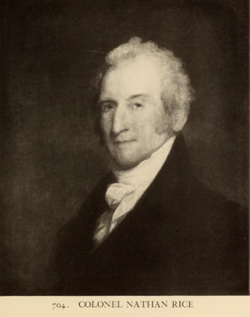
The “Mr. Rice” who started all this heartache with an offhand joke to little Charles was Nathan Rice (1754–1834, shown above later in life), son of a Sturbridge minister who graduated from Harvard College in 1773. By then his widowed mother had married a man in Hingham, bringing the family to the South Shore.

In August 1774 Rice joined the Adams household as one of John’s law clerks alongside John Thaxter. Because their arrival coincided with the shutdown of the Massachusetts courts and Adams’s service at the First Continental Congress, those young men didn’t get to see much lawyering.

Thaxter transitioned into being the Adams family’s live-in tutor, also going on that mission to Europe. Rice joined the army in May 1775, serving in staff positions for most of the war, including as aide de camp to Gen. Benjamin Lincoln.

Rice settled in Hingham, having married Sophia Blake. He returned to the army during the Adams administration’s Quasi-War, retiring as a lieutenant colonel. In the 1810s, after raising their children, Nathan and Sophia Rice moved up to Winooski, Vermont. The house they built in 1818, remodeled extensively, became known as the “Mansion House”; there was a local dispute over removing it to build apartments in 2019, and I don’t know how that turned out.

Sunday, September 27, 2020

Exploring Benjamin Lincoln’s Life in Hingham

This afternoon the Hingham Historical Society launches its new season of lectures with the theme “Benjamin Lincoln’s World: Stories from Colonial Hingham to the Early Republic.”

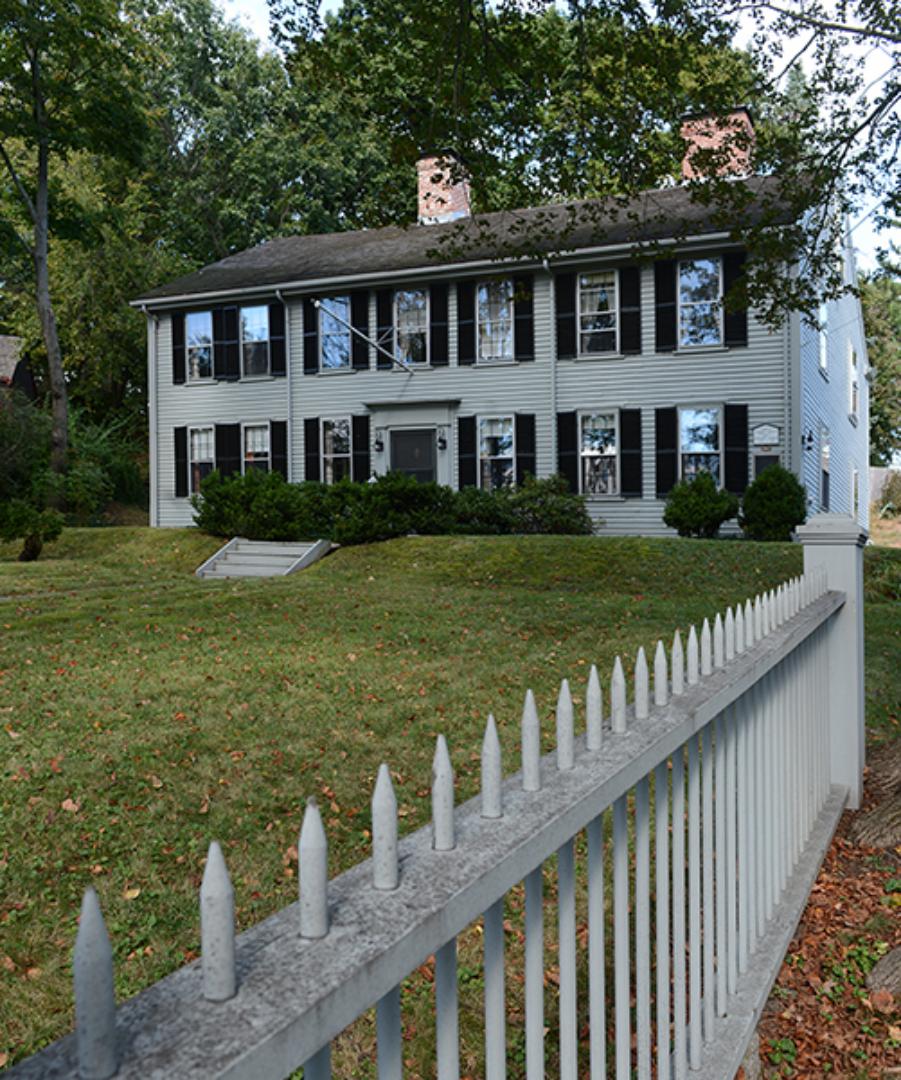
The society is in the process of acquiring Gen. Benjamin Lincoln’s house, a National Historic Landmark that has been owned by one family for eleven generations (shown here).

These online talks are designed to explore Lincoln’s life and work in the Revolution, and to raise interest and funds for turning the house into a house museum. There are seven lectures scheduled through May 2021 and a self-guided walking tour.

Here are the first two events:

Sunday, 27 September, 3:00 P.M.
“Benjamin Lincoln and the American Revolution: A Conversation with David Mattern”
Andy Hoey, Head of Social Studies for the Hingham Public Schools, will interview David Mattern, Gen. Lincoln’s biographer and the recently retired editor of the Papers of James Madison.

Sunday, 25 October, 3:00 P.M.
“The Evolution of Benjamin Lincoln’s Lifelong Home”
J. Ritchie Garrison, Ph.D., former Director of the Winterthur Program in American Material Culture at the University of Delaware, will lead an architectural examination of the Benjamin Lincoln House.

Further lectures will discuss Hingham and the slave trade, colonial schooling, beer-making, women’s lives in early New England, and eighteenth-century lighthouses.

The self-guided walking tour “Getting to Know Benjamin Lincoln’s Neighborhood” will debut on the web in October. It will describe downtown Hingham structures that would have been standing in the general’s lifetime and the families who lived there.

Access to the full series of seven online lectures costs $200, or $175 for Hingham Historical Society members. One can order gift subscriptions, memberships, or copies of David Mattern’s book from the same webpage. Unlike some other online talks, I don’t expect these to be available on the web for free soon, so don’t sleep on this subscription! (That’s a little narcolepsy joke in Gen. Lincoln’s honor.)

Wednesday, January 01, 2020

“Where BOSTONIA lifts her spires”

It’s a Boston 1775 tradition to share a “carrier verse” at the turn of the year. Traditionally those were poems written and printed by newspaper apprentices as a way to cadge tips from their customers.

Often those apprentices commented on political concerns, but usually in a general, patriotic way, looking ahead to a better year. They didn’t want to put anybody in an ungenerous mood, after all.

In the early republic the high Federalist “Connecticut Wits” seized on the “carrier verse” form as a vehicle for their political satire. Without the same economic pressures as the apprentices, they dug deeper into domestic public affairs, lambasted their political rivals, and went on and on. And on.

Dr. Lemuel Hopkins (1750-1801, shown here as painted by John Trumbull, courtesy of the Yale University Art Gallery) wrote such a poem for the Connecticut Courant’s 1 Jan 1795 issue. Here’s just a snatch of it, the part dealing with Massachusetts politics:
Yet where BOSTONIA lifts her spires.
Like Phenix from devouring fires,
See federal Virtue take her stand,
And ward Destruction from the land.
Hail Nurse of Heroes! Statesmen sage!
The guard and glory of the age!
At the end of June 1794, a fire broke out in the ropewalk district of Boston’s South End. It consumed those proto-industrial buildings and many nearby houses before people could put it out. Hopkins praised Boston for rising above such disasters through the strength of its Federalist politics.
Above the mists of mouldering time,
Thy Fame, O ADAMS! soars sublime,
Who first the British lion spurn’d,
And gave the terms when peace return’d;
Cull’d from the lapse of ages past,
And fram’d a Work with time to last;
Display’d in truth’s celestial light,
How Freedom, Law, and Power unite.
Even though President George Washington hadn’t yet announced that he would not seek reelection, New England Federalists were coalescing behind John Adams as his obvious successor. These lines laud Adams’s early support for independence and his role in negotiating the 1783 Treaty of Paris. They couldn’t praise his accomplishments as Vice President since, of course, there weren’t any.
May choicest Sowers with tears bedew’d,
O’er thy brave WARREN’s grave be strew’d;
And long heroic LINCOLN stand,
The laurel’d bulwark of the land.
Here Hopkins referred to Dr. Joseph Warren and Gen. Benjamin Lincoln. Warren was a beloved martyr who for obvious reasons left no thoughts about the politics of the 1790s and therefore could be seized on by either party.

Lincoln had led the repression of the Shays Rebellion in between serving briefly as U.S. Secretary of War under the Congress and as lieutenant governor under John Hancock. Lincoln wasn’t really involved in politics anymore by this time, but he was a Federalist.

That praise out of the way, Hopkins turned to what the Connecticut Wits did best—saying nasty things about what they disliked.

TOMORROW: New Year’s wishes for one’s enemies.

Friday, August 09, 2019

Laying Out Roxbury’s History in the Dillaway-Thomas House

On the corporate blog of Content•Design Collaborative LLC, which is in the business of “effective visitor experiences for public and private institutions,” there’s an interesting discussion of how the firm helped to redesign the Dillaway-Thomas House in Roxbury Heritage State Park for the Roxbury Historical Society and the city of Boston.

The park is a single acre between the First Church and the Timilty Middle School, and the house contains 2,200 square feet of exhibit space or, as the organization says, “a mere 600 square-feet per century” of town history.

The solution was to use each room for a different historical era:
Visitors enter the House from the accessible annex, the first thing you encounter is a cavernous ten-foot wide cooking hearth, so we deemed this space the Parsons Kitchen, and it covered the pre-revolutionary war era. This gallery was followed by the Revolutionary War gallery, or the Thomas Gallery, for General [John] Thomas who took residence there during the Siege of Boston. Next comes the Dillaway Room, named after Charles K. Dillaway, a scholar and early headmaster of Boston Latin. The next exhibit area is the Historic Hallway and the 20th Century Roxbury Room. Upstairs the House featured a gallery loosely dedicated to 21st Century Roxbury accompanied the multi-purpose changeable art gallery and community meeting space.
In the eighteenth century Roxbury was the large rural town right outside of Boston by land. It was enmeshed in Boston’s politics and social issues. In 1768, for example, town minister Amos Adams and his wife Elizabeth hosted a spinning meeting. There’s no evidence about slavery at that site, but in 1771 Roxbury’s population included 21 “servants for life.” The museum therefore includes displays about slavery in the town.

As for the Revolutionary War:
With all hell breaking loose in the spring of 1775, the leaders of the colonial rebels appointed veteran John Thomas as a leader of the militia tasked with keeping the British troops in Boston. Roxbury stood on one side of the only ground route called Boston Neck. Our exhibit features a letter from the collection of the Massachusetts Historical Society where General Benjamin Lincoln informs Amos Adams that “It would be quite agreeable for General Thomas to remove into your house…”. Other experiences are a recreation of General Thomas’s field desk where you can hear a dramatic reading of one of his many letters to his wife and an interactive map placing the House in context of the siege of 1775-76.
(Lincoln wasn’t yet a general when he wrote that letter to Thomas; he was clerk of the Massachusetts Provincial Congress. As for Thomas’s letters home, they’re terrific.)

One interesting requirement from the Roxbury Historical Society was that the maps inside the house “show the 1868 borders when Roxbury was annexed to Boston.” That area is larger than the Boston neighborhood now designated as Roxbury—it includes the Fenway, the Longwood Medical District, and Mission Hill. But it’s much smaller than the Roxbury of the eighteenth century, which also included Jamaica Plain, West Roxbury, and the modern Arnold Arboretum and Franklin Park—part of the big town’s farmland.

Tuesday, September 26, 2017

Tracking Miss Troutbeck

Yesterday I quoted a description of Capt. Thomas Preston, the British army officer tried for the Boston Massacre, credited to “Miss Troutbeck who resided in Hingham, daughter of the clergyman in Boston.”

I found two women who fit that description, both daughters of the Rev. John Troutbeck, assistant rector at King’s Chapel in Boston from 1755 to 1776, and his wife Sarah. They had seven daughters baptized at the chapel between 1760 and 1774, four dying at young ages.

The extended Troutbeck family evacuated with the British military in March 1776, and the minister died three years later. His widow was unusually active in applying for support as a Loyalist, pursuing debts, and seeking to recover property left by her father in Massachusetts. She came back to the state for a visit in the 1785 and eventually settled permanently, bringing her oldest daughter Sarah, baptized in 1760. According to the Annals of King’s Chapel:
About 1803 or 1804 they found a home in Hingham, occupying the house of General [Benjamin] Lincoln, then collector of the port of Boston; and again, five years after, resided there in the Beal house, and later removed to Dr. [Thomas] Thaxter’s, where they lived till the mother’s death in 1813, at the age of seventy-seven.
Gen. Lincoln’s house appears above.

Meanwhile, in England the Troutbecks’ other daughter, Hannah (1768-1851) married William Bowes (1771-1850), the son of another Loyalist refugee, also named William Bowes (1734-1805). The Annals says:
Their marriage was a clandestine one, on account of the opposition of his father, formerly a Boston merchant, cousin and joint-heir with John Hancock. Having separated from her husband, she came to this country, where she was known only as Miss Troutbeck. . . .

After her mother’s death Miss Troutbeck went to England, where she had previously rejoined her husband after his father’s death, residing for a time with his mother, Mrs. Bowes, at Otterton.
I can’t find any exact statement of when William and Hannah Bowes married. Their first recorded child was Emily, born in London in 1806, who became the mother of the author Edmund Gosse. Two more children were born in 1808 and 1813.

All the Troutbeck women appear to have moved around a lot, propelled by family crises and genteel poverty. In 1829 Sarah Troutbeck wrote to a friend that “About four months back, by the death of a clergyman who had a large fortune and took an interest in us, I came into possession of a comfortable house, ready furnished, for life; and at my death it is to go to my Sister, and then revert to the family from which we receive it.” She died in 1840.

Thus, the most likely “Miss Troutbeck” to have spoken to Caleb Bates in Hingham was Sarah, who lived in that town for about a decade until 1813 and perhaps later. However, it’s also possible that Bates’s informant was Hannah Bowes, using the name “Miss Troutbeck” while living in America apart from her husband.

TOMORROW: Assessing Miss Troutbeck’s story.

Wednesday, July 26, 2017

“With great zeal I went to Genl Washington”

Elias Boudinot (1740-1821) was a Continental Congress delegate from New Jersey, eventually president of that body, and later a U.S. Congressman and director of the U.S. Mint. He was brother-in-law of Richard Stockton twice over (i.e., each married the other’s sister).

For a considerable period of the war Boudinot was the American commissary of prisoners, meaning he was responsible for feeding and supplying captured British and Hessian soldiers. As such, he often worked closely with the Congress, local authorities, and Gen. George Washington.

Boudinot left behind a manuscript in which he explained:
A great many interesting anecdotes, that happened during the American Revolutionary War, are likely to be lost to Posterity, by the negligence of the parties concerned, in not recording them, so that in future time they may be resorted to, as throwing great light on the eventful Crisis, of this important Æra—I shall therefore without any attention to order, but merely as they arise in my memory, set down those I have had any acquaintance with, attending principally to the TRUTH of the facts.
That manuscript was published in 1890 as Boudinot’s Journal or Historical Recollections of American Events during the Revolutionary War. It’s not really a journal since he didn’t record events as they happened; indeed, most of the stories aren’t tied to specific dates. But they’re valuable nonetheless.

Here’s one example:
In [April] 1777 Genl [Benjamin] Lincoln, was surprised at the Dawn of Day in his Quarters at Bound Brook. by Lord Cornwallis. who had marched from Brunswick passed his out Centinels captured or destroyed his main guard, and was at the Genls Quarters before he knew anything of it. He had but just time to escape out of a back door. Several men were killed and one or two pieces of ordnance taken.

It was sometime a mystery how this had been effected with so much secrecy, till I was well informed by a Gentn of note who was with the Enemy at Brunswick, that a certain Farmer whose name he mentioned and who lived in the midst of our Camp had communicated to Lord Cornwallis our Countersign, by which he had accomplished his intentions,

My spirit was very much aroused ags this Traitor and with great zeal I went to Genl Washington with the information, stating the substance of it. but keeping back the name of my informant; as he had assured me his life depended on my prudence & faithfulness to him; I urged the Genl, (to give) orders to sieze the Culprit without delay & make an Example of him. The Genl did not immediately answer me. on which I repeated my request.

He then said. did not you tell me that the life of your informant depended on your secrecy,—would you take up a Citizen & confine him without letting him know his crime or his accuser.—No—let him alone for the present: watch him carefully. and if you can catch him in any other crime. so as to confront him by witnesses. we will then punish him severely.——

My mortification was very great. to think. that I who had entered the Army to watch the Military & preserve the civil rights of my fellow citizens. should be so reproved by a Military man, who was so interested in having acted otherwise I recd it as a severe lecture on my own imprudence
When I read that story, I thought that the interaction with Washington could have come right out of the television show Turn: Washington’s Spies, given how it presents the commander’s character.

I’ve been reviewing the final season of Turn for Den of Geek; you can find my assessments here. Gen. Washington, played by Ian Kahn, remains one of the decidedly best parts of the show.

Monday, July 20, 2015

The Fight from the Other Side

For the past few days I’ve been quoting an 1835 account written from the perspective of a young British officer captured in Boston harbor in June 1776.

That article names “Colonel Crofts” as the American official who took charge of him and his fellow prisoners. I wondered if that was Thomas Crafts, colonel in charge of Massachusetts’s artillery force (show here).

As it happens, we also have an “Extract of a Letter from an Officer in the Colony Train, at Nantasket, under the Command of Col. Crafts, to his Friend in Boston, June 17, 1776,” describing that capture from the opposite direction. It was published in the 20 June 1776 Continental Journal.

Before quoting that, I should mention that Crafts’s regiment was stocked with Boston businessmen active in prewar politics, so the opening of the letter drops a lot of familiar names:
My dear Friend,

I promis’d to give you a short account of our transactions—We embarked with a part of Col. [Thomas] Marshall’s and [Josiah] Whitney’s Regiment late on Thursday evening for the lower harbour, under the Command of Major [Paul] Revere. The whole expedition directed by General [Benjamin] LINCOLN, Capt. [James] Swan for Petticks Island, Major Revere and Capt. [Thomas] Melvill for Nantasket: Capt. [Joseph] Balch for Hoff’s Neck and Capt. [Jonathan W.] Edes for Moonhead, and Capt. [Edward] Burbeck of the Continental Train with 500 men for Long-Island Head.—
The troops’ first mission was to fire cannon at the British warships still hanging around the harbor. They drove off that force, leaving no one to warn incoming British ships that the port had changed hands.
On Sunday afternoon we saw a ship and a Brigt. standing in for the Light-House channel, chased and fir’d upon by 4 privateers, who frequently exchang’d broad sides. We suppos’d them to be part of the Scotch fleet, got every man to his quarters, and carried one 18-pounder to point alderson, on purpose to hinder their retreat, should they get into the road, opposite where we had 3 18 pounders. About 5 o’clock the privateers left them and stood for the southward, when the ship and Brig crouded all their sail for the channel.

Our orders were not to fire till the last got a breast of us. In tacking she got aground just under our cannon; when we hail’d her to strike to this Colony: They refus’d, and we fired one 18-pounder loaded with round and cannister shot, when she struck and cried out for quarters. We order’d the boat and captain on shore, and then fired at the ship; but being quite dark, we suppos’d she had struck. By this time the privateers came up. A Capt. of the Highlanders, in the Brigt’s boat came on shore. Sometime after the ship got under way, and stood for the narrows; when a fine privateer Brigt. commanded by Capt. [Seth] Harding of New Haven, (who we hear came in this bay on purpose to meet our old friend Darson) and 5 Schooners gave chase.

The Brig came a long side, when a hot engagement ensu’d which lasted three quarters of an hour, when the ship struck. The Brigt floating took the advantage of the confusion and attempted to follow, both supposing the enemy in possession of Boston. We found them from Scotland, with highlanders to join General Howe. The ship had on board 114, the Brigt. 74. The former lost in the engagement Major Menzies, 8 privates, and 13 wounded. The latter 1 killed by the privateers in the day:—The privateer Brigt, had 3 wounded, one suppos’d mortally.
The mention of Maj. Robert Menzies’s death confirms that this was the same ship and the same fight.

TOMORROW: Capt. Harding’s luck.

Saturday, April 11, 2015

“Elizabeth went from hence with the said Leonard Brown”

Elizabeth Otis was born in Boston on 28 Mar 1757, the oldest child of James Otis, Jr., and his wife, the former Ruth Cunningham. Betsy was a small child when her father broke with Massachusetts’s “court party” and the royal patronage system in favor of championing Boston’s Whig merchants through electoral politics. She was twelve years old when her father had his first serious bout of insanity.

As I discussed way back here, Ruth Otis remained politically Loyalist. And as her husband became non compos mentis, she naturally took an even bigger role in raising the children. Ruth and Betsy Otis remained in Boston during the siege while James was outside under doctor’s care.

On 25 Feb 1776, Betsy Otis married Lt. Leonard Brown of the King’s Own (4th) Regiment. According to an inscription in the church in Pinchbeck, Lincolnshire, Brown was born in 1749. He might have been in the Battle of Lexington and Concord, and he was definitely wounded at Bunker Hill.

Boston town records of this marriage identify Brown as a gentleman (“Esq.”), but not an officer. The officiating minister was the Rev. Moses Badger, not one of Boston’s pastors but perhaps acting as a Royal Navy chaplain. Badger was a Harvard graduate from Haverhill who had converted from New England Congregationalism to the Anglican Church years earlier.

According to family traditions, Ruth Otis supported Betsy’s marriage, but James Otis was upset when he learned about it. Within a month, the couple evacuated with the royal army to Halifax. During the war, Brown was promoted to captain and reportedly “placed in command of one of the fortresses on the coast of England.”

In 1782, Betsy’s cousin Harrison Gray Otis later recalled, he brought James Otis down from his asylum in Andover to Boston, “at a period when my father [Samuel Allyne Otis] and his friends thought he was recovered.” During this journey, James Otis shared “delightfully instructive” observations about the law and as an exercise for his nephew started to compose his will.

That will, completed the next year, had little to offer his oldest child:

whereas the said Elizabeth went from hence with the said Leonard Brown at the evacuation of Boston to Halifax & thence for England & with him settled at Steaford [actually Sleaford] in Lincolnshire, and as I hear he has left his wife & joined the British Arm[y] again, and the last I hear is that she was in a consumption I give the said Elizabeth five shillings if alive.
James Otis died later in 1783, leaving the rest of his property to his widow, who had remained in Massachusetts, and his younger daughter, Mary, who married a son of Gen. Benjamin Lincoln. But what about Betsy?

TOMORROW: Can this marriage be saved?

Tuesday, November 26, 2013

American Revolution Conference in Williamsburg, 21-23 March

Next March, America’s History, L.L.C., is hosting its third annual American Revolution conference in Williamsburg, Virginia. From the evening of Friday, 21 March, through the morning of Sunday, 23 March, the Colonial Williamsburg Woodlands Hotel will be the site of presentations like these:
  • Edward G. Lengel, editor of the George Washington Papers: “Philadelphia is the Object in View”: George Washington at the Battle of Brandywine, 1777
  • James Kirby Martin: Forgotten Allies: The Oneida Indians’ Contribution to the American Revolution
  • Andrew O’Shaughnessy: First in War or First in Peace: Sir William Howe as Commander-in-Chief
  • Glenn Williams: Revenge and Reprisals: Irregular Warfare and the Sullivan-Clinton Campaign against the Iroquois
  • Todd Andrlik: Reporting the Revolutionary War: Colonial Newspapers as a Historical Record
  • Don Hagist: Sixty Men at Yorktown: A British Light Infantry Company
  • David Mattern: Major General Benjamin Lincoln and the American Revolution
  • James L. Nelson: The Best General on Either Side: Benedict Arnold’s Naval Operations on Lake Champlain and the Chesapeake Bay
Two panel discussions will address the questions “Could the British Have Won the American Revolution? Where and How?” and “What Revolutionary War Personality Would You Like to Have Dinner with and Why?”

Speaking of which, dinner is not included in the $225 conference registration fee, but lunch on Saturday is, and a breakfast buffet is included in the conference’s hotel room rate of $86 per night. For more information, including how to register, visit the conference webpage.

On the landscape between history academics and history buffs that I mapped out earlier in the year, this event is definitely designed for buffs. Almost all the presentations are about military topics, with an emphasis on leaders, as opposed to, say, sociological change. But the quality of the research and analysis on those topics promises to be top-notch.

Saturday, September 07, 2013

“This is, unquestionably, very funny”

The Rev. Dr. Mather Byles (shown here) was one of those historic figures who becomes a magnet for witty quotations. In America our primary examples are Benjamin Franklin and Mark Twain; any untethered funny remark can be attached to one man or the other, depending on whether it’s also optimistic (Franklin) or pessimistic (Twain).

Back in eighteenth-century Boston, Byles was known for his puns and other jokes. People liked to retell those jokes. And I suspect that some people attributed wordplay to Dr. Byles that he never actually spoke: “As Dr. Byles would have said…” became “As Dr. Byles said…” So which of the surviving stories are most likely to be authentic?

Here’s an anecdote that appeared in the Boston Transcript in 1850 and was then reprinted in a supplement to the Hartford Courant along with a bunch of other examples of Dr. Byles’s puns:
Tho first story that I ever heard, of Mather Byles was related, at my father’s table, by the Rev. Dr. [Jeremy] Belknap, in 1797, the year before he died. It was upon a Saturday; and Dr. John Clarke and some other gentlemen, among whom I well remember Major General [Benjamin] Lincoln, ate their salt fish there, that day.

I was a boy; and I remember their mirth, when, after Dr. Belknap had told the story, I said to our minister, Dr. Clarke, near whom I was eating my apple, that I wished he was half as funny a minister, as Dr. Byles.

Upon a Fast Day, Dr. Byles had negotiated an exchange, with a country clergyman [i.e., they agreed to preach in each other’s pulpits]. Upon the appointed morning, each of them—for vehicles were not common then—proceeded, on horseback, to his respective place of appointment. Dr. Byles, no sooner observed his brother clergyman approaching, at a distance, than he applied the whip; put his horse into a gallop; and, with his canonicals flying all abroad, passed his friend at full run.

“What is the matter?” he exclaimed, raising his hand in astonishment—“Why so fast, brother Byles?”

to which the Dr. without slackening his speed, replied, over his shoulder—“It is Fast day!”

This is, unquestionably, very funny—but it is surely undesirable for a consecrated servant of the Lord, thus lavishly to sacrifice, upon the altars of Momus.
Six years later that newspaper story was republished in the second volume of Dealings with the Dead, by Lucius Manlius Sargent (1786-1867). Thus, for this Byles pun we have a clear provenance: from Belknap, who knew many fellow ministers, to eleven-year-old Lucius in 1797, and to the world fifty-three years later.

Wednesday, June 17, 2009

Dr. Joseph Warren: “very desirous to go on ye Ground”

Dr. Joseph Warren was killed in the Battle of Bunker Hill on 17 June 1775, one of the highest-ranking Patriots (combining political and military rank) to die in the war. The Massachusetts Provincial Congress had elected Warren as its president on 31 May, and on 14 June the body also appointed him the province’s “second major general.” Naturally, Warren was quickly made a martyr figure, especially for Bostonians and for Freemasons; at the time of his death he was “Grand Master of Masons for the Continent of America”—at least according to a Scottish charter. The doctor’s prominence caused people to record and romanticize what he’d done leading up to the battle, and I’ll explore three versions of those events this week. One of the earlier and more detailed accounts appears in the notebooks of the Rev. Dr. Jeremy Belknap, founder of the Massachusetts Historical Society:

August 24, 1787. I was informed by Mr. Sheriff [Joseph] Henderson that he was one of ye Clerks of ye Board of War in the year 1775 of wh[ich] Dr Jos Warren then newly made Majr Genl was a Member. That on ye day of ye action at Bunker hill, he was very desirous to go on ye Ground and take part in ye affair, that ye other Gentn did all they could to dissuade him, alledging that his Life was of too much consequence to be exposed on that occasion. Col. (afterward Genl) [Benjamin] Lincoln offered to go & execute any orders wh[ich] he would give, as did one or 2 other Gentn. At length to deceive them he pretended that he was going to Roxbury—but went directly to Charlestown & entered the Lines. Col [William] Prescott who had the command, begged him to retire, & upon his refusal offered to resign ye Command to him. He said he would not interfere with him, & yt [i.e., that] he came only as a Volunteer. As he was binding up a wound w[hi]ch a Man had rec[eive]d in his arm the Enemy entered by storm. He Retreated a few rods with ye rest before they killed him.
Belknap wrote this down twelve years after the battle, so there had been enough time for memories to fade and little and legends to take their place. But eyewitnesses to these events were still alive, and Belknap was a good historian, gathering information for himself and for posterity rather trying to make an inspiring story. Warren’s name doesn’t appear in the records of the Provincial Congress or its Committee of Safety for 17 June 1775, so we know he probably wasn’t in those meetings. So far as I know, there are no corresponding records for the “board of war,” or council of high-ranking officers under Gen. Artemas Ward in Cambridge. But Henderson’s account seems reliable. Dr. Warren had also gone out on the lines during the Battle of Lexington and Concord. Gen. William Heath recalled:
on the plain below the [Menotomy] meeting-house...Dr. Joseph Warren,—afterwards Major-General Warren,—who kept constantly near me, and then but a few feet distant, a musket-ball from the enemy came so near his head as to strike the pin out of the hair of his ear-lock.
Warren’s bravery is admirable, but his desire for personal military glory led him to risk his life when he had important political responsibilities. As a result, on 18 June the province was missing one of its most capable leaders at a crucial time. TOMORROW: Replacing Dr. Warren.

Friday, November 24, 2006

Benjamin Lincoln: general, narcoleptic

Benjamin Lincoln of Hingham, Massachusetts, was another of the Continental Army's top generals from New England. He was neither as successful nor as celebrated in later years as Nathanael Greene and Henry Knox, but he retained the respect of Congress throughout the war, even after such reverses as being captured at Charleston, South Carolina, in 1779. In fact, Gen. George Washington made Lincoln second-in-command for the Yorktown campaign, and he accepted the sword of surrender when neither force's commander chose to appear at the ceremony.

Lincoln's medical handicap was narcolepsy. As David B. Mattern explains in Benjamin Lincoln and the American Revolution:

A contemporary wrote that, "in the midst of conversation, at table, and when driving himself in a chaise, he would fall into a sound sleep." Lincoln would fall asleep while dictating dispatches, wake, and carry on as if nothing had happened.

While disconcerting to others, this condition did not seem to slow him down. It provided the substance for more than one jest and many occasions in which Lincoln was warmly defended by those who knew him well. Once a gentleman disparaged Lincoln in the presence of Major William Jackson by saying that the general was always falling asleep. Jackson, who had served as Lincoln’s aide during the war, retorted, "Sir, General Lincoln was never asleep when it was necessary for him to be awake."

Lincoln himself "considered this as an infirmity, and his friends never ventured to speak to him of it."
And that ends this week's short series on high-ranking Continental Army officers and the infirmities they had to overcome.