J. L. BELL is a Massachusetts writer who specializes in (among other things) the start of the American Revolution in and around Boston. He is particularly interested in the experiences of children in 1765-75. He has published scholarly papers and popular articles for both children and adults. He was consultant for an episode of History Detectives, and contributed to a display at Minute Man National Historic Park.

Subscribe thru Follow.it


•••••••••••••••••


Showing posts with label Moses Parker. Show all posts

Saturday, June 22, 2019

Dr. Ezekiel Brown in the Concord Jail

Yesterday we found Ezekiel Brown back in his native town of Concord. He had left as a boy, his poor family seeking better farmland, and returned as a young man with enough skills and drive to set up a shop—only to be locked in jail for debt on the eve of the Revolution.

Brown rejoined his family in Concord in 1781, having read a bunch of medical books and served in the Continental Army for four years as a military surgeon. He entered private practice. Soon Dr. Brown’s neighbors again elected him to town offices and invited him to join the Social Club.

But then the war ended. From London, Brown’s old creditor Frederick William Geyer contacted his father-in-law—Duncan Ingraham of Concord, another member of the Social Club. Together the two men resumed Geyer’s lawsuit for debt.

In February 1786, Brown signed a certificate stating he had witnessed the death of Moses Parker in the Boston jail back in 1775, a document now held by the Boston Public Library. Two months later, Ingraham and Geyer won a judgment against him of more than £500.

Naturally, that made the Social Club meetings more rancorous. The oldest members of the group, later called the Social Circle, remembered Dr. Brown as the main reason that it broke up in the 1780s. Lemuel Shattuck wrote that he was a “notorious disturber” who wouldn’t let anyone else speak. John S. Keyes described him as “that hot-headed, long-winded, hard-used, rough-tongued, ill-bred, ‘jack at all trades,’” who “would out-talk his neighbors, especially choleric old Duncan Ingraham.”

On the other hand, Grindall Reynolds, who wrote a profile of Brown in 1871 later published in The Centennial of the Social Circle in Concord, took the doctor’s side of the quarrel. Reynolds made much of the fact that Brown was an American military veteran while Geyer was a Loyalist and Ingraham had Loyalist leanings before the war.

According to Shattuck, Dr. Brown offered to pay his debt in “government securities”—presumably at full face value. But 1786 was at the height of the economic crisis that provoked the Shays Rebellion. The market value of those securities was low. Ingraham refused the offer. There was no way Brown could raise enough cash. At depressed prices, even his property in the center of Concord couldn’t cover the debt.

Ingraham and Geyer had Brown committed to the Concord jail on 13 May 1787. The doctor escaped at some point but was locked back up on 8 May 1788. After a move to the Cambridge jail, the creditors finally agreed to let Brown go free in June 1789.

By then Dr. Brown and his wife Mary had seven children, the oldest fourteen and the youngest an infant. Their best option was to leave Concord for Maine, where Brown or his father had received a land grant before the war. The family settled on about 500 uncultivated acres in what was then Clinton and is now Benton. For the third time Dr. Brown set to work establishing himself.

Ultimately, Dr. Ezekiel Brown was able to regain his social and financial footing. He made his house a tavern. His sons held town offices and cleared their own farms. In 1818 the Revolutionary veteran applied for a federal pension. He stated that he was in reduced circumstances and had “lost the use of my left arm and hand by reason of an ague” while still supporting his wife, two widowed daughters (one “insane”), and a grandson.

Under the 1820 pension law, however, the federal government said Brown owned too much property to need support. He and the selectmen of his town petitioned Congress to approve a pension, but it doesn’t look like that happened before his death in 1824 at the age of eighty.

Tuesday, June 13, 2017

Remembering Moses Parker

As described yesterday, Lt. Col. Moses Parker of Chelmsford died as a prisoner of war on 4 July 1775 from a leg wound he suffered in the Battle of Bunker Hill.

On 21 July the New-England Chronicle published an unusually long death notice, showing how much esteem people had for Parker. It said:

…through the several Commissions to which his Merit entitled him, he had always the Pleasure to find that he possessed the Esteem and Respect of his Soldiers, and the Applause of his Countrymen. In him Fortitude, Prudence, Humanity and Compassion, all conspired to heighten the Lustre of his military Virtues—

He also, at this important Day, when the Parent is stretching the Iron Hand of Power over her Children, and threatening them and their Posterity with Slavery; being possessed of the most sacred Veneration for the inestimable civil and religious Privileges of his native Country, again “unappalled by Danger,” with equal Firmness and Intrepidity, steps forth to meet her restless Enemies, and thus offers himself a Victim to the Shrine of Freedom.

God grant each Individual that now is, or may be, engaged in the American Army, an equal Magnitude of Soul; so shall their Names, unsullied, be transmitted in the latest Catalogue of Fame; and if any Vestiges of Liberty shall remain, their Praises shall be rehearsed through the Earth “till the Sickle of Time shall crop the Creation.”
But that’s not all. The Gilder Lehrman Institute owns a handwritten poem (or perhaps words to a hymn) by Samuel Richardson of Chelmsford lamenting Parker’s loss:
Col. Moses Parker of Chelmsford, In Newengland Who Died in Bostone on June 1775 of the Wound he Receivd. in the Bloody battle on Bunkers-Hill in Charlestown while he was Gloriously Fighting in the cause of Liberty and his Country,

Come all who have skill and Lament
and let your hearts and eys have vent
While you to memory do call
The Valiant Colonel Parkers fall

He bravely did with courage go
To Charlstown fight to meet his foe
And in his place was Valient found
And with great boldness kept his ground

But fighting for his Countrys goods
What Dangers roled like a flood
A Wound Rea[d]er in his thigh
Of which in Boston he Did die

While he was in Captivity
Before he of his Wound did die
We he[ar] was Com-mended high
By his Relations enmy

He was a Valant offiser
In the last Canadian war
And in this present war Did go
To face his Countrys bloody foe

Brave Parker their must bled and Die
To Save his friends from Slavery
Its with great grief we view they fall
When thee to memory we call

His Townsmen Do Lamet his fate
His nearer friends and Living Mate
With Sorow do condole his loss
And need Support to bear their cross

God grant this Loss may be their gain
May they not murmer nor complain
But with Submission kiss rod
And know that it is the hand of God

As they find creature screams Dry
O may their minds arise more high
To God in whome is perfat peace
And Solid joy that cannot cease

God is th joy of those mourn
That do to him through Christ return
And rest by faith upon his grace
Shall find relief in all Distress

His officers and Soldiers all
Who mourn their Valiant Leaders fall
May God inquire with courage Still
And giv Submission to his will

May Gods protection them Surround
And all their bloody foes confound
May they possess the gates of those
That Do our city now inclose

God Sanctify this Loss at all
Who Saw this noble Hero fall
And while his courage they relate
May they his virtue emitate

May oficers that yet Servive
Who by their God are kept alive
By courage and good conduct Shew
Their hearts to Liberty are true

May they be kept from Sinful way
Least they Should fall with foul Disgrace
And Sink beneath the tyrants rod
And feel the Vengeance of God

May they their Soldiers govern well
And in their places all excel
That Honour on their heads m[a]y ly
Both while, they Liv and when they Die

But British troops Digrace must Share
How can their Valour honour bear
Since they their flesh and blood Do fight
To rob them of their proper right

The greater Victories they gain
The more the Doth their honour Stain
Since God oppressors will pull Down
That the oppressor may wear the crown

Tho for a time they may rise high
And Kings and Nations terrify
Yet time will bring their Shamefull fall
Their crimes Shall be exposd to all

They may think they Shall have peace
And by this war their welth increase
Yet wealth thats got unlawfully
Like chaff Shall from the owner fly

Welth that men Do obtain by blood
Tho it increaseth like a flood
It will against the owner cry
And end in endless misery

The Stone Shall cry out of the wall
And timber from their Buildings call
For wrath from God Which Shall Distress
All Such as do the poore oppress
In 1786, there must have been some legal need to document Parker’s death. The Boston Public Library holds two documents from that effort:
Finally, John Trumbull included Parker in his painting of “The Death of Warren.” Parker is the figure seated in the dark area on the far left, clutching his knee.

Monday, June 12, 2017

Moses Parker and His Comrades in the Redoubt

As I said yesterday, Col. Ebenezer Bridge’s regiment was one of the New England units ordered onto the Charlestown peninsula on the night of 16 June 1775. Maj. John Brooks and three companies stayed behind at first for other duties, but Bridge, Lt. Col. Moses Parker, and the rest of the regiment crossed the isthmus to Bunker’s Hill.

That meant those men helped to dig the redoubt on Breed’s Hill during the morning of 17 June. The soldier usually said to be first killed in the battle was a member of the regiment: Asa Pollard of Billerica. Men from Bridge’s regiment were presumably those who wanted to give their comrade a religious burial while Col. William Prescott insisted they keep digging.

In the same regiment, Capt. Ebenezer Bancroft’s company used a cannon to widen embrasures in the redoubt, as discussed here. Capt. John Ford and his men fired another of the cannon left behind by members of the Massachusetts artillery regiment.

During the battle Col. Bridge suffered wounds from a sword, indicating close combat at the end of the battle. Nonetheless, some junior officers accused him of “misbehaviour and neglect of duty,” saying he had cowered behind the walls of the redoubt. On 20 August, Gen. George Washington ordered “A Court of enquiry to sit this day, at three in the afternoon, to examine into the Reasons for a complaint exhibited against Col. Ebenezer Bridge.” On that board was Col. Prescott, who knew more than anyone about the conditions in the redoubt.

That board of officers recommended a general court-martial to adjudicate Bridge’s case. On 11 September, Washington’s general orders announced “The Court are of opinion that Indisposition of body, render’d the prisoner incapable of action, and do therefore acquit him.” Ebenezer Bridge remained with the army until December, then held military posts in Massachusetts for many years.

In that battle Bridge’s regiment suffered 16 or 17 men dead and 25 wounded. Lt. Col. Parker was shot in the thigh (or knee, according to one source) and left wounded in the redoubt. As the British troops swept over the fortification and up to Bunker’s Hill, they made Parker and the other wounded provincials into prisoners of war.

Reporting rumors from inside Boston, Abigail Adams wrote on 5 July:
Our prisoners were brought over to the long wharff and there laid all night without any care of their wounds or any resting place but the pavements till the next day, when they exchanged it for the jail, since which we hear they are civily treated. Their living cannot be good, as they can have no fresh provisions.
Later American accounts declared that the conditions inside the Boston jail were terrible, though no jail at that time was healthy. This period was when Boston suffered the worst food shortages since the British government’s supply ships hadn’t yet started to arrive.

Parker’s wound apparently became infected. Surgeons amputated his leg, probably a desperate measure. On 4 July 1775, he died.

TOMORROW: Remembering Moses Parker.

Sunday, June 11, 2017

Moses Parker, “the most prominent military character”

Moses Parker was born on 13 May 1731 in Chelmsford. Seven years earlier, his father Joseph had served as a “Lieutenant of a company of snowshoe-men” in what would be called Dummer’s War. Once back home, Joseph Parker served on committees and boards for both his meetinghouse and his town.

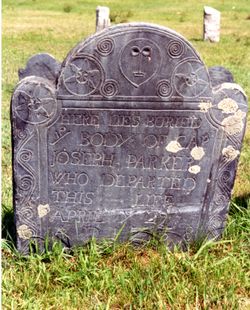
In 1738, when Moses was seven years old, Joseph Parker died. According to a Parker family genealogy he “perished, with his whole command, in a terrible battle with the Oneidas.” However, I can’t find any other mention of such an event. And his body was buried in Chelmsford, not a frontier battlefield. Joseph Parker’s gravestone appears here, courtesy of Find a Grave.

As an adult, Moses Parker followed his father into the provincial military service. A Chelmsford company set out for northern New York in March 1755 and stayed until January. Moses Parker went out as a sergeant and evidently came back as an ensign.

Wilkes Allen’s 1820 History of Chelmsford then says of Parker:
In 1758, he was honored with a lieutenant’s commission in a company commanded by Capt. Jona. Butterfield, and raised for the express purpose of a general invasion of Canada. He was promoted to a captain in the succeeding year, and in 1760, commanded a company at Fort Frederick, St. John’s. In this expedition he distinguished himself as a brave soldier, and as an intrepid and dauntless officer, he was endeared to those under his care by his assidiuous [sic] attention to their wants and constant endeavors to render their situation as pleasant as circumstances would permit.

Such was his reputation that when Governour [Francis] Bernard in 1761, was selecting from a multitude of applicants, thirty captains for that year’s service, Capt. Parker stood forth the most prominent military character on the list. Col. [Nathaniel] Thwing [1703-1768] and Col. [William] Arbuthnot [1726-1765] declared, that “they would not go without him, that he was the only Captain they had insisted upon.” So great was his popularity, that his friends assured him, that if he would accept of a captainship, “fifty men might be immediately raised to serve under him.” [Footnote citation: “M.S. Letter of Oliver Fletcher, Esq.”]
According to the Rev. Wilson Waters’s 1917 history of Chelmsford, Parker’s farm was 150 rods south of where “the Middlesex turnpike [now Turnpike Road]…crosses River Meadow brook.”

In May 1774, Moses Parker was named as one of Chelmsford’s committee of correspondence. In April 1775, he commanded a company that responded to the Lexington Alarm. And on 19 May 1775 he accepted a commission from the Massachusetts Provincial Congress, with Dr. Joseph Warren presiding and signing the paperwork, as a lieutenant colonel.

Parker was in the regiment of Col. Ebenezer Bridge, a thirty-one-year-old Harvard graduate and son of Chelmsford’s minister. The major was twenty-three-year-old Dr. John Brooks of Reading. At age forty-four, with four military campaigns under his belt, Lt. Col. Parker was the regiment’s veteran officer.

On the night of 16 June 1775, Col. Bridge’s regiment was ordered to march onto the Charlestown peninsula under Col. William Prescott and fortify Bunker’s Hill.

TOMORROW: In the redoubt.

Tuesday, June 24, 2014

The Russells’ Poetic Broadside on Bunker Hill

After the Battle of Bunker Hill, the Ezekiel Russell print shop in Salem issued “AN ELEGIAC POEM” on the battle. That broadside probably appeared toward the end of 1775 since a note on its bottom said Russell’s almanacs for the following year were “now in the press.”

The Russell broadside is a useful snapshot of how New Englanders wanted to remember the battle in 1775:
THE NEVER-TO-BE-FORGOTTEN
TERRIBLE AND BLOODY BATTLE
FOUGHT AT AN INTRENCHMENT ON
BUNKER-HILL,

Now justly called (by the Regulars) BLOODY-HILL, situated two miles from the head-quarters of the Regulars at BOSTON, and one mile northward from the centre of the town of CHARLESTOWN, in NEW-ENGLAND, in AMERICA, which was wantonly and inhumanly set on fire and consumed, previous to the engagement: This town contained one large meeting-house, about three hundred dwelling-houses, a great number of which were large and elegant, besides one hundred and fifty or two hundred other buildings, whereby about six or seven hundred of its distressed inhabitants are now forced from their dwellings, and obliged to seek new habitations for themselves, many of whom having left, on this calamitous occasion, their houses, cloaths, furniture, and in short every thing that was valuable, depend at this time entirely on the benevolent charity of their kind and simpathizing brethren and friends in the country; who have the unfeigned and hearty thanks of all such as have been relieved: May whole kindness, shewn to the distressed people who have been obliged to take refuge from that or any other town, be rewarded an hundred fold in this world, and in the world to come may they receive life everlasting, is the sincere and fervent wish of every true Friend to the RIGHTS and LIBERTIES of the AMERICAN COLONIES!—

We are sure an attempt to delineate the horrible and shocking situation the distressed souls were in, that still remained in that unfortunate town, at the time the cannonading began, would melt the stoutest heart, and give a shock to the human imagination, which would very far surpass the compass of this sheet; but the relation of this wicked and cruel affair may perhaps hereafter afford matter of speculation to the Historian, and serve to fill many pages in the history of AMERICA.—

What soul but must be filled with horror at viewing the aged and decrepit ones begging for the assistance of the youth, who were now flying through the red-hot cannon balls and smoke occasioned by the flames of their dwellings? What heart but must melt at beholding the Women with their helpless little ones around them, in the greatest confusion seeking a refuge from the devouring jaws [of] destruction, and from the violent fury of their cruel and barbarous enemies? It is said this diabolical transaction was executed by orders from that arch-traitor and worst of villains T[homas] G[age], whom posterity will forever curse, so long as his name shall be remembered.—

This bloody battle was fought about four o’clock in the afternoon of Saturday the seventeenth of JUNE, one thousand seven hundred and seventy five, between an advanced party of seven hundred Provincials, and fourteen regiments and a train of artillery, of the Ministerial forces, the former of whom after bearing about two hours, with the utmost fortitude and bravery, as severe a fire as perhaps ever was known, and many having fired away all their ammunition, they were over-powered by numbers, and obliged to leave the intrenchments, with three pieces of cannon, and retreat about sun-set to a small distance over Charlestown-neck.—

By the returns made in the Provincial and Ministerial Armies it appears, that there were of the Provincials one major-general, one colonel, one lieutenant-colonel, two captains, three lieutenants, and ninety privates, killed, among which number, to the inexpressible grief of our whole army, is that honorable, renowned, and magnanimous Hero, MAJOR-GENERAL JOSEPH WARREN, Esquire, who commanded on this occasion, as also the brave and intrepid Colonels [Thomas] GARDNER and [Moses] PARKER; there were one lieutenant and two hundred and fifty privates wounded: Total killed and wounded three hundred and twenty four.—

On the side of the Regulars there were one lieutenant-colonel, four majors, eleven captains, thirteen lieutenants, one ensign, one hundred and two serjeants, one hundred corporals, seven hundred and fifty-three rank and file, killed; one quarter-master, three majors, fifteen captains, nineteen lieutenants, six ensigns, and five hundred and four wounded; Total of killed and wounded, fourteen hundred and fifty.—

The above account, which contains in substance as accurate a detail as can be collected from the different advices received from Boston and elsewhere, of the transactions of both armies on that ever-memorable seventeenth of June, is here annexed to the proceeding Poem, and printed in this form at the request of a great number of Friends to the AMERICAN CAUSE, to whom (but more especially those belonging to the Continental Army, who may have this sheet very cheap) it is recommended to preserve, not only as a token of gratitude to their deceased Friends, we mean those immortal and heroic WORTHIES, who lately so nobly bled in defence of the RIGHTS, LIBERTIES, and PRIVILEGES of NORTH-AMERICA: This sheet may be thought necessary to keep in eternal remembrance the heroic BATTLE of CHARLESTOWN, where a few hundreds of Americans several times repulsed eight times their number of Ministerial Troops of Great-Britain.
This broadside greatly overstated the number of British involved in the battle and the number of those troops killed, apparently by double-counting the wounded. It also understated the number of Americans engaged, their casualties, and the number of cannon they left on the field (five).

Evidently in 1775 the people of Massachusetts recalled Dr. Warren as leading the American forces, but in later years authors repeated Col. William Prescott’s story that the doctor had refused a command position. The broadside’s description of the British attack as lasting “two hours” is an interesting contrast to Samuel Paine’s account of an assault taking about an hour.

After that far-from-brief introduction came an all-too-long set of verses. Just a taste:
ADIEU to wanton songs and foolish joys,
  To idle tales that fill the ear,
A mournful theme my heart employs,
  And hope the living will it hear.
A horrid fight there hap’d of late,
  ’Twas on June seventeen,
When a great number met their fate
  In fighting on the green.
Yes, hundreds of poor souls are dead,
  In battle they were slain,
Both sides met with a heavy stroke,
  T’ rehearse it gives me pain.
You can read the whole poem, and view the broadside, at the Massachusetts Historical Society’s website.

As I noted back here, Isaiah Thomas reported that the Russell shop printed a lot of ballads decorated with coffins like this one. Thomas first stated that Russell’s wife Sarah composed the elegiac verses, but later penciled in a note that “a young woman” working in the shop did so. (I still think it was Sarah.)

TOMORROW: But wait, there’s more!