J. L. BELL is a Massachusetts writer who specializes in (among other things) the start of the American Revolution in and around Boston. He is particularly interested in the experiences of children in 1765-75. He has published scholarly papers and popular articles for both children and adults. He was consultant for an episode of History Detectives, and contributed to a display at Minute Man National Historic Park.

Subscribe thru Follow.it


•••••••••••••••••


Showing posts with label Henry Prentiss. Show all posts

Sunday, May 18, 2025

“What Stock you had upon the Island”

Most islands in Boston harbor weren’t convenient for living on, but some were good for keeping livestock.

Cattle and sheep could graze on the natural grasses, taking in adequate water and salt, and they couldn’t run away.

That meant that as the Revolutionary War began, several islands had a lot of animals on them, as well as pasturage that could feed horses.

As the same time, the British military found itself penned up inside Boston, cut off from the town’s usual supply of food from the countryside.

It would take about six weeks before the government and merchants of London would hear of the outbreak of war, another six weeks before any supply ships they sent in response would arrive at Boston. The royal authorities therefore had to secure their own provisions for the next three months. Of course, that was a concern for Boston’s civilian authorities as well.

Leaders of the Massachusetts Provincial Congress saw the same situation. Recognizing that it was to their advantage to starve out the enemy, the committee of safety told farmers around the harbor not to sell provisions to anyone in the British military. Of course, that was easier said than done.

Boston selectman Oliver Wendell owned animals on Hog Island. “Greatly shocked by the Nervous Disorder,” he had left Boston for Newbury before the fighting broke out. His former apprentice Henry Prentiss therefore was trying to manage Wendell’s assets for him from Charlestown.

Of course, neither of those merchants actually handled the animals; that was the job of an employee named William Harris. On 9 May, Prentiss told Oliver Wendell, “Harris continues [on the] Island and sells to every one that comes.”

That wasn’t entirely voluntary. The next day, a man named Elijah Shaw told the committee of safety that British soldiers had “robbed him of 11 cows, 3 calves, a yearling heifer, 48 sheep, 61 lambs, 4 hogs, and poultry, hay 5 tons, and almost all his furniture.” The military was confiscating valuable provisions from people who wouldn’t sell.

On 12 May, Prentiss sent more details, starting with an inquiry from one of Wendell’s fellow selectmen, Thomas Marshall:
Coll. Marshall sent over here to know what Stock you had upon the Island, upon which I sent Mingo to the Island to bring an account to me.

He tells me Mr. Harris is very uneasy, the people from the Men of War frequently go to the Island to Buy fresh Provision, his own safety obliges him to sell to them, on the other Hand the Committee of Safety have thretned if he sells anything to the Army or Navy, that they will take all the Cattle from the Island, & our folks tell him they shall handle him very rufly.
Mingo was enslaved to Wendell, it appears, and trusted by him. At the start of the month another mercantile partner, Nathaniel Appleton, reported that Mingo had just gotten out of besieged Boston and “will give you more particulars of the Town.” Then the man returned from Newbury to Charlestown, doing this job for Prentiss.

Sunday, March 08, 2020

“They all four were buried in one grave”

On the afternoon of Thursday, 8 Mar 1770—250 years ago today—Boston had a huge public funeral for the first four people to die after the Boston Massacre.

This was only eleven days after the funeral for Christopher Seider, reportedly attended by 1,300 to 2,000 people. The March procession had, in the estimate of merchant John Rowe, at least five times as many mourners:
I attended the Funeral of the four Unhappy People that were killed on Monday last. Such a Concourse of People I never saw before — I believe Ten or Twelve thousand. One Corps with their Relations followed the other & then the Select Men & Inhabitants.
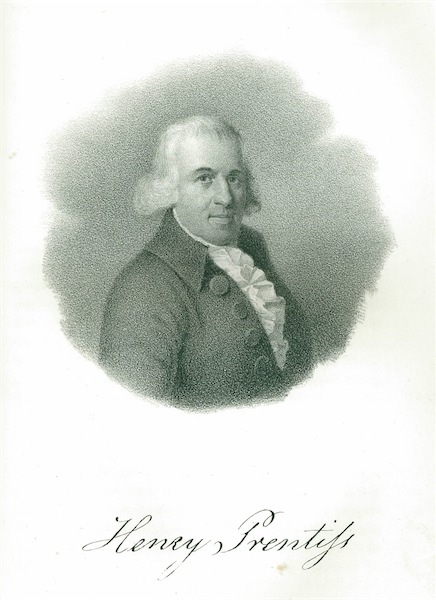
Christopher Davis alerted me through Facebook to a letter about this funeral from Henry Prentiss (1749-1821, shown here in middle age) to his father, a minister in Holliston. Prentiss had just finished an apprenticeship with the merchant Oliver Wendell and asked his father to check “what he [Wendell] was to give me when my time was up”—meaning he didn’t have a copy of his own indenture.

Prentiss sent his father an eyewitness account of the shooting on King Street and the government deliberations that followed. In a postscript, he added what information he’d gathered about the Massacre victims:
The Names of those persons that were killed and their occupation. Jackson a Molatto fellow. Sailor. Gray a Rope maker. Covil mate of a vessell. Munk a Boat Builder. Maverick a Lad about fifteen years of age. Wounded viz., Edwd Payne Mercht in this town shot thro his arm. Green a Taylor shot through his thigh. Patterson shot thro his arm. The Names of the Rest have slip’d my memory.
Even what Prentiss recalled had errors. The “Molatto fellow” was then being identified as “Michael Johnson,” though within days he’d been named as Crispus Attucks. “Covil” was James Caldwell.

It doesn’t appear that Prentiss was close to any of the victims. Indeed, he gave only one man’s full name—Edward Payne, a fellow merchant. 

The next morning, Prentiss appended his description of the funeral:
Yestaday Afternoon four of those unhappy persons that were shot last Monday Evening were inter’d, the procession was much the grandest of any ever seen in America. Gray’s Corps went first then his Relations, then Covil and his Relations, then Maverick and his Relations & then Jackson & after Jackson the Inhabitants walk’d four a brest. I imagine to the number of three or four Thousand, & then a vast number of Carriges, they all four were buried in one grave & young Snider dug up & put with them.

severall company’s of Soldiers are gone to the Castle and the Remainder embarking as fast as possible, to-morrow Night the town will be Clear of them.
Prentiss’s estimate of the crowd at “three or four Thousand” might have been more accurate than Rowe’s, but that was still the largest procession Boston had seen in decades. And speaking of estimates, it took a lot longer than two days to move all the soldiers out of Boston.

(My thanks to Christopher Davis, and to Holliston chronicler George F. Walker, for bringing this source to light.)