J. L. BELL is a Massachusetts writer who specializes in (among other things) the start of the American Revolution in and around Boston. He is particularly interested in the experiences of children in 1765-75. He has published scholarly papers and popular articles for both children and adults. He was consultant for an episode of History Detectives, and contributed to a display at Minute Man National Historic Park.

Subscribe thru Follow.it


•••••••••••••••••


Showing posts with label Timothy Ruggles. Show all posts

Saturday, July 26, 2025

“Ye most vilolent Fire Perhaps yt Ever was heard of in this Country”
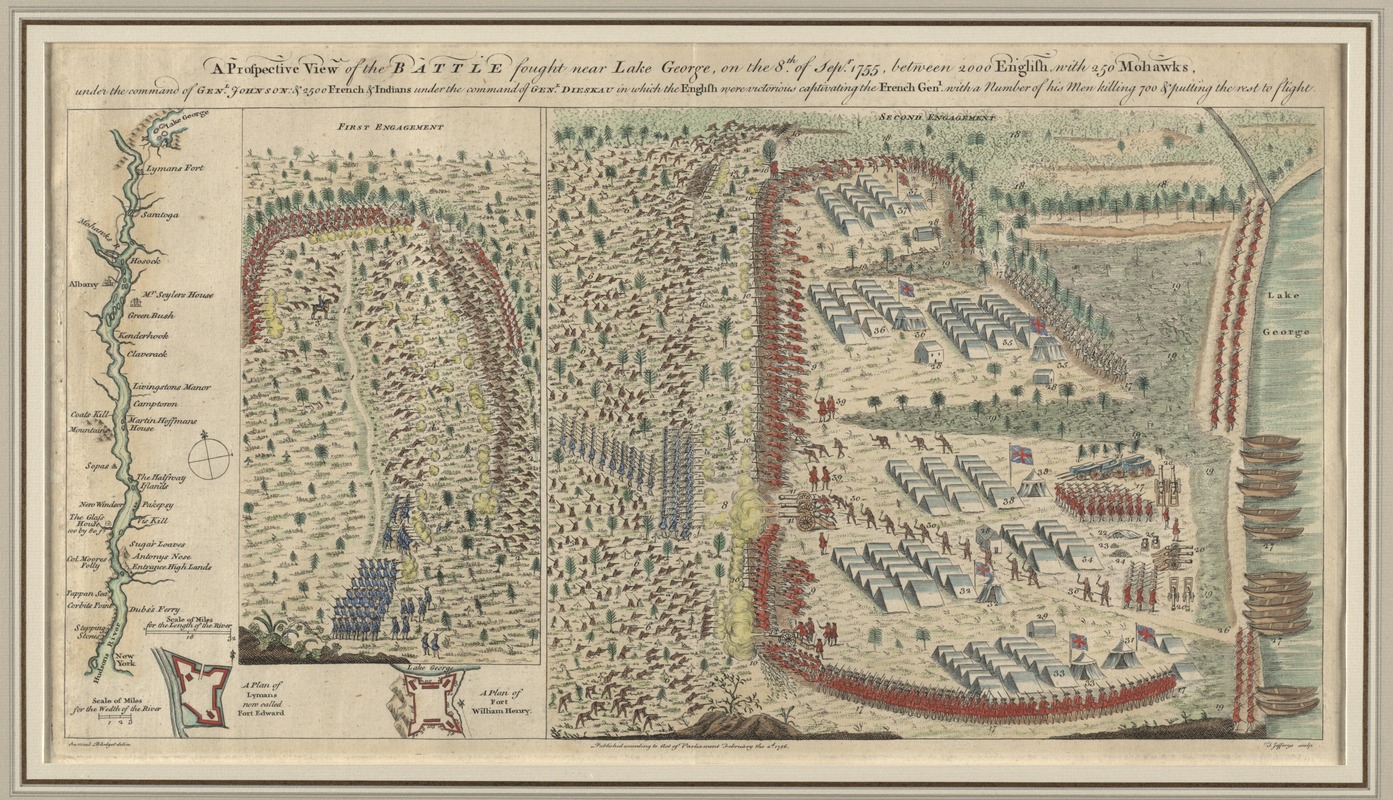
Yesterday we left Capt. Nathaniel Folsom of New Hampshire and Capt. William Maginnis of New York leading their provincial companies north from Fort Lyman (soon renamed Fort Edward) on the afternoon of 8 Sept 1755. They were headed to Gen. William Johnson’s camp at Lake George, a distance of at least fifteen miles.

That morning, French forces had successfully ambushed a British column that had tried to come the other way. The column’s commanders were killed, leaving Lt. Col. Nathan Whiting of Connecticut and Lt. Col. Seth Pomeroy of Massachusetts in charge.

Pomeroy’s diary, published by the Society of Colonial Wars in New York in 1926, offers a vivid description of what happened:
we this Morning Sent out about 1200 men near 200 of them our Indians went Down ye Rhode toward ye Carrying pla[ce] got about 3 miles they ware ambush’d & Fir’d upon By ye Franch and Indians a number of ours yt war Forward Return’d ye Fre & fought bravely but many of our men toward hind Part Fled

ye others being over match’t ware oblig’d to fight upon a Retreet & a very hansom retreet they made by Continuing there fire & then retreeting a little & then rise and give them a brisk Fire So Continued till they Came within about 3/4 of a mile of our Camp

there was ye Last Fire our men gave our Enenies which kill’d grate numbers of them Sean to Drop as Pigons yt put ye Ennemy to a Little Stop

they very Soon Drove on with udanted Corage Doun to our Camp

ye Regulars Came rank & File about 6 abrest So reach’d near 20 rods In Length Close order the Canadans & Indians Took ye Left wing Hilter Scilter down along Toward the Camp

they had ye advantage of the ground Passing over a hollow & rising a note within gun Shot then took Trees & Logs & Places to hide them Selves-we made ye best Shift we Could for battrys to get behind but had but a few minuts to do It in

Soon they all Came within Shot ye regulars rank & file they Came towards yt Part of ye Camp whare we had Drew 3 or 4 Field Peaces ye others towards the west Part of ye Camp there I Placed my Self Part of Coll. [Timothy] Ruggles & of our Rigement a long togater

the Fire begun between 11 & 12 of ye Clock and Continued till near 5 afternoon ye most vilolent Fire Perhaps yt Ever was heard of in this Country In any Battle then we beat ’em of ye ground

we Took ye French General wounded
That general was Jean-Ardman, Baron Dieskau. He’d been shot four times and declared that the last wound was mortal. But in fact he survived as a prisoner of war in Britain until 1763 and then at home another four years.

Meanwhile, Folsom and Maginnis were moving north. According to Folsom’s March 1756 letter to the Rev. Samuel Langdon, published by the Massachusetts Historical Society in 1904, Capt. Maginnis neglected to send out “advance guards” to prevent an ambush and moved too slow besides.

(Maginnis might have countered that for all of Folsom’s claim that he and his officers were hungry to enter the fight, they’d managed to beat the Yorkers back to Fort Lyman and then lagged them in returning to face the enemy.)

Toward the late afternoon:
Captain McGennes and company started nine Indians, who run up the wagon road from us, upon which Captain McGennes stopt. I, seeing them halt (being on a plain) ordered our men to move forward and pass by them. As soon as I came up with McGennes, I asked the reason of his stopping, which he told me was the starting of the Indians.

I then moved forward and we ran about 80 rods and discovered a Frenchman running from us on the left. Some of us chased him about a gunshot, fired at him, but, fearing ambushments, we turned into the wagon road again and traveled a few rods, when we discovered a number of French and Indians about two or three gunshots from us.

Then we made a loud huzza and followed them up a rising ground and then met a large body of French and Indians, on whom we discharged our guns briskly, till we had exchanged shots about four or five times.

When I was called upon to bring up the Yorkers, who I thought had been up with us before but finding them two or three gunshots back, I ordered them up to our assistance. And though but a small number of them came up, we still continued the engagement and soon caught a French lieutenant and an Indian, who informed us that we had engaged upward of 800.
Folsom said his force consisted of “but 143 men”—leaving out the 90 Yorkers, of course.

TOMORROW: Endgame.

Sunday, June 06, 2021

“I told Cushing as Ruggles told Tyler”

Yesterday I quoted a long anecdote that John Adams wrote out in 1789 about a discussion between two Massachusetts politicians seventeen years earlier.

The specifics of Adams’s anecdotes aren’t always reliable when he was trying to make a point about politics or personalities or, in this case, both.

Adams dated that exchange to 1772. At that time one of the men he quoted, Timothy Ruggles, no longer had a seat in the Massachusetts General Court. He lived in Hardwick, in western Worcester County. The Boston merchant John Rowe recorded several encounters with Ruggles in the late 1760s but none in the early 1770s, suggesting he didn’t routinely visit the coast. So how likely was Ruggles to be socializing with Royall Tyler and other Boston Whigs in 1772?

As it turns out, however, Adams also left us solid evidence that he had heard (or heard about) that exchange between Ruggles and Tyler by the end of 1772.

On 1 Jan 1773, Adams recorded this event in his diary:
This Evening my Friend Mr. [Samuel] Pemberton invited me and I went with him, to spend the Evening with Jere. Wheelwright. Mr. Wheelwright is a Gentleman of a liberal Education about 50 Years of Age, and constantly confined to his Chamber by Lameness. A Fortune of about two hundred a Year enables him to entertain his few Friends very handsomely, and he has them regularly at his Chamber every Tuesday and Fryday Evening.
Wheelwright (1717-1784) was a wealthy heir who graduated from Harvard College in 1736. On receiving his master’s degree three years later, he delivered a speech against slavery, its effect diluted by being in Latin. After that he enjoyed a long life of wealthy obscurity, keeping out of religious and political controversies. Among Wheelwright’s properties were “the Hills at New-Boston,” which we now call the crest of the Beacon Hill neighborhood, and settlements in New Hampshire and Maine.

In Sibley’s Harvard Graduates, Clifford K. Shipton wrote:
About 1770 one of Wheelwright’s legs was so badly broken by the upsetting of his riding chair that he was confined to his chamber for the rest of his life. Having an income of about £200 a year, he moved into comfortable quarters in Newton from which, during his remaining years, he surveyed the world with intelligent curiosity.
Wheelwright kept notes on current events in his almanac diaries for more than forty-five years. Only one folder’s worth of that work survives at the Massachusetts Historical Society. He never married or had children.

Back to Adams’s diary entry, which describes a New Year’s visit to Wheelwright’s house. (Shipton identified “Mr. Swift” as John Swift, Harvard 1733; Adams doesn’t mention that man in his papers while Samuel Swift was a good friend and a link between him and Wheelwright, so I put Samuel Swift in this party.) Adams wrote:
The Speaker [Thomas Cushing], Dr. [Joseph] Warren and Mr. [Samuel] Swift were there— And We Six had a very pleasant Evening. Our Conversation turned upon the Distress of Rhode Island [during the Gaspee investigation], upon the Judges Dependency [salary grants from the tea tax], the late numerous Town Meetings, upon [William] Brattles Publication in [Richard] Drapers Paper [the Boston News-Letter] of Yesterday, and upon each others Characters. We were very free, especially upon one another.

I told Cushing as Ruggles told Tyler, that I never knew a Pendulum swing so clear.

Warren told me, that Pemberton said I was the proudest and cunningest Fellow, he ever knew.

We all rallied Pemberton, upon the late Appointment of Tommy Hutchinson [the governor’s son] to be a Judge of the common Bench, and pretended to insist upon it that he was disappointed, and had lost all his late Trimming, and Lukewarmness and Toryism.

Warren thought I was rather a cautious Man, but that he could not say I ever trimmed. When I spoke at all I always spoke my Sentiments. This was a little soothing to my proud Heart, no doubt.
Thus, by the time of this gathering Adams definitely knew that Ruggles got off a good line about Tyler and was happy to borrow it to tease Cushing. Perhaps the original conversation happened earlier than 1772, and perhaps it didn’t really start with Dr. Thomas Young, but it happened.

Now I can’t imagine anything more antsy for John Adams than waiting for his colleagues to tease him and having to chuckle about it.

Saturday, June 05, 2021

Adams on Ruggles on Young

On 8 Feb 1789, John Adams wrote to Dr. Benjamin Rush about the creation of Pennsylvania’s wartime constitution, which was too simple and radical for his tastes.

Adams listed Dr. Thomas Young, whom he had known in Boston, as one of the four men principly responsible for that constitution. He told Rush their characters “should be analyzed and developed in a manner that would give offence.” And to that end, he wrote:
Let me give you the character of one of them, (Young) in a conversation which really passed in 1772 between Timothy Ruggles, & Royal Tyler.
Ruggles (shown here) was a lawyer and legislator from Hardwick, a general in the provincial militia, chief judge of his county’s court of common pleas, and a one-time speaker of the Massachusetts house. He was charming enough to maintain friendships even when he differed from people politically.

In 1765 Ruggles chaired the Stamp Act Congress but refused to sign its protest against the law. From then on he was counted as a friend of the royal government. He maintained enough local popularity to be elected to the General Court as late as 1770, but after that he didn’t return to state government until the mandamus Council of 1774.

As for Royall Tyler, he was a Boston politician notorious for actually seeking votes, especially from tradesmen. While Tyler was generally populist in his politics, it was hard to pin him down on specific policies or actions, and he could loudly deny having said things that many people had heard him say. By the 1770s Tyler was on the Massachusetts Council, a thorn in the royal governors’ sides.

According to Adams, Ruggles and Tyler had this conversation about Dr. Young:
Ruggles. That Tom Young is a firebrand, an incendiary, an eternal fisher in troubled waters. Boston will never be in peace while that fellow is in it. He is a scourge, a pestilence, a judgement.

Tyler. come! come! dont abuse Dr. Young; He is a necessary man in the Town of Boston. He is in the city, what you are in the House of Rep: a useful man.

Ruggles. useful for what?

Tyler. I was yesterday in a watch makers shop, and looked over his shoulder while he put a watch together: The springs and wheels, were all clean, and in good order, every one in its place as far as I could see, but the watch would not go: the artist at length with his thumb and forefinger groping in the dust, upon his shop board took up a little dirty pin, scarcely visible to my naked sight, blew off the dust and screwed it into a certain part of the wheelwork, the watch then click’d in an instant, and went very well.—

This little dirty screw are you in the Legislature and Dr Young in the town of Boston.

Here was a loud roar of Laughter at Ruggles’s expence; but his wit has seldom failed him as his power of face; with all the gravity of a Judge he replied,

Ruggles. Since you are upon clock work, I’l tell you what: you resemble, the Pendulum—eternaly vibrating from one side to the other; but I must do you the justice to say, I never knew one swing so clear.

the answer hit the character so exactly, that the tide of laughter was now turned the contrary way.

We have had my dear sir, in all the States in the course of the late revolution, two many of these little Pins who have acquired the reputation of great wheels and main springs.
In 1970 David Freeman Hawke used the phrase “eternal fisher in troubled waters” in the title of an article about Dr. Young. The idiom “to fish in troubled waters” meant to wade into a troublesome situation, especially for one’s own advantage. Young wasn’t out for himself, but he didn’t shy from trouble.

TOMORROW: But did this conversation actually happen?

Tuesday, July 05, 2016

Marshfield’s Special Spot on the Road to Concord, 7 July

On Thursday, 7 July, I’ll speak on “The Road to Concord: How Massachusetts Moved Toward War in 1774-75” at the Winslow House in Marshfield. There will be a book signing and light refreshments afterwards. Admission is $5 for members of the Historic Winslow House Association, $7 for others. If you’re on the South Shore, please come!

In The Road to Concord, and in my talks about it, I say that after the “Powder Alarm” on 2 Sept 1774, Gen. Thomas Gage’s authority as royal governor of Massachusetts stopped at the gates of Boston. That was of course more than seven months before actual war broke out.

In the fall of 1774 Gage held power in Boston and in nearby Castle William. In every other town of the province, people were free to ignore the Massachusetts Government Act, and they did. They kept the courts closed and the Provincial Congress open, and there was almost nothing the governor could do about it.

There was one exception to that pattern, however. In 1775 Gen. Gage wrested back some control over Marshfield, a coastal town in Plymouth County.

That episode started with a call by Timothy Ruggles, a former speaker of the Massachusetts House and militia general, for men to form a military Association to support the royal government. A large contingent of Loyalists from Marshfield answered that call, led by Nathaniel Ray Thomas, one of the mandamus Council. A letter sent from Boston on 26 Jan 1775 described how folks in the neighboring towns responded in turn:
About a week ago, one hundred and fifty of the principal inhabitants of the Town of Marshfield entered into General Ruggles’s Association against the Liberty plan. When this was known at Plymouth, the faction there threatened to come down in a body and make them recant, or drive them off their farms; on this the Marshfield Associators sent an express to General Gage, to acquaint him with their situation and determination, and to beg his support.
On 23 January, the governor detached Capt. Nisbet Balfour of the 4th Regiment to support the Marshfield Loyalists. The letter described him as bringing “three Subalterns, and a hundred private men,” plus “three hundred stand of Arms for the use of the gentlemen of Marshfield.” Those companies landed near the mouth of the North River and moved into buildings on Thomas’s estate.

The next day, one of those supporters reported on the regulars’ arrival in a letter which James Rivington later printed in his newspaper in New York:
Two hundred of the principal inhabitants of this loyal Town, insulted and intimidated by the licentious spirit that unhappily has been prevalent amongst the lower ranks, of people in the Massachusetts Government, having applied to the Governour for a detachment of his Majesty’s Troops to assist in preserving the peace, and to check the insupportable insolence of the disaffected and turbulent, were happily relieved by the appearance of Captain Balfour’s party, consisting of one hundred Soldiers, who were joyfully received by the Loyalists.

Upon their arrival, the valour of the Minute-Men was called forth by [Samuel] Adams’s crew; they were accordingly mustered, and to the unspeakable confusion of the enemies of our happy Constitution, no more than twelve persons presented themselves to bear Arms against the Lord’s anointed. It was necessary that some apology should be made for the scanty appearance of their volunteers, and they coloured it over with a declaration that “had the party sent to Marshfield consisted of half a dozen Battalions, it might have been worth their attention to meet and engage them; but a day would come when the courage of their Minute host would be able to clear the country of all their enemies, howsoever formidable in numbers.”

The King’s Troops are very comfortably accommodated, and preserve the most exact discipline; and now every faithful subject to his King dare freely utter his thoughts, drink his Tea, and kill his Sheep as profusely as he pleases.
The Patriot movement was encouraging Americans to make as much wool as possible so as to supply American spinners and weavers and cut down the need for imported cloth. Killing a sheep for meat had therefore become a political act.

On 27 January, Gen. Gage reported to the Earl of Dartmouth in London:
The town of Marshfield, with part of that of Scituate, having been lately under terrors…from the threats of their neighbours, for having formed some associations amongst themselves, applied to me for protection; and I have sent a detachment of one hundred men to their relief. It is the first instance of an application to government for assistance, which the faction has ever tried to persuade the people they would never obtain, but be left to themselves.
Three weeks later he confidently added, “The sending a detachment to Marshfield has had a good effect in that quarter of the country, and I hope will encourage other places, where oppression is felt, to make applications of the same nature.”

TOMORROW: Protests from the neighboring towns.

Monday, October 26, 2015

Timothy Ruggles Makes His Case

I’m going to jump ahead of the sestercentennial anniversaries to finish the story of Timothy Ruggles’s refusal to sign the results of the Stamp Act Congress he had presided over.

In 1766, the Massachusetts House demanded to know what Ruggles had been thinking. He told them. The legislature voted to reprimand its former speaker on 12 February.

Ruggles then asked his colleagues to allow him to publish his reasons for his conduct in the legislative record, and they said yes. A week later, after Ruggles submitted his case in writing, they voted no.

On 3 March, Ruggles read that same memorandum to the town meeting at his home in Hardwick. His neighbors voted that his reasons were “sufficient to vindicate his conduct.” Finally, on 5 May 1766, Ruggles had his case published in the Boston Post-Boy.

His arguments were:
  • “The petition agreed upon by the congress to be presented to his majesty not being conceived in terms clearly enough expressive of that duty and loyalty which are due to the best of sovereigns.”
  • “That it is more regular, constitutional and conformable to the constant practice of the colonies to have their petitions and remonstrances to the King and Parliament of Great Britain signed by the Speaker of their House,” not by a congress representing multiple colonies.
  • “That the signing said addresses by the committees of the several colonies which attended the congress, and who were empowered to sign the same, could by no construction come up to a general address from the colonies” since so few colonies were officially represented in New York.
  • “A matter of so great importance to the colonies and of so delicate a nature as the open and avowed claim of an exclusive right of taxation (however true) to be asserted in addresses to the King and Parliament for relief from an Act made by this very Parliament was a measure I could not bring myself to adopt.”
Ruggles acknowledged that he’d left New York on 25 October while other delegates gathered for one final session to sign the petitions. He didn’t really address the question of why, if he’d perceived such basic flaws in what the Stamp Act Congress was doing, he had presided over its meetings for the previous two and a half weeks.

The people of Hardwick continued to support Ruggles. They reelected him as their representative to the General Court and kept doing so until 1770, even after he voted to rescind the House’s circular letter of 1768.

In 1774 the ministry in London made Ruggles a mandamus councilor; Mercy Warren made him “Brigadier Hateall” in her satirical play The Group. During the siege of Boston he led a Loyalist militia. Ruggles evacuated the colony and died in Nova Scotia in 1795, thirty years after the Stamp Act Congress.

Sunday, October 25, 2015

Timothy Ruggles’s Challenge

One of the Stamp Act Congress’s first actions was to elect Timothy Ruggles as the presiding officer. People expected him to be more moderate than his fellow Massachusetts delegate, James Otis, Jr.

People also expected Ruggles to sign the public documents issued by that congress, along with clerk John Cotton. That was part of a convention chairman’s duties. (That’s why John Hancock’s name appeared on the first printed copies of the Declaration of Independence, and was so big on the calligraphic copy.)

But Ruggles refused to endorse the congress’s three petitions to the government in London, undercutting their legitimacy.

Otis argued with Ruggles, saying that the Massachusetts House had explicitly foreseen that the congress would prepare “a most loyal and dutiful address to his Majesty and his Parliament,” and “empowered [them] to sign and forward” such a document. It was important for the American colonies to show unity. But Ruggles insisted he wouldn’t sign.

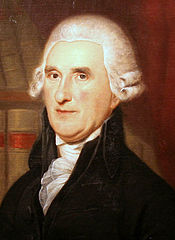
In 1813, the Delaware delegate Thomas McKean (shown above more than twenty years later) told John Adams how heated the discussion had become:
…when the business was finished, our President would not sign the petitions, and peremptorily refused to assign any reasons, until I pressed him so hard that he at last said, “it was against his conscience,” on which word I rung the charge so loud, that a plain challenge was given by him and accepted, in the presence of the whole corps; but he departed the next morning before day without an adieu to any of his brethren.

He seemed to accord with what was done during the session so fully and heartily, that Mr; Otis told me frequently it gave him surprize, as he confessed he suspected his sincerity.
Did Ruggles really challenge McKean to a duel on 24 October and then leave town? Ruggles was fifty-four, a former speaker of the Massachusetts house, a militia general and war veteran. His standing as a gentleman was secure, and New England didn’t have a big tradition of dueling.

In contrast, McKean was a thirty-one-year-old lawyer from Delaware, which barely qualified as a colony. (It was a three-county adjunct to Pennsylvania with a small separate legislature.) I can’t help but think that Ruggles would easily have brushed off whatever remarks the younger man had made. Almost five full decades later, however, there was no one left to contradict McKean’s dramatic version of events.

In any event, when the congress delegates gathered one last time on 25 October to sign the documents they had written together, Ruggles was already on his way home.

TOMORROW: The fallout in Massachusetts.

Thursday, October 08, 2015

The Choice between Ruggles and Otis

One of the first acts of the Stamp Act Congress when it convened in New York in October 1765 was to elect a chairman.

Arguably, that was the first political office to derive its authority from the thirteen colonies that would form the U.S. of A. eleven years later. Even if only nine of them had actually sent delegates to that congress, the others (plus Nova Scotia) at least got an invitation.

The winner of the vote was Timothy Ruggles (1711-1795, shown here), brigadier in the Massachusetts militia. According to the New York merchant John Watts, writing to a friend:
Brigr. Ruggles is Chairman, [James] Otis aimed at it and would have succeeded but they thought as he had figured much in the popular way, it might give their meeting an ill grace, but it is observed Otis is now a quite different man, and so he seems to be to me, not riotous at all.
Nearly forty years later, delegate Thomas McKean of Delaware recounted his version of events to John Adams, starting:
In the congress of 1765 there were several conspicuous characters: Mr; James Otis appeared to me to be the boldest and best speaker.—I voted for him as our President, but Brigadier Ruggles succeeded by one vote, owing to the number of the committee from New-York, as we voted individually
The record of the Stamp Act Congress states that the delegates chose Ruggles, and suggests the vote wasn’t unanimous, but it doesn’t mention any other candidates or any vote count. No delegates kept diaries or sent gossipy letters that have survived. Thus, there’s no contemporaneous evidence to confirm or refute McKean’s recollection. (More on his claims to come.)

As its clerk, the congress chose John Cotton (1728-1775), who was deputy secretary of the province back in Massachusetts, as well as registrar of wills in Suffolk County. Cotton was also half-brother to Lt. Gov. Thomas Hutchinson’s late wife and to the wife of former stamp agent Andrew Oliver, who was also his boss in the secretary’s office. In 1770 Hutchinson called Cotton “attached to Government and serviceable so far as his Sphere would permit.” He continued to hold offices in the royal bureaucracy until he died of the flux inside besieged Boston.

Cotton’s record of the congress is very spare, recording only the actions the body agreed to and not the preceding proposals, debates, and amendments. As their first procedural decision, later that first day, the delegates decided that each colony should have one vote, a precedent that remained for the Continental Congress of the 1770s. If McKean’s memory was accurate, then that form of voting would have made Otis the chairman instead of Ruggles.

Wednesday, October 07, 2015

When the Stamp Act Congress Convened

On 7 Oct 1765, the Stamp Act Congress convened at City Hall in New York (shown here). It was a week behind schedule.

As proposed by the Massachusetts House of Representatives back in June, this was a convention of delegates from the colonial legislatures of North America to come up with a common response to the Stamp Act.

Royal governors had done their best to stymie legislatures’ plans to participate in the congress, mostly by declining to convene those legislatures in time to choose delegates.

As a result, in Delaware, New York, and New Jersey legislative leaders chose delegates through committees or in meetings held without the governors’ approval. Other colonies, including the oldest and most populous, Virginia, couldn’t finagle a way to send anyone. Out of fourteen colonial legislatures invited (including Nova Scotia), only nine had representatives at the congress.

Massachusetts was one of those nine, but royal governor Francis Bernard was confident that he had things under control, as he reported to the Board of Trade in London on 8 July 1765:
It was impossible to oppose this Measure [for the congress] to any good purpose: and therefore the friends of Government took the lead in it, & have kept it in their hands; in pursuance of which, of the Committee appointed by this house to meet the other Committees at New York on the first of Octr. next, Two of the three are fast friends to Government & prudent & discreet men, such as I am assured will never consent to any undutiful or improper applications to the Government of great Britain. It is the general Opinion that nothing will be done in consequence of this intended Congress: but I hope I may promise myself that this province will act no indecent part therein.
The three Massachusetts delegates were all members of the committee that had recommended proposing the congress:
Probably because Massachusetts had instigated the meeting, there seems to have been consensus among the delegates that their chairman should be from that colony. But which man?

TOMORROW: America’s first national election?

Monday, June 08, 2015

Massachusetts Issues Invitations for a Stamp Act Congress—in New York

Two hundred fifty years ago on this date, the Massachusetts General Court took its first step to counter the new Stamp Act.

The process started two days earlier when James Otis, Jr., of Boston, proposed that the assembly respond to “the many difficulties to which the colonies are and must be reduced by the operation of some late acts of Parliament.”

To do that, the legislature chose a committee of:
Other colonies were also preparing responses to the Stamp Act. Virginia’s House of Burgesses had issued some bold resolutions, as I recently discussed, but that news hadn’t reached Boston yet. And early in the year, even before Parliament passed the new law, the New York Assembly had raised the idea of a convention of delegates from different colonies—like the Albany Congress of 1754.

In her history of the Revolution, Mercy Warren gave credit for the same idea to someone closer:
All remonstrances against this innovating system had hitherto been without effect; and in this period of suspense, apprehension and anxiety, a general congress of delegates from the several provinces was proposed by the honorable James Otis, of Barnstable, in the Massachusetts. He was a gentleman of great probity, experience, and parliamentary abilities, whose religious adherence to the rights of his country had distinguished him through a long course of years, in which he had sustained some of the first offices in government.
“The honorable James Otis, of Barnstable,” was also Mercy Warren’s father. (According to Benson J. Lossing, he made this proposal while visiting the Warrens in Plymouth with her brother James; however, I’ve found no confirmation for that.)

The younger Otis was most likely the driving force behind the Massachusetts committee’s report:
The committee appointed to consider what dutiful, loyal, and humble address may be proper to make to our gracious Sovereign and his Parliament, in relation to the several acts passed, for levying duties and taxes on the colonies, have attended that service, and are humbly of opinion:

That it is highly expedient there should be a meeting, as soon as may be, of committees from the Houses of Representatives, or Burgesses, in the several colonies on this continent, to consult together on the present circumstances of the colonies, and the difficulties to which they are and must be reduced by the operation of the late acts of Parliament for levying duties and taxes on the colonies, and to consider of a general and humble address to his Majesty and the Parliament, to implore relief.

And the committee are further of opinion, that a meeting of such committees should be held at New-York, on the first Tuesday of October next, and that a committee of three persons be chosen by this House on the part of this Province, to attend the same.

And that letters be forthwith prepared and transmitted to the respective Speakers of the several Houses of Representatives, or Burgesses in the colonies aforesaid, advising them of the resolution of this House thereon, and inviting such Houses of Representatives, or Burgesses, to join this with their committees, in the meeting, and for the purposes aforesaid.
The legislature unanimously adopted the committee’s proposal. It then chose White, Otis, and [I believe] Joseph Lee of Cambridge to “prepare a draft of letters to be sent to the respective Speakers of the several Houses of Representatives in the colonies.” Again, Otis is usually considered the principal author of the circular letter that resulted:
Province of Massachusetts Bay. Boston, June 8, 1765.

Sir—

The House of Representatives of this Province in the present session of the General Court, have unanimously agreed to propose a meeting, as soon as may be, of committees from the Houses of Representatives, or Burgesses, of the several British colonies on this continent, to consult together on the present circumstances of the colonies, and the difficulties to which they are and must be reduced by the operation of the acts of Parliament for levying duties and taxes on the colonies; and to consider of a general and united, dutiful and humble representation of their condition to his Majesty and the Parliament, to implore relief.

The House of Representatives of this Province have also voted to propose that such meeting be at the city of New-York, on the first Tuesday of October next, and have appointed a committee of three of their members to attend that service, with such as the other Houses of Representatives, or Burgesses, in the several colonies may think fit to appoint to meet him: And the committee of the House of Representatives of this Province are directed to repair to said New-York, on said first Tuesday of October next, accordingly.

If, therefore, your honorable House should agree to this proposal, it would be acceptable, that as early notice of it as possible might be transmitted to the Speaker of the House of Representatives of this Province.

SAMUEL WHITE, Speaker.
The Massachusetts legislature also chose Ruggles, Partridge (a veteran of the Albany Congress), and Otis as delegates to this Stamp Act Congress, if it were actually to take place.

Tuesday, November 12, 2013

John Adams and “Uncle Fairfield”

I’ve been reviewing the Boston 1775 postings related to the caucus, starting with this one from 2008. That quoted John Adams’s 1763 description of what he’d heard about the “Caucas Clubb” that met in Thomas Dawes’s attic. His list of members was: “Uncle Fairfield, Story, Ruddock, Adams, Cooper, and a rudis indigestaque Moles of others.”

I spotted local office-holders William Story, John Ruddock, Samuel Adams, and William Cooper, but for the first name on that list all I could write was:
I haven’t identified “Uncle Fairfield,” who was presumably one of John Adams’s uncles. [How’s that for historical detective work?]
Back in 1961, the editors of the first volume of the Papers of John Adams could only guess at that relationship and wrote, “JA frequently used ‘Uncle’ or ‘Aunt’ for an older person vaguely related to himself.”

In a 1970 New England Quarterly article titled “The Caucus and Democracy in Colonial Boston,” G. B. Warden identified that man as William Fairfield (1692-1770), elected as one of Boston’s property assessors from 1742 to his death. Fairfield wasn’t John Adams’s uncle, said Warden—he was Samuel Adams’s uncle. He was a brother of Samuel Adams’s mother Mary, whose original surname is often rendered as “Fifield” or “Fyfield.”

But was that John Adams’s only relationship to “Uncle Fairfield”? On 30 May 1771 he wrote in his diary:
I rode this forenoon from little Cambridge [i.e., modern Allston-Brighton] to Brewers [tavern in Waltham], with Mr. Ruggles of Roxbury, the Butcher, and I find him my Relation.—His Mother, who is still living above 70, is Sister to my Grandmother, Aunt Fairfield, Aunt Sharp, and Aunt Ruggles of Rochester, and Parson Ruggles of Rochester, and the Butchers Father were Brothers, so that Tim and he are very near—both by fathers and Mothers side.
Decoded, that passage means that “Aunt Fairfield” and the butcher’s mother were both sisters of John Adams’s grandmother Ann (White) Boylston. And indeed, records show that in 1727 Elizabeth White (1697-1769) married William Fairfield of Boston. Thus, “Uncle Fairfield” was also John Adams’s great-uncle by marriage.

Furthermore, that conversation reveals that the butcher’s mother, “still living,” must have been Joanna (White) Ruggles (1701-1778). She had two sons, the younger one named Nathaniel—and what do you know? The Boston selectmen’s minutes show that an out-of-town butcher named Nathaniel Ruggles leased a stall in or beside Faneuil Hall market in the 1760s, and got into an ongoing dispute over whether he would sell hides to Boston tanners at a set price as his lease required.

Sunday, June 07, 2009

The Trial of Bathsheba Spooner

At the Early American Crime blog, Anthony Vaver discussed one of the exciting scandals of Revolutionary Massachusetts: the trial of Bathsheba Spooner of Brookfield for arranging the murder of her husband. 


This 1778 crime gained an unavoidable political dimension because Spooner was the daughter of a leading Loyalist exile, Timothy Ruggles, and her alleged accomplices included two British prisoners of war—as well as a young Continental Army veteran. 

What’s more, as part of the 150th anniversary of the Massachusetts Superior Court, the trial of Bathsheba Spooner was reenacted at the Worcester Trial Court last week. Vaver provides lots of photographs, including some of men portraying prosecutor Robert Treat Paine and local newspaper publisher Isaiah Thomas

Tuesday, October 30, 2007

Gen. Howe Endorses the Loyal American Association

Boston selectman Timothy Newell reported two disparate events in his journal entry for 30 Oct 1775:

A soldier, one of the Light-horse men was hanged at the head of their camp for attempting to desert.

Proclamation issued by General [William] Howe for the Inhabitants to sign an Association to take arms &c.
The general’s proclamation was dated 28 October, and the Institute for Advanced Loyalist Studies offers its full text. The picture of Howe comes from NNDB.com.

“Association” meant a sort of Loyalist militia, responsible for patrolling the streets of Boston. Some members of Association companies went on to serve in other Loyalist units or the regular British army.

On the 29th, a group calling itself “Royal North British Volunteers,” a socially acceptable way of referring to their origins in Scotland, formed a similar group. They included printer John Fleeming, a link in the Dr. Benjamin Church spy case. On 7 December, the Loyal Irish Volunteers officially formed; their officers included James Forrest and Ralph Cunningham, apparently son of provost-martial William Cunningham.

By 17 November, the main Loyal American Association had formed its official command structure under Timothy Ruggles, who had been a brigadier in the pre-war militia. Ruggles’s orders to company captain Francis Green, dated two days before, give a sense of the group’s duties:
I have it in command to acquaint you, that the General expects (for the present) you take charge of the District about Liberty Tree & the Lanes, Alleys & Wharves adjacent, & that by a constant patroling party from sunset, to sunrise you prevent all disorders within the district by either Signals, Fires, Thieves, Robers, house breakers or Rioters;
Again, that text comes courtesy of the Loyalist Institute.

However, other documents indicate that the Loyalists in Boston had formed themselves into companies as early as the preceding July, so Howe was merely giving his official blessing to those groups. Those early muster rolls from that month show some familiar names and intriguing patterns. Capt. Adino Paddock was head of Boston’s militia artillery company before the war. Without any cannon to command, he became an infantry captain in July 1775. Among his troops were shopkeeper Theophilus Lillie; the younger John Lovell, balanced on the edge of madness; Joshua Loring, Jr., whose wife became Howe’s mistress; Martin Gay, who had supported the Whigs in 1770 and would return to Boston after the war; &c.

An especially intriguing name is Sgt. Hopestill Capen, who was briefly the employer of Benjamin Thompson and the landlord of Isaiah Thomas. Capen was jailed by Massachusetts authorities after the British evacuation. He told them that his religion (Sandemanian Christianity) forbade him from taking up arms against a government, and some historians have treated that to mean it was a pacifist sect. But Capen’s church preached against taking up arms in rebellion; defending a government was apparently just fine.