


J. L. BELL is a Massachusetts writer who specializes in (among other things) the start of the American Revolution in and around Boston. He is particularly interested in the experiences of children in 1765-75. He has published scholarly papers and popular articles for both children and adults. He was consultant for an episode of History Detectives, and contributed to a display at Minute Man National Historic Park.

Subscribe thru Follow.it


•••••••••••••••••


Showing posts with label David Province. Show all posts

Monday, November 11, 2019

The Mysteries of David Province
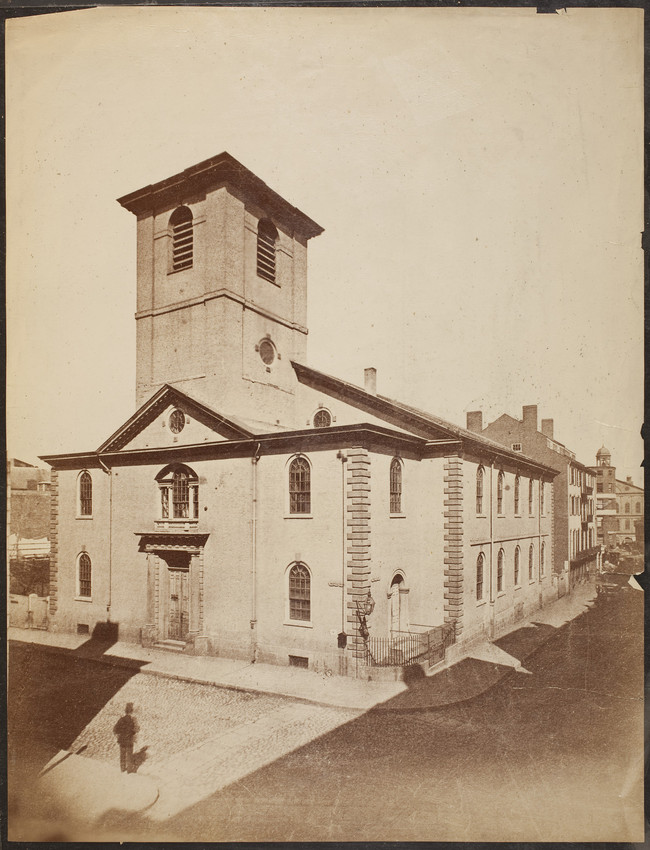
When George Gailer sued for damages after being tarred and feathered, he named four people from Boston: “David Bradley, Pool Spear, Taylors, and David Provence Infant and Edward Mathews Mariner.”

I’ve come up blank on “Edward Mathews[,] Mariner.” Ordinary sailors don’t leave a lot of records, and this man’s name is too common.

For David Province I have limited information about his childhood. David’s father, John Province, married Sarah Prince in late December 1747. Brattle Street Meetinghouse (shown here) recorded that they had Mary in 1752, Sarah in 1757, and twins Abigail and Elizabeth in 1763. However, there’s no sign of a son named David in those published records.

In 1758 Sarah (Prince) Province’s father, a ship’s captain named John Prince, died. His estate included a house and land on Milk Street, an enslaved man named Jack, and a two-masted, fully rigged boat. But he left only 20s. to his daughter Sarah, saying he had already supported her in life. He left a larger sum—£13.6s.8d.—to her children. That bequest may have been a way to make sure her husband John Province didn’t control much of his estate.

In September 1760 Thomas Hutchinson, in his capacity as a probate judge, assigned John Province to be guardian for his son David Province, who was under the age of twelve. In other words, Province ended up controlling any bequest from his father-in-law to his son anyway, but he had to keep accounts under court supervision.

(I note the possibility that David Province was John Province’s son by another woman, born after his marriage to Sarah Prince. That would be unusual, but could explain the anomalous details. Of course, there might just be gaps in the surviving records.)

The Province family lost their home in the great fire of 1760—the one that had started at the Sign of the Brazen Head. [Whatever happened to that storyline, anyway?] But the Province children were among the fortunate Bostonians who received public support. That September, John Province bought new real estate on Lynde Street.

By 1767 John Province was established securely enough to join the Scots Charitable Society. Later he took in apprentices through the Overseers of the Poor. He died in 1792 at the age of 72, and the Columbian Centinel reported that the funeral would be out of his home in West Boston. His will mentioned two married daughters, one in Nova Scotia and one in Albany, but no son.

Indeed, I found no records of David Province after the 1770 lawsuit, in which he played only a minor [!] part. He was probably the right age to serve in the military during the war, but he’s not listed in Massachusetts Soldiers and Sailors… He may have died before 1775.

As to the attack on George Gailer, the most pertinent information about David Province may be that his father was a tailor. That’s stated in both the probate and Overseers records. David may therefore have been an apprentice tailor. Two of the three Boston men in the lawsuit were tailors, the only men not connected with the maritime trade.

Why, I wondered, were tailors so interested in tarring and feathering a sailor for informing on a smuggler? Then I realized that might not be the right question. Out of all the crowd that attacked him, how did Gailer learn the names of two or three tailors? The answer might have something to do with how Gailer “took Shelter in a House” for most of the day before being grabbed. Perhaps workers in a nearby tailor shop kept a watch for him, or something like that.

TOMORROW: Pool Spear and the long arm of the law.

Monday, November 04, 2019

“An assault, on the Body of the said George Gailer”

George Gailer, the first victim of tarring and feathering in Boston, was an ordinary sailor. He was therefore not the type of person who typically left letters, journals, newspaper essays, or other writings.

However, we do have Gailer’s perspective on that assault through a lawsuit he filed three months later in January 1770.

The sailor’s attorney was Robert Auchmuty (c.1722-1788, shown here as a young man, courtesy of Amherst College), who also had Crown appointments. Since Auchmuty was probably beyond Gailer’s price range, I suspect the Customs office helped pay his fees.

John Adams represented one of the defendants, the Boston tailor David Bradlee. Adams also copied Auchmuty’s initial filing into his “Pleadings Book,” just in case he needed to file a similar motion for another client. We’re lucky he did so because the original court file has been lost.

Gailer’s warrant said:
Attach &c. Eleazar Trevett Junior and Benjamin Trevett, Merchants, Daniel Vaun Mariner, all of Newport in the County of Newport and Colony of Rhode Island and Providence Plantation, and David Bradley, Pool Spear, Taylors, and David Provence Infant and Edward Mathews Mariner all of Boston in our County of Suffolk.

To answer unto George Gailer of Boston aforesaid Mariner, in a Plea of Trespass, for that the said Eleazar Trevett Jnr., Benjamin Trevet, Daniel Vaun, David Bradley, Pool Spear, David Provence, and Edward Mathews, at said Boston in the Evening of the twenty Eighth Day of October last, together with diverse other Persons to the said George Gailer unknown, with Force and Arms, an assault, on the Body of the said George Gailer did make, and then and there with Force as aforesaid did strip the said George Gailer naked, tar and feather his Skin, and carry the said George Gailer naked, tarred and feathered, as aforesaid in a Cart about said Boston for the space of Three Hours, and with Clubbs, Staves, and a hand saw did then and there strike him the said George Gailer, sundry heavy and grievous Blows, upon the said George Gailers naked Body, and greatly bruise, and wound him and hit him the said George Gailer diverse grievous Blows, with Stones:

By Reason of all which the said George Gailers Life was put into great Hazard and Danger, and greatly despaired of, and many other Enormities, and Cruelties, the said Eleazer Trevett Jnr., Benja. Trevett, Daniel Vaun, David Bradley, Pool Spear, David Provence, and Edward Mathews, with others unknown to the said George Gailer did then and there commit, on the said George Galer, against the Peace of our Lord the King and to the Damage &c. £2000.
This description of the assault differed in some details from what was in the newspapers. The warrant said the crowd “did strip the said George Gailer naked.” However, the Boston Post-Boy said “his Cloaths except his Breeches [were] pulled or torn off,” and other papers agreed. So this is an example of the period usage of “naked” not being stark naked.

On the other hand, the warrant described more violence than the newspapers, saying the crowd hit Gailer “with Clubbs, Staves, and a hand saw” and “Stones.” The press, particularly the Whig press, might have suppressed those blows, or decided they were few and exceptional and didn’t deserve mention. It’s also possible Gailer and Auchmuty pumped up those details because they were fighting a perception that a tar-and-feathering wasn’t a real assault. Yet that “hand saw” doesn’t seem like the sort of detail one could make up.

According to The Adams Legal Papers, Gailer’s case was initially “decided in the defendants’ favor on demurrer,” meaning the defendants didn’t address the truth of the allegation but argued that those actions weren’t enough to justify a legal judgment. Adams received 19s.4d. from Bradlee. Auchmuty filed an appeal in March 1770. None of the parties appeared when the case came up in the August 1771 term, and the case was dropped. I’ve never come across any other mention of George Gailer.

TOMORROW: An eyewitness account from a soldier.