


J. L. BELL is a Massachusetts writer who specializes in (among other things) the start of the American Revolution in and around Boston. He is particularly interested in the experiences of children in 1765-75. He has published scholarly papers and popular articles for both children and adults. He was consultant for an episode of History Detectives, and contributed to a display at Minute Man National Historic Park.

Subscribe thru Follow.it


•••••••••••••••••


Showing posts with label Francis Williams. Show all posts

Sunday, November 17, 2024

More Light from the Portrait of Francis Williams
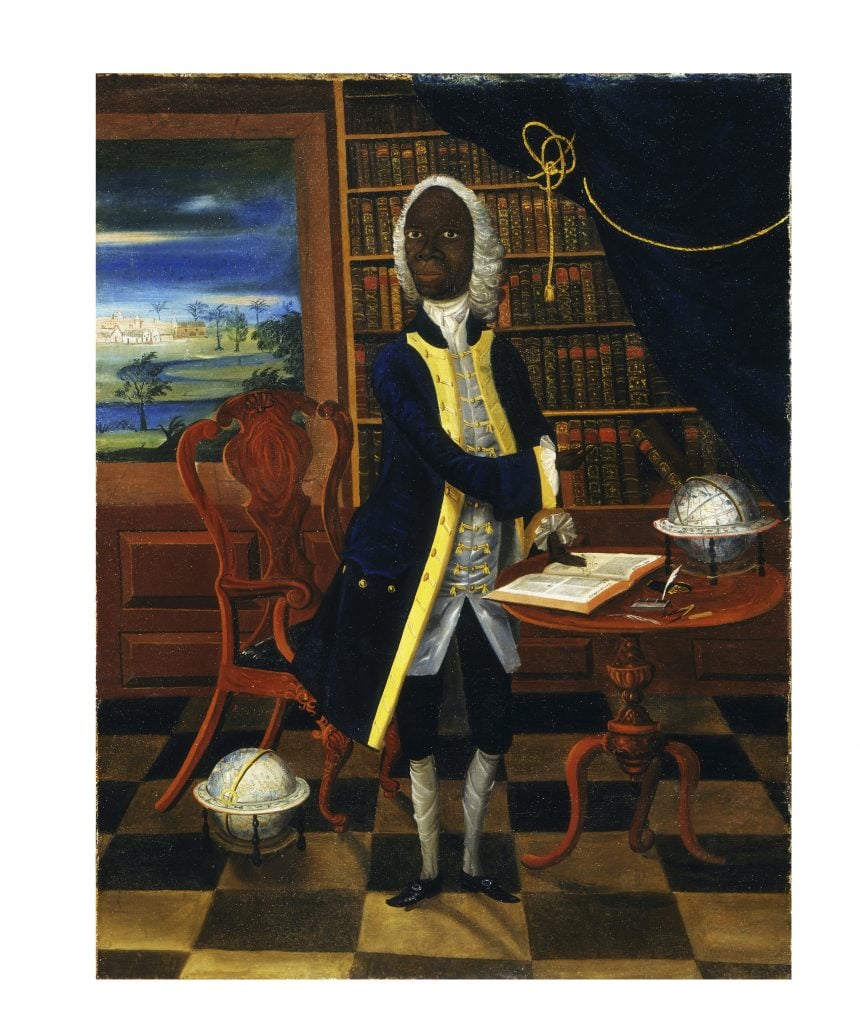
Earlier in the month I reported on Fara Dabhoiwala’s work on the portrait of Francis Williams based on two news articles.

I’ve now read Prof. Dabhoiwala’s own article in the London Review of Books, and he has even more to say.

About the painter:
The only oil painter known to have been active in Jamaica during these years was an Anglo-American artist called William Williams, who was then in his early thirties. This Williams, the son of an ordinary mariner, had been born in Bristol in 1727. He’d always loved to draw. Sent to sea as a youth, he abandoned his crew in Virginia and spent a few years knocking around the West Indies and Central America, sometimes living among Indians, learning their language and trying his luck as a painter for the local colonists.

Eventually, around 1747, he ended up in Philadelphia, where he worked for a theatre, painting sets and backdrops, and in a boatyard, painting ships, as well as doing sign-painting and lettering, teaching music, writing poetry and composing what is now regarded as the first American novel.

Though he was entirely self-taught, he also made landscapes and portraits; he collected engravings; he used a camera obscura as a drawing aid; he studied the lives of the great artists and wanted to be one himself. He was the earliest teacher of the young Benjamin West, who…in the 1770s commemorated his old mentor by including his likeness in one of his monumental historical canvases.

William Williams kept a list of every painting he ever made. The original doesn’t survive, but in the 19th century someone jotted down a summary of it. In the spring of 1760, Williams travelled from Philadelphia to Jamaica to offer his services as an artist. His list recorded that during his months in Jamaica, he painted 54 pictures. None of these has ever been found. I am confident that the portrait of Francis Williams is one of them.

There is in fact a scientific test that could prove this, because it has recently been discovered that William Williams prepared his canvases with a distinctive and very unusual triple layer of underpainting. I’m pressing the V&A [Victoria & Albert Museum] to undertake this new test as soon as possible.
Dabhoiwala also posits that the painting depicts not only the page in Newton’s Principia showing how to calculate the path of a comet but Halley’s comet itself. I’m not entirely convinced by this because the visual clues aren’t distinct. Then again, neither are comets a lot of the time. And the painter was definitely charting something in that portion of the canvas:
We can see that on the infrared scans of the picture. When William Williams made his first pencilled marks on this canvas, to plot the composition, he carefully ruled a series of lines to show where that white object in the sky should go – and to mark its relation to the constellations he was told to paint below. His sitter made sure of that, as he made sure of every other carefully placed detail in his portrait.

The portrait of Francis Williams is the only painting ever made of Halley’s comet in 1759, on its momentous first predicted return. 

Saturday, November 09, 2024

The Intriguing Portraits of William Williams

[Today’s posting would be simpler if so many of the people involved weren’t named Williams.]

Yesterday I passed on articles about Fara Dabhoiwala’s conclusions about a painting of the Jamaican scholar Francis Williams.

Dabhoiwala hypothesizes that this portrait was made in or shortly after 1759 by the artist William Williams, born in Wales in 1727 but active in the American colonies.

William Williams is known for a couple of other portraits of unusual men in Britain’s American empire.

One portrait, now lost, showed the Haudenosaunee leader Theyanoquin, often called “King Hendrick” by British sources. In January 1755, Theyanoquin was in Philadelphia meeting with Gov. John Penn and the Council about a land dispute. At the time, British authorities were pleased to have the Haudenosaunee as allies in their growing conflict with the French.

The Fishing Company of Fort St. David’s, a genteel men’s club, commissioned William Williams to paint Theyanoquin’s portrait, and club records show it was displayed in their clubhouse. (This club later merged with the Schuylkill Fishing Company, discussed here.)

Later in 1755, Theyanoquin led a contingent of Native soldiers in a British force commanded by Sir William Johnson. Col. Ephraim Williams, Jr., led the Massachusetts contingent. (His brother, Dr. Thomas Williams of Deerfield, came along as a surgeon, and their relative, the Rev. Stephen Williams, as a chaplain.)

That British force clashed with the French beside Lake George on 8 September. Col. Williams and Theyanoquin were both killed, though ultimately Johnson claimed victory.

That event made Theyanoquin, or Hendrick, a martyr for people in Britain. Elizabeth Bakewell and Henry Parker issued an engraved portrait of him titled “The Brave old Hendrick the great Sachem or Chief of the Mohawk Indians” (shown above). That print isn’t dated, and its source is uncertain, but scholars appear to believe that it was most likely based on the William Williams painting. If so, it’s the only remaining version of that image.

In the same decade, Williams painted the radical Quaker Benjamin Lay. The earliest trace of this portrait appears to be a remark in Benjamin Franklin’s 10 June 1758 letter from London to his wife Deborah. The retired printer wrote: “I wonder how you came by Ben. Lay’s Picture.”

Unfortunately, Deborah’s letters to Benjamin before and after that one don’t survive, so we don’t know what she’d told him about that picture or how she answered his query. Franklin had published some of Lay’s writing decades earlier, but the man wrote a lot, and I don’t see signs of a close friendship.

Deborah Franklin might have commissioned William Williams to paint Lay because she sensed public interest in an engraved portrait. At some point such an engraving appeared, credited to painter “W. Williams” and engraver “H.D.” That was Henry Dawkins, another British-born craftsman who had come to the Middle Colonies of America to be a bigger fish in a smaller pond. (It’s also possible Dawkins published that engraving himself and the “Picture” Benjamin Franklin wrote about was a print, not the painting.)

That brings us back to Francis Williams, the Jamaican polymath. Did William Williams paint his portrait with an eye toward its eventual engraving? No such engraving survives.

The painting went into the hands of the planter and lawyer Edward Long (1734–1813), who published a history of Jamaica in 1774. That book includes a poem by Francis Williams and a short, inaccurate, racist biography of him. Did Long at some point also think of putting an illustration of Williams into the book?

For more about those unusual portrait subjects, see Eric Hinderaker’s The Two Hendricks: Unraveling a Mohawk Mystery, Marcus Rediker’s The Fearless Benjamin Lay, and Vincent Carretta’s article “Who Was Francis Williams?” in Early American Literature.

Friday, November 08, 2024

New Light on the Portrait of Francis Williams

Last month Artnet and the Guardian reported on historian Fara Dabhoiwala’s findings about a painting I discussed in 2009.

The painting shows Francis Williams (1697–1762), a Jamaican of African ancestry. Born into a free and prospering family with special legal status, he went to London for education and then returned to the family estate.

The painting is in the collection of the Victoria and Albert Museum, and fifteen years ago I quoted its webpage as saying:
Some writers have suggested that the painting is a caricature of Francis as he has been depicted with a large head and skinny legs. . . . Other critics have considered that the ‘unnaturalistic’ depiction may have been intended to emphasise the subject’s intellectual skills over his physical stature (Francis was alive at the time of the painting’s creation and may even have commissioned it). It may, more simply, be a reflection of the artist’s limited skills.
The new research connects the creation of the painting to a specific historical, and astronomical event.

The Guardian report explains:
Dabhoiwala…discovered the significance of the page number carefully inscribed on the book Williams is reading: it is the page in the third edition of Newton’s Principia that discusses how to calculate the trajectory of a comet by reference to the constellations around it.

An X-ray of the window scene depicted in the background of the painting showed lines intersecting what appears to be a luminous white comet, streaking through the sky at dusk, and connecting – with stunning accuracy – to constellations of stars. These stars would have been visible in that position in the firmament when Halley’s comet was in the sky over Jamaica in 1759, according to research by Dabhoiwala.
In other words, this picture shows a particular moment when Halley’s comet appeared over Williams’s estate, and it shows him as an educated gentleman who knew how to calculate the path of that comet.

Artnet adds:
As for the painting’s creator, Dabhoiwala is confident it’s the work of William Williams, an English-American artist who traveled to Jamaica in the 1760s. The comet together with the appearance [in the bookcase] of [Dr. Samuel] Johnson’s Dictionary, which was first published in 1755, align with this timing and the painting’s style is similar to other early Williams portraits of Benjamin Lay, a Quaker abolitionist, and Hendrick Theyanoguin, a Mohawk Indian.
The Lay portrait, now at the Smithsonian’s National Portrait Gallery, also shows a man “with a large head and skinny legs.” Like Williams, Lay (c. 1681–1759) was notable for standing out in British-American society rather than fitting in. Williams (1727–1791) might have specialized in such subjects.

TOMORROw: More on William Williams’s work.

Saturday, February 28, 2009

Francis Williams, Man and Symbol

This interview with Octavian Nothing author M. T. Anderson pointed me to these two webpages about Francis Williams (1697-1762), who held a unique place in the eighteenth-century British Empire because of his combination of learning, property, and African ancestry.

After digging a bit more, I found that only one of those webpages—the first, from the Victoria & Albert Museum—is informed by Prof. Vincent Carretta’s article “Who Was Francis Williams?” published in Early American Literature in 2003. That provided a valuable corrective to what had been written about Williams since shortly after his death.

Most of our previous information about Williams came ultimately from Edward Long’s History of Jamaica (1774). That book includes an inaccurate capsule biography, one of Williams’s poems, and the argument that he hadn’t really accomplished much. Long was hostile to the idea of an intelligent, educated, property-owning black man, so why did he mention Williams at all? For one thing, he seems to have been fascinated by the man at some level; the portrait above came down in Long’s family.

More importantly, when Long wrote, Williams had already become a minor celebrity. Anti-slavery authors used him as an example of how people of blacks could succeed very well given a fair chance at education and wealth, and white supremacists struggled to denigrate his accomplishments. Among the writers mentioning (or presumably mentioning) Williams were:
  • Dr. Alexander Hamilton, in his “Itinerarium” of 1744 (not published until 1948): “There, talking of a certain free negroe in Jamaica who was a man of estate, good sense, and education, the ’forementioned gentleman…asked if that negroe’s parents were not whites, for he was sure that nothing good could come of the whole generation of blacks.”
  • David Hume, in “Of National Character” (1748): “In Jamaica, indeed, they talk of one Negro as a man of parts and learning; but it is likely he is admired for slender accomplishments, like a parrot who speaks a few words plainly.”
  • The editors of The Gentlemen’s Magazine in 1771: “About forty years ago, Mr. Williams, an African of fortune, who dressed like other gentlemen in a tye wig, sword, etc. and who was honoured with the friendship of Mr Chelselden [Dr. William Cheselden (1688-1752)], and other men of science was admitted to the meetings of the Royal Society and, being proposed as a member, was rejected solely for a reason unworthy of that learned body, viz. on account of his complection.”
Long claimed that Williams’s education was “the subject of an experiment” by the second Duke of Montagu in educating a black boy. That understanding may have arisen from that peer’s documented sponsorship of another man of African descent, Ignatius Sancho (c.1729-1780). It became part of our received wisdom about Williams. For example, Massachusetts Abolitionist Lydia Maria Child included the tale in her Appeal in Favor of that Class of Americans Called Africans (1833), though she mistakenly credited the “Duke of Montaigne.”

In fact, Carretta dug into primary sources and found that Francis Williams was born the second or third son (he was a twin) of John and Dorothy Williams, a free black couple on Jamaica. John Williams, apparently a former slave, was an established property-owner and trader. In 1708, 1711, and 1716 the colony’s legislature passed laws granting the Williams family legal privileges usually reserved for whites. So already their presence threatened the traditional social structure.

Carretta found that “The register of Lincoln’s Inn in London...records the admission on 8 August 1721 of ‘Francis Williams, youngest son of John W., of Jamaica, merchant,’ confirming the statement of the anonymous author of An Inquiry [into the Origin, Progress, & Present State of Slavery (1789)], though no record has been found of his actually having attained a law degree.” John Williams died in 1723, leaving an estate worth £12,000. Francis soon returned to Jamaica to take up his inheritance.

In 1724, Francis Williams got into a fight with a white man named William Brodrick, who then petitioned the Jamaica legislature to end the Williams family’s legal privileges because they were “of great encouragement to the negroes of this island in general.” The legislature did that in 1730, after the First Maroon War had broken out. Williams protested to the Privy Council in London, insisting it was already “Notorious that no Free Negro [could] wear a Sword or Pistols besides himself.” In November 1732 the council recommended that Jamaica repeal its new law.

Long claimed that Williams set up a school to support himself, but there’s no evidence for that. Instead, he appears to have lived off his inherited property. He wrote poetry on public occasions, and remained a local curiosity. When he died, Williams owned fifteen slaves, but his home was rented and his entire estate worth £525.

The picture of Williams at the upper right comes from the Victoria & Albert Museum in London. I bought a postcard of it a few years ago, not knowing anything about him at the time. The museum’s page on the painting says:
Some writers have suggested that the painting is a caricature of Francis as he has been depicted with a large head and skinny legs. . . . Other critics have considered that the ‘unnaturalistic’ depiction may have been intended to emphasise the subject’s intellectual skills over his physical stature (Francis was alive at the time of the painting’s creation and may even have commissioned it). It may, more simply, be a reflection of the artist’s limited skills.