J. L. BELL is a Massachusetts writer who specializes in (among other things) the start of the American Revolution in and around Boston. He is particularly interested in the experiences of children in 1765-75. He has published scholarly papers and popular articles for both children and adults. He was consultant for an episode of History Detectives, and contributed to a display at Minute Man National Historic Park.

Subscribe thru Follow.it


•••••••••••••••••


Showing posts with label Benjamin Russell. Show all posts

Wednesday, January 17, 2024

“We know nearly a dozen of the ‘party’ alluded to…”

On 16 Aug 1826, the Columbian Centinel newspaper of Boston published this item on the upper left corner of its front page:

Tea Destroyers.—“One of the famous Boston “Tea Party” is still alive in Newburyport. His name is NICHOLAS CAMPBELL, aged 94 years.” New York Advocate.

“Why is it, that the names of the persons who destroyed the Tea in Boston in 1773 have been so pertinaciously concealed from the public? They ought not to be ashamed of the exploit.” Providence paper.

REMARK.—We know nearly a dozen of the “party” alluded to, all now alive and well, and among our most wealthy and enterprizing citizens. To our knowledge they have never concealed their agency in the “exploit;” but they are not boasters.—To hundreds of Bostonians their names have been as familiar as those of Adams, Hancock, Otis, &c.

We have recently seen a phial filled with the tea which two of the party found in their shoes after their return home, and have preserved as a memorial. It may be recollected that the shoes worn in those days did not fit to the ancle so snug as those of our modern dandies, and that boots were then only worn by fishermen.
I read this as the flagship of Boston’s Federalist press claiming full authority on the “Tea Destroyers.” Of course we in Boston know who these heroes are, the writer says; we just don’t want to tell you.

I particularly like the couple of backhand, scare-quoted allusions to the new term spreading in the national press: “Tea Party.” That phrase seems to have surfaced at the start of the year in an interview with Joshua Wyeth.

In 1826 the Columbian Centinel was still owned by its founding editor, Benjamin Russell (shown above). Years ago I hypothesized that about a decade later he was the “aged Bostonian” who supplied the list of tea destroyers published in Traits of the Tea Party.

The “phial” of tea this article described was probably Thomas Melvill’s, already mentioned in the Boston Daily Advertiser in 1821. That first item said Melvill had collected it from “himself and companions.” This one says “two of the party.” By 1856 that tea was said to have come from Melvill’s clothing alone.

Sunday, December 12, 2021

A Shortage of Anti-Federalist Verse

Of all the poems, light verse, and songs I’ve quoted from the debate over a new U.S. Constitution this week, only one has come from Anti-Federalists.

That wasn’t because I lean Federalist. It’s because the corpus leans Federalist.

The University of Wisconsin project documenting the ratification process has a collection of twenty-seven “Poetry and Songs” that mention the debate. So far as I can tell, the song from Carlisle, Pennsylvania, that I quoted yesterday is the only one that’s explicitly Anti-Federalist.

A few of those songs or verses lampoon the whole debate over the proposed new constitution. But most express Federalist positions. Five are even labeled “Federal.” Five originated in Benjamin Russell’s strongly Federalist Massachusetts Centinel. Two are attacks on the Anti-Federalist governor of New York, George Clinton (shown above).

Why does this corpus lean to one side of the political debate? I think there are several overlapping reasons:
  • Most newspaper publishers were Federalist.
  • The Federalists predominated in the ports and market towns where newspapers were published, thus comprising more of the readers and supporters of those newspapers.
  • The wealthy gentlemen more likely to have the time, education, and fervor to write verse were also more likely to support the new Constitution.
  • Anti-Federalism wasn’t a united platform with a clear program to rally around. Rather, it was a collection of worries about the new frame of government. Those skeptics didn’t cohere into a party as Federalists had started to do when they advocated for a new constitutional convention.
Within a short time after the new Constitution was in place, and the promised amendments were under way, a network of newspapers opposed to the Washington administration developed. Within a few years they coalesced around Thomas Jefferson and his political allies. After that, the output of political poems and songs probably evened out.

Monday, July 20, 2020

News from France and “the language of patriotism”

Boston’s Civic Festival to honor the new republic of France on 24 Jan 1793 came at an unusual cultural and political moment.

The latest news from Europe relayed the events of late 1792. Bostonians knew about how the French assembly had deposed Louis XVI and proclaimed a republic. The French army was pushing back the combined forces of several European monarchies and keeping Britain at bay. It looked like the American model of political liberty and equality was spreading in the Old World.

To be sure, the news included a hint of French Revolutionaries turning on themselves. After trying and failing to preserve the king and constitutional monarchy, the Marquis de Lafayette (shown here) had fled to Austrian territory. He was under arrest, viewed by both French republicans and Austrian monarchists with suspicion.

The 26 January Columbian Centinel showed how Bostonians still admired Lafayette and were following his story. One of the toasts offered at the festival was “Justice to M. LAFAYETTE.” Did that mean justice from France or from Austria? Quite possibly both.

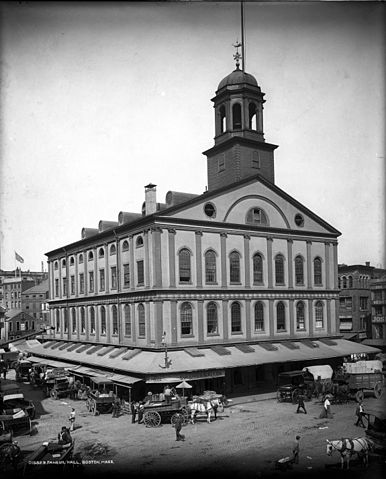
For the most part, however, the people of Boston saw plenty to celebrate. Though Louis XVI’s government did support the U.S. of A. in its fight for independence, Americans had grown up thinking of the French monarchy as an example of tyranny. Now the former king appeared to be in alliance with his fellow despots against his people, so it was easy to hail his downfall. Likewise, New Englanders with their Puritan heritage and established Calvinism felt little sympathy for the Catholic church in France. The decorations on Faneuil Hall included “a crown, sceptre, mitre, and chains” being broken under the feet of Liberty.

The festival toasts signaled high hopes for republicanism:
  • “The Law—May it always breathe the spirit of liberty and speak the language of patriotism.”
  • “Civic virtues to the military, and a military spirit to the citizens.”
  • “May the light of philosophy irradiate the caverns of superstition and despotism, and reveal their horrors."
  • “In all governments may Liberty be the check, and Equality the balance.”
There were similar but smaller celebrations in other Massachusetts towns.

New Englanders didn’t know that the French government had indicted Louis XVI for treason in December and beheaded him just three days before their festival. Once news of that execution arrived in late March, Americans’ support for the French republic began to fade. Splintering opinion about France was a big part of the development of two semi-organized political parties in the U.S. of A.

In the spring of 1793, some Americans founded what historians later called Democratic-Republican Societies, the basis of what became the Jeffersonian party. On 8 April, Edmond-Charles Genêt arrived in Charleston as the new French minister to America and set about commissioning privateers to attack British ships. President George Washington issued a controversial neutrality proclamation on 22 April.

Those developments changed how Bostonians responded to the French Revolution. In January, as I discussed, Benjamin Russell’s Columbian Centinel not only applauded the Civic Festival but referred to local dignitaries and the editor himself with the title “Citizen.” By June, however, that newspaper was firmly Federalist and using that honorific only for officials from France. In his book Parades and the Politics of the Street, Simon P. Newman wrote that by spring Federalist politicians were conspicuously absent from further celebrations of the French republic.

The Centinel continued to refer to “Liberty Square” instead of Dock Square for several months, but that term faded away. As for “Equality Lane,” the name appeared almost exclusively in advertising for John Bryant’s tavern (no longer called “Liberty Hall”). The last reference that I found came in the 23 Aug 1793 American Apollo, in an advertisement for young acrobats.

After that, “Equality Lane” reverted to being called “Exchange Lane” (no more “Royal”) or “Shrimpton’s Lane” after an early owner of the land. The new name had lasted such a short time that it was never official, never appeared in town directories or on maps. When historians have mentioned “Equality Lane,” it was always in the way William Cobbett used it, as evidence of Boston’s brief infatuation with the French Revolution.

But for a moment in early 1793, Bostonians were calling each other “Citizen” and honoring “Equality” over commercial “Exchange.”


Tuesday, July 14, 2020

Citizens at Boston’s Civic Festival of 1793

I’m jumping around among multiple series here [whatever happened to the Saga of the Brazen Head?], but there’s no better date than 14 July to return to Boston’s celebration of republican France in 1793.

At the start of the month I quoted a suggestion in the 21 Jan 1793 Boston Gazette that the selectmen find a new name for the short street in central Boston called “Royal Exchange Lane.” The word “royal” was just so pre-Revolutionary.

That proposal appeared in the midst of reports on Bostonians preparing for a big “Civic Feast” celebrating how France had become a republic. The deposition of King Louis XVI meant that Americans could be grateful to the French nation for being a crucial ally in the war for independence without the awkwardness of supporting a despot far less constitutionally fettered than George III.

Boston’s civic holiday took place on Thursday, 24 January. That day’s Independent Chronicle reported one some of the events:
A large number of citizens will dine at Fanuiel [sic] Hall; notwithstanding which tables plentiously provided, will be laid in State Street; and whoever chooses may partake freely.

At the Stump of Liberty-Tree, an entertainment is providing for a large number of citizens, who usually have celebrated propitious events at that spot.

The Citizen Soldiers of the Independent Fusiliers, will dine at BRYANT’s Liberty Hall, Equality-Lane, (late Royal Exchange Lane.)
It looks like innholder John Bryant decided to rename the street his establishment stood on “Equality Lane” to reflect the new political ethos, even in advance of action by the selectmen.

The long, detailed report on the “CIVIC FESTIVAL!” in the 26 January Columbian Centinel showed how people were adopting that new name. That newspaper said the fusilier company “dined together at Citizen BRYANT’s, in Equality-lane.” Likewise, it referred to the nearby Dock Square as “Liberty-Square.”

Innkeeper Bryant wasn’t the only celebrant to receive the republican title “Citizen.” The newspaper reported that “citizen S[amuel]. Adams,” then lieutenant governor, presided over the feast in Faneuil Hall alongside “Citizen Letombe”—French consul Philippe André-Joseph de Létombe, who had started serving under the king and would remain in office through to the emperor. “Citizen [Josiah?] Waters” was marshal of the parade and oversaw the decorations. “Citizen [Samuel] Bradlee” commanded the company of artillery.

“Citizen Joseph Croswell, of Plymouth” provided the words of a hymn “To Liberty” while “Citizen [John] Woart” hosted another gathering at the Green Dragon Tavern where mechanics sang “God Save Great Washington.” Likewise, “Citizen Charles Jarvis,” soon to be one of Boston’s leading Jeffersonians, proposed a toast to President George Washington.

Most striking of all to me, this same page of the Columbian Centinel included a letter to the editor that proudly began “Citizen Russell.” Benjamin Russell (shown above in later life) and his newspaper would soon be pillars of the Federalist Party in New England. Yet in January 1793 they were going gaga over Revolutionary France.

Indeed, another news item on this page of the Centinel warned “24 Frenchmen” in Boston who had signed “A Protest against the French revolution” that they should be “upon their guard, in attempts of this nature,” and maintain “a respectful silence.” Nobody, not even Frenchmen, were supposed to criticize France as it finally became a republic.

COMING UP: Party poopers.

Friday, December 20, 2019

Amos Lincoln at the Tea Party

Back in 2006, I posted the first list of men who participated in the Boston Tea Party, published at the back of Traits of the Tea Party in 1835, followed by my best guess about who came up with that list.

I posited that those names came from Benjamin Russell (shown here), a Boston newspaper publisher and politician who came of age during the Revolution.

A lot of the names on that first list were members of the Massachusetts Charitable Mechanic Association, which Russell headed. Items in his newspapers in the early 1830s showed someone in those offices was keeping track of Tea Party veterans as they died out.

Amos Lincoln, however, tests that hypothesis. He died on 15 Jan 1829, and two days later this notice appeared in Russell’s Columbian Centinel:
DIED.…

In Quincy, on Wednesday, Capt. AMOS LINCOLN, aged 75, formerly of Boston, and uncle of the Governors of Massachusetts and Maine,—a patriot and a soldier of the Revolution, he was one of the intrepid band who consigned the Tea to the ocean, in 1773,—commanded a company of Artillery during the first years of the Revolution, and sustained through life the character of an undeviating disciple of Washington, and that of an honest, useful man. His funeral will be this afternoon at 3 o’clock, from the residence of Mr. Nathan Josselyn, in Quincy.

Mr. Ezra Lincoln, aged 72, brother of the above, died suddenly at Hingham, on the preceding Sabbath.
Lincoln had also been a member of the Mechanic Association before moving out of Boston and letting his dues drop. The chronicler of that organization, Joseph T. Buckingham, even stated that Russell and Lincoln were friends.

Yet Lincoln does not appear on that first list of Tea Party members in 1835. Whoever compiled it must have missed or forgotten his Centinel obituary. Does that suggest Russell was not the source of that first list? Perhaps, although he could just as easily have forgotten the name of a man no longer living in town as anybody else.

In any event, Amos Lincoln was publicly identified as someone who helped to destroy the tea in 1829, when people who witnessed the furor of 1773 were still around. That recognition seems quite reliable.

It wasn’t until decades later that the more dramatic details of the Amos Lincoln story came out.

TOMORROW: The master carpenter’s prayer.

Thursday, November 21, 2019

Inspecting the Tea Party House

In the 1890s the old Bradlee house at the corner of Hollis and Tremont Streets became known as the “Tea Party House.” Until it was leveled in 1898, it was on lists of what tourists should see in Boston. Even after that, people sold souvenir photos and postcards. The Bradlee home was a setting in the 1899 teen novel When Boston Braved the King.

All that celebrity was based entirely on stories that Sarah Bradlee Fulton’s family shared with the world starting in 1873 but really taking off after 1884. As I’ve noted, there’s no documentation to support the stories.

So what do I make of the family lore about Fulton, particularly that she, her husband, and her brothers participated in the Boston Tea Party?

On the one hand, there’s definite contemporaneous evidence that Sarah’s brother David was involved in the Revolutionary movement. He was sued for tarring and feathering a Customs sailor. He saw another Customs man aim a gun at him. He lifted Crispus Attucks’s body off King Street. You can’t get more involved in the street-level resistance than that.

Furthermore, as I’ll discuss tomorrow, David Bradlee remained part of that crowd of pushy mechanics-class Patriots as the war began. So if I wanted someone to toss the East India Company’s tea into the harbor in 1773, Bradlee would be one of the first guys I’d go to.

On the other hand, no one publicly connected the Bradlee family to the Tea Party in the first century after the event. David Bradlee lived until 1811. He and his sons remained prominent in Boston’s business community and civic government well into the nineteenth century. If they talked about him helping to destroy the tea, Benjamin Russell or whoever else published the first list of Tea Partiers in 1835 would probably have heard about it.

Likewise, there’s no question that Sarah Bradlee Fulton lived through the American Revolution. She had brothers in Boston during the most tumultuous years. Her house in Medford was close to the siege lines. As a wife, mother, and farmer, she undoubtedly went through a lot of anxiety, and it would be great to know what she experienced. That doesn’t mean she disguised her brothers to look like Indians, scared off British soldiers, or carried secret messages across the Charles River for George Washington.

In the end, I’m not convinced by the legends of Sarah Bradlee Fulton. I can’t disprove them, but that’s not my job. It’s the responsibility of authors retelling those stories to assess and support them with evidence, and the mere fact that some of her descendants grew up hearing those narratives isn’t enough to convince me.

For me the stories about Sarah Bradlee Fulton, her husband, her brothers, and her punchbowl fit into a genre I call “grandmother’s tales.” Fulton was indeed a grandmother, widowed in 1790 and probably helping to raise descendants for her remaining forty-six years. I suspect she told her grandchildren and great-grandchildren stories of the Revolution, inspired by history but exaggerated, massaged, or wholly invented for better effect. Fulton wasn’t necessarily aiming to put herself and her family into the history books. She simply wanted to entertain, education, and inspire those children at home.

But then those children grew up with Grandma’s stories as part of their understanding of their family and their country. As adults, with the centenary of the Revolution coming around, they retold those stories for the public. Because they believed those stories and believed they were important.

With enough insistent retelling, those tales found a wider audience in post-Centennial Massachusetts and America. They hit a chord with the public, especially women looking for a model female Patriot of a certain type.

Meanwhile, evidence for David Bradlee’s street actions, which frankly weren’t so savory, was confined to archives. In 1965 The Legal Papers of John Adams included the documents linking Bradlee to the George Gailer and Ebenezer Richardson mobbings. It took another thirty-five years before someone [well, me] wrote an article stringing all his appearances together. But his sister Sarah was already famous.

TOMORROW: David Bradlee in and after the war.

Tuesday, December 18, 2018

John Hooton and “his claim as a member of the ‘Tea Party’”

In 1832 an elderly Bostonian named John Hooton applied for a Revolutionary War pension from the federal government. He had served a few months in a Massachusetts regiment in 1777 and 1778, guarding the town and a shipment of specie from France.

With his application Hooton included a letter from a solicitor named Elias Hasket Derby (grandson of the Salem merchant of the same name). It said Hooton was “believed to be the sole surviver of the Boston boys who threw the tea into Charles river at the commencement of the revolution.”

Of course, there were other living veterans of the Boston Tea Party, and the tea didn’t go into the Charles. That shows the state of knowledge about the event just before it became a celebrated historical milestone.

On 21 Sept 1833 the Saturday Morning Transcript of Boston shared more news under the novel headline “The Tea Party”:
Mr. John Hooton, a North Ender, called upon us this morning to put in his claim as a member of the “Tea Party.” The old gentleman was 79 years of age, the 4th day of this month, and is still hale and hearty. He assisted in throwing the tea overboard, and carried some of it home in his shoes to show his father what part he had taken in the business.

He relates an anecdote we had not heard before. He says that whilst the party was at work, a man in a canoe dropped a stern of the Tea ship, and commenced taking in cargo, in bulk on his own account. He was soon discovered, his canoe taken from him and broken to pieces, and himself stripped to the skin, and left to find his way home the shortest way he could. Mr. Hooton remembers the incidents of that memorable day as perfectly as though they were the occurrences of yesterday.
Hooton’s story of the man in the canoe was similar to the episode of Charles Conner stealing tea, documented as early as 1773, but this anecdote took place on the water.

That article was reprinted in Benjamin Russell’s Columbian Centinel the same day. Two years later,  Hooton’s story was cited in the appendix of Traits of the Tea-Party. That suggests no locals objected to his claim.

In 1773 Hooton had been a nineteen-year-old apprentice, probably to an oarmaker. Despite his youth, he had succeeded his father as a warden of Christ Church in the North End. Hooton left no details about whether he was among the men who planned to destroy the tea or, like other teenagers, pushed himself onto the ships after the destruction had started.

In 1910, the American Monthly Magazine of the Daughters of the American Revolution published the traditions passed down in Hooton’s family:
I am a grandson of one John Hooton, who was born in Boston, September 14th [sic], 1754, and died in September, 1844, in his 90th year. I remember seeing him during his last illness, he was a soldier of the Revolution, was at the seige of Boston and served in Capt. Elias Parkman’s Company, Col. Joseph Webb’s regiment, he was sergeant of his company.

In regard to his part in the destruction of the tea, my father often related to me many incidents connected with the affair. With a hatchet he smashed the boxes of tea and dumped their contents into the water, at one time he noticed a man in a boat with quite a quantity of the tea he had scooped up, rowing away. Mr. Hooton called to him to come back, the man endeavored to get away, Mr. Hooton took a chest of tea and threw it with all his strength into the boat, upsetting it and the occupant had to swim to the wharf. No one was permitted to carry any of the tea away, pockets were searched and emptied of every vestige.

Mr. Hooton did take some home in his shoes. This was saved in a bottle by his mother, and kept as a memento for many years, it was finally mislaid and lost.
Back in 1833 Hooton hadn’t said anything about tossing a tea chest at the man in the canoe, which the Transcript editors would surely have printed. I think that shows how the story got improved in the telling for young grandchildren.

Tuesday, October 31, 2017

“My hair rose on end, and seemed to lift my hat from my head”

Since this is Hallowe’en, I’ll relay a story from the newspaper publisher and politician Benjamin Russell (1761-1845), who grew up in Boston before the Revolutionary War.

The printer Joseph T. Buckingham set down and published Russell’s story “as near as can be recollected”:
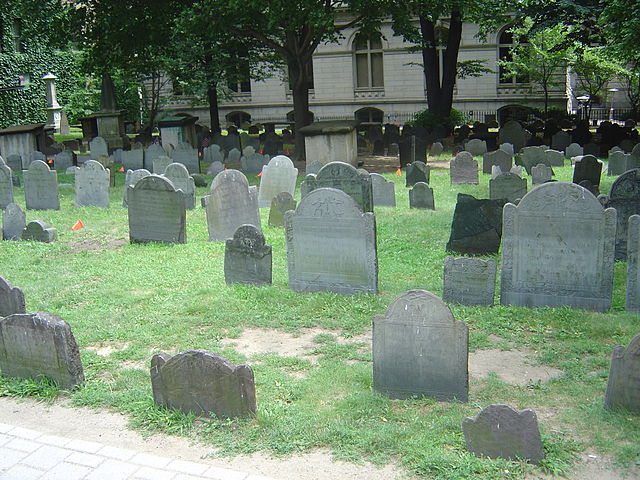
It was a part of my duty as an assistant in the domestic affairs of the family, to have the care of the cow. One evening, after it was quite dark, I was driving the cow to her pasturage,—the common. Passing by the burial-ground, adjoining the Stone Chapel, I saw several lights that appeared to be springing from the earth, among the graves and immediately sinking again to the ground, or expiring. To my young imagination, these lights could be nothing but ghosts. I left the cow to find her way to the common, or wherever else she pleased, and ran home at my utmost speed.

Having told my father the cause of my fright, as well as I was able, while in such a state of terror and agitation, he took me by the hand and led me directly to the spot, where the supposed ghosts were still leaping and playing their pranks near the surface of the ground. My hair rose on end, and seemed to lift my hat from my head. My flesh was chilled through to my very bones. I trembled so that I could scarcely walk. Still my father continued rapidly marching towards the spot that inspired me with so much terror.

When lo! there was a sexton, up to his shoulders in a grave, throwing out, as he proceeded in digging, bones and fragments of rotten coffins. The phosphorus in the decaying wood, blended with the peculiar state of the atmosphere, presented the appearance that had completely unstrung my nerves, and terrified me beyond description.

I was never afterwards troubled with the fear of ghosts.
So nothing to worry about, kids! Just the sexton digging up old bones and glow-in-the-dark coffins to make room for new bodies.

And since I’ll speak at Old North Church tomorrow about Revolutionary Boston’s schools, here is Buckingham on Russell’s education:
When quite a child Russell was noted for a remarkably retentive memory and more than ordinary facility in learning the tasks prescribed by his teacher. He was placed at the public school taught by Master [James] Carter, whose aptness in teaching and mildness of discipline were somewhat celebrated. Nothing was then taught in the common schools of Boston but the simplest elements of education. The tasks, that Russell had to perform, embraced nothing but easy lessons in reading, writing, and arithmetic.
No science, history, geography, or other subjects.

Wednesday, June 14, 2017

Looking at Ben’s Revolution

This spring brought us a new book from Nathaniel Philbrick, author of Bunker Hill and Valiant Ambition, and Wendell Minor, jacket designer for John Adams and 1776. Unlike those books, Ben’s Revolution is written for young readers.

In its format, Ben’s Revolution is a rarity among recent children’s books, almost a unicorn. It’s a “picture storybook.” At sixty-four pages it’s twice the length of a typical picture book today (through a lot of picture books used to be that length). That means the publisher invested in about twice as many illustrations, and paid twice the printing and paper costs. The book’s word count is similarly supersized, far above the 500 words aspiring picture-book authors are told to limit themselves to.

Penguin was no doubt willing to go beyond the normal parameters of a modern picture book because of the names involved: Philbrick, a bestselling author; Minor, a highly respected artist; and the Revolutionary War, a staple of American school curricula. In fact, that probably wasn’t a difficult calculation at all. But picture-book authors without such a track record shouldn’t take Ben’s Revolution as a model.

In content, Philbrick built this book around the experiences of Benjamin Russell, subject of several Boston 1775 postings. Young Ben starts the book as a schoolboy in Boston, serves time as an off-the-books clerk for a provincial military company in the first months of the war, and finishes as an apprentice to printer Isaiah Thomas. Russell actually witnessed some of the fighting on 19 April and 17 June 1775, and those stories provide the backbone of the book.

Philbrick also uses two anecdotes of unnamed boys from this time, casting Ben Russell as the protagonist. He becomes one of the boys who demanded that Gen. Frederick Haldimand preserve their coasting run down School Street. He’s the boy who hears Col. Percy’s musicians playing “Yankee Doodle” and tells the earl that he’ll dance to that tune by sundown. In addition, the book gives us a look at such events as the Tea Party, the shots on Lexington common, and the British evacuation of Boston without straining to put Ben on the scene.

All those moments are handsomely painted by Minor, who in addition to designing iconic jackets has also illustrated many children’s books, specializing in Americana and nature. A few years back Minor illustrated a biography of Henry Knox which I found beautiful but riddled with errors. This time my only big quibble about the art is that Minor depicts Ben and his young friends with the haircuts of today’s boys—a fairly common approach to portraying the period, whenever an artist works. As I’ve noted, the fashion for boys in the 1770s was suspiciously close to a mullet.

The nature of Ben Russell’s actions, and of how he and others through Philbrick and Minor chose to tell his story, means there are no female characters in the story. Even Ben’s mother is mentioned only from afar. And there are very few females visible in the art. Likewise, Russell didn’t say anything about the black or Native soldiers in the provincial camp, and I spotted only two darker faces in the pictures’ backgrounds, one in the redoubt on Breed’s Hill.

I should note that Nat Philbrick and I have shared conversations and manuscripts about Revolutionary Boston for a while. Ben’s Revolution therefore reflects the argument I made in The Road to Concord that Gen. Thomas Gage triggered the war by sending troops “on a secret mission to seize the cannon that the patriots had hidden in Concord.” I now have hopes that the next generation of Americans will grow up with that story instead of the assumption that the British were hunting John Hancock and Samuel Adams.

Tuesday, August 26, 2014

Wire-Worker Adams at Boston’s Last Town Meetings

The wire-worker Samuel Adams was a prominent character in nineteenth-century Boston, as Kathryn Griffith described in her recent profile for the Bostonian Society.

He started the century as town crier before going into the business of manufacturing screens and other wire objects. Later he became an indefatigable voice on the political left.

In 1884 James Mascarene Hubbard delivered a paper to the Bostonian Society about Boston’s transition from town to city in the early 1820s. His description of a town meeting in Faneuil Hall over the turn of the year 1822 offers glimpses of this Samuel Adams, as filtered through the Daily Advertiser:
[On whether to relabel Boston as a city.] Finally a hearing was obtained for Mr. Samuel Adams, wire-worker, that is, a maker of rat-traps, and late town-crier, who made a characteristic speech amid malicious “cries of Louder” although the orator appeared to labor excessively at his lungs. His opening words were, “Fellow citizens, you must consider me as on the brink of an eternal world,“ [Adams was then in his early sixties, but he would live three more decades] and the burden of his speech was, “Names is nothing. Only let us have Boston, and I care not what you call it.” Later on in the debate, which from this time took a more serious turn, he “rose and moved that the word ‘Boston’ be added to the word ‘city,’” to the great merriment of the assembly. . . .

[On what to call the new city’s top official.] Mr. Adams made a fresh appearance in the character of a New England Dogberry. “He was opposed to the term Mayor. A mare is a horse, and he had as lief be called a horse or an ass as a mare. He preferred the name President. There was dignity in the sound. He should count it an honor to be called President, but had he the wisdom of Solomon and the riches of the East, he would not accept the office to be called a Mare.” . . .

[On whether to hold elections in the neighborhoods or at Faneuil Hall.] As the irrepressible Adams puts it: “Many persons can’t attend here. For instance a journeyman who is in your employ. They feel so delicate in your employ, they are afraid of offending you. They are the sinners [sinews] of the State.” . . .

On the clause authorizing the City Council to sell or lease the property of the city,…Mr. Adams [was heard] to say, among other things, that “a new set of men might get together under the capacity of selling city property.” . . .

Our final quotation shall be from a speech by Mr. Adams, whose office as Town-crier seems to have given him a power and persistence of lungs which no cries of “Question” could overcome. “I would examine the act,” he exclaimed; “Like David of old, I would not give sleep to my eyes nor slumber to my eyelids until I had pondered it well. I have done it, have lain awake all night ruminating on these here things.”
Hubbard suggested that Adams belonged in a group he called ”mushroom town-meeting orators, and weak heads.” He showed more respect for upper-class figures, including such men as Benjamin Russell, William Tudor, James T. Austin, future mayor Josiah Quincy, and S. A. Wells, descendant and biographer of the other Samuel Adams.

Boston’s business elite had been pushing to incorporate the town as a city like New York since the early 1700s. The populace had long pushed back, preferring the town-meeting form of government, which didn’t turn over power to just a few elected men.

Wire-worker Adams appears to have been suspicious about concentrating power, to judge by his support for neighborhood elections and poorly expressed worry about a conspiracy to sell public property. But he also seems to have been fairly resigned to the change. Boston had grown to more than 40,000 people, nearly three times its size when he was a boy, and a city charter may have seemed necessary.

Ironically, by 1835 the term “wire-worker“ became a synonym for “wire-puller”—someone who manipulated politics or government from behind the scenes. Samuel Adams was a real wire-worker, and he never seems to have held significant power, despite all his efforts.

TOMORROW: What did this Samuel Adams do in the Revolution?

Tuesday, August 12, 2014

Dispatch from the Green Dragon

I’m typing this in a coffee house in Carlsbad, California. But not just any coffee house—the one attached to the Green Dragon Tavern and Museum.

I reported on the plans for this complex and its opening last year. So when I made plans for a convention in San Diego, I included time to drive forty minutes up the coast to south Carlsbad and check it out for myself.

I went thinking I’d find something fairly kitschy: a replica of the original Green Dragon (as depicted by John Johnson) tacked onto a California strip mall.

And in fact the site is in an area of strip malls. Next door is a car wash with a lovely Southwestern tile roof, as seen in the background of this photo. The first thing one sees getting off that exit from I-5 is a giant windmill attached to a motel.

But the Green Dragon Tavern and Museum is a more extensive and substantive enterprise than I’d expected. In size, it’s not just part of a strip mall—it’s an entire strip mall’s worth of structures. The part made to look like the original tavern is the main restaurant dining room, two levels high, and the coffee shop and bookstore. On the far side are a series of meeting rooms for special dinners.

And in between is a museum devoted to the owner’s interests in New England history, particularly the Revolution but starting in Plymouth Colony and including the Salem Witch Trials. The displays include replicas of significant documents and many original artifacts bearing the signatures of famous historical figures: legal documents signed by Samuel Sewall, Thomas Hutchinson, John Adams, and Robert Treat Paine, for example.

Throughout the building are framed copies of early American newspapers, mostly from the last two decades of the eighteenth century. And by throughout, I mean throughout. The hall to one set of restrooms, for example, includes a 1783 issue of the Providence Gazette and two issues of Benjamin Russell’s Columbian Centinel from the early 1790s. In another issue of the Centinel I spotted a big advertisement from Samuel Gore, one of “my guys.”

Amidst those genuine period documents are reproductions of nineteenth-century popular art, posters of the most famous Founders, postcard photographs of national monuments, and so on. So there’s definitely the potential for hagiographic kitsch. But the quotations on those Founder posters all have citations to particular documents (which is more than some folks can provide). There’s a display clearly explaining the eighteenth-century long s to visitors. Some of the labels discuss how American historiography or commemoration has changed over time.

I quibble with some of the historical statements I see in the displays or literature. I don’t think of the Sons of Liberty as a “secret society” but rather an amorphous political label like “Tea Party” or “Occupy Movement.” I don’t think “Paul Revere departed the Green Dragon Tavern for his famous ride,” though he definitely spent a lot of time there. But for me the list of quibbles is small.

The bookstore attached to the coffee shop includes a lot of popular titles for both kids and adults, focusing mostly on the Founders (and including some I think are flawed). However, the selection includes ground-breaking biographies from academics, including Woody Holton on Abigail Adams and Jill Lepore on Jane Mecom. And I can’t complain about any store carrying Reporting the Revolutionary War, with two essays by me.

The restaurant has wood paneling and a fireplace, but it’s not trying to be a period site (at least at lunchtime). There are multiple televisions tuned to sports channels. The menu may have sandwiches named after Boston Revolutionaries, but they’re all California cuisine, heavy on the avocado.

Overall, the Green Dragon Tavern and Museum is a solid little private museum with a significant number of print artifacts to examine, particularly newspapers. In its emphasis on the most prominent Founders, their signatures, and genealogy, its sensibility is old-fashioned, but within that sensibility the standards are high. The site is a very short drive off I-5, so I feel confident recommending it to folks traveling between San Diego and Los Angeles and seeking a genuine taste of the Revolutionary Era (as well as California cuisine).

Thursday, July 03, 2014

A Different Point of View on the “Bunker Hill” Song

As I discussed yesterday, in post-Revolutionary Boston young veterans of the war preserved and passed around the words to a song about the Battle of Bunker Hill written from the British point of view.

They had different things to say, however, about who had written that song:
  • The first surviving broadside says it was “Composed by the British Soldiers,” and an 1811 reprint says it was “Composed by the British.”
  • A handwritten copy of the verses kept by the merchant John Marston credited “one of the British army.”
  • The historian Samuel Swett apparently had a broadside headlined “Composed by a British Officer after the engagement.”
  • Either working with more information or splitting the difference between his sources, Swett labeled the lines “Extracts from a song said to be written by a British Serjeant” in his 1826 book.
  • Finally, in the 1830s newspaper publisher Benjamin Russell told a visitor that the song had been “written by a common British soldier, who afterwards deserted to the Americans, and used to sing it in the American camp.”
I’m inclined to think the song came from the British enlisted ranks rather than from an officer. Whether or not that lyricist deserted, some deserter may well have carried the lyrics across the siege line. Russell was in the American camp until August 1775 (when his father grabbed him), so he could have heard the song first- or second-hand. But of course there could have been a lot of distortion in memory or oral tradition over the next sixty years.

And there was even more distortion to come! Sometime in the mid-1830s the Boston printer Leonard Deming reprinted the song once more. His broadside said “Battle of Bunker Hill” had been “Composed by a British Officer, the day after the Battle, June 17, 1775.”

And something curious happened as Deming’s shop put the lyrics into print. His text matches the earlier broadsides closely through the bottom of the first column. Then the next stanza is based on lines that had appeared toward the end of the preceding versions, with some changes. It says:
Brave Howe is so considerate,
As to guard against all dangers;
He allow’d each half a gill this day,
To rum we are no strangers.
The earliest printed version said:
Brave Howe is so considerate, as to prevent all danger,
He allows us half a pint each day, to him we are not strangers:
The Deming broadside reproduced two more stanzas intact, but then the American typographers apparently got fed up with all that British boasting. For the rest of the song they rewrote nearly every verse to criticize the British commanders and praise the Americans. The new lines went:
And when the works were got into,
And put them to the flight, sir,
They pepper’d us, poor British elves,
And show’d us they could fight, sir.

And when their works we got into,
With some hard knocks and danger;
Their works we found both firm and strong,
Too strong for British Rangers.

But as for our Artillery,
They gave all way and run,
For while their ammunition held,
They gave us Yankee fun.

But our commander, he got broke,
For his misconduct, sure, sir;
The shot he sent for twelve pound guns,
Were made for twenty-fours, sir.

There’s some in Boston, pleas’d to say,
As we the field were taking,
We went to kill their countrymen,
While they their hay were making.

For such stout whigs I never saw,
To hang them all I’d rather;
By making hay with musket balls,
Lord Howe cursedly did bother.

Bad luck to him by land and sea,
For he’s despis’d by many;
The name of Bunker Hill he dreads,
Where he was flogg’d most plainly.

And now my song is at an end,
And to conclude my ditty;
’Tis only Britons ignorant,
That I most sincerely pity.

As for our King and William Howe,
And General Gage, if they’re taken,
The Yankees will hang their heads up high,
On that fine hill call’d Beacon.
Compare those lines, especially the last, with the original.

There’s no indication on the Deming broadside that it didn’t offer the original lyrics, so later authors took those lines to be authentic. There’s even a lesson plan from the Library of Congress using the 1830s broadside as a Revolutionary text. It says, “within hours of the battle, it also inspired an unknown British officer to set down his own impressions in verse. As you read his account of the bloody day and notice his clear respect for his enemies, you might think about how a different point of view can shed new light on even the most familiar events.”

So here I am shedding new light with a different point of view. We don’t know who wrote the original song, but we know the lyrics on the Deming broadside from the 1830s were not written by a British officer in 1775.

Wednesday, July 02, 2014

“It has been copied so many times, for the last fifty years”

It’s no surprise that British soldiers composed a song about the Battle of Bunker Hill, as quoted yesterday. After all, they won the fight, and then they had several months in Boston to fill. What’s surprising is that the song was printed and preserved in American broadsides and archives.

It’s conceivable that the song was first printed inside Boston during the siege by one of the remaining Loyalist printers, and a copy of that remained after the evacuation. However, there’s strong evidence that Massachusetts youths of the Revolutionary generation passed along the song.

Complicating the picture a bit is that in 1811 the Boston printer Nathaniel Coverly reissued the verses on a broadside headlined “BATTLE OF BUNKER HILL. This Song was composed by the British, after the engagement.” That had the same text and punctuation as the earlier printing, but Coverly broke the long rhyming lines in two to produce twenty-four stanzas instead of twelve. That broadside could have reinforced and distorted people’s memory of the song from Revolutionary times, but people don’t seem to have noticed it.

After the fiftieth anniversary of the battle, Samuel Swett began to work on his History of Bunker Hill Battle. On 17 Apr 1826 a Quincy man named John Marston (1756-1846) wrote this to him:

Agreeably to your request, I send you a copy of the British song, on the battle of Bunker Hill. I will not vouch for its perfect correctness. It has been copied so many times, for the last fifty years, there are probably some mistakes and omissions.

You will observe a word is wanting at the end of the fourteenth verse, to rhyme with “danger.” I believe the meaning of the word wanting is, coward or cowardice. It was a favorite object of the British to represent us as cowards, and that we could not fight except behind stone walls and breast-works.
Marston’s handwritten copy was headed, “A song on the battle of Bunker Hill, composed by one of the British army, June, 1775, Tune—‘When Sawney up to London came.’” Compared to the previously printed texts, Marston omitted two stanzas and occasional words, and transposed two other stanzas.

In addition, in 1838 E. C. Wines wrote this about visiting Bunker Hill in A Trip to Boston, in a Series of Letters to the Editor of the United States Gazette:
I considered myself fortunate in having so excellent a guide as Major [Benjamin] Russell, who, he says, was on the spot the day when the battle occurred, and saw the whole of it, though, as he was but a mere stripling, he took no active part in it. Being, however, a “looker-on in Venice,” he is familiar with every locality and with all the incidents of the day. He gave me a minute and graphic account of the battle, specifying all the leading events, and pointing out the place where each one happened.

Among other things, he repeated a doggerel description of the battle, written by a common British soldier, who afterwards deserted to the Americans, and used to sing it in the American camp. It has no poetical merit, but as the Major declares it to be perfectly accurate in its facts, and as it has never yet appeared in print, I venture to transcribe it.
Wines then wrote out a ten-stanza version of the song. Despite being Boston’s leading Federalist publisher, Russell (1761-1845, shown above) apparently didn’t know that those lines had been published at least three times before.

Thus, Bostonians who were teenagers during the Battle of Bunker Hill preserved this British army song about the fight and helped it get into history books over half a century later.

TOMORROW: So who wrote those lines? And why do we remember a different version?

Tuesday, June 03, 2014

Benjamin Russell Saved from Lightning

Benjamin Russell (1761-1845) was the publisher of the Columbian Centinel, Boston’s most powerful Federalist newspaper, and an employer or mentor of many printers in the early republic. He had great influence in state politics and even held political office himself.

In shifting from the printing press, where a man literally got his hands dirty, to offices traditionally reserved for gentlemen, Russell followed in the path of Benjamin Franklin. In fact, Russell might have owed not only his career but his life to Franklin.

The Printer Boy, or How Benjamin Franklin Made His Mark, authored by William Makepeace Thayer (1820-1898) in 1864, includes this anecdote about Russell as a lad:

A very little knowledge of electricity once saved the life of Benjamin Russell in his youth. He was an eminent citizen of Boston, born in the year 1761, and in his younger years he had learned from the writings of Franklin, who had become a philosopher, that it was dangerous to take shelter, during a thunder-shower, under a tree, or in a building not protected with lightning-rods.

One day, in company with several associates, he was overtaken by a tempest, and some of the number proposed that they should take shelter under a large tree near by, while others advised to enter a neighbouring barn. But young Russell opposed both plans, and counselled going under a large projecting rock as the safest place.

The result showed that a little knowledge of electricity was of great service to him; for both the barn and the tree were struck by lightning.
Obviously, Thayer or someone he spoke to had heard this tale from Russell. Alas, the surviving story doesn’t say how old Benjamin and his friends were when they had this experience.

Thursday, May 03, 2012

Which Teacher Said, “War’s Begun”?

Last month Prof. Chris McDonough of the University of the South queried me about how Master John Lovell (shown here) of Boston’s South Latin School announced an end to the school day on 19 Apr 1775. Did he make the announcement in Latin or English or both? I’d noticed a discrepancy, but hadn’t tried to nail it down until then.

Our main (and perhaps only) source for that day in the South Latin School is the recollection that politician Harrison Gray Otis wrote down in 1844, quoted here:

As I entered School I heard the announcement of “deponite libros” and ran home for fear of the regulars.
Deponite libros [put down your books]” was the traditional way that Latin School masters signaled the end of every school day. It just came early that April morning.

Meanwhile, an alumnus of the Writing School on Queen Street, the newspaper publisher and politician Benjamin Russell, recalled how Master James Carter had closed that school. People recorded Russell’s anecdote in a couple of different ways.
  • “Master Carter then said: ‘Boys, war has begun; the school is broken up’,” quoted here.
  • “Master Carter said,—‘Boys, the war’s begun, and you may run’,” quoted here.
It makes sense for Carter to give his instructions in English.

In 1880, Henry F. Jenks wrote a history of Boston’s South Latin School that quoted Otis’s letter but added to it the line ”War’s begun and school’s done,” evidently inspired by Russell’s story. I haven’t found those words in any previous publication.

Jenks’s book was prestigious and widespread enough that his formulation went into a lot of reference books and histories over the next few decades. In fact, in 1887 a writer in The Nation responded to a recent article in The Magazine of History with this quibble:
And when Mr. Benjamin tells of “Master Carter,” in Boston, saying to his pupils, “Boys, the war’s begun, and you may run!” is he not thinking of Master John Lovell, of the Public Latin School, whose formula of dismissal was—“War’s begun and school’s done”?
Master Carter had been totally forgotten, and his best line assigned to someone else!

Saturday, October 08, 2011

Benjamin Russell, thirteen-year-old company clerk

When we left thirteen-year-old Benjamin Russell yesterday, he and some schoolmates had walked out of Boston behind Col. Percy’s reinforcement column on 19 Apr 1775, and stayed in Cambridge while the British troops continued west. At the end of that exciting day, the boys discovered that they couldn’t get back into Boston. And, we can presume, their families were discovering that they had disappeared.

Russell later wrote that he and his chums “could not inform our parents of the situation.” Of course, over the next several weeks people got passes to go into Boston, the two competing military authorities exchanged written messages, and friends and relatives sometimes met at the lines to share news.

Young Benjamin and friends knew how to write. They had just come from the Queen Street Writing School, after all. They were sleeping at Harvard College, where, Russell later recalled, Samuel Hall had set up a printing press issuing “streams of intelligence, and those patriotic songs and tracts which so pre-eminently animated the defenders of American liberty.” They surely could have gotten some pens and paper.

In fact, by late June, according to Russell’s account, the boys had been drafted as company clerks.

It fell to my lot to become the clerk of the company of Connecticut troops commanded by Captain [Daniel] Putnam, a nephew or son of the General [Israel Putnam, shown above]. We were stationed with other troops on Prospect Hill, where the General was in command.
Obviously, Benjamin and the other boys were having too much fun to tell their parents, and risk being told to do something else. They even got to watch some military action. When they heard cannonading on 17 June, they hiked over to Charlestown. According to eulogist Francis Baylies:
Several of the boys…crossed and recrossed the neck during the battle—that same neck over which an American officer told General Putnam no one could cross and live. General Putnam, who was a great favorite with the boys, in his eccentric movements on his “long-tailed Connecticut horse, often came near us,” says Major Russell, “and then we cheered him with an huzza for Old Put.”
But fun like that couldn’t last, as Russell explained:
One day [in August] I was returning from the Commissaries’ depot, with the weekly provisions of the company, having four men with me, and I met my father and uncle, who had just escaped from Boston. My father had not seen or heard of me since the 19th of April. He was so rejoiced to see me, that he was about to shake me for not writing to him.

One of the soldiers took fire—“Don’t shake that boy, Sir,” said he, “he is our clerk.”
Benjamin explained his situation. His father hauled him off immediately to Gen. Putnam. The general discharged the boy into his father’s custody—honorably, he said.

The next day, John Russell took his son to Worcester and indentured him to a young printer who had moved his Massachusetts Spy out there: Isaiah Thomas. (For Russell’s recollection of working for Thomas, see this posting.) Benjamin Russell didn’t officially enlist in the Continental Army until July 1780, at the age of eighteen.

Friday, October 07, 2011

Benjamin Russell’s Busy Day

I’ve previously quoted Joseph T. Buckingham’s account of how young Benjamin Russell (shown here as a dignified publisher and politician) experienced the outbreak of the Revolutionary War. Russell wrote his own account as well; it doesn’t seem to have been published, but Francis Baylies summarized and quoted from it in his eulogy for Russell in 1845.

Benjamin was born in September 1761, so he was nearly at the end of his career at Master James Carter’s writing school in April 1775. Baylies’s account:

In the morning, soon after the opening of the town school (which was kept in Scollay’s Buildings [later Scollay Square, now gone]), martial music was heard, and the Regulars were seen in motion. They were soon paraded in Long Acre [Tremont Street], and the line extended from the head of the Mall [Park Street] to the head of Queen [Court] Street, facing which was the school-house. Lord Percy, mounted on a white horse, was busy in arranging the column. . . .

When these movements were seen, Master Carter sent out one of the boys for information. It came full soon. The British had fallen on the Americans at Lexington, killed several, and sent for a reinforcement. [It seems too soon for Bostonians to have heard about the shooting at Lexington, but they did know of the departure of an earlier column of royal troops, so Percy’s mission was clear.]

Master Carter then said: “Boys, war has begun; the school is broken up.” This announcement was received with three cheers, and the boys, having gained their own freedom, sallied forth to see whether the men would gain theirs.

They followed in the rear of the column, when the British took up the line of march, and at Roxbury, through the courtesy of the Provost Marshal, (an unwonted quality in such characters,) they were permitted to pass the fortifications, and followed as far as the Colleges in Cambridge. The boys being wearied, rested on the Common, and Lord Percy’s column proceeded through West Cambridge to Lexington.

The boys remained in play on the common until near sunset, and as the firing then appeared to be near, they ascended a rising ground and saw the British army, followed by the Americans, in full retreat. They heard the whistling of the bullets, but…knew not what it meant, until they were informed by Farmer Hastings, of Cambridge [probably Jonathan Hastings, not a farmer but steward of Harvard College], that they were in danger.

They descended, regained the Cambridge road, and began to think of eating, for since breakfasting they had taken no food. On an examination, they found their pockets nearly as empty as their stomachs, but through the kindness of Mr. Hastings, they obtained a supper, and lay down to their rest in one of the colleges, and amidst the din of arms they slept the sleep which heaven in its mercy sends to the weary and the young.
According to Russell himself, the boys awoke with “nothing to regret except that, owing to the closeness of the siege, we could not inform our parents of our situation.”

TOMORROW: Do the Russells ever find young Benjamin?

Saturday, June 11, 2011

William Russell’s Writing

Last month the Seth Kaller auction house alerted me to this collection of the Revolutionary War documents of William Russell (1748-1784), a Tea Party participant, charter member of Col. Thomas Crafts’s militia artillery regiment after the war began, privateer crewman under Capt. John Manley, and twice prisoner of war.

The collection includes a note from Crafts and several letters written home while Russell was in captivity in Britain or New York harbor. I see mentions of Benjamin Edes and James Brewer. Some of the material has been published in The Ships and Sailors of Old Salem, by Ralph D. Paine.

According to Francis S. Drake’s Tea Leaves, Russell was “sometime usher in Master Griffiths’ school, on Hanover Street, below the Orange Tree.” John Griffith was a private schoolteacher, rather than one employed by the town. I’ve long wondered how he had enough students to hire an usher, or assistant teacher.

Handwriting was a major part of the colonial curriculum, and Russell’s ability to write clearly was a big part of his military career. As sergeant major of Crafts’s regiment, he wrote out the first list of recruits. Later he was the regiment’s adjutant, or administrative officer, during an attempt to drive the British military from Newport.

On board Manley’s ship, Russell was a clerk. The captain was reportedly barely literate, so a clerk would have been a good thing. During his first stint as a prisoner, in the Mill Prison in England, Russell kept a detailed diary, which I believe is now at the Peabody Essex Museum. Someday I’ll quote from the published version.

Russell’s name appeared on the first published list of Tea Party members, in the back of Traits of the Tea Party (1835). One of Russell’s sons, John, had grown up to be an apprentice at the Massachusetts/Columbian Centinel; I’ve theorized that that newspaper’s publisher, Benjamin Russell, was the source of that first Tea Party list.

The same year that book came out, as the Boston Tea Party became famous, John Russell gave a lecture about the event in Salem, and of course he invoked his father’s name. I should note, however, that John Russell was born in 1779, so he had no first-hand knowledge of what happened in 1773. He was also only five years old when his father died, so he probably couldn’t sort out what he’d heard his father say from what he’d heard from other relatives. Still, Russell’s connections to Crafts and other activists make it likely that he did help to destroy the tea.

Thursday, December 23, 2010

Tea Party Boys “Living with Tory Masters”?

When Ben Carp was writing Defiance of the Patriots: The Boston Tea Party and the Making of America, we disagreed about Joshua Wyeth, the first man associated with the phrase “Boston Tea Party.” Ben thought that there was enough evidence to make him basically credible. I was suspicious about his story of helping destroy the East India Company’s tea in 1773.

Here’s how Francis S. Drake quoted Wyeth’s account in the magazine Old and New in 1874 and his book Tea Leaves in 1884:

It was proposed that young men, not much known in town, and not liable to be easily recognized, should lead in the business. Most of the persons selected for the occasion were apprentices and journeymen, not a few of them, as was the case with myself, living with tory masters.
Why, I asked, would the Boston radicals select apprentices and journeymen for this sensitive job which required minimal violence when the mindset of the time was that boys and young, unanchored men easily went out of control?

Even more important, why would they entrust such a big secret to boys who depended on known Loyalists for their food, clothing, shelter, and future livelihood?

And most important, I said, Joshua Wyeth was not living with a “tory master” in 1773. He recalled working for a blacksmith named “Watson” or “Western.” That man was actually Obadiah Whiston, and actually a mighty big radical. Here’s Whiston’s rap sheet:
  • 24 Oct 1769: As a British army company marched back from the gate on Boston Neck, a crowd followed them, shouting and throwing stuff, because their officer refused to answer a warrant about stealing firewood. One soldier’s musket went off, the bullet striking the doorway of Whiston’s forge on Orange Street. He shoved his way into the ranks and slugged that soldier in the face.
  • 5 Mar 1770: Alarm bells rang in the center of town, and Whiston ran in that direction. Someone told him there was no fire, only a fight between civilians and soldiers. So Whiston went on ahead, ready to get some punches in. Later he testified to town magistrates about the ensuing Boston Massacre.
  • October 1774: Whiston hid two purloined militia cannons in his forge so that the British army couldn’t confiscate them, and helped the Patriots smuggle them out to a tavern in Dorchester.
Those don’t seem like the actions of a Loyalist.

Whiston became a “tory” in early 1775—a switch that’s still mysterious. On 5 February, Dr. Joseph Warren wrote to Samuel Adams that the blacksmith “has hitherto been thought firm in our cause, but is now making carriages for the army.” That change must have thrown his apprentices for a loop.

And Wyeth must have been an apprentice, despite Drake calling him “a journeyman blacksmith in the employ of Watson and Gridley.” He was only sixteen years old, not close to being a legal adult.

My theory was that at the Tea Party Joshua Wyeth was just a wannabe or hanger-on. Maybe he was one of the teenagers who pushed their way into the event and were put to cleaning up. But the account attributed to him just didn’t make logical sense or fit the historic facts.

After moving out to Cincinnati, I theorized, Wyeth found he was the only Boston man around—the only source of stories about the famous pre-Revolutionary troubles. Wyeth could turn himself from an apprentice to a journeyman. He could describe being summoned to help destroy the tea. He could explain to the world that having a “tory master” was actually an asset, not a reason for suspicion. He could come up with the cute name “Boston Tea Party.” And there was no one around to contradict anything he said.

That wasn’t just my theory. Back in 1827, after the Western Monthly Review published a profile of Wyeth as a Tea Party participant, the Boston Gazette fired back. As I’ve already noted, the editor of that paper, Benjamin Russell, kept track of Bostonians who had been at the Tea Party. His Gazette noted errors in Wyeth’s account, including the detail about young men being chosen to “lead in the business,” and insisted that at most Wyeth had been a spectator.

Hard-nosed skeptics like Russell and me might be responsible for the footnote in Defiance of the Patriots acknowledging that Wyeth’s account might contain some fudged details.

TOMORROW: Digging deeper into Wyeth’s story.

Sunday, March 07, 2010

Sleeping on Linen Rags

At last night’s Boston Massacre reenactment I got to see a number of familiar faces, and a couple of new ones: the gents from TeachHistory and RagLinen. The latter had, in fact, come all the way from Chicago to witness the event.

This brief posting, therefore, is in honor of rag linen, which printers collected to give to their paper-makers so they could eventually have more paper to print on. Particularly during the war, when imports from Britain were scant, newspapers contained a lot of advertisements asking homemakers to bring in scraps of linen for recycling.

The printer Joseph T. Buckingham collected this anecdote from an older printer, Benjamin Russell (1761-1845, shown here), who had been a teen-aged apprentice to Isaiah Thomas around 1776. Feeling threatened by the army, Thomas had left Boston in a hurry just before the war broke out. He had a tough time establishing himself in central Massachusetts. Buckingham wrote:

Mr. Thomas was not, at that time, in very affluent circumstances. During the first year or two of his apprenticeship, Russell, with a fellow-apprentice, slept in a garret, over the printing-office, on the rags that were taken in from time to time for the paper-maker.

Not only his apprentices, but the master himself, frequently made their meals in the office on bread, and “milk bought by the penny-worth at a time.”
Eventually Thomas was able to put his Massachusetts Spy newspaper on firm footing in Worcester, and became one of America’s pioneering printers of children’s books (mostly pirated from Britain). He founded the American Antiquarian Society.

Benjamin Russell also became a prosperous printer, publishing the Columbian Centinel, Boston’s leading Federalist newspaper, and Boston Gazette. Over the course of his career, printers moved from being ink-stained members of the working class to influential shapers of opinion, and Russell ended up in the state senate and on the governor’s council.