J. L. BELL is a Massachusetts writer who specializes in (among other things) the start of the American Revolution in and around Boston. He is particularly interested in the experiences of children in 1765-75. He has published scholarly papers and popular articles for both children and adults. He was consultant for an episode of History Detectives, and contributed to a display at Minute Man National Historic Park.

Subscribe thru Follow.it


•••••••••••••••••


Showing posts with label Edes and Gill. Show all posts

Monday, November 03, 2025

“The Disease was rapid and poignant”?

Last month I faced a Boston 1775 emergency.

Which was, of course, not really an emergency. No one was in the least danger. I just felt an urgent need to confirm a statement I’d been repeating for years and suddenly had reason to question.

This dire situation arose because I asked myself how the coroners of Suffolk County responded to the death of William Molineux on Saturday, 22 Oct 1774.

John Rowe wrote in his diary that Molineux died “suddenly,” though Dr. Joseph Warren had visited the man the day before. Thomas Newell recorded death came “after three days’ illness,” Molineux’s political work having “produced an inflammation of the bowels.” John Andrews said Molineux died “After surviving a fit of apoplexy two days.”

By the time the Monday newspapers appeared, the Patriots had their story down. Edes and Gill’s Boston Gazette declared:
His Watchfulness, Labours, Distresses and Exertions to promote the general Interest, produced an Inflammation in his Bowels: The Disease was rapid and poignant; but in the severest Pangs, he rose superior to Complaint; he felt no Distresses but for the Public.
As for the Boston Post-Boy and Boston News-Letter, friendly to the royal government, they didn’t report Molineux’s death at all.

Some diarists and the Boston Gazette said that Molineux’s last words were “O SAVE MY COUNTRY HEAVEN!” That may even have been true, but I must note that “Oh, save my country, heav’n!” is a line from Alexander Pope’s Moral Essays. And that Molineux was notorious in his time for being a deist.

By March, Loyalists were publicly hinting that Molineux had committed suicide: through “the Laudanum of Doctor Warren, he quitted this Planet.” But there were also rumors, recalled by George Robert Twelves Hewes, that British army officers had poisoned the man.

That muddled situation led me to wonder if there was any official verdict on Molineux’s death. Massachusetts had inherited the English system of county coroners convening juries and holding inquests on suspicious deaths.

Unfortunately, not much paperwork seems to survive from inquests in pre-Revolutionary Massachusetts. There’s a small cache of documents relating to the Boston Massacre, probably saved those for their historic significance. Otherwise, collectors preserved a few determinations of coroners’ juries because they contained notable signatures.

Furthermore, in late 1774 the Massachusetts judicial system was being brought to a standstill by Patriot protests over judicial salaries and the Massachusetts Government Act. Some men, most prominently Molineux, refused to serve on juries. Outside Boston, crowds were blockading courthouses. Did that shutdown extend to coroners’ inquests as well?

Those questions led me to look more deeply into the coroners. How many were there? How long did they serve? How did they operate?

TOMORROW: Reading the law.

Friday, May 30, 2025

“Lucky for the Town that the Fire broke out in the Day Time”?

Just above its report on the Royal Navy store ship that caught fire in Boston harbor on 29 May 1773 (quoted yesterday), Richard Draper’s Boston News-Letter ran this brief item about another event that same day:
Saturday last being the Anniversary of the Restoration of King Charles II. a Feu de Joy was fired on board the Men of War in this Harbour.
Ordinarily, royal anniversaries like the king’s and queen’s birthdays were celebrated by both civil and military authorities in Boston. In this case, there was a conspicuous absence of cannon salutes, bell-ringing, or toasts inside the town.

New England had generally supported the Parliamentary side in the English Civil War and the Protectorate of Oliver Cromwell that followed. Its people and elected officials shielded regicides from Charles II’s retribution. Most British people thought the Glorious Revolution of 1688 was a Good Thing, but New Englanders were particularly convinced that deposing the Stuarts was a necessary course correction as the kingdom sank back into papist tyranny.

Therefore, local forts and authorities didn’t join the Royal Navy in celebrating the Stuart Restoration that May day in 1773. But did the descendants of Puritans begrudge the military’s action?

Of course they did. Thomas and John Fleet’s Boston Evening-Post reported the same event this way:
Saturday last being the anniversary of the Nativity and Restoration of King CHARLES II. the Colours, (as usual on Red Letter Days) were displayed on board the Flag Ship here, and at One o’Clock a Feu de Joy from her and the Gibraltar (being the only Ships of War we had then here to protect us) was all the Notice, as we have yet heard, that was taken to honor the Memory of the execrable Race of the STEUART Family.
Even the newspaper’s use of the phrase “Red Letter Days” was fraught with meaning. Those were the saints’ days on the Anglican calendar, shunned by the Puritans. As late as 1758 Roger Sherman had to explain why he acknowledged those dates in the almanacs he published “to serve the Publick” of Connecticut despite being a devout Congregationalist.

As for the radical Boston Gazette, it didn’t mention the anniversary of Charles II’s coronation at all. But Edes and Gill’s report on the ship catching fire was highly political:
Saturday last about 12 o’Clock at Noon a Fire broke out on board the Britannia, Capt. John Walker, a Store Ship for the Fleet station’d here for the Protection of the Trade and Fishery, lying in the Harbour, and within Gunshot of the Town.

It being reported that there was a considerable Quantity of Powder on board, it put the Inhabitants in great Consternation. Thousands of People seeking Refuge from the falling of Chimneys, &c. in Case of an Explosion. However as it turn’d out, there was no Powder on Board; which if it had at first been ascertain’d, would have sav’d said Ship from being burnt almost to the Water’s Edge. Considerable Stores we hear were not consumed.

It is however some what lucky for the Town that the Fire broke out in the Day Time, and when only the People belonging to the Ship were on board, otherwise it might have been Matter of Representation to the Board of Admiralty at Home to have immediately fitted out a Fleet in order to apprehend certain Persons to be sent beyond the Seas to be tried, as in the Case of the Gaspee Schooner at Rhode-Island.

Be it as it may, this Accident may prove very beneficial to some in settling Accounts.
In this one report the Boston Gazette thus managed to suggest that:
  • The idea that Royal Navy warships were in the harbor to protect locals instead of threatening them was laughable.
  • Naval administrators were to blame for the slow firefighting response.
  • Authorities like Thomas Hutchinson would have been happy to add this fire to their list of false accusations about Boston.
  • The royal government was acting unconstitutionally in the Gaspee inquiry.
  • Some corrupt officials or contractors would use the fire to cover up embezzling or other crimes.
That was some impressive conspiracy theorizing.

I should note that the fire was seen at noon, the cannon salute to Charles II at 1:00 P.M. So locals couldn’t have set fire to the ship to protest the royalist celebration. On the other hand, navy commanders might have been more eager to salute the Stuart Restoration after seeing their store ship burning out of control in Boston harbor.

Sunday, October 20, 2024

”No other than the notorious Richardson”

As I quoted back here, on 24 May 1773 Edes and Gill’s Boston Gazette closed an item about Ebenezer Richardson with the line: “Balf, McQuirk & Kennedys are not the only Instances of the unexampled Goodness of George the Third.”

By invoking those London legal controversies from a couple of years before, this newspaper linked Richardson’s pardon after killing Christopher Seider in a riot to two cases that London radicals had held up as examples of government corruption.

In the same way, they treated the Boston Massacre of 1770 as the local equivalent of the Massacre of St. George’s Fields in 1768. American Whigs viewed and presented their efforts as part of reforming the whole British Empire.

John Wilkes, Catharine Macaulay, and a few other radicals wrote back to the Bostonians, but they didn’t win over many other people in Britain.

The Boston Whigs had more success building solidarity in other mainland British colonies. Case in point: They were able to convince Philadelphians to dislike Ebenezer Richardson.

That invocation of the Kennedy brothers, McQuirk, and Balfe came a paragraph below a report that the Customs service was seeking a new berth for Richardson in Philadelphia.

About six weeks later, on 5 July, the Boston Gazette shared this anecdote:
A correspondent has sent the following, viz.

“Notwithstanding the art made use of to conceal the appointment of that pardoned murderer, the infamous and ever to be detested Ebenezer Richardson, this may certify, that said Richardson lately employed a friend to bespeak a passage for him in a vessel bound from Salem to Philadelphia.

The master enquiring who the intended passenger was, and being told it was one belonging to the customs and no other than the notorious Richardson, he refused carrying him on any consideration.[”]
That item was reprinted in the Pennsylvania Journal on 14 July.

Richardson did eventually make it to Philadelphia, but the city was ready for him.

TOMORROW: In the city of brotherly love.

Tuesday, October 15, 2024

“Not the only Instances of the unexampled Goodness”

As I quoted yesterday, on 24 May 1773 the Boston Gazette ran a delightfully bitter attack on Commissioner Charles Paxton for finding a job for Ebenezer Richardson in the Philadelphia Customs office.

A couple of paragraphs below that invective, Edes and Gill printed:
Some Time last Week Ebenezer Richardson, Esq; who lately had such a fortunate and surprizing Escape from the Gallows for the Murder of young SEIDER; through the extraordinary Clemency of our pious and gracious Monarch, set out for the City of Philadelphia, being appointed an Officer in the Customs, for this notable Exertions in Behalf of Government———

Balf, McQuirk & Kennedys are not the only Instances of the unexampled Goodness of George the Third.
This writer obviously expected readers to recognize those names, but I didn’t.

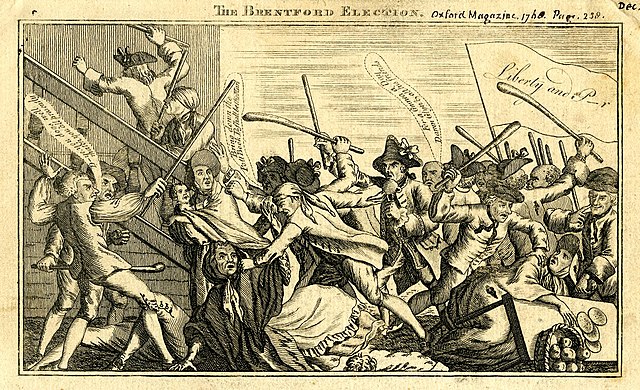
Laurence Balfe and Edward McQuirk (or Quirk or Kirk) were accused of hitting George Clarke on the head during a riot sparked by a by-election at Brentford in West London on 8 Dec 1768, as shown above.

The rival candidates in that election were Sir William Beauchamp-Proctor, a Rockingham Whig, and John Glynn, lawyer for the radical John Wilkes. (Glynn won and served in Parliament till his death in 1779.)

A “gentleman of very considerable fortune” testified that he had seen McQuirk and Balfe among Proctor’s supporters on the first day of voting. The two men were carrying clubs, and McQuirk was “very active in the fray.”

That night, the wealthy gentleman spoke to McQuirk and Balfe, letting them believe he was on their side. McQuirk admitted to having been in the brawl and hinted he might have to flee the country. Balfe said he’d been paid “a guinea for going down to Brentford.”

The gentleman took his information to a “parson Horne,” no doubt the political radical John Horne, then still a Wilkes ally. That man arranged for McQuirk and Balfe to be arrested by Sir John Fielding, the London magistrate. Clarke died on 14 December, elevating the charge to murder.

In January 1769 McQuirk and Balfe were convicted of murder at the Old Bailey, with the jury deliberating only twenty minutes. Proctor immediately launched a public campaign for royal clemency, calling this verdict unjust.

Advocates for mercy pointed out that the prosecutors never accused either defendant of hitting Clarke. Indeed, there was no evidence Balfe hit anyone, just that he was in the crowd. The Earl of Rochford also reported there was “some doubt whether Clarke’s death happened in consequence of the blow he received.”

On 10 March, the Crown pardoned McQuirk and Balfe.

Proctor was a supporter of the Marquess of Rockingham, and Rockingham had been mostly supportive of America during this first term as prime minister in 1765–1766. Furthermore, the case against McQuirk and Balfe really was flimsy, and they were obviously pawns in a much bigger game. We might therefore expect colonials to support clemency for them.

However, American Whigs were enamored of John Wilkes. They suspected any attack on his party as oppression by the establishment. Thus, Edes and Gill could present “Balf [and] McQuirk” as an example of George III or the ministers around him abusing the royal pardon power to benefit political supporters, just like Ebenezer Richardson.

TOMORROW: The case of the Kennedys.

Monday, October 14, 2024

“A proper Person to be employed in the REVENUE”

On 10 Mar 1772, as described yesterday, Massachusetts’s high court delivered a royal pardon to Ebenezer Richardson, convicted twenty-three months earlier of murder.

According to one of the judges on that court, Peter Oliver, “The Prisoner fled the Town immediately on his Discharge; the Rabble heard of it, & pursued him to execute their own Law upon him, but he happily escaped.”

Gov. Thomas Hutchinson reported to his predecessor, Sir Francis Bernard, that the “poor fellow who has been in close prison more than two years…hapned to be discharged when the Inhabitants of the Town were engaged in an Affair at their annual meeting & by this means we saved a tumult at least if nothing more.”

Richardson still had family north of Boston in the Woburn/Stoneham/Reading area, so he probably lay low there. I haven’t found clues about his second wife Kezia and their children.

For a decade before his conviction Richardson had worked for the Customs service. The Commissioners of Customs appear to have eventually found another place for him—a distant place.

Or, as Edes and Gill’s Boston Gazette put it on 24 May 1773:
As an additional Affront to the Feelings of his Countrymen; as an aggravated Outrage on the Sensibility, Humanity, Virtue and Justice of this People; as a Master Stroke of rancorous Enormity, to put to the Rack the most obstinate Quietist: BE IT KNOWN;

that the cringing, smiling, fawning, bowing CHARLES FROTH, Esq; a Wretch, who from his earliest Puppy-hood, thro’ the lingering Progress of a too-long protracted Life, to a Period when he withers on the Crutch of Decrepitude, might challenge his recording Angel to produce one single Action, that sifted to it’s Motive, would not effectually consign him to eternal Infamy; has, O! unparalelled Effrontery! O! the detestable Parricide! has appointed that execrable Villain, the condemned Vagabond; the rank, bloody, and as yet unhanged EBENEZER RICHARDSON, an Officer in the Customs in the Port of Philadelphia.

And what is infinitely aggravating, and renders the Transaction much more atrocious; the Murderer is distinguished by a particular Recommendation to the Collector and Comptroller of that Port; declaring the Miscreant to be a distinguished Friend to Government, a proper Person to be employed in the REVENUE, and ordering them to reward him with a Guinea per Week.——

As the said Ebenezer Richardson is now placed on the Ladder of Promotion, we may expect him one of the Honorable Board of Commissioners, in a few Years; where he may probably make as distinguished a Figure as the Rest of his BRETHREN.
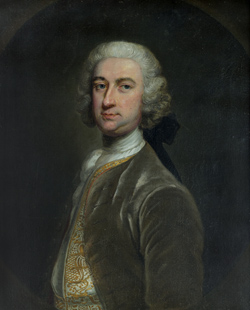
“Charles Froth” was the Whigs’ usual insult for Customs Commissioner Charles Paxton (shown above), who had employed Richardson as a confidential informer soon after he moved to Boston. As you might guess, Paxton was about as unpopular as Richardson himself.

TOMORROW: Shifting to Philadelphia.

Monday, August 05, 2024

“John Hancock, Esq; lay past all hopes of recovery”

By 1774, John Hancock was a well known Massachusetts Whig.

Newspapers in other colonies reported on him, though not always correctly. This item appeared in the Norwich Packet on 2 June:
By a Gentleman that arrived here Yesterday, from New-York, we are informed, that a Vessel from London had brought Intelligence, that…General [Thomas] Gage is ordered to send the Honourable John Hancock, of Boston, to England in Irons.
That peril wasn’t why Hancock didn’t attend the Salem session of the Massachusetts General Court, though. Instead, he became seriously ill.

The earliest public mention of this illness that I’ve found appeared in Rivington’s New-York Gazetteer. The issue was dated 22 June, but this item was dated 23 June, suggesting the newspaper may have been printed late: “By accounts from Boston we are told, that John Hancock, Esq; is in a very bad state of health…”

Things escalated quickly. John Holt’s New-York Journal stated on 7 July: “We have the melancholy news from Boston, that the Hon. John Hancock, Esq; lay past all hopes of recovery.”

And William Goddard’s Maryland Journal, 16 July:
The last Boston Mail brings us the melancholy News that the Honourable JOHN HANCOCK, Esq; that distinguished Patriot and amiable Gentleman, who has been long indisposed, lay, to the inexpressible Grief of his affectionate Countrymen, past all Hopes of Recovery.
However, by then Bostonians could read good news in Isaiah Thomas’s 15 July Massachusetts Spy (delayed one day from its usual Thursday publication, probably because that had been proclaimed a “day of fasting and prayer”):
It is with pleasure we can inform the public that the Hon. John Hancock, has so far recovered his health as to be able to take an airing in his chariot.
The following Monday, 18 July, Edes and Gill’s Boston Gazette shared inside information on Hancock’s health:
It is with the greatest Pleasure, we can inform tha Publick, that the Hon. JOHN HANCOCK, Esq; has so far recovered his Health, as to be able to walk abroad; and in the Course of the past Week, has twice honored this Office with his presence. He likewise attended divine Service Yesterday.
Boston Post-Boy printers Mills and Hicks backed the Crown government, but even they shared that day’s news, albeit with less enthusiasm: “The Hon. John Hancock, Esq; is so far recovered from his long Indisposition, as that he Yesterday attended Divine Service.”

The update reached Rivington’s New-York Gazetteer on 21 July: “We hear from Boston, that the Hon. John Hancock, Esq; is now perfectly recovered; and is engaged in returning visits received from his numerous acquaintance during his late illness.”

Finally, on 18 August the Massachusetts Spy reported on a dinner in Roxbury celebrating the first public protest against the Stamp Act in 1765. It quoted several toasts, and the eighth was: “Recovered and confirmed Health to that worthy Patriot the Honourable John Hancock, Esq.” No other local was called out by name.

TOMORROW: The consequence of that illness.

Tuesday, July 16, 2024

“The foregoing is a Copy of a Covenant…”

The Boston committee of correspondence’s Solemn League and Covenant went further than previous boycotts by having ordinary people pledge not to buy any goods from Britain after a certain date, and to shun business with anyone who continued to sell.

That’s why the 30 May town meeting voted “That the Comittee of Correspondence be & hereby are directed, to comunicate the Non Consumption Agreement aforesaid to the other Towns in the Province.” Not just non-importation by merchants but non-consumption by everyone.

According to the merchant John Andrews, that agreement was “sent out in printed copies by the Clerk to the Committee. W[illiam]. Cooper,” along with his printed letter dated 8 June 1774.

One might think that it would therefore be easy to identify the official text of that boycott agreement.

But there’s a lingering mystery about the Solemn League and Covenant. Two different texts were printed in American newspapers by the end of the month. Both also exist as broadsides carrying the date of June 1774. To add to the muddle, a third text was also printed as a broadside.

In 1915 Albert Matthews compared the two June 1774 texts for the Colonial Society of Massachusetts, calling them Form A and Form B. I guess I’ll call that third version Form C when I get to it.

Normally the Boston town government favored the Edes and Gill print shop. The letter and broadside might well have come from its presses. On 20 June Edes and Gill’s Boston Gazette editorialized in favor of it:
The Solemn League & Covenant for a non-consumption of British Merchandize is an Ax to the Root of the tree; by coming into it we establish our own Manufactures, save our Money, and finally our Country from the destruction that threatens it.
But that newspaper didn’t report the actual text of the new agreement. The Boston committee evidently didn’t want to publicize details of the boycott in town, at least not until a lot of rural communities had signed on to it.

Instead, the recently widowed Margaret Draper printed the document in her Boston News-Letter on 23 June. This wasn’t an official release. The document was prefaced with a request to print it and followed by:
The foregoing is a Copy of a Covenant, which I am told great Pains are now taking to promote in the Country. As I think it is of the most pernicious Tendency, as at present circumstanced, I beg Leave through your Paper to propose some Questions relating thereto.
Nearly a full column of political questions and argument followed. Then came an even longer series of questions leading to the suggestion not to take any action until “the approaching Congress.”

Four days later Mills and Hicks’s Boston Post-Boy printed the entire text of Cooper’s letter followed by the same form of the Solemn League and Covenant as in the News-Letter.

In other words, the Solemn League and Covenant wasn’t announced by Boston’s committee of correspondence. It was leaked by opponents through the Loyalist press.

TOMORROW: Form A.

Monday, July 01, 2024

“Deliberating upon the Steps to be taken on the present Exigencies”

On 17 June 1774, as Samuel Adams was orchestrating what would be the last session of the Massachusetts General Court under royal rule, his cousin John took the chair of Boston’s town meeting.

In Faneuil Hall, the first item of business was a report from the committee on ways and means.

The Adams family physician, Dr. Joseph Warren, stood up and said “they thought it best to defer making Report, till they had heard from the other Governments.” So enough of that.

Then the meeting got to the article stated in the warrant—i.e., the official reason for this meeting:
To consider & determine what Measures are proper to be taken upon the present Exigency of our public Affairs, more especially relative to the late Edict of the British Parliament for Blocking up the Harbour of Boston, & annihilating the Trade of this Town
Town clerk William Cooper recorded that there were “very serious Debates” on that very broad question. He also put on paper that only one brave voter (his name not recorded) dissented from this resolution:
That the Comittee of Correspondence be enjoined forthwith to write to all the other Colonies, acquainting them that we are not idle, that we are deliberating upon the Steps to be taken on the present Exigencies of our public Affairs; that our Brethren the landed Interest of the Province, with an unexampled Spirit and Unanimity, are entring into a NonConsumption agreement; And that we are waiting with anxious Expectation for the Result of a Continental Congress; whose Meeting we impatiently desire, & in whose Wisdom & Firmness we can Confide, & in whose Determinations we shall chearfully acquiesce
The meeting then broke for midday dinner, reconvening at 3:00 P.M.

The afternoon session, John Adams still in the chair, the gathering authorized the committee of correspondence to send thanks to other towns and colonies for their support, and then thanked the committee itself.

Some of those towns and colonies were sending donations for the Boston poor. The meeting delegated the distribution of that aid to the elected Overseers of the Poor “in Concert with the Comittee lately appointed by this Town for the Consideration of the Ways & Means of Employing the Poor.”

Finally, the meeting ordered Cooper to “Publish the Proceedings,” paying the town’s chosen printers, Edes and Gill, to issue a broadside based on his record.

All those afternoon actions were obviously designed to show support for the standing committees, validating them in defying the Crown and refusing to seek a compromise.

By the end of the month, there would be pushback.

TOMORROW: The same town meeting continues, ten days later.

Sunday, May 19, 2024

“The taste of their fish being altered”

Just because the British Empire was sliding toward internal warfare in 1774, that was no reason to stop laughing about the news.

Here are a couple of items that appeared in New England newspapers 250 years ago.

The first must have originated in a London newspaper. The earliest North American reprinting I’ve found is in John Dunlap’s Pennsylvania Packet on 18 Apr 1774. Four days later it appeared in both Isaiah Thomas’s Massachusetts Spy and Timothy Green’s Connecticut Gazette of New London, followed by other papers.

Jan. 28. Letters from Boston complain much of the taste of their fish being altered: Four or five hundred chests of tea may have so contaminated the water in the harbour, that the fish may have contracted a disorder not unlike the nervous complaints of the human body. Should this complaint extend itself as far as the banks of Newfoundland, our Spanish and Portugal fish trade may be much affected by it.
Needless to say, even 340 chests of tea dumped off Griffin’s Wharf weren’t really enough to affect the New England fisheries.
Earlier this month artist Cortney Skinner shared this clip from the 9 May 1774 Boston Gazette. It appeared on page 3 right after a political essay and right before the many mercantile ads it resembled.

This notice reads:
WANTED immediately,
A long, strong BOOM,
that will reach from Cape-Cod to Cape-Ann.———
Any Person having such an One to dispose of, will meet with a good Price, by applying to
N***H.
N. B. The Distance is only 18 Leagues.
This was a poke at Lord North’s plan to close Boston harbor to shipping. Unofficial hints of the Boston Port Bill had started to arrive, and Edes and Gill wanted readers to laugh at the folly of that policy.

The same satirical ad appeared the next day in Samuel and Ebenezer Hall’s Essex Gazette of Salem.

Then the text was reprinted (though no longer looking like an advertisement) in the 16 May New-York Gazette, the 18 May New-Haven Post-Boy and Pennsylvania Journal, and the 23 May Newport Mercury. For readers without so much maritime experience, the capper became “The Distance only 54 miles.”

When the Royal Navy and Customs service really did shut down the port of Boston in June, though, suddenly the situation didn’t seem so laughable.

Wednesday, February 21, 2024

Is That a Phrygian Cap or Are You Just Glad to See Me?

One thing I learned last year and am still working through is that a Phrygian cap isn’t the same as a Liberty Cap, but became the same in the 1790s.

In classical Greek and Roman cultures, the Phrygian cap and Phrygian helmet were markers of someone from greater Anatolia, or in general east of the civilized world. The Phrygian cap was a soft cloth cap with a bulge at the top that flopped forward. Lots of statuary and other artwork from that ancient period used the floppy cap as a sign of exoticism.

The Romans had another type of cloth cap with symbolic meaning: the pileus. Made of felt, it was used in the ceremony of freeing a slave. This cap was conical and symmetric, without that bulge. The pileus thus came to symbolize liberty in general, especially when it was held up by a spear.

That’s how the pileus appears in many eighteenth-century pictures of Liberty, and in British (and British-American) pictures of Britannica, since of course the British constitution provided the most liberty.

William Hogarth caricatured John Wilkes in 1763 as holding a spear and domed cap helpfully labeled “LIBERTY.” Some analyses say contemporaries would have recognized that thing on the spear as a chamber pot, not a cap. I’m not sure, but it definitely doesn’t look like cloth.

The allegorical woman on the masthead ornament of Edes and Gill’s Boston Gazette held a spear and pileus, as did figures on the 1774 and 1781 cuts for Isaiah Thomas’s Massachusetts Spy.

Paul Revere engraved such figures many more times: on the picture of the Stamp Act repeal obelisk, in the frames around his portraits of Samuel Adams and John Hancock, and so on. When he adapted the London print “Britannia in Distress” into “America in Distress” and “A Certain Cabinet Junto,” he transferred the spear and pileus from Britannia’s arm to America’s.

In those years, the object was called the “Cap of Liberty.” The phrase “Liberty Cap” appeared in American newspapers only once before the Revolutionary War, in a 3 Feb 1774 New-York Journal article signed “An English Yeoman, with his Liberty Cap on.”

When you hold a cloth cap up on a spear, the top doesn’t naturally flop over. All those Liberty Caps are conical or in the shape we’d now call bulletheads. (Bullets were spherical then, remember.)

During the French Revolution, fashion and art merged the Cap of Liberty, the bonnets rouges of a 1675 anti-tax revolt in France, and the Phrygian cap. After a short while, iconographic Liberty Caps were mostly red, and they all had that little bulge flopping over. Even when they were on spears!

(Back when I wrote about rattlesnakes, I found an image of the Continental Congress’s Board of War and Ordnance seal. It showed that the flying snake originally had a rattle, though that detail has disappeared in later U.S. Army redesigns. Now I wonder if the Liberty Cap on that original seal had the bulge of the Phrygian cap, or if that was a later addition. Alas, the image from 1779 is no longer on the web.)

Wednesday, January 31, 2024

“I then gave him a genteel Basting or Caneing”

The 18 Feb 1771 issue of Edes and Gill’s Boston Gazette reported that the Customs Commissioners had promoted John Malcolm from the post of Tide Surveyor in Newport, Rhode Island, to Controller in Carratook, North Carolina.

Carratook was a much smaller port, but Controller was a position of more responsibility, especially when it came to money. Malcolm had joined the service less than two years before, so that indicated the commissioners had some confidence in him.

Just below that report (in much smaller type) ran this letter:
Messieurs EDES & GILL.

Please to insert the following in your much-esteemed Paper, and you’ll oblige your humble servant, JOHN MALCOM.

WHEREAS three Officers belonging to his Majesty’s Navy us’d me very ill sometime past, by cutting Buttons from my Hussar Cloak in a private Manner, and carrying them off in their Pockets, which I resented; and on Friday the 15th Instant [i.e., of this month] I met with one of them, whose Name was Davis, two other Officers being with him—

And as said Davis had not given me Gentleman-like Satisfaction as he sundry Times promis’d, I again demanded Satisfaction of him, and he struck me with a Stick—

I then gave him a genteel Basting or Caneing, and sent him off, bidding him if he pleas’d to go and acquaint his Commodore [James Gambier] that a Boston-born Man had given him the said Davis a genteel Trimming.

JOHN MALCOM.
Boston, Feb. 1771
This newspaper item isn’t discussed in Frank W. C. Hersey’s article on Malcolm for the Colonial Society of Massachusetts, or anywhere else that I can find.

The confrontation Malcolm described here bears some resemblance to his more famous street fight in early 1774, particularly his insistence on being treated like a gentleman and his whaling away with his cane when that didn’t happen.

One big difference, of course, is that Malcolm’s target in 1771 was a fellow employee of the royal government, albeit in another branch. If there was any political issue in this earlier fight, it was his suspicion that British officers looked down on him as a “Boston-born” colonial.

At this time, Malcolm aligned himself with the town—the same town that would attack him brutally a few years later. He was even using the Boston Whigs’ principal newspaper to promulgate that message.

[My photo above shows a “fist cane” that belonged to Thomas Hancock and was on display at the Massachusetts Historical Society five years ago.]

Friday, December 29, 2023

“A Number of the Cape or Narragansett-Indians” in Dorchester

On 31 Dec 1773, as recounted yesterday, Charlestown burned its tea at high noon. Everyone could see that happen, but of course bonfires are even more visible at night.

As that action took place across the Charles River north of Boston, another drama was playing out to the south in Dorchester.

Last year I quoted sources about the search for tea that survived destruction in the harbor, floated across to the Dorchester shore, and was reportedly being sold by a man named Withington.

After searching two houses (with the assent of two homeowners named Withington), a crowd said by local Samuel Pierce to be “from Boston” found the rumored tea at the home of Ebenezer Withington.

Leaving Dorchester to deal with the man through its town meeting, the Bostonians carried that tea back to Boston and used it to fuel their own bonfire after dark on Boston Common.

When the Boston Gazette reported on this event on 3 Jan 1774, it said the search had been carried about by “a Number of the Cape or Narragansett-Indians.” This was, I believe, the first time the press had referred to the men destroying tea not merely as dressed like Indians but actually as Indians (wink, wink).

When Edes & Gill first reported on the destruction of the East India Company tea, their 20 December Boston Gazette printed two accounts which described the actors quite differently.

The story on Page 3 said the raiders were “A number of brave & resolute men, determined to do all in their power to save their country from the ruin which their enemies had plotted.” That account treated those men as respectable members of Massachusetts society, taking collective civic action.

However, “An Impartial Observer” on page 2 described “a number of persons, supposed to be the Aboriginal Natives from their complexion,” and later referred to those people as “Savages.” These destroyers came from outside civilized society, so Boston couldn’t be held responsible for their action. That approach prevailed in the following months.

The Boston Gazette’s account of events on 31 December showed that dichotomy. North of Boston, the people of Charlestown acted through their town meeting, through collective boycotts, and at high noon. South of Boston, “the Cape or Narragansett-Indians” carried out intimidating actions, destroyed imperial property, and acted in the dark.

Monday, August 14, 2023

“The ever-memorable Anniversary”

The Boston Gazette published on Monday, 17 Aug 1767, included this local report:

Friday last being the ever-memorable Anniversary of the 14th of August, a great Number of Gentlemen met at Liberty-Hall, under the sacred Elm, which was decently decorated, and drank the following Toasts.
  1. The King.
  2. The Queen and Royal Family.
  3. The Sons of Liberty.
  4. All Mankind.
  5. Friends to America in Great-Britain.
  6. May an Abhorrence of Slavery still and ever remain the best Criterion of a true British Subject.
  7. None but Tories Slaves.
  8. America.
  9. The 14th of August 1765.
  10. May the 26th of August 1765, be veil’d in perpetual Darkness.
  11. May every House of Respresentatives in America strenuously defend what they have wisely resolv’d.
  12. Union, Stability and Fidelity among the Sons of Liberty throughout America.
  13. May the Man who will not defend the Cause of his Country, in Case of Danger, be held in universal Contempt by every Son of Virtue and Liberty.
  14. May that Day which sees America submit to Slavery, be the last of her Existence.
That Friday, 14 August, was the second anniversary of Boston’s first public protest against the Stamp Act, which inspired a wave of similar protests all along the North American coast and even into the Caribbean. Boston’s political organizers were proud of that.

They weren’t proud of the mob that had nearly destroyed Lt. Gov. Thomas Hutchinson’s house twelve days later. In these toasts they mentioned that event once, but they thought they got away with it all right.

As for the numerous mentions of “Slavery,” these gentlemen meant political slavery, or giving up their traditional British rights. They didn’t mean, you know, slavery slavery.

Monday, December 12, 2022

“They found part of a half chest which had floated”

A natural question after hearing the stories of chests from the Boston Tea Party floating across the bay to the Dorchester shore is whether that was even possible.

The men and boys of the Tea Party worked hard to break open all the chests, pour out the tea leaves, and even then make sure those leaves got submerged in the salt water. Could a container of tea have escaped their attention?

In fact, there’s good evidence from 1773 for a small chest making it across the water with some drinkable tea inside.

Samuel Pierce of Dorchester wrote in his diary for 30 December:
There was a number of men came from Boston in disguise, about 40; they came to Mr Eben Withington’s down in town, and demanded his Tee from him which he had taken up, and carried it off and burnt it at Boston.
The merchant John Rowe recorded the same event from his Bostonian perspective the next day:
There was found in the House of One Withington of Dorchester about half a Chest of Tea—the People gathered together & took the Tea, Brought it into the Common of Boston & Burnt it this night about eleven of Clock

This is supposed to be part of the Tea that was taken out of the Ships & floated over to Dorchester.
On 3 Jan 1774, Edes and Gill’s Boston Gazette laid out the story that the town’s Whig leaders wanted people to know:
Whereas it was reported that one Withington, of Dorchester, had taken up and partly disposed of a Chest of the East-India Company’s Tea: a Number of the Cape or Narragansett-Indians, went to the Houses of Capt. Ebenezer Withington, and his Brother Philip Withington, (both living upon the lower Road from Boston to Milton) last Friday Evening, and with their consent thoroughly searched their Houses, without offering the least offence to any one.

But finding no Tea they proceeded to the House of old Ebenezer Withington, at a place called Sodom, below Dorchester Meeting House, where they found part of a half chest which had floated and was cast up on Dorchester point. This they seized and brought to Boston Common where they committed it to the flames.
Pierce identified the men enforcing the tea boycott as “from Boston,” but the Gazette referred to them as “Cape or Narragansett-Indians.” This is an early example of the Whigs realizing that referring to the men who destroyed the tea as unrecognizable Natives let everyone maintain deniability.

There were many Withingtons in Dorchester, obviously. The Gazette emphasized how two Withingtons of the higher class—the militia captain and his brother—had done nothing wrong and were eager to cooperate with the searchers.

“Old Ebenezer Withington” didn’t come off as well. This is the only reference I’ve found to a place in eighteenth-century Dorchester being called “Sodom.”

On the same day that issue of the Boston Gazette appeared, old Ebenezer Withington had to answer to the Dorchester town meeting.

TOMORROW: The town takes a stand.

Tuesday, September 06, 2022

“All the marks of the Whig propaganda department”?

The newspaper item I quoted yesterday, listing fifteen Whigs as Boston’s chief troublemakers and adding the surnames of three printers in a postscript, tends to be quoted in books and articles focused on those individuals.

That letter or “handbill,” various authors have said, is evidence of the real threats faced by [take your pick] Samuel Adams, Dr. Thomas Young, William Cooper, the Rev. Dr. Samuel Cooper, Benjamin Edes, Isaiah Thomas, and even Dorothy Quincy, John Hancock’s fiancée.

One anomalous but influential author who mentioned the text was Clifford K. Shipton, compiler of Sibley’s Harvard Graduates in the mid-1900s. He didn’t like radicals, which meant he was less than sympathetic to New England’s Patriots.

In his profile of the Rev. Dr. Charles Chauncy (shown above), a staunch opponent of both bishops and New Lights and a strong supporter of the Boston Whigs, Shipton quoted a bit of the document and wrote:
The “handbill” has all the marks of the Whig propaganda department, and Charles Old Brick [i.e., Chauncy] may have put his own name into it.
Shipton offered no evidence that Chauncy ever engaged in this sort of subterfuge and provocation, however. Indeed, that same paragraph quoted the minister in August worrying that some towns would act with too much “precipitancy,” so he wanted the political atmosphere to calm down, not heat up.

I think stronger evidence that this letter was a hoax is that the Boston Whigs made so little of it. As I said yesterday, I found only one mention in the local press, in the Fleet brothersBoston Evening-Post after the text had appeared in New York. (Of course, if anyone finds an earlier Boston printing that I missed, then I’d have to rethink this whole line of thought.)

Benjamin Edes and John Gill didn’t complain about the threat in their Boston Gazette, nor did Isaiah Thomas in his Massachusetts Spy—and they were the printers the letter called “trumpeters of sedition” (an old term). Newspapers in Hartford, Salem, New London, and Portsmouth picked up the item, to be sure, but those printers didn’t have first-hand knowledge of what was really going on in Boston.

Perhaps, we might consider, those Boston printers were scared and didn’t want to give the letter more publicity. But there’s also nothing about the threats in the private minutes of the Boston selectmen, even as they complained to Gen. Thomas Gage about other things that month. There’s nothing in John Andrews’s gossipy letters. That pattern leads me to think that the Boston Whigs didn’t believe that this message was a real threat.

Thinking about where the text came from and why, I see four possibilities.

1) A Boston Loyalist really did throw this letter into the army camps to direct military attention to specific Whig leaders and printers. Charles W. Akers takes this position in his biography of Samuel Cooper, The Divine Politician. In that case, we must ask how the text leaked out, and why Boston leaders showed so little reaction to it.

2) A Boston Whig wrote the letter, tossed it into the camps, and made sure it got into the press in order to inflame public opinion. Why, then, did it not appear first in any Boston newspapers? How come so few Whigs trumpeted it? (Akers further argues that no one who was truly allied with Chauncy and Cooper would have had the effrontery to suggest they were involved in worldly politics, even though everyone knew they were.)

3) Someone in Boston created the letter and sent it to New York as authentic. It appeared in James Rivington’s New-York Gazetteer below an extract of a private letter from Boston, and it wasn’t credited to any Boston newspaper like items that followed. If this was the case, was the person who created the fake letter a Whig or a Loyalist?

4) Rivington created the letter himself. He was already speaking up for Crown authority, and Whigs already accused him of creating fake news. Later in the war he certainly did that, either as satire or propaganda. Was this an early example?

The item appeared in the New-York Gazetteer as army regiments were moving from that city to Boston, a process that Gen. Gage sped up after the “Powder Alarm” of 2 September. The letter’s intended audience might therefore have been not “the Officers and Soldiers of his Majesty’s Troops at Boston” but those on their way.

TOMORROW: Naming names.

Friday, July 15, 2022

“If the burning the Gaspee schooner was a matter of serious importance…”

Benjamin Galloway was indeed at Mount Vernon on 1–5 January 1773, much as he described decades later. The evidence for that is George Washington’s own diary.

The anecdote Galloway told about Washington hinged on him reading an article from a recent newspaper, one of several fetched by William Lee from Alexandria, which described the destruction of H.M.S. Gaspee in Rhode Island.

The Gaspee was burned in June 1772, however. Would it have still been hot news in Virginia early the next year?

As I discussed back here, the initial news stories on the Gaspee affair were quite low-key, considering it was an armed attack on a Royal Navy schooner. The American Whig press didn’t make a big deal out of it, as if the event was an embarrassment.

Only one issue of the three Virginia Gazette newspapers—Purdie and Dixon’s for 9 July—carried a report of the burning. Through the end of the year, the rare follow-up items were short dispatches reporting on government actions, such as offering rewards for information and setting up an investigatory commission.

However, in December Rhode Island politicians began to write to local newspapers and to colleagues in other colonies, like Samuel Adams in Massachusetts and Richard Henry Lee in Virginia. They highlighted how that commission might send defendants and witnesses to Britain for treason trials. That would violate sacred British rights, they declared.

The 30 Dec 1772 Pennsylvania Journal joined that campaign by reprinting three separate items about the Gaspee affair from New England newspapers. Under the dateline of Boston, 17 December, printer William Bradford (shown above) combined an angry report on the commission from the 17 December Massachusetts Spy and this commentary from the 21 December Boston Gazette:
If the burning the Gaspee schooner was a matter of serious importance, much more so are the methods pursued by the British administration in consequence of it. This affair was transacted within the body of a county, in a free English government; one would think therefore it should be the subject of the inquiry of the grand jury of inquest for the same county: Instead of which we are told, that five gentlemen, four of whom are of superior rank in different colonies, the other indeed a judge of the admiralty, are appointed by commission to make the enquiry.

By a gentleman lately from Rhode-Island, we are informed, that three of these commissioners are empowered to act, at whose call the army and navy are to attend; that any persons accused, against whom the commissioners shall judge there is evidence sufficient to convict them, are to be apprehended, and together with the evidences [i.e., witnesses] sent to England for trial. And that Capt. [Robert] Keeler, of the Mercury, has notified Gov. [Joseph] Wanton, in consequence of orders, that his ship is ready to receive such persons for the purpose aforesaid.

[Boston News-Letter printer Richard] Draper tells us, that “Admiral [John] Montagu is ordered to hoist his flag in Newport harbour.” The purport of this parade is obvious to common sense. The Admiral will no doubt acquit himself to the satisfaction of his masters upon this occasion. It is said that he has recommended that those who, it is supposed, can give evidence of this matter, and refuse to do it, be put on board the men of war, and there kept until they do; which perhaps may be rather more eligible of the two, than the torture of the RACK.

The indignity offered to all the Colonies, and particularly Rhode-Island, says a gentleman of a neighbouring town in a letter to his friend in this, is not to be equalled. To have a set of crown officers commissioned by the ministry, and supported by ships and troops to enquire into offences against the crown, instead of the ordinary and constitutional method of a grand jury carries an implication that the people of that colony are all so deeply tinctured with rebellious principles, as that they are not to be trusted by the crown.

The inhabitants of this town and province can feel for their brethren of Rhode-Island, having themselves tasted of the cup of ministerial vengeance; when to aid and protect the commissioners of the customs, in carrying into execution a revenue act of the British parliament, Hillsborough’s troops were stationed in the capital, and the city turned into a garrison!—And though these troops, after slaughtering some of our innocent inhabitants, were obliged to retire from the town, they are yet posted in the principal fortress and key of the province.

What shall hinder the like scene of blood, rapine and slaughter in the capitol of Rhode-Island, if the commissions of enquiry there, should so readily call for the military aid as the commissioners of the customs did here? Such treatment of the colonies calls for the most serious attention; and however prophane it may be called by Mr. Draper’s writer the Yeoman, or his canting neighbour, we have reason with firm affiance in HIM who hateth oppression and tyranny, devoutly to acclaim, How Long!—O LORD!—How Long!
That was immediately followed by similar news from the 19 December Providence Gazette, which concluded:
The idea of seizing a number of persons, under the points of bayonets, and transporting them three thousand miles for trial, where, whether guilty or innocent, they must unavoidably fall victims alike to revenge or prejudice, is shocking to humanity, repugnant to every dictate of reason, liberty and Justice, and in which Americans and Freeman ought never to acquiesce.
And then material from the 21 December Newport Mercury, including a letter from a Bostonian warning that three army regiments were soon to march into Rhode Island and another from a Londoner saying:
Our tyrants in administration are greatly exasperated with the late manoeuvre of the brave Rhode-Islanders. . . . We believe that the ancient British spirit of independence which once blest this island, has improved by transportation, and preserves its vigour in the breasts of Americans; cherish it my dear friends! And by relieving yourselves save the small remnant of the virtuous in Britain.
Washington could have received this newspaper among others in early 1773. Living on Virginia’s northern border, he was almost as close to Philadelphia as to Williamsburg, and Philadelphia was a dynamic port with a freer press.

Thus, a newspaper delivered to Mount Vernon in the first days of 1773 could have ignited a dinner-table discussion about the Gaspee affair, British rights, and the use of the military to put down protests and tax resistance, as Galloway described. Those topics were all over the Pennsylvania Journal.

On the other hand, that newspaper did not include the details about how the Gaspee ran aground chasing a smuggling ship, details that Galloway explicitly recalled reading out to the company. He must have picked up that part of the story from other sources.

TOMORROW: George Washington’s other diary.

Saturday, March 20, 2021

The Aftermath of the Second Boston Tea Party

Yesterday I discussed the political effect of the second Boston Tea Party in London. Today I’ll wrap up this topic with a look at the ripples from the event in Massachusetts.

Five local men were linked to the shipment of tea on the Fortune. All of them insisted that they hadn’t expected the tea to cause such trouble and wanted to send it back. How did the public accept those assurances?

The captain of the Fortune was Benjamin Gorham. Alas, not only were there other men of that name in Massachusetts, but two had the title “captain” from either maritime or military service. One was born in 1715, died in 1788, and is buried in Barnstable.

According to genealogists, though, this ship’s captain was the Benjamin Gorham born to Shubael and Mary (Thacher) Gorham in Barnstable on 5 June 1726. As of the late 1760s he commanded coasting vessels, bringing in the Hannah in 1769. In 1773, the owners of the Fortune sent him to London with a cargo and instructions to sell the ship there. Instead, Capt. Gorham came back with a range of goods, including those 28 1/2 chests of tea.

Nonetheless, Boston merchants continued to regard Gorham as reliable. On 18 April the Boston Post-Boy announced that he would soon sail the brig Leopard back across the Atlantic, carrying its owner, Jonathan Williams, Jr., and passengers in “genteel Accommodations.”

Gorham was back in Boston that fall; he married Nancy Hinckley in Boston on 28 Nov 1774 at the Rev. Samuel Stillman’s Baptist church. Eventually they had five children.

Early in the war, Gorham carried hatter Nathaniel Balch back to New England from London. In 1776 he became commander of a privateer named the Lizard, but that appears to have been his only military venture. In 1782 the Gorhams bought a house on North or Fore Street; four years later they sold it to John Hinckley, probably a relative of Nancy. In 1785 Capt. Gorham had the license for the Pine Tree Tavern in Dock Square. According to the Columbian Centinel, Gorham was widowed at the start of the year 1793, and genealogists say he died two years later.

The merchant who was supposed to receive most of the tea on the Fortune was Henry Lloyd (1709-1795). In its first report on the cargo, the Boston Gazette accused him of ordering forty chests. A week later, evidently after Lloyd showed them his letterbook, printers Edes and Gill ran a correction:
Better information obliges us to inform the public that Mr. Lloyd on the fifth and seventh of November last wrote to his correspondent to send him no tea on any account whatever, till further orders. . . .

Mr. Lloyd directly contrary to his order and expectation has been drawn into view in a light very disagreeable to himself, and wishes nothing more ardently than to have his conduct truly represented to his Country, with whom his highest ambition is to stand fair and agreeably.
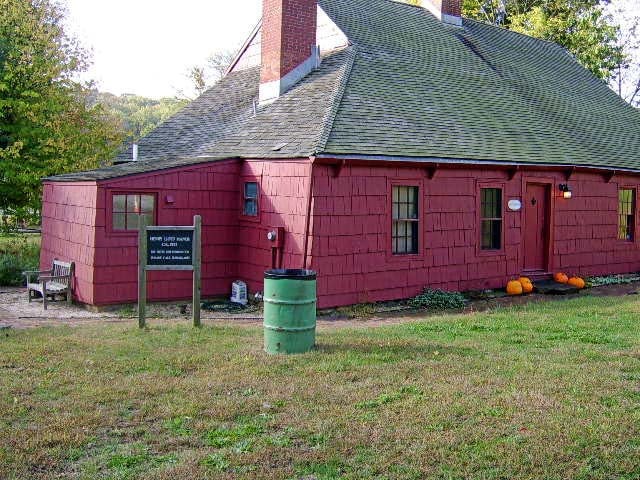
In his politics, religion, and extensive property outside Massachusetts (family manor in Huntington, New York, shown above), Lloyd had many reasons to align with the royal government. As the political split widened in 1774, he signed the address welcoming Gen. Thomas Gage to Boston. Later he supplied the army. A niece he raised, Elizabeth, married royal appointee Joshua Loring, Jr., and also became mistress to Gen. William Howe. In 1776 Henry Lloyd joined the evacuation to Halifax. Though he made one return visit to Boston in 1785, Lloyd didn’t end up standing “fair and agreeably” with most of the people there.

Also among the Loyalist refugees was the brazier William Bowes, who in March 1774 loudly if unreliably stated that the owners of the Fortune had brought in tea for themselves. Although Bowes later claimed to have supported from the Crown from early on, in August 1769 he was among the many Boston men dining with the Sons of Liberty. Bowes’s father was a Congregationalist minister and his mother was a Hancock, so it would have been natural for him to be a Whig. Instead, after 1774 he declared his Loyalism by signing all the addresses to royal governors and then leaving the province.

As for those three owners of the Fortune, I still can’t trace William Thompson. Thomas Walley and Peter Boyer were, as I wrote before, solid Whig merchants up to 1774. Like Lloyd, they insisted that they had told their London contacts they didn’t want any tea and were completely surprised at what Capt. Gorham brought back.

Unlike Lloyd, Walley and Boyer remained trusted Whigs after the second Tea Party. Indeed, they became more politically active.

According to John W. Tyler’s Smugglers and Patriots, Walley was a documented smuggler, and he remained firmly in the center of the Boston business community. He served in the Massachusetts General Court during the war, and from 1786 to 1797 the town chose him as a selectman.

Meanwhile, Boyer served on Boston’s committee to help the poor after the Boston Port Bill and on the committee of correspondence, safety, and inspection in 1776. The following year he signed Massachusetts money along with John Scollay and Ezekiel Price. In 1782 David Jeffries resigned as Boston’s treasurer after many years, and the town meeting elected Boyer to that office, which he held until 1791. The community couldn’t have demonstrated any more trust in him. 

Sunday, March 14, 2021

“King of the Narragansett tribe of Indians”?

The second Boston Tea Party cemented the “Indian disguises” aspect of the events.

On the morning after the Fortune arrived in Boston harbor, the report in Edes and Gill’s radical Boston Gazette ended by saying:
The SACHEMS must have a Talk upon this Matter—Upon THEM we depend to extricate us out of this fresh Difficulty; and to THEIR Decisions all the GOOD People will say, AMEN!
Obviously those “SACHEMS” weren’t real Native leaders. That was a code for the men who had organized the destruction of tea the previous December. 

As at the first and bigger Tea Party, some of the men who broke open the tea chests that night indeed came disguised somehow as Indians. London merchants passed on a report that many were “dressed and talking like Indians.” But that means some weren’t. The real value of that disguise was how it gave Whigs a chance to talk about the people who destroyed the tea while denying knowledge of their identity.

Thus, Thomas Newell wrote in his diary for 7 March:
This evening, a number of Indians—as is said, of his Majesty of Oknookortunkogg tribe—emptied every chest into the dock, and destroyed the whole 28 1/2 chests.
Such deniability was even more useful for the press. On 10 March, Isaiah Thomas’s Massachusetts Spy ran the first detailed report on the tea destruction, but only in code:
His Majesty Oknookortunkogog King of the Narragansett tribe of Indians, on receiving information of the arrival of another cargo of that cursed weed Tea, immediately summoned his Council at the Great Swamp by the river Jordan, who did advise and consent to the immediate destruction thereof, after resolving that the IMPORTATION of this Herb, by ANY persons whatever, was attended with perncious and dangerous consequences to the lives and properties of all his subjects throughout America.

Orders were then issued to the seizor and destroyer-general, and their deputies to assemble the executive body under their command, to proceed directly to the place where this noxious herb was. They arrived last Monday evening in town, and finding the vessel, they emptied every chest, into the great Pacific ocean, and effectually destroyed the whole, (twenty-eight chests and a half.)

They are now returned to Narragansett to make report of their doings to his Majesty, who we hear is determined to honour them with commissions for the peace.
The same dispatch appeared in the 14 March Boston Gazette and Boston Post-Boy.

Phrases like “executive body” and “commissions for the peace,” not to mention references to “the Great Swamp,” “river Jordan,” and “Pacific ocean,” show that whoever wrote this article wasn’t trying to convince readers that actual Narragansett Indians had dumped the tea in Boston harbor. It was all a joke, and the smart people were in on it.

Years later, artists began to depict the men of the original Tea Party with feathers in their hair, and eventually full feathered headdresses and bare chests, as shown above. That was taking the joke too far.

TOMORROW: More Native cosplay.

Sunday, March 07, 2021

“Emptied and threw the Tea into the Water”

On Sunday, 6 Mar 1774, as described yesterday, the brig Fortune carried 28 1/2 chests of tea into Boston harbor, along with “Gun-Powder, Duck and Hemp.”

“The next day,” Gov. Thomas Hutchinson wrote, “the vessel was haled to the wharffe, where the vessels lay which had the East India Company’s tea.” And we know what had happened to that tea the preceding December.

That same Monday, the Boston Gazette ran this calm and measured item:

Messi’rs Edes & Gill, PUBLISH THIS!

It is said that Capt. [Benjamin] Gorham who is just arrived from London, has brought Forty Chests of that baneful, detested, dutied Article TEA, shipped by the East-India Company, their Brokers or Employers, and consigned to HENRY LLOYD, Esq; of this Town, Merchant.

Justice to ourselves and to AMERICA—Justice even to the other Consignees—A Regard to our own Reputation and Honor—Every Obligation binds us most SOLEMNLY, at once to DETERMINE ABSOLUTELY to oppose its Landing—Experience has fully convinced us that the Governor and the Custom-House Officers concern’d will lay INSUPERABLE Bars in the Way of sending it back to London. The Consent of the Consignee to have it return’d would be to no Purpose, if he be waited upon to request it.

The SACHEMS must have a Talk upon this Matter—Upon THEM we depend to extricate us out of this fresh Difficulty; and to THEIR Decisions all the GOOD People will say, AMEN!
That dispatch got some factual details wrong—namely, the number of tea chests, who had sent them, and who was to receive them.

But the Whig newspaper was accurate in predicting the royal authorities would make no compromises to allow the tea to be returned to Britain.

The owners of the FortuneThomas Walley, Peter Boyer, and William Thompson—laid out what they were doing that Monday in the next Boston News-Letter. With Lloyd, who had been sent sixteen tea chests; Henry Bromfield, who owned much of the ship’s cargo; and Gorham they “applied to the Collector and Comptroller of the Customs, and unitedly requested a Qualification for the Vessel to return with the Tea.” Because otherwise, they declared, there was “Danger of this Tea’s being destroyed.”

The Customs officers replied:
it was absolutely contrary to their Duty, and therefore could not give any Papers to qualify the Vessel to go back; and that although no Report [legal notice of the arrival] had been then made, yet she could not go away without being liable to be seized, and that even if they should give a Clearance, she would inevitably be stopped by the Officers of the King’s Ships, who were also Custom-House Officers . . . moreover that she could not be reported that Day after two o’Clock, and if not reported within 24 Hours the Capt. as liable to a Penalty of £100 Sterling.
Seeing where his interest lay, Capt. Gorham quickly reported the ship’s arrival and “took out a Permit to unlade the Gun-Powder.” Everyone agreed that was a good idea.

As for further steps, Boston town clerk William Cooper wrote to the Brookline committee of correspondence, seeking to rebuild the united front that had formed the preceding December:
We think it our duty to acquaint you that a Brigantine Benjamin Gorham Master is just arrived from London with a quantity of Tea on board liable to a duty: We ask the favor of your Company at the Selectmens Chamber in Boston toMorrow afternoon 3. OClock in order for a joint consultation, relative to this matter——
As it turned out, that meeting became moot.

Evening fell. Illuminated pictures of the Boston Massacre shone out from the windows of Mary Clapham’s Royal Exchange Tavern on King Street. (That display had been postponed from the 5th because that fell on the eve of the Sabbath.) As I recounted back here, in 1774 there was a new image attacking Gov. Hutchinson and Chief Justice Peter Oliver.

Bostonians had spent weeks talking about what to do with the first three shiploads of tea. They had no patience left for the Fortune. In the words of a petition from shippers in London:
about Eight o’Clock in the Evening…a great Number of Persons all of whom were unknown to the Captain and many of them disguised and dressed and talking like Indians armed with Axes and Hatchets with Force and violence entered on Board the said Vessel and broke open the Hatches and proceeded to rummage the Hold and hoisted out Twenty eight Chests of Tea…upon the Deck of the said Vessel and there with Hatchets axes and Clubs broke open the said Chests and emptied and threw the Tea into the Water whereby the same was wholly lost and destroyed.
That was the lesser-known second Boston Tea Party on the night of 7 Mar 1774.

COMING UP: John Adams surveys the scene.