J. L. BELL is a Massachusetts writer who specializes in (among other things) the start of the American Revolution in and around Boston. He is particularly interested in the experiences of children in 1765-75. He has published scholarly papers and popular articles for both children and adults. He was consultant for an episode of History Detectives, and contributed to a display at Minute Man National Historic Park.

Subscribe thru Follow.it


•••••••••••••••••


Showing posts with label Thomas Gage. Show all posts

Thursday, May 14, 2026

Twenty Years of Boston 1775

Twenty years ago today, on 14 May 2006, I posted my first item on this blog.

That post was a link to an article I’d written for the magazine then called New England Ancestors, now American Ancestors, published by the New England Historical and Genealogical Society.

The original link broke. A subsequent link from 2012 broke. But Boston 1775 is still here.

That article described how a message from Dr. John Homans to his mentor, Dr. Joseph Gardner, in the first days of the Revolutionary War was detoured by the duplicitous Dr. Benjamin Church, Jr.

Last August I revealed other messages that Dr. Church diverted into the files of Gen. Thomas Gage, from Boston magistrate Edmund Quincy to his daughter Dorothy and her fiancé, John Hancock.

Tonight I’m speaking in Stoneham about how Dr. Church managed to infiltrate Gen. George Washington’s network for sneaking intelligence out of besieged Boston before the Continentals realized their surgeon-general as a spy.

One way to look at this situation is that after twenty years of daily blogging I’m still working the same ground.

Another is that Dr. Benjamin Church’s treachery is an endless source of revelations and fun.

Monday, April 13, 2026

Caleb Wheaton “industriously vindicating the Measures of the Ministry”

In yesterday’s discussion of how the Massachusetts legislature dealt with Loyalists captured on the Elizabeth in April 1776, I left out Caleb Wheaton and his sons: Caleb, Jr.; Joseph; and John.

That’s because their story is complex and detailed enough to deserve a few postings on their own. And even then there will be holes and mysteries.

Vital records of Rehoboth show Caleb Wheaton born there in 1713. There were lots of Wheatons in that region, however, including across the nearby border in Rhode Island. Unfortunately for us, that means there were other men with the same name moving in and out of the eighteenth-century record.

Documents in Caleb Wheaton’s filing to the Loyalist Commission in 1784 show that he served in the Massachusetts army raised by Gov. William Shirley to hold Annapolis Royal in 1744. Later he was “Commandant of St. George’s Fort in the Eastern Part of the Province of Massachusetts,” now Thomaston, Maine.

Customs Commissioner Charles Paxton certified that his agency made Wheaton “a preventive Officer at Machias in which he conducted himself faithfully and diligently to the Acceptance of the Board.” That couldn’t have been a full-time position, given the size of trade in the region.

By 1774, Wheaton owned 200 acres in Machias, Maine, where he lived, and 173 more acres in Dedham. Capt. Solomon Smith wrote that he “was Situated in the most advantagest place for traid in the harbour of Machias.” Wheaton’s family consisted of a wife and nine children, some grown.

That year, Caleb Wheaton testified, he was “obliged to fly from his Estate and Property…on Account of his Attachment to the British Government.”

The 13 Feb 1775 Newport Mercury ran these two articles:
Rehoboth, February 3, 1775.

A Number of the Inhabitants of this Town assembled on Monday last [28 January], to enquire into the Conduct of Mr. Caleb Wheaton, who lately came here from the Eastward, and who had rendered himself obnoxious, by openly espousing & vindicating the Plan of Despotism now carrying on against the Colonies. A Committee was appointed to wait on him, and after making an Acknowledgment of his Villany, asking Forgiveness, and promising Amendment, he was ordered to depart the Town in twelve Hours. . . .

PROVIDENCE, Feb. 4.

Mr. Caleb Wheaton, who some Time since was obliged to quit this Town for industriously vindicating the Measures of the Ministry, returned here from Rehoboth the Beginning of this Week, which Place he had likewise been obliged to leave; and Yesterday a Number of the Inhabitants paid him a second Visit, to remind him of their former Request, when he thought proper to make a precipitate Flight.—So many all the Enemies to America become destitute of a Resting-Place for the Soles of their Feet.
The reference to “the Eastward” makes me think these items referred to Caleb Wheaton, Sr., from Maine.

Like other New England Loyalists, Wheaton found protection in army-occupied Boston. Gen. Thomas Gage certified that “he was employ’d as an Officer of Guides in the Kings Service.” According to E. Alfred Jones’s Loyalists of Massachusetts, “By orders of General Sir William Howe he pulled down the Old North Meeting House,” which happened on 16 Jan 1776.

TOMORROW: The Wheaton brothers.

Saturday, April 04, 2026

Crean Brush’s American Career

Yesterday’s post reported that among the people captured aboard the evacuation ship Elizabeth in April 1776 was Crean Brush.

Eric Wiser wrote a good article about Brush for the Journal of the American Revolution: “Hell’s Half-Acre: The Fall of Loyalist Crean Brush.” More information can be found in “Crean Brush vs. Ethan Allen: A Winner’s Tale” by John J. Duffy and Eugene A. Coyle, published in Vermont History (P.D.F. download). I’ll review just the main points here.

Brush came to America from county Tyrone in Ireland in the 1760s when he was in his thirties and already a widower. He soon established himself as a lawyer and government appointee in New York City.

Brush married Margaretha Schoolcraft, who had a daughter named Frances from her previous relationship with Capt. John Montresor, the British army engineer. (Some sources say this girl was Margaretha’s niece. Others give the girl’s surname as Montezuma. It seems clear those were cover stories.)

In 1772, after accumulating grants of tens of thousands of acres of frontier land, Brush moved his family to the new town of Westminster, New York, between Lake Champlain and the Connecticut River. Soon he was a leader of the new community, variously commissioner of the court, surrogate of the court, county clerk, and representative in the colonial legislature. Brush worked with Philip Schuyler to establish the rule of (New York) law in his new county.

Unfortunately for Brush, others had settled the same region with grants from New Hampshire that overlapped and competed with the grants from New York. These men, led by Ethan Allen, Seth Warner, and Remember Baker, called themselves the Green Mountain Boys. Brush called them the Bennington Mob, becoming an early opponent and target of that faction. The London government had approved New York’s side of that dispute, giving Brush more reason to support royal policies.

On 13 Mar 1775, while Brush was away at the legislature, there was a fatal fight around the Westminster courthouse. Then war broke out in Massachusetts. The Green Mountain Boys seized Fort Ticonderoga for the rebels. Brush realized the region wasn’t safe for him, and neither was his former home in New York City. The Brush family moved into besieged Boston.

On 1 October, Gen. Thomas Gage gave Brush a commission to collect goods from the buildings of people who had left Boston so they wouldn’t be damaged when British soldiers were lodged in those homes and warehouses. The general required Brush “to take all due Care thereof, and to deliver said Goods when called upon, to those to whom you shall have given Receipts for the same.”

What Brush really wanted, though, was the British commander’s approval for his scheme to raise a Loyalist regiment and take back his corner of New York from the Green Mountain Boys. Gage never authorized that, which probably saved Brush from dying in a futile battle. Still, Brush presented the same proposal to Gen. William Howe in early 1776, but he didn’t get any further before it was time to leave.

TOMORROW: Preparing to evacuate.

Sunday, March 29, 2026

“After this they went to it with their fists”

Here’s an example of how Gen. John Burgoyne’s diary of the late 1775, just brought to light, offers new detail on life inside besieged Boston.

We’ve long known that in August 1775 Adm. Samuel Graves (shown below) and Customs Commmissioner Benjamin Hallowell (shown at right) got into a fistfight. In 1929, Allen French delivered a whole paper on this incident to the Massachusetts Historical Society.

The two men had already butted heads over the unloading of a merchant ship. One report suggests that Hallowell had critiqued the way Graves deployed warships during the Battle of Bunker Hill. But the immediate conflict was over hay growing on Gallops Island in the outer harbor.

Hallowell had purchased the right to harvest that hay. Graves wanted that hay, or at least half of it, for the navy. (Or maybe he wanted half the value of the hay for himself.) Hallowell secured permission from Gov. Thomas Gage to harvest. Graves refused to allow haying on the islands, and he had warships.

Hallowell sent increasingly angry letters to the admiral. Graves sent no replies. Hallowell took that silence as a sign of disrespect, and he was probably right.

The next time the commissioner saw Adm. Graves, on Milk Street on 11 August, he demanded the sort of answer that he, “as a gentleman, had a right to expect."

A letter sent from Boston on 19 August and printed in the 21-23 Sept 1775 London Chronicle stated:
To this civil question, the Admiral replied in his usual style; and while the Commissioner was whispering a challenge to him, returned a blow in the face.

Though Mr. Hallowell was unarmed, the Admiral had recourse to his sword, on which the former rushed upon him, forced it from him, broke it over his knee, and then flung it in Greaves’s face; after this they went to it with their fists, but were soon parted.—

The Admiral has come off with a black eye. He has not yet proposed a renewal of battle, probably preserving himself for the Yankies, who have already carried off all his fresh stock, burnt his hay on the islands, and destroyed the light-house twice under his very nose.
Over the next couple of days Graves’s nephew, Capt. Thomas Graves, R.N., twice challenged Hallowell on the admiral’s behalf. Another nephew, Capt. Samuel Graves, R.N., hit the commissioner on the back of the head with a cane, and Sheriff Stephen Greenleaf had to separate the men. Hallowell declared he wouldn’t duel on instructions from Gen. Gage—at least not with anyone but the admiral.

According to a 21 August letter from Capt. Samuel Graves summarized in the Dartmouth Manuscripts, the dispute was heard by a court martial. The board faulted the admiral for “An error in judgment for disobedience of orders and neglect of duty.”

Our most detailed description of this fight comes from Hallowell, and most of the other sources sympathize with him, too. (Given the commissioner’s snappish temper, that shows how many people disliked Adm. Graves.) At least a couple of those sources say the admiral came away with a black eye, suggesting the commissioner got the better of the fight.

Per Andrew O’Shaughnessy, Gen. Burgoyne called the whole incident “shameful” and recorded that Hallowell suffered a black eye, too.

Prof. O’Shaughnessy will share more details about the Burgoyne diary and how it came to light in an online “fireside chat”/Zoom webinar on 15 April at 6 P.M. Harvard time.

Thursday, March 12, 2026

“Without the leave of the Governor”

Earlier this month the Journal of the American Revolution ran an article by Ray Raphael about colonial Massachusetts’s constitution and how the royal government tried to curtail it.

Here’s a taste:
Of the four punitive acts passed in response to the Boston Tea Party, closing the port of Boston receives most attention in textbooks today—but at the time, with 95 percent of the colony’s population living outside Boston, it was “An Act for the Better Regulating the Government of the Province of the Massachusetts Bay”—known today as the Massachusetts Government Act—that sparked the people’s fury and led them to cast off British rule.

Under the 1691 Charter, “freeholders” could call a town meeting whenever they saw fit—but no longer: “Whereas a great abuse has been made of the power of calling such meetings, and the inhabitants have, contrary to the design of their institution, been misled to treat upon matters of the most general concern, and to pass many dangerous and unwarrantable resolves,” the 1774 act declared, “no meeting shall be called by the Selectmen, or at the request of any number of freeholders of any township, district, or precinct, without the leave of the Governor, or, in his absence, of the Lieutenant Governor, in writing, expressing the special business of the said meeting.”

Likewise, on the provincial level, power was wrested from the people. No longer would the incoming “general court or assembly” choose the Governor’s Council:
Whereas the said method of electing such counsellors or assistants. . . hath been so far from contributing to the attainment of the good ends and purposes thereby intended, and to the promoting of the internal welfare, peace, and good government of the said province, or to the maintenance of the just subordination to, and conformity with, the laws of Great Britain, . . . the said method of annually electing the counsellors or assistants . . . should no longer be suffered to continue . . .

Be it therefore enacted . . . that the council, or court of assistants, shall be composed of such of the inhabitants or proprietors of lands within the same as shall be thereunto nominated and appointed by his Majesty.
All other officers would also be appointed by the governor, who could remove them at will…
The voters of Massachusetts didn’t like to see Gov. Thomas Gage implement the new law. Soon they were protesting against it—and shutting down the colonial government to do so.
The next courts were scheduled for Springfield, shiretown of Hampshire County, two weeks later, on August 30—but some 1,500 citizens made sure they did not sit. One eyewitness, Joseph Clarke of Northampton, gave a vivid account: “The people of each town being drawn into separate companies marched with staves & musick . . . The trumpets sounding, drums beating, fifes playing and Colours flying, struck the passions of the soul into a proper tone, and inspired martial courage into each.”

The judges and justices of the peace offered no resistance to “the body of the county,” as Clarke called the men who marched with their town’s militia companies. When a committee asked them “whether they meant to hold their commissions and exercise their authority according to the new act of parliament for altering the constitution of the province,” they all said they would not.
One corrective for the article: The Boston Port Bill went into effect on 1 June 1774. The Massachusetts Government Act may have been drafted to start at the same time, but the final language said it took effect on 1 August. And then the text didn’t arrive in Salem until a few days after that.

In other words, it took only about two weeks from the start of the law for people in western Massachusetts to organize major protests and shut down a branch of the royal government. That’s how much people wanted to maintain their constitution.

Monday, February 23, 2026

“At length we have had the Commencement of Hostilities begun”

Here’s an account of the start of the Revolutionary War that I don’t believe has been published before.

It’s a letter dated 11 June 1775 from Jonathan Hastings, Jr. (1751–1831), son of the steward of Harvard College, to a friend named Jacob.

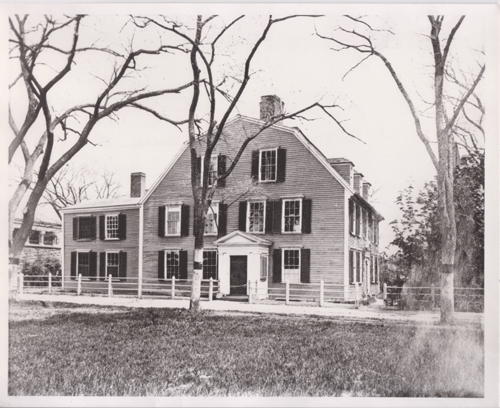
Hastings graduated from Harvard in 1768 and a few years later become one of Cambridge’s school teachers. He was living in his father’s house beside the common, shown here. On 8 June, three days before writing this letter, the young man took the job of town postmaster.

Ironically, his letter appears to have been intercepted by the Crown forces because it’s filed among Gov. Thomas Gage’s papers at the Clements Library. The library offers scans and an imperfect transcription.

Hastings wrote:
Your Brother’s Letter of 18th. May we received the 9 of June. Notwithstanding my many Avocations (our House being made Head Quarters) I cannot miss an Opportunity of sending you a Letter. Am happy you had so safe a Passage & found your Friends well.

At length we have had the Commencement of Hostilities begun by Gage’s Troops, at the Battle of Lexington, where 8 of our Men were killed, there being about 50 assembled on a Green.—

The Evening preceeding the 19 of April, I was met by 11 Officers equipt with Pistols & Cutlasses; when I got Home I acquainted several Gentlemen therewith; but they thought it was like to prove nothing but a false Alarm. They were mistaken. About 2 OClock the next Morning, we were roused out of Bed to pursue 1100 Grendadiers & Light Infantry being a Detachment from all the Regiments in Boston.—

They made their way to our Magazines at Concord, but affected nothing more than destroying 80 Barrels Flour, knocking of [sic] the Ears of 3 twenty four pounders & burning the Carriages. A Quantity of Bullets they threw into a pond, but have been got out since.

Coll. [Thomas] Gardner ordered our Regiment to parade at Watertown, not knowing but that Gage’s Reinforcement would take that Course. He was mistataken [sic], they marched thro’ Cambridge, wch. being known our Regiment took the nearest Way to meet the Detachment. Unluckily for us we had no sooner placed ourselves in an advantageous Post near Lexington Meeting House to give Battle to the Detachment, than we perceived the Brigade in the other Side of us. Our Situation was bad, being between both Armies.
Well, that seems like an exciting place to break, doesn’t it?

TOMORROW: Under fire.

Wednesday, January 21, 2026

“Also embarked Colonel Richard Prescott”

In late 1774 the British 7th Regiment, known as the Royal Fusiliers, was stationed southwest of Montréal, guarding the frontier of the British Empire.

But its commanding officer, Col. Richard Prescott (shown here), wasn’t with them.

The 17 October New-York Gazette reported:
On Thursday Morning last Major General [Frederick] Haldimand embarked on board the Transport named the Countess of Darlington, attended by Major of Brigade [Thomas] Moncrieff, Capt. Thomas Gamble, Assistant Quarter-Master General, Captain [Dietrich] Brehm, Aid de Camp, and Captain [Francis] Hutcheson;

with General Haldimand also embarked Colonel Richard Prescott of his Majesty’s Royal Fusileers, a Company of the Royal Artillery, with a large Quantity of Ordnance Stores for Castle-William.
Also headed to Boston were the 47th Regiment, three companies of “the Royal Regiment of Ireland” (18th), an artillery company, and artificers to build barracks.

Those transport ships arrived on Sunday, 23 October, as reported four days later in the Boston News-Letter. This was part of Gen. Thomas Gage’s military build-up after the “Powder Alarm.” Indeed, by the end of the year the 7th would be one of the few regiments in North America not stationed inside Boston.

Col. Prescott was still in Boston when the war began because on 12 June 1775 Gen. Gage wrote to the Secretary of War, Viscount Barrington, that “Colonel Prescot, now declared Brigadier,…is going to Canada to Assist General [Guy] Carleton.”

In addition, this 1905 publication by the Canadian Archives stated that Gage sent the same news that day to Lord Dartmouth, the Secretary of State: “The Colonel Prescott goes immediately to Canada to assist General Carleton, for I hear the Rebels, after surprising Ticonderoga, made Incursions, and committed Hostilities upon the Frontiers of the Province of Quebec…” I haven’t found a copy of that letter in Gage’s papers at the Clements Library, but its online database and transcriptions are still a work in progress.

Thus, through the first half of October 1774 Col. (later Gen.) Richard Prescott was in New York, where Hugh Gaine printed A Letter from a Veteran, to the Officers of the Army Encamped at Boston, as discussed here.

Prescott then sailed north. Eight days after he arrived, booksellers Cox and Berry advertised that pamphlet for sale in Boston.

As a senior officer in Gage’s force, particularly one not engrossed in the daily duty of his regiment, Prescott had the motive and opportunity to pen advice from a “Veteran” to younger officers. He was much closer to the situation in Boston than his younger brother Robert.

When William Tudor, Jr., recorded that people said A Letter from a Veteran was written by “General Prescott,” he most likely meant Richard Prescott.

Thank you for your attention to this matter.

Monday, November 10, 2025

“Writing this has employed a day”

Dr. Benjamin Church, Jr., used a variety of ways to send messages into Boston after the start of the war, including:
  • crossing the siege lines himself in April 1775 and pretending to have been placed under arrest.
  • having a letter “sewed in the waist of [a paid confederate’s] breeches.” That unnamed man was stopped and “confined a few days,” but the letter wasn’t found.
  • possibly piggybacking on a letter from Gen. Charles Lee that Church arranged to be sent into Boston in early July.
  • meeting a Crown agent in Salem. William Warden told the Loyalists Commission “he was sent by General [Thomas] Gage to Salem and Marblehead to receive intelligence from Dr. Benjamin Church, but failed to execute his business.” Church wrote in July, “I have been to Salem to reconnoitre, but I could not escape the geese of the capitol.”
  • asking Gen. George Washington’s staff to send in a letter through the channel they established to communicate to their agent, John Carnes. That document was sent through the hands of military secretary Joseph Reed, Lt. Col. Loammi Baldwin, a man named Tewksbury raising sheep what’s now Winthrop, and a waterman going into Boston.
  • And of course asking his mistress, Mary (Butler) Wenwood, to arrange for someone she knew in Newport, Rhode Island, to deliver a letter to a royal official there to pass into Boston. Unluckily for them, she chose her ex-husband, Godfrey Wenwood.
Of those communications, only the last letter survives and can be connected with a transmission route because it was intercepted, proving to be Church’s undoing.

For that letter through Newport, Dr. Church used a cipher for added security. One of the many fine questions asked after yesterday’s presentation on Dr. Church was if there were any other ciphered letters from him in Gen. Gage’s papers. I don’t think there are others. And in fact, since the one that incriminated Dr. Church was never delivered, there aren’t any at all.

As part of his defense Dr. Church displayed and translated a letter from his brother-in-law, John Fleeming, written using the same cipher. The doctor said Fleeming had asked him to use the cipher. That letter survives only in printed translations. Earlier Church told Washington that he had received and destroyed another ciphered letter from Fleeming, but that might have been the same one he later displayed.

In General Gage’s Informants, Allen French identified other letters from Dr. Church in the general’s papers on the basis of internal detail (the writer was about to leave for Philadelphia) or handwriting. Those were all in plain English.

As is the long letter written on 24 Sept 1775 and published in Henry Belcher’s The First American Civil War, which I identified in this post as probably Church’s last report to his royal handlers.

It appears, therefore, that Church used the cipher only in exchanges with Fleeming. Why not all the time?

One reason is that having a cipher and sending lots of coded letters might have raised questions. In one of those letters in Gage’s files Church said that an encounter with an angry man named Timothy had prompted him to destroy his cipher lest people suspect him.

Another factor may simply have been time. It took extra effort to copy each letter symbol by symbol. In the intercepted letter the doctor complained, “Writing this has employed a day.”

We might say that using every means to conceal a spy letter would be time well spent. But in Church’s case, the cipher roused Godfrey Wenwood’s suspicions and was soon broken, but the letters the doctor sent in other ways remained secret for over a century.

Monday, October 13, 2025

On the Trail of Capt. William Browne

In the HUB History podcast episode “Drinker, Draftsman, Soldier, Spy,” Jake Sconyers quotes my remark on how difficult it is to track Capt. William Browne of the 52nd Regiment before 1775 because there were so many men named William Brown(e).

He also quoted a portion of Ens. Henry DeBerniere’s report on his spy missions with Capt. Browne that I’d read many times but hadn’t tumbled to how it’s helpful with that precise challenge.

One of my favorite moments in that narrative is when Browne, DeBerniere, and their manservant have reached Jonathan Brewer’s tavern in Waltham.

a little out of this town [Watertown] we went into a tavern, a Mr. Brewer’s, a whig, we called for dinner, which was brought in by a black woman, at first she was very civil, but afterwards began to eye us very attentively; she then went out and a little after returned, when we observed to her that it was a very fine country, upon which she answered so it is, and we have got brave fellows to defend it, and if you go up any higher you find it so,—

This disconcerted us a good deal, and we imagined she knew us from our papers which we took out before her, as the General had told us to pass for surveyors; however, we resolved not to sleep there that night, as we had intended, accordingly we paid our bill which amounted to two pounds odd shillings, but in [sic] was old tenor.

After we had left the house we enquired of John, our servant, what she had said, he told us that she knew Capt. Brown very well, that she had seen him five years before at Boston, and knew him to be an officer, and that she was sure I was one also, and told John that he was a regular—he denied it; but she said she knew our errant was to take a plan of the country; that she had seen the river and road through Charlestown on the paper; she also advised him to tell us not to go any higher, for if we did we should meet with very bad usage
That waitress didn’t just recognize Brown—she recognized him from “five years before at Boston.” That was in 1770, and there were only two British army regiments in Boston then: the 29th and the 14th. That narrows the field considerably.

Sure enough, the officers of the 14th included Lt. William Browne. On 12 July 1771, the War Office announced that “Lieut. William Brown, of the 14th regiment of Foot,” had purchased the rank of captain in the 52nd in the place of Archibald Williams. In the 14th, Ens. William Napier moved up to lieutenant’s rank.

One implication of that fact is that Gen. Thomas Gage might have chosen Capt. Browne to scout the countryside in 1775 because that officer was more familiar with Massachusetts than most of his colleagues, having spent about two years in Boston and on Castle Island back in 1768–1770.

Of course, that had the drawback of more people in Massachusetts being familiar with Browne, as the woman in Waltham showed.

For earlier information on Lt. Browne I hunted down the Army List for 1767. And I found this list of lieutenants in the 14th Regiment of Foot:
Goddammit!

Two men named William Browne became lieutenants in the 14th Regiment four days apart in June 1766. One of them had joined the army in 1762, the other at some unknown time. They were both still lieutenants in the 14th at the start of 1771. 

And during the same period when one or both of these lieutenants were serving in Boston:
And there were probably others.

TOMORROW: Capt. Browne’s own voice?

Saturday, September 06, 2025

“He Lieut. Thos. Hawkshaw did affirm this to be the Fact & Truth”

On 23 Apr 1775, Lt. Thomas Hawkshaw of the 5th Regiment was lying near death.

He’d been shot through the throat during the Battle of Lexington and Concord. He’d lost a lot of blood, not only from that wound but from supposedly therapeutic bleeding. He was suffering spasms of pain. He had trouble swallowing pain relief, much less solid foods.

And his commander-in-chief, Gen. Thomas Gage, had just intercepted a letter from justice Edmund Quincy to the Patriot leader John Hancock saying Hawkshaw had been heard saying that British troops had fired first and started the war.

Hawkshaw’s regimental commander, Lt. Col. William Walcott, and other officers came to speak to him. They went away with this document, now in Gage’s papers. It said:
Boston, 23d. April 1775

Lieut. Thos. Hawkshaw of the 5th: Regt. of Foot, declares in the most solemn Manner to Lt. Col. Walcott, in the Presence of Capt. Smith & Lieut. Ben. Baker All of the same Regimt.,

That, he, Lieut. Thos. Harkshaw, never did say to any Person whatsoever, that, the King’s Troops gave the first Fire upon the People of this Country in the Affair which happened between the said Troops & the said Country People on Wednesday last the 19th. April;

that, so far from knowing or believing that the Troops were the first who fired, he, Lieut. Thos. Harkshaw, knows & believes that the Country People did fire first upon His Majesty’s Troops, & that he Lieut. Thos. Hawkshaw did affirm this to be the Fact & Truth to Lt: Col. [Francis] Smith of the 10th: Regt. of Foot who commanded the Grenadiers & Light Companies, upon the Spot, and that he, Lt. Thos. Harkshaw, did again upon his being brought into Boston, make the same Declaration to Capt. [John] Gore of the 5th. Regt. of Foot, That, to the best of his Knowledge & Belief, the Country People fired first upon His Majesty’s Troops.

Thomas Hawkshaw
Lieut 5th Regt. Foot

Wm: Walcott, Lt: Col. 5th. Foot.
John Smith Capt: 5th. Foot
Ben Baker, Lt. & Adjt. 5th. Foot
The regiment contained lieutenants named Benjamin Baker and Thomas Baker, so they used first names to sort out those men. The handwriting of the document looks like Walcott’s.

The detail about Hawkshaw telling Lt. Col. Smith (shown above) that the provincials in Lexington had fired first suggests the lieutenant was on or near the common during that shooting while Smith was still back with the grenadiers.

However, the document doesn’t add any detail about what Hawkshaw actually heard or saw there, and Gage was collecting such detail from other officers at this time. That makes me think Hawkshaw had passed on what he’d heard from other officers. (If Hawkshaw turns out to have been a light-infantry officer, then that’s off.)

In any event, from his sickbed Lt. Hawkshaw was insisting that he’d consistently blamed the provincials for shooting first.

TOMORROW: Corroborating witnesses.

Friday, August 29, 2025

Bell on “Dr. Benjamin Church,” 9 Nov.

As long as I’m discussing Dr. Benjamin Church, Jr., here’s early notice of a talk I’ll give about him for the Historical Society of Watertown this fall.

Sunday, 9 November, 2:00 P.M.
Dr. Benjamin Church
Watertown Free Public Library

The society’s event description says:
Dr. Benjamin Church was a patriot activist who was exposed as a spy for British Major General Thomas Gage. The Massachusetts General Court held an inquiry into his activities from October to November 1775. November 2025 will mark the 250th anniversary of the legislature’s decisions. New details regarding Church's spying activities will be revealed. Attendees will also learn where the Massachusetts General Court held the Church inquiry.

J. L Bell is a writer who specializes in the start of the American Revolution in New England and is the proprietor of the popular Boston 1775 website. A Fellow of the Massachusetts Historical Society and elected member of the American Antiquarian Society and Colonial Society of Massachusetts, he authored the book The Road to Concord: How Four Stolen Cannon Ignited the Revolutionary War as well as a National Park Service study of George Washington’s work in Cambridge. He has written many articles, delivered papers to the Massachusetts Historical Society and appeared on a panel of the Organization of American Historians. Some of his lectures have been broadcast on the C-Span Networks and he has spoken at many historic sites around greater Boston and beyond.
This event will be free and open to the public. Parking in the Watertown library lot is free on Sundays. This historical society’s programming is funded by a 2025 grant from the Watertown Community Foundation.

Thursday, August 28, 2025

“By Doctor Church I send”

As recounted yesterday, after returning from besieged Boston on 23 Apr 1775, Dr. Benjamin Church told Paul Revere that he’d been detained by Gov. Thomas Gage’s troops and kept in a North End barrack for most of his time in town.

Church’s Patriot colleagues accepted that story, probably even admired his daring. They chose him to travel to Philadelphia and consult with the Continental Congress, and the Congress in turn made him Surgeon-General of its army.

However, the documentary record I explored earlier this week casts doubt on Church’s story. While in Boston he was clearly communicating with relatives of his colleagues and offering to deliver letters for them.

On 22 April, Edmund Quincy gave Church two letters to carry out of town: to his daughter Dorothy and to her fiancé, John Hancock. The letter to Dolly Quincy refers to the “opporty (unexpected) by Doctr. Church” to communicate. There’s no apparent worry about Church being under the royal authorities’ control.

In addition, Edmund’s son Henry Quincy wrote a letter to the elder Dr. John Sprague in Dedham, shown here. That too stated: “Dr. Church Arrived here this PM. from Concord on Business with the General is Allowed in the Morning to Return.”

In further addition, Rachel Revere (shown above) wrote a short, undated note to her husband Paul. That began “by Doctor Church I send a hundred & twenty five pounds”—probably devalued Old Tenor currency.

All those documents are in the files of Gen. Gage. Did soldiers seize them from Dr. Church as he left Boston? That wouldn’t explain how those same files contain Dr. John Homans’s note to Dr. Joseph Gardner asking for surgical knives, which Church carried into town. 

When Allen French explored Church’s activities in General Gage’s Informers (1932), the letter from Rachel Revere was one of the prime pieces of proof that the doctor was cooperating with the royal authorities. I wrote about the Homans letter in an article for New England Ancestors in 2006. The Quincy letters add more evidence to that pile.

I wonder what Dr. Church told his colleagues when he arrived back in Cambridge, knowing that their relatives inside Boston would eventually mention that they’d given him letters to deliver. Presumably to maintain his cover the doctor spoke ruefully of having the big, bad soldiers take all his papers away. No one appears to have spoken of those missing documents as evidence of Church’s treachery, even after Gen. George Washington put him under arrest in October.

All the documents I’m speaking of remain in the Thomas Gage Papers at the Clements Library in Michigan. The library has just released digital scans of Gage’s correspondence in the weeks after the start of the war (along with poor computerized transcriptions which I’ve largely ignored). I’m sure there are some surprises to be found, as well as more evidence for what we already know.

Wednesday, August 27, 2025

“Are you serious, Dr. Church?”

In a letter to the Rev. Dr. Jeremy Belknap, Paul Revere recalled a dramatic moment on 21 Apr 1775:
The Friday evening after [the Battle of Lexington and Concord], about sun set, I was sitting with some, or near all that Committee [of safety], in their room, which was at Mr. [Jonathan] Hastings’s House at Cambridge. Dr. [Benjamin] Church, all at once, started up—

Dr. Warren, said He, I am determined to go into Boston tomorrow—

(it set them all a stairing)—

Dr. [Joseph] Warren replyed, Are you serious, Dr. Church? they will Hang you if they catch you in Boston.

He replyed, I am serious, and am determined to go at all adventures.

After a considerable conversation, Dr. Warren said, If you are determined, let us make some business for you. They agreed that he should go to git medicine for their & our Wounded officers.

He went the next morning; & I think he came back on Sunday evening.
As part of his medical mission, Dr. Church carried in a note from Dr. John Homans of Brookline to his mentor Dr. Joseph Gardner, asking for surgical knives.

Revere recalled speaking to Church after his return:
After He had told the Committee how things were, I took him a side, & inquired particularly how they treated him? he said, that as soon as he got to their lines on the Boston Neck, they made him a prisoner, & carried him to General [Thomas] Gage, where He was examined, & then He was sent to Gould’s Barracks, & was not suffered to go home but once.
In Igniting the American Revolution, Derek W. Beck guessed that the Gould of “Gould’s Barracks” was Lt. Edward Thoroton Gould, who on that day was a wounded prisoner of war outside of Boston. But I think the answer appears in a letter of merchant John Andrews on 11 January:
This morning the soldiers in the barrack opposite our house, left it, and took quarters with the royal Irish in Gould’s auction room or store—in the street leading to Charlestown ferry.
Bostonians often referred to barracks by the name of the local landlord who had rented those buildings to the army, making “Gould’s barracks” a big building on Back Street in the North End.

Robert Gould was a merchant who in August 1773 announced that the Boston selectmen had authorized him to set up as an auctioneer. He advertised heavily over the next several months (usually signing those notices “R. Gould”) before the Boston Port Bill hit. Renting his store to the army might have seemed like the best possible deal.

Robert Gould had also invested in Maine land along with Francis Shaw, Sr., a settlement that became Gouldsboro. He had trained Francis Shaw, Jr., in business, and newspaper ads in 1770 show that the younger man was selling ceramics out of “the store lately improved by Mr. Robert Gould.” In June 1776, Francis, Jr., and his wife Hannah had a boy they named Robert Gould Shaw. That man would pass the name on to his grandson, the Civil War hero.

Robert Gould remained in Boston after the British evacuation, but the Patriot authorities were suspicious of his dealings with the king’s army. The selectmen recommended detaining him for questioning, but the Massachusetts General Court decided to drop him from the list. Gould went back to advertising as a regular merchant in late 1776. But then he died unexpectedly, intestate and in debt, in January 1777, aged 57.

TOMORROW: The doctor’s documents.

Tuesday, August 26, 2025

“Pray the God of Armies to restrain Man

John Hancock wasn’t the only person Edmund Quincy wrote to on 22 Apr 1775, just after the start of the Revolutionary War, as quoted yesterday.

Justice Quincy couldn’t very well write to Hancock and ignore the man’s fiancée, Dorothy Quincy, could he? After all, she was his daughter.

Thus, we have this second, shorter letter written inside “Boston (a Garison’d town)”:
Dear Dolly—

I’ve an opporty (unexpected) by Doctr. [Benjamin] Church, Just to tell you, that I’m kept from my intended Journey to L[exing]ton & [Lene’y?] by restraint of Princes—endeavors are using to obtain an opening but how soon, none know!

It’s ye. will of Heaven, that it should be thus—!—To His Will, let us learn Submission, thro’ all the Changing Scenes of a Short uncertain Life—I pray God we may all learn this profitable Lesson, that we may be reaping the advantage at all times, especially in a time of Sharp trials, to wch. we are in every State more or less liable

We are generally in good health—but as generally under great sorrow, for the loss of so many humane lives, Wednesday last: pray the God of Armies to restrain Man, from further Attempts of a Similar kind—

Your Bror. & family propose removal—to Providence—if the Gates are opened to us—your Trunk is here—if mine go, yours will also—

I condole with Madm. [Lydia] Hancock, & you, under present & late Circumstances of things—I hope to see you soon, if it please God

Interim recommending you to his protection, with. all your near-Connexions in this devoted Town—I am with my Sincere regards to Madm. H. Mr. [Jonas] Clark & Lady—, Dear Child, Your Affectionate Father & Friend
Edm: Quincy

[Postscript:] Your S[iste]r. [Esther] Sewall distress’d, with ye View she has of things

[Postscript vertical along left margin:] I hope Mr. H. is well on is Journey—you are happy in yo. being out of this town—tho’ ye. Govr. Speaks Fair He is much troubled himself
Esther Sewall was another of Edmund Quincy’s daughters, married to royal attorney general Jonathan Sewall. She evidently had a close-up “View” of the administration of Gen. Thomas Gage and was “distress’d” at what lay ahead.

TOMORROW: The letter carrier.

Monday, August 25, 2025

“No Carriage from L. & if there was—no permiso. to pass”

On 22 Apr 1775, three days after the Battle of Lexington and Concord, the Boston merchant and magistrate Edmund Quincy sat down to write a letter to John Hancock.

Quincy wasn’t just a colleague of Hancock in the Boston Patriot movement. He was also the father of Dorothy Quincy, Hancock’s fiancée (shown here).

Earlier that month, Dorothy had taken the family carriage out to Lexington and then used it to flee with Lydia Hancock from the regulars on 19 April. That left her father stuck inside Boston as the siege began.

Justice Quincy wrote to Hancock:

Dear Sir,

Referring you to a Ltr. wrote the 8th. currt: [i.e., of this month] I’m now to enclose you one I had this day out of [ship captain John] Callihan’s bag:—32 days fro. Lond: into Salem pr young Doct. [John] Sprague—who tells me [captain Nathaniel Byfield] Lyde sail’d 14 days before them wth. Jo. Quincy Esq & other passengers—that some of ye Men of War & transports sail’d also before Callihan. As to ye times [?] at home—ye Doctr. is little able to inform us—youl probably have Some papers via Salem.—————

As to my Scituation here ye unexpected extraordy. event of ye 19th: of wch. Ive wrote my thots—) now & for days past impedes my leaving town[.] No Carriage from L[exington]. & if there was—no permiso. to pass ye lines—The people will be distress’d for fresh provisions—in a Short time—

The Govr: & Genl.—is very much concern’d about ye Provl. troops without—wch. probably will be very numerous ’ere long if desired—Dorchester hill—I’m just now told, is possess’d by our provls—& I hope its true, for Ive reason to believe, ye Genl. had ye same thing in Contemplation——

Here they say & swear to it all round, in excuse of ye Regulars, proceeding at Lexinton—that they were attack’d first & I doubt not many oaths of Officers & men are taken before J. G—ley [Justice Benjamin Gridley], to confirm it—but among others who contradict ’em—Lt. [Thomas] Hawkshaw yesterday near expiring thro. his bad wounds——Call’d Several Credible persons to him & told ’em as a dying man—that he was obliged in Conscience to confess—that the first Action of ye Whole at L. was done by the Kings troops—wr. they killd & wounded eight men—but doubtless you have sufficient proof of ye Fact & every Circumstance attending near at hand—

my advice is that the Whole Matter—be forwarded at ye province expence or otherwise wth. the Greatest dispatch—that so your Advices may be in London as early as GG’s——

If the people of G:B: are not under a political Lethargy—The Account of ye late Memorable Event, will excite them to consider of their own Close Connexion wth. America; and to Suppose at length, that ye Americans especially N. Englanders will act as they’ve wrote, & engag’d—A Blessed Mistake our prudent G[ag]e has indeed made, & ye Sensible part of his Officers & Soldiers own it—& are vastly uneasie—

I had been at L— days to pay my real regards to yr. good Aunt & Dolly—but wn. we shall have ye passage clear I dont [know] we are in hopes of effecting soon. But ye Gl. is really intimidated & no wonder wn. he hears of 50.000 men &c.—Much is Confess’d of ye intripedity of ye provinls. Im much Surpriz’d to hear that the Regulars abt. 1700—were drove off & defeated by near an Equal Corps only.—

Capt. [John] Erving, at his house yesterday Gave me ye Account of Hawkshaws Confesso.-proved to him at ye No: End yesterday to be real, he also says that from all he can gather from ye Circumstances of the people of Gt. Bn. they are by this day in a State of fermentation—if we could be so happy, as to get speedily home, the necessary advices—I doubt not a Flame would soon appear—& ere its quench’d, may it burn up ye heads of the Accursed Faction fro. whence ye present British Evils spring

Genl. Gage is thrown himself into great perplexity—Ld. Percy is a thorn in his side & its said has menaced him Several times, for his late imprudence—a Good Omen

I cant nor ought I to add, but my best regards—& Love respectively & that I am
Dr. Sir Your most affecto: Friend
& H. Servt.
Ed. Quincy

youl excuse erro. for Ive not time to correct em
There are a lot of interesting bits of intelligence in this letter—Gen. Thomas Gage hoping to seize the heights of Dorchester, Col. Percy criticizing his Concord mission, Lt. Hawkshaw saying the British soldiers had fired first. Quincy urged Hancock and his colleagues to send the Patriot side of events to London as quickly as possible.

How did John Hancock respond to seeing this letter? In fact, he never saw it.

TOMORROW: Diverted mail.

Saturday, August 09, 2025

“Lt. Coll. Walcott now excuses it”

As I’ve been discussing, a British army court-martial ordered Lt. Col. William Walcott to be reprimanded on the Common in front of the second brigade of British troops in Boston on 17 Apr 1775.

Part of that ceremonial punishment might have been for Ens. Robert Patrick, the young officer Walcott had yelled at and struck, to draw his hand across the regimental commander’s face, thus making things even.

Though a couple of other young officers, Lt. John Barker and Lt. Frederick Mackenzie, wrote the long court-martial verdict into their diaries, neither man described seeing that embarrassing punishment. And Mackenzie was in the second brigade, so he would have been on the Common.

Perhaps that detail was too small to mention. Or maybe it never happened, and the sources from the early 1800s are wrong.

We do know there was another wrinkle in Lt. Col. Walcott’s penalty. He was supposed to be “Suspended for the Space of three Months.” However, Gen. Thomas Gage’s orders for 18 April state:
The Commander in Chief is pleas’d to take off the Suspension ordered upon Lt. Coll. Walcott from this Day inclusive; It having Appeared thro’ the course of the tryal, that Ens. Patrick did behave disrespectfull to his Commanding Officer, but it not being inserted in the Crime, the Court did not proceed upon it, & Lt. Coll. Walcott now excuses it, And will not bring it to a Tryal; but the Commander in Chief thinks proper to Warn Ensign Patrick to behave with more respect for the future to his Commanding Officer.
Thus, although the court martial acquitted Ens. Patrick of “Quarrelling,” “giving a blow,” and “giving…a Challange to fight,” he could still have been brought up on charges of being “disrespectfull.”

But Lt. Col. Walcott decided to let that charge lie. Maybe the family relationship between the two men reported by Lt. Mackenzie was a factor. Maybe this forbearance let Walcott show he was behaving as a proper officer again.

As for Gen. Gage, he was about to send 700 or so soldiers to Concord that evening, with another 1,200 to follow them a few hours later. He needed all his regiments working as efficiently as possible, and that meant keeping Lt. Col. Walcott on the job.

The 5th Regiment took casualties on 19 April, and more at Bunker Hill. Ens. Patrick was promoted to lieutenant on 22 November. He was still at that rank in the 1778 Army List.

Lt. Col. Walcott continued to command the regiment as its official colonel, Earl Percy, handled higher responsibilities. In January 1777 Gen. Sir William Howe gave him responsibility for negotiating exchanges of prisoners of war with Gen. George Washington’s military secretary, Robert Hanson Harrison. In October, Walcott was wounded at the Battle of Germantown, and he died on 16 November.

Friday, August 08, 2025

“Ordered to draw his Hand across the Face of his Lieutenant Colonel”

As quoted yesterday, on 15 Apr 1775 a court-martial sentenced Lt. Col. William Walcott to be reprimanded in front of the entire second brigade of the British army in Boston.

Walcott had struck a young officer in his regiment, Ens. Robert Patrick. The military court deemed that behavior “unmilitary & ungentleman like.” Regimental commanders weren’t supposed to slap down that far.

Another possible detail of the sentence didn’t make it into Gen. Thomas Gage’s general orders, however. Some sources say that the court or the brigadier who both presided over it and commanded the brigade, Gen. Robert Pigot, told Ens. Patrick to swipe his hand across Lt. Col. Walcott’s face in return for the lieutenant colonel striking him.

The earliest I’ve found that detail mentioned is a book published in Bristol in 1806: The Singular and Interesting Trial of Henry Stanton, Esq., of the 8th. (or King’s) Regiment: On Charges for Unofficer-like Behaviour, as Preferred Against Him by Lieutenant Colonel Young, Commanding the Said Regiment. Tried by a General Court-Martial Held at Doncaster, August 14, 1805, and several subsequent Days.

In the course of the arguments, someone stated:
Lieutenant Colonel Walcot, of the 5th. Regiment of Foot, encamped in Boston, North America, in 1775, was suspended for Six Months, for striking Ensign Patrick, of the same Regiment; who was ordered to draw his Hand across the Face of his Lieutenant Colonel, before the Whole Garrison, in return for the Insult he received. Notwithstanding he had challenged Colonel Walcot.

This was tried before an Honourable Court Martial, Brigadier General Pigot, President.
Those words appear between quotation marks, but I haven’t found their source.

Ten years later, E. Samuel published An Historical Account of the British Army: And of the Law Military, as Declared by the Ancient and Modern Statutes, and Articles of War for Its Government with a Free Commentary on the Mutiny Act, and the Rules and Articles of War; Illustrated by Various Decisions of Courts Martial.

That book stated in a footnote:
A remarkable instance of this kind occurred in the late war in America. Lieutenant-Colonel Walcot, of the 5th regiment of foot, while encamped near Boston, was so unfortunate, in a hasty and intemperate moment, to be moved to strike a subaltern (Ensign Patrick) under his command; and notwithstanding the latter had challenged him, the lieutenant-colonel was brought to a court martial, of which Brigadier-General Pigot was president, for the offence, when the court, after due consideration, suspended him from pay and allowances for six months, and was further pleased to order that Ensign Patrick should draw his hand across the face of the lieutenant-colonel before the whole garrison, in return for the insult he had received.
Samuel’s publication was authoritative enough that the anecdote appeared in several more histories of the British army, the 5th Regiment, dueling, and courts martial over the next century.

As I said above, the detail of Ens. Patrick touching Lt. Col. Walcott’s face does not appear in the general orders describing the outcome of the case. Furthermore, the court martial officially acquitted Patrick of challenging Walcott, contrary to the later descriptions of the punishment.

Neither of the British army officers who followed this case in their diaries—Lt. John Barker and Lt. Frederick Mackenzie—described seeing Ens. Patrick carry out this action. But perhaps another contemporaneous source will surface.

Paradoxically, this alleged detail of the Walcott case has gotten more discussion in print than the verdict in Gen. Gage’s official announcement. It’s in the literature as an unusual but still precedented measure the British army has taken to encourage good behavior in officers.

TOMORROW: Suspended.

(The picture above shows an officer from an Irish volunteer regiment being manly about 1780.)

Thursday, August 07, 2025

“Agreeable to the Sentince of the General Court Martial”

As described yesterday, in March 1775 Lt. Col. William Walcott came to blows, and nearly to a pistol duel, with Robert Patrick, an ensign in his regiment and a young relative.

Walcott was overseeing the 5th Regiment while its colonel, Earl Percy, was in charge of the British army’s first brigade in Boston. The 5th was assigned to the second brigade under Brig. Gen. Robert Pigot (shown here).

Pigot also presided over a court-martial trial of the two feuding officers starting on 26 March.

The always cranky Lt. John Barker wrote in his diary on 30 March: “A General Court Martial has been sitting some days to try Lt. Cl. Walcott; and Ensn. Patrick of the 5th; it’s thought it will be a tedious one.”

Gen. Thomas Gage’s orders for 15 April announced the outcome:
The Genl. Court Martial of which Brigr. Genl. Pigot is President for the Tryal of Lt. Coll. Walcot & Ensign Patrick of the 5th Regt. of Foot, for Quarrelling, & the Consequences that ensued, which were reported to be blows given & a Challange to fight, is of Opinion, that the said Lt. Coll. Walcott is guilty, first of Quarrelling with Ens. Patrick, Secondly of making use of Menaceing, Reproachfull and Abusive Language, thirdly of giving a blow to & drawing his Sword on the said Ens Patrick on the Publick Parade in presence of the Officers of the Regt. when Addressing the former as Commanding Officer, which Conduct the Court considers, as highly prejudicial of good order & Military Discipline, as well as ungentleman like, which the Court finds to be a breach of the 1st Article of the 7th Section, & of the 3d Article of the 20th Section of the Articles of War, therefore Sentence the said Lt. Coll. Walcott to ask Ensign Patrick’s Pardon, at the head of the 5th Regt. (the 2d. Brigade under Arms) for the insult given him, & then & there to be Repremanded for the unmilitary & ungentleman like behavior, & also to be Suspended for the Space of three Months.

The Court Acquits Lt. Coll. Walcott of giving Ens. Patrick a Challange to fight, It is further the Opinion of the Court Martial, that Ens. Robt. Patrick is not guilty, either of Quarrelling with Lt. Coll. Walcott on the Evening of the 23d of March, or of giving a blow, And it Appearing also to the Court, that the evidence produced does not prove Ens. Patrick guilty of giving Lt. Coll. Walcott, a Challange to fight.

The said Ensign Patrick is Acquitted of every part of the Charge exhibited against him.

The Commander in Chief Approves of the above Sentence. . . .

The 2d. Brigade to be under Arms on Monday Morning at 11 O’Clock on the Common when the Brigadier Commanding the 2d. Brigade will repremand Lt. Coll. Walcott Agreeable to the Sentince of the General Court Martial.
Because that ruling was in Gage’s 15 April general orders, adjutant officers copied and carried it to every regiment in Boston.

Lt. Barker copied the text into his personal diary, underlining the phrase “then & there” to emphasize how Lt. Col. Walcott would have to eat crow in front of the whole brigade.

Lt. Frederick Mackenzie likewise recorded the verdict in his diary and (ever efficient) added that the reprimand was to take place on 17 April.

TOMORROW: A gesture of reconciliation?

Wednesday, August 06, 2025

“They agreed to fight with Pistols”

What were officers of the British army in Boston thinking about in the weeks leading up to 18 Apr 1775?

Judging by the word count of what they wrote in their general orders and diaries, they were closely watching the fallout of a dispute between two officers in the 5th Regiment.

On 23 March, Lt. John Barker of the 4th recorded:
another duel stop’d between the Lt. Col. [William Walcott]…and Ensn. [Robert] Patrick of the same [regiment]; some words passing between them, the Lt. Cl. struck Mr. P——k in the face upon which they both immediately drew their Swords, but the other Officers interfering it was put a stop to ’till the Rolls were call’d when they both went to the Common, where they agreed to fight with Pistols which Mr. Patrick went for and upon his return was met by an Officer of the Regt. who by some means took the Pistols and fired ’em in the air, which alarmed the Guard which turned out and took him Prisoner and carried him to Lord Percy who put him in arrest, then went to Col. Wallcott and put him in arrest likewise; there the affair rests.
Three days later, Lt. Frederick Mackenzie of the 23rd wrote:
There was a dispute lately on the Evening parade of the 5th Regiment, between Lieut Colo. Walcott, and Ensign Patrick of that Corps, at the close of which the former struck the latter, and drew his Sword upon him, which occasioned a Challenge; but the Officers having interfered, and the matter having been reported to Genl. [Thomas] Gage, he ordered them both to be put under arrest, and tried by a General Court Martial

Ensign Patrick is related to the Lieut Colonel.
Mackenzie was a reliable veteran officer, so his statement about the two men being related is probably correct, but I haven’t been able to find more details.

Lt. Col. Walcott was born around 1742 and had been with the 5th Regiment since 1760, joining as a captain. Ens. Patrick had arrived in July 1771.

TOMORROW: The verdict.

[The picture above shows the uniform of an officer in the 5th Regiment as of 1792.]

Tuesday, August 05, 2025

“On the Alarm being given…”

The Massachusetts Patriots weren’t the only folks building an alarm system over the winter of 1774–75.

On 30 December, Gen. Thomas Gage set out this plan for his garrison in case they were attacked from the countryside:
The Alarm Guns Will be Posted at the Artillery Barracks, the Common & the Lines, the Alarm given at either of those places, is to be repeated at all the rest, by firing three Rounds each.

On the Alarm being given the 52d Regt. is immediately to Reinforce the Lines, leaving a Captain & 50 at the Neck, The 5th Regt. will draw up between the Neck Guard & the Liberty Tree.

The 4th or Kings own Regt. will Reinforce the Magazine Guard with a Captain & 50 and with the Remainder draw up under Bartons Point.

The 43d Regt. will join the Marines & together defend the Passage between Bartons Point & Charles Town Ferry.

The 47th Regt. will draw up in Hanover Street securing both the Bridges over Mill Creek.

The 59th Regt. will draw up in the Front of the Court House.

The 3 Companies of the 18th Regt. joined by those of the 65th Regt. the 10th 23d & 38th Regts will draw up in the Street between the Generals House & Liberty Tree.

Majors [William] Martins Company of the Royal Regt. of Artillery will move with expedition to the Lines, Reinforcing the Neck with one Commission’d Officer 2 Non Commission’d & 12 Men the Remainder of the Royal Regt. of Artillery will get their Guns in order & wait for orders.

If any Alarm happens in the Night, the Troops will March to their Post without Loading, & on no Account to Load their Firelocks, it is forbid under the Severest Penalty to fire in the Night, even if the Troops should be fired upon, but they are to Oppose & Route any body that shall dare to Attack them (with their Bayonetts) And the greatest care will be taken that the Countersign is well known to all the Corps & Small Parties, Advanced, that in case of meeting they should know their friends & not Attack each other in the Night thro’ Mistake.

The Officers Commanding Regts will Reconoiter the Streets leading from their Quarters, to their Respective Alarm Posts. & fix upon the Streets they intend passing thro’, each taking a different Route.
Bartons Point was the northwest tip of the town, sticking out into the Charles River. It’s striking that the army adopted the designation “Liberty Tree” for the big elm in the South End, despite its political origin.

Gen. Gage’s plan was never implemented, of course. On 20 Apr 1775, he stated: ”All former Orders Respecting Alarm Posts to be Cancel’d, & the Regts. to form in their Barracks.”