J. L. BELL is a Massachusetts writer who specializes in (among other things) the start of the American Revolution in and around Boston. He is particularly interested in the experiences of children in 1765-75. He has published scholarly papers and popular articles for both children and adults. He was consultant for an episode of History Detectives, and contributed to a display at Minute Man National Historic Park.

Subscribe thru Follow.it


•••••••••••••••••


Showing posts with label Brandywine. Show all posts

Friday, August 19, 2022

The Mysteries of Fortune Freeman
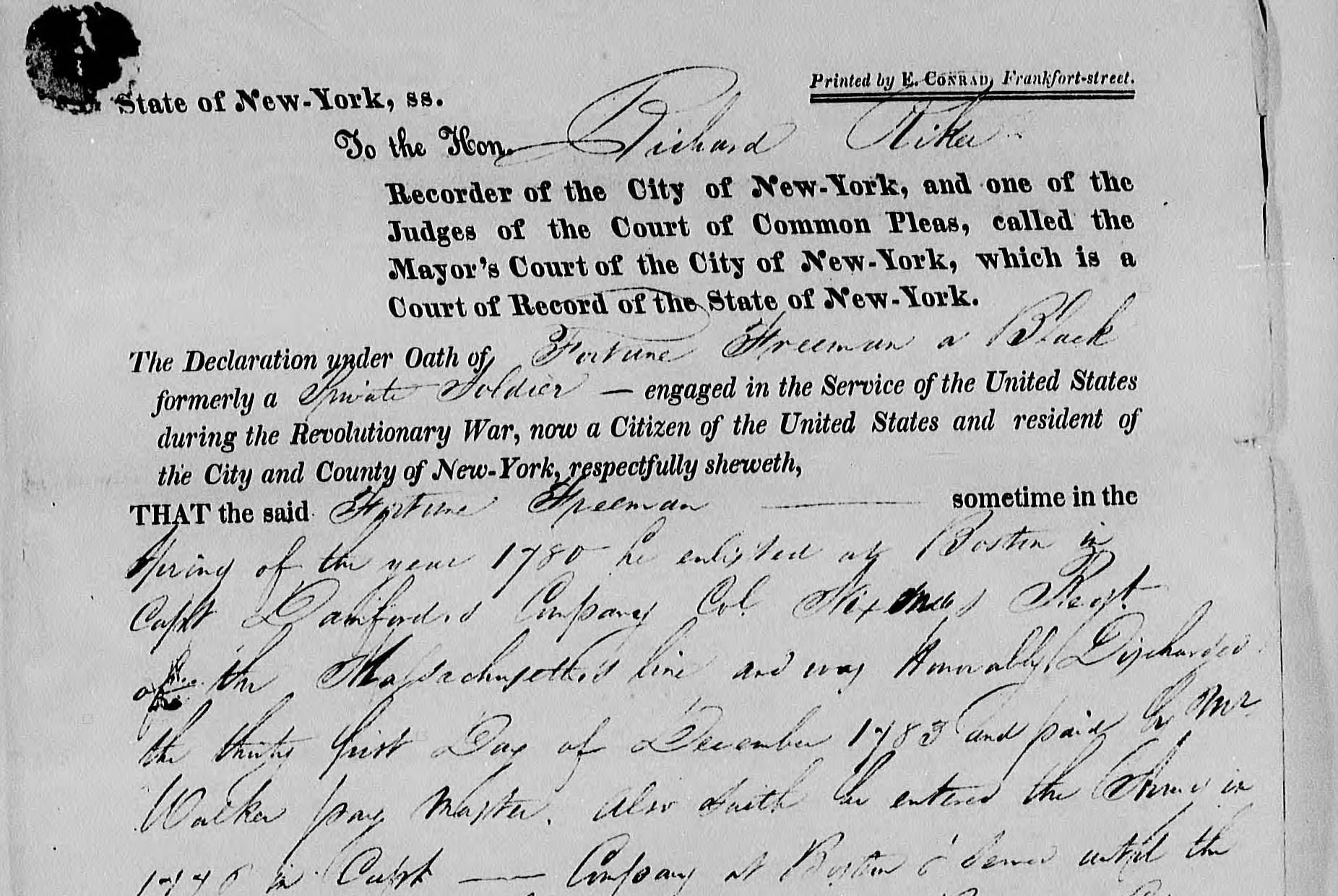
Earlier this year Boston National Historical Park shared a research article by Anjelica Oswald about an African-American Revolutionary War pensioner. It starts with this scene:
In the spring of 1818, an old man named Fortune Freeman…swore to the court that he served as a soldier in the Revolution, and applied for a veteran’s pension for some relief. Arriving to the court with merely the clothes on his back, Freeman provided few details about his personal life in his statement. Aside from his own declarations, few records of his life exist before or after the war. Only one of these precious few records remained in his possession when he approached the court: a discharge paper from the 4th Massachusetts, issued to him at the close of the Revolutionary War in 1783.
Because many veterans similarly lacked paperwork, and because the U.S. War Department had suffered a fire in 1800, the pension process for aging Revolutionary War veterans relied on applicants’ memories. That makes the pension files detailed historical sources but also leaves them riddled with gaps and contradictions.

In Fortune Freeman’s case, his memories didn’t match the remaining paper trail in several ways.
Freeman claimed to have first enlisted in Boston in 1776 in Captain Elijah Danforth’s company, Colonel Thomas Nixon’s regiment, later designated the 6th Massachusetts Regiment in 1779. He stated that he continued to serve in the same regiment until his honorable discharge in 1783. However, when looking through muster rolls, there is no record of a “Fortune Freeman” enlisting in 1776 in Danforth’s company. In fact, there is no record of a “Fortune Freeman” in Danforth’s company at all.
Capt. Danforth was from Billerica, serving from the first day of the war. But he left the army in March 1779. So whom commanded Fortune Freeman after that?

Freeman also testified to having been wounded at the Battle of Brandywine and to witnessing the surrender of Gen. John Burgoyne at Saratoga. Those two major battles took place in the same season hundreds of miles apart, so no army units were at both.

Freeman’s pension application thus shows some of those gaps and contradictions. However, Oswald also found that in May 1777 Col. James Barrett mustered a Billerica man named Fortune (or “Forten”) Conant into Capt. Danforth’s company. This man served in that Massachusetts regiment until 1780. Then there’s no further record of him.

But there is a record of a man named Fortune Freeman enlisting into the 4th Massachusetts regiment in 1781 and serving until the end of the war two years later. Those details matched the discharge paper Freeman presented with his pension application decades later.

Oswald’s essay explores the likelihood had Fortune Conant and Fortune Freeman were the same man, with some details dovetailing, others (like his later commanding officer) left aside, and a few (either Brandywine or Saratoga) embellished.

It also uses the record of the units Conant and Freeman were linked to, and later civilian records, to fill in the big holes of his/their life. Was Fortune Conant born enslaved, perhaps to the Conant family of Billerica? Did Fortune Freeman return to Massachusetts after being discharged? The U.S. government continued to pay his pension until 1824, so is that when this veteran died? The article is a detailed read, careful to distinguish evidence from supposition.

Wednesday, January 15, 2020

The Legends of Sandy Flash Drive

The Philadelphia Inquirer just published an article about how two roads in the region—in areas where I’ve traveled, in fact—are named after a Revolutionary turncoat and highwayman.

This circumstance raises interesting questions about how we remember the past with public names and monuments.

Here’s a link to Rosemary S. Warden’s article “‘The Infamous Fitch’: The Tory Bandit, James Fitzpatrick of Chester County.”

James Fitzpatrick served with the Continental forces in 1775 and 1776, but then resisted further militia call-ups. In late 1777 he threw in with the British, serving as a scout around the time of the Battle of Brandywine and the seizure of Philadelphia.

For the next year, Fitzpatrick fought for himself as “Captain Fitz,” head of a band of highwaymen who targeted Whig officials, particularly tax collectors and militia officers. Chester County was a no-man’s land during the British occupation of the capital.

When Gen. William Howe withdrew to New York City in the summer of 1778, however, Fitzpatrick lost his refuge. He was captured in August, tried in September, and hanged—though not without special effort by the executioner.

Stories about Fitzpatrick grew into legends in the nineteenth century. In 1866 the novelist Bayard Taylor wrote The Story of Kennett based on those tales. Taylor called his recurring highwayman character “Sandy Flash.” In the romantic and credulous style of the Colonial Revival, the fictional tales of Sandy Flash soon became amalgamated with the real history of James Fitzpatrick.

Fitzpatrick’s crimes (and his treachery, when seen from an American point of view) thus became part of the exciting tableau of the American Revolution. Authors treated him as a Robin Hood, as an example of gallant bravado. There were rumors he’d left behind buried treasure. His story was deemed suitable for children’s literature.

As reporter Joseph A. Gambardello writes, in 1972 Pennsylvania laid out Ridley Creek State Park (which includes the Colonial Pennsylvania Plantation, a living-history museum, shown above) just in time for the Bicentennial. The state chose to name a main artery in the park after a man hanged for being a traitor to the state—Sandy Flash Drive. Later a new development in Kennett Square got streets named after Taylor’s characters, including another Sandy Flash Drive.

The issue of historical place names never fully goes away, but we’re at a moment of extra attention to those things. Do they always honor the people whose names they preserve? Do those people always deserve that honor? Here’s an example where the real figure, entwined with a fictional character and legends that might or might not be real, wouldn’t seem to merit official esteem.

But James Fitzpatrick’s history isn’t touching raw nerves—southeastern Pennsylvania isn’t being plagued by highwaymen. It may help that both Fitzpatrick and Sandy Flash were punished, providing a satisfyingly moral end to his tale. Still, we might ask why we like to overlook some historical figures’ misdeeds yet celebrate others.

Saturday, May 13, 2017

Uniforms Less Than Uniform

Last year Prof. Ashli White of the University of Miami wrote on the Omohundro Institute’s blog about her research at the institute and nearby Colonial Williamsburg.
As armies and navies were deployed throughout the Atlantic, they took with them uniforms, flags, banners, and even dinnerware, emblazoned with insignia that declared where they stood on the ideological spectrum of revolution. . . .

Sources show that soldiers were not wearing uniforms as we tend to think of them—snappy, carefully coordinated sets with various accoutrements and details that adhered to clear codes. Rather, soldiers’ and even officers’ clothing was much more mixed, if not at times downright ad-hoc. This situation resulted because of the difficulties of distributing clothing and its constant wear-and-tear. What’s more, armies appropriated their enemy’s clothing as spoils of war and then incorporated it into their kits. And whenever possible, soldiers exerted their own sartorial preferences, too.

Take, for example, a uniform coat in CW’s collections that had worn by a British Field officer in North America. I had the privilege to meet with Linda Baumgarten, curator of textiles, to look at examples of both civilian and military clothing, including this remarkable coat. It dates from about 1790, but as Erik Goldstein, the curator of mechanical arts and numismatics, has demonstrated, it is stylistically in keeping with coats worn during the American Revolution. So while gearing up for war with France, this British officer chose a cut for his coat that harkened to his service almost twenty years before, even though it was out of step with the latest trends.
I couldn’t find a picture of the coat White described, but this waistcoat (shown above) came into the Colonial Williamsburg collection with it.

The museum curators understand that the coat and waistcoat were made for Col. James Moncrieff, who had become a young army engineer in 1763 in time for the siege of Havana. During the Revolutionary War he served at Brandywine, Stono Ferry, Savannah (from the inside), and Charleston (from the outside). The museum says, “He attained the appointment to deputy adjutant general in 1790. The style of this coat is specific to deputy adjutant general and quartermaster general.” Moncrieff was mortally wounded at Dunkirk in 1793.

Saturday, May 28, 2016

Venues for Valiant Ambition by Nathaniel Philbrick

Following up on Bunker Hill (discussed in most of these postings), Nathaniel Philbrick has brought out Valiant Ambition: George Washington, Benedict Arnold, and the Fate of the American Revolution.

As the title indicates, this book focuses on the Continental commander-in-chief and one of his most capable yet prickly protégés.

Philbrick describes Arnold’s feats on Lake Champlain in the Battle of Valcour Island in the fall of 1776, at the same time that the British army was driving Washington out of New York City. He follows the two men through their separate campaigns—Washington running into defeat at Brandywine, Arnold enjoying part of the victory at Saratoga.

And then everything started to go terribly wrong.

Nat Philbrick’s great skill as a historian is finding details and quotations that bring out the emotional core of a story. In this book he focuses on the two men’s psyches as they grew together and apart. He also argues that the revelation of Arnold’s treachery, coming at a low point in the fight for independence, strengthened American unity by providing an enemy to rally against.

I missed Philbrick’s first swing through these parts on his book tour, but he’s coming back through New England next month. Here are the venues:
  • 7 June, 7:00, Main Street Landing Performing Arts Center on behalf of the Lake Champlain Maritime Center, Burlington, Vermont
  • 9 June, 7:00, American Antiquarian Society, Worcester
  • 10 June, 4:00, Falmouth Historical Society
  • 15 June, 7:00, Barrington Books, Barrington, Rhode Island
  • 16 June, 6:00, Boston Athenaeum
Then three events at the Nantucket Book Festival:
  • 18 June, 9:00 A.M., “Revolutionary Figures on a Shifting Canvas,” Nantucket Atheneum
  • 18 June, 1:00 P.M., Mitchell’s Book Corner
  • 19 June, 6:00 P.M., panel discussion at Nantucket Whaling Museum
For more details and other venues, check Philbrick’s website.

Friday, September 11, 2015

EXTRA: Brandywine Animated

This is the anniversary of the Battle of Brandywine in 1777, one of the largest and most consequential battles of the Revolutionary War—though, since the Continentals didn’t win the battle or the campaign, not a field preserved at the federal level.

Here is an animated map of the battle, which does a good job of showing how British general Sir William Howe flanked Gen. George Washington’s position by crossing the Brandywine River at little-known fords to the north.

Unfortunately, that map requires a web browser with the Flash plug-in, so not everyone will be able to see it easily.

If you can see the site, zoom in on the lower right corner where the blue symbols are clustered around Chadd’s Ford. Then run the animation. The sudden appearance of red symbols on the east side of the river is a nice approximation of Washington’s experience.

Wednesday, March 19, 2014

Washington “lamenting the disappointment”

Most Americans viewed the British evacuation of Boston in March 1776 as a triumph. The colonies’ third-largest port had been liberated without major loss of life or property. Most British forces in North America had withdrawn from the thirteen colonies represented in the Continental Congress.

The Congress even voted to have a medal struck for Gen. George Washington, a rare honor (full story here).

But how did Washington himself view the development? On 27 March, he wrote a letter to neighbor Landon Carter about the British action:
Upon their discovery of it [i.e., the fortification on Dorchester Heights] next Morning great preparations were made for attacking us with their whole force but not being ready before the Afternoon and the Weather getting very tempestuous much Blood was Saved, and a very important blow (to one Side or the other) prevented—

That this remarkable Interposition of Providence was designed to answer some wise purpose I have no doubt of but as the proposed end of the Manouvre was to draw the Enemy to an Ingagement under disadvantageous circumstances—as a premeditated Plan was laid for this purpose—and seemd to be succeeding to my utmost wish—and as no Men could be better disposed to make the Appeal than ours seemd Upon that occasion I can scarce forbear lamenting the disappointment as we were prepared for them at all points and had a chosen Corps of 4000 Men with Boats ready to push into Boston upon a signal given if the Enemy should have sent out large detachments—

However they thinking (as we have since been informed) that we had got too formidably Posted before the Storm abated (for we Workd through the whole of it) to be much hurt by them, and apprehending great annoyance from us resolved upon a precipitate retreat & accordingly Imbarkd in as much hurry, and as much confusion as ever Troops did on the 17th Instt not having got their Transports half fitted & leaving Kings property in Boston to the amount as is supposed of thirty of £40,000 in Provisions, Stores, &ca among which many Pieces of Cannon some Mortars & a number of Shot Shells &ca are left—
On 31 March, the general repeated his language in a letter to his brother John Augustine Washington:
I can scarce forbear lamenting the disappointment, unless the dispute is drawing to an Accomodation, and the Sword going to be Sheathed.
Washington had wanted a battle for two reasons:
  • He hoped to hurt the British forces as much as at the Battle of Bunker Hill, thus convincing the government in London that the war would be too costly to continue.
  • He viewed that sort of battlefield victory as the only way for a military leader to gain honor and fame.
Over the next two years Washington kept setting up situations which he thought would force the British army to attack his troops head-on so the Continentals could inflict heavy casualties: at Brooklyn, on Manhattan, at Brandywine. Most of the time the Continental Army came off worse from those confrontations.

Only after Valley Forge did the American commander abandon his hope of battlefield glory in favor of outlasting the king’s forces—what his generals called his Fabian strategy. Washington learned that it was more disappointing to lose a big battle than not to fight it.

Tuesday, November 26, 2013

American Revolution Conference in Williamsburg, 21-23 March

Next March, America’s History, L.L.C., is hosting its third annual American Revolution conference in Williamsburg, Virginia. From the evening of Friday, 21 March, through the morning of Sunday, 23 March, the Colonial Williamsburg Woodlands Hotel will be the site of presentations like these:
  • Edward G. Lengel, editor of the George Washington Papers: “Philadelphia is the Object in View”: George Washington at the Battle of Brandywine, 1777
  • James Kirby Martin: Forgotten Allies: The Oneida Indians’ Contribution to the American Revolution
  • Andrew O’Shaughnessy: First in War or First in Peace: Sir William Howe as Commander-in-Chief
  • Glenn Williams: Revenge and Reprisals: Irregular Warfare and the Sullivan-Clinton Campaign against the Iroquois
  • Todd Andrlik: Reporting the Revolutionary War: Colonial Newspapers as a Historical Record
  • Don Hagist: Sixty Men at Yorktown: A British Light Infantry Company
  • David Mattern: Major General Benjamin Lincoln and the American Revolution
  • James L. Nelson: The Best General on Either Side: Benedict Arnold’s Naval Operations on Lake Champlain and the Chesapeake Bay
Two panel discussions will address the questions “Could the British Have Won the American Revolution? Where and How?” and “What Revolutionary War Personality Would You Like to Have Dinner with and Why?”

Speaking of which, dinner is not included in the $225 conference registration fee, but lunch on Saturday is, and a breakfast buffet is included in the conference’s hotel room rate of $86 per night. For more information, including how to register, visit the conference webpage.

On the landscape between history academics and history buffs that I mapped out earlier in the year, this event is definitely designed for buffs. Almost all the presentations are about military topics, with an emphasis on leaders, as opposed to, say, sociological change. But the quality of the research and analysis on those topics promises to be top-notch.

Friday, September 20, 2013

Top Ten Turning-Points?

All Things Liberty recently featured new co-editor Don Hagist’s list of “Top 10 Battles of the Revolutionary War.” The only certainty about that sort of list is that it won’t please everybody, and indeed I was among commenters asking about other “turning-point” battles that didn’t make the cut.

In a lot of those Revolutionary War lists, I’ve observed, most of the turning-points turn one way—usually for the Americans. But surely the Crown forces enjoyed some turning-points as well. Otherwise, the Americans wouldn’t have needed to turn anything. Don’s list does include some British triumphs, though not a couple that I think are significant.

It turned out, as Don explained his thinking in comments, that he went looking for battles that changed the course of campaigns. In other words, the arrival of the British in New York in 1776 and their victories at Brooklyn and White Plains all furthered a successful campaign, but the turning-point came at Trenton, where the Continentals finally slowed the British advance.

Thus, Don’s list included the first British attack on Charleston, South Carolina, in 1776, when their campaign was defeated; but not the second in 1780, when they took over America’s principal southern port, captured 5,000 Continental soldiers, and established a second garrison within the U.S. of A. that lasted to the end of the war.

I realized I approach turning-points differently, looking for events that changed people’s thinking about the war. But before I continue quibbling, I have to acknowledge that Top Ten lists require cutting things out. It’s all very well to complain that a movie critic left your favorites off her Top Ten Films of the Year, but to play the same game you have to cross out as many items as you add.

So I’ll start by striking the first battle off Don’s chronological list: the Battle of Lexington and Concord. Obviously significant in starting the war, it was nevertheless not a turning-point. It just solidified what each side thought about the situation. For months Gov. Thomas Gage knew his political authority stopped at the gates of Boston; the siege militarized the isolation that already existed.

Before 19 Apr 1775, Massachusetts Patriots were already convinced that the royal authorities were out to destroy their ability to defend themselves. The royal forces already believed most New Englanders were a swarm of rebellious zealots. I’m not sure the actual fighting changed many minds. Some provincial militiamen were pleasantly surprised they could shoot regulars, but they’d been hearing stories about their region’s triumph at Louisbourg for months. After the battle, the Massachusetts Provincial Congress’s communications didn’t emphasize the battlefield victory but the new set of grievances, which they said confirmed what they’d been warning about the Crown all along.

I think the Battle of Bunker Hill (#2 on Don’s list) was a turning-point—even though the immediate result in the field also looks small. The British took control of a second peninsula in Boston harbor, but one that the provincials had occupied for less than twenty hours, and then sat on it for nine months. But that bloody fight made both sides rethink things. The Americans were scared, then gradually reassured about their ability to inflict damage on a regular army. The British commanders became convinced that there was no reason to stay in Boston. It took months for the London government to approve their plans to leave, and then winter came on, but the Battle of Bunker Hill really decided the first campaign of the war and changed people’s thinking.

Unfortunately, I think Gen. George Washington came away from hearing about Bunker Hill with the wrong thinking. As I wrote back here, he thought the key to the war would be another Bunker Hill—another big battle with lots of enemy casualties that would make the London government pull back. He kept proposing that strategy to his generals around Boston, he hoped the fortification of Dorchester Heights would lead to such a battle, he waited for the same thing at Brooklyn, and so on.

Which brings me to the Battle of Brandywine on 11 Sept 1777. That battle didn’t fit Don’s “turning-point” criteria because it was part of Gen. William Howe’s successful campaign to take Philadelphia; he never had to turn around. The battlefield isn’t part of our National Park Service system, probably because the Americans lost. (It’s a Pennsylvania state park instead.) But boy, did it change people’s thinking!

Brandywine was the battle Washington wanted: a direct confrontation with Howe. Huge numbers in the field. The British attacking the Continental position, leaving themselves open to heavy casualties. And it all went horribly wrong. Howe surprised Washington by sneaking around to the left. The Continentals had to fall back. Within weeks, the Crown forces were in Philadelphia.

Now when a country loses its largest city and capital to the enemy a year and a half after declaring independence, that’s bound to change people’s thinking. Combined with the news of Saratoga (#6 on Don’s list), Brandywine made some members of the Continental Congress rethink whether Washington should remain commander-in-chief. And frankly, when they had hastily evacuated to Lancaster and York, who could blame them? Washington himself was rethinking. We remember the winter at Valley Forge for Gen. Steuben’s training of the Continental core, but that was also when Gen. Washington came around to his “Fabian” strategy. That’s why I see Brandywine as a very big turning-point.

Of course, that won’t please everybody.

Saturday, December 26, 2009

Saratoga Not the Turning Point?

The Smithsonian website offers Prof. John Ferling’s article “Myths of the American Revolution”. Ferling explores how some common generalizations about the war aren’t completely correct, and may in fact be mostly incorrect. As an example:

Saratoga was not the turning point of the war. Protracted conflicts—the Revolutionary War was America’s longest military engagement until Vietnam nearly 200 years later—are seldom defined by a single decisive event. In addition to Saratoga, four other key moments can be identified.
The first of those four moments is the combination of Lexington and Concord and Bunker Hill, which, one might argue, was a starting point rather than a turning point. But those events did mark a turn from a political conflict with threatening military moves by both sides to a shooting war.

I’ll let you discover the three other “turning points” Ferling mentions. To make it harder, not all of them are battlefield developments. To make it easier, they all involve the tide turning in favor of the Americans.

But surely there had to be moments when the war turned in favor of the British, right? Otherwise, the war wouldn’t have lasted so long. Gen. William Howe’s sweeping reconquest of New York in 1776 wiped out a lot of the American momentum after successful campaigns at Boston and Charleston. Similarly, Howe’s victory at Brandywine sent the Congress scrambling out of its capital and erased the memory of Gen. George Washington’s smaller battlefield triumphs months before.

Finally, as Ferling notes elsewhere in the article, the British military’s southern strategy looked very good after the battle of Camden, with Georgia back in the Empire, Charleston firmly in British hands, and many Americans sick of the war. At that point, the Americans really needed a new turning point.

Sunday, August 16, 2009

Brandywine Battlefield Park to Reopen with Volunteers

The Pennsylvania government has reached an agreement with the Friends of Brandywine Battlefield Park that will reopen the park next week. A press release from a state senator’s office says:

Under the facilities agreement, Brandywine Battlefield Park Associates will operate the park at no additional cost to the state. Park visitors should not see any change in the daily operations. Much of the park’s current staff has agreed to continue working as volunteers while a long-term solution is finalized.
Obviously, this is not a feasible way to run the park in the long term. But I hope it will preserve the operation until the current economic crunch lessens.

I’m quite sure none of this would be necessary if Gen. George Washington had only won this large battle.

Tuesday, August 11, 2009

Brandywine Battlefield Event Canceled, Park to Close

I hear that the lecture at Brandywine Battlefield Park that I mentioned back here has been canceled. The state of Pennsylvania has decided to shut the park at the end of this week, and all employees there will be furloughed. For more on the background of this decision, see the Save Brandywine Battlefield website.

Sunday, August 02, 2009

Bureaucracy at Brandywine

On Sunday, 16 August, the Brandywine Battlefield Park will host a special program titled “Red Tape and the Revolution,” presented by Bob Sullivan. He’ll discuss the forms and paperwork used during the American Revolution. Both the Continental and British armies tried to keep detailed records of their personnel, supplies, ordnance, money, and other important material. Sometimes they used printed forms, and other times officers and sergeants were simply supposed to follow a common model.

Sullivan Press publishes reproductions of various period documents for reenactors, including this collection suitable for a regimental sergeant in the Continental Army.
Other kits cover the British army bureaucracy and colonial civilian life.

Being adept at writing, like Joseph White, appears to have been a good way to rise out of the ranks to the equivalent of company clerk. Soldiers who were illiterate, such as Mathew Kilroy, were stuck at the level of private.

Sullivan’s program, which is free and open to the public, begins at 2:00 P.M. The Brandywine Battlefield Park is just off U.S. Route 1 about a mile south of U.S. Route 202. It’s administered by the Pennsylvania Historical and Museum Commission (which, as a government agency, is under a lot of fiscal pressure now), and supported by the Brandywine Battlefield Park Associates.

Friday, September 26, 2008

Samuel Adams Destroys His Letters

On 17 Sept 1777, six days after the Battle of Brandywine, Samuel Adams wrote to James Warren back in Massachusetts:

The Enemy were left Masters of the Field, but by all Accounts the Advantage was on our side. [Gen. William] Howe and his Army remain near the Field of Battle. They have had much to do in dressing their wounded and burying their dead. General Washington retreated over the Schuilkil to Germantown a few Miles above this City, where he recruited his Soldiers.

He has since recrossed the River and is posted on the Lancaster Road about 12 Miles distant from the Enemy. His Troops are in high Spirits and eager for Action. We soon expect another Battle. May Heaven favor our righteous Cause and grant us compleat Victory! Both the Armies are about 26 Miles from this Place. A Wish for the New England Militia would be fruitless. I hope we shall do the Business without them.
Adams was far too optimistic. The Continental troops had been beaten badly, their commanders outmaneuvered, and their casualties more than twice as high as the British. On 26 September, the Crown forces under Howe marched into Philadelphia, meeting no resistance. Adams and his colleagues in the Continental Congress had fled from the city.

Despite his tough talk, Adams had apparently prepared for such close calls by regularly burning his sensitive correspondence. His cousin John Adams wrote, in a letter to William Tudor, Jr., dated 5 June 1817:
I have seen him, at Mrs. Yard’s [boardinghouse] in Philadelphia, when he was about to leave Congress, cut up with his scissors whole bundles of letters into atoms that could never be reunited, and throw them out of the window, to be scattered by the winds. This was in summer, when he had no fire; in winter he threw whole handfuls into the fire. As we were on terms of perfect intimacy, I have joked him, perhaps rudely, upon his anxious caution. His answer was, “Whatever becomes of me, my friends shall never suffer by my negligence.”
The Congress regrouped in Lancaster and then York, Pennsylvania. Washington found a winter encampment at Valley Forge. After word of the American victory at Saratoga, Samuel Adams began to think that perhaps Gen. Horatio Gates would do a better job as commander-in-chief. I think it’s interesting how as late as 17 September he still expressed confidence in Washington.

Thursday, September 25, 2008

Driving the Battle of Brandywine

Last year I had the pleasure of following this Battle of Brandywine driving tour. Although there’s a Brandywine Battlefield Park, with a nice gift-shop staff, that land is only a small part of the area in southeastern Pennsylvania where the British and American armies fought on 11 Sept 1777. You need a car to take it all in.

The Battle of Brandywine involved 29,000 soldiers, more than any other land battle during the Revolutionary War. Both armies were personally led by their commanders-in-chief, Gen. William Howe and Gen. George Washington. The battle resulted in the British army taking Philadelphia, the U.S. of A.’s largest city and de facto capital (despite John Adams’s confidence that wouldn’t happen). After that, sixty percent of the Continental Army melted away, and Washington had to find winter quarters at Valley Forge.

Obviously, the Brandywine battle was a very significant event. So why doesn’t the park contain more of the battlefield? Why isn’t it a federal park? Why don’t we hear more about the Battle of Brandywine?

Well, the Americans lost. Big. Howe completely outmaneuvered Washington by sending Gen. Cornwallis north to cross the Brandywine at places that Loyalist scouts knew (one of them shown above) but that the American commanders had overlooked. The driving tour is a great way to understand the scope and geography of that move.

There are a few historical monuments along the way: obelisks raised where American officers fell, or a division held out for an hour, or troops made a heroic retreat. But at the end of the day there wasn’t much for the Continentals to celebrate. They had lost a lot of their artillery. Gen. Nathanael Greene estimated that his side suffered about 1,350 men killed, wounded, and captured (compared to the Crown forces’ 600). But even that casualty figure is an estimate; the Americans seem to have been so demoralized and disorganized by the battle that they never made a careful count of their losses.

TOMORROW: Samuel Adams’s reaction in Philadelphia.

Wednesday, September 24, 2008

John Adams Sits Tight in Philadelphia

On 23 Aug 1777, John Adams wrote home to Abigail about the British military’s approach to Philadelphia, where the Continental Congress was meeting:

It is now no longer a Secret, where Mr. [Gen. William] Hows Fleet is. We have authentic Intelligence that it is arrived, at the Head of Cheasopeak Bay, above the River Petapsco upon which the Town of Baltimore stands.

I wish I could describe to you the Geography of this Country, so as to give you an Adequate Idea of the Situation of the two great Bays of Cheasopeak and Delaware, because it would enable you to form a Conjecture, concerning the Object, he aims at.—

The Distance across Land from the Heads of these Bays is but small, and forms an Istmus, below which is a large Peninsula comprehending the Counties of Accomack and Northampton in Virginia, the Counties of Somersett and Worcester in Maryland, and the Counties of Kent and Sussex on Delaware. His March by Land to Philadelphia, may be about sixty or seventy Miles. I think there can be no doubt that he aims at this Place, and he has taken this Voyage of six Weeks, long enough to have gone to London, merely to avoid an Army in his Rear.

He found he could not march this Way from Somersett Court House, without leaving G. Washington in his Rear.

We have called out the Militia of Virginia, Maryland, Delaware, and Pensilvania, to oppose him, and G. Washington is handy enough, to meet him, and as G. Washington saved Philadelphia last Winter, by crossing the Delaware and marching to Morristown, and so getting in the Rear of Howe, so I conjecture he will still find Means to get in his Rear between him and Cheasapeak Bay.

You may now sit under your own Vine, and have none to make you afraid.—I sent off my Man and Horse at an unlucky Time, but, if We should be obliged to remove from hence, We shall not go far.
Adams was apparently sure that Howe feared having Washington “in his rear.” But wouldn’t that mean no Continental troops between the British army and Philadelphia? I might not have been so confident.

TOMORROW: Revisiting the Battle of Brandywine.

(German map of the 1777 Philadelphia campaign above from Wikipedia.)