


J. L. BELL is a Massachusetts writer who specializes in (among other things) the start of the American Revolution in and around Boston. He is particularly interested in the experiences of children in 1765-75. He has published scholarly papers and popular articles for both children and adults. He was consultant for an episode of History Detectives, and contributed to a display at Minute Man National Historic Park.

Subscribe thru Follow.it


•••••••••••••••••


Showing posts with label Amos Baker. Show all posts

Saturday, May 04, 2024

G. F. Hoar and “stories of the Battle of Concord”
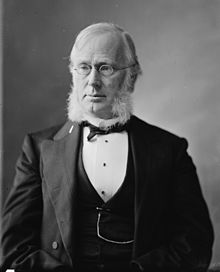
George Frisbie Hoar (1826–1904, shown here) was born in Concord. His father, Samuel Hoar, represented the area in the U.S. Congress and contributed to the wording of the town’s monument at the North Bridge.

In his autobiography Hoar wrote fondly about growing up in Concord, and particularly about living reminders of the Revolutionary War:
Scattered about the church were the good gray heads of many survivors of the Revolution—the men who had been at the bridge on the 19th of April, and who made the first armed resistance to the British power. They were very striking and venerable figures, with their queues and knee-breeches and shoes with shining buckles. Men were more particular about their apparel in those days than we are now. They had great stateliness of behavior, and admitted of little familiarity.

They had heard John Buttrick’s order to fire, which marked the moment when our country was born. The order was given to British subjects. It was obeyed by American citizens. Among them was old Master [Thaddeus] Blood, who saw a ball strike the water when the British fired their first volley. I heard many of the old men tell their stories of the Battle of Concord, and of the capture of Burgoyne.

I lay down on the grass one summer afternoon, when old Amos Baker of Lincoln, who was in the Lincoln Company on the 19th of April, told me the whole story. He was very indignant at the claim that the Acton men marched first to attack the British because the others hesitated. He said, “It was because they had bagnets [bayonets]. The rest of us hadn’t no bagnets.”

One day a few years later, when I was in college, I walked up from Cambridge to Concord, through Lexington, and had a chat with old Jonathan Harrington by the roadside. He told me he was on the Common when the British Regulars fired upon the Lexington men.

He did not tell me then the story which he told afterward at the great celebration at Concord in 1850. He and Amos Baker were the only survivors who were there that day. He said he was a boy about fifteen years old on April 19, 1775. He was a fifer in the company. He had been up the greater part of the night helping get the stores out of the way of the British, who were expected, and went to bed about three o’clock, very tired and sleepy. His mother came and pounded with her fist on the door of his chamber, and said, “Git up, Jonathan! The Reg’lars are comin’ and somethin’ must be done!” . . .

A very curious and amusing incident is said, and I have no doubt truly, to have happened at this celebration. It shows how carefully the great orator, Edward Everett, looked out for the striking effects in his speech. He turned in the midst of his speech to the seat where Amos Baker and Jonathan Harrington sat, and addressed them. At once they both stood up, and Mr. Everett said, with fine dramatic effect, “Sit, venerable friends. It is for us to stand in your presence.”

After the proceedings were over, old Amos Baker was heard to say to somebody, “What do you suppose Squire Everett meant? He came to us before his speech and told us to stand up when he spoke to us, and when we stood up he told us to sit down.”
In Concord, George F. Hoar became lifelong friends with Henry David Thoreau. They met as schoolboys at different grades, and George later attended the Thoreau brothers’ Concord Academy for a while. It’s unclear whether he overlapped with Edmund Quincy Sewall, Jr.

However, in an 1891 letter Hoar wrote that as a boy he attended a lecture in Concord where the speaker exhibited the skull of a British soldier killed in 1775. That could only have been Walton Felch at the town’s lyceum in the spring of 1840.

After the obligatory years at Harvard, George F. Hoar went into the law, establishing his practice in Worcester. Then he went into politics. He served in the Massachusetts General Court, then the U.S. Congress after the Civil War, and finally the U.S. Senate from 1877 to 1904.

Back home, Hoar helped found what became the Worcester Polytechnic Institute and served as president of the American Antiquarian Society. He also sat on boards of the Smithsonian Institute and the Peabody Museum of Archaeology and Ethnology, so he didn’t have a complete aversion to museums holding human remains.

But Sen. Hoar didn’t like the idea of the Worcester Society of Antiquity holding that skull of a British soldier killed on 19 Apr 1775.

TOMORROW: A private arrangement.

Monday, April 18, 2016

“Now the war has begun and no one knows when it will end.”

When we left the nonagenarian Amos Baker of Lincoln yesterday, he had just described how the commanders of the Middlesex County militiamen massed above the North Bridge in Concord agreed to march toward the British regulars holding that position.

Baker then recounted:
And the order was given to march, and we all marched down without any further order or arrangement.

The British had got up two of the planks of the bridge. It is a mercy they fired on us at the bridge, for we were going to march into the town, and the British could load and fire three times to our once, because we had only powder horns and no cartridge boxes, and it would have been presumptuous. I understood that Colonel Abijah Pierce got the gun of one of the British soldiers who was killed at the bridge, and armed himself with it.
Pierce had come out with nothing but a walking-stick as a weapon. Baker probably exaggerated when he said the provincials had “only powder horns and no cartridge boxes,” emphasizing how much the locals were underdogs. At the bridge they had a clear numerical superiority, which is why the regulars soon retreated.
There were two British soldiers killed at the bridge. I saw them when I went over the bridge, lying close together, side by side, dead.

Joshua Brooks, of Lincoln, was at the bridge and was struck with a ball that cut through his hat, and drew blood on his forehead, and it looked as if it was cut with a knife; and we concluded they were firing jackknives.

When we had fired at the bridge and killed the British, Noah Parkhurst, who was my right hand man, said, “Now the war has begun and no one knows when it will end.”
Baker then told the story of James Nichols, an Englishman in the Lincoln company. Richard C. Wiggin wrote about that story and the records behind it here.
I believe I was the only man from Lincoln that had a bayonet. My father got it in the time of the French war.

I went into the house where [Isaac] Davis and [Joseph] Hosmer were carried after they fell, and saw their bodies. I supposed the house to be Major [John] Buttrick’s.

When we marched down to the bridge, Major Buttrick marched first, and Captain Davis next to him. I did not see Colonel [John] Robinson [of Westford] to know him.

I verily believe that I felt better that day, take it all the day through, than if I had stayed at home.
After justice of the peace Ebenezer Rockwood Hoar finished writing this down, the text was read back to Baker and he signed it in front of three witnesses. Baker died later that year, thought to be the last veteran of the Battle of Lexington and Concord.

(The picture above is Don Troiani’s painting of the fight at the North Bridge. True to form, he has given the provincial militiamen up front bayonets.)

Sunday, April 17, 2016

Amos Baker at the Bridge

On 22 Apr 1850, three days after the seventy-fifth anniversary of the Battle of Lexington and Concord, justice of the peace Ebenezer Rockwood Hoar took down the memories of a nonagenarian veteran named Amos Baker.

Baker was thought to be “the sole survivor of the men who were present at the North Bridge at Concord,…and the only man living who bore arms on that day.”

Hoar wrote out an affidavit that said:
I, Amos Baker, of Lincoln, in the County of Middlesex, and Commonwealth of Massachusetts, on oath depose and say that I was ninety-four years old on the eighth day of April, 1850; I was at Concord Fight on the nineteenth of April, 1775; I was then nineteen years and eleven days old.

My brother Nathaniel, who was then paying his addresses to the girl whom he afterwards married, was at the house where she was staying, near the line between Lexington and Lincoln, and received the alarm there from Dr. Samuel Prescott, and came over and gave it to me. My father and my four brothers, Jacob, Nathaniel, James, and Samuel, and my brother in law, Daniel Hosmer, were in arms at the North Bridge. After the fight at the bridge, I saw nothing more of them, and did not know whether they were alive or dead, until I found two of my brothers engaged in the pursuit near Lexington meeting house. Nathaniel followed the enemy to Charlestown.

When I went to Concord in the morning, I joined the Lincoln company at the brook by Flint’s pond, near the house then of Zachary Smith, and now of Jonas Smith. I loaded my gun with two balls,—ounce balls, and powder accordingly. I saw the British troops coming up the road that leads on to the Common at Concord. The sun shone very bright on their bayonets and guns.

Abijah Pierce of Lincoln, the Colonel of the minute men, went up armed with nothing but a cane.

When we were going to march down to the bridge, it was mentioned between Major [John] Buttrick, and Capt. Isaac Davis, that the minute men had better be put in front, because they were the only men that had bayonets, and it was not certain whether the British would fire, or whether they would charge bayonets without firing. I do not remember which of them said it, but they both agreed to it; and Captain Davis’s company of minute men [from Acton] was then brought up on the right. Then they saw the smoke of the town house, and, I think, Major Buttrick said “Will you stand here and let them burn the town down?”
Local historian Josiah Adams noted that other witnesses were more certain in ascribing these words to adjutant Joseph Hosmer.

That smoke having roused the officers, Baker said, “the order was given to march, and we all marched down without any further order or arrangement.”

TOMORROW: “Firing jackknives”?

Saturday, April 16, 2016

“I wished to ask him more about the Concord Fight”

On 5 July 1850 Josiah Adams called on Amos Baker of Lincoln, a veteran of the fight at Concord’s North Bridge over seventy-five years before. Adams hoped to interview Baker about his experiences.

Adams, a native of Acton, was preparing a pamphlet that championed his own town’s minute company against implications by Concord historian Lemuel Shattuck that it had not marched foremost among the provincial companies at the bridge.

Adams later described his visit to Baker this way:
He was asleep on his bed, and I was unwilling to disturb him. In about half an hour, he awoke and walked very slow and feebly across the room to a chair. I understood he had failed very much in a few days. I told him I wished to ask him more about the Concord Fight, but he seemed so feeble, and so distressed with the idea, that I judged it improper to trouble him further.

It was my purpose to inquire if he heard anything about the hatchet [the killing of a wounded British soldier], either at the time or afterwards; if he knew that both the soldiers who lay side by side were dead;—whether he saw them when he pursued over the bridge, or when he returned;—whether the Concord Minute Companies had bayonets—whether Major [John] Buttrick was present when he saw the bodies of [Isaac] Davis and [Joseph] Hosmer, and whether he or Col. [James] Barrett pursued in the afternoon—whether there was any firing, on the retreat, between the bridge and the village, and some other matters to which his attention did not seem to have been called; but his state was such that it did not appear probable that certain reliance could be placed on his answers.

Mr. Baker died July 16.
Fortunately, the previous April three other men had helped Baker create and sign an affidavit about his memories of the battle.

TOMORROW: Amos Baker’s account.

(That’s actually Josiah Adams’s gravestone up there, courtesy of Find-a-Grave, not Amos Baker’s. The researcher lived only four years longer than the old veteran.)

Sunday, April 14, 2013

The Mystery of James Nichols, Reluctant Soldier

One of the most striking anecdotes of the confrontation at the North Bridge in Concord is the story of an Englishman who mustered with his local militia, but decided to go down to talk to the redcoats at the bridge. After that chat he took his gun and went home, not wanting to be part of the fight. However, only one witness recounted this story, and that seventy-five years after the battle. Back in the spring of 2001, D. Michael Ryan pondered the mystery for Concord Magazine, wondering if it was just a legend.

Richard C. Wiggin, author of
Embattled Farmers: Campaigns and Profiles of Revolutionary Soldiers from Lincoln, Massachusetts, 1775-1783, has found a longer trail for that Englishman, with a different ending from what the one witness recalled. I asked Rick to share that essay from the book here as a guest blogger.

In 1850, 75 years after the battle at Concord’s North Bridge, Lincoln’s Amos Baker recalled an interesting anecdote about one of the men present:

Before the fighting begun, when we were on the hill, James Nichols, of Lincoln, who was an Englishman, and a droll fellow, and a fine singer, said, “If any of you will hold my gun, I will go down and talk to them.”

Some of them held his gun, and he went down alone to the British soldiers at the bridge and talked to them some time. Then he came back and took his gun and said he was going home, and went off before the fighting. Afterwards he enlisted to go to Dorchester and there deserted to the British, and I never heard of him again.
The story has fascinated generations of history buffs. Amos Baker may never have “heard of him again,” but James Nichols did leave a small trail in the historical records through which we can piece together the rest of the story...and test the mental acuity of the 94-year-old Baker.

The record tells us that shortly after leaving Concord, Nichols enlisted in the provincial army besieging Boston, and he participated in the Battle of Bunker Hill. He served through that summer and fall, and into the following spring. He appears to have served through the fortification of Dorchester Heights—but without deserting to the British. Baker, too, served at Dorchester Heights, albeit in a different unit.

That summer (1776), Nichols appears to have left Lincoln, gone to Weston, then taken up residence in Acton, perhaps an itinerant worker moving from job to job. By wintertime, he was back in militia service at Dorchester—this time in the same unit as Baker, and they evidently renewed their friendship. During their three-month stint, Nichols was recruited into the Continental Army, and one January day Baker discovered his friend gone.

The Continental unit Nichols joined had a handful of other Lincoln men in it. They were marched northward in chase of the British army of General John Burgoyne, who was threatening to split the country along the Hudson River/Lake Champlain corridor. In September 1777, after eight months of Continental service, Nichols was reported as having deserted. He may have become disillusioned at the not-so-rosy life of a Continental soldier. Or gotten cold feet with the approach of what was certain to be a climactic battle. Or perhaps he simply succumbed to itinerant tendencies. The historical record does not reveal what was going on in his head. Two months later, he appears to have returned to militia service in Cambridge, guarding the British and German troops surrendered by General Burgoyne following the climactic battles at Saratoga.

Somewhere along the line, Amos Baker learned of the reported desertion by Nichols, probably from one of the Lincoln men serving in the same unit. Perhaps in the years that followed, he occasionally thought about the good times they had together—the singing, the humor, the storytelling. He recalled the incident at the bridge. He remembered last seeing his friend at Dorchester....

Seventy-plus years later, Baker was feted as the last known surviving participant of the fight at the Concord bridge. Old memories returned, a little worn with age. He was coaxed to write them down for posterity. And he left us with a wonderful snippet of the human side of the developing conflict. He got it almost right; he passes the acuity test. But even he did not know the rest of the story.

Thanks, Rick! The launch party for Embattled Farmers, published by the Lincoln Historical Society, is on Monday, 15 April (Patriot’s Day), at 5:00 P.M. in the Lincoln Public Library.

Friday, April 22, 2011

Exploring Concord on the 19th of April and Beyond

Concord and the Dawn of Revolution: The Untold Truths is a collection of articles by D. Michael Ryan about the details of the outbreak of war in 1775. Published in 2007, it reflects some of the latest research about the traditions of Concord, sorting out which stories seem well rooted in evidence and which are probably no more than legends.

Several of Ryan’s articles appeared in earlier form in the online Concord Magazine, which has collected those links and more in “Concord Fight: A Virtual Booklet.” So you can sample the quality of his work.

For example, there’s the mystery of a man named James Nichols, born in Britain and living in Lincoln in 1775. Reportedly he broke ranks with his militia unit during the stand-off at the North Bridge, walked down to chat with some redcoats, and decided to go home rather than fight.

At least that’s what a survivor of the battle named Amos Baker said decades later. Yet there’s no mention of Nichols in Lincoln town records. On the other hand, that would be a weird story for Baker to make up—what cultural or psychological need might it fulfill? Ryan lays out the mystery and leaves it open for further investigation.

The articles in Concord and the Dawn of Revolution are on bigger topics like James Barrett, Daniel Bliss, and the curious Bedford flag. They’re well researched, and often spotlight corners of the conflict that other books leave out or speed past.

Of course, there’s still more to be found out. For example, it’s unlikely that James Hall was one of the British soldiers buried in Concord, as suggested in this article (not collected in the book). But that’s someone else’s story.