J. L. BELL is a Massachusetts writer who specializes in (among other things) the start of the American Revolution in and around Boston. He is particularly interested in the experiences of children in 1765-75. He has published scholarly papers and popular articles for both children and adults. He was consultant for an episode of History Detectives, and contributed to a display at Minute Man National Historic Park.

Subscribe thru Follow.it


•••••••••••••••••


Showing posts with label George Wilmot. Show all posts

Friday, October 25, 2024

“With Geat diffickalty We Exaped With our Lives”

Ebenezer Richardson and George Wilmot evidently met with Gen. Thomas Gage in Salem in the middle of September 1774.

The royal governor moved back to Boston in the last week of that month after an unsuccessful confrontation with the local committee of safety.

Richardson and Wilmot went to the Stoneham home of Kezia and Daniel Bryant, Richardson’s sister and brother-in-law, as I recounted yesterday. They were there on 3 September.

When I first wrote about Wilmot’s story for what was then New England Ancestors magazine, I didn’t realize the significance of that date. That was the day after the “Powder Alarm.”

That event showed how powerless Gov. Gage was outside of Boston. Up to five thousand militiamen had marched into Cambridge, demanded that royal appointees resign, chased Customs Commissioner Benjamin Hallowell for miles, and surrounded Lt. Gov. Thomas Oliver’s mansion until he signed a resignation. And there was no response from the royal government.

If Gage couldn’t protect high officials in Cambridge, right across the Charles River, he certainly couldn’t protect an infamous child-killer up in Stoneham. And on 3 September, a rural mob came for Richardson.

According to Wilmot’s petition to Secretary of State Dartmouth:
about Eleven a Clock at Night thee came forty men armed with Goons and Suronded the house of Mr. Brayant—and broke his Windows Strocke out on of his Wife Eyes, and swore they would distroy us for we Ware Toary and Enemys to there Countery—and With Geat diffickalty We Exaped With our Lives and Came to Boston under the protection of the fourth Rigment of foot Quartred there.
His Majesty’s 4th Regiment of Foot was camped on Boston Common.

Richardson and Wilmot must eventually have gotten on board H.M.S. St. Lawrence as planned. They were in London on 19 January when they signed their petitions to Lord Dartmouth. Judging by the handwriting (and spelling), Wilmot wrote both petitions, and Richardson added his signature.

On January, undersecretary John Pownall sent those papers to his counterpart at the Treasury Office, Grey Cooper. He wrote:
As the inclosed Petitions relate to Services performed and Hardships sustained by the Petitioners as Officers of the Revenue, I am directed by the Lord of Dartmouth to transmit them to you and to desire that you will communicate them to Lord North.
In other words, this is a Customs service problem, so it’s up to your department to deal with it.

Treasury officials read the papers on 26 January, and a note on the outside of the bundle states that the two men were paid £10 each.

And with that, “the rank, bloody, and as yet unhanged Ebenezer Richardson” departed from the historical record.

Thursday, October 24, 2024

“The infamous murderer Richardson, resided last week at Stoneham”

As of the summer of 1774, Ebenezer Richardson was back in Massachusetts.

We know that from two January 1775 petitions to Lord Dartmouth, one from Richardson and the other from George Wilmot.

Wilmot was Richardson’s co-defendant for murder back in April 1770. A sailor on the Customs ship Liberty, he went into Richardson’s house on 22 February to help defend it from a young mob. However, the gun he held was defective and therefore couldn’t have fired the shot that killed Christopher Seider. The jury acquitted him.

But Wilmot was still an outcast. Or, as his petition said:
And after your Lordships petitioner Stood a fare tryal for his Life and was discharged by there own Laws, they would not Lett him live Quaiett in boston but drove him from his house and famely.

And he was forced to Go to the Castell under the protection of the forteenth Rigment Quarterd thear—Where he remaind Nine Months before he dared Venter abroad—and since that tyme he Could Get No Imployment from them to suporte himself and famely.
Wilmot’s name didn’t appear in the press like Richardson’s, but he may still have been chased around.

Late in the summer of 1774, Wilmot wrote, he and Richardson went “to Salam to Petition Gineral [Thomas] Gagge—for a passeg to Great britton.” According to Richardson, the governor advised them “to Go to England, and procured a passage for them in the Scooner St: Larance.”

That was the Royal Navy warship St. Lawrence, discussed back here. It wouldn’t sail for London until November, so Richardson and Wilmot had to lay low for several more weeks.

On 3 Sept 1774, Wilmot stated, he and Richardson were both “at the house of Mr. Daniel Brayant at Stonham.” Daniel Bryant (1731–1779) had married Ebenezer’s younger sister Kezia (1732–1784). (Yes, Ebenezer also had a wife and a daughter named Kezia.)

Back on 26 Mar 1772, a couple of weeks after Richardson had received his royal pardon, the Massachusetts Spy reported:
We are well informed, that the infamous murderer Richardson, resided last week at Stoneham, at his sister-in-law’s. It is said he intends to come and tarry in Boston very shortly.
I don’t know if that’s a garbled reference to Richardson’s sister Kezia Bryant, or if one of Richardson’s brothers had also married and settled in Stoneham. Either way, people knew the man had relatives north of Boston, and the emphasized word “tarry” looks like a threat of tar and feathers.

Daniel Bryant was a respected member of his community. During the Battle of Lexington and Concord, he was sergeant of one of Stoneham’s militia companies. Soon he would rise to the rank of lieutenant. But was that local standing enough to protect his infamous brother-in-law?

TOMORROW: Yet unhanged.

Tuesday, April 21, 2020

“Jury went out after noon and did not agree all night”

On 20 Apr 1770, Benjamin Lynde, acting chief justice of the Massachusetts Superior Court, wrote in his diary:
Fair. Richardson and Wilmot’s tryal, begun morn. and Jury went out after noon and did not agree all night.
As recounted yesterday, Lynde indeed presided over the trial of former Customs employees Ebenezer Richardson and George Wilmot for murder.

The jury actually started deliberating about 11:00 P.M. Per the rules of the time, they were shut into a room of the courthouse and not given any food or drink or allowed to sleep. That was to encourage them to reach a verdict. (And of course it saved the government money.)

Those jurors had been drawn from Suffolk County outside of Boston, on the assumption that Bostonians might be biased. We have their names, and I wish I knew which towns they came from in order to nail down their identifications. I’m going to assume they’re the most prominent men of those names from Suffolk County outside Boston since a man had to be at a certain economic level to be on the jury list. (And because it’s easier to search where the light is best.)

The foreman was Jonathan Deming. A man of that name lived in the part of Needham that eventually became Wellesley. He was born in Boston in 1723, possibly son of a sea captain from Wethersfield, Connecticut, who later retired to the country. From his twenties Deming filled various town offices in Needham. In November 1768, Boston ministers published his intention to marry Elizabeth Clark, but that doesn’t appear to have worked out since in November of 1770 Deming went to Charlestown and married Esther Edes. He was in his late forties, but she was sixteen years younger, and they had three children over the next few years. Jonathan died in 1791 and Esther in 1792.

Apparently Deming and all the other jurors quickly agreed that Wilmot was innocent of the charge of murder. Most also agreed that Richardson was guilty. There were two holdouts from a quick unanimous verdict, Deming later testified:
Mr. Lothrop was satisfied as to Fact, but not Law. Mr. Clap not so fully satisfied as to Law.
Thomas Lothrop was from Hingham, the portion that became Cohasset in 1770. He had been born in 1738. After his father died and his mother remarried, he went to live with a rich uncle who left him an estate. Lothrop served in the French and Indian War, becoming a lieutenant, and in town government his neighbors chose him to be clerk, moderator, selectman, and eventually representative to the Massachusetts General Court. He married Ruth Nichols in 1760; they moved into a big house “near the cold spring” and raised twelve children.

Notably, as Massachusetts’s conflict with Britain heated up, Lothrop was active on Cohasset’s committee of correspondence and committee of inspection. He was also a militia officer, rising to lieutenant colonel in the 2nd Suffolk regiment during the war. Lothrop lived until 1813.

Seth Clap was born in Dedham in 1722, two years before part of that old town broke off to become Walpole, where he lived the rest of his life. Clap married Mary Bullard in 1745 and they had ten children before she died. In February 1769 Clap married Elizabeth Weatherbee, and they got right to having more children, the first arriving in November. Ultimately they had six. Clap served Walpole in various ways: as a schoolteacher as a young man, as a town clerk in his fifties, and in 1758 by “making a place in the meeting-house to secure the town stock of ammunition.” He died in 1788.

There’s no sign that Lothrop or Clap supported the royal government in 1770. In other words, their reluctance to convict Ebenezer Richardson wasn’t due to their politics. They were sincerely concerned about whether he should be convicted of murder for shooting at a crowd attacking his house. Lothrop later said, “I did not fall in so soon as some, for I thought the time might be as well spent in Argument.” Clap agreed, “At first going out I was not so clear as afterwards.”

In the wee hours of 21 April, 250 years ago today, Deming and the rest of the jury worked at winning over those two men. Clap apparently noted that under British common law a man was not guilty of murder if he killed someone breaking into his house. But that was only at night, other jurors replied. Richardson had shot young Christopher Seider “in the Day,” and that won Clap over. Deming assured him that “the Court knew the Law.”

What finally moved Lothrop was his fellow jurors’ belief that “if the verdict was not agreeable to Law the Court would not receive it.” The judges had already made clear they believed Richardson did not commit murder. Thus, a man could vote to convict him of a capital crime and not feel that he was necessarily sending the man to his death.

After dawn, the twelve jurors finally agreed on a verdict. About half an hour later Deming announced their decision in the courtroom. Wilmot was free to go, but everyone really cared about the other defendant. As Judge Lynde wrote in his diary:
Fair; Jury agreed abo. 9; Richardson guilty.
Judge Peter Oliver later wrote of the Whig crowd: “the Courtroom resounded with Expressions of Pleasure; ’till, even one of the Faction, who had some of the Feelings of Humanity not quite erased, cried out, ‘for Shame, for Shame Gentlemen!’—This hushed the clamorous Joy.”

The judges then adjourned court until 29 May, when one of the first orders of business would be sentencing Ebenezer Richardson.


Monday, April 20, 2020

The Trial of Ebenezer Richardson

On 20 Apr 1770, 250 years ago today, Ebenezer Richardson went on trial for the killing of young Christopher Seider.

This was just short of two months after the fatal confrontation at Richardson’s house in the North End, but for the Boston Whigs that was too long.

They suspected that the judges and attorneys who leaned toward the Crown had delayed the trial to cool the passions aroused by the violent death of a child. The Crown was definitely trying to delay the Boston Massacre trials.

At various times the provincial Attorney General, the appointed defense attorney, and some judges didn’t show up for procedures in Rex v. Richardson and Wilmot. But at last on 20 April everyone was present.

Justice Benjamin Lynde presided, with Edmund Trowbridge, Peter Oliver, and William Cushing on the bench with him. The prosecutors were Massachusetts solicitor general Samuel Quincy and Robert Treat Paine, hired by the town of Boston. The newly appointed defense attorney was Josiah Quincy, Jr.

The two sides agreed on the basic facts of the case. After Richardson had tried to break up a boys’ protest outside of importer Theophilus Lillie’s shop, the boys attacked his house. The violence and damage escalated. Eventually Richardson fired a musket full of birdshot out of his window. Christopher Seider fell, mortally wounded.

The question was whether Richardson was rightfully defending his home and family from attack. Did the boys’ actions justify a lethal response? Was Christopher participating in illegal activity? Did Richardson aim at the child? Possible verdicts included guilty of murder, guilty of manslaughter, and not guilty entirely.

(Of course there was also the sailor George Wilmot, who had gone into Richardson’s house to help but hadn’t fired a gun.)

Samuel Quincy opened by questioning the prosecution witnesses, as his partner’s notes show. They played down the danger from the riotous boys and talked about Richardson’s anger. Among those witnesses were the Whig activists Edward Procter, David Bradlee, and Dr. Thomas Young.

Josiah Quincy’s notes preserve his strategy to win over the jurors:
1st. To open the Defence with a proper Address to the Jury to remove all popular Prejudices and Passions and engage them to make a fair, candid and impartial Enquiry and to give their Verdict agreeable to Law and the Evidence, uninfluenc’d by any other Motive; to mention the manner of my becoming engaged as Council for the Prisoners, explain my Duty and the Part I ought and am determin’d to act.

2d. The Witnesses for the Crown having been carefully and thoroughly cross-examined, to produce those for the Prisoners, and endeavour to find out what the Nature and Degree of Provocation offered; how far the Attack upon the house was carried; Whether and to what Degree the Windows were demolished before the firing, and whether the Door was broke open, and any Attempt made upon it; whether any actual Attempt was made to enter; or any Evidence of such Design from threatning Words; Whether Men as well as Boys were not concerned in that Attack; What Weapons were used or thrown into the house; and whether any One within was wounded; and upon the whole whether this is not to be consider’d as an Attack upon the Persons of the Prisoners.

3d. To sum up the Evidence and state the Facts as they shall appear upon Evidence.

4thly. To explain the Nature of the Crime of Murder and the different Kinds of Homicide, as justifiable, excusable (as se defendendo) and felonious: and to shew the Distinction between felonious Homicide of Malice prepense, which is properly Murder, and without such Malice, which is Manslaughter.
The defense witnesses included Richardson’s daughters Sarah and Kezia, possibly Harvard student William Eustis, schoolmaster Elias Dupee, and one of the Dr. Perkins. The witness testimony and then the legal arguments of Paine and Josiah Quincy lasted well past dark.

An unofficial factor in the courtroom were the many people who had come to see the trial. So many, in fact, that there were complaints of pickpocketing afterward. Judge Oliver called this audience “a vast Concourse of Rabble.”

Today we expect a judge to sum up legal issues and options for the jury but to leave the decisions to them. At this time, however, the multiple judges also advised on guilt and innocence. A report sent to Gov. Francis Bernard said that all those gentlemen felt the facts favored Richardson’s case:
They said it appeared by the Evidence that the prisoner was attacked in his own house by a number of tumultuous people. That what he had done was in his own defence. That self-defence was a right inherent in every man. . . . they were convinced the jury could find him guilty of nothing more than manslaughter.
According to acting governor Thomas Hutchinson, his friend and relation on the bench went even further:
Mr. Just. Oliver doubted whether it could amount to that and with great spirit charged the death of the Boy upon the Promoters of the Effigies and the Exhibitions which had drawn the people together and caused unlawful and tumultuous assemblies and he did not excuse such as had neglected suppressing these Assemblies as the Civil Magistrate had done.
At that, Oliver heard someone in the audience shout, “Damn that Judge, if I was nigh him, I would give it to him!” Other Crown informants said they heard people call, “Remember, jury, you are upon Oath”; “Blood requires blood!” and “Damn him, hang him! Murder, no manslaughter!”

At 11:00 P.M. the jurors went into a private room to deliberate. The defendants were supposed to be taken back to the jail, but the judges had heard that some spectators had brought “an Halter, ready at the Door of the Court Room,” to hang Richardson. (People had nearly lynched him on the day of the shooting.) Sheriff Stephen Greenleaf locked the defendants inside the courthouse instead.

The judges also waited in the building for most of the crowd to disperse. They finally ventured out at midnight. Even so, one Crown informant said, “The judges were hissed and abused in a most shameful manner in passing from the bench to their carriages.”

Meanwhile, the jury was still deliberating.

TOMORROW: The verdicts.

Friday, April 17, 2020

Ebenezer Richardson’s New Attorney

On 17 Apr 1770, 250 years ago today, the Massachusetts Superior Court convened to try Ebenezer Richardson and George Wilmot for murdering young Christopher Seider.

At least, the court tried to. The attorney whom the judges had ordered to represent Richardson, Samuel Fitch, didn’t appear. He was apparently home sick.

The judges therefore assigned the principal defendant a new lawyer: Josiah Quincy, Jr. (shown here in a posthumous portrait by Gilbert Stuart).

Already, back in late March, Quincy had agreed to help defend Capt. Thomas Preston and the eight soldiers charged with murder for the Boston Massacre. He explained his decision in a firmly worded letter to his father, which I quoted here.

That letter also said the top Boston Whigs supported young Quincy’s choice. They wanted the military men to receive what all of Britain would have to acknowledge was a fair trial. It’s not so clear that they felt the same about representing Richardson, but for Quincy the principle had been established.

Josiah Quincy would have to argue against his older brother, Massachusetts solicitor general Samuel Quincy, on the prosecution team with Robert Treat Paine. But the brothers didn’t have the most curious conflict in the case.

One of the judges overseeing the trial was Edmund Trowbridge, attorney general of Massachusetts from 1749 to 1767. Back in the early 1750s, he had also represented the Rev. Edward Jackson of Woburn in his defamation case against Roland and Josiah Cotton. Just when it looked like Jackson had lost his suit, another man admitted that he had fathered the illegitimate child that the Cotton brothers had blamed on Jackson.

That now-admitted real father was none other than Ebenezer Richardson. He had had to move out of Woburn into Boston. And he had to find a new form of employment—which involved serving Trowbridge as a confidential informant. In a document sent to London in the early 1760s, Trowbridge even cited Richardson for being “very serviceable to me in detecting a conspiracy to father a bastard child on the parson of a parish.” But in the small world of the colonial Massachusetts bar, that wasn’t enough of a conflict to take Trowbridge off the bench for this trial.

The judges rescheduled Richardson and Wilmot’s case for 20 April. In other words, Josiah Quincy had three days to prepare.

Sunday, March 01, 2020

A New Month in Boston, the Same Old Arguments

What did the Customs service’s anonymous informer report about Thursday, 1 Mar 1770, 250 years ago today?

He (or she) wrote: “the weekley Exhibition at Jacksons as usual.” Boys were once again picketing William Jackson’s hardware shop, the Sign of the Brazen Head, with signs and effigies. Even after the previous week’s protest led to one boy’s death at the hands of Ebenezer Richardson.

There were two important developments at that shop since 1760, when I left off the Saga of the Brazen Head. First, ten years later, the business was no longer operating under the name of “Mary Jackson & Son.” The widow Jackson had retired.

Second, back in 1760 the Brazen Head sign hung “a few Doors from the Town House,” as the Jacksons’ advertising said. By 1770, after the big fire, William Jackson was in business right across King Street from northwest corner of that government building. Mary Jackson was living a distance away. When William testified about the events of 5 March, he said, “I went to my mothers.”

At her home, Mary Jackson had rented space to at least one British army officer. That man no doubt got to hear his landlady’s side of the non-importation debate—how radical Whigs were condemning her son, picketing and vandalizing his shop. That officer was Capt. Thomas Preston.

Down King Street from the Brazen Head was the Customs office. On 2 March, Customs board secretary Richard Reeve wrote to Boston Gazette printers Edes and Gill with a statement from his bosses, the Commissioners:
that Ebenezer Richardson has never been employed as an Officer or Under Officer, or in any Capacity in the Customs.—That [George] Wilmot was not sent with any Message by the Commissioners, or by any Crown Officer or other Person with the Knowledge or Privity of the Commissioners or any of them.—That he has never been employed in the Service of the Commissioners, unless as a Seaman shipped by the Commander of the Sloop Liberty…
With Richardson and Wilmot in jail for murder, the Commissioners were trying to disavow all connection with them—however ridiculous that claim. Even Lt. Gov. Thomas Hutchinson wrote privately that Richardson was a land-waiter for the Customs service.

Some politicians today deny connections to people as soon as they become embarrassing or even criminal liabilities. In our information-soaked world, that rarely works. Likewise, back in 1770 the Boston Gazette printers followed the message from the Commissioners with their own commentary:
It is well known that this same Richardson not many years past, solemnly swore before a Grand Jury that he acted in a certain riotous affair by a commission or warrant from Charles Paxton, which Paxton was then an officer in the Customs, and is now a Commissioner.

Paxton indeed upon oath denied it, and said that Richardson was a d——d villain: The Grand Jury at that Time chose rather to think that Richardson was the perjur’d person, & thereupon complain’d of him to a Magistrate; and it was currently reported that Paxton was his bondsman. If this is not true, Mr. Paxton is at liberty to set the matter right in the Boston Gazette.

Richardson has for many years been known by the name of THE INFORMER——————And we dare appeal to Mr. Paxton, Whether he has not been known to be an Informer, to the officers of the customs—And whether he himself has not frequently encourag’d him and paid him as an Informer—And if so! How could Mr. Paxton with any face desire us to publish, that “Richardson has never been employ’d in ANY Capacity in the Customs.”
That court case offers another possible reason for Richardson shouting, “Perjury! Perjury!” back on 22 February, as described here.

Thus, as March began, the Whigs were back to enforcing non-importation and blaming the Customs service for everything bad, the town was still full of soldiers, and Ebenezer Richardson was feeling abandoned in the town jail.

TOMORROW: Many ways of looking at a brawl.

(The picture above is William Jackson’s trade card, engraved for him by Paul Revere, courtesy of the American Antiquarian Society. It is now on display at the Worcester Art Museum as part of the “Beyond Midnight” exhibit.)

Sunday, February 23, 2020

“The first thought was to hang him up at once”

When Ebenezer Richardson fired his musket out of window of his house on 22 Feb 1770, as recounted yesterday, that gun was loaded with “Swan shot.” Those were lead pellets ”about the bigness of large peas”—larger than “Goose shot” and “duck shot” and similar to a typical pistol bullet of the time.

Several slugs of swan shot were enough to knock down one of the young boys mobbing his house. The Boston Evening-Post reported, “The child fell, but was taken up and carried into a neighboring house, where all the surgeons, within call, were assembled.” Another boy, nineteen years old, was wounded in the hand and thigh.

The men gathered on that North End street had largely been standing back, watching the boys attack Richardson’s house. Now they took action. Again from the Evening-Post:
The people, on hearing the report of the gun, seeing one wounded and another as they thought killed, got into the new brick meeting house and rang the bell; on which they soon had company enough to beset the house front and rear…
According to an anonymous letter sympathetic to Richardson, the “vast Concourse of people…broke down the side of his house & when they had made a breach wide enough several entered.”

Two witnesses testified that when the crowd yelled at Richardson that he had killed a boy, he answered, “I don’t care what I’ve done.” Edward Procter said, “He had a Cutlass drawn, and resisted. He said he would resign himself to proper Officer.” But there was no magistrate on the scene, and no police officer in Boston. People expected to band together to capture criminals, just as they all fought fires or trained for war. They pressed in.

Some men “wrenched a gun” from George Wilmot, the Customs service sailor who had come to help Richardson. They found it “heavily charged with powder, and crammed with 149 goose and buck shot.” Wilmot protested that “he could not have fired for the Screw pin was gone.”

Soon the crowd dragged Richardson out to the street. According to acting governor Thomas Hutchinson, “The first thought was to hang him up at once and a halter was brought and a sign post picked upon,” even though both of the wounded boys were still alive.

But by then William Molineux had arrived on the scene. He was normally the most aggressive of the Whig leaders, but at this moment he saved Richardson from lynching. Even Hutchinson acknowledged, “one who is supposed to have stirred up the tumultuous proceedings took great pains and prevented it.”

Molineux convinced the crowd to carry the two men to John Ruddock, justice of the peace and boss of the North End. The Evening-Post stated that Ruddock
was pleased to send them to Faneuil Hall, under a sufficient guard, where three other magistrates, Richard Dana, Edmund Quincy and Samuel Pemberton, Esquires with Mr. Ruddock, took their examination before at least a thousand people and and committed them.
All those magistrates were solid Whigs, of course.

The Boston News-Letter and Boston Chronicle both published issues that Thursday. Their printersRichard Draper and John Fleeming, respectively—scrambled to add the latest news to the bottom of the local round-ups. The 22 February News-Letter stated:
This Instant we hear that one Richardson having attempted to destroy some Effigies in the North End, the Lads beat him off into his House, and broke his Windows, upon which he fired among them, mortally wounded one Boy, & slightly wounded two or three others. Richardson is now under Examination.
The Boston Chronicle leaned more to the Crown:
This forenoon, a boy of about 14 years of age, was mortally wounded, and two others slightly wounded by a shot from a musket, fired out of a house at the north end.—Two persons, who were in the house from whence the gun was fired, are now under examination at Faneuil Hall.
The Chronicle was printed at 2:00 P.M., meaning the magistrates’ proceeding extended well into the afternoon. Already people expected one of the boys to die.

Eventually those justices determined there was enough evidence to charge Richardson and Wilmot with a crime—whether assault or murder depended on whether that badly wounded boy lived or died. The next step was to convey the prisoners from Faneuil Hall to the jail on Court Street.

According to an anonymous Crown report, “when the Sheriff [Stephen Greenleaf] was carrying them to Goal, several attempts were made to gett a Rope round Richardsons neck.” The Evening-Post report obliquely admitted the same: “The numberless affronts and abuses both these persons had heaped on the inhabitants, exasperated them to such a pitch that, had not gentlemen of influence interposed, they would never have reached the prison.”

At the end of the afternoon, Ebenezer Richardson and George Wilmot were finally in the Boston jail. People turned their attention back to the house where doctors had come to treat the young boy.

TOMORROW: “The king of terrors.”

Saturday, February 22, 2020

Riot at the Richardson House

By 22 Feb 1770, 250 years ago today, the anonymous informant reporting events in Boston to Customs Collector Joseph Harrison judged that the Sons of Liberty had “seemed greatly to gain ground” over the previous week.

One piece of evidence was that “a subscription was sett on foot amongst the females in town to discontinue to Drinking of Tea.” The newspapers also featured a spinning meeting in the North End. (I’ll get back to that.) On the night of 21 February, another anonymous letter said, someone “besmeared…the Importers windows with feathers & tar & feathers.”

In another sign of Whig strength, on 22 February the boys doubled their picket lines enforcing non-importation. According to the letter to Harrison: “The Exhibition at [William] Jacksons [was] the same as Last week—there was likewise an Exhibition at Theopiluis Lillie.” Jackson’s Brazen Head hardware store was in the center of town, but Lillie’s dry-goods shop was up in the North End on Middle Street (now Hanover Street).

Another person living in that neighborhood, “about fifty or sixty paces away,” was Ebenezer Richardson, a Customs service land-waiter. Richardson was a notorious outcast. While living in Woburn in the 1750s, he’d gotten his wife’s sister pregnant, then kept quiet for over a year as people blamed one of the town’s ministers. Once the truth came out, Richardson, now widowed, and his sister-in-law had to move to Boston, where they married at King’s Chapel.

In Boston, Richardson began to supply confidential information to the province’s attorney general, Edmund Trowbridge, and then to Customs official Charles Paxton. That work stopped being confidential after some documents leaked from London in the early 1760s. The Customs office then hired Richardson officially, but Bostonians continued to refer to him as “the Informer.”

During the anti-Stamp Act riots of 24 Aug 1765, a crowd attacked the Richardsons’ house, and a few days later the Overseers of the Poor paid to have the family removed back to Woburn, perhaps for their own safety. By 1766 Richardson was back in Boston. After Capt. Daniel Malcom defied Customs officials, boys went over to Richardson’s house to taunt him for not gaining a reward—and it’s not even clear he was involved in that case.

Not that Richardson was quietly minding his own business in the political disputes of the period. According to William Gray, “Some mention of Effigies” had come up on 21 February, and Richardson said “he hoped if these was before Importers Doors there be a Dust beat up, wish’d the 14. Regiment there. They would Cut up the d——d Yankees.” (Richardson came from an old Puritan family himself, so here “Yankees” was a political epithet.)

According to the next week’s Boston Evening-Post:

Soon after it [the non-importation pageantry] was set up, Ebenezer Richardson, the famous Informer, came by and endeavored to persuade a countryman to overturn it with his wagon; which he refusing, he applied to a charcoal man to drive his cart against it; but he said he had no business with it, and would not concern himself about it.

Richardson (as the boys say) pressed him to it, saying he was a magistrate in the town and would bear him out in it. The man still denying to meddle therewith, Richardson laid hold on the horses and endeavored to shove them upon the pole which supported the pageantry; the cart, however, passed without disturbing it.
Frustrated, Richardson started to stomp off. But by this point some Whig men had arrived “to see Pagentry before Lilly’s Door,” as one of them, Edward Procter, later testified. Richardson saw them, perhaps laughing at him, and shouted, “Perjury! Perjury!”

Nobody’s sure what Richardson meant by that. Was he saying that calling Lillie an enemy of the country was perjury? Was he accusing those men of having perjured themselves in the past? Was he denying what they might have shouted at him (and, as shown above, Bostonians had a lot of stories to tell)? The men challenged Richardson to explain, and he replied that he was directing his comment not at Procter but at another man, Thomas Knox—which doesn’t help.

A neighbor named Deborah Warner said Richardson “Went into his house, and then…he came out in a great Rage, doubling his Fists and challenged the Gentlemen to the Door. Said it should be hot enough before night.” Sarah Richardson, one of the land-waiter’s daughters, testified that Knox and Capt. John Matchet responded, “come out you damn Son of Bitch, I’ll have your Heart out your Liver out.”

The yelling outside of Richardson’s door caught the attention of the boys. They left the signs and shoppers in front of Lillie’s shop and ran over to Richardson’s to “call him Informer,” in the Evening-Post’s words. Richardson and his wife Kezia—the woman who had once been his sister-in-law—tried to shoo the boys away, “flourishing their arms and advancing out into the street, with high threatenings.” That didn’t work. As the newspaper reported, “the children would retreat and on their return, advance, with the squealing and noise they usually make on such occasions.”

Lieutenant Governor Thomas Hutchinson later wrote that he “gave express directions to the Sheriff [Stephen Greenleaf] to go and suppress this unlawful assembly…but he did not think it safe to attempt it nor is there a J[ustice]. of P[eace]. in the town who will appear upon such an occasion.”

Outside the Richardsons’ house, the young mob started throwing “light rubbish.” Ebenezer came out “with a stick” and ordered the boys to go away. Invoking traditional British liberty, the children “said they would not, Kings high Way”—i.e., they had the right to be in the street. They threw more garbage. Kezia Richardson threw some back and was in return struck by an egg.

At some point a sailor who worked for the Customs service named George Wilmot came to the Richardsons’ house and offered to help his colleague. According to Sarah Richardson, “Wilmot said he would stand by him as Long as he had breath. Wilmot asked if he had any Gun. R[ichardson]. said he must get his Gun.”

Becoming desperate, “Richardson opened the door and snapped a gun” at the crowd—showing that he had a working musket but not firing anything. He reportedly threatened, “if you dont go away I’ll blow a hole thro you enough to Drive a Cart and Oxen” or “as sure as there was a G— in heaven, he’d blow a Lane thro ’em.” After a moment of fright, the young mob just started flinging things more ferociously.

Multiple witnesses said that someone threw a stick or brickbat out of the house and hit a passing soldier. He threw it back, smashing a window. That got the boys even more excited. Witness Andrew Tewksbury stated, “They threw Limon Peels then Stones. Some Men looked on Boys and they threw faster. Men shew’d no signs of Approbation but laughing.” Ebenezer, Kezia, and Sarah Richardson were all hit by stones.

Soon most of the windows in the house were broken. Sarah Richardson testified, “I staid till no Lead, no Frame, and then went away.” Ebenezer Richardson and George Wilmot retreated to an upper story. The active Whig tailor David Bradlee testified, “I saw one or two Men in the Room with Guns in their hands. R[ichardson] put a Gun on edge of Window.”

Finally, Richardson fired his musket. This time it was loaded.

TOMORROW: Rough justice.

Thursday, February 22, 2018

The “Swan Shot” that Killed Christopher Seider

On 22 February 1770, Customs service employee Ebenezer Richardson killed a young boy named Christopher Seider.

Christopher was part of a crowd of boys mobbing Richardson’s house. Indeed, he had just stooped to pick up a stone when he was hit by the discharge from Richardson’s gun.

Richardson had not shot a musket ball. Instead, he had loaded his musket with “Swan shot.” What that meant is clear from the Whig newspapers’ report on the boy’s injuries:

soon after the child’s decease his body was opened by Dr. [Joseph] Warren and others and in it were found eleven shot or plugs, about the bigness of large peas; one of which pierced his breast about an inch and one-half above the midriff and passing clear through the lobe of the lungs, lodged in his back.

This, three of the surgeons deposed before the Jury of Inquest, was the cause of his death; on which they brought in their verdict, wilful murder by Richardson. The right hand of the boy was cruelly torn, whence it seems to have been across his breast and to have deadened the force of the shot, which might otherwise have pierced the stomach.
“Swan shot” was a common term at the time. For example, in the 6 Nov 1729 Pennsylvania Gazette Benjamin Franklin reported:
We are inform’d that the following Accident lately happen’d at Merion, viz. A Man had order’d his Servant to take some Fowls in from Roost every Night for fear of the Fox: But one Evening hearing them cry, he look’d out and saw, as he thought, a Fox among them; accordingly he took his Gun, charg’d with Swan Shot, and fir’d at him; when to his Surprize it prov’d to be the Servant’s Arm, which taking down the Fowls he had mistaken for a Fox. The Man receiv’d several Shot, some thro’ his Arm, but none of them are thought to be dangerous.
In 1751, reporting on how he had knocked himself out with an electric shock, Franklin wrote, “I afterwards found it had rais’d a Swelling there the bigness of half a Swan Shot or pistol Bullet.” Likewise, in Robinson Crusoe, Daniel Defoe had his hero speak of “swan-shot, or small pistol bullets.”

On 22 Aug 1774, a crowd surrounded the house of Daniel Leonard of Taunton, protesting his appointment to the Council under Parliament’s new Massachusetts Government Act. According to Leonard, most people went home but “at 11 o’Clock in the evening a Party fixed upon the house with small arms and run off;...four bullets and some Swan-shot entered the house at the windows.” This is the earliest incident I’ve found of Massachusetts Patriots firing guns in their long political dispute with the royal government and its supporters.

Back in 1770, Richardson’s gun might have contained even smaller pellets than swan shot. During his trial, prosecuting attorney Robert Treat Paine took notes on testimony about George Wilmot, who had helped Richardson defend his house (and was acquitted of murder). If we can read Paine’s handwriting accurately, a witness said: “I took from W[ilmot]. a Gun loaded with 179 Shots. 17. Swan Shot. The rest Goose and Duck.” “Goose shot” and “duck shot” were evidently smaller pellets. Nowadays we’d lump them all together as “birdshot” and assign them numbers.

Thursday, February 22, 2007

Boston's First Revolutionary Death, 237 Years Ago

For a couple of days I’ve been discussing how in early 1770 Boston was aboil with conflict over a “nonimportation” of goods from Britain to protest the Townshend duties. Most of the town supported this boycott, and Whigs were pressuring the handful of merchants and shopkeepers who refused to sign on.

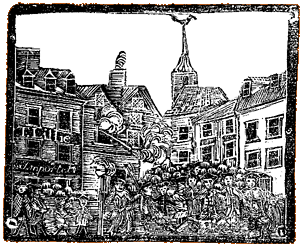
Part of that pressure in early February were crowds of boys marching outside importers’ stores; these protests appeared every Thursday morning when there was no school. On 22 Feb 1770, these young Whigs focused their attention on small merchant Theophilus Lillie. They set up their “Pageantry” on Union Street: a hand pointing to his shop with the word IMPORTER, and an effigy of Lillie’s head on a pole.

Along came Ebenezer Richardson, a Customs service employee. As I described in a New England Ancestors article available online, Richardson had become notorious in his home town of Woburn for having impregnated his wife’s sister and letting blame fall on the town’s minister for several months. He then moved to Boston and made his living as a confidential informer, first for the Attorney General and then for the Customs service. When that work was exposed in the early 1760s, Richardson became even more unpopular, and started to work openly for Customs since no one else would employ him.

The Customs establishment opposed the nonimportation movement, and Richardson apparently took it upon himself to break up the boys’ protest of Lillie’s shop. First he tried to persuade two farmers in Boston for market day to knock down the carved head with their wagons. The drivers refused. Whig gentlemen watching the action laughed at Richardson’s efforts. He stomped off to his nearby home, shouting, “Perjury! Perjury!”

It’s unclear what Richardson was referring to, but, as the Boston Evening-Post reported, “The Boys on hearing the words began to gather round, and call him an informer.” Richardson and his wife Kezia (the same woman he had impregnated and eventually married years before) shooed them away. The boys said, “they would not, Kings high Way”—meaning they had every right to be on the street.

Richardson flourished a stick. The boys ran around “with the squeeling and noise they usually make on such occasion,” said the newspaper. The young mob, now numbering at least “60 or 70 Boys,” left Lillie’s shop and started pelting Richardson’s house with “Limon Peels,” witnesses later testified. The boys hit Kezia Richardson with an egg. Someone inside the house tossed out a brickbat, striking a sailor. He threw it back through a window.

A low-level Customs employee named George Wilmot came to the house and offered help. According to one of the Richardsons’ daughters, “Wilmot asked [my father] if he had any Gun.” Both men armed themselves with muskets.

Richardson came out his front door and yelled at the boys, “as sure as there was a G[od] in heaven, he’d blow a Lane thro ’em.” He “snapped” his gun—firing it with powder but no ball, like a blank shot. The boys scattered and came back again, no longer tossing “light rubbish of one kind or another” but throwing stones through windows.

Richardson reappeared with his musket at an upper window. The boys continued to throw rocks. Richardson fired his musket again. This time he had loaded it with buckshot pellets, “about the bigness of large peas.”

Some of those pellets sliced through the baggy pants of a sailor named Robert Patterson. A few pierced the right hand and thigh of a nineteen-year-old painter named Sammy Gore. Eleven pieces flew into the chest of Christopher Seider, a servant boy just about eleven years old, who was “stooping to take up a Stone.”

The wounded boys were taken into a nearby house. As the violence continued outside, Dr. Joseph Warren, Dr. Thomas Young, and other surgeons examined them. Christopher’s chest was gradually filling with blood. People brought his parents, poor German immigrants, from their little home at the far end of Boston Common. Clergymen came to pray with the family. Christopher Seider died around nine o’clock on the night of 22 February, the first death of Boston’s Revolutionary conflict.