J. L. BELL is a Massachusetts writer who specializes in (among other things) the start of the American Revolution in and around Boston. He is particularly interested in the experiences of children in 1765-75. He has published scholarly papers and popular articles for both children and adults. He was consultant for an episode of History Detectives, and contributed to a display at Minute Man National Historic Park.

Subscribe thru Follow.it


•••••••••••••••••


Showing posts with label Lemuel Child. Show all posts

Saturday, April 29, 2017

“Paddocks Coach was shut out of Boston”

We left Sarah Deming and her family on the morning of 21 Apr 1775 at the house of the Rev. William Gordon in Roxbury, relieved that the British army had not attacked that site as feared.

Nevertheless, Deming and her female companions decided they had to get farther away from the siege lines. Her description of those efforts includes some more familiar names:
Miss Sarah Mason & I took our stand in turns, & sometimes together, at or without the door to try if we could get any conveyance to Dedham, which was six miles farther from Boston. At last we lit on a one horse Cart, & the driver was willing to take us all in, & carry us to [Dr. Nathaniel] Ames’s.

We toss’d in our bundles, & one of us had clim’d into the Cart, when Capt. [Lemuel] Child of the Peacock [tavern] came by, & told us that [Adino] Paddocks Coach was shut out of Boston, & he would engage it for us, to carry us as far as we would—that it was at but a quarter of a mile distant from us, & we should be more comfortable in that than in a cart—Out of which our things were then taken, & we began to see & acknowledge a kind providence.
“Paddocks Coach” wasn’t coachmaker Adino Paddock’s personal vehicle, I believe. Rather, in his yard near the Common he hosted a “genteel Berlin Coach, commodious for six Persons,” which Isaac Wendell offered to drive “in Town or out, on moderate terms” in a 9 Jan 1772 Boston News-Letter advertisment. That vehicle was now stuck outside the British lines, and the coachman was taking the best fares he could find.

Deming continued:
Mr. Gorden was abroad we knew not where—but he was coming for us. He knew we wish’d for nothing so much, in our deplorable circumstances as to be gone from his hospitable house. He had been to see, & comfort as well as he could, Mrs. [Josiah?] Waters & her children—He had found Paddocks Coach drawn by only two horses, & had agreed with his man to take us all in, together with Mrs. Gorden whom he was to call for at Mrs. Havens, & carry us to Providence for 12 Dollars. This agreement was made before Capt. Child came up to the Coach-man. But the business was done just as he appeared only Mr. Gorden had aded Mrs. Waters & her family to our company.
The minister gave Deming and her company midday dinner at his house before they set off for safety. At one point on the journey, Deming wrote, they
were now 12 in number; drawn by two horses; viz 9 within the Coach, consisting of Mrs. Gorden, Miss Mason, Mrs. Waters within two months of lying in (She is since delivered of a daughter) her three children, & fat maid, Sally & myself—without [i.e., outside] a man on the box with ye driver, & Lucinda behind
Lucinda, we recall, was Deming’s enslaved maid.

Sunday, April 16, 2017

“About one a clock the minute men were alarmed”

Samuel Haws of Wrentham, Massachusetts, was one of the militiamen called out on 19 Apr 1775 who left a journal of his experiences.

Haws’s journal would be consulted even more if he’d seen actual fighting that day. But Wrentham is on the Rhode Island border—too far for its militia company to hear of the regulars’ march, to assemble, and to hike all the way to the battle road. Instead, Haws and his comrades saw a lot of taverns and eventually made their own action.

Here’s an extract from Haws’s diary as it appeared in its second publication, in the New England Historical and Genealogical Register for 1976. The annotations are by editor Richard Brigham Johnson and me:
About one a clock the minute men were alarmed and met at Landlord [David] Mann’s.

We marched from there the sun about half an our high towards Roxbury for we heard that the regulars had gone out and had killed six men and had wounded Some more that was at Lexinton then the kings troops proceded to concord and there they were Defeated and Drove Back fiting as they went. They got to charlstown hill that night.

We marched to headens [Jonathan Hidden’s] at Walpole and their got a little refreshment and from their we marched to Doctor [Samuel] cheneys [still in Walpole] and their we got some victuals and Drink and from thence we marched to Landlord ellises at Dedham and their captain parson [Samuel Payson?] and company [from Stoughton?] joined us and then we marched to [Benjamin] Gays and their captain [John] Boyd and company [from Dedham] joined us and we marched to Landlord [Daniel] Whitings [still in Dedham]

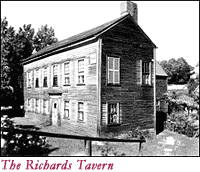
we taried their about one hour and then we marched to [Nathaniel] richardes [in west Roxbury, shown above] and Searched the house and found Ebenezer aldis and one pery who we supposed to Be torys
The Wrentham militiamen no doubt recognized Ebenezer Aldis as one of their neighbors. In fact, he even was a cousin of sorts to Samuel Haws. (I can’t identify “Pery”; Aldis’s wife was a Penniman, so it’s conceivable that man was one of her relatives and Haws wrote the name inaccurately.)

Haws’s report might dovetail with a tradition that came down in the family of Nathaniel Richards and was eventually published in Abner Morse’s A Genealogical Register of the Descendants of Several Ancient Puritans, vol. 3. That story focused on the landlord’s new son-in-law (and cousin) Solomon Richards:
On the morning of the battle at Lexington, he was met, on his way to Boston, with the report that the British were on their march to Concord; and as he was turning his course for Dover, to rally men to the scene of conflict, up rode a man direct from Boston, contradicting the report.

Capt. R. instantly marked him for a tory, took him prisoner, bound him upon his own horse, and escorted him to the Peacock tavern at Jamaica Plain, and detained him until the truth could be known. In the meantime a body of soldiers arrived, and demanded the tory, that they might hang him during their halt.
Morse believed that the Richards family owned the Peacock Tavern, but he was mistaken—its landlord was Lemuel Child. The Peacock Tavern was at the corner of Allandale and Centre; Nathaniel Richards’s tavern was further out along Centre where the West Roxbury post office now stands. The Richards family understood that Solomon Richards took his suspicious prisoner to his father-in-law’s tavern, and it looks like Morse inserted the Peacock Tavern name by mistake.

TOMORROW: Did the Wrentham company hang Ebenezer Aldis?