J. L. BELL is a Massachusetts writer who specializes in (among other things) the start of the American Revolution in and around Boston. He is particularly interested in the experiences of children in 1765-75. He has published scholarly papers and popular articles for both children and adults. He was consultant for an episode of History Detectives, and contributed to a display at Minute Man National Historic Park.

Subscribe thru Follow.it


•••••••••••••••••


Showing posts with label Samuel Blachley Webb. Show all posts

Tuesday, June 03, 2025

“To turn his back sullenly on his General”?

As discussed yesterday, on 19 July 1775 Gen. Joseph Spencer arrived back in the camps of what was now the Continental Army, bringing a letter from the governor of his home colony of Connecticut, Jonathan Trumbull.

Trumbull asked Gen. George Washington to understand how Spencer was miffed at seeing Israel Putnam promoted to major general over him. And merely because Putnam had led troops in the Battle of Chelsea Creek.

Delivering that letter was probably the first time Spencer had met Washington. And I imagine the discussion was as stiff and cold as the new commander-in-chief could be. As Maj. Samuel Blachley Webb (shown here) wrote on 11 July, Spencer’s departure “without leave or license from Gen. Washington,…displeased him much.”

Indeed, Spencer’s hissy fit had damaged his standing even among his own officers. He’d asked his subordinates to sign a protest on his behalf, and Webb reported:
I have since been to Roxbury, and find the officers, many of them, heartily sick of what they have done, in particular, Maj. [Return Jonathan] Meiggs,—who says he was forced to sign what the others did—to keep peace; and says he had rather serve under Putnam than Spencer.

You’ll find Generals Washington and [Charles] Lee, are vastly more fond, and think higher of Putnam, than any man in the army; and he truly is the Hero of the day. . . . Better is it for us to lose four Spencers than half a Putnam.
News of Putnam’s higher rank “gave universal satisfaction,” Webb added.

Webb was sending these observations to his stepfather, Silas Deane. On 20 July, Deane told his wife how the Continental Congress was responding to Spencer’s behavior:
You can be at no loss to infer what opinion is formed of him from this conduct, in doors and out. Suffice it to say, the voice here is, that he acted a part inconsistent with the character either of a soldier, a patriot, or even of a common gentleman. To desert his post in an hour of danger,—to sacrifice his Country, which he certainly did as far as was in his power,—and to turn his back sullenly on his General, a General, too, of such exalted worth and character,—will, I can assure you, unless he take the most speedy and effectual measures to atone, draw upon him the resentment of the whole Continent.
Neither Deane nor fellow Connecticut delegate Eliphalet Dyer ever pushed Spencer for promotion again. (He was made a major general in the fall of 1776 as part of a general wave of promotions.)

On 21 July, Gen. Washington reported to the Congress that Spencer had agreed to “serve under Puttnam, rather than leave the Army intirely.” The men’s relative ranks would not change.

The next day, Gen. Washington announced a new organization for the Continental Army around Boston. With three major generals under him, he put Artemas Ward in charge of a brigade on the southern side of the siege lines, Lee in charge of the northern wing, and Putnam in charge of the center.

Among the brigadier generals, he assigned Spencer to the southern wing under Ward. Thus, Spencer would answer to a general he’d already acknowledged as senior, not to Putnam. Gov. Trumbull had suggested a similar way of keeping the two Connecticut officers apart. Which wasn’t the sort of issue Washington wanted to face.

Spencer served the rest of the siege, making no distinct contribution at all. He never gained Washington’s trust, and after an unsuccessful Rhode Island campaign he left the army.

Monday, June 02, 2025

“General Spencer’s uneasiness, &c., at being overlooked, &c.”

According to the young Connecticut officer Samuel Blachley Webb, when Gen. Joseph Spencer learned the Continental Congress had ranked Israel Putnam over him, “He began to speak very freely; and finally, persuaded the officers, to remonstrate to the Assembly of Connecticut; and he set off immediately for home.”

Spencer was older than Putnam. He had raised a company for King George’s War in the 1740s while Putnam’s vaunted military career began in 1755. The Connecticut legislature had granted Spencer seniority, and he wanted to keep that status.

Forty-nine Connecticut officers signed a letter to their legislature that praised Spencer’s “exemplary life, good conduct, prudence, and courage.” It said:
You are sensible it will be with great reluctance our Troops at Roxbury could see their General superseded by an officer in previous lower command. We have no objection to the appointment of Generals [George] Washington and [Charles] Lee, and shall endeavour to preserve the good order and submission to their government as hath before distinguished this part of the Connecticut Troops whilst under General Spencer’s command; but the late arrangement so far removes General Spencer from his former command, that he cannot and will not continue in the service under this arrangement.
In his home colony, Spencer seemed to get the support he was after. In Lebanon on 13 July, Gov. Jonathan Trumbull showed his Council a draft letter to Gen. Washington about the issue. The official record of that meeting says the letter was
hinting at General Spencer’s uneasiness, &c., at being overlooked, &c., and that it was beside our expectations, &c., and proposing, &c., that said General Spencer may remain stationed at Roxbury with the body of Connecticut Troops now there, &c.; which are approved, though a small alteration was made in the Letter to gratify Gen. Spencer after he came in, &c.
Two politicians, Samuel Huntington and William Williams (the governor’s son-in-law and speaker of the assembly), went to the tavern where Spencer was staying to hear him out about “his dissatisfaction, &c.” They tried to “reconcile him cheerfully to pursue the service.”

That afternoon, Gov. Trumbull and the Council invited Spencer to join their meeting. They
had a long conference with him on the subject matter of his being superseded by the General Congress, in putting Gen. Putnam above him &c., which he thinks very hard of and resents &c., and is at length persuaded to return to the army and not at present quit the service as he proposed; and Genl. Spencer set out on his return to camp with the letters to Genl. Washington.
Trumbull’s letter to Gen. Washington said that “Generals [David] Wooster and Spencer will think they have reason to complain” about their ranking relative to Putnam and suggested a “Method to obviate the difficulties that are apprehended”:
The Army before Boston is necessarily thrown into two Grand Divisions. General Spencer with a Number of Our Troops hath hitherto been at Roxbury, and General Putnam at Cambridge —That Destination continued and Observed, may prevent uneasy Competition; preserve good order, and promote the public Service.
Spencer arrived back on the siege lines around Boston on 19 July.

TOMORROW: A triumphant return?

Tuesday, March 07, 2023

“Came to Head Quarters and gave the following Intelligence”

After Continental troops moved onto Dorchester heights on the night of 4–5 March 1776, Gen. George Washington and his commanders waited anxiously for the British response.

As of 8 March, Gen. Horatio Gates was telling John Adams that headquarters still didn’t know what was going on inside Boston “as neither Townsman, nor Deserter, has yet come in to acquaint us!”

But some men were making their way out of Boston, bringing intelligence. Maj. Samuel Blachley Webb (shown above, courtesy of the New-York Historical Society), stationed with Gen. Israel Putnam’s brigade in Cambridge, wrote in his journal on 8 March about “Capt. Erving, of Salem, who last night stole out of Boston.”

Four different letters sent from Washington’s headquarters on 9 March, the next day, described that man in slightly different ways:
After looking at Salem vital records, which provide yet more variant spellings, I think this captain was most likely named Ervin, so I’m going to refer to him that way.

At first I thought Capt. Ervin was the most likely person to have reported Gen. William Howe’s exclamation on seeing the Dorchester heights fortifications. His rank as a captain in command of a “Transport,” or troop ship, suggested that the general was more likely to have spoken frankly in front of him.

However, the timing doesn’t quite work. In one of his 9 March letters Gen. Washington wrote that it was “Yesterday evening,” or 8 March, when this captain “came to Head Quarters and gave the following Intelligence.” James Bowdoin understood that the general questioned the source we’re looking for at or after midday dinner on 9 March.

In addition, Bowdoin used the term “deserter.” None of the headquarters letters used that word for the sea captain, even when Washington described him as “A Captain of a Transport,” presumably working for the Crown.

But Maj. Webb did use that language in describing another man in his diary on 9 March: “Three Inhabitants and one Soldier last night deserted to us from Boston—they confirmed the accounts Rec’d yesterday…” If that soldier reached Washington’s Cambridge headquarters on 9 March, then the general would have seen him as an army deserter and questioned him that day, as Bowdoin described.

Finally, while Ervin and the deserter told the same basic story about the British authorities preparing to leave, they provided different details—about numbers, hospital ships, and so on.

It therefore looks like Gen. Washington spoke to Capt. Ervin on the evening of 8 March, received a letter from the Boston selectmen with similar news (as discussed here), and dispatched reports based on all that information to the Congress and nearby colonies in the middle of 9 March. Later on that day the deserting soldier arrived, offering yet more corroboration and the story of Gen. Howe exclaiming, “Good God! These fellows have done more work in one night than I could have made my army do in 3 months. What shall I do?”

TOMORROW: Digging into these intelligence sources.

Friday, July 24, 2015

Matching Up the Stories of the Fight in Boston Harbor

Last week I started quoting lengthy passages from an 1835 United Service Journal article about the capture of ships carrying men of the 71st Regiment of Foot in Boston harbor, said to be extracted from letters that a young Scottish officer wrote to his sister.

This week I quoted reports of that event written in 1776 by various participants, including the commander of those Crown forces. Some salient details match, but others are far off.

For example, Lt. Col. Archibald Campbell wrote about how a cannon shot from a shore battery was his first clue that Boston was no longer in British hands:
As we stood up for Nantasket road, an American battery opened upon us; which was the first serious proof we had that there could scarcely be many of our friends at Boston…
The 1835 account echoes that moment with more drama:
The men were clustering in the forecastle, and the officers leaning over the taffrail, with glasses turned towards the town, when a flash from the battery on the island, followed by an instantaneous report, caused us to look up. We had scarce done so, when a ball, after touching the water once or twice in its course, buried itself in a swell of the sea, just under our stern. We stared with astonishment one upon another, for the signal—if such it was—had been very awkwardly managed; but ere a Word had been exchanged, another and another gun was fired, the shots from which passed some ahead, some far over, and one right through the shrouds, so as to cut away several of the ratlins. “This is a rough reception,” said our commanding officer; “and devil take me if I don’t see into it.”
(When first quoting that passage I assumed the battery was part of Castle William, but it doesn’t have to be. The letter from a Massachusetts artillery officer specified it was on “point alderson,” or Point Allerton in Hull. Nearby Fort Revere, on a site first fortified in 1776 and decommissioned in 1947, is shown above.)

But the 1835 account is entirely missing what must have been a significant part of the Scottish ships’ voyage: four small American privateers had chased them toward Boston all the previous day. Campbell refers to that engagement, counting casualties from it. So does the artillerist’s letter and even Capt. Seth Harding’s battle report (though he left out the role of those ships in the final capture).

Instead, the 1835 account says that after that first shot from the battery, the two Scottish troop ships were attacked by ”a numerous flotilla, consisting of schooners, launches, and row-boats of the most formidable size, put off from the town.“ No contemporaneous report agrees with that.

The 1835 account says the British troops, once they realized their commanders had to surrender, destroyed their equipment to ensure it didn’t fall into Yankee hands:
our soldiers no sooner found themselves below, than they ran to the arm-racks. In five minutes there was not a musket there of which the stock was not broken across. The belts, cartouchboxes, and bayonets likewise were caught up, and all, together with the fragments of the firelocks, were cast into the sea.
When American authorities searched the George, they found “31 small-arms,” “361 black shoulder belts; 74 bundles and 1 bag gun straps;” “7 bundles leather bullet pouches; 3 cartouch boxes;” and “2 bags with belts and knapsacks.”

So the troops captured on that ship didn’t destroy everything, but that does seem like a small number of muskets for so many soldiers. Gen. George Washington’s aide-de-camp Samuel Blachley Webb wrote in July that the commander-in-chief thought as much: “he is surprized that out of upwards of 400 Prisoners only 73 Arms have been sent on, as he supposed every man must have his Arms with him”.

However, so far I’ve found no statement from Massachusetts explaining that the prisoners had destroyed most of their arms. Webb seems to have suspected that local authorities had requisitioned those weapons for their own forces rather than sending them south to the Continental Army. So Massachusetts officials did have a reason to explain.

Finally, the 1835 story describes the American attackers’ last act this way:
they plundered the transport of everything contained in it, whether of public property or belonging to individuals; and finding on examination that it would not float, they summed up all by setting it on fire.
But an advertisement from 1776 show that within a couple of months all three of the captured troop ships were up for auction at Hancock’s Wharf. No period source indicates that the Americans burned any of those vessels.

As a result of those discrepancies with the fight in Boston harbor, the event of the 1835 narrative that prompted the most contemporaneous records, I’ve reluctantly concluded that the United Service Journal articles aren’t a reliable source. Not just the narrator’s flight from captivity and the Indian ambush in darkest Connecticut (which always seemed like a romance), but also the British officers listening to the Declaration of Independence and even their difficulties training the new Highlander soldiers aboard ship.

It’s possible that some 71st Regiment officer’s letters or anecdotes were the basis for those articles. But any eyewitness memories have been so built up with additional detail and drama—whether extrapolated, drawn from published sources, or made up—that it’s impossible to separate out what’s authentic from what’s wishful. Which is too bad, because those articles contain some really good storytelling.

Thursday, July 23, 2015

Dividing the Prizes from Scotland

In June 1776, Gen. Artemas Ward wrote to his commander-in-chief, Gen. George Washington, with news of the fight in Boston harbor:
P.S. June 17. I have just received information that the Continental Privateers have taken and brought into Nantasket in this Harbour a Ship and a Brig from Glasgow with two hundred and ten Highland troops on board, with their baggage; the Ship mounted six carriage guns, and fought the Privateers some time before she struck, we had four men wounded, the Enemy had three privates killed and a Major, and eight or ten men wounded. The prisoners are coming up to Town among whom is a Colonel. Any further particulars that may be of importance I shall forward as soon as I can learn them.
This was news not just because of the prisoners, but because of the military supplies on those ships. The Continental Army had first claim on those useful supplies.

For example, the ship George was inventoried on 22 June and found to contain:
20 fusees; 31 small-arms; 6 kegs bullets and shot; 6 bundles paper for cartridges; part of a bag flints; 2 kegs part filled with cartridges; a cask containing a few books and 1 bundle bedding; 2 trunks and 2 portmanteaus; 1 black trunk; 1 bundle; 1 black canteen; 1 red bundle; 1 chest; 1 portmanteau; 3 casks porter; 1 cask hams; 3 casks bottled wine; 7 hogsheads and part of a hogshead rum; 361 black shoulder belts; 74 bundles and 1 bag gun straps; 1 field bed and 2 bundles binding; 4 markees; the Quartermaster’s camp equipage; Colonel [Archibald] Campbell’s ditto; a bundle ditto not directed; 3 field tents and materials; 6 bundles tent poles for markees; 12 bundles common tent poles; 7 bundles leather bullet pouches; 3 cartouch boxes; 6 kegs bullets and shot; 23 camp tents; a remnant of ticklenburg; 1 cask and 2 bundles tent-pins; 1 cask tin canteens, and 69 loose; 10 tin pans; 23 camp kettles; 1 package tent stools; 82 canvass knapsacks; 199 hair knapsacks; a bale containing 80 blankets; a bale containing 50 watch-coats; 1 box black plumes; 4 bundles soldiers’ clothing; 1 bundle stockings; 3 pair shoes; 2 bags with belts and knapsacks; 2 pieces plaid; 7 bonnets; 2 pieces and part of a piece duffel; 144 soldiers' blankets; 33 beds; 85 pillows; a bale of brown paper; 44 hatchets; 1 bundle twine; 1 cask sheathing nails; 2 casks five-penny nails; 1 set small weights; 2 iron spades; part of a cask currants; 15 barrels pease; 6 barrels flour; 2 barrels barley; 9 barrels pork; 27 barrels beef; 19 kegs butter; 15 barrels oat meal; 2 tierces and part of a tierce vinegar; 2 barrels herring; 1 bag rice; 74 bags bread; 14 hogsheads bread; water cask.
Washington’s aide Samuel Blachley Webb asked the Continental agent in Massachusetts to send “From Ship George All the Fuzees, Small Arms & Bayonetts, Shoulder Straps, Gun Straps—Leather Bullet pouches, hair knapsacks, Canvass Knapsacks, Belts, Flints, Marquees, and Soldiers Tents, Common Tent Poles, Tin Canteens, Camp Kettles, Blankets, Watch Coats, Soldiers Cloathing, Stockings[,] Black Plumes.”

The rest of the cargo and the ships themselves were to be auctioned off, as announced in the 15 August New-England Chronicle. The proceeds were to be divided up between the local government and the captains and crews involved in capturing them.

However, as Jackson Kuhl explained in this Journal of the American Revolution article:
Everything else was sold but because the transports were Royal Navy[-leased] ships, the money first had to flow through the office of the naval agent in Boston, where it evaporated — used to pay for expenses of the Continental navy. Neither the state of Connecticut nor the men of Defence ever saw a penny of it.

So afterwards, Captain [Seth] Harding, along with Governor [Jonathan] Trumbull and the Council of Safety, made a very conscious decision not to strike military targets but instead to pursue merchant ships.
That’s one of the results of a privateering and prize system: it creates incentives for warships to seek the biggest profits rather than the biggest military benefits.

TOMORROW: Assessing the evidence.

Saturday, November 10, 2012

“Better…to lose four Spencers than half a Putnam

As I described yesterday, the biggest managerial challenge Gen. George Washington faced when he arrived in Cambridge on 2 July 1775 was sorting out the generals who would serve under him. The Continental Congress had made a list of major and brigadier generals, but its ranking didn’t match the set of commanders Washington found in Massachusetts or how they had organized themselves.

Fortunately, the commander-in-chief had some help in solving the problem. The nearby colonial governments did their part. After Nathaniel Folsom saw that the Congress had chosen John Sullivan to be the one general from New Hampshire (based on the enthusiastic recommendation of Congress delegate John Sullivan), he went home. And New Hampshire put him in charge of its militia.

Similarly, the Massachusetts government saved face for John Whitcomb, who hadn’t been that enthusiastic about serving in the army, by electing him to its Council. During a Continental Army inquiry in late July witnesses still called him “General Whitcomb,” but the official record referred to him as “Colonel John Whitcomb, who is styled by the foregoing deponents General.”

Joseph Spencer had stormed off to Hartford, Connecticut, to complain that the Congress had promoted Israel Putnam over him. He brought a letter signed by many Connecticut officers supporting him. But that action hurt his cause by making him look selfish and unprofessional.

On 11 July young officer Samuel Blachley Webb wrote to his stepfather, Congress delegate Silas Deane:
I have since been to Roxbury, and find the officers, many of them, heartily sick of what they have done, in particular, Maj. [Return Jonathan] Meiggs,—who says he was forced to sign what the others did—to keep peace; and says he had rather serve under Putnam than Spencer. You’ll find Generals Washington and [Charles] Lee, are vastly more fond, and think higher of Putnam, than any man in the army. . . . Better is it for us to lose four Spencers than half a Putnam.
In Philadelphia, Deane and his colleague Eliphalet Dyer were so embarrassed they agreed not to seek any promotion for Spencer from the Congress.

Back in Hartford the colony’s Committee of Safety handled the matter:
Samuel Huntington and William Williams were desired to wait on General Spencer, at Gray’s, the tavern where he was just arrived, and confer with him on the subject-matter of his dissatisfaction, &c., and endeavour to remove, &c., and reconcile him cheerfully to pursue the service; which they did accordingly.
Spencer rode back to the siege lines, arriving on 19 July. In later years, Washington probably wouldn’t have accepted Spencer’s behavior, but on that date the commander-in-chief had been on the job less than three weeks. Spencer was almost two decades older and had served in King George’s War and the Seven Years’ War. His name was on that official Continental Army commission. It was easier for Washington to overlook Spencer’s hissyfit than to make an issue of it.

Nevertheless, Gen. Washington probably didn’t harbor warm feelings about this brigadier. And Gen. Spencer made no particular contribution to the siege. Later in the war he commanded one campaign, an aborted attack on British positions at Newport, and then served in a single session of the Continental Congress.

[The image above comes courtesy of the Colonel Spencer Inn in Campton, New Hampshire. I have no idea if it’s an accurate portrait of the man.]

TOMORROW: Saving Gen. Thomas.

Wednesday, July 06, 2011

Two Mysterious Frenchmen at the Siege of Boston

According to Lt. Col. Stephen Kemble of Gen. Thomas Gage’s military and marital family (shown here courtesy of Live Auctioneers), on 6 July 1775 a Frenchman came into Boston from the American lines.

He brought the news that another Frenchman, “one Dubue, is their [the enemy’s] Chief Engineer, as Gridley cannot Act from his Wound.” Col. Richard Gridley, head of the American artillery regiment, had been wounded at the Battle of Bunker Hill. Various volunteers, including Henry Knox and Rufus Putnam, were filling in.

[ADDENDUM: Continental Army private Nathaniel Ober wrote in his diary on 6 July: “This Day a french man Desarted from us and went to the Regelors.” So that’s confirmation but no additional information.]

Five days later, the Connecticut officer Samuel Blachley Webb wrote to Silas Deane, who was both one of his Continental Congress delegates and his stepfather:
a Frenchman, who came here in the character of a gentleman, was detected in stealing. The next day he deserted to the enemy; but he’s of no consequence, being simple, a foolish fellow.
That man might not have been reliable, but on 17 August Kemble stated:
The Capt. of the Man of War that Conveyed the Inhabitants to Salem returned, and brought with him Monsieur Dubuque, a French Man, who had been employed by the Rebels as an Engineer.
I can’t find any mention of this French engineer in American sources, however.

I do have accounts of a couple of minor French noblemen viewing the siege of Boston for a while before sailing to London. (One day I’ll trace their story.) But they weren’t named Dubuque—not that the engineer must have used his real name.

A man named Dubuque owned the Shirley-Eustis house sometime around 1800, but he was said to have come to America as a refugee from the French Revolution, not before. But you never know.

Monday, July 27, 2009

Nailing Down Mount Whoredom

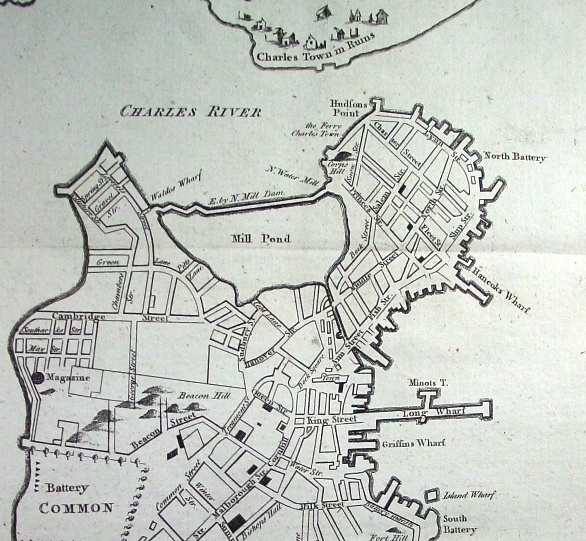
One of the mysteries of great importance that Boston 1775 has poked through is the term “Mount Whoredom,” used by British officers in 1775-76 to describe a promontory west of Boston Common. That area became the Mount Vernon neighborhood of Beacon Hill.

As Christopher Lenney and I tracked down, there was a landmark of the same name in greater London, near the Royal Artillery training ground. So was that name brought across the Atlantic by the British officers themselves? Or was it local?

Recently a Boston 1775 commenter alerted me to this entry in the diary of Judge Samuel Sewall back in 1715:

Monday, Augt. 8. Set out at 11. at night on Horseback with Tho. Wallis to inspect the order of the Town. Constable Eady, Mr Allen, Salter, Herishor Simson, Howel, Mr John Marion. Dissipated the players at Nine Pins at Mount Whoredom.

Benjamin Davis, Chairmaker, and Jacob Hasy were two of them. Reproved Thomas Messenger for entertaining them.
So Bostonians were referring to Mount Whoredom many decades before the Revolution, and it was already a site of iniquity—of sorts. On this night the worst behavior the Puritan authorities found was “Nine Pins.” (Make your blood boil? Well, I should say!)

I’ll also quote a letter from Samuel Blachley Webb to Silas Deane, dated 16 Oct 1775:
in my last I mentioned the building the flat Bottom Boats which are now almost compleated and the men are daily exercising in them, such as learning to Row—paddle—land & clime a precipice & form immediately for Action,—they behave much beyond expectation,—this exercise will be of great service if ever we land on the shore of our Enemies, which it seems they much fear as they have hall’d up another Frigate in the Bay back of Mount Whoredom
This amphibious-landing training came a few months before my earlier example of American commanders using the term. Finding additional examples from 1775 will show the name to be even more established in America.

So what’s the full story of Boston’s “Mount Whoredom”? Was that hill:
  • named for a similar hill near London? (London certainly has a livelier night life than Puritan Boston.)
  • the inspiration for naming the hill in London? (The Boston usage is documented earlier, after all.)
  • named after a common term for a red-light district throughout the British Empire? (In that case, there should be more examples out there.)