J. L. BELL is a Massachusetts writer who specializes in (among other things) the start of the American Revolution in and around Boston. He is particularly interested in the experiences of children in 1765-75. He has published scholarly papers and popular articles for both children and adults. He was consultant for an episode of History Detectives, and contributed to a display at Minute Man National Historic Park.

Subscribe thru Follow.it


•••••••••••••••••


Showing posts with label Samuel Gerrish. Show all posts

Thursday, July 03, 2025

“Necessary that the regiments be immediately settled”

Many accounts of George Washington’s arrival in Cambridge in 1775 say that he converted the ragtag New England militia into the Continental Army.

That’s a misconception. It’s common enough that I might have expressed that understanding myself when I first wrote about the beginning of the war. But it misses an important development that I now see more clearly, and see as more important.

The New England colonies had already formed armies in the spring of 1775. Militia companies were designed to respond to emergencies, such as the Lexington Alarm. When an emergency was over, men expected to go home. Enlisting in an army meant a man agreed to serve for a defined time.

That was a different legal relationship between a government and its citizens, and for New Englanders military service was all about that maintaining that covenant. As Fred Anderson has written, British army officers (who were used to enlisting for life and commanding men who had done the same) and later Gen. Washington ran into trouble because they didn’t share that outlook.

On 19 April and shortly afterward, about 20,000 militia men mobilized, ending up in camps ringing the peninsula of Boston. But with all the regulars back inside the town, the immediate emergency had passed. Some men wanted to go home.

Two days later, Gen. Artemas Ward wrote to the Massachusetts Provincial Congress:
My situation is such that, if I have not enlisting orders immediately, I shall be left all alone: it is impossible to keep the men here, excepting something be done. I therefore pray that the plan may be completed and handed to me this morning, that you, gentlemen of the Congress, issue orders for enlisting men.
The committee of safety responded with a proposal to sign up “out of the Massachusetts forces, eight thousand effective men,” to serve for seven months.

Two days later, on 23 April, the full congress went further with two votes:
Resolved, unanimously, that it is necessary for the defence of the colony, that an army of 30,000 men be immediately raised and established.

Resolved, That 13,600 men be raised immediately by this province.
The rest were expected to come from the neighboring colonies.

That Massachusetts army would have fewer men per company and fewer companies per regiment than the Massachusetts militia. The Patriot authorities expected some men to go home and hoped to keep units as cohesive as possible.

In the following weeks, there must have been a lot of discussion within the ranks. Some companies enlisted nearly en masse under their familiar officers. Other men chose to go home to their wives, children, and farms. Some went home and came back. To fill holes, there was some shuffling of officers’ ranks and which companies belonged to which regiments (i.e., reported to which colonels).

Ward and his top officers were worried enough about the war to recommend a formal militia call on 9 May so there would be enough armed men to protect Roxbury and Dorchester. Ten days later the general wrote to Dr. Joseph Warren as president of the congress:
It appears to me absolutely necessary that the regiments be immediately settled, the officers commissioned, the soldiers mustered and paid agreeable to what has been proposed by the Congress—if we would save our Country.
That day the provincial congress approved its first Massachusetts army commission, to Col. Samuel Gerrish.

Gradually more pieces were put into place. Ward was sworn in as an army general, not just a militia general, the next day. By the end of the month, what Patriot newspapers started calling “the Grand American Army” had about 16,000 men from four colonies.

To be sure, not all those forces were formally enrolled yet. In Moses Little’s regiment from Essex County, Moses Sleeper had signed on as a corporal on 9 May. But the committee of safety didn’t approve paperwork for the whole regiment until 26 June, the last regimental commission of the spring. By then some of Col. Little’s companies had already fought in the Battle of Bunker Hill.

For more about the process of creating this provincial army, see Mike Cecere’s article “The Army of Observation Forms: Spring 1775 in Massachusetts” at the Journal of the American Revolution.

COMING UP: Taking the oath.

Wednesday, August 02, 2023

“To pass unmolested into the town of Boston”

On Sunday, 30 April, the Massachusetts committee of safety:
  • heard from Col. Benedict Arnold of Connecticut about artillery up along Lake Champlain.
  • ordered Maj. Timothy Bigelow to move weapons from Worcester to the siege lines.
  • hired an express rider.
  • urged its subcommittee of Azor Orne, Richard Devens, and Benjamin White to “form a plan for the liberation of the inhabitants” of Boston now that Gen. Thomas Gage was allowing them to leave.
So this committee wasn’t idle.

Probably after being stung by the letter from the Massachusetts Provincial Congress quoted yesterday, the committee appointed its chair, Dr. Joseph Warren, along with Joseph Palmer and Orne, to take their resolution out to that body in Watertown.

The committee’s recommendation was:
Whereas, proposals have been made by General Gage to the inhabitants of the town of Boston, for the removal of their persons and effects into the country, excepting their arms and ammunition:

Resolved, that any of the inhabitants of this colony, who may incline to go into the town of Boston with their effects, fire-arms and ammunition excepted, have toleration for that purpose, and that they be protected from any injury or insult whatsoever. This resolve to be immediately published.

The following orders were delivered to Col. Samuel Gerrish:
You are hereby empowered, agreeably to a vote of the Provincial Congress, to grant liberty, that any of the inhabitants of this colony, who may incline to go into Boston with their effects, fire-arms and ammunition excepted, have toleration for that purpose; and that they be protected from any injury or insult whatsoever, in their removal to Boston.

The following form of a permit is for your government, the blanks in which you are to fill up with the names and number of the persons, viz.:
Permit A. B., the bearer hereof, with his family, consisting of persons, with his effects, fire-arms and ammunition excepted, to pass unmolested into the town of Boston, between sunrise and sunset. By order of the Provincial Congress.
Dr. Warren signed that report “clerk pro tem.,” indicating he had taken on yet another job.

The committee of safety addressed only the question of how to reciprocate to Gen. Gage’s decision and let Loyalists enter Boston. It left the bigger question of how to help refugees who had left their homes in that town up to the congress.

The provincial congress made some amendments to the committee’s recommendation, so this is what went out officially:
In PROVINCIAL CONGRESS, Watertown, April 30, 1775.

Whereas an agreement has been made between General Gage and the inhabitants of the city of Boston, for the removal of the persons and effects of such of the inhabitants of the town of Boston, as may be so disposed, excepting their fire arms and ammunitions into the country:

RESOLVED, That any of the inhabitants of this colony, who may incline to go into the town of Boston with their effects, Fire-Arms and Amunitions excepted, have toleration for that purpose; and that they be protected from any injury and insult whatsoever, in their removal to Boston, and that this resolve be immediately published.

P. S. Officers are appointed for the giving permits for the above purposes; one at the sign of the Sun at Charlestown, and another at the house of Mr. John Greaton, jun. at Roxbury.

Ordered, That attested copies of the foregoing resolve be forthwith posted up at Roxbury, Charlestown and Cambridge.

Resolved, That the resolution of Congress, relative to the removal of the inhabitants of Boston, be authenticated, and sent to the selectmen of Boston, immediately, to be communicated to general Gage, and also be published in the Worcester and Salem papers.

Ordered, That Doct. Taylor, Mr. Bailey, Mr. Lothrop, Mr. Holmes and Col. Farley, be a committee to consider what steps are necessary to be taken for the assisting the poor of Boston in moving out with their effects to bring in a resolve for that purpose; and to sit forthwith.
The congress delegates, having given up their whole Sunday waiting for the committee, then adjourned for the day.

By the time the congress’s resolve was published in the 3 May Massachusetts Spy, the Rev. John Murray had stepped down as its president pro tempore and James Warren of Plymouth had declined the post. So the resolution was published over the name of the new president pro tem., Dr. Joseph Warren. As if he didn’t already have plenty to do.

TOMORROW: Spreading out the refugees.

Tuesday, September 15, 2020

An Acquittal and a Conviction

On 29 Aug 1775, Gen. George Washington told Richard Henry Lee, “I have at this time one Colo., one Major, one Captn, & two Subalterns under arrest for tryal.”

The colonel was John Mansfield of Lynn, originally scheduled to be tried in early August. The major was Scarborough Gridley of Stoughton, in the artillery regiment. As I described yesterday, Gridley had stayed out of the main fighting at Bunker Hill and ordered Mansfield (who had a higher rank) to keep his infantry regiment nearby.

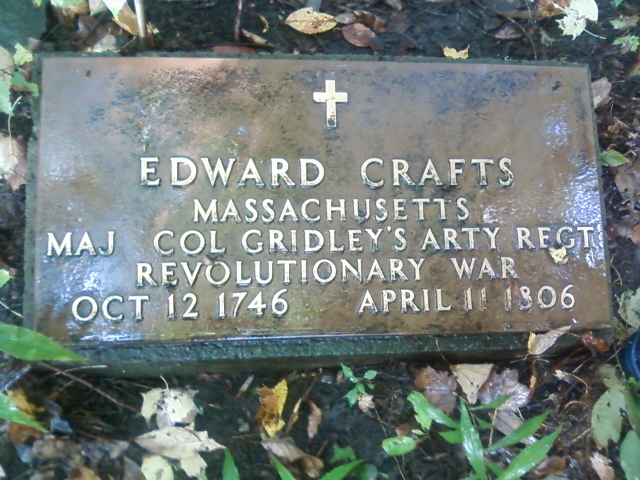
The captain was another artillery officer, Capt. Edward Crafts (1746-1806). He was a younger brother of Thomas Crafts, one of the Loyall Nine who organized the first public protest against the Stamp Act and then remained active in Whig politics. Thomas was an officer in Boston’s militia artillery company, and Edward trained in that unit as a young man.

Edward Crafts was a tinner by profession. He was still in Boston in 1770, when he supplied a deposition for the town’s Short Narrative of the Horrid Massacre. But back in 1768 he had married a country girl, Eliot Winship of Lexington. In 1771 the growing family moved to Worcester. At the end of 1773 Edward became a founding member of the American Political Society, his new town’s new club for Whig politics.

As the province moved toward military conflict in 1774, Worcester put Crafts on a committee to acquire and mount four cannon. He started to train a militia regiment to use those guns. Both Massachusetts Provincial Congress records and spy reports to Gen. Thomas Gage describe a large number of artillery pieces in the town by the spring of 1775.

When war broke out, however, Edward Crafts marched as a private in the town’s minuteman company. Then he returned home and recruited an artillery company to serve through the rest of the year. According to most listings of the Massachusetts artillery regiment under Col. Richard Gridley, Crafts was the senior captain.

That might have given him the stature, and the boldness, to challenge Maj. Scar Gridley. The colonel’s son was nominally fourth in command of the regiment, but in practice he was the colonel’s main aide and protégé. Sometime in the summer of 1775, after Maj. Gridley had behaved so ineffectually at Bunker Hill, he and Capt. Crafts exchanged words and accusations.

That led to the first of a series of court-martial proceedings, starting 1 September. The next day’s general orders announced the verdict:
Capt. Edward Crafts of Col. Gridley’s regiment of Artillery, tried yesterday by a General Court Martial, is acquitted of that part of the Charge against him, which relates to [“]defrauding of his men,” and the Court are also of opinion, that no part of the Charge against the prisoner is proved, except that of using abusive expressions to Major Gridley; which being a breach of the 49th Article of the Rules and Regulations for the Massachusetts Army; sentence the Prisoner to receive a severe reprimand from the Lt Col. of the Artillery in the presence of all the Officers of the regiment and that he at the said time, ask pardon of Major Gridley for the said abusive language.
The lieutenant colonel of the regiment was William Burbeck. I have no idea if he made Capt. Crafts perform this ritual before the end of the month because there was still more legal business to get through.

According to the diary of Lt. Benjamin Crafts (an Essex County cousin of the Crafts brothers from Boston), Col. Mansfield’s court-martial started on 8 September. A week later, on 15 September, the commander’s general orders declared the outcome:
Col. John Mansfield of the 19th Regt of foot, tried at a General Court Martial, whereof Brigdr Genl [Nathanael] Green was president, for “remissness and backwardness in the execution of his duty, at the late engagement on Bunkers-hill”; The Court found the Prisoner guilty of the Charge and of a breach of the 49th Article of the rules and regulations of the Massachusetts Army and therefore sentence him to be cashiered and render’d unfit to serve in the Continental Army.

The General [Washington] approves the sentence and directs it to take place immediately.
Notably, although the Continental Army kicked Mansfield out, the voters of Lynn chose him for their town committee of correspondence, inspection, and safety almost every year until the end of the war, and also voted to have him moderate town meetings.

Likewise, the voters of Newbury sent Samuel Gerrish to the Massachusetts General Court in 1776, the year after the army cashiered him the same way. Those gentlemen’s neighbors felt they still deserved leadership responsibilities.

COMING UP: The trial of Scarborough Gridley.

[The photo above shows the modern marker on Edward Crafts’s grave in Potter, New York, where the family moved in 1792, courtesy of Find a Grave. The original stone also survives there.]

Sunday, August 16, 2020

“Improper to sustain a commission”

On 16 Aug 1775, the Continental Army issued its internal response to the fiery British raid on the Penny Ferry landing in Malden, described back here.

As quoted in Col. William Henshaw’s orderly book:
Captain Eleazer Lindsey of Colonel Gerrish’s regiment, tried by a general court-martial for absenting himself from his post, which was attacked and abandoned to the enemy; the court, on consideration, are of opinion that Captain Lindsey be discharged the service, as a person improper to sustain a commission.
This was one of a series of court-martial proceedings in that week. On 13 August orders had gone out for some men to be confined, and the next day Gen. Nathanael Greene (shown here) assembled a panel of high-ranking officers in the Harvard College chapel.

On 18 August, Greene’s panel tried Col. Samuel Gerrish and unanimously found “That he behaved unworthy an Officer” during the British assault on Sewall’s Point. The court-martial cited “the 49th Article of the Rules and Regulations of the Massachusetts Army,” which was a grab-bag clause:
All Crimes not capital, and all Disorders and Neglects, which Officers and Soldiers may be guilty of, to the Prejudice of good Order and military Discipline, though not mentioned in the Articles of War, are to be taken cognizance of by a general or regimental Court-Martial, according to the Nature and Degree of the Offence, and be punished at their Discretion.
The court recommended that Gerrish “be cashiered, and render’d incapable of any employment in the American Army.” Gen. George Washington approved that sentence the next day.

On 25 August, the commander-in-chief transferred the company formerly under Capt. Lindsey out of the regiment formerly under Col. Gerrish and back into the regiment of Col. Ruggles Woodbridge.

I’ve already quoted what Washington wrote about these actions to his overseer on 20 August. Nine days later he wrote something similar to Richard Henry Lee:
I have made a pretty good Slam among such kind of officers as the Massachusets Government abound in since I came to this Camp, having Broke one Colo. and two Captains for Cowardly beh[aviour in] the action on Bunker’s Hill—Two captains for drawing more provisions and pay than they had men in their Company—and one for being absent from his Post when the Enemy appeared there, and burnt a House just by it.

Besides these, I have at this time one Colo., one Major, one Captn, & two Subalterns under arrest for tryal—

In short I spare none & yet fear it will not all do, as these Peeple seem to be too inattentive to every thing but their Interest.
Washington’s comments don’t line up exactly with the court-martial sentences. Gerrish was formally charged with poor behavior well after Bunker Hill, and both Lindsey and Capt. Christopher Gardner could be described as “being absent from his Post when the Enemy appeared there, and burnt a House just by it.” But the overall trend is clear.

Thursday, August 13, 2020

“Brisk Firing” along the Rivers in 1775

When we last peeked in on Malden during the siege of Boston, a British raiding party from Charlestown had crossed the Mystic River and burned the building at the Penny Ferry landing.

The Continental Army officer assigned to that spot, Capt. Eleazer Lindsey, was no help. Reports differ about whether he had gone home or took just that moment to go home in a hurry.

The British floating battery remained in the Mystic River, threatening those parts of the American siege lines.

A week later, on 13 Aug 1775, there was another exchange of fire. It started when some British boats came to resupply the floating battery. Capt. William T. Miller of Rhode Island, stationed on Prospect Hill, told his wife there were “2 Boats that were armed from Bunkers hill.” The historian Richard Frothingham later stated there were “two barges and two sail boats, on their way from Boston.”

Men guarding Malden’s ferry landing opened fire. Capt. Miller wrote that the British boats “were Drove back by the brisk firing of Some field pieces from Malden this day which Caused them in a Very great Hurry to Retreat and Run ashore on Bunkers hill Shore.”

Those small cannon might have been the two that had arrived in April from Newburyport. If so, the men firing them appear to have been a local guard rather than men from Lindsey’s company. In addition, Lt. Col. Loammi Baldwin’s soldiers at Winnisimmet in Chelsea fired on the British boats.

There were no known casualties on either side. The Continentals were quite pleased with their performance in comparison to the previous week, though presumably the redcoats would have gone back to their lines anyway.

Both Lindsey and Baldwin reported to Col. Samuel Gerrish of Newbury. His regiment was spread out over several spots along the northern wing of the siege lines. When a group of officers from the regiment sent a petition to Gen. George Washington complaining that they hadn’t been paid, they signed from the “Camps at Chelsea, Malden, Medford, and Sewells Point” near what is now the B. U. Bridge.

Gen. William Heath’s memoir records a similar British attack on that Brookline fortification a couple of weeks earlier, on 31 July:
A little before one o’clock, A.M. a British floating-battery came up the river, within 300 yards of Sewall’s Point, and fired a number of shot at the American works, on both sides of the river.
Some of the works on the Cambridge side survive as Fort Washington Park. The picture above, a detail from Henry Pelham’s map of the siege, shows the area in 1775. (Pelham’s map has north on the right.)

That attack might have been the occasion when Col. Gerrish chose not to shoot back at the British but instead told his men to hunker down behind their walls. Reportedly he said, “the rascals can do us no harm, and it would be a mere waste of powder, to fire at them with our 4 pounders.” That was the wrong attitude for an officer already under criticism for how he had behaved at the Battle of Bunker Hill.

COMING UP: Washington’s “pretty good Slam” among the officers.

Tuesday, June 21, 2016

Samuel Gerrish “unworthy an Officer”

As I described yesterday, Col. Samuel Gerrish of Newbury was the first infantry officer to receive a Massachusetts commission in May 1775, but then ran out his string with a series of embarrassing actions and lack of action.

On 17 August, the Continental Army court-martialed Gerrish on the charge “That he behaved unworthy an Officer.” With Gen. Nathanael Greene presiding, a panel of officers found him guilty and ordered him “to be cashiered, and render’d incapable of any employment in the American Army.” Gen. George Washington approved that sentence on 19 August.

Washington’s private letters show that he was pleased with that outcome and, whatever incident was behind the formal charge, linked it to Gerrish’s behavior at Bunker Hill. To his overseer Lund Washington the commander wrote:

The People of this Government have obtained a Character which they by no means deserved—their Officers generally speaking are the most indifferent kind of People I ever saw. I have already broke one Colo. and five Captain’s for Cowardice, & for drawing more Pay & Provision’s than they had Men in their Companies. . . .

in short they are by no means such Troops, in any respect, as you are led to believe of them from the Accts which are published, but I need not make myself Enemies among them, by this declaration, although it is consistent with truth. I daresay the Men would fight very well (if properly Officered) although they are an exceeding dirty & nasty people. had they been properly conducted at Bunkers Hill (on the 17th of June) or those that were there properly supported, the Regulars would have met with a shameful defeat; & a much more considerable loss than they did. . .

it was for their behaviour on that occasion that the above Officers were broke, for I never spared one that was accused of Cowardice but brot ’em to immediate Tryal.
Likewise he told Richard Henry Lee that he “Broke one Colo. and two Captains for Cowardly behaviour in the action on Bunker’s Hill.” Gen. William Heath later told John Adams that Gerrish’s fault had been “Backwardness in Duty on the 17th. of June.”

According to Swett, judge advocate general William Tudor later said that Gerrish “was treated far too severely.” (At the time, however, Tudor’s main complaint to his mentor John Adams was that the courts-martial were unfair to him because of all the work he had to do.)

Samuel Gerrish went back to Newbury. Loammi Baldwin took over the leadership of the regiment. However, not everyone had lost respect for Gerrish since his town elected him to the Massachusetts General Court the next year.

Monday, June 20, 2016

Samuel Gerrish, First Officer of the Massachusetts Army

Last month I wrote about how the Massachusetts Provincial Congress finally started commissioning infantry officers for its army (as opposed to its militia) on 19 May 1775.

The first colonel to receive a commission was Samuel Gerrish (c. 1729–1795) of Newbury. I thought it would be interesting to look at what happened to him.

First of all, according to historian Richard Frothingham, Gerrish’s regiment wasn’t as complete as the congress had been led to believe; “there were difficulties in relation to six of the companies, which were investigated June 2.” Five of the companies originally listed under Gerrish’s name asked to serve under another Newbury colonel, Moses Little. It took another twenty days before eight companies were fully commissioned under Gerrish.

During that spring the regiment was spread out along the north side of Boston harbor with three companies at Chelsea, three in east Cambridge, and two at Sewall’s Point, the finger of Brookline land in front of the Charles and Muddy Rivers. On 16 June the officers of the regiment met at Chelsea and assigned jobs: Loammi Baldwin to be lieutenant-colonel, Richard Dodge major, Christian Febiger adjutant, and so on. This was the New England way, electing from below rather than the colonel appointing from above.

One day after that meeting, of course, came the Battle of Bunker Hill. In 1870 the Quincy family presented to the Massachusetts Historical Society one sheet of what had been a two-page letter describing the fight. Whoever wrote that account took particular notice of Col. Gerrish’s behavior, referring to him by his rank from the French & Indian War:
Major Gerrish was ordered also to Charlestown with a reinforcement, but he no sooner came in sight of the enemy than a tremor seiz’d him & he began to bellow, “Retreat! retreat! or you’l all be cutt off!” which so confus’d & scar’d our men, that they retreated most precipitately, & our soldiery now sware vengeance against him & determine not to be under his commd.
The historian Samuel Swett later wrote that Gerrish “was unwieldy from excessive corpulence”; on reaching Bunker’s Hill above the fighting, “he declared that he was completely exhausted, and lay prostrate on the ground.” Col. Israel Putnam roared at all the men stalled on that hill, hitting some with his sword, but they refused to go farther down and eventually retreated.

There was plenty of blame to go around after that battle. Other Massachusetts officers hadn’t even taken their troops onto the peninsula as Gerrish had. Swett wrote, “A complaint was lodged against him with [Gen. Artemas] Ward immediately after the battle, who refused to notice it on account of the unorganized state of the army.”

Not that Col. Gerrish was helping alleviate that disorganization. On 7 July the new commander-in-chief’s secretary, Joseph Reed, wrote to him to ask a second time for a return of all the men in the regiment. “The Express [to the Continental Congress] has been detain’d some time thro’ this Inattention,” Reed chided, “The Forces raised in Connecticut, New Hampshire & Rhode Island having sent in their Returns very complete.”

Gerrish finally reported having 258 men in his regiment. Even after that, there were administrative problems. In August eight officers at Sewall’s Point wrote to headquarters to complain that most of them had “been here in actual Service, since the Beginning of the Campaign, and been to a vast Deal of Expense, and not receiv’d one farthing of our pay.”

In early August, British floating batteries made some attacks on American positions near the water. One fired on Sewall’s Point. Instead of shooting back at that boat, Gerrish told his men to put out any lights and hunker down behind their fortifications. He was reported to have said, “the rascals can do us no harm, and it would be a mere waste of powder, to fire at them with our 4 pounders.” Technically, Gerrish might have been right. The British shots caused no casualties. But the colonel had used up any benefit of the doubt about his behavior in battle.

TOMORROW: Washington weighs in.

Saturday, June 20, 2015

George Marsden: “half-way up Bunker’s hill with Col. Scammans”

The last witness in the July 1775 trial of Col. James Scamman for “Backwardness” during the Battle of Bunker Hill was his regimental adjutant, George Marsden.

The record of Scamman’s court martial states:
Adjutant Marsden was sworn at the desire of the complainants and deposed that we were three-quarters of an hour on the little hill and continued about twenty minutes after we heard of the firing on the hill in Charlestown. I went half-way up Bunker’s hill with Col. Scammans when I left him and went to the breastwork, where I got before the enemy forced it; the confusion was so great when we got to Bunker’s-Hill we could not form the regiment.
On Monday, 17 July, precisely one month after the battle, the court-martial board deliberated and acquitted Scamman of the charge against him. The chaos of the battle and the lack of clear lines of command meant there wasn’t enough proof to find him guilty of disobeying orders.

Nonetheless, Scamman’s reputation suffered. Junior officers like Ens. Joshua Trafton treated him with disrespect. At the start of 1776 he wasn’t offered a commission in the reformed Continental Army. His name had even come up in the secret correspondence of Dr. Benjamin Church, who told his contact inside Boston, “the cowardice of the clumsy Col. [Samuel] Gerrish and Col. Scammon, were the lucky occasion of their [the provincials’] defeat.”

After that correspondence became public, Scamman sent the record of his court martial to the New-England Chronicle in the hope of vindicating himself. But he couldn’t let that record speak for itself; he added comments about how particular testimony justified his actions or should be disbelieved.

In regard to Adj. Marsden, Scamman wrote:
It is observable that the Adjutant would insinuate by his deposition that the regiment arrived at Bunker’s-Hill time enough to reinforce the breastwork before it was forced by the enemy, but if the public will only consider that those regiments which were stationed only two miles distance, did not arrive seasonable enough, and that the deponent had heretofore perjured himself by his desertion from the enemy, and by his common deportment discovers no regard to the Deity, his deposition will have but little weight with them.
So Marsden was a deserter? (As well as having “no regard to the Deity,” whatever that might have meant to New England Congregationalists.) That’s interesting.

A genealogy titled George Marsden, Revolutionary Patriot; His Family, Friends & Descendants, published in 1961, states this family understanding:
George Marsden was born in Leeds, England in the year 1737, the youngest son of an English gentleman. Upon the death of his father, his older brother inherited the estate, titles, etc., and George was procured a commission in the British army as was customary at that time for the younger sons of an English family. Soon thereafter, he was sent to the Colonies by way of Nova Scotia, to fight the French and Indians. He performed his duties with exceptional valor and bravery, and it was a great disappointment to his fellow officers when, early in 1775, he tendered his resignation as an officer in the British army, joined the Colonies against, the motherland and thereby became a rebel in the eyes of his friends and his family.
Was that what Scamman meant by referring to Marsden’s “desertion from the enemy”?

TOMORROW: How George Marsden really came to the American army.

Monday, June 16, 2014

Capt. Bancroft’s “severe struggle to escape out of the fort”

I’ve been quoting the account of the Bunker Hill battle set down by a grandson of Capt. Ebenezer Bancroft reportedly around 1826. When we last left the captain and his Dunstable men, the British had made their third advance on the Breed’s Hill redoubt and had flanked it on the west side, overwhelming the provincial defenses.

Capt. Bancroft is quoted as saying:
As I was loading my gun the last time, and just withdrawing the ramrod, an officer sprang over the breastwork in front of me and presented his piece. I threw away the rammer which was in my hand, and instantly placed the muzzle of my gun against his right shoulder, a little below the collar-bone, and fired, and he fell into the trench. This was my twenty-second fire that day. The wound it gave was in the same place as that by which Pitcairn died, and as near as I can recollect the person I shot answered the description of that officer who was found mortally wounded in our trench.
Bancroft thus became yet another claimant for the honor of having killed Maj. John Pitcairn as he entered the redoubt. In an article published in the first Journal of the American Revolution collection, I argue that British sources show that Pitcairn was mortally wounded before he reached the redoubt, and none of those American stories is likely to be accurate. Bancroft may have killed another, less notable officer.

Whomever he shot at, Bancroft now had an unloaded gun with enemy soldiers swarming in from all sides.
I had then a severe struggle to escape out of the fort, the gateway of which was completely filled with British soldiers. I held my gun broadwise before my face and rushed upon them, and at first bore some of them down, but I soon lost my gun, a remarkably long one, which I had taken from the French at Chamblee, in the old French war.

I leaped upon the heads of the throng in the gateway and fortunately struck my breast upon the head of a soldier, who settled down under me so that I came with my feet to the ground. Directly as I came to the ground a blow was aimed at me, with the butt of a gun, which missed my head but gave me a severe contusion on the right shoulder.

Numbers were trying to seize me by the arms but I broke from them, and with my elbows and knees cleared the way so that at length I got through the fort. The last man I passed stood alone, and the thought struck me that he might kill me after I had passed him. As I ran by him I struck him a blow across the throat with the side of my hand. I saw his mouth open, and I have not seen him since.

A shower of shot was falling all around me as I ran down the hill. One struck my hat, several marked my clothes, one struck me in the left hand, and served off the forefinger. Our men were all in advance of me, and I was almost, if not entirely, alone, from the time I left the fort till I came to Charlestown Neck, on which there was not a man to be seen.

I thought it might be some protection from the fire of the floating batteries, to go behind the buildings, but on turning the corner I found Col. [Samuel] Gerrish with a body of men posted there. I said to him, “Colonel Gerrish, are you here? I hope to God you will be killed, but I will not stay to die with you,” and took the street again.

By this time I grew very faint with fatigue and loss of blood. There was a horse tied by the side of the common, and I made towards him. Colonel James Varnum saw me and came to me. He took me by the arm and led me to the horse. While he was with me, the ball of the last cannon I heard that day passed within a foot or two of me and struck the ground, at a short distance before me. We found the owner of the horse by him, and he cheerfully offered him to me to ride to Cambridge.
Many people criticized Col. Gerrish for his behavior on 17 June 1775, but he remained in the army until August, when he was court-martialed and cashiered for how he behaved in a lesser confrontation with the enemy.

Though Bancroft lived and died in Massachusetts, his grave (shown above, courtesy of Find a Grave) is located in New Hampshire. That’s because the sliver of Dunstable containing the cemetery where he was interred was later found to be across the state border.

Wednesday, June 15, 2011

“To take immediate Possession of Bunker’s Hill, and Dorchester Neck”

A couple of days ago, I quoted a warning from New Hampshire to Massachusetts about the British army planning to seize the Charlestown and Dorchester peninsulas.

In response to that and other warnings, the Massachusetts Committee of Safety met on 15 June at the house of Harvard steward Jonathan Hastings and came to this conclusion:
Whereas, it appears of Importance to the Safety of this Colony, that possession of the Hill, called Bunker’s Hill, in Charlestown, be securely kept and defended; and also some one hill or hills on Dorchester Neck [i.e., peninsula] be likewise Secured. Therefore, Resolved, Unanimously, that it be recommended to the Council of War, that the abovementioned Bunker’s Hill be maintained, by sufficient force being posted there; and as the particular situation of Dorchester Neck is unknown to this Committee, they advise that the Council of War take and pursue such steps respecting the Same, as to them shall appear to be for the Security of this Colony.
As Charles Martyn interpreted the documentary evidence in his biography of Gen. Artemas Ward, that commander convened his council of war, also in the Hastings house, and decided:
Resolved in Council of War to take immediate Possession of Bunker’s Hill, and Dorchester Neck.
But Gen. John Thomas wasn’t at Ward’s council of war in Cambridge. In fact, I’m not sure whether he was at any of Ward’s councils of war. And Thomas had responsibility for Dorchester and the southern wing of the siege.

So the Committee of Safety sent two members, Joseph Palmer and Benjamin White, to meet with Thomas. And Ward’s council of war sent Gen. Israel Putnam, Col. Joseph Ward (the commander’s secretary), and Col. Samuel Gerrish to relay its resolve. They were all “to consult with the Commanding Officers at Roxbury respecting the expediency of carrying the above Resolutions into Execution.”

Thomas didn’t take the decision of Ward’s council as an order. He evidently convened his own council of war, and they concluded that they didn’t have the resources to hold the Dorchester peninsula against a likely British countermove. As a result, that area remained a no-man’s land until the following March.

Would the siege of Boston have been different if Gen. Thomas’s troops had taken possession of the Dorchester peninsula at the same time that Ward’s wing marched into Charlestown? Well, sure. But different in what way is hard to figure.

Would Gen. Thomas Gage have split his forces to attack both peninsulas, and not been able to capture either? Or would sending men into Dorchester have weakened Thomas’s defenses in Roxbury, opening the door for a British charge down the Boston Neck?

Given the topography of the Dorchester peninsula, would its hills’ defenders have been cut off? (Most of the provincials who went into Charlestown got out.) Would holding the heights of either peninsula have mattered for the New England forces when they had little to no heavy artillery? We’ll never know.

Meanwhile, in Philadelphia, on 15 June 1775, the Continental Congress appointed George Washington as commander-in-chief of the army it had just created on paper.

(Above is Thomas’s headquarters in Roxbury, now known as the Dillaway-Thomas House. The photograph is by Tim Sackton via Flickr through a Creative Commons license.)