J. L. BELL is a Massachusetts writer who specializes in (among other things) the start of the American Revolution in and around Boston. He is particularly interested in the experiences of children in 1765-75. He has published scholarly papers and popular articles for both children and adults. He was consultant for an episode of History Detectives, and contributed to a display at Minute Man National Historic Park.

Subscribe thru Follow.it


•••••••••••••••••


Showing posts with label James Warren. Show all posts

Tuesday, May 19, 2026

“They talk of sinking Hulks by the Castle”

On 29 Apr 1776, one week after writing the letter to John Adams that I quoted yesterday, the Rev. Dr. Samuel Cooper wrote to Samuel Adams:
this Town…is now in some better Posture of Defence, but the Works proceed slowly. I must repeat what I said to you in my last, There is an absolute Necessity of some able active Commander here, such as [Nathanael] Green, [John] Sullivan, [Israel] Putnam &c upon other Accounts besides fortifying, tho this is of extreme Importance in our Situation— . . .

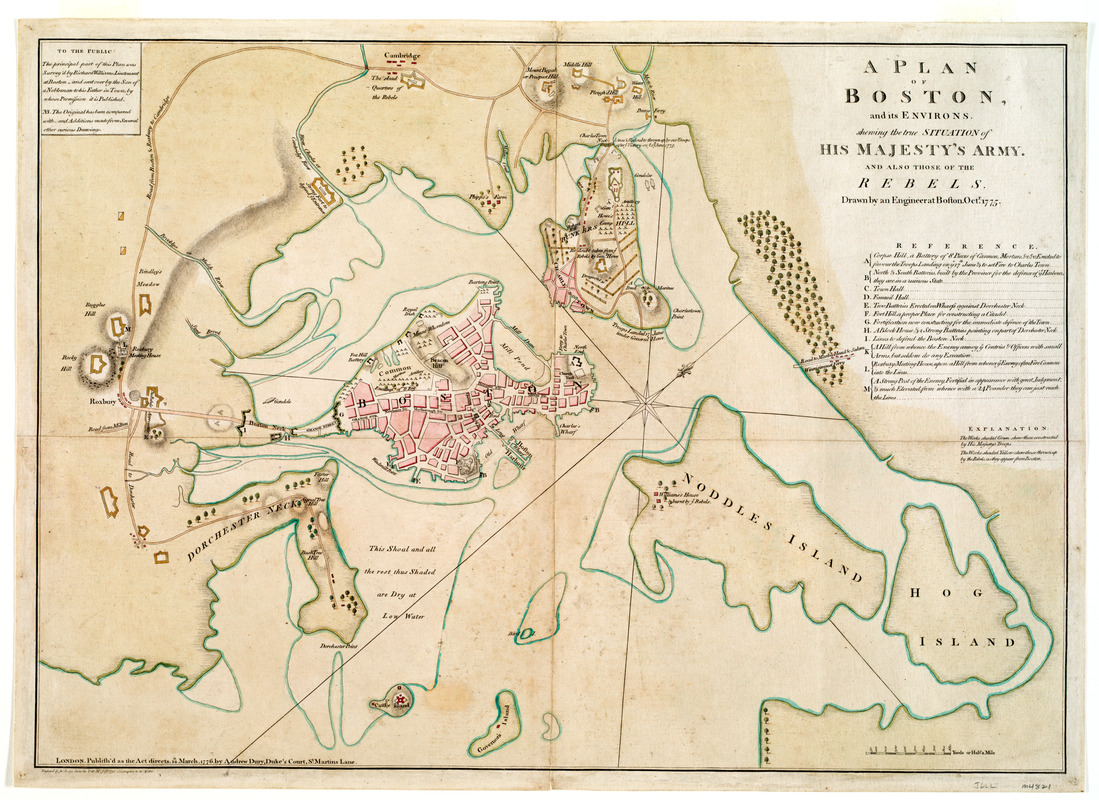
We have some good Lines, excellent Cannon at Fort Hill; this is all our Defence at present, except the Works thrown up at Dorchester Point which are said to be good—We are now going to erect Works at the Castle, & hope to have a Line of Guns well defended, on the Eastern Point; & are preparing to sink Hulks, between the Rocks of Castle Island, & the lower middle Ground.

The Enemy employ’d no little Time in ruining all the old Works there, and destroying the Guns…
Cooper still wanted someone besides Gen. Artemas Ward to supervise the defense of Boston, but his description of the town’s defenses was a little advanced from the previous week.

A 22 April letter from Boston quoted in the Connecticut Gazette of New London also said: “Tomorrow they talk of sinking Hulks by the Castle.” Those hulks were the keels of old ships, meant to impede Royal Navy warships from sailing easily into the inner harbor.

Of course, those same obstacles would also be a problem for merchant vessels, or American warships. On 30 April James Warren told John Adams: “No hulks as yet sunk; the people of Boston seem much against it; and whether it will be done or not I can’t say.” After all, Warren was merely the speaker of the Massachusetts house.

On 9 May that legislature directed its harbor defense committee “without delay to sink the Hulks.” But on 23 May the Boston town meeting voted (unanimously, it was later said) against that measure. The General Court on 5 June suspended the operation, though empowering the committee to proceed “upon any sudden Alarm or appearance of danger.”

Soon enough, fear of British warships invading Boston waned. No hulks were sunk in the harbor.

Sunday, May 17, 2026

“There is something off about this sword”

Earlier this year the Sandwich Enterprise shared a story by Cearra O’Hern about the identification of an artifact at the Pilgrim Hall Museum.

The article focuses on Michael L. Welch, Jr., who uses first-person interpretation of Revolutionary figures in teaching history at the Sandwich Middle School.

The article explains:
Welch primarily portrays Major General James Warren, a leading revolutionary in Massachusetts who also served as president of the Massachusetts Provincial Congress during the American Revolution. Welch heard that the Pilgrim Hall Museum in Plymouth had Warren’s sword

“I connected with the curator, who was very helpful in lining up a time to go in and look at the sword,” Welch said. “I was given the attribution of the sword, how the sword was passed down through the Warren family and donated. I photographed it extensively, I scanned it, I made a 3D rendering of it, and the whole time I am looking at this sword, I am like, ‘There is something off about this sword.’”

Welch had seen a sword like Warren’s before, which was believed to date back to 1764-1765. As he continued to examine its pommel, guard and counter-guard, Welch determined the sword was not a general’s sword; it was a mass-produced sword made much later, after the American Revolution.

Welch identified the sword as a Model 1796 Hanger carried by British sergeants, a discovery that “broke his heart,” as he did not want to say anything to the Pilgrim Hall Museum.
The photo above, which the museum shared on social media a few weeks before this article appeared, may show one of those awkward moments when Welch looked at the sword and wondered about sharing doubts with curator Anne Mason.

After confirming his assessment with an expert, Welch did indeed discuss those findings with Mason and her colleagues. The museum will add that information to its files and assess how it displays the hanger. As Welch points out in the article, the fact that this sword was made in 1796 doesn’t mean it wasn’t owned by James Warren; his son James, Jr. (1757–1821), a Continental Marine officer who lost a limb in 1781; or another member of the family. It just doesn’t go back as far as the Revolution.

Monday, April 20, 2026

“Such Cost and Charge as hath arisen by their being brought before the General Court”

On 13 Apr 1776, the Massachusetts General Court decided that “Caleb Wheaton and others [well, other men], who were taken aboard the brig,” should be brought to its meeting-place in Watertown ”for Examination.”

Four days later, as quoted yesterday, the Marblehead committee of correspondence wrote to say they now thought two of Wheaton’s sons—Joseph and Caleb, Jr.—had stolen a local man’s boat about six weeks before. That apparently focused the legislators’ attention on the family.

On 19 April the Council and the House named members to a joint committee to question the Wheatons.

Four days later, those members determined that Caleb Wheaton, Sr., had been “an Associator”—a member of the Loyalist militia—inside besieged Boston. Furthermore, he had been “in other Instances unfriendly to American Liberty,” perhaps a reference to his work as a Customs officer in Maine, or his statements supporting Parliament back in early 1775.

But the two legislative houses disagreed about what to do with the Wheatons. The published record of the Massachusetts House, readable here, says simply that the Council approved the first recommendation from the committee and the assembly didn’t concur.

Peter Force’s American Archives, evidently based on more complete manuscript records from the Council, revealed more details. The committee recommended
that the said Caleb Wheaton give bond to the Treasurer of this Colony for the sum of three hundred Pounds, with sufficient surety for his future good behaviour, or be confined in some Jail within this Colony until he shall find such surety; or if the said Wheaton shall think proper, and shall procure his passage for himself and family to Nova-Scotia, he may have liberty to remove there on his own expense, provided he will give his promise in writing, not to bear arms against the United Colonies.

And that the said Caleb Wheaton, Jun., and Joseph Wheaton, upon their giving their written paroles not to bear arms against the United Colonies, nor any way to aid or assist the enemies of said Colonies, and they paying the expense of being brought before this Court, may be discharged.
After the lower house said that wasn’t good enough, two more legislators were added to the joint committee, and they went back to rethink their recommendation.

The next day the Council approved a revised proposal:
  • All three Wheatons would be responsible for a £500 bond.
  • They not only had to promise not to fight the colonies, but also “not correspond with any of the Enemies of America.”
  • They had to “pay such Cost and Charge as hath arisen by their being brought before the General Court.” 
  • If any of those conditions weren’t met, they would be “committed to close confinement.”
There was no more mention of letting the Wheaton family resume their trip to Nova Scotia.

On 25 April the House considered those strictures and agreed. (Its journal says “close Imprisonment” instead of “close confinement,” if that matters.)

The committee report on that measure, signed off by Caleb Cushing of Salisbury for the Council, Perez Morton as Council secretary, and James Warren as speaker of the house, went up for auction last year.

Caleb Wheaton came back on 4 May with a petition to the House
setting forth that he has been apprehended as inimical to his Country, that he is released by giving Bonds, and is now in low Circumstance; and praying therefore that he may be enabled to recover his Household Furniture, Provisions, &c. on board the Brig Elizabeth, at Portsmouth; whereby he may support himself and Family.
The assembly gave Wheaton “Leave to withdraw his Petition.” In other words, it said no.

The Massachusetts legislature, especially the lower house, was in no mood to do any favors to Loyalists. In fact, the Wheatons even had to pay the costs of being transported to the General Court. And it appears Caleb, Sr., later told the British government that he was locked up for three months. The Wheatons’ case reflects a popular mood in the spring of 1776 that affected other Loyalists as well.

TOMORROW: William Jackson returns to Boston.

Thursday, November 13, 2025

The Vanishing of Mary Wenwood?

As recounted earlier, Gen. George Washington had Mary Wenwood brought his headquarters to answer questions about a ciphered letter she had given to her former husband to pass on.

The woman held out against the general’s questioning for hours. But still under guard the morning after she arrived, she gave up the name of the cipherer: her lover, Dr. Benjamin Church.

After that, Mary Wenwood fades from the historical record. She had every reason to adopt a low profile. Gen. Washington kept her name out of his official report and paperwork. No surviving informal comment on the episode mentions her name. 

But men had a lot to say about her character. Indeed, just as she vanished as a person, she started to appear as a character in a moral fable—the downfall of a doctor.

James Warren, speaker of the Massachusetts house, called her “a suttle, shrewd Jade” and “an Infamous Hussey.” The Rev. Ezra Stiles of Newport said she was “a Girl of Pleasure,” and had carried the ciphered letter “in her stocking on her Leg.” How did he know?

Lt. Ebenezer Huntington of Norwich, Connecticut, told his brother: “the Plot was discoverd by his [Church’s] Miss who is now with Child by him and he owns himself the father (for he has Dismissed his Wife).” Huntington was stationed in Roxbury, far from Washington’s headquarters, and had no link to people in the case. No one closer to the investigation said the woman was pregnant. Some other details in Huntington’s account are wrong. Therefore, unless other evidence turns up, I think this was probably baseless gossip.

Here are further facts possibly about Mary Wenwood.

The 14 December 1775 New-England Chronicle reported that the Cambridge post office was holding mail for a woman named Mary Butler—which was Mary Wenwood’s maiden name.

Mary was the most common given name for women, and Butler a fairly common surname. Wainwood/Wenwood/Wanewood was much less common. Indeed, all mentions of “Wenwood” and its variants in late-1700s New England newspapers lead back to Godfrey Wenwood, Mary’s former husband.

That said, Newport vital records show that another Mary Wenwood, wife of Frederick Wenwood, gave birth to a baby girl named Mary in December 1785, and that couple baptized a baby girl named Mary (perhaps a new one) in June 1787. Even an uncommon name isn’t necessarily unique.

The most tantalizing clues are that a Mary Wainwood/Wanewood was in and out of the Boston almshouse after the war:
  • Admitted 6 May 1785, left 30 May 1786.
  • Admitted 29 Feb 1792.
  • Admitted 12 Jan 1793.
  • Admitted 25 Apr 1797, died 23 May 1797.
And that last entry stated that the woman was from Rhode Island.

Saturday, November 08, 2025

“A proper Method for bringing Dr. Church before the House”

As described yesterday, on 17 Oct 1775 the Massachusetts General Court decided to summon Dr. Benjamin Church to Watertown to explain why he’d sent a ciphered letter into British-occupied Boston.

Dr. Church’s first response to that action arrived on 23 October, as reported by James Warren: “The Speaker communicated to the House a Letter received from Dr. Church, wherein he expresses a Desire to resign his Seat in the House of Representatives.”

The previous month, Church had also tried to resign as Surgeon-General of the Continental Army, following a month of turf disputes with regimental surgeons. Gen. George Washington and his aides had urged him to stay, only to be blindsided by that ciphered letter. Those two resignations suggest that Church was realizing what a hole he’d dug for himself and just wanted to go away.

The legislators didn’t want to let Church go, though. Particularly Speaker Warren. He’d been immersed in this case since Washington had called him to Cambridge to share the first hints of the doctor’s dealings.

Back on 1 October, Warren had written to his friend John Adams:
Dr. C——h has been detected in a Correspondence with the Enemy at least so far that a Letter wrote by him in Curious Cypher . . .

We all thought the Suspicion quite sufficient to Justify an Arrest of him and his Papers, which was done, and he is now under a Guard. He owns the writeing and sending the Letter. Says it was for [John] Fleeming in Answer to one he wrote to him, and is Calculated, by Magnifying the Numbers of the Army, their regularity, their provisions and Ammunition &c, to do great Service to us. He declares his Conduct tho’ Indiscreet was not wicked.
Something had to be done. The legislature therefore voted on 23 October to let Church’s resignation letter “lay on the Table, till the Committee who are directed to consider a proper Method for bringing Dr. Church before the House shall report.”

As Warren and others understood by this time, the Continental Army rules and regulations didn’t allow a court-martial to sentence a spy to death. Gen. Washington was therefore holding off on formal proceedings. His most recent council had decided “to refer Doctor Church for Tryal & Punishment to the General Court of Massachusetts Bay.”

On 26 October the house committee came back with their recommendation. They started by stating that Church “has been convicted by the Judgment of a Council of War, at which his Excellency [Gen. Washington] presided, of having carried on a criminal Correspondence with the Enemy.”

In fact, Washington’s councils weren’t courts and had no power to convict anyone. But neither did the legislature have the power to try and punish Church as the last council suggested—all the General Court could do was expel the doctor. Each body was pushing for the other to take on the authority of judging Dr. Church. And everyone was still waiting for guidance from the Continental Congress.

The General Court voted:
…whereas the said Benjamin Church is also a Member of this House, and the Charge brought against him is of so criminal a Nature, that it is the Duty of the House to make strict Enquiry into the Fact, and upon Proof of the same to manifest their utter Abhorrence thereof:

Therefore, Resolved, That Mr. William Howe, the Messenger of this House, be and he hereby is directed on Friday the 27th of October Instant [i.e., this month], to apply to his Excellency George Washington, Esq; for a sufficient Guard, safely to conduct the said Benjamin Church to and from the Barr of this House, and being furnished therewith, to take the Body of the said Church and bring him to the Barr of the House accordingly, at Ten o’Clock in the Forenoon of the same Day.
On that Friday morning, there was a motion “That there be fixed in the Alley [i.e., aisle] a Bar, at which Dr. Church will be brought.” The stage was set.

I’ll speak about what happened next in Watertown on Sunday afternoon, as detailed here.

TOMORROW: Records of the case.

Friday, November 07, 2025

“The House being jealous of their Priviledges”

As recounted yesterday, on 4 Oct 1775 Gen. George Washington and his fellow generals realized that the Continental Congress’s articles of war weren’t strict enough about passing information to the enemy.

Which was a problem since they had just uncovered evidence that the head of the army’s hospitals, Dr. Benjamin Church, had been doing just that.

In reporting the situation to John Hancock as chairman of the Congress, Washington respectfully wrote that he was “suggesting to their Consideration, whether an Alteration of the 28th Article of War may not be necessary.”

Dr. Church didn’t just have a military appointment. He was also one of Boston’s four representatives in the Massachusetts General Court, elected back on 18 July. Of course, that town meeting hadn’t happened inside British-held Boston. Instead, the “dispersed” inhabitants had gathered in the meetinghouse at Concord.

Dr. Church was active in the first few days of the legislative session in Watertown’s meetinghouse. But in August he took up his new job overseeing the medical care of the army. Two of the other men chosen to represent Boston, Samuel Adams and John Hancock, were away in Philadelphia. That left John Pitts to speak for the town. But that assembly couldn’t do much to affect life in Boston then anyway.

Then in early October came the bombshell news that the army had put Church under arrest. People were soon hearing about why, but this was the house’s first formal response on 14 October:
ORDERED, That Mr. [James] Sullivan bring in a Resolve making a proper Application to General Washington, relative to the imprisonment of one of the members of this House, viz. Doctor Benjamin Church.
The resulting resolution said:
…the House being jealous of their Priviledges, and desirous to know the Cause of said Imprisonment:—— Therefore

Resolved, That the Speaker [James Warren], Mr. Sullivan and Major [John] Bliss, be a Committee to apply to is Excellency George Washington, Esq; requesting him as soon as may be to certify to this House the Cause of the Detention and Imprisonment of said Benjamin Church, Esq; that they may advise thereon.
On 17 October, Warren reported that he had received from Joseph Reed, Washington’s military secretary, “a Letter from Dr. Church to the Enemy, as decyphered by the Rev. Mr. [Samuel] West.” The house voted:
Resolved, That Dr. Church ought to be brought to the Bar of this House, to shew Cause, if any he has, why he should not be expell’d the same.
The next day, Gen. Washington sat down for a council with Benjamin Franklin, Benjamin Harrison, and Thomas Lynch from the Continental Congress and with officials from the New England governments. That meeting would run through 24 October and cover many topics. One item on the agenda was “What Steps are necessary to be pursued with Regard to Dr Church?”

The developments in Watertown offered an out: “Upon a Discussion of all Circumstances it was agreed to refer Doctor Church for Tryal & Punishment to the General Court of Massachusetts Bay.” As for what the army should do, given the articles of war, Washington would wait for the Congress’s guidance.

TOMORROW: Dr. Church makes his move.

Tuesday, July 08, 2025

Rhode Island’s “vote for raising men”

As soon as he heard about the shooting at Lexington, James Warren, delegate from Plymouth to the Massachusetts Provincial Congress, passed the news on to Patriots in Rhode Island.

On 20 April the elite militia company called the Kentish Guards mustered and marched toward Massachusetts.

Before those men reached the border, a message arrived from Gov. Joseph Wanton (shown here), ordering the unit to stand down.

Four members continued on horseback, three of them being Nathanael Greene and his brothers. But once those men heard that the British troops were back inside Boston and the emergency had passed, they went home to Rhode Island to sort things out.

The colony’s first step came quickly. On 22 April the assembly passed an act to raise 1,500 men
properly armed and disciplined, to continue in this colony, as an army of observation, to repel any insult or violence that may be offered to the inhabitants. And also, if it be necessary for the safety and preservation of any of the colonies, to march out of this colony and join and co-operate with the forces of the neighboring colonies.
The Massachusetts Provincial Congress had also used the phrase “army of observation” in early April, implying a purely defensive force. Once the fighting began, however, it dropped that phrase entirely. Even as the Rhode Island assembly called its new troops an “army of observation,” it was clearly opening the door to sending those men off to help Massachusetts in its war.

Top officials in the colony resisted. Though Gov. Wanton had been crucial to stymieing the Crown’s Gaspee inquiry a couple of years before, he filed a protest against the legislature’s vote. Deputy Governor Darius Sessions joined him along with two members of the Council of Assistants (the upper house), Thomas Wickes and William Potter. On 25 April they declared their opposition to the new army
Because we are of opinion that such a measure will be attended with the most fatal consequences to our charter privileges, involve the Colony in all the horrors of a civil war, and, as we conceive, is an open violation of the oath of allegiance, which we have severally taken upon our admission into the respective offices we now hold in the Colony.
Coincidentally, Rhode Island’s charter called for a new legislative session to start on the first Wednesday of each May. In that spring’s annual election, Sessions, Wickes, and Potter all lost their seats. (Potter would recant and apologize in June, and then return to the Council of Assistants.) Nicholas Cooke became the new deputy governor.

Rhode Island’s freemen reelected Joseph Wanton as governor, but on 2 May he sent a letter to the assembly saying, “indisposition prevents me from meeting you.” Instead he enclosed what Lord Dartmouth, the British Secretary of State, considered a conciliatory offer. Wanton thought that was a more promising route to resolving the crisis. He told the legislators:
The prosperity and happiness of this colony, is founded in its connexion with Great Britain; “for if once we are separated, where shall we find another Britain to supply our loss? Torn from the body to which we are united by religion, liberty, laws and commerce, we must bleed at every vein.”
That passage quoted from John Dickinson’s Letters from a Farmer in Pennsylvania. (Some authors miss the quote marks and attribute those words to Wanton himself.)

On 5 May the legislative speaker, Metcalf Bowler, tried to force the governor’s hand. He sent a blank commission for an officer in the new army and asked Wanton whether he would sign such a form. The governor replied:
I cannot comply with it; having heretofore protested against the vote for raising men, as a measure inconsistent with my duty to the King, and repugnant to the true and real interest of this government.
At that point the assembly bypassed Gov. Wanton and started treating Nicholas Cooke as the colony’s chief executive. Wanton wouldn’t be officially replaced until November, but he could no longer stand in the way of Rhode Island’s army.

TOMORROW: Finding a general.

Saturday, May 03, 2025

“Eads escaped out of town last night”

I got interested this week in how printers exited Boston around the start of the war because of a question from a Boston 1775 reader about Benjamin Edes.

The standard understanding of Edes’s departure goes back to the 1901 biography of his son, Peter Edes, Pioneer Printer in Maine. Samuel Lane Boardman wrote:
In the spring of 1775, the town of Boston being in possession of the British troops, Mr. Edes contrived to evade the vigilance of their guards and went to Watertown with an old press and one or two imperfect fonts of type. The escape was made by night in a boat up the Charles river.
We know Edes reestablished the Boston Gazette in Watertown on 5 June 1775, and the shortest distance between Boston and Watertown is indeed up the Charles River.

But Edes’s journey was more complicated than that. Let’s start with a letter from Peter Edes that Boardman reprinted later in his biography, the same letter that I quoted a couple of days ago in regard to the Tea Party.

Writing to a grandson in 1836, Peter Edes said his father:
made his escape by disguising himself as a fisherman, and getting on board a fishing boat; and when they were a few miles from town he was landed on one of the islands, from which he made his escape to the main land.
To escape from Boston on a fishing vessel and to land on an island meant heading out into the harbor or beyond, not up the Charles River.

That detail matches a couple of contemporary reports from south of Boston, both sent to John Adams.

First, on 7 May Abigail Adams told her husband:
Poor Eads escaped out of town last night with one Ayers in a small boat, and was fired upon, but got safe and came up to Braintree to day. His name it seems was upon the black list.
On the same day James Warren wrote to his friend:
By the way I have Just heard that Edes has stole out. I wish his partner was with him. I called on Mrs. Adams as I came along. Found her and Family well.
Thus, Benjamin Edes left Boston in disguise on the night of 6 May. He may have brought out printing equipment, though these early sources don’t say that. I’d love to identify “Ayers,” but I’m not even certain of that spelling.

Edes must have landed somewhere off the south shore, given how Patriots in Braintree heard about his arrival within a day. Did Warren tell Adams, or did Adams tell Warren?

Then Edes made his way back toward the siege lines, settling in Watertown to be close to the Massachusetts Provincial Congress, its news, and its printing jobs.

Edes’s partner, John Gill, didn’t get out of Boston. Instead, in the wake of the Battle of Bunker Hill he and the teen-aged Peter Edes were arrested and held in the Boston jail for several weeks.

COMING UP: Under one roof.

Thursday, April 24, 2025

Esther Sewall and “the female Connections”

In the fall of 1774 and winter of 1775, Massachusetts attorney general Jonathan Sewall appears to have worked as an advisor to the royal governor, Thomas Gage.

With the courts closed by crowds and Gage’s authority confined to Boston, there wasn’t much else for Sewall to do.

There’s a renewed debate about whether Sewall wrote the “Massachusettensis” essays published in those months. Patriots of the time believed he did, but his former law trainee Ward Chipman described copying them out for another Loyalist lawyer, Daniel Leonard. In 2018 a team led by Colin Nicolson reported in the New England Quarterly that their linguistic analysis pointed the finger back at Sewall.

In early April 1775, a dispatch from Lord Dartmouth brought instructions to arrest the leaders of the Massachusetts Provincial Congress. Gen. Gage might well have discussed the legalities of such arrests with his attorney general.

The president of that congress was John Hancock. His fiancée, Dorothy Quincy, was the sister of Esther Sewall, the attorney general’s wife. On 7 April, James Warren wrote to his own wife:
The Inhabitants of Boston are on the move. H[ancock] and A[dams] go no more into that Garrison, the female Connections of the first come out early this morning and measures are taken relative to those of the last.
Dorothy Quincy was soon staying with Hancock and Samuel Adams at the parsonage in Lexington.

As discussed yesterday, though Esther Sewall was married to a leading Massachusetts Loyalist, she was still emotionally attached to her family, friends, and neighbors on the Patriot side. She might have heard her husband talk of Hancock and Adams being arrested. Any military operation to do that could put her sister in danger.

Esther Sewall therefore had a motive and possible means to be the “daughter of liberty, unequally yoked in point of politics,” who sent a warning that British soldiers might arrest Hancock and Adams, as the Rev. William Gordon later wrote. When I first discussed that question, I didn’t see how Esther would have had access to inside information. Jonathan’s work with Gov. Gage offers a possible answer. (And, we must remember, this “daughter of liberty” did not have information on Concord as Gage’s real target.)

A few months into the siege of Boston, Jonathan and Esther Sewall sailed for London. They remained yoked together for the rest of his life. But neither of them was happy. For most of those years Jonathan was seriously depressed, often confined to his bedroom. Esther was terribly homesick. Jonathan blamed Esther for his difficulties. Yet she stayed with him.

Esther Sewall made two trips back to Massachusetts, first in 1789 and then in 1797, the year after she became a widow. Her grown sons Jonathan and Stephen became important lawyers in Canada, and she settled in Montreal.

In 1809, Esther sued in Massachusetts court for her dower property, confiscated thirty years before as part of Jonathan’s assets. Though she didn’t live to hear about it, the state’s highest judges decided in her favor. Then the Massachusetts General Court passed a special law to compensate the man who’d bought that property for what he had to pay her estate. So the Massachusetts government ended up paying Esther Sewall money.

Friday, April 18, 2025

Counterfactual 3: If Prescott Hadn’t Alerted Concord

Continuing my speculation about what might have happened if Paul Revere and William Dawes hadn’t alerted Lexington about the regulars coming out, I’m now going to look at Concord.

This post was prompted by the suggestion in Kostya Kennedy’s book The Ride that if Revere hadn’t ridden out on 18 April “the munitions at Concord could have been seized.”

That’s mistaken because militia colonel James Barrett, his helpers, and his family had started moving the most valuable military supplies out of town days before the British army march. In part because Revere had brought a warning from Boston on an earlier ride. 

On 6 April, James Warren was in Concord for a meeting of the Massachusetts Provincial Congress, and he wrote to his wife Mercy: “This Town is full of Cannon, ammunition, stores, etc., and the Army long for them and they want nothing but strength to Induce an attempt on them.”

But when the redcoats arrived, Ens. Henry DeBerniere said, they “did not find so much as we expected.” Specifically, he reported:
Capt. [Mundy] Pole of 10th regiment…knock’d the trunnions off three iron 24 pound cannon and burnt their carriages; they also destroyed a quantity of flour, and some barrels of trenchers and spoons of wood for their camp.
At Barrett’s farm the soldiers burned some more carriage wheels. But the town was obviously no longer “full” of military stores. And that change had taken days, not a few hours.

If the British expedition hadn’t paused in Lexington but marched straight through, as I posited yesterday, the vanguard would probably have arrived in Concord less than half an hour earlier. Some of the local militia might have been on alert, but without Dr. Samuel Prescott’s warning, it probably wouldn’t have been at full force.

But would that have mattered at first? When the regulars approached the town, the Concord militia marched away and took a position on a hill west of the North Bridge. Other men and then other town companies joined them there while the redcoats searched both the town and Barrett’s farm.

Without the earlier alerts from Revere riding west from Medford to Lincoln and the Prescott brothers riding out of Concord, those militia companies from other towns wouldn’t have joined the Concord companies as quickly as they did. It’s thus possible there would have been significantly fewer men on that hill when smoke began to rise from the center of town, where redcoats were burning carriage wheels (and, briefly, the town house).

The Concord men might have been just as upset by the sight of that smoke, but might not have felt their numbers were strong enough to do anything about it. And eventually the smoke would have dissipated as people in town succeeded in dousing the fire. So the provincials might never have made their fatal march down to the bridge, with the Acton company in the lead.

TOMORROW: The battle that never was.

Wednesday, June 26, 2024

“Keep the committee in play, and I will go and make a caucus”

In addition to Robert Treat Paine’s recollection quoted here, the Rev. William Gordon’s early history of the American Revolution offers another peek at the delicate political maneuverings in Salem in June 1774.

Gordon wrote:
Mr. Samuel Adams observed, that some of the committee were for mild measures, which he judged no way suited to the present emergency. He conferred with Mr. [James] Warren of Plymouth upon the necessity of giving into spirited measures, and then said, “Do you keep the committee in play, and I will go and make a caucus against the evening; and do you meet me.”

Mr. Samuel Adams secured a meeting of about five principal members of the house, at the time specified; and repeated his endeavours against the next night; and so as to the third, when they were more than thirty; the friends of administration knew nothing of the matter. The popular leaders took the sense of the members in a private way, and found that they should be able to carry their scheme by a sufficient majority.
Adams and his team came up with a two-step plan.

First, the Massachusetts House would appoint delegates to a Continental Congress, an idea raised by the Providence town meeting, the Virginia House of Burgesses, and other political allies outside of the colony. The House would also alert all its counterparts of that step and urge them to participate as well.

But then there was the age-old question of how to pay for this. Sending five gentlemen to Philadelphia would cost upwards of £500. Any legislative action involving money, even if it passed the Council, could be vetoed by Gov. Thomas Gage.

The solution was to write a bill authorizing that expenditure of £500 and then adding this clause:
Wherefore this House would recommend, and they do accordingly hereby recommend to the several Towns and Districts within this Province, that each Town and District, raise, collect and pay, to the Honorable THOMAS CUSHING, Esq; of Boston, the Sum of FIVE HUNDRED POUNDS by the Fifteenth Day of August next, agreeable to a List herewith exhibited, being each Town and District’s proportion of said Sum, according to the last Province Tax, to enable them to discharge the important Trust to which they are appointed; they upon their Return to be accountable for the same.
Adams’s unofficial caucus managed to formulate that plan without official committee member Daniel Leonard or other Loyalists catching on.

The next problem was how to pass those resolutions through the House. As Paine wrote:
it was Considered that the regular Method was for the Committee on the State of the Province to make report of these doings as their Report; eight of that Committee were then present, but the ninth [Leonard] was known to be adverse to any Such measure & therefore could not be trusted, least the whole should be defeated by the Governor;…
If Gov. Gage learned about the measures that the House was discussing, he could use his constitutional authority to shut down the legislature entirely.

TOMORROW: The Bristol feint.

Tuesday, April 16, 2024

“The Inhabitants of Boston are on the move”

Among the items in the London newspapers that arrived in Marblehead in the first week of April 1775 was this:
Yesterday a messenger was sent to Falmouth, with dispatches for General [Thomas] Gage at Boston, to be forwarded by a packet boat detained there for that purpose.
It didn’t take long for the Massachusetts Patriots to figure out that if this report had gone into the newspapers, and those newspapers had traveled to New England, then those dispatches could have made it to New England, too. And in that case, the royal governor might already be preparing to act on them.

Decades later, Mercy Warren wrote of the royal authorities in Massachusetts: “from their deportment, there was the highest reason to expect they would extend their researches, and endeavour to seize and secure, as they termed them, the factious leaders of rebellion.”

I can’t actually find those italicized words in the writings of royal officials, and “deportment” is a lousy basis for such a conclusion. But the Patriots may have had a more solid basis for expecting arrests, possibly from sympathetic people in Britain.

On behalf of the imperial government, the Earl of Dartmouth had written to Gage: “the first & essential step to be taken towards re-establishing Government, would be to arrest and imprison the principal actors & abettors in the Provincial Congress.” That letter didn’t arrive in Massachusetts until 14 April, but it looks like Patriots anticipated it after those Marblehead arrivals.

Most of the rest of the letter from James Warren to his wife Mercy that I’ve been discussing is about that worry—that Gage’s government would start arresting resistance leaders. On 6 April, James wrote from Concord:
The Inhabitants of Boston begin to move. The Selectmen and Committee of Correspondence are to be with us, I mean our Committee, this day. The Snow Storm yesterday and Business prevented them then. From this Conference some vigorous resolutions may grow. . . .

I am with regards to all Friends and the greatest Expressions of Love and regard to you, your very affect. Husband, JAS. WARREN

Love to my Boys. I feel disposed to add to this long letter but neither time nor place will permit it.
Then on 7 April James went back to his letter with more information and a warning:
I am up this morning to add. Mr. [Isaac] Lothrop [another Plymouth delegate] is the bearer of this and can give you an Acct. of us.

The Inhabitants of Boston are on the move. [John] H[ancock] and [Samuel] A[dams] go no more into that Garrison, the female Connections of the first [Lydia Hancock and Dorothy Quincy] come out early this morning and measures are taken relative to those of the last [Elizabeth Adams, who didn’t make it out before the siege]. The moving of the Inhabitants of Boston if effected will be one grand Move. I hope one thing will follow another till America shall appear Grand to all the world.

I begin to think of the Trunks which may be ready against I come home, we perhaps may be forced to move: if we are let us strive to submit to the dispensations of Providence with Christian resignation and phylosophick Dignity.

God has given you great abilities; you have improved them in great Acquirements. You are possessd of eminent Virtues and distinguished Piety. For all these I esteem I love you in a degree that I can't express. They are all now to be called into action for the good of Mankind, for the good of your friends, for the promotion of Virtue and Patriotism. Don’t let the fluttering of your Heart interrupt your Health or disturb your repose. Believe me I am continually Anxious about you. Ride when the weather is good and don’t work or read too much at other times. I must bid you adieu. God Almighty bless you. No letter yet. What can it mean? Is she not well? She can't forget me or have any Objections to writing.
James Warren appears to have gone home to Plymouth a few days later and then immediately gone on to Rhode Island to try to convince that elected government to help prepare a New England army. He was in that colony when word came of shooting at Lexington.

Monday, April 15, 2024

“Concord, where a provincial magazine was kept”

Now we come to the part of James Warren’s 6 Apr 1775 letter to his wife Mercy that I like to quote in talks.

James was in Concord for the Massachusetts Provincial Congress, and he wrote frankly about military preparations:
All things wear a warlike appearance here. This Town is full of Cannon, ammunition, stores, etc., and the Army long for them and they want nothing but strength to Induce an attempt on them. The people are ready and determine to defend this Country Inch by Inch.
Earlier in the letter James alluded to news from London that the imperial government would insist on making Massachusetts obey Parliament’s laws. He told Mercy: “you well know my Sentiments of the Force of both Countrys.” That appears to refer to the strength of Britain and Massachusetts—or perhaps New England or even America. Whatever his “country” was, James expressed confidence that his side would be strong enough to prevail.

All that adds up to a very different picture from how later American historians liked to portray the Patriot cause: as poorly equipped and unprepared for war. For example, in publishing the records of the provincial congress, which are full of references to artillery and other weapons, William Lincoln wrote: “It is not improbable, that in the confusion occasioned by the sudden march of the British troops to Concord, the documents exhibiting the weakness of the province in martial stores, as well as the strength of its patriotism, were destroyed.” The provincials had to be the underdogs in the fight.

I’m not saying James Warren’s confidence was more realistic than those later assessments. He and his colleagues did overestimate their military preparations—how ready for use those cannon were, how much gunpowder was on hand, and so on. But knowing that Warren saw lots of weaponry around him and felt his faction’s force was the stronger helps us to understand his political decisions.

James’s remark about Concord being full of cannon also connects to a passage that Mercy Warren wrote decades later in his history of the Revolution:
When the gentlemen left congress for the purpose of combining and organizing an army in the eastern states, a short adjournment was made. Before they separated they selected a standing committee to reside at Concord, where a provincial magazine was kept, and vested them with power to summon congress to meet again at a moment’s warning, if any extraordinary emergence should arise.
The records of the provincial congress and its committee of safety (the same ones published by William Lincoln) do mention “the gentlemen [who] left congress for the purpose of combining and organizing an army in the eastern states.” The Massachusetts Patriots designated envoys to Connecticut, New Hampshire, and Rhode Island—the last group including James Warren.

But those records don’t mention this “standing committee to reside at Concord.” I’d like to know who they were, what they did when the British column arrived. I’m keeping my eyes open for signs.

TOMORROW: Run away!

Sunday, April 14, 2024

“We shall have many chearful rides together yet”

As I quoted yesterday, in his 6 Apr 1775 letter to his wife Mercy, James Warren started by telling her that the latest news from London made a political solution to Massachusetts’s conflict with the Crown less likely.

And that had kept the Massachusetts Provincial Congress in Concord from adjourning as he’d hoped.

Warren went on:
However my Spirits are by no means depressd, you well know my Sentiments of the Force of both Countrys, you know my opinion of the Justness of our Cause, you know my Confidence in a Righteous Providence. I seem to want nothing to keep up my Spirits and to Inspire me with a proper resolution to Act my part well in this difficult time but seeing you in Spirits, and knowing that they flow from the heart.

How shall I support myself if you suffer these Misfortunes to prey on your tender frame and Add to my difficulties an affliction too great to bear of itself. The Vertuous should be happy under all Circumstances. This state of things will last but a little while. I believe we shall have many chearful rides together yet.

We proposed last week a short adjournment and I had in a manner Engaged a Chamber here for my Beloved and pleased myself with the health and pleasure the Journey was to give her; but I believe it must be postponed till some Event takes place and changes the face of things.
There was deep affection between the Warrens, just as there was between their friends, John and Abigail Adams. At this time James was forty-eight years old, Mercy forty-six. They had five children, all boys; the youngest was George, who turned nine that year. Looks like James thought that was old enough for Mercy to come to Concord for some private time with him while the congress wasn’t in session.

At the end of his 6 April letter, James returned to that personal message for Mercy:
But to dismiss publick matters, let me ask how you do and how do my little Boys, especially my little Henry [second youngest, born in 1764], who was Complaining. I long to see you. I long to sit with you under our Vines etc and have none to make us afraid. Do you know that I have not heard from you since I left you, and that is a long while. It seems a month at least. I can't believe it less. I intend to fly Home I mean as soon as Prudence Duty and Honour will permitt.
The line about “Vines” was another Biblical allusion (Micah 4:4; also 1 Kings 4:25; Zechariah 3:10). The Warrens knew that phrase well enough that James could cut it off with an “etc.”

That verse was also a favorite of George Washington, another gentleman planter. And through him it got into the lyrics of Hamilton.

TOMORROW: Concord’s cannon.

Saturday, April 13, 2024

James Warren: “News we have”

On 6 Apr 1775, James Warren was in Concord, representing Plymouth in the Massachusetts Provincial Congress.

He started writing home to his wife, Mercy, that day. That letter contains a passage I’ve quoted many times in my Road to Concord talks, but there’s a lot more going on, too.

So over the next few days I’ll analyze of Warren’s whole letter.
My Dear Mercy,—

Four days ago I had full Confidence that I should have had the pleasure of being with you this day, we were then near closeing the Session. Last Saturday we came near to an Adjournment, were almost equally divided on that question, the principle argument that seemd to preponderate, and turn in favour of sitting into this week was the prospect of News and News we have.

Last week things wore rather a favourable aspect, but alas how uncertain are our prospects. Sunday Evening brought us accounts of a Vessel at Marblehead from Falmouth, and the English Papers etc by her. I have no need to recite perticulars. you will have the whole in the Papers, and wont wonder at my forgoeing the pleasure of being with you. I dare say you would not desire to see me till I could tell you that I had done all in my power to secure and defend us and our Country.

We are no longer at a loss what is Intended us by our dear Mother. We have Ask’d for Bread and she gives us a Stone, and a serpent for a Fish.
That last line is an allusion to Matthew 7:9–11.

The British news that Warren alluded was printed in the Essex Journal of Newburyport before spreading to other papers. “Capts. Barker and Andrews” had sailed from England on 17 February, bringing the latest.

The Essex Journal reprinted a long report on debate in Parliament on 5 April and an even longer one on 12 April. Those two articles don’t agree in all the details, but they’re clear on the basic developments.

For years the Massachusetts Whigs had hoped that their pleas, protests, and persistence would prompt a change in British government policy. Instead, the Lords refused to hear the latest petitions from America.

The Earl of Chatham, formerly William Pitt and still America’s favorite, moved that Parliament repeal the Coercive Acts and remove troops from Boston. Other peers argued for “compelling the Americans to the immediate obedience of the legislature of the mother country.” Ultimately the House of Lords rejected all of Chatham’s proposals by margins like 77 to 18.

Furthermore, on 9 February both houses of Parliament had signed off on an address to the king that declared in part:
…we find that a part of your majesty’s subjects in the province of Massachusetts Bay have proceeded so far to resist the authority of the supreme legislature; that a rebellion at this time actually exists within the said province. . . .

we consider it as our indispensible duty, humbly to beseech your majesty that you will take the most effectual measures to enforce due obedience to the laws and authority of the supreme legislature; and we assure your majesty that it is our fixed resolution, at the hazard of our lives and properties, to stand by your majesty against all rebellious attempts…
The king’s official response was to promise “the most speedy and effectual measure for enforcing due obedience to the laws, and the authority of the supreme legislature.”

And that was just the official record. The London newspapers also threw in comments like “Lord N—h is determined that the Americans shall wear chains.”

TOMORROW: Keeping up spirits, keeping up defenses.

Saturday, December 30, 2023

“Poor Boston will feel the whole weight of ministerial vengeance”

One facet of the Boston Tea Party that I’m thinking about this season is how many observers expected quick retaliation of some sort from the London government.

But those same Massachusetts men got busy convincing themselves that reaction would be no worse than they would have suffered anyway, given Lord North’s established policies.

A day and a half after the tea destruction, the merchant John Andrews wrote to his brother-in-law in Pennsylvania:

However precarious our situation may be, yet such is the present calm composure of the people that a stranger would hardly think that ten thousand pounds sterling of the East India Company’s tea was destroy’d the night, or rather evening before last, yet its a serious truth; and if your’s, together with ye. other Southern provinces, should rest satisfied with their quota being stor’d, poor Boston will feel the whole weight of ministerial vengeance.

However, its the opinion of most people that we stand an equal chance now, whether troops are sent in consequence of it or not; whereas, had it been stor’d, we should inevitably have had ’em, to enforce the sale of it.
On 17 December, John Adams worried in his diary:
What Measures will the Ministry take, in Consequence of this?—Will they resent it? will they dare to resent it? will they punish Us? How? By quartering Troops upon Us?—by annulling our Charter?—by laying on more duties? By restraining our Trade? By Sacrifice of Individuals, or how.
But in a letter to his friend James Warren (shown above), Adams was more dismissive of the dangers. First he quoted the Wellfleet merchant Elisha Doane: “The worst that can happen, I think, Says he in Consequence of it, will be that the Province must pay for it. . . . it will take them 10 Years to get the Province to pay for it. If so, we shall Save 10 Years Interest of the Money. Whereas if it is drank it must be paid for immediately.”

Then he tried to convince Warren and himself that the consequences of the tea destruction couldn’t be worse than paying the tea tax in the first place:
the final Ruin, of our Constitution of Government, and of all American Liberties, would be the certain Consequence of Suffering it to be landed. . . .

Threats, Phantoms, Bugbears, by the million, will be invented and propagated among the People upon this occasion. Individuals will be threatened with Suits and Prosecutions. Armies and Navies will be talked of—military Execution—Charters annull’d—Treason—Tryals in England and all that—But—these Terrors, are all but Imaginations. Yet if they should become Realities they had better be Suffered, than the great Principle, of Parliamentary Taxation given up.
In response, Warren agreed with Adams on 3 Jan 1774:
They have now Indeed passed the River and left no retreat and must therefore Abide the Consequences. What those will be seems to be the great matter of Speculation and as People are determined by Reason or by the frightful List of Scarecrows and Bugbears (mentioned in your last and which are Employed on this Occasion) their speculations will differ.
Adams and Warren both insisted that the real blame for the crisis lay with Gov. Thomas Hutchinson and the Customs Commissioners for being such sticklers about the law.

So did their friend Samuel Adams. Anticipating a crackdown, he wrote to Arthur Lee in London on 28 January:
The Destruction of the Tea is the pretence for the unprecedented Severity shown to the Town of Boston but the real Cause is the opposition to Tyranny for which the people of that Town have always made themselves remarkeable & for which I think this Country is much obligd to them. They are suffering the Vengeance of Administration in the Common Cause of America.
Adams offered that spin even before the details of the imperial government’s “unprecedented Severity” and “Vengeance” became clear.

A transatlantic crossing in this era took about six weeks. That meant it would be three months, or until mid-March, before Boston would hear about how people in London were responding to the tea destruction, and at least a couple of more weeks before they learned about Parliament’s official reaction.

Monday, September 04, 2023

“Strength, Spirit and Abilities so exhausted”

In the immediate aftermath of the Continental Congress’s vote for independence in early July 1776, almost all the Massachusetts delegation got sick.

As I wrote last month, on 15 July 1776 John Adams saw Elbridge Gerry off on a trip back to Massachusetts. Gerry was “worn out of of Health, by the Fatigues of this station,” Adams told his wife, Abigail.

To James Warren he wrote that Gerry “is obliged to take a Ride for his Health, as I shall be very soon or have none. God grant he may recover it for he is a Man of immense Worth.”

Eleven days later, Adams wrote to Warren more ominously:
My Health has lasted much longer, than I expected but at last it fails. The Increasing Heat of the Weather added to incessant application to Business, without any Intermissions of Exercise, has relaxed me, to such a degree that a few Weeks more would totally incapacitate me for any Thing. I must therefore return home.
And the next day:
I assure you the Necessity of your sending along fresh delegates, here, is not chimerical. [Robert Treat] Paine has been very ill for this whole Week and remains, in a bad Way. He has not been able to attend Congress, for several days, and if I was to judge by his Eye, his Skin, and his Cough, I should conclude he never would be fit to do duty there again, without a long Intermission, and a Course of Air, Exercise, Diet, and Medicine. In this I may be mistaken.

The Secretary [i.e., Massachusetts General Court clerk Samuel Adams], between you and me, is compleatly worn out. I wish he had gone home Six months ago, and rested himself. Then, he might have done it, without any Disadvantage. But in plain English he has been so long here, and his Strength, Spirit and Abilities so exhausted, that an hundred such delegates, here would not be worth a shilling.

My Case is worse. My Face is grown pale, my Eyes weak and inflamed, my Nerves tremulous, and my Mind weak as Water—fevourous Heats by Day and Sweats by Night are returned upon me, which is an infallible Symptom with me that it is Time to throw off all Care, for a Time, and take a little Rest. I have several Times with the Blessing of God, saved my Life in this Way, and am now determined to attempt it once more.

You must be very Speedy in appointing other Delegates, or you will not be represented here. Go home I will, if I leave the Massachusetts without a Member here.
I looked at Paine’s surviving correspondence from this month, and I don’t see him saying anything about being sick.

On 3 August, Gerry wrote back to both John and Samuel Adams from Massachusetts:
I have heard this Morning that Colo. Warren has received a Letter mentioning Mr. Pain’s Illness and your Intention to set off for N England in a fortnights’ Time; and that the Government would be unrepresented. I left Boston yesterday and the Letter had not then arrived, but Mr. [Benjamin] Edes mentions it as a Fact communicated to him by Colonel or rather Major General Warren and therefore I have no Doubt of it.

I should have been glad that You had tarryed untill my Return, as the Absence of so many at one Time will I fear be considered by the people as a discourageing Circumstance; but I shall at all Events Return in a Week or ten Days from hence notwithstanding It will be impossible in so short a Time to benefit much by the Journey, and to recover from a febrile State which the southern Climate has fixed upon me and within this Day or two I find increased.
On 12 August, Samuel Adams left Philadelphia. Gerry arrived back in that city by 6 September. Paine and John Adams never left.

Ironically, John Hancock, who was already becoming known for pleading ill health when he didn’t want to do something, was the one Massachusetts delegate who seems to have remained perfectly well in this period. And as chairman of the Congress, he had plenty of work to do.

Hancock did write to Thomas Cushing on 30 July: “I have Determin’d to move my Family to Boston the Beginning of September, and propose being there my self in all that month.” But that was probably because of his wife Dorothy’s health, not his own. She was pregnant with their first child.

The Massachusetts legislature didn’t send anybody new to the Continental Congress until 1777.

Monday, February 13, 2023

“We had not one half lb: of powder left that night”

Returning to Dr. Benjamin Church’s intelligence report dated 24 Sept 1775, he had a couple more things to say about the Continental Army’s gunpowder shortage.

Having addressed that topic at length at the start, Church returned to it with this remark:
If you will believe me Mr. Pidgeon the Commessary General then, now declairs that we had not one half lb: of powder left that night the bunker hill was taken and had you pursued, the Camp must have been broken up—this they Confess.
John Pigeon was a Boston merchant and insurance broker who had moved out to Newton several years before the war. (I wish I knew where he and his family, as Anglicans, went to church. There weren’t a lot of options in rural Massachusetts. Did he ride to Cambridge or into Boston?)

As a country gentleman, Pigeon pushed his new town toward supporting the Whig cause. He bought the local militia company two cannon. He served in the Massachusetts Provincial Congress, becoming clerk of the committee of safety in November 1774, commissary of stores in February 1775, and commissary of the provincial army as it officially formed on 19 May.

During the Battle of Bunker Hill, Pigeon was, as Church wrote, “the Commessary General then.” He submitted a resignation shortly afterward, only for the provincial congress to reject it on 20 June. Gen. Artemas Ward sent Pigeon a letter listing the army’s needs ten days later. Pigeon responded by requesting a larger staff. James Warren decided he was becoming “petulant.”

A few weeks later the Continental Congress took responsibility for the New England army and appointed Joseph Trumbull, son of Connecticut’s governor, as commissary general. Pigeon soon went home, which caused problems toward the end of the year when the army needed his account books.

Church’s 24 September letter suggests that he had been in touch with Pigeon recently, and that Pigeon felt the New England army’s supply chain hadn’t been working back in June.

Another remark on gunpowder from later in the letter:
I heard General [John] Sullivan say at a Court of inquiry where I was that had they only powder Sufficient they would keep up a Continual fire on the town, and force you and your ships to go off, but says he what can we do without it, and that it was a happy thing that General [Thomas] Gage was not made acquainted with our matters.
By writing that, Church was of course making Gen. Gage acquainted with the gunpowder situation. The British commanders knew that they were in no danger of “Continual fire.”

TOMORROW: Internal disputes.

Friday, July 23, 2021

“Manly and McNeal do not agree”

As documented yesterday, there were a lot of people that Capt. John Manley of the Continental Navy didn’t get along with.

One of the most prominent was the navy’s next most senior captain, Hector McNeill. Their animosity was actually a matter of public concern in the spring of 1777, when they were both in Boston preparing frigates for cruises.

On 23 March, state official James Warren wrote to his friend John Adams, who had been on the Continental Congress’s marine committee but was now on the board of war:
The Hancock, Boston, Alfred and Cabot are all yet in port. It is said the Hancock [Manley’s ship] is ready to sail and was to have gone yesterday but remains here yet. I fear the Consequences of their going out single, but McNeil and Manly it is said like the Jews and Samaritans will have no Connections or Intercourse. They will not sail together.
The Rev. Dr. Samuel Cooper sent a similar warning on 3 April:
Manly and McNeal do not agree. It is not I believe, the Fault of the first. They ought to sail together with all the Force they can obtain here to join them—a large Privateer would have readily done it. McNeal is inclin’d, and has obtain’d Liberty from Congress it is said, to sail alone. All may be lost in this Way. Jointly they might take single Frigates of the Enemy, or oblige them to sail in Fleets, which would greatly open the Ports for the Supplies from France and evry Quarter. Pray let some Orders be taken in this Matter as early as may be.
Later in the same letter Cooper returned to that theme:
Manly and McNeal are now, like Matthews and Lestac [two feuding British captains in the 1740s]. If they are not better united, infinite Damage may acrue. The latter hardly brooks the Superiority of the former—tho no Man has merited more, in the marine than Manly, or promises better.
It’s not clear how Warren and Cooper knew about the captains’ animosity. Were there open arguments? Grousing behind each other’s backs? However the rift opened, a lot of people knew about it.

For his part, McNeill later insisted that in this period he’d been on his best behavior:
The General opinion which had prevail’d, that I was dissatisfied with being under Manley’s Command, made me sett up a resolution to obey implicitly every one of his Commands, (as for Signals, I never could get any from him) to the utmost of my power. I did however endeavour to advise him now and then when in a good mood, and he often appear’d to attend to what I said; but the unstableness of his Temper led him rather to do as he pleas’d. Nevertheless I follow’d him as the Jackall does the Lyon, without Grumbling except in my Gizard.
I find it striking that each of those writers reached for a metaphor as the best way to convey the depths of the two men’s relationship.

After the Hancock and Boston left port in May, the two captains managed to work together well enough to make some captures and avoid being captured themselves. But people back in Boston remembered the bad blood between Manley and McNeill.

TOMORROW: Back into battle.