J. L. BELL is a Massachusetts writer who specializes in (among other things) the start of the American Revolution in and around Boston. He is particularly interested in the experiences of children in 1765-75. He has published scholarly papers and popular articles for both children and adults. He was consultant for an episode of History Detectives, and contributed to a display at Minute Man National Historic Park.

Subscribe thru Follow.it


•••••••••••••••••


Showing posts with label Connecticut. Show all posts

Tuesday, July 28, 2026

“Praying for an Act of Assembly to hang the Memorialist”

At the end of August 1771, Richard Steele finished a very busy year.

Since the start of September 1770, the young man had been:
  • convicted of theft, whipped, cropped, and branded twice
  • locked up seven times, twice in irons
  • escaped three times
  • acquitted of theft twice
All those events were reported in Connecticut’s newspapers. And then we don’t hear about Steele’s activity for three years.

That said, on 15 October the Connecticut Courant in Hartford ran a long essay, filling most of a newspaper page and headed:
A MEMORIAL, praying for an Act of Assembly to hang the Memorialist.

To the Honorable the General Assembly of the Colony of Connecticut, to be conven’d at New-Haven, on the second Thursday of October, 1771.

The MEMORIAL of Richard Steele Burglarian, now confin’d in Fairfield Goal, in behalf of himself and the rest of the Housebreakers who now, or hereafter may, practice their calling and profession, within said colony
In this context the word “memorial” meant a memorandum, not a remembrance of the dead (yet).

The author was not Richard Steele but someone (ironically) stealing his persona to complain, for himself and fellow criminals, about the state of legal justice in the colony. The essay was dated September, and its writer was apparently unaware that in late August a court acquitted Steele of the charges that had landed him in the Fairfield jail. Not that such knowledge would have made the author happy.

The essay argued that under Connecticut’s legal system “the reformation of the punished—has…never been to any degree effected.” Yet “the confining of us to hard labour” was “utterly inconsistent with the privileges and liberties of Englishmen.”

That left only one course of action: “That your honors would order, decree and enact that the first offence be punished with death.”

It’s a weird use of sarcasm. I suspect that the real target was talk of establishing a prison to lock up convicted criminals for long terms. The essayist expressed hope
That the proposal for confining us to hard labour may (as we are confident it will) be treated with the contempt it deserves.
The Connecticut assembly didn’t approve converting the Simsbury copper mine into a prison until October 1773, but this looks like an attempt to quash that proposal early. It didn’t work.

Indeed, Richard Steele probably was the sort of criminal the New-Gate Prison was designed for. The traditional corporal punishments hadn’t deterred him, and by the end of 1770 he had no more ears to crop. Yet juries may have been reluctant to send the young man to the gallows for property crimes—hence the two acquittals in 1771.

An underground prison might have looked like the best way to keep Richard Steele off the streets.

COMING UP: Steele goes to New-Gate.

Monday, July 27, 2026

“Steel made a most vigorous Resistance”

The 7 May 1771 Connecticut Courant newspaper of Hartford repeated Sheriff Ezekiel Williams’s wanted notice for Richard Steele that I quoted yesterday.

Folks up in Hartford Country didn’t know that Steele was once again in jail.

Four days earlier, on 3 May, the Connecticut Journal of New Haven reported:
Last Monday [29 April], the notorious Burglar, Richard Steel, was taken up at Milford, and conveyed to Fairfield Goal, (charged with several Burglaries and Thefts, since his late Escape from Hartford Goal, the last of which was committed in Stratford) also one Evens, an occasional Landlord of Steel’s, and as whose House he was taken; Steel made a most vigorous Resistance, and wounded the Person in the Head, with a Cutlass who took him.
The same item was reprinted in the 18 May Providence Gazette with the landlord’s name spelled “Evans.”

As far as I can tell, this was the first time Steele was accused of a violent act, as opposed to stealing clothing, jewelry, or horses.

Steele had a record of breaking out of jails, but Fairfield County managed to hold onto him. On 30 July, the Connecticut Courant ran this item:
NEW-HAVEN, July 26.

A few Days ago a Letter from the notorious Richard Steel (now in Fairfield Goal, and who is to be tried for his Life for Burglary at the next Superior Court) directed to a Woman belonging to Milford, named Alling was intercepted, the Contents of which was to desire her to be out of the Way at the Time of his Tryal, she being the principal Witness against him;——but to prevent her escape she was last Evening committed to the Goal in this Town; not being able to procure Bail.
Steele thus stayed in custody until his case came up in August. Furthermore, Connecticut authorities had detained two possible accomplices or witnesses against him. Surely he wouldn’t get away with his crimes again!

On 27 August, the Connecticut Courant reported:
The notorious Richard Steel, so well known in this Town and County, and who was tried for his Life for Burglary last March Term, in this Place and acquitted, was again tried for his Life last Week at Fairfield for a like Offence, and again acquitted.
TOMORROW: The “Memorial of Richard Steele.”

Sunday, July 26, 2026

“The notorious Burglarian, that called himself Richard Steel”

Yesterday we left young Richard Steele back in the custody of Hartford County law enforcement in February 1771.

According to the 27 August Connecticut Courant, Steele “was tried for his Life for Burglary last March Term, in this Place and acquitted.”

Acquitted! The man was already being labeled “notorious.” But the evidence must not have been strong enough this time.

Nonetheless, the Connecticut authorities detained Steele on the grounds that he hadn’t paid the costs of his last case. That kept him off the streets for a few weeks, but the 2 April Connecticut Courant reported:
A few Days since the noted Richard Steel was dismissed from Goal in this Place, where he had been confined for Costs on his last Trial for Burglary——and on Tuesday Night last Week [26 March] he broke open the House of Mr. —— Kibbe, of Enfield, and rob’d it of sundry Articles and a small Sum in Money; from thence he went to the Barn of Mr. Terry of Enfield, and stole a Horse, and made off; but he was pursued and taken the next Day at Weston, and on Saturday returned to his former Lodgings in this Place, where it is hoped he will be confined till he shall receive a full Reward for all his past Offences.
Those hopes were soon dashed, though. This advertisement appeared in the 23 April Connecticut Courant and ran in that newspaper through early May:
Hartford, April 16, 1771

BROKE out of the county Gaol in this town, last Night and escaped, the following persons viz.

The notorious Burglarian, that called himself Richard Steel, that has been twice crop’d and branded, and was at March Court, in Hartford, again tried for the third Offence, but found not guilty, pursuing his old Trade, was again taken up and closely confined in Irons, but has found Means to get them off.

His appearance is that of a likely young Man of about 21 year of Age, about middling for Height somewha [sic] slender, has a lively, keen, dark colour’d Eye and is finely pitted with the Small Pox, wears his Hair, pretty dark Colour’d, but not unlikely he may soon get a wig to cover his Ears; he is pretty quick and lively in speaking, and has a little different Manner from persons born among us.
After descriptions of two other escapees, the same ad listed:
Also a woman called Rosanna Blanchard, who had been convicted of harbouring and entertaining the above named Steel and punished, and was held for the Cost.

Whoever shall take up either of the first mentioned notorious Criminals, and secure them that they may be brought to Justice, shall have a Reward of Forty Shillings; Lawful Money, and all necessary Charges paid;…and for the woman, Ten Shillings.

Ezekiel Williams, Sheriff.
The same newspaper carried this notice:
Ten Dollars Reward.

STOLEN from the Subscriber, out of his Stable in Hartford, on the Evening of the 17th Inst. a dark brown, or black colour’d MARE, with white on her near hind Foot, had on her Breast, the Mark or Print of a Collar, about fourteen Hands High, five years old; said Mare is well shaped, very high Liv’d, and good Carriage, both Paces and Trots. ALSO a plain Russett SADDLE, with a Saddle Cloth, and Bridle.—

Said Mare, &c. is supposed to be Stolen by that notorious Burglarian, who calls himself by the Name of Richard Steel, he hath been twice Crop’d and Branded within 12 Months past. Said Steel, broke out of Hartford Goal but two Nights before said Mare was Stolen, is about 21 Years old, of a middling Stature, somewhat slender, of a genteel Shape and Appearance, hath lively Dark coloured Eyes, and is very finely pitted with the Small Pox, Dark coloured Hair, European Born.

Whoever shall Apprehend and Secure said Thief, so that he may be brought to Justice, or shall secure said Mare, Saddle and Bridle, so that the Owner may have them again, shall have a Reward of TEN DOLLARS, Paid by me,
WILLIAM HOOKER.

Hartford, April 20th, 1771.
The description of Steele as “European Born” and the statement that “has a little different Manner from persons born among us” suggests that he had grown up somewhere in the British Isles.

By this time Steele was so infamous that people were assuming he was responsible for thefts simply because he was in the vicinity. Those accusations may well have been accurate, but the authorities would need better evidence if they wanted to convict him.

TOMORROW: A summer in jail.

Saturday, July 25, 2026

“When at liberty very sociable and familiar”

Yesterday’s posting left Richard Steele in New Haven, Connecticut, in December 1770, being branded and cropped on his ear the second time in a few months.

(I presume his right ear was cropped first, then his left, but the newspaper accounts don’t specify that.)

You might think that punishment would have taught Steele the error of his ways, or at least made it harder for him to keep committing crimes.

But no, Steele managed to get in one more theft before the end of the year, according to the Connecticut Journal of 4 Jan 1771:
----Stop the Felons!----

A Goldsmith’s Shop, belonging to the Subscriber in Waterbury, was broken up, on the Night of the 27th Instant, and sundry Pair of Stone Ear Rings, one Pair Stone Buttons, one Pair Gold ditto, and one Gold Ring, with some Shillings in Coppers, and some other Money, and likely some other Articles of Goldsmith’s Ware, was taken away, supposed by one Richard Steele, (and his Partner unknown) who was lately punished for breaking open Mr. Marks’s House in Derby.

Said Steele is of middling Stature, about 21 Years of Age, has dark brown Hair, not much curl’d, black Eyes, and beautiful Complection, but much Pockbroken, both Ears crop’d, branded twice in the Forehead, wears a brownish Coat, check’d woollen Shirt, old leather Breeches, and Hat slop’d.

Whoever will take up said Steele, or his Accomplice, and secure him or them, and notify me, shall have Three Dollars Reward, and necessary Charges paid, by
JOSEPH HOPKINS.
Dec. 31, 1770.
The 8 January Connecticut Courant, published in Steele’s usual haunt of Hartford, summarized the news about him for local readers.

Then on 5 February the Connecticut Courant had good news:
The Thief is Caught!

And was last thursday bro’t to this town and again committed to goal. He is perhaps the most notorious one that ever infested this colony, was last September before the hon. Superior Court, held in this place, convicted of Burglary by the name of Richard Steele, and in consequence thereof crop’d and branded, not long after which he broke goal, and escaped but pursuing his trade, was again taken for Burglary committed in Derby, and indicted at New-Haven before the adjourn’d Superior Court in December last, for the second offence, and again crop’d and branded, and very soon after escaped from that goal, and has since (perhaps) committed more Burglary’s than ever the notorious [Isaac] Frasier who was hanged at Fairfield ever did in so short a time.

He is now put in irons in very close confinement but least he should again escape, would that the world might know him, observe that he is a young man of about 20 years old, rather of a slender make, and about or little more than middling for stature, his facce [sic] finely pitted with the small pox, has a keen black eye, wears his own hair, of a very dark colour, pretty well down on his forehead in order no doubt to hide his scars, is a very lively active man and I believe when at liberty very sociable and familiar.

He had on him now when taken a light coloured surtout, of a cloth call’d bearskin or coating, most probably stolen from Mr. Ingersol of Westfield; a strait bodyed coat, stolen from Dr. Hooker of this town, trim’d with silver buttons, one each of which was wrote at large Sept. 2d, Daniel Hooker 1764; also 2 summer jackets stolen out of Mr. Mattock’s shop a barber in this place from whom also it is supposed, he took at the same time 2 wiggs, not yet found; had also with him, two silver watches; one of which stolen from Mr. Jonah Gillot of Wintonbury, the other with a China face, seems to answer the description of one advertized to be stolen from somebody in Stratford; also 5 pair silver shoe buckles; 2 gold necklaces; 2 pair stone jewels set in gold; 2 small Rings with 3 stones set in each; 3 watch seals set in silver; one pair gold sleeve buttons; one chain ditto, marked within side B W; one worsted purse with a mill’d dollar, marked G R and sundry other pieces of silver money; 4 very good black Barcelona handkerchiefs, with a paper pin’d on one of them marked 9s; a hatt crape; one brass inker with penknife and case, marked D, a scale for a womans finger; a bodkin, and a small gimblet; said to be owned by Jonathan Burney of Union, where he has disposed of a considerable quantity of valuable goods—

The foregoing articles are now lodged with the Sheriff of this County, and may be seen by any claimers this week at the Court House in Hartford, and any time afterwards before the setting of the superior court, in March next at his own house in Weathersfield.

If the Printers should generally insert the foregoing in their papers, it might perhaps be of public service.
This was, by my count, the fourth time Sheriff Ezekiel Williams had Steele in his custody.

And it looks like this time Steele stayed in jail for nearly two months.

TOMORROW: A busy April.

Friday, July 24, 2026

“Punished at Hartford, for Burglary, by the Name of Richard Steele”

On 17 Sept 1770, the Connecticut Courant of Hartford reported on recent cases from “the Superior Court of Assize and General Goal Delivery.”

After trials on bestiality (acquitted) and rape (acquitted), the newspaper told readers:
Also, Richard Steele and John Galloway, both transient Persons, were convicted of Burglary, and sentenced to be whip’d 15 Stripes each, and to be crop’d and branded with the Letter B on their Forehead, which Punishments they accordingly received on Friday last.
That corporal punishment took place on 14 September. Then the felons were set free.

Several weeks later, the Connecticut Courant for 6 November advertised Steele, Galloway, and Charles Livingston as wanted men. They had evidently been arrested again and escaped because the paper said:
The two first are shrewdly suspected to be the same that on the next evening, broke open a shoe makers shop, in said Hartford, and stole a greatcoat suit of cloaths, and two pair of shoes, and also last night Mr. [Peter] Verstille’s shop at Weathersfield, carried off considerable money, and sundry goods, were poorly clad when they went away, but probably by this time are well cloathed.

Whoever shall take up either of the two first mentioned persons, and convey the said Galloway to New-Haven Goal or to this, and the said Steel to this, shall have 20s. lawful money reward for each, and, for the said Livingston, a reward of 10s.

per Ezekiel Williams, Sheriff.

N.B. The Thief stole from Mr. Verstille two dollars, the one a Cobb, the other a Mill’d Dollar, which were both counterfeit, & about a Doz. black Barcelona handkerchiefs, several pieces of ribbon, &c.
That advertisement included a physical description of Steele, but unfortunately the page is ripped in the newspaper database I use, so I can’t offer a word picture of him yet.

On 4 December, the Connecticut Courant offered some good news, datelined New Haven on 30 November:
Last Tuesday was committed to the Goal in this Town, a Person Charged with breaking open and robbing the Shop of Mr. Marks of Derby: he says his Name is Richard James, but by the Mark on his Forehead, and some other Circumstances, it appears he is the Person who was lately punished at Hartford, for Burglary, by the Name of Richard Steele.
The authorities in New Haven sent the man back to Sheriff Williams in Hartford County. (The sheriff’s house in Wethersfield appears above, courtesy of Daniel Sterner’s Historic Buildings of Connecticut.)

On 24 December, the Boston Evening-Post ran this item from New London, dated 14 December:
Last Monday, one Richard Steele, was punished at Hartford, for the second offence of Burglary, by being whipt & branded, and having his left Ear cropt. He has since escaped from goal, but was yesterday taken and re-committed.
Thus, in the course of four months Richard Steele had been accused of burglary in Hartford, Wethersfield, and Derby; had been whipped, branded, and cropped on his ears twice; and had escaped jail twice—but was once again back in custody.

TOMORROW: On into 1771!

Thursday, July 23, 2026

Back to the Old New-Gate Prison

In January I broke off a series of postings about the first years of Connecticut’s New-Gate Prison because of the press of other matters.

As awful as we might think of being imprisoned underground in an old, dank copper mine, the colony actually opened that prison as a reform measure. It was an alternative to corporal and capital punishment. And enforced labor might even make that mine profitable.

From December 1773 to April 1774, Connecticut courts sent six convicted criminals to the prison in Simsbury, to be locked down under the eye of keeper John Viets.

By that April, all six had disappeared, either to parts unknown or under the rubble of a collapsed tunnel.

In a comment on my last posting Mike asked:
Did it occur to the people of Connecticut that Mr. Viet may have been a less than adequate overseer?
That’s a good question, and here are some thoughts grappling for an answer.

First, the official “overseers” of the prison were three members of the Connecticut legislature who supervised Viets. They had the responsibility to hire the keeper, but they were also responsible for securing him the resources necessary to do that job.

Second, long-term incarceration was still an experiment. If the Connecticut legislature wanted its prison to work (and the government had already sunk a fair amount of money into converting the old mine), it needed to get the budget and rules right. The legislators might have expected (or accepted) a period of adjustment.

Finally, the overseers had probably hired John Viets because he was convenient. He owned a tavern right next to the mine. That was the infrastructure for feeding the prisoners, housing the guards, and keeping someone on site watching for disturbances and escapes. Hiring a new keeper and setting him up in Simsbury would have been a big expense.

Viets knew that an unfortunate pattern was developing. His 26 April advertisement began “New Gate Prison was again broke open…” But he remained on the job.

TOMORROW: A hardened criminal appears.

Tuesday, July 14, 2026

Interrogating Elizabeth and Mary Hill at the Boston Jail

Back in April I wrote a series of postings about John Hill, his wife Elizabeth (?), and their daughter, captured on board the brig Elizabeth as they evacuated Boston in March 1776.

Recently I stumbled back across a source I may have seen before since I could have mentioned it in 2012. But I viewed it with new eyes.

As you recall, on 12 Oct 1776, Patriots in New London detected the two female Hills trying to carry secret letters onto British-occupied Long Island. They sent those women back to Boston, where John Hill was locked up, for questioning.

The records of the Boston committee, inspection, and safety, published by the New England Historical Genealogical Society in 1880, let us fill out that story.

On 21 October, the committee met at the house of Joseph Otis, the jailkeeper. The merchant William Davis chaired. They summoned “One Mrs. Hill Wife of one Hill now in the Jayl of this County examined together with her Daughter” about the incriminating papers they were carrying when detained.

The committee minutes say:
A Letter of recommendation given Mrs. Hill by Dr. [Benjamin] Church was read, together with the other Papers found upon her.

Mrs. Mary Hill the younger was brought in, and examined particularly with respect to Dr. Church, and one Ralph Cunningham mentioned in the Paper, the latter of whom appeared to be a Person who had made Courtship to the said Hill & supposed to be in the British Army at New York.
This source thus tells us that John Hill’s daughter was named Mary, and that she must have been the daughter of John Hill who married Lt. Cunningham of the Legion in 1779, as I guessed here.
Mrs. Hill the Mother was brought in & examined more particularly with respect to Mr. John Timmins of this Town Merchant, who was characterized by Hill the Husband, as a person who had been faithful to Government [i.e., Loyalist].

Mrs. Hill being asked who it was that delivered her the Paper wrote by her Husband answered. that she could not well recollect but thought it was one Richard Newton.
Well, of course we know what happened next: the authorities went on a hunt for Timmins and Newton.

TOMORROW: Further investigation.

Saturday, July 11, 2026

New Dramas at Old Places in Newport, Deerfield, and East Granby

This is a very busy summer for Plays in Place, which works with historic sites to create new plays built on their past, informed by their archives, and designed for their spaces.

At the Hunter House in Newport, Rhode Island, Newport Mansions presents Loyalty or Liberty, a trio of short plays set between 1778 and 1781 as control of that port changed hands.

“Dinah” by Ken Green follows an enslaved woman in a Loyalist household whose husband plans to enlist in the Continental Army, seeking freedom for the family. “For Love and Glory” by Patrick Gabridge dramatizes the conference between Axel von Fersen, aide-de-camp to Gen. Rochambeau, and Adm. de Barras, who has to be convinced to sail his fleet to Yorktown. “Where We Once” by Lily Mathews picks up the story of Dinah’s enslaver, Sarah Wanton, as she faces life in an independent republic. These plays are directed by Rachel Walshe and produced by Jessica Chace.

Loyalty or Liberty will run Tuesday and Saturday evenings through 1 September. Normally the plays will be staged outdoors, overlooking Narragansett Bay, but in bad weather the production will move into the Guild Hall at St. John’s Church. Buy tickets here.

Historic Deerfield is hosting A Stake in the Ground: 1774, three short plays about conflicts in that Loyalist-leaning town as Massachusetts slid out of royal control.

In the summer of 1774, Patriots brought a Liberty Pole into Deerfield. “The Liberty Lark” by Talya Kingston, “Jinny and Cato” by Valyn Lyric Turner, and “Sparks on Dry Tinder” by Patrick Gabridge explore the political divisions, tangled family relations, and complexities of enslavement stirred up by that political act and the protest against it. These dramas are directed by Brianna Sloane and produced by Talya Kingston.

Performances will take place on Friday and Saturday evenings and Sunday afternoons through 16 August. A Stake in the Ground will be staged outside, with the audience walking to each location and sitting on folding chairs. On 31 July–2 August, and in very bad weather, the same plays will be performed inside the Deerfield Community Center for a more traditional and accessible theatrical experience. Tickets available here.

At the Old New-Gate Prison & Copper Mine in East Granby, Connecticut, visitors can take in The Slippery Truth: Prisonbreak at New Gate by Patrick Gabridge, directed by Zoë Golub-Sass and produced by Nicole Young-Martin.

On 18 May 1781, a group of captive Loyalists rushed up a 35-foot ladder and overpowered their guards, killing one man before escaping into the night. Was this brave resistance by political prisoners or a desperate blow by criminals? Did they have inside help? Prison trustee John Forward interrogates guards and recaptured prisoners to find the truth.

The Slippery Truth will be produced indoors—to be precise, inside the mine. The audience will enter via 33 steps and a 100-yard loop starting at 35 feet below ground and descending to 75 feet below. The shortest tunnel is 4 feet. The mine is always 52 degrees and wet. Strollers, wheelchairs, walkers, and similar devices are not permitted, and visitors should consider their medical history and physical limitations before attending.

Performances will happen on Friday, Saturday, and Sunday evenings through 30 August. Tickets at this page.

Friday, June 19, 2026

“Intrenched on the southerly part of Charlestown Hill”

In his History of the Siege of Boston, Richard Frothingham published a letter about the Battle of Bunker Hill written by Samuel Gray in Roxbury on 12 July 1775.

That letter was addressed to a “Mr. Dyer.” I agree with Bernard Knollenberg’s guess that Samuel Gray was from Windham, Connecticut, probably the man born in 1751 who served as a Continental Army commissary, and “Mr. Dyer” was his uncle Eliphalet Dyer, or another maternal relation.

Gray provided an account of the battle that gives us a different name for where the provincials dug their redoubt:
Friday night, after the 16th of June, a large part of the Continental army intrenched on the southerly part of Charlestown Hill, on the height toward Charles River. North of this hill lies Bunker Hill, adjoining East or Mystic River. Between these two is a valley. North of Bunker Hill is a low, flat, narrow neck of land, the only avenue to the hill and town. The low neck and the valley (both which must be passed in advancing to or retreating from the intrenchment) are exposed to a cross fire from the ships and floating batteries on each side, and the valley to the fire of the battery on Copps Hill, in Boston.

About sunrise, the 17th, our intrenchment was discovered, and a heavy fire immediately began from the ships and batteries, which continued with very little cessation till about one o’clock, when a large party of the ministerial troops landed on a point of land S. E. from the intrenchment, about 4 o’clock. The savages set fire to the town, beginning with the meeting-house. A heavy fire from the cannon and musketry was kept up on both sides till about five o’clock, when our men retreated:…
Gray thus referred the high spot above the Charlestown waterfront as “Charlestown Hill,” different from “Bunker Hill” to the north. And he apparently thought Dyer would recognize those designations.

I haven’t found “Charlestown Hill” in any newspaper, but some other eighteenth-century sources use the term:
  • Isaac Winslow, 10 July: “We were alarmed by the firing of guns the morning of the seventeenth of last month and found the country people had erected a work on Charlestown Hill.”
  • James Jeffry, 7 July, in Québec: “This day four or five topsail vessels arrived, a transport or two from Boston. The report off the Capt. of one of the transports is that the battle was at Charlestown hill; that a party of Provincials were on the evg. of the 17th. entrenching themselves there & a party of the Regulars were sent out to dislodge them.”
  • William Cooper, 3 Jan 1776 letter: “an attested Copy of the account of the Battle on Charlestown Hill”
But of course that nomenclature isn’t entirely clear for us. Decades earlier, Judge Samuel Sewall wrote in his diary on 5 Oct 1709, “As came homeward went over Charlestown Hill on the Neck of Land; and came into the Rode again by Mr Emerson’s.” That appears to use the same term to refer to Bunker’s Hill.

And in a 26 Jan 1776 letter from Boston, Lt. William Carter twice used “Charles-Town Hill” to mean Bunker’s Hill since he was writing about the promontory that the British army had fortified against the Continentals.

At the very least, these sources offer more evidence that “Breed’s Hill” hadn’t yet solidified as the name of the place where the provincials built their redoubt.

TOMORROW: The choice.

Friday, June 12, 2026

Did Sybil Ludington’s Ride Really Happen?

Last month I talked with Ryan Chatelain of Spectrum News about the tale of Sybil Ludington.

His story, headlined “Sybil Ludington is called the ‘female Paul Revere.’ But did her ride really happen?” is a good primer on the historical debate.

On the one hand, Vincent Dacquino has succeeded in pushing back the documented mentions of Sybil Ludington’s ride, as shown in the most recent edition of his book Patriot Hero of the Hudson Valley:
Through his research, Dacquino uncovered that the earliest evidence of her ride actually came in 1854, when Charles Ludington — Henry’s grandson and Sybil’s nephew — argued in a letter to a group of Masons planning a statue for Gen. David Wooster, who was killed in the Battle of Ridgefield, that Henry and Sybil Ludington should also be included in their tribute.
On the other hand, as I state in the article, we still lack contemporaneous evidence about the Ludingtons’ effect on the Battle of Ridgefield or anything else to support the family lore. Knowing that Charles Ludington believed the story seventy years later isn’t proof that it actually happened.

On such lore, Chatelain quotes me on my theory of “grandmothers’ tales”:
Women, sometimes men, involved in raising children would tell stories of the family’s involvement in historical events, presenting those stories simply as educational, as inspirational, as entertaining, not expecting them to be put into the public realm,” Bell said. “…But the children who are hearing those stories grow up — and because these are the earliest stories they’ve heard, because they have to do with their family, because they hear them maybe many times — they really stick with them. And so as they become older, they want these stories, which they believe to be gospel truth, out for everyone to hear.”
The legend of Sybil Ludington’s ride is one of many that fit that model. We know that in other ways the Ludington family lore exaggerates how central their ancestors were to events—just as most family traditions and many personal memoirs do. All the more reason to look for solid evidence.

As I said to Chatelain, the Sybil Ludington story may have some basis in fact. But we have to acknowledge how that account was massaged and enlarged over the years. In the early 1900s an author published a conjectural map of her ride, based on what he acknowledged was supposition. That’s became the basis of more maps, measurements, and highway markers, as well as the repeated claim that Sybil rode farther than Revere—without any additional evidence being offered.

Friday, June 05, 2026

“I know that our way will bring us there”

Yesterday’s posting mentioned the Rev. Samuel Ashbow, a Baptist minister from the Mohegan community in Connecticut.

A lot of information about Ashbow comes from Samson Occom and the Christian Indians of New England by W. DeLoss Love (1899). Both Ashbow and Occom studied with the Rev. Eleazer Wheelock and worked on his conversion missions before breaking with him theologically and organizationally.

The Rev. David McClure (1748–1820, shown here) also left a glimpse of Ashbow in his diary. This passage comes from the summer of 1768 when McClure was an undergraduate at Yale College. He “took a ride to the Sea Shore & in company with Mr. Chester Bingham tarried a few days at Narraganset,” the Native community in what’s now Charlestown, Rhode Island.
Sabbath, attended the Indian meeting, at their meeting house, which was small & about the size of a common school house. About 50 Indians were present. They were mostly elderly people. They sung, prayed & exhorted. There were 4 or 5 who exhorted. The principal speaker was called Sam’l Ashpo.

They were all very earnest in voice & gesture, so much so that some of them foamed at the mouth & seemed transported with a kind of enthusiasm. When they prayed, all spake audibly, some in english & some in Indian. It was indeed a confused noise. . . .

I stood near to Ashpo, and noticed the following expressions in his prayer er in confession of sins. We must allow for grossness of the style, from his imperfect knowledge. “Lord, thou knowest what a poor vile sinner I have been; how I have been a vile drunkard, and like a beast have lain drunk in my own spue, all night at taverns and on the road; but O Lord, thou has forgiven me my sins, for the sake of our blessed Saviour Jesus Christ, who can save the vilest sinner” &c.— . . .

As a sample of their ready wit even in serious things, among other instances, after meeting passing the house of one of the speakers, standing in his door, He said to me, “How do you like our way of worship?[”] I replied some things are very good; but would it not be more edifying, in prayer for one to pray & the congregation to join?—He replied “that will never do. Must make ’em all pray. Plaguy apt to cheat.”

When in the Meeting, one of the Exhorters addressed me & my companion, & said “this is the way that we Indians have to get to Heaven. You white people have another way. I don't know but your way will bring you there, but I know that our way will bring us there.”
Though McClure was contemptuous about the worshippers’ “simple and vulgar” way of expressing their understanding, I thought the metaphors he recorded them using were actually quite evocative.
One of the exhorters said, “I have been up the North ward in the french war, and when cold weather come on orders come—Go into winter quarters. This was dreadful news, to stay there all winter in cold & hunger; but soon word come again, strike your tents & home boys home. Then was all glad, and so it is with a christian going to Heaven.”

Another said, “I have been to New Port & down the wharf, & seen a ship just going to sea. There friends shake hands, and cry farewell, soon the sails are up & the wind comes & she goes, & all hands huzza, (hurraw) so it is with a christian going to Heaven.”
Three or four of Ashbow’s sons died fighting for the Continental cause, starting with Samuel, Jr., at Bunker Hill. He remained in Connecticut after the war while many other Christian Natives in the northeast, including Occom, were pushed to the Brotherton community in upstate New York and then on to Wisconsin. 

Thursday, June 04, 2026

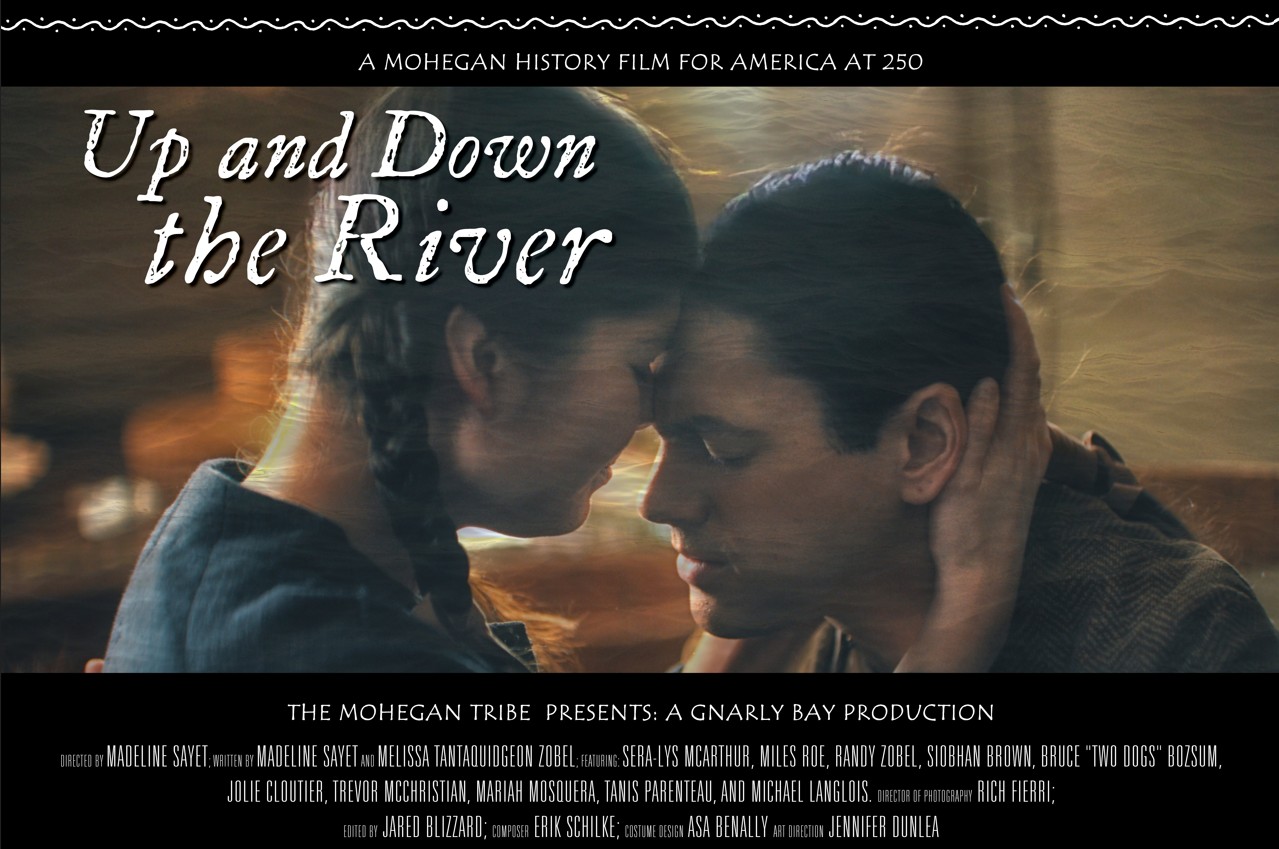
Up and Down the River Screening and Discussion in Charlestown, 11 June


On Thursday, 11 June, the National Parks of Boston and Bunker Hill Community College will host a screening and discussion of the new short film Up and Down the River, dramatizing the choices of Mohegan people during the American Revolution.

This movie was directed by Madeline Sayet and co-written by her and her mother, Melissa Tantaquidgeon Zobel, vice chair of the Mohegan Council of Elders. It stars several Native actors from the Mohegan and other communities.

The film description says:
Spanning the colonial and American Revolutionary eras, Up and Down the River delves into the difficult decisions made by members of the Mohegan Tribe at these pivotal periods in both tribal and U.S. history. Featured in this film is the Ashbow family, including Hannah and her son Samuel Ashbow, Jr. Choosing to fight alongside the American colonists, Samuel Ashbow, Jr., died at the Battle of Bunker Hill in 1775, becoming one of the first Indigenous soldiers to die in the American Revolution.
Ashbow’s father was the Rev. Samuel Ashbow (1718–1795) of New London, Connecticut.

After the film showing, there will be a reflective conversation between Zobel and endawnis Spears, Practitioner in Residence for Tribal Engagement at Brown University and Co-Founder and Director of Programming and Outreach at the Akomawt Educational Initiative.

This program will begin at 6 P.M., with doors open half an hour before. It’s scheduled to last ninety minutes. The showing and discussion are free to the public, but registration is required.

Friday, May 29, 2026

Meeting the Real Samuel McClellan

Yesterday’s post introduced Samuel McClellan (1730–1807) of Woodstock, Connecticut, the captain of a militia troop of horse in 1774.

McClellan was a shopkeeper and landowner in his small town. After the Revolutionary War he became a brigadier general in the state militia.

The McClellans remained locally important, and one of his great-grandsons was Gen. George B. McClellan of the Union Army and the 1864 Presidential race.

As often happens in that situation, Samuel McClellan’s descendants were influential enough to get their understanding of his role in the Revolution into local histories and biographical profiles when primary sources were hard to consult. For example, the 1902 National Cyclopedia of American Biography said:
On Oct. 13, 1773, he was commissioned captain of a fine troop of horse, raised in the towns of Pomfret, Woodstock, and Killingly, and led it Boston on receipt of the news of the battle of Lexington. He passed through the battle of Bunker hill uninjured, and in commemoration of that his wife planted three elm trees in front of residence, which attained great size and were standing when Gen. George B. McClellan visited Woodstock in 1884.
Ellen Douglas Larned’s History of Windham County, Connecticut: 1760–1880 says there were originally four elms.

The latest version of that lore is Samuel McClellan’s Wikipedia page, which as of this week says:
In 1775 Major Samuel McClellan led 184 men at the Battles of Lexington and Concord. He played a prominent role in the Battle of Bunker Hill, and after achieving the rank of lieutenant colonel in 1776, colonel in 1777, and brigadier general of the 5th Brigade in 1779, his regiment of the Connecticut Militia was stationed near New Jersey. McClellan was solicited by General George Washington to join the Continental Army and was offered a commission, but his domestic and business affairs compelled him to refuse.
That overstates the facts in multiple ways, starting with how McClellan wasn’t commissioned a major in the militia until October 1775.

News of the outbreak of war in Massachusetts didn’t reach Woodstock until 20 April, after the fighting was over, so there was no way men from that town were “at the Battles of Lexington and Concord.” Col. Israel Putnam was one of the first men from Connecticut to respond. On 21 April he wrote from Concord to say that the Massachusetts Provincial Congress hoped that Connecticut would send 6,000 men for “a standing Army.”

Putnam added as a postscript: “The Troops of Horse are not expected to come until further notice.” But Capt. McClellan had already led his 184 mounted men north into Massachusetts. That’s shown by Connecticut records of militia service, as tabulated here.

However, those same records also show that McClellan was paid for only eight days of service. Like most of his neighbors, he went home when it was clear the emergency had passed. Some men stayed or returned and enlisted in what became the New England army. McClellan didn’t.

There’s no evidence putting McClellan at the Battle of Bunker Hill or on the siege lines around Boston at the time. That undercuts the claim he “played a prominent role” in the battle, but it does explain how he remained “uninjured.”

Later in the war McClellan did mobilize with his militia regiment for short assignments in the Northern Department. He also served in the Connecticut assembly and as a commissary. In that last capacity his name comes up in Washington’s papers, but there’s no direct written solicitation from the commander for McClellan to join the Continental Army.

McClellan apparently left a fowling-piece, made by the Massachusetts gunsmith Joel White, equipped with a bayonet mount and bearing the initials “SMC.” That’s been displayed as a weapon from the Battle of Bunker Hill. McClellan may well have carried it during the Revolutionary War, but not at that fight.

Thursday, May 28, 2026

“Specimens of Indian Insult”

I’ve quoted a couple of accounts of mock battles on Boston Common during militia musters, as reported proudly in the local newspapers. On those occasions, half the local unit provided an enemy by portraying the French.

Here’s a report from the 12 May 1774 Norwich Packet, describing a different scenario in Woodstock, Connecticut, a town on the border with Massachusetts:
NORWICH, May, 12.

A Correspondent from Woodstock informs us, that on Monday the 2d. Inst. the Three Military Companies of that Town met upon the Parade, in the First Society, where they performed the Manual Exercise with a Spirit and Activity that did Honour to their Officers and themselves.

At Eleven o’Clock a Troop of Horse, under the Command of Capt. Samuel McClellan, came upon the Parade; which, for elegance of Dress, goodness of the Horses, and suitable Furniture, were judged, by the numerous Spectators present, to be inferior to no Troop in America.

At Three o’Clock the Foot and Troop feigned a Skirmish with each other, which they conducted with Propriety and Order: Suddenly a Company of Aborigines appeared, who made Captives of some of the Children present, and gave other Specimens of Indian Insult to the Foot and Horse: Their Depredations roused the New-England Spirit in the Troop, who, with seem Fury, attacked and drove them yelling off the Field, to the great Joy of the Spectators.

The good Order that was observed, not only by the Troop and Foot Companies, but also by the Spectators, was remarkable.----No Injury was sustained by any One present. The Day and Evening Entertainments, were concluded with strict Sobriety and Decency.

The Captain of the Troop gave an elegant Dinner to his Company and a Number of Gentlemen, as also did Capt. [Benjamin?] Lyon, and the Colonel of the Regiment honoured the Day with his Presence.
I’ve found this event mentioned in a local history but not quoted in full. It offers an example of what Philip J. Deloria called “playing Indian” in American culture. This moment was a few months after the Boston Tea Party, a few months before the Patriot press began to share fearful speculations that the Crown government might recruit Natives and French Canadians to attack resistant colonies.

Ironically, the town of Woodstock contains the site of Wabaquasset, a Native American “praying town” from the mid-1600s. That community was split and depopulated by the King Philip’s War. Englishmen from Roxbury then settled the land. The town’s seal now depicts Native and English men standing on either side of a heraldic shield.

Friday, May 22, 2026

A Long Line of Preserved Claps

Dr. Preserved Clap, the man who stepped forward to render Boston’s broken cannon useful again in the spring of 1776, came from a long line of Preserved Claps.

According to The Clapp Memorial (1876), the doctor’s ancestors Roger Clapp and Joanna Ford arrived in Massachusetts in 1630, settling in Dorchester.

(This genealogy preferred the spelling “Clapp,” even changing how the name appeared in the period sources it quoted.)

Those Clapps named their first children Samuel, William, and Elizabeth, but then went full Puritan for most of the rest: Experience, Waitstill, Preserved, Hopestill, Thanks, Desire, Thomas, Unite, and Supply.

Preserved Clapp (1643–1720) moved to Northampton and had a son named Preserved Clapp (1675–1757), who likewise had a son named Preserved Clapp (1705–1758). That last man moved to Hadley. He married Sarah West in August 1730, and they had their first son the following May: Preserved Clap (1731–1811).

Histories of Northfield and Deerfield say that in the fall of 1754 our Preserved Clap was in charge of a small force—nine or ten men—guarding the settlement of Huntstown, now Ashfield.

The genealogy above didn’t have this information, but more recent researchers have found that in 1756 this Preserved Clapp married Eunice Atherton of Lancaster, and they started having children by 1760. His name appears a couple of times in the Amherst town records in the following decade.

On 1 Jan 1770 the Connecticut Courant of Hartford ran this notice:
CLOCKS and Watches made in the best Manner, by
PRESERVED CLAP
of Amherst.

Likewise all Kinds of Instruments in Surgery.
That’s the first surviving sign that the latest Preserved Clap had ambitions to be more than a country farmer.

The Colonial Society of Massachusetts published the image of a clockface above in an article about the engraver Thomas Johnston (1708–1767). At the top it says: “Preserved Clapp / New England.”

Did Clap order this plate from Johnston for a clock he planned to build, or for one he planned to own? And did he pay for it? Johnston kept that sheet of copper and used the other side to engrave a musical score for his publication of Daniel Bayley’s A New and Compleat Introduction to the Grounds and Rules of Musick (Boston, 1766).

Massachusetts Soldiers and Sailors of the Revolutionary War records that in 1775 a man named Preserved Clap served a few months as a private in the company of Capt. Benjamin Hastings of Bolton. I haven’t found anyone else named Preserved Clap of military age at the time. But it seems unusual for a forty-three-year-old man with military experience, social ambition, and some connection to medicine to serve in the ranks. In any event, Hastings’s company saw action at Bunker Hill.

The next time Preserved Clap surfaces in the records I’ve found is the Rev. Dr. Samuel Cooper’s 29 Apr 1776 letter to Samuel Adams, which refers to him as “a Country Surgeon in our Army.” By this time he was evidently using those “Instruments in Surgery,” not just making them. However, I haven’t found any record of Clap being surgeon for a Continental regiment. Perhaps he had taken that role in one of the militia regiments that Massachusetts raised in early 1776.

TOMORROW: Claiming credit.

Tuesday, April 28, 2026

“For attempting to Carry Intillegence to the Enemy”

As I quoted back here, on 12 Oct 1776 the New London committee of correspondence detected two women trying to carry secret letters into British-occupied New York.

Due to the quirks of weekly newspaper publication, the first report of the arrest of those women didn’t appear in New London’s newspaper but on 17 October in the Independent Chronicle of Boston:
Last Saturday two Women were apprehended at New-London and properly secured, for attempting to convey a Number of Letters to the Commanders of the Foreign and British Mercenaries there, containing a very particular Account of the Situation of this and the adjacent Towns, with their present state of Defence.—

Some of them were wrote by a certain John Hill, now a Prisoner in this Town.
A week later, the Independent Chronicle updated its readers:
Last Tuesday, the Wife and Daughter of one John Hill, mentioned in our last to have been apprehended at New-London, for attempting to convey Intelligence to the Enemy at New-York, were brought to this Town, and committed to safe Custody.
That meant the Boston jail. As I said yesterday, I suspect the older woman was named Elizabeth Hill, and the younger might have been John Hill’s daughter by a previous marriage.

In his 1858 History of Eastern Vermont, Benjamin H. Hall stated:
Hill, on the 4th of June [1776], petitioned for his release, alleging as reasons the dying condition of his wife, and the starving state of his mother and daughter.
Hall presumed that request was granted because “it is well known that cruelty was not a characteristic of the conduct of the Americans in the war of the revolution.” 

In fact, Hill’s wife and daughter remained in custody for months.

TOMORROW: A look inside the jail.

Monday, April 27, 2026

“Possessed of that sweet Disposition towards all Mankind”

I’ve been hunting for the names of John Hill’s wife and daughter in 1776.

According to the profile of Hill at the Loyalist Directory, his first wife was Ann Powell (1737–1775), and they had a son named John in 1764.

If that’s true, Hill remarried quickly after Ann’s death since newspapers and legal documents say he had a wife by the fall of 1776. We might presume his daughter came from the first marriage.

Intriguingly, Boston’s marriage intentions list the couple ”John Hill & Eliza Kennedy” with the date of 7 Oct 1776. (But as a reminder about common names, that same volume shows men named John Hill marrying women named Elizabeth in 1753, 1759, 1784, and 1793—and women named Hannah in 1756 and 1808.)

The 29 April 1779 New-York Gazette stated that “Mrs. ELIZABETH HILL, Wife of John Hill, Esq;” had just died. It called her “A Woman amiable in her the domestic Relations, and possessed of that sweet Disposition towards all Mankind, which nothing but Christianity can bestow.” I’m guessing she’s the same wife as three years earlier.

As for Hill’s daughter, the 22 Nov 1779 New-York Gazette reported the marriage of “Miss Hill, Daughter of Mr. John Hill,” to “Lieut. Cunningham, of the Legion.” Alas, the newspaper didn’t provide the young people’s first names. The lieutenant might well be Ralph Cunningham, given John’s link to William Cunningham. Lt. Cunningham was killed in a fight at Hanging Rock, South Carolina, on 6 Aug 1780.

The reason John Hill’s wife and daughter are so interesting is that, as recounted yesterday, in 12 Oct 1776 the New London committee of correspondence stopped them from crossing onto Long Island and found they were carrying incriminating papers.

The Connecticut Gazette described “sundry Papers, containing Matters of Intelligence respecting the People, and State of the Country, sent from said Hill and others in Boston, to be communicated to General [William] Howe.”

What’s more, the women didn’t seem to be carrying that correspondence unknowingly. The article went on: “it appeared from the Papers found upon them, that they had been possessed of other Papers, which they had secured or destroyed.”

Hill’s wife and daughter “were both sent back with the Papers, under a proper Convoy, to the Place from whence they came,” reported to be Providence, Rhode Island.

TOMORROW: A family reunited.

Sunday, April 26, 2026

“John Hill be sent under a proper Guard to Boston Goal”

As recounted yesterday, on 25 Apr 1776 the Massachusetts General Court issued a resolve to catch John Hill, an Irish-born Loyalist accused of helping to loot Boston as the British evacuated.

I haven’t found any newspaper advertisements for Hill, suggesting that local authorities located him within just a few days.

The Marblehead committee of correspondence sent the man back to Watertown, and on 1 May the legislature passed a new act: 
Whereas John Hill a Prisoner now before this Court is justly suspected to have been assisting Crean Brush in Robbing the Inhabitants of the Town of Boston of their Goods & Merchandize

It is therefore
Resolved that the said John Hill be sent under a proper Guard to Boston Goal, there to be confined as a prisoner until he shall be Examined by the Seven Justices of the Peace of the County of Suffolk or the major part of them who are appointed to try associators and abetters of the Ministerial Army, which Justices are impowered to Examine the said Hill and deal with him in the same manner as if he had remained in Boston after the said Fleet & Army had gone away
Magistrates in Boston were questioning a long list of people who had stayed in town through the siege about their political loyalties.

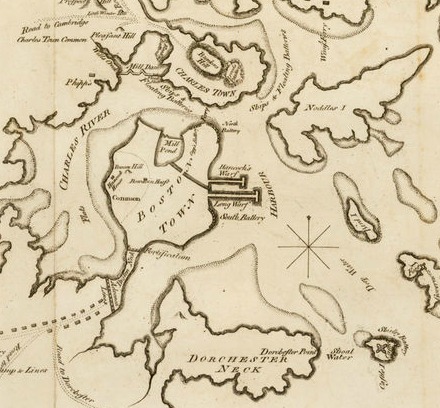
Boston’s “goal” or jail appears on the detail from the 1769 town map above, but barely. At the bottom of that image are two large buildings: the Town House, now the Old State House (lowercase a), and the First or Old Brick Meeting-House (big A). Above the meeting-house is the label “Church Square.” And above that, mostly worn off because of a fold, is the label “Prison.” That building faced onto Queen Street, now Court Street—named for the courthouse, which was conveniently near the prison.

Hill remained in that Boston jail for several months. The United States declared independence. The British military returned to New York in force.

On 18 October, the Connecticut Gazette of New London reported:
Last Saturday [12 October], the Wife and Daughter of one John Hill, a Prisoner in Boston Goal, for being concerned with Crean Brush and others, in Robbing the Inhabitants of Boston, when that Place was evacuated; came to this Town from Providence by Water, and was endeavouring to get a Passage to the West End of Long-Island, but were stopped by the Committee of this Town, and on Examination were found upon them, sundry Papers, containing Matters of Intelligence respecting the People, and State of the Country, sent from said Hill and others in Boston, to be communicated to General [William] Howe;…
TOMORROW: Mystery women.

Thursday, March 19, 2026

“The gratifycation of being selected to carry the American flag”

Ens. Samuel Richards had a unique perspective on the Continental Army’s entrance into Boston after the British evacuation on 17 Mar 1776.

The young Connecticut officer was chosen (I don’t know how) to lead the troops in with his regiment’s flag.

He recorded his memories for his family many decades later:
By the enemies inactivity for several succeeding days we concluded they had abandoned the idea of attacking our fort. This comparative inactivity continued untill the 17th of the month when the whole of our troops were paraded and commenced our march into Boston, it being announced that the enemy were evacuating it. I had the gratifycation of being selected to carry the American flag at the head of the column which entered from the Roxbury side.

When arrived in the town numerous incidents crouded upon our view: I can particurize but few of them. The burst of joy shown in the countenances of our friends so long shut up and domineered over by an insulting enemy: the meeting and mutual salutations of parents and children and other members of families having been seperated and continued seperated by the sudden shuting up of the town after the battle of Lexington: the general delapidation of the houses: several churches emptied of all the inside work—and turned into riding schools for their cavalry [that actually happened in only one church, the Old South Meeting-House]: all the places which had been previously used for public resort torn to pieces: and at the stores around the wharves groceries—particularly salt—were in a state of destruction.

As I had no particular command I rambled at my pleasure—and being the carrier of the flag attracted some attention, was almost constantly pressed with invitations to “call in and take a glass of wine with me”

I saw the last boat of the enemy put off and proceed to the shiping.
Richards did some sightseeing, first visiting the fortifications left behind in Charlestown.
The next day I went and viewed the works on Castle island, the enemy had endeavored to blow up every usefull part of the works; in many instances they had succeeded, in others but partially, they had broken off the trunnions of all the heavy cannon, and in addition had spiked them up. In general every thing was mutilated and rendered useless.

I was invited to take lodgings at the house of a respectable widow lady Mrs. C. and treated with the utmost hospitality during the few days of my stay in the town.

On the 25th of the month the troops began their march by regiments toward New York, and by the 4th of April 21 regiments had moved on, ours being one of the number: five regiments being left to garrison the town…
Richards remained in the Continental Army through the year 1780, becoming a captain. He returned to Farmington and worked as the postmaster for two decades. In retirement he followed a daughter to Wilkes-Barre, Pennsylvania, where he died at age eighty-eight.

Wednesday, March 18, 2026

“The next morning presented to the view of the enemy a regular fort”

Samuel Richards (1753–1841) came from Farmington, Connecticut. In May 1775 he marched north with his town’s company to the Boston siege lines.

According to the memoir he wrote for his family decades later, Richards went as a gentleman volunteer, not in the ranks, and in Roxbury, Gen. Joseph Spencer offered him a post as private secretary.

However, contemporaneous records show that the young man was a sergeant in Capt. Noadiah Hooker’s company from May to December 1775. Perhaps Richards preferred his family to consider him as always of genteel class. 

Those sources agree that when the Continental Army was enlisted for a second year, Samuel Richards signed on as an ensign—the lowest rank of officer.

Ens. Richards’s regiment served on the southern side of the siege. For a while they camped on Gen. William Heath’s family farm in Roxbury, then in barracks as close to the Neck as possible.

Richards and his company were part of the reinforcement that went onto the Dorchester peninsula on the morning of 5 Mar 1776 to prepare for an expected British counterattack. He left this account of what followed in his memoir, published in 1909:
the next morning at 8 oClock a relief was sent on—of which I was one—in passing the neck the tide having overflowed it I found my boots filled with mud and water, but we had no dry clothes with us, nor any time or opportunity for changing. . . .

I found a redoubt considerably advanced in a position well calculated for defence. Outside the parapet were casks filled with sand and so placed that a slight touch would set them rolling down the hill which was very steep on every side, and thus break the ranks of the enemy on their advance.
Those barrels had prompted a lot of discussion.
On the afternoon of the 6th we very plainly saw the enemy in motion in the town: dense columns of troops moving down the main street to the wharf and embarking on board the ships which moved down the harbor and formed in a kind of crescent at considerable distance from the hill.

most of the next day [still 6 March] was spent by those ships in beating up nearer to our post—the wind being a head:

we continued our work incessantly in compleating the redoubt, being urged to exertion by a full expectation of being attacked by the enemy’s troops we had seen embark on board the ships; we had no time to spare for reflecting on and counting the cost of the issue of the expected battle, we did not work litterally with arms in our hands, but they were lying by our sides, and it is presumed that every one ardently wished for the opportunity of shewing the enemy what freemen would do when contending for their just rights. No one needed stimulating to the performance of his duty as every one possessed the inclination.

As night approached an uncommonly severe South East rain storm came on with very high wind, and in that elevated situation, surrounded by the sea, it was felt in all its force, but the severity of the storm did not stop our work, which we pushed forward with the utmost alacrity. The next morning presented to the view of the enemy a regular fort, far advanced to completion—and to our view their ships below apparently in a very disorderly condition: the day passed without any thing worthy of particular notice.
In looking back, Ens. Richards skipped over the couple of days that passed before the next action.
At evening we broke ground on Nook, or Nuke point, a small hill very near the water oposite South Boston. The enemy could plainly hear the sound of our entrenching tools, on which they opened and continued an incessant cannonade with a general direction towards this point. I counted the number of discharges up to about 1500 during half an hour and then left off counting; this firing was continued through the night, and the morning shewed a novel sight; the ground all around where the work had been carrying on appeared as if it had been plowed irregularly, and a very great number of cannon balls were picked up: but strange as it may seem there was but a surgeons mate and two privates killed during the night.
Contemporaneous sources say a doctor and three Continental privates were killed.

TOMORROW: Marching into Boston.

(Richards’s portrait, as copied for another family member around 1890, appears above. It was auctioned in 2020.)