J. L. BELL is a Massachusetts writer who specializes in (among other things) the start of the American Revolution in and around Boston. He is particularly interested in the experiences of children in 1765-75. He has published scholarly papers and popular articles for both children and adults. He was consultant for an episode of History Detectives, and contributed to a display at Minute Man National Historic Park.

Subscribe thru Follow.it


•••••••••••••••••


Showing posts with label Christopher Greene. Show all posts

Tuesday, July 15, 2025

“I have pleased myself with the thought of serving under you”

As discussed yesterday, sometime in the first week of May 1775 the Rhode Island legislature appointed Nathanael Greene to be the brigadier general of its army of observation.

In his biography of his grandfather, George Washington Greene wrote:
There is a tradition, but I will not vouch for it, that the first choice fell upon an Episcopalian, who declined; the second, on a Congregationalist, who also declined; and that, when the third vote was announced as having fallen on Greene, he rose in his place, and said: “Since the Episcopalian and Congregationalist won’t, I suppose the Quaker must.”
That’s about as tepid an endorsement for a “tradition” as a nineteenth-century biographer could provide. And the religious terms “Episcopalian” and “Congregationalist” weren’t standard in 1775, suggesting it wasn’t exact.

One recent biographer of Nathanael Greene has suggested that those first two candidates for command declined on religious grounds. I think that’s a misreading of the tradition. The first two faiths mentioned weren’t pacifist. That was the point of the anecdote—the irony of a (lapsed) Quaker leading an army instead of men from sects that didn’t object to military action. And the story might have some validity, though I doubt it happened in a legislative session.

The legislature’s first choice probably was Simeon Potter, already major general of the colony militia. At least, the body couldn’t ignore him. And Potter was an Anglican, even if he’d punched his minister in the face back in 1761. (Incidentally, the Rev. John Usher died on 30 Apr 1775, just as these discussions about the Rhode Island army were under way.)

Another candidate for command whom G. W. Greene and later biographers mentioned is James Mitchell Varnum (shown here), captain of the Kentish Guards. He’d grown up in Dracut, Massachusetts, as what people would later term a Congregationalist. That said, there were many others of that faith in Rhode Island as well, some probably quite senior to the twenty-six-year-old Varnum.

Varnum and Greene had worked together in the fall of 1774 to form the Guards, an independent militia company based in East Greenwich. Varnum, a rising young attorney, was chosen as the first captain. Encouraged by a cousin, Greene put his name forward to be a lieutenant, only to learn that some members thought his limp meant he didn’t look good marching in an elite company at all.

Sometime in October, it appears, Greene wrote to Varnum:
If I conceive right of the force of the objection of the gentlemen of the town, it was not as an officer, but as a soldier for that my halting was a blemish to the rest. I confess it is my misfortune to limp a little, but I did not conceive it to be so great; but we are not apt to discover our own defects. . . .

I have pleased myself with the thought of serving under you, but as it is the general opinion that I am unfit for such an undertaking, I shall desist. I feel not the less inclination to promote the good of the company, because I am not to be one of its members. I will do anything that's in my power to procure the charter.
Apparently Varnum had spoken of leaving the company himself if Greene was forced out because the letter continued:
Let me entreat you, Sir, if you have any regard for me, not to forsake the company at this critical season for I fear the consequences—if you mean to oblige me by it, I assure you it will not, I would not have the company break and disband for fifty Dollars
Varnum stayed with the company and apparently convinced Greene to do the same.

On 29 October, the legislature, with Greene as a delegate, issued a charter for the Kentish Guards. Its act listed the dozens of men who had petitioned for that charter, starting with Varnum and the other three designated as officers, including Christopher Greene. The fifth name on that list was Nathanael Greene. So officially he was a leading member.

It’s conceivable that some fallout from that affair influenced the choice of Greene as general in May 1775. If the legislature did approach Varnum, he may have thought it was Greene’s turn to lead. Or perhaps, with a real war looming, organizational skills seemed a lot more important than a slight limp.

TOMORROW: Hidden factors in the decision.

Monday, January 29, 2018

A Greene Family Crisis over Playing Cards

On 29 January 1776, Gen. Nathanael Greene wrote to his brother Christopher from the Continental camp on Prospect Hill about a family crisis—his wife’s friends had played cards in front of their stepmother.

The general wrote:
I am extream sorry that Mr [John] Gooch and Nancy Varnum affronted Mother at my House with Cards. Surely Mrs [Catherine] Greene could not be present. She must have known better. It was insult that I would not have sufferd the best friend I had in the World to have offerd to her.

Altho I think Cards in themselves as innocent as any other pieces of Paper yet its criminal to play before her because they knew how Conscious the friends are in these matters. In the choice of all our pleasures regard should be had to time and place, private and publick Prejudices. Since the Resolution of Congress I have never had a Card in my hand to play, not sufferd one in my House that I remember.

I Love and Esteem the old Lady and should be very sorry that this disagreeable circumstance should be constered into an intentiononal [sic] affront, for I dare presume it proceeded intirely from Ignorance and not out of any disrespect to her. People that have been Accustomed to these things all their Days dont feel upon the Occasion like you and me who have stole the pleasures in secret Corners.
There are layers of disapprobation here. Mary (Collins Rodman) Greene disliked card-playing because of her Quaker values—but obviously her stepsons had snuck in more than a few games.

Then the Continental Congress in its Association of 20 Oct 1774 had urged Americans to avoid “all kinds of gaming,” including cards, and Nathanael Greene said he had complied.

But Nathanael’s wife Catherine came from a higher social class, and she was independent in many ways. It looks like her social circle didn’t adhere to either the Congress’s or traditional Quakers’ strictures against cards. Indeed, despite the general’s expression of certainty, it strikes me that Catherine Greene probably knew exactly what was going on in their house.

John Gooch was probably the same man of that name who became a captain in James Varnum’s Continental Army regiment and saw action at Harlem Heights and Fort Washington in 1776. However, that man’s service at least nominally started in January, so he should have been in the camp when Greene wrote this letter. Maybe he was on recruiting duty while playing cards.

On 9 Feb 1776, Nathanael and Catherine’s first child was born. They named that son after Nathanael’s boss: George Washington Greene. Giving birth apparently freed Catherine to travel, and she reportedly visited the camp at Cambridge before the end of the siege. She certainly spent many months later in the war traveling with the army and socializing with other commanders’ wives rather than staying at home in Rhode Island with her mother-in-law.

Sunday, February 26, 2012

Persons of Bronze

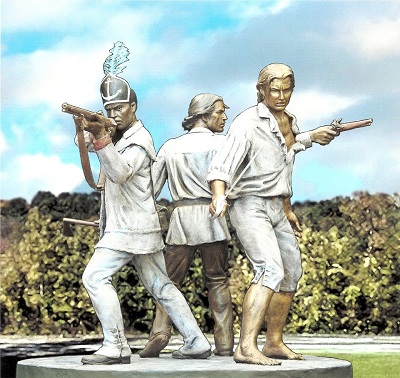
Michael Aubrecht at Blog, or Die just posted information about the choice of a design for the Battle of Pines Bridge Monument in Virginia. That model, by Jay Warren, is striking, to be sure.

The Pines Bridge Monument Committee explains its subject this way:
On May 14, 1781, just after sunrise there was a surprise attack on the first Rhode Island Regiment headquartered at the Davenport House in Croton Heights. This regiment was comprised of African American, Native American and European American soldiers under the command of Colonel Christopher Greene.
Earlier in the war, the First Rhode Island was known for being mostly composed of soldiers of color. Other regiments of the Continental Army had some black and Native soldiers, but they were interspersed among a larger number of whites. That made the First Rhode Island a source of pride for some Americans, but not to others.

On 29 June 1780, Gen. George Washington responded to news of its recruiting difficulties by telling Gen. William Heath, “The objection to joining Greenes Regiment may be removed by dividing the Blacks in such a manner between the two [regiments], as to abolish the name and appearance of a Black Corps.” After that the First Rhode Island’s enlisted ranks were racially integrated like other Continental regiments. Of course, it still had a disproportionately large number of veteran soldiers with African and Native American ancestry.

Coincidentally, at the David Library of the American Revolution’s blog, Judith Van Buskirk just shared thoughts on the challenge of researching the individual men of that regiment.

And I might as well mention that on Saturday, 3 March, I’ll have a public conversation with Marty Blatt, historian of Boston National Historical Park, about Washington’s changing thoughts on black soldiers while he was in Massachusetts in 1775-76. That will take place at noon in the National Park Service visitor center at 15 State Street.

Friday, February 03, 2012

“Whether there be a Distinction between such as are Slaves & those who are free?”

Although the Continental Congress decided not to order Gen. George Washington to discharge all black soldiers he found in the Continental Army when he arrived in Massachusetts in July 1775, that doesn’t meant that American governments were okay with the idea of African-Americans in arms.

In fact, on 8 July, less than a week after the new commander’s arrival, the Massachusetts Provincial Congress told officers recruiting new men: “You are not to enlist any deserter from the Ministerial Army, nor any stroller, negro, or vagabond, or person suspected of being an enemy to the liberty of America, nor any under eighteen years of age.” Gen. Horatio Gates, the army’s adjutant general, repeated those instructions in his orders a few days later.

On 5 October, Washington convened his generals in a council of war at his headquarters. He was trying to come up with recommendations to the Congress about the new army that would take the field in January since all the current soldiers had enlisted only till the end of the year or sooner.

Among the questions the generals discussed was: “Whether it will be adviseable to re-inlist any Negroes in the new Army—or whether there be a Distinction between such as are Slaves & those who are free?”

Sending off enslaved men to battle for other people’s liberty was foolhardy, everyone agreed, not to mention hypocritical. But what about free blacks? According to the official minutes of the meeting, the council “Agreed unanimously to reject all Slaves, & by a great Majority to reject Negroes altogether.” Most of the generals wanted to maintain the rules instituted in July. Only a small minority—maybe one to three men out of ten—were willing to accept any black soldiers.

A history student named Patrick Charles looked into this debate and published his findings in Washington’s Decision. And by “published,” I don’t mean he convinced a scholarly journal or press to publish his work. He published it himself through BookSurge.

The resulting paperback has grammatical and typographical errors and sometimes unclear language. But the research looks solid. Charles corrects some misconceptions about the topic, distinguishes facts from supposition, and offers a strong argument for his conclusions.

Among other things, he guesses that the minority in that October meeting included, or consisted of, Gen. John Thomas and Gen. Nathanael Greene. As quoted yesterday, Thomas said the black troops serving under him were as good as the whites. Greene later supported his cousin Christopher Greene’s effort to recruit African-American and Native American men into the First Rhode Island Regiment.

Whatever the generals said in their meeting, they decided against retaining any black soldiers. On 23 October, Washington met with three delegates visiting from the Congress and raised the question again: “Ought not Negroes to be excluded from the new Inlistment especially such as are Slaves—all were thought improper by the Council of Officers?” There’s no doubt about what answer he was pushing for.

Benjamin Franklin, Benjamin Harrison, and Thomas Lynch, having sat through the previous month’s debate in Philadelphia, agreed that black soldiers should “be rejected altogether.” At the end of the month Gen. Washington issued recruiting orders for the new army specifically excluding “Negroes…, which the Congress do not incline to inlist again.”

That policy lasted for only two months.

TOMORROW: Gen. Washington changes his mind.

Sunday, December 21, 2008

Learning About The Black Regiment

I’ll wind up this impromptu series of book reviews with a pointer to The Black Regiment of the American Revolution, by author Linda Crotta Brennan and artist Cheryl Kirk Noll. This nonfiction picture book for the middle grades was first published in 2004 and reissued earlier this year by Apprentice Shop Books.

This book was created largely to answer interest from schools in Rhode Island. It provides a simple but thorough history of the Continental Army’s 1st Rhode Island Regiment, organized by Col. Christopher Greene in early 1778. In order to fulfill its recruiting quota, the state’s legislature authorized Greene and his officers to sign up slaves who were willing the fight the British, granting them freedom and reimbursing their former owners.

Along with free blacks and Native Americans (there was a lot of overlap between those communities), the newly freed slaves made up a bit more than half of the regiment’s strength. Furthermore, while most of the Continental regiments had their smaller numbers of black soldiers mixed in with the white, the Rhode Islanders were grouped in all-black (or all-men-of-color) companies, making their numbers even more visible. The unit thus became known as “the Black Regiment.”

Apparently some whites objected to being assigned to that regiment. On 29 June 1780, Gen. George Washington wrote to Gen. William Heath, his commander in New England:

I think it will be best to march Colo. [Christopher] Greenes Regt. and the Levies when collected, to the Army [outside New York], and upon their arrival here, so arrange and model them, as to level the Regiments [i.e., to make them even in strength]. The objection to joining Greenes Regiment may be removed by dividing the Blacks in such a manner between the two, as to abolish the name and appearance of a Black Corps.
In early 1781, the regiment was merged with the 2nd Rhode Island to create a single regiment.

Brennan describes this history in crisp, clear prose. Unfortunately, she can’t quote first-person accounts from men of this regiment; she has only the names of soldiers to remind us they were individuals with their own stories. As a result, the “Black Regiment” really functions in the narrative as a single collective character.

The dramatic center of the book is the Battle of Rhode Island in August 1778, when the Continental Army and New England militia units tried and failed to drive the British military out of Newport. The Black Regiment helped hold back a British and Hessian attack, allowing the Americans to retreat off the island. Later the integrated Rhode Island regiment was part of the victorious Continental Army at Yorktown, and some of its black soldiers served through the end of the war in 1783.

Noll provides a series of varied, well researched watercolor illustrations in realistic style. Alongside them are images of period documents and artifacts, helpful maps, timelines, and indexes. (One portrait of a black man reprinted in the book has since been revealed as a modern forgery. That was the topic of the second posting on Boston 1775, back in 2006.)

That amount of material makes for crowded pages, even with small type. The book’s design, and the lack of an individual protagonist to follow, may limit its appeal as entertainment. But for students wanting to learn more about American history, it provides a lot of solid information in an attractive package.