J. L. BELL is a Massachusetts writer who specializes in (among other things) the start of the American Revolution in and around Boston. He is particularly interested in the experiences of children in 1765-75. He has published scholarly papers and popular articles for both children and adults. He was consultant for an episode of History Detectives, and contributed to a display at Minute Man National Historic Park.

Subscribe thru Follow.it


•••••••••••••••••


Showing posts with label Ward Chipman. Show all posts

Thursday, April 24, 2025

Esther Sewall and “the female Connections”

In the fall of 1774 and winter of 1775, Massachusetts attorney general Jonathan Sewall appears to have worked as an advisor to the royal governor, Thomas Gage.

With the courts closed by crowds and Gage’s authority confined to Boston, there wasn’t much else for Sewall to do.

There’s a renewed debate about whether Sewall wrote the “Massachusettensis” essays published in those months. Patriots of the time believed he did, but his former law trainee Ward Chipman described copying them out for another Loyalist lawyer, Daniel Leonard. In 2018 a team led by Colin Nicolson reported in the New England Quarterly that their linguistic analysis pointed the finger back at Sewall.

In early April 1775, a dispatch from Lord Dartmouth brought instructions to arrest the leaders of the Massachusetts Provincial Congress. Gen. Gage might well have discussed the legalities of such arrests with his attorney general.

The president of that congress was John Hancock. His fiancée, Dorothy Quincy, was the sister of Esther Sewall, the attorney general’s wife. On 7 April, James Warren wrote to his own wife:
The Inhabitants of Boston are on the move. H[ancock] and A[dams] go no more into that Garrison, the female Connections of the first come out early this morning and measures are taken relative to those of the last.
Dorothy Quincy was soon staying with Hancock and Samuel Adams at the parsonage in Lexington.

As discussed yesterday, though Esther Sewall was married to a leading Massachusetts Loyalist, she was still emotionally attached to her family, friends, and neighbors on the Patriot side. She might have heard her husband talk of Hancock and Adams being arrested. Any military operation to do that could put her sister in danger.

Esther Sewall therefore had a motive and possible means to be the “daughter of liberty, unequally yoked in point of politics,” who sent a warning that British soldiers might arrest Hancock and Adams, as the Rev. William Gordon later wrote. When I first discussed that question, I didn’t see how Esther would have had access to inside information. Jonathan’s work with Gov. Gage offers a possible answer. (And, we must remember, this “daughter of liberty” did not have information on Concord as Gage’s real target.)

A few months into the siege of Boston, Jonathan and Esther Sewall sailed for London. They remained yoked together for the rest of his life. But neither of them was happy. For most of those years Jonathan was seriously depressed, often confined to his bedroom. Esther was terribly homesick. Jonathan blamed Esther for his difficulties. Yet she stayed with him.

Esther Sewall made two trips back to Massachusetts, first in 1789 and then in 1797, the year after she became a widow. Her grown sons Jonathan and Stephen became important lawyers in Canada, and she settled in Montreal.

In 1809, Esther sued in Massachusetts court for her dower property, confiscated thirty years before as part of Jonathan’s assets. Though she didn’t live to hear about it, the state’s highest judges decided in her favor. Then the Massachusetts General Court passed a special law to compensate the man who’d bought that property for what he had to pay her estate. So the Massachusetts government ended up paying Esther Sewall money.

Wednesday, April 23, 2025

“Putting all matters of politicks out of view”?

Esther Quincy married Jonathan Sewall in January 1764, after a courtship of more than four years.

She was the daughter of the Boston merchant and magistrate Edmund Quincy, who had come back from bankruptcy a couple of years before.

He was a young lawyer of sharp wit and moderate means trying to establish himself, building up from the position of justice of the peace.

Jonathan Sewall didn’t enter the political debate over the Stamp Act, but in December 1766 he came out swinging on behalf of Gov. Francis Bernard and royal policy in newspaper essays signed “Philantrop.”

The governor rewarded Sewall with appointments as the province’s solicitor general and then attorney general. He later got to be a judge in the Vice Admiralty Court as well.

Esther’s father was on the other side of the political divide. He was one of the justices the Boston Whigs called on when they had a complaint about a royal official or soldier. He joined other magistrates in resisting Gov. Bernard’s call for barracks in 1768. He took the (conflicting) testimony of Charles Bourgate after the Boston Massacre. He issued the warrant to arrest John Malcolm for assault.

Most of Esther Sewall’s other male relatives were also Whigs. Uncle Josiah Quincy, Sr., in Braintree was on the Council, one of several thorns in the royal governors’ sides. Cousin Josiah, Jr., practiced law in Boston, wrote newspaper essays, counseled local activists, and traveled to meet fellow Whigs in the southern colonies and London. The major exception within the Quincy family was cousin Samuel Quincy, who followed in Jonathan’s wake as the province’s solicitor general.

Many of Jonathan’s old friends were Whigs, including John Adams, and that produced some awkward social moments. Jonathan prosecuted John Hancock on smuggling charges (eventually dropping the case for lack of solid evidence). But in 1772 the merchant wrote to him expressing
my inclination and wish (putting all matters of politicks out of view) that a perfect harmony and friendship may be kept up between us, and wish rather more familiarity than the common shew of friendship expresses, considering the connection I have formed with the sister of your Lady.
That was Esther’s sister Dorothy. She became Hancock’s fiancée, their engagement almost as long as the Sewalls’ had been.

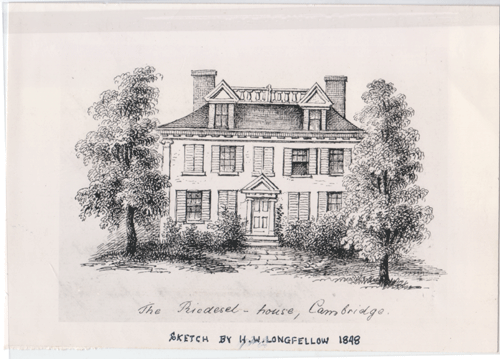
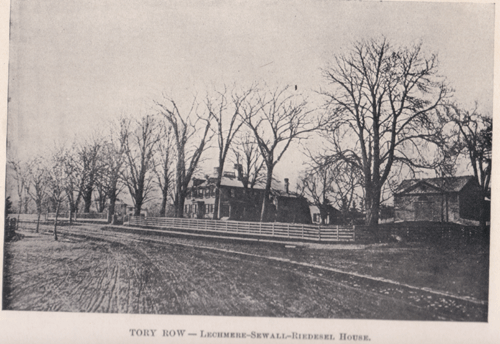
By 1774 the Sewalls were living in Cambridge in a country mansion bought from Richard Lechmere. Their household included three small children, three young men studying the law, and at least one enslaved young man.

Early on 1 September, Gen. Thomas Gage’s soldiers seized militia gunpowder in Charlestown and cannon in Cambridge. Around noon, Jonathan Sewall suddenly left home and headed to Boston. The governor might have sent for him, or he might have feared how the neighbors would react to the army operation. Or he might have had a whim.

After dark, those neighbors came to the Sewalls’ house. They refused to take Esther’s word that Jonathan was out. Some men pushed into the house, and the young men inside beat them back. One of those boarders, Ward Chipman, fired a pistol inside the house—some sources say accidentally, some not. Either way, that noise got everyone’s attention. The two groups of men agreed not to do further violence as long as they could enjoy some of the Sewalls’ wine.

Soon afterward, Esther took the children into Boston to be with Jonathan. That might have been as early as 2 September when the “Powder Alarm” brought thousands of militiamen into the street outside.

Unlike some people threatened by crowd violence, Esther Sewall never renounced Massachusetts. Her family ties were too strong. In 1778 she wrote to her father: “I had not forgot my own Country, and Friends no, my D[ea]r Father, I should as soon forget myself.” But as of September 1774 she was stuck inside Boston with her unpopular husband.

TOMORROW: Can this marriage be saved?

Sunday, April 05, 2020

The Disappearance of Jonathan Sewall

In the mid-1760s, Jonathan Sewall allied with Gov. Francis Bernard, writing pseudonymous newspaper essays lampooning James Otis and favoring the Crown. The governor appointed Sewall to be attorney general of Massachusetts in 1767.

Sometime in March 1770, Attorney General Sewall wrote out the indictment of Capt. Thomas Preston and eight soldiers for multiple counts of murder—the Boston Massacre. This document used old British legal formulas: “not having the Fear of God before their eyes, but being moved and seduced by the Instigation of the devil and their own wicked Hearts…”

After 27 March, Sewall expanded that indictment to include three Customs service employees and notary John Munro, caught up in young Charles Bourgate’s accusations. It’s highly unlikely he believed in those charges, but he didn’t fight them.

Ordinarily Sewall would have prosecuted all those defendants, as well as the murder charges against Ebenezer Richardson and George Wilmot. He had personally argued all previous criminal cases since his appointment. Because people knew Sewall was a friend of the royal government, on 13 March the town of Boston voted to hire an attorney to assist him—an unusual move to ensure there was an aggressive prosecution.

Instead, the indictment turned out to be Sewall’s last official act in the Massacre trials. He never appeared in the Boston courthouse again that term. In 1816 defense counsel John Adams recalled: “Mr. Sewall, the Attorney General, who ought, at the hazard of his existence, to have conducted those prosecutions, disappeared.” Solicitor general Samuel Quincy wrote that Sewall couldn’t appear “by reason of Ill health.”

According to Thomas Hutchinson, the problem was the Boston Whigs’ visit to the court on 22 March to demand that the judges proceed to those murder trials. The acting governor wrote, “Sewall tells me he never will appear at any other court in that town, after the present, as Attorney General, and the whole court say they do not sit there with freedom.”

Yet the judges continued to sit. To prosecute the big murder cases, they appointed Robert Treat Paine, a private lawyer in Taunton, and Samuel Quincy. Adams wondered if Sewall was involved in those choices, but there’s no surviving evidence that he was.

Samuel Phillips Savage of Weston complained that Sewall didn’t stop all legal work. In his almanac diary Savage wrote that the attorney general continued to appear “with the jurys of the Inferior Courts at Charlston and Ipswich in the petty Concerns cognizable before the General Sessions of the Peace.” But he never went into Boston.

I suspect there was another factor in Sewall’s action, or lack of it: he was prone to depression. During the war he had a breakdown and spent more than a year in his bedroom. He had other spells of depression later in life, and his son suffered from the same spells while serving as chief justice of Upper Canada.

Even before the war, I think Sewall’s public writing shows a pattern of bursts of energy and silence. He published series of lively and often verbose essays from February to June 1763 (as “J,” “Jehosaphat Smoothingplain,” and “J. Philanthrop”), December 1766 to August 1767 (“Philanthrop”), December 1770 to February 1771 (Philanthrop” reviewing the Massacre trials he’d stayed away from), and June to August 1773 (“Philalethes”).

But in late 1774, after the Powder Alarm drove him into Boston, Sewall went silent. To argue for the Crown, “several of the principal gentlemen” turned to Daniel Leonard and Sewall’s law clerk Ward Chipman to deliver the “Massachusettensis” essays. Sewall may have supported the project, but he couldn’t do the work.

Historians are reluctant to apply psychiatric diagnoses like bipolar disorder to figures of the past. They’re beyond the reach of psychologists. And more than anyone historians know how concepts of mental illness change over time.

But in Sewall’s case, I think attributing his refusal after March 1770 to try the Massacre cases solely to his politics or to Whig pressure might miss a crucial internal force. The attorney general couldn’t bring himself to prosecute the big cases, nor to refuse to prosecute. He just stayed away.

Monday, September 02, 2019

On the Night Before the Powder Alarm

Yesterday we left Esther Sewall in her house in rural Cambridge on the night of 1 Sept 1774.

Sewall had two young sons. Her husband, attorney general Jonathan Sewall, had gone into Boston that morning. The household also included a couple of law students about twenty years old and at least one enslaved man.

Outside, there were upwards of forty local men and boys demanding that her husband come out and answer for the royal governor’s actions. Not only was Gen. Thomas Gage implementing the Massachusetts Government Act, but he had just taken gunpowder and cannon away from the local militia.

Yesterday I started quoting an account of that confrontation from a third, unnamed young man inside the house. It continued:
…those without played their artillery of stones & brickbats against the windows.

The door being shut, & they being enraged by the explosion of a gun in the entry near the front window tho’ without the least design of hurting & at a different side of the house from where we supposed the mob were, they went into the front yard & broke those windows.

We then went out to them & declared that the gun went off accidentally, that we were very sorry for it as it was agreed upon since we had got them out of the house not to fire but on the last extremity; yet that we were determined to defend ourselves at the risque of our lives & they might depend upon resistance at all events if they offered to reenter. We begged them to consider the distress this might occasion to Mrs Sewall & family & to disperse

They appeared to be satisfied about the gun at last, told us we had fought like brave fellows & if we would give them something to drink they would not go to Judge [Joseph] Lee’s as they intended but would disperse

which they did after drinking a few glasses of wine & cordially bid each other Good-Night.
It was still possible for young men to stop their violence before anyone was hurt. As long as there was wine involved.

Years later, in speaking to the Loyalists Commission, one of the law students, Ward Chipman, declared that he had deliberately fired that pistol. He went on to be one of the most important builders of New Brunswick, Canada.

Massachusetts Patriots seized on Chipman’s gunshot and spun events to suggest that it provoked the crowd’s violence. For example, Dr. Joseph Warren wrote to Samuel Adams on 4 September: “some boys and negroes had called at Mr. Sewall’s house at Cambridge; and, by the imprudent discharge of a pistol by a person in the house, they were provoked to break the windows, but very soon left the house without doing further damage.”

Even Esther Sewall’s own father, Edmund Quincy, unhelpfully told her sister: “Im sorry to understand, that thro. great inadvertency, a Gun or pistol was dischd. from ye. house—ye sole Cause of ye Violence wch. ensued.”

By the end of 2 September, however, almost no one was talking about the assault on the attorney general’s house. Sparked by wildly exaggerated rumors of a British military attack, thousands of Massachusetts militiamen had marched into Cambridge and forced resignations from everyone from the county clerk to the lieutenant governor. That “Powder Alarm” signaled the end of royal rule in almost all of New England. The conflict in Massachusetts turned from political to military.

The Sewall house still stands on Brattle Street in Cambridge, though moved from its original site. It’s in private hands and unmarked.

As far as I can tell, the anonymous account of what happened there in September 1774 has been published only in Leslie F. S. Upton’s 1968 collection of readings, Revolutionary Versus Loyalist: The First American Civil War, 1774-1784.

Sunday, September 01, 2019

Attack on Jonathan Sewall’s House

On 1 Sept 1774, Gen. Thomas Gage sent soldiers out to Charlestown to remove the provincial militia’s supply of gunpowder from the stone tower that still stands in what is now Somerville.

Some of Gage’s troops went on into Cambridge and wheeled away two small cannon that the Middlesex County militia trained with.

Locals treated those actions as a raid on their military resources, an attempt to curtail their self-defense. By the end of the afternoon, people learned that William Brattle of Cambridge had alerted the governor about that gunpowder. Men surrounded Brattle’s house, but he had already fled into the army camp in Boston.

Some of that crowd moved out the Watertown road to the house of Jonathan Sewall, attorney general and Vice Admiralty Court judge. He was a high-profile supporter of the royal government, having represented it in court (though he sat out the Boston Massacre case) and written newspaper essays.

Sewall lived in a country mansion with his wife Esther and two young sons, a few household servants, and at least two young men studying law, Ward Chipman (1754-1824) and Thomas Aston Cotton (1754-1810). Chipman also tutored the boys in Latin.

A third young man was also in the Sewall house that night and left an anonymous description of events now preserved in the Public Archives of Canada:
On Thursday evening September 1, 1774 there was a riotous assembling of about 40 or 50 men & boys in the town of Cambridge—I passed by them several times in the course of the evening carefully observing their number strength & movements—

About half past 11 or at 12 o’clock in the night, thinking that they had dispersed in a great measure & perceiving that they had been in indifferent spirits the whole evening, I went to Judge Sewall’s & informed Mrs Sewall that I believed there was no danger of a visit from them at that time of night; but if they came, they were so little used to acts of violence that I thought we might safely venture to resist them.

About 1/2 hour after being alarmed with the noise of their coming, & having secured the Windows & Doors as well as we could, we repaired to Mrs Sewall’s Chamber; they came shouting & blowing a horn & Mrs Sewall threw up the window when they had got to the house & asked them what they would have—

they replied Mr. Sewall,—

she told them he was not at home, but had gone to Boston in the morning & had not returned since;

on which they exclaimed she was a damned liar &c that he was in the house & they would search the house for him & have him;—

on which there was a tumultuous noise, but Mrs Sewall begged to be heard, & being a little more silent, she observed to them that being a woman she expected civil treatment from them as she had & would treat them;

they exclaimed that he was an enemy to his country & have him they would—

Mrs Sewall begged them not to disturb her—that being alone she hoped they would not treat her or her children ill, & if they would go away, they should have anything she could give them out of the house.

They swore they would search the house & immediately burst open the door. Finding they had entered & hearing them below, Mr. Chipman, Mr. Coffin & myself, together with a servant [i.e., slave] of Judge Sewall’s, being all the males that were in the house ran downstairs, attacked them & by an active & vigorous application of the argumentum baculinum [argument by means of clubs] drove them out & Mr. Coffin declared he would blow the first man’s brains out, that offered to enter again.
Jonathan Sewall really had gone into Boston earlier that day. According to his father-in-law, Boston magistrate Edmund Quincy, he “came here between 12 & one yesterday, said he was advised to leave his house & come to town.” Gage might have anticipated trouble, or he might simply have wanted legal counsel.

Either way, that left Esther Sewall overseeing a besieged house of small children, servants, and three hotheaded young men.

TOMORROW: Beyond the argumentum baculinum.