J. L. BELL is a Massachusetts writer who specializes in (among other things) the start of the American Revolution in and around Boston. He is particularly interested in the experiences of children in 1765-75. He has published scholarly papers and popular articles for both children and adults. He was consultant for an episode of History Detectives, and contributed to a display at Minute Man National Historic Park.

Subscribe thru Follow.it


•••••••••••••••••


Showing posts with label Liberty riot. Show all posts

Tuesday, June 04, 2024

Capt. Daniel Malcom, Brandy, Wine, and Punch

In the mid-1760s, while John Malcom was trading out of Québec, his younger brother Daniel Malcom was becoming prominent in Boston.

On 24 Sept 1766, three high officials came to his home on Bennett Street in the North End:
Those men had brought some lesser Customs officers as well, to do the heavy lifting.

Malcom didn’t really want the honor of their visit. Those authorities had come to search his cellar for brandy and wine allegedly smuggled onto shore without the legal duties being paid.

To be technical, the Customs officers wanted to search Malcom’s whole cellar, while he was happy to show them part of it but insisted he’d rented a locked portion to his friend William Mackay, so it wasn’t up to him to open that. Also, Malcom insisted the writs should name the officers’ source of information, which of course they didn’t want to do. And occasionally he brandished (empty) pistols to make his point.

This produced a stalemate that lasted hours. A crowd grew to watch and/or intimidate the legal authorities. Among the people involved in the incident were John Ruddock, Paul Revere, John Pigeon, John Tudor, Nathaniel Barber, and the boys of the North Latin School. Ebenezer Richardson, whom I’m speaking about tonight, hovered just off-stage.

Ultimately the Customs officials gave up on this particular search, but they used Malcom’s intractability and the threat of crowd violence to lobby for beefing up their powers. Gov. Francis Bernard ordered an inquiry. The many depositions thus created are printed in George G. Wolkins’s “Daniel Malcom and Writs of Assistance,” a study presented to the Massachusetts Historical Society in 1924 and now available through JSTOR.

After that event, the Boston town meeting started to name Daniel Malcom to committees on merchants’ issues, particularly complaints about the Customs. Late in 1768 he was on hand for the Liberty riot, and his testimony about events was sent to London and even published in the St. James’s Chronicle.

Malcom, Mackay, Barber, and twelve more friends commissioned Revere to make and engrave a silver punch bowl, now in the Museum of Fine Arts. The text on that bowl celebrates the Massachusetts General Court’s refusal to rescind the Circular Letter of 1768. It’s called the “Sons of Liberty Bowl,” but those fifteen men weren’t the town’s political leaders. Daniel Malcom was the only one at the head of a crowd.

TOMORROW: 1769, a year of change.

Wednesday, May 22, 2024

Adm. Benjamin Hallowell Carew, R.N., a Son of Boston

Last month David Morgan’s Inside Croydon website profiled a notable British naval figure who grew up in pre-Revolutionary Boston.

Adm. Benjamin Hallowell Carew was one of the sons of Loyalists who joined the British military during the American War and remained in it through the wars with Revolutionary and Napoleonic France.

Morgan writes:
He was an American, born in 1761 in Boston to a family who were supporters of the British in the difficult years before the American War of Independence. Hallowell’s father, also named Benjamin, had also seen service in the Royal Navy, and had become a Commissioner of the Board of Customs in the port of Boston. His mother, Mary Boylston, was a second cousin of John Adams, who would go on to become the second President of America. . . .

The Hallowells of Boston lived a comfortable life by the standards of the time, with enough income to be able to employ one of the great American portrait painters of the day, John Singleton Copley, to produce family portraits.
Distance from Boston led Morgan into some geographical errors in describing the Hallowells’ houses. On 26 Aug 1765, an anti-Stamp Act mob damaged the Customs official’s house in Boston. He also owned a mansion in the Jamaica Plain part of Roxbury which was more secluded and safe. (J.P. and Roxbury are separate neighborhoods now, but in colonial times Roxbury was the town, Jamaica Plain simply an area within it.)

As a Customs officer, Benjamin Hallowell was unpopular with the merchants and people of Boston. He may have attracted special resentment because he was from a local family, his father a prominent merchant captain himself. In other words, people might have perceived him as switching sides.

In 1768 Hallowell helped to seize John Hancock’s ship Liberty, and the waterfront crowd physically attacked him, driving him into hiding onto Castle Island. Within the Customs service, however, Hallowell parlayed that treatment into a promotion as the Crown’s replacement for John Temple, a commissioner the administration came to see as too close to the locals.

Commissioner Hallowell was also the target of part of the “Powder Alarm” multitude gathered on Cambridge common on 2 Sept 1774. Leaders of that crowd successfully urged most of the men to leave him alone, but some chased him on horseback all the way across the Charles River bridge, up through Brookline and Roxbury to the gates of Boston.

Naturally, the family didn’t stick around to try their chances in March 1776. Commissioner Hallowell moved to Britain, taking his wife and children.

The next Benjamin's story continues:
Young Hallowell was aged 14 or 15 when he arrived in England, and wasted little time before joining the navy.

Hallowell enjoyed Navy life and was promoted to lieutenant in 1783 having already been involved in the Battle of Chesapeake Bay in 1781, St Kitts in 1782 and the Battle of Dominica later that same year.

Hallowell, by then a Commodore on frigate HMS Minerve, was on board the British flagship HMS Victory with Nelson at the Battle of Cape Saint Vincent in 1797. . . .

By the time of Battle of the Nile in 1798, Hallowell was in command of the 74-gun HMS Swiftsure. The British had hunted down the French fleet all the way from Toulon, via Malta, and tracked them to Egypt.
For how that fight worked out for Hallowell, why Adm. Horatio Nelson sent him a coffin, and finally how his surname became Carew, see the Inside Croydon post.

Friday, October 21, 2022

The Mystery of “Mr. Inspector Williams”

I’ve been laying out a new interpretation of these entries from Josiah Quincy, Jr.’s journal of his trip to London in 1774:
November 17. Proceeded to London, where I arrived about 11 oClock a.m. . . . Was waited upon by Messrs. Thomas Bromfield, and Edward Dilly, and Mr. Jonathan Williams—from all of whom I received many civilities. . . .

November 18. This morning Jonathan Williams Esqr., Inspector of the Customs in the Massachusetts Bay[,] waited upon me and we had more than an hour [of] private conversation together.
The only Jonathan Williams from Massachusetts in London in late 1774 was the one born in 1750, a young merchant using his status as the famous Benjamin Franklin’s great-nephew to amass contacts.

But based on the second journal entry, the editors of the Quincy diary concluded that he had secured a no-show job as “a customs inspector in Massachusetts.” When I read that, my first thought was that a twentysomething would have to be very lucky to snag a government appointment at that level. Maybe nepotism helped—he was Franklin’s protégé, after all, plus a nephew of John Williams, documented elsewhere as Inspector-General of Customs in North America. But I couldn’t find anything more about a Jonathan Williams being in the Customs service. And if he had that job, why had he been sailing back and forth to Boston with goods to sell? 

After several days I had a breakthrough. We have to read Quincy’s diary carefully—and to recognize his own confusion about Williamses.

Look at how Quincy wrote about his visitors on those two successive days: “Mr. Jonathan Williams” on 17 November and “Jonathan Williams Esqr., Inspector of the Customs” on 18 November. Under eighteenth-century etiquette, a plain ‘Mr. Williams’ ranked below a ‘Williams, Esq.’ In his journal Quincy was indicating two different men. One was a young merchant, the other a middle-aged government official. When in his diary Quincy went to the trouble of referring to “Jonathan Williams Esqr.” and “Mr. Inspector Williams” at the start of an entry, he was referring to the second man.

Furthermore, I think Quincy misstated the first name and title of the Customs official who visited on 18 November. That was actually John Williams, who had been Inspector-General of His Majesty’s Customs in North America since 1767. Knowing so many men from Boston named Jonathan Williams, Quincy slipped and created one more.

In writing “Inspector of the Customs in the Massachusetts Bay,” Quincy referred to how John Williams was normally based in Boston, but the man’s job wasn’t limited to one colony. As Inspector-General, Williams didn’t inspect ships like lower Customs officers. Instead, he was tasked with visiting the Customs offices in all North American ports to make sure they were efficient and uncorrupted. Since he worked for a bureaucracy, Williams’s professional activity is well documented; here’s a whole William & Mary Quarterly paper based on his reports about the Chesapeake region.

Boston’s waterfront crowd attacked John Williams’s house during the Liberty riot of 1768, as reported by a colleague. He then got into a dispute with the Customs Commissioners over compensation. John Adams recorded Williams speaking snarkily about his bosses in late 1769. Soon he headed off to London to complain that he deserved more money. John Williams wasn’t a close relative of Franklin, being a half-sister’s daughter’s husband’s brother, but he did try to borrow funds in the summer of 1773.

Thus, in late 1774 Inspector-General John Williams was in London with, at least nominally, an important role in imperial government. He was somewhat alienated from the North American Customs department. He was also linked to the Boston Whig business community through his brother, Jonathan Williams, Sr. That position between the two hostile camps goes a long way to explaining why Inspector Williams tried to set himself up as an intermediary between Quincy and the government ministers in London.

My annotations for the diary passage above would be:
  • Mr. Jonathan Williams: Benjamin Franklin’s grandnephew (1750–1815). His father Jonathan, Sr., a wealthy Boston merchant and prominent Whig, had married Franklin’s niece, Grace Harris. In the early 1770s the younger Williams was establishing himself as a transatlantic merchant, using contacts gained during visits to his great-uncle. On January 16, 1775, he would deliver a letter from Dr. Joseph Warren to Quincy.”
  • Jonathan Williams Esqr., Inspector of the Customs in the Massachusetts Bay: Quincy misstated the given name of John Williams, Esq., Inspector-General of Customs in North America (d. 1791). Inspector Williams was an uncle of the Jonathan Williams who had visited Quincy the day before. Quincy took care to use ‘Inspector’ or ‘Esq.’ when referring to the older man. At odds with his supervisors in Boston, Inspector Williams spent most of the 1770s in London lobbying unsuccessfully for better compensation. He would engineer Quincy’s meetings with Lord North, the Earl of Dartmouth, and Customs Commissioner Corbyn Morris.”
Again, blame for the confusion starts with Quincy not getting the Inspector-General’s given name right. But in Quincy’s defense, colonial Boston was just running over with men named Jonathan Williams.

Tuesday, May 17, 2022

“No one justifies the burning of the Gaspee”

The first Boston newspapers to report the 11 June 1772 attack on H.M.S. Gaspee were Richard Draper’s Boston News-Letter, which supported the Crown, and Isaiah Thomas’s Massachusetts Spy, which didn’t.

The 11 June News-Letter told readers that a Rhode Island mob had “dangerously wounded the commander, Lieut. [William] Duddington, and used the Company cruelly” before burning his schooner.

The same day’s Spy said nothing about Dudingston’s injury and stated only that the attackers “bound the men.” It also added in editorializing italics:
To what a dreadful dilemma are the people reduced!—They must suffer themselves to be plundered, or——
However, over the next several weeks the Boston newspapers appear to have reported as little as possible about the Gaspee affair. They stated the facts with a bit of spin, but, after that initial Spy comment, they didn’t use the event as fodder for political arguments. Likewise, neither Samuel Adams nor his cousin John mentioned the Gaspee in their surviving writing from that summer.

“No one justifies the burning of the Gaspee,” the Rev. Dr. Ezra Stiles of Newport (shown above) insisted to a fellow minister the following year. The closest to a defense of the event he could offer was, “But no one ever thought of such a Thing as being Treason.”

That sounds a bit like the Costanza Defense: ‘Storming a government ship—assaulting a naval officer—destroying an entire schooner—was that wrong? Because if we’d known that sort of thing was frowned upon…’

Crowds had in fact attacked British government ships before, as in the Liberty riots in Boston in 1768 and Newport in 1769. In those instances, local press and politicians decried the violence but argued that it was a natural response to seeing the Customs service overreaching.

That argument was harder to make in the case of the Gaspee. The June 1772 attack did grow from the ongoing conflict between merchants ready to break imperial trade laws for higher profits and the royal authorities determined to enforce those laws (and augment their salaries by doing so). But otherwise the locals’ actions looked bad.

Storming the Gaspee wasn’t a spontaneous reaction by waterfront workers. It was obviously a carefully planned operation, with three boats full of armed men rowing out to the schooner after it had run aground.

The men who boarded the Gaspee were the aggressors, not on the defense. They wounded an officer and burned a ship of the Royal Navy, pride of the British people. That action was impossible to spin into a dignified political protest against Parliament’s unjust new laws. It looked much more like racketeers using violence against legal authorities to protect their personal profits.

Boston’s Whigs made sure their destruction of East India Company tea in December 1773 looked different. They protected the Customs officials and others aboard the ships from personal violence. They forbade participants from taking any tea for their own gain and publicly punished one man who tried.

Before that Boston Tea Party, the owners of those three ships were worried that mobs would ruin their valuable property. Instead, leaders of the action ensured that their crew hurt nothing but the tea itself. They even replaced a lock they had broken open—and made sure the press reported on that restitution.

As with the Crown’s frustrated response to the Gaspee attack, the main lesson that American Whigs took from the event was what not to do in future.

TOMORROW: When the royal government gave the Whigs an opening.

Monday, August 02, 2021

Podcast Episodes to Search Out

I subscribe to several podcasts dedicated to Revolutionary history (broadly defined).

I also listen to several podcasts that range more widely in topics but every so often land in the eighteenth century.

Here are a few recordings from the latter group that I’ve found interesting in recent weeks.

At HUB History, Jake Sconyers recounted “The Liberty Riot” of 1768, “Three Battles for Boston Light” during the siege, and “The Prison Ship Uprising” in 1780.

At Mainely History, Ian Saxine welcomed Tiffany Link for a discussion of “The Bombardment of Falmouth,” Maine, on 18 Oct 1775. The podcast also hosted a “Pageant of Corruption,” with Saxine, Kristalyn Shefveland, and Alexandra Montgomery presenting their case for the most string-pulling, greedy, and petty gentleman of colonial America. The contenders were Virginia lieutenant governor Alexander Spotswood, New Jersey and Massachusetts governor Francis Bernard, and Maine developer Samuel Waldo.

On the B.B.C. interview show In Our Time, Melvyn Bragg led discussions by academic experts on “Edward Gibbon,” author of The History of the Decline and Fall of the Roman Empire (1776–), and “Kant’s Copernican Revolution,” about the significance of Critique of Pure Reason and its sequels (1781–).

The In Our Time discussion of “Longitude” makes a good companion for the Travels Through Time podcast interview of author Nicholas Crane on “Latitude.”

And cementing the Anglophiliac theme of this posting, the History Extra podcast offers interviews with Jacqueline Riding about “Hogarth: The Chronicler of the 18th Century,” with Sir Tom Devine on “The Highland Clearances,” and with Norman Davies on “George II.”

Thursday, October 31, 2019

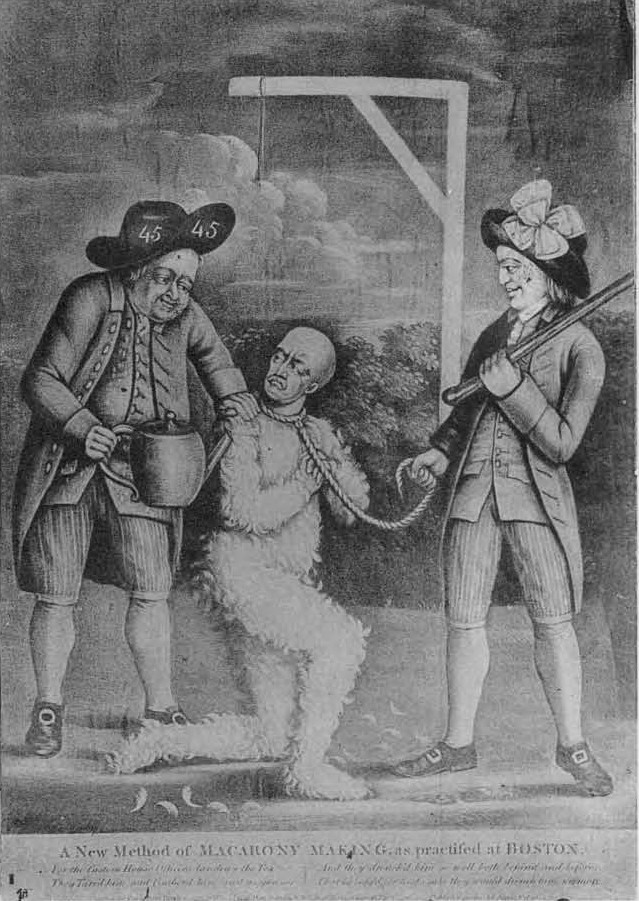
“Carting the feather’d Informer thro’ the principal Streets in Town”

John Mein going under cover didn’t end the violence in Boston on Saturday, 28 Oct 1769. In fact, that date saw the town’s first tarring and feathering.

Though Boston became notorious in the British Empire for tar-and-feathers attacks in the 1770s, the town adopted that form of public punishment late. The first documented example took place in Norfolk, Virginia, in 1766.

A couple of years later, crowds used tar and feathers three times in Salem and once in Newburyport. (With typical Massachusetts chauvinism, Judge Peter Oliver later wrote that the ritual was invented in Salem.) In his 2003 article for the New England Quarterly, Ben Irvin then listed incidents in New Haven, New York, and Philadelphia.

In all those attacks, the victims were men who worked at a low level for the Customs service or were thought to have given Customs officers information about smuggling. Several were identified simply as “informers.” The attackers were usually sailors and waterfront workers directly affected by Customs seizures. The 16 Oct 1769 Boston Gazette and Boston Evening-Post reprinted a favorable report on the New York attack. (Irvin lists two attacks in that city, based on reports with differing details, but an item in the 5 Oct 1769 New-York Journal shows they were the same event.)

Many histories of pre-Revolutionary Boston depict the tar-and-feathers attack as an outgrowth of the uproar over Mein. Indeed, witnesses of the time had to sort them out. Province secretary Andrew Oliver wrote on 11 November:
Just before Sunset I heard that Mr. Mein had fired a pistol upon some people in the street & had betaken himself to the Main guard for protection. Soon after this there was a great noise of halloing & huzzaing by people who I could easily perceive shifted their Stations, by the Noise coming from different quarters successively: upon which I concluded that the populace had got Mr. Mein & were carrying him about the Town in an abusive manner; but I was afterwards told that it was an informer whom they were serving in this manner. It was thought a lucky incident for Mr. Mein that his Man fell in their way, as it diverted the Attention of the People from Mr. Mein.
However, the Boston Gazette’s sympathetic report on the tarring and feathering says that during the day, before the merchants confronted John Mein, people were already preparing to attack sailor George Gailer. The crowd may have grown larger and more worked up because of the excitement over Mein, but it looks like the two incidents developed independently and in parallel. The upper-class merchants confronted the printer while working-class sailors lay in wait for one of their own. We historians might have been tempted by the longer paper trail and political roots of the Mein attack to treat the other event as subordinate.

Here’s the Boston Gazette report from 30 Oct 1769, which also appeared in the Boston Evening-Post:
Saturday Afternoon, a Person who lately belonged to the Sloop Liberty, and came round to this Place in the Sloop Success from Rhode Island, and soon after his Arrival informed of her having a Cask or two of Wine on board, which occasioned the Vessel’s being seiz’d, was discovered and pursued, but took Shelter in a House where he secreted himself till the beginning of the Evening, when thinking the Coast clear he ventured out, but, the Avenues to the House being strictly watched the whole of the Time, he was immediately seized upon by the Populace, and soon placed in a Cart, his Jacket and Shirt taken off, and his naked Skin well tarr’d and feather’d; they oblig’d him to hold a large Glass Lanthorn in his Hand that People might see the doleful Condition he was in, and deter others from such infamous Practices:—

He was then carted from the Town-House thro’ the main Street up to Liberty Tree, amidst a vast Concourse of People, where he was made to swear never to be guilty of the like Crime for the future; but in their going thither, as they pass’d Mein and Fleming’s Printing-Office a Gun was fired from thence and two others snap’d at them just as they got by, upon which some of the Company rushed into the Office in order to secure the Offenders, but they had fled; however they bro’t off three Guns, two of them well charg’d, as Evidence against them whenever they can be taken:—

This imprudent Conduct of those in the Printing Office (for what Reason we know not, as no injury seemed designed them) did not interrupt the Carting the feather’d Informer thro’ the principal Streets in Town for about three Hours, when they bro’t him back to Kingstreet, and after renewing his Obligation of behaving better for time to come, and asking Pardon for his past Offence, he was dismissed without further Damage, after having his Cloaths returned him again, and then all peaceably dispersed about Nine o’Clock.
A few more observations about this article. First, historians often report Gailer’s service on the Customs sloop Liberty, which would make this yet another Liberty riot tied to North America’s resistance to the Townshend duties. It looks like his more recent informing about the “Cask or two of Wine” (the same issue as in the New York attack) was the bigger reason.

Second, in a letter Mein complained that after threatening him the Boston crowd “attacked the House & Printing Office, broke open the great Gate, & our other Doors, and our Ware room.” Was he referring to the same forcible search this article described? If so, that’s another example of an event pegged to Mein that had at least a mix of motives. The crowd didn’t go the print shop immediately after the confrontation on King Street. They went by during their procession that night, perhaps even making a special stop to jeer the people inside. Gunfire from inside prompted people to break in and seize weapons.

TOMORROW: More on the shots from the printing office.

Saturday, August 31, 2019

“Cheat them much as you can of ye Duties”

The Connecticut merchant Nathaniel Shaw, Jr., shipped a lot of molasses to merchants in New York and Philadelphia. Since there was very little sugar cane grown around New London, he was buying that commodity in the Caribbean—mostly from French and Spanish colonies.

Under the Sugar Act of 1764, every gallon of molasses imported into British North America carried a duty of 3 pence. (There were duties on other goods as well.) Ships had to carry papers declaring how much molasses and other stuff they carried. When a crew landed cargo at a particular port, the Customs office there collected the duty and “cleared” for shipment anywhere else within the empire. 


Shaw’s letters show he was constantly betting on which port would offer the best price for his molasses. The duty was the same in every port, but Shaw also did his best to minimize the tax he had to pay. And he was blatant about evading duties.

Here are samples from Shaw’s correspondence with his main trading partners showing the many tricks he and his captains used.

On 9 June 1766 to Peter Vandervoort at New York:
(…I want [Abijah] Bebee to to Land his Cargoe without Entring and Return to New Londn. and take another Cargoe of molasses on Board & Return to New York with the Same Clearance if you think it may be done, wich I leave to you) for I Cannot Clear out any more Molasses att the Custom House haveing all Ready Cleard as much as have pd. the Dutys for
Two shipments using the same certificate of duties paid.

On 14 July 1766 to Vandervoort:
I have shipt you by the bearer Abijah Bebee Ten hogsheads and Five Terses of Molasses wich is not Cleared in the Custom House and would have you do the best in Landing and Disposing of it
On 18 July 1766 to Vandervoort:
I have by the Bearer Capt. [William] Hancock shipped you as pr the Inclosed bill of Lading thirty Four Casks of Molasses wich I have Clear’d att the Custom house att about sixty Gallon. they being very large Casks I would have you dispose of them before Hancok hauls into the Dock and then have them Carried off Immediately, as I Imagine if any of the Custo. House Officers should see them they would take notice of their being very large and Possible have them Gauged Again, wich I should not Choose to have done.
Underreporting the size of the casks and working fast so the authorities wouldn’t notice.

On 1 July 1767 to Thomas and Isaac Wharton of Philadelphia:
I…should have wrote you before but have been Endavoring to find what Pretentions your Collector had for obliging you to pay 1d. Sterg. pr Gallon on the Molasses after it had paid the duty in this Port, and am Inform’d by Persons who know as much about Acts of Parliment as Mr. [John] Swieft that it is not the Intention of the Act that Molasses should pay the Duty more than Once, and I should Imagine that when Mr. Swieft finds (wich is Certainly Facts) that no Other Collectr. on the Continent takes the duty but himSelf he will Repay you the money back Again on that Accott.

I shall let the matter Rest a little longer, and if I Find that he Continues to keep the Duty, I shall Imploy an Attorney to git it from him att Common Law and make no Doubt but I shall be Able to Recover it.

If Molasses should take a Rise let me know it and if I should have any Arive will order it to you without Entring of it hear.
Threatening to sue the Customs service for collecting duties twice because he cared so much about following the law. Also, not paying duties in the first place.

On 5 Oct 1769 to Vandervoort:
I have also by Capt. [Edward] Tinker shipt Six hogsheads of Rum and Four Terses for Mr. John Wattles which he would have you forward as pr the Inclos’d Directions and send Ten Keggs of Brandy as I did not Choose to send any by Tinker. I hope you’l have the Terses taken out Soon as they may appear Suspicious.
Unloading quickly before officials could notice.

On 14 Feb 1770 to Vandervoort:
Yesterday Capt. [Joseph] Latham arived in a Sloop of mine from Cape Francoise and I am now Loading Harris with molasses and Sugars for N Y, the Sugars shall Clear as Seads.
On 14 May 1771 to the Whartons:
Inclosed is a bill of lading of 45 hhds. & 9 teirces of Melasses, and Ten hhds. of Sugar by Capt. Powers. . . . Their is only two hogsheads of Sugar cleared out, and you must get the Remainder on shore in the best manner you can. I have put 19 bags Coffee on board which is cleared out as Cocoa, you must manage that in the best manner you can.
Mislabeling cargo, and getting casks “on shore in the best manner you can.”

On 17 May 1771 to the Whartons:
I have by the bearer Capt. Edwd. Tinker in the Sloop Sally, Shipt you seventy four hogsheads of Melasses, and thirteen hogsheads Sugar, which dispose of for my Accott. The Sugar is in Melasses Hogsheads & you must Land them in the Safetest manner you can, for I Could not Clear them out.
11 Nov 1772 to the Whartons:
I Should have wrote you by the last Post but was att New Port on a very Disagreable Errand. A Brigg of mine from Guadalupe with Two hundred hogsheads of Melasses, by Stress of Weather was drove into New Port and the Custom House Officers Oblig’d him to Enter his Cargoe and the Stupid fellow Reported only Seventy hogsheads and they have made a Seizure of the Remainder. I have Sent a Petition to the board of Commissioners att Boston praying that it might be Admitted to an Entry. How farr they will be prevaild on, time only will Discover. In Case its Condemn’d they flatter me that I Shall have it att About Seven pence Sterling pr Gallon.
Even if the Newport Customs office confiscated the 130 extra hogsheads, officials suggested that at auction he should be able to buy that molasses back at a good price.

On 2 Jan 1773 to Vandervoort:
I wrote Messrs. Whartons for a full Load for [Edward] Chappell, and I now send him with a Load of Sugars and have only Clear’d out Seventeen hogsheads and think the best plan will be for him to enter at New York and apply for Liberty to take in those twenty Casks he brought down before, and git Certificates for abought Twenty more and go on to Phila. or if you think their is no danger let him go on with his Clearance for the 17 hhds. but am really afraid of the Consiquence and think it best to Clear out some more at N York.

In Case Chappell cannot git up to Phila. by reason of the Ice, I would have him return to N. York, and if you can not get 48/ pr Ct. for his Sugars, I should be glad to have him Cleared out for Boston, and let him take out a new Register in his own name as I do not choose to have the Sloop go their with the old Register.
Duplicate paperwork.

On 13 July 1774 to Vandevoort:
The bearer [Capn?] Tinker has on board about twenty thousand Gal Melasses in the Brig Mermaid wich you must dispose off on the best terms you can for my Interest. We have reported 150 hhd & 50 Teirces. I beg you will Cheat them much as you can of ye Duties.
Shaw and Tinker had reported 15,000 gallons in hogsheads and another 3,300 in the smaller casks called tierces, or about 10% short of what they actually had brought in. So any way that Vandervoort could “Cheat” on the duties was added profit.

Given Shaw’s normal way of doing business, Capt. William Reid probably had good reason to be suspicious when he saw two of the merchant’s ships rendezvousing in Long Island Sound on 17 July 1769. Once Reid had seized those ships, Shaw came roaring into Newport to get them back.

It’s possible that Shaw didn’t plan to extend his repertoire of resistance to include holding Reid hostage, inciting a riot, ruining the Customs sloop, and absconding with his sloop. But that’s what he and his men and the Newport crowd ended up doing.

Friday, August 30, 2019

“I am as Inocent of Destroying the Sloop as Either of you”

In 1933, the New London County Historical Society published the second volume of its collections, titled Connecticut’s Naval Office at New London During the War of the American Revolution.

The Continental agent in that port was Nathaniel Shaw, Jr. (1735-1782). As an addendum to the collection of public papers, the society’s editor and honorary president, Ernest E. Rogers, included a transcript of Shaw’s letterbox as a merchant in the years before the war.

That source from Shaw’s own hand confirms his connection to the ships involved in the Liberty riots in Newport, Rhode Island, and New London, Connecticut.

On 12 June 1769, Shaw wrote to a man he called Theopulas Backe: “Sir, Inclosed is a letter from Capt. Joseph Packwood which he desir’d might be forwarded to you. He is now in the West Indias, and when he will Return is Uncertain.” Packwood returned to Long Island Sound with Haitian sugar and molasses the next month.

Eight days later, Shaw wrote to his regular trading partners in Philadelphia, Thomas and Isaac Wharton:
I wrote you ye 16 Inst. by Capt. Edwd. Tinker ye Sloop Sally who had on Board 121 Casks of Melasses, who was to Proceed to N. York & in Case ye price of Melasses was not Equal to what you wrote [me?] by the Post, I gave him Orders to Proceed to Philadelphia & deliver his Cargoe to you.
The Customs sloop Liberty seized Tinker’s Sally and Packwood’s Thames in July. Shaw and Packwood went to Newport to get them back. And one riot later, they went home.

As I reported yesterday, in September the New London Customs office seized the Sally again.

Here’s what Nathaniel Shaw had to say about that situation in a 14 Sept 1769 letter to John and George Erving of Boston:
Gentlemen, I Received yours of the 28th Ulto. and am very much Oblig’d to you for your Advise in Regard to the Prosecution that is Intended Against me.

Att Present I Cant Conceive on what Accott. they Intend to trouble me, as I am as Inocent of Destroying the Sloop [Liberty] as Either of you, and can make it Appear so to the Sattisfaction of any Court or Jury in this Colony, and I am of the Opinion if I can do that, it will be Suffecient and In Case they are Determined to have the Matter try’d in Boston att a Court of Admiralty, should be glad you would Inform me in your next what method they are to take to Oblige Either Packwood or me to Appear their or if it goes Against us by Default what Plan they are to Persue to get the Money. Att Present we have no Judge of ye Admiralty in this Colony and I beleive no Person hear would att this time Except of it.

Mr. [Duncan] Stewart has Seiz’d a Sloop which he Suspects is the Sloop that was Carried of[f] att N Port the Night the Liberty was Destroy’d. It is now Seventeen days Since the Seizure was made and he has done nothing towards having her Libel’d. Neither can he git any advise from the Commisoners what steps to take with her, he has no Evidence hear to Prove this to be the Sloop, nor Cant have any, unless Capt. [William] Read or some of his People should come hear, & I beleive it will not be Convenient for them to make their appearence very Soon and haveing the Sloop detain’d so long must Consequently Create an Expense which must fall some where,

I Proposed to Mr. Stewart to have ye Sloop Appriz’d as she now is & give him Security for ye Vallue In Case she be Finally Condemn’d, that we might go on with her Repairs as she wants much before she is in a Condition for the Seas, I should be glad you would Consult some Person who can Advise me in this matter, what steps to take for I Suppose Mr. Stewart will not do any thing untill he has Orders from ye Commisoners.
Shaw’s letterbook doesn’t tell us directly whether Collector Stuart accepted his proposal. But he must have gotten his sloop back because on 17 May 1771 he wrote to the Wharton brothers again:
I have by the bearer Capt. Edwd. Tinker in the Sloop Sally, Shipt you seventy four hogsheads of Melasses, and thirteen hogsheads Sugar, which dispose of for my Accott.
Shaw insisted he was innocent of destroying the Liberty, that the Customs sloop hadn’t caught his Sally, and by extension that he wasn’t in the business of smuggling molasses.

TOMORROW: What Shaw’s other letters have to say about that.

[The photo above, courtesy of Historic Buildings of Connecticut, is Nathaniel Shaw’s house, now owned by the New London County Historical Society.]

Thursday, August 29, 2019

“Having made Seizure of a Sloop named the Sally”

As I’ve been relating, July of 1769 was not a good month for the royal Customs service in New England.

On 19 July, a Newport mob had ruined the Customs patrol ship Liberty after threatening its captain and crew. The next day, with no armed vessel to stop them, sailors “rescued” a sloop named Sally that the Liberty had seized. The captain of another ship detained at the same time, the brig Thames, successfully demanded that his vessel be released for lack of evidence.

On 25 July, a smaller mob in New London beat up one Customs officer and intimidated others. And on 31 July, the hull of the Liberty caught fire and burned to the waterline, rendering it beyond repair.

It took a while for the Commissioners of Customs in Boston to respond, but in August they made a move. On 14 August this advertisement appeared in the Newport Mercury:
WHEREAS William Reid Commander of the Sloop Liberty, employed in the Service of his Majesty’s Customs, having made Seizure of a Sloop named the Sally, Edward Finker Master, belonging to New-London, loaded with a Cargo of prohibited Goods, carried the same into the Harbour of Newport, Rhode Island, where a great Number of People, riotously and tumultuously assembled together, in the Evening of the 19th of July last, and having, by Force and Arms, attacked and secured the said Captain Reid and his Men, and taken Possession of both Vessels; they set Fire to, and sank the Liberty, and carried off the Sloop Sally:

For the apprehending, and bringing to condign Punishment, the Persons concerned in this daring and atrocious Outrage, The Commissioners of his Majesty’s Customs do hereby promise a Reward of One Hundred Pounds Sterling, to any Person or Persons who shall inform against any of the Offender or Offenders (except Nathaniel Shaw, Joseph Packwood and —— Angel;) to be paid on his or their Conviction.

By Order of the Commissioners,
RICHARD REEVE, Sec’ry.
This advertisement and Capt. Reid’s report to the head office referred to the captain of the Sally as Edward Finker. However, other sources make clear his name was Edward Tinker. A handwriting error, or had he given the authorities a false name?

As for the other men named in the ad, Nathaniel Shaw, Jr., was the owner of the Thames and the Sally. Joseph Packwood was captain of the Thames. James Angel or Angell worked for Shaw as a captain after 1774; at this time he might have been a mate. The parenthetical phrase with their names is placed ambiguously, but I think the commissioners meant those three were ineligible for the reward since they had carried out the crime.

As good bureaucrats, the commissioners also set out to close the books on the Liberty project. On 4 September, this ad ran in the Boston Evening-Post:
All Persons who have any Demands for Stores, Carpenter’s Work, Provisions, &c. upon Account of the Sloop Liberty, lately employed in the Service of his Majesty’s Customs, are hereby desired to send in their Accounts forthwith to Messrs. Green & Russell, Printers at Boston. Sept. 2. 1769,
Green and Russell were the printers of the Boston Post-Boy, which got the bulk of the Customs office printing business—at least until John Mein came to town. It’s striking that they were collecting bills for work on the Liberty rather than the Customs staff, but probably more artisans felt safe walking into their print shop than into the Customs house on King Street.

According to Joseph R. Frese’s article, in all the Customs service paid £980 to fit out the Liberty as a patrol vessel, plus £371 for “maintenance.” To be sure, most of that money went to shipwright Robert Hallowell, brother of Customs Commissioner Benjamin Hallowell.

Then the Customs service caught a break—and a ship. The 11 September Boston Evening-Post reported:
We hear from Norwich, that last Wednesday se’nnight a small Sloop was seized there by Duncan Stewart, Esq; Collector at the Port of New London, upon information that it was the same Sloop lately seized by Capt. Reid, in the Sloop Liberty, and carried into Newport, and thence rescued.
The Customs service had the Sally in custody again.

TOMORROW: Nathaniel Shaw wanted his sloop back.

Wednesday, August 28, 2019

New London’s Liberty Riot

Newport, Rhode Island, wasn’t the only New England town that saw disturbances connected to the Customs sloop Liberty in July 1769. There was also violence in New London, Connecticut.

In fact, the whole affair started with action off New London. Treasury Department documents that Joseph R. Frese cited in this article from the Colonial Society of Massachusetts reveal more details than I knew last week.

On the morning of 16 July, Capt. William Reid of the sloop Liberty stopped two vessels in Long Island Sound about three miles from the New London lighthouse. One was the brig Thames, commanded by Joseph Packwood. The other was the sloop Sally, commanded by Edward Tinker. Both those ships were based in New London, but the Thames was nominally sailing from Haiti to New York.

As some New England newspapers reported, Reid suspected that Packwood had unloaded some of his Haitian rum and sugar onto Finker’s sloop so it could be landed secretly on the Connecticut coast and the Customs department couldn’t collect duties on it. Then he’d deliver the rest in New York.

Reid put his own men onto the brig and sloop and led the little fleet into Newport. Packwood, Finker, and most of their crewmen had to make their way home in boats. Soon after Packwood landed, he and the owner of the Thames, Nathaniel Shaw, Jr., set out for Newport. We know what happened there on 19 July. By the next day, the Liberty was wrecked, the Thames released for lack of evidence, and the Sally illegally “rescued.”

Back in New London, the waterfront crowd went hunting for the local Customs officers whom they held responsible for those seizures. Deputy Collector John Miller and Comptroller Thomas Moffatt reported that on 24 July “several People” threatened a tidesman named Barnabas Willson. They wrote, “on this occasion We said what We then thought was proper to him & took such steps as inclined Us to hope and beleive that no mischief would happen to him, but We were mistaken if not deceived.” Dr. Moffatt had been the victim of mobbing during Newport’s Stamp Act riots, so he should have known better.

Whatever “steps” those officials took, it wasn’t enough for Willson’s sake. In “the twilight of the Evening of the 25th,” the crowd came looking for him again, as well as another tidesman named John Bloyd. The Customs officers wrote of Bloyd:
not finding him at home they suspected he was in the House of Mr Collector [Duncan] Stewart where they repaired and demanded him but being denied and refused admittance by a Maid Servant from the Window of an upper Chamber they broke forcibly into the House search’d every where and found him on the House top, from which they led him through the Street near the Episcopal Church and there questioned him concerning the Information given to Captain Reid and chiefly about some Rum seized & afterwards stolen at East Haddam a year and a half ago then they dismised him without further Injury
The crowd turned back to Willson. That man himself later told justice James Murray of Boston:
they seized this Deponent Drag’d him thro’ the Streets, strip’d him of his Cloaths, tied him to a sign Post (having cut off his Hair) and then gave him Thirty two severe lashes with a Whip.
By then it was “about Eleven OClock at night.” Some of the rioters went to find Thomas Dare, the Customs office surveyor—a social step up from the tidesmen. Those men took Dare to the place where they had tied up Willson. They “questioned him concerning the late seizure and seemd disposed to Use him very roughly, but were prevented by the Interposition of some who either rescued or beg’d him off.”

Finally, the New London crowd attacked the top local Customs official symbolically, the same way Bostonians had done in June 1768 and Newporters had done a few days before. The men
repaired to Mr Stewart’s Wharf seized the Boat hauld her ashore hoisted her sails with all Appurtenances except the Iron Ballast which they threw on shore, then drag’d her in triumph to a rising ground near the Town where they burnt her, on the Morning of the 26th very early
That makes a total of four burned boats, with the Liberty itself still to come.

Miller and Moffatt reported that “poor Willson set out on foot for Boston who can inform your Honors more exactly of this Mob and of what has been said and done to him.” In Boston, Willson testified to Justice Murray and reported to the Commissioners of Customs, who gave him £2.5 for his troubles.

Surveyor Thomas Dare “thought it best to retire for the present,” his colleagues reported, though by the end of 27 August they expected him to “return here this day and We have some assurance that he will not be insulted.”

TOMORROW: The Customs service strikes back.

Monday, August 26, 2019

“They must be Sent directly, or by God, I should never See the Morning”

Last week I guessed that the Boston Chronicle’s 24 July 1769 account of Newport’s Liberty riot reflected the perspective of William Reid, commander of that sloop for the Customs Commissioners.

It turns out we have Capt. Reid’s description of the event in his own words, preserved and published in Connecticut. Dated 21 July 1769, Reid testified:
On the Evening of the 19th Inst. between Seven & Eight OClock, as I was going down the Long Wharfe to go on Board the Sloop Liberty, A Vessell then under my Comand, employed in the Service of the Revenue, I was, of a sudden, surrounded by a great Number of Men, some of which seized hold of me,

upon asking what they wanted I was answered that I was a Damn’d Rascal, & that they had now caught me, I asked what I had done to any of them, they Answered that I had Seised many of their Vessels & by God I should now pay for all,

the first Person that I knew in the Mob was Jos: Packwood, Master of the Brigantine Thames, A Vessell which I had detained, he told me that some of my People, on Board of the Brigantine had used him very Ill,

soon after Nathl. Shaw, Owner of Brigantine Thames came up to me, & told me that I had not five minutes to Live, if I did not order Two Frenchmen on shore, which was then on Board of the Sloop Liberty, that I had taken out of the Sloop Sally, a Vessell then under Seisure,

I told them I had no design in keeping those Frenchmen, & that they should come on Shore, provided the Mob would not hurt them, which they declared they would not, they were brought on shore,

the Sd. Packwood then mentioned to the Mob that John Carr second Mate of the Liberty had used him ill & had ordered the People on Board of the Liberty to prevent his going on Shore in the Brigantine’s Boat, by Firing at him, & further said, that they did fire at him, & that he wanted them to be brought ashore to be delivered up to a Magistrate,

the Mob, then with Threats of Violence, against my Life, Insisted, that I should Order Said Carr & John Freeman Pilot to be brought to Justice,

I proposed to send them on Shore in the Morning, but was answer’d they must be Sent directly, or by God, I should never See the Morning,

being in this Defenceless condition, I found myself under the Necessity of Complying with every thing they had a Mind, to propose, & accordingly ordered them on Shore,

as Soon as they came the Sd. Packwood again Addressed himself to the Mob & told them there was another Mate, that had fired at him, from on Board the Sloop Sally,

The Mob ordered that he might be bro’t also, which was accordingly done.

I desired that they would let me go on Board of the Liberty, & that if there was any Person on Board, which had been guilty of any Indiscretion, I would deliver him up to Justice directly.

They told me I should not go off the Wharf Alive nor any of my People, if I attempted to go, & insisted, that there was another Man on Board, which was concerned in firing at Capt Packwood, & that they would have him on Shore likewise, they then Man’d two Boats, one of which put off to go on Board to search for the aforesd. Man,

[Joseph] Adams then Comanding Officer on Board of the Liberty, called to me, to know, if they should go on Board,

as I thought to refuse, their going on Board, would perhaps exasperate the Mob to some Acts of Violence against the Sloop Liberty I told him to permit them which he did,

the Boat then returned with Two of the Men, that went in her, & one of mine, the Mob then seemed more Satisfied,

I asked them again to let me go on Board my Vessell, which they refused. But told me I might go to my Lodgings, about 11 oClock, I got clear of the Mob & went directly to Charles Dudley Esqr. Collr. of His Majesty’s Customs for his Assistance who advised me to apply to the Govr. [Joseph Wanton] which I did by Letter requesting His Honor to use his Authority in preventing the further Violence of the Mob, against the Sloop Liberty, & the two aforementioned Vessels.

About four O’clock in the Morning, as soon as I thought the Mob was disposed, I went to go on Board of the Sloop Liberty, But found her cut from her Anchors, & laying on Shore, with her mast cut away by the Deck, her Sails & Rigging all Cut to pieces. Two of her Guns, all her Swivels & small Arms, hove over Board her Bottom Scuttled, her two Boats Burn’d, my Cabbin tore all to Pieces, & all my Furniture Cloaths Papers & every thing belonging to me Destroyed.
Duncan Stuart and Thomas Moffatt, the top two Customs officials in New London, had the number-three man, surveyor Thomas Dare, carry Reid’s testimony to Hartford. They wanted William Pitkin, governor of the colony, to help in prosecuting Shaw and Packwood.

According to the governor’s files, “Govr Pitkin gave a general prudent Answer to the foregoing Matters, that entirely satisfied the Officers of the Customs at New London.” Which suggests he didn’t help that much, but the Customs officials had little opportunity to appeal because Pitkin died on 1 October.

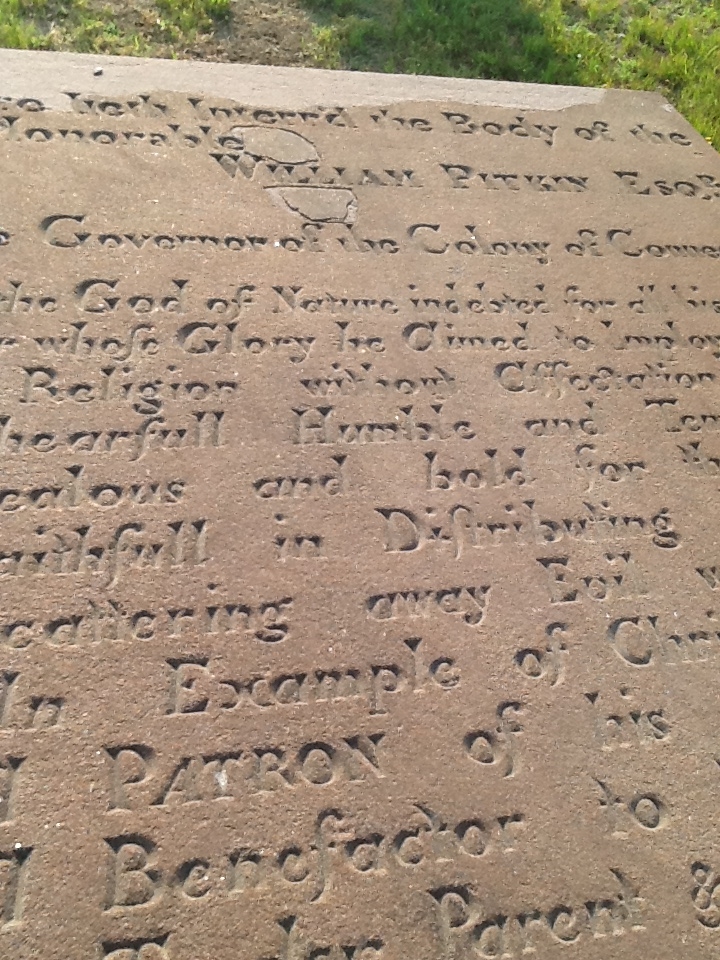
(The picture above shows Gov. Pitkin’s grave, as photographed by Lori for Find-a-Grave. It’s quite wordy. It describes Pitkin as “Zealous and bold for the Truth, Faithfull in Distributing Justice, Scattering away Evil with his Eye…”)

COMING UP: The Customs service strikes back.

Thursday, August 22, 2019

Wanted by Governor Wanton

The official Rhode Island response to the destruction of the Customs sloop Liberty in Newport harbor started even before the ship went up in flames. 

A mob attacked the ship on 19 July. Two days later, this proclamation appeared, as printed in the newspapers: 
By the Honorable
Joseph Wanton, Esquire,
Governor, Captain-General, and Commander in Chief, of and over the English Colony of Rhode-Island, and Providence Plantations, in New-England, in America:

A PROCLAMATION.
Whereas, Charles Dudley, Esq; Collector and Surveyor, and John Nicoll, Esq; Comptroller, of His Majesty’s Customs for the Colony aforesaid, have this Day presented unto me a Memorial, setting forth, That a Number of People on the Nineteenth Instant, in the Evening, being assembled in a riotous and tumultuous Manner, did, with Threats against his Life, compel Captain William Reid, Commander of the Sloop Liberty in the Service of the Revenue, lying in the Harbour of Newport, to order the People who had the keeping and Charge of his Vessel, to come on Shore; after which a Number of Men boarded the said Sloop, and set at Liberty a Sloop brought into this Port by the said William Reid, laden with prohibited Goods and under Seizure, and she was afterwards carried away to the great Prejudice of his Majesty: And that they then proceeded to destroy the said Sloop Liberty, by cutting away her Mast and Rigging, and scuttling her so that she sunk; and burnt her Two Boats:

I HAVE, THEREFORE, thought fit, by and with the Advice of such Members of his Majesty’s Council, as could conveniently be called together, to issue this Proclamation, hereby directing and requiring all the Officers of Justice, in this Colony, to use their utmost Endeavours, to enquire after and discover the Persons guilty of the aforesaid Crimes, that they may be brought to Justice.
Many of the men who had attacked the Liberty on 19 July probably came off Capt. Joseph Packwood’s brig, based in New London, Connecticut. Packwood had sailed out of Narragansett Bay as soon as he could after the riot. The Rhode Island authorities would therefore have had a hard time tracking down those men—if they even really wanted to.

Ten days after this proclamation, the rest of the Liberty burned on Goat Island. That was more likely a local job, but since it took place away from town on a stormy night, there were no witnesses. Gov. Wanton didn’t even bother to use a new proclamation.

COMING UP: A new lead for the Customs office.

Wednesday, August 21, 2019

Visit Newport in the Summer of 1769, 24 Aug.

On Saturday, 24 August, the Newport Historical Society will host a living-history exploration of “Life During the Burning of H.M.S. Liberty.”

This is the society’s Sixth Annual Living History Event, and its presentations bring in top-notch reenactors from all over New England to explore different events.

Since you’ve read the last three postings, you know all about how what led to the Liberty Customs sloop going up in flames in July 1769, two and a half centuries ago this summer.

The society’s event announcement says:
This one-day event features over 50 costumed historical interpreters who will represent all ages and various stations of life, along with conflicting political viewpoints. Learn and experience aspects of life from 1769 including:
Visit stations around Washington Square such as a tavern, school and printer. Much like the Newport Historical Society’s previous summer History Space events, visitors might find themselves in the midst of hostile debates as the living historians recreate the tensions that surrounded this incident which helped to spark the American Revolution.
“Life During the Burning of H.M.S. Liberty” will take place from noon till 5:00 P.M. in Washington Square and at the Wanton-Lyman-Hazard House, 17 Broadway.

The program is free to all, but donations to the Newport Historical Society are welcome.

(Photo from a past event in Newport by Sarah Long.)

Tuesday, August 20, 2019

The Burnings of the Liberty

The Boston Gazette was the town’s staunchest Whig newspaper, quick to attack royal officials and to defend locals against charges of unrest. But printers Edes and Gill weren’t so protective about other communities.

The Boston Gazette’s first report on the attack on the Customs sloop Liberty in Newport harbor, dated 24 July, had no detail about why people there were so upset at that ship. It had a lot of detail on how the crowd took their revenge:
a Number of Persons…went on board the Liberty as she lay at Anchor in the Harbour, and cut her Cables, and let her drift ashore, they then set her on Fire, but being informed a considerable Quantity of Powder was on board, for fear of endangering the Town, they extinguished it again; then they cut away her Mast, threw her Guns and Stores overboard, entered the Cabin and destroyed the Captain’s and his Wife’s Cloaths, Bedding, &c. broke the Tables, Chairs, China and other Things therein, and did not quit her till 3 o’clock in the next Morning, when, after scuttling the Vessel, they left her a meer Wreck, and now remains sunk near one of the Wharfs there.
The 24 July Boston Chronicle also mentioned how people had started to burn the ship, but gave a different reason for them stopping:
They also set fire to the sloop, but it being nigh a warehouse and some vessels where she was run on shore, they extinguished it for fear of the flames spreading.
The Providence Gazette of 22 July took more effort to protect local reputations by pointing the finger at men from the next colony over:
a Number of Men, chiefly from Connecticut, went on board, and after cutting away her Mast, and rendering her unfit for Service, they threw every thing that was valuable overboard, and scuttled the Vessel, after which they quietly dispersed.
Both that paper and the 24 July Newport Mercury omitted any mention of people trying to set fire to the ship.

A week later, on Monday, the Newport Mercury reported a new development:
Last Saturday Afternoon the Sloop Liberty was floated by a high Tide, drifted over to Goat-Island, and is grounded at the North-End, very near where the Pirates were buried; what this prognosticates we leave to the Determination of Astrologers!
And what do you know? The Liberty caught on fire again that very night! At least, that’s how the Rhode Island newspapers told it. On 5 August, the Providence Gazette reported:
Saturday last the Sloop Liberty was drifted by a high Tide to Goat-Island, since which we are informed she has been set on Fire by Lightning, and nearly consumed.
Two days later the Newport Mercury stated:
Last Monday Evening, just after the Storm of Rain, Hail, and Lightening, the Liberty Sloop, which we mentioned in our last to have drifted to Goat-Island, near where the Pirates were buried, was discovered on Fire; and she continued burning for several Days, till almost intirely consumed.
The Liberty was not the first royal government vessel that Rhode Islanders had burned in recent years, and it would not be the last.

TOMORROW: A sestercentennial commemoration.

Monday, August 19, 2019

Captain Reid versus Captain Packwood

Yesterday I shared an official description of the confrontation in Newport, Rhode Island, over the Customs ship Liberty on 19 July 1769.

By “official” I mean that the town’s Whig leadership supplied that text to the Newport Mercury. They sent similar letters to sympathetic printers in Providence and Boston. Naturally, their account put the crowd’s assault on royal property in the best possible light.

Some newspapers printed less favorable accounts. For example, the 24 July Boston Chronicle reported that the brig and sloop seized two days before the riot weren’t just random ships. Capt. William Reid of the Liberty had “information” that Capt. Joseph Packwood had shifted “brandy, wine, &c.” from his brig onto the sloop so that it could be landed secretly. He therefore stopped both ships, sent away their crews, and had his own men sail them to Newport.

The Chronicle also provided more details about Capt. Packwood’s return to his brig while it was in Customs department custody:
On the Wednesday following, Capt. Packwood went on board the brig to get his cloaths to be washed, and asked for his sword, all which, the commanding Officer on board refused to deliver him; but which, after some altercations, he took possession of and put into the boat, and was rowing on shore, when the people on board the brig hailed the sloop Liberty, and told the Commanding Officer, (Capt. Reid not being on board) that Capt. Packwood had used them very ill, and desired him to bring the boat too,

on which some person on board the Liberty fired a musket with a brace of balls at Capt. Packwood, one of which went but a few inches over his head, and the other over the heads of some people standing on the wharf, they afterwards attempted to fire a swivel, but it only flashed, and Capt. Packwood pushed on shore.
[Let me point out this is yet another period description of a musket being loaded with “a brace of balls,” or two balls.]
By this time a number of people assembled, who with Capt. Packwood went in search of Capt. Reid, whom they soon met in the street, when they demanded the reason of the insolent behavior of his people?

Capt. Reid told them that he was ignorant of the affair, was extremely sorry for what had happened, that he would deliver up the people who had fired, to be punished according to law; and proposed to go himself on board and fetch them on shore:—This the people would not permit, but insisted on his going to hail the sloop and ordering them to be immediately sent on shore.——

This was complyed with, and a boat was sent off for them, which soon returned with two of the sloop’s hands, but the people declaring these were not the persons who had fired; the boat was sent on board a second time, and brought two others, but these likewise being declared not to be the persons, the board was again sent off and brought some others, till there were only two left on board belonging to the sloop; soon after which, some people who had tarried on board the sloop, cut her cables and ran her on shore, threw the guns overboard, cut away the mast, rigging, &c. and scuttled her:
I suspect some of this account came ultimately from Capt. Reid since it reflects well on him—justified in his seizures, blameless for the crew’s shots at Packwood, powerless to stop the mob. In contrast, the Whigs’ letter complained that “no Proof appeared against the Brig” and that Reid “had never condescended to exhibit his Commission to the Governor of this Colony.”

Both reports depict the Newporters as trying to enforce local law against the Customs ship sailors. That’s similar to the conflict going on in Boston over whether British soldiers had to obey local watchmen and magistrates. But in the Chronicle that demand for the rule of law seems more like a smokescreen to move sailors off the Liberty until it had only a couple of defenders.

TOMORROW: The final fate of the Liberty.

Sunday, August 18, 2019

The Second Liberty Riot

I’ve been focused on events 250 years ago this week in Boston, but it’s time to look in on other events in New England.

You may recall how in June 1768 the Customs office in Boston confiscated John Hancock’s sloop Liberty on charges of smuggling wine. That produced a riot against Customs officials, which strengthened the royal government’s decision to station troops in Boston. Months later, the government’s Admiralty Court prosecution against Hancock collapsed.

That didn’t mean he got his sloop back, though. Following the law, Customs officials had put the Liberty up for auction. The winning bid came from…the Commissioners of Customs. Soon the sloop was armed and patrolling out of Narragansett Bay to catch smugglers.

On 10 July 1769 the Newport Mercury reported:
We hear the Liberty Sloop, which sail’d a few Days past on a Cruise, has taken a Prize; but of what Nation, or whither bound, we have not learn’d; but imagine her to belong to some of the North-American Colonies, as the whole N–v–l Force of h–s B—t——c M——y seems to be principally aim’d against those Colonies, notwithstanding they are inhabited by the best Subjects that ever serv’d a King; most remarkable for Loyalty and yielding Obedience to every just and constitutional ACT of Parliament.
The captured brig was out of New London, Connecticut, under the command of Joseph Packwood. According to the 24 July Boston Chronicle, it had just come “from Hispaniola with a cargo of molasses and sugar on board.” The 21 July New London Gazette claimed that Packwood was headed for New York and seized in Long Island Sound.

The same day, the Liberty also seized a sloop, “where belonging and from whence, unknown, having on board brandy, wine, &c.” The New London Gazette said the Customs men left “most of the crew adrift in a leaky old canoe” and sailed away with that sloop.

Two weeks later, the Newport Mercury had more to say:
LAST Monday Morning the 17th Instant [i.e., of this month], the armed Sloop Liberty, commanded by Capt. William Reid, arrived here and bro’t in a Brig and a Sloop belonging to Connecticut, taken in the Sound, without this Colony, on Suspicion of the Brig’s having done some illicit Act, & that the Sloop had contraband Goods on Board; but as no Proof appeared against the Brig, she reported her Cargo at the Custom House here;—

and on Wednesday, no Prosecution having been enter’d against either of them, Capt. Packwood went on Board his Brig in Order to get his Sword and some necessary Apparel, which the Commanding Officer on Board, (one of the Liberty’s Men) refused to let him bring away, and tis said, offer’d him Violence; which reduced Capt. Packwood to the necessity of drawing his Sword, to force his Way into his Boat, whereupon the Officer call’d to the Liberty’s People to fire on Capt. Packwood as he was going ashore, which they did, and a Brace of Balls, tis suppos’d, went very near but did not hurt him; they then attempted to fire several more Guns upon him, which happily all snapped or flashed and cou’d not be discharged.

This Attempt at Violence by the Liberty’s People, whose Commander had never condescended to exhibit his Commission to the Governor of this Colony, so enraged a Number of Persons, that, the ensuing Evening, having met Capt. Reid on the Long-Wharf, they obliged him to send for his Men on Shore, in Order to discover the Man who first fired at Capt. Packwood; upon which Capt. Reid sent for all his Hands except his Mate, afterwards a Number of Persons, unknown, went on Board the Liberty, sent the Mate away, cut her Cables and let her drive ashore at the Point, where they cut away her Mast, scuttled her, and carried both her Boats to the upper Part of this Town and burnt them.—

While this Affair was transacting, the Sloop suspected of having contraband Goods on Board made her Escape; and the Brig has since received her Papers and sail’d last Friday.
Arthur A. Ross’s A Discourse, Embracing the Civil and Religious History of Rhode-Island (1838) said that the crowd which took the Liberty’s boats dragged them
up the Long-wharf, thence up the Parade, through Broadstreet, at the head of which, on the Common, they were burned.— Tradition says, that, owing to the keel of the boats being shod with iron, such was the velocity of their locomotion, as they passed up the Parade, that a stream of fire was left in the rear, of several feet in length.
Meanwhile, the Liberty itself was sitting grounded out on a point in the harbor. 

COMING UP: Lightning strikes?

Thursday, April 11, 2019

The “Hutchinson Letters” Published at Last

I’ve been tracing the maneuvers in 1773 around the “Hutchinson letters.” Benjamin Franklin sent those documents to the speaker of the Massachusetts house under conditions of secrecy. The Massachusetts Whigs nibbled away at the edges of that promise until in June they just decided to publish.

Edes and Gill issued the letters about Massachusetts in pamphlet form. (Their first edition omitted the letters from others about Connecticut and Rhode Island.) Isaiah Thomas’s Massachusetts Spy reprinted them all over the following weeks. Here is a British reprinting of the letters, plus a defense of them and an attack on Franklin for divulging them.

In order of publication, those documents were:
  • Lt. Gov. Thomas Hutchinson, 18 June 1768, on the Liberty seizure and riot.
  • Hutchinson, August 1768, on protests against the Customs Commissioners.
  • Hutchinson, 4 Oct 1768, on unrest and the landing of the regiments.
  • Robert Auchmuty to Hutchinson, 14 Sept 1768, warning about a death threat (enclosed with the above).
  • Hutchinson, 10 Dec 1768, on actions of the Massachusetts Council.
  • Hutchinson, 20 Jan 1769, on Parliament’s relationship to Massachusetts. (This is the letter that stated, “There must be an abridgment of what are called English liberties.”)
  • Hutchinson, 26 Oct 1769, on the non-importation boycott and Gov. Francis Bernard’s departure.
  • Secretary Andrew Oliver (shown above), 7 May 1767, on the problems of an elected Council, his salary, and other matters.
  • Oliver, 11 May 1768, on protests against the lieutenant governor and Customs Commissioners.
  • Oliver, 13 Feb 1769, with ideas for changing the Council to be independent of the lower house.
  • Oliver, 12 Aug 1769 from New York on colonial business, non-importation, and his appointment.
  • Customs Commissioner Charles Paxton, 20 June 1768 from H.M.S. Romney, on the Liberty riot. (Very short.)
  • Nathaniel Rogers (Hutchinson’s nephew), 12 Dec 1768, seeking Oliver’s position if Hutchinson moved up to become governor and Oliver moved up to become lieutenant governor.
As Hutchinson pointed out after the publication, his letters never proposed new laws or changes to the Massachusetts charter. (Oliver mused on such possibilities, and the letters from Rhode Island and Connecticut were open about change.) Hutchinson’s phrase “an abridgment of what are called English liberties” came after a lament about the distance between North America and London; in his mind, it was a statement of regrettable fact, not a prescription.

Neither Hutchinson nor Oliver suggested sending troops into Boston to keep order. As Hutchinson noted, his report on the Liberty riot couldn’t have reached London until the ministry already had those plans under weigh.

Finally, Hutchinson pointed out that in the year before these letters leaked, he had engaged in a public debate with the Massachusetts house about the relationship between the elected colonial government and the royal authorities, making the same points he had made in his letters. So how could he have engaged in a secret conspiracy?

Nonetheless, the letters destroyed Hutchinson’s credibility and political career in Massachusetts.

TOMORROW: What was wrong with the letters.