J. L. BELL is a Massachusetts writer who specializes in (among other things) the start of the American Revolution in and around Boston. He is particularly interested in the experiences of children in 1765-75. He has published scholarly papers and popular articles for both children and adults. He was consultant for an episode of History Detectives, and contributed to a display at Minute Man National Historic Park.

Subscribe thru Follow.it


•••••••••••••••••


Showing posts with label John Dunlap. Show all posts

Monday, July 06, 2026

How Philadelphia Printers Shared News of the Declaration

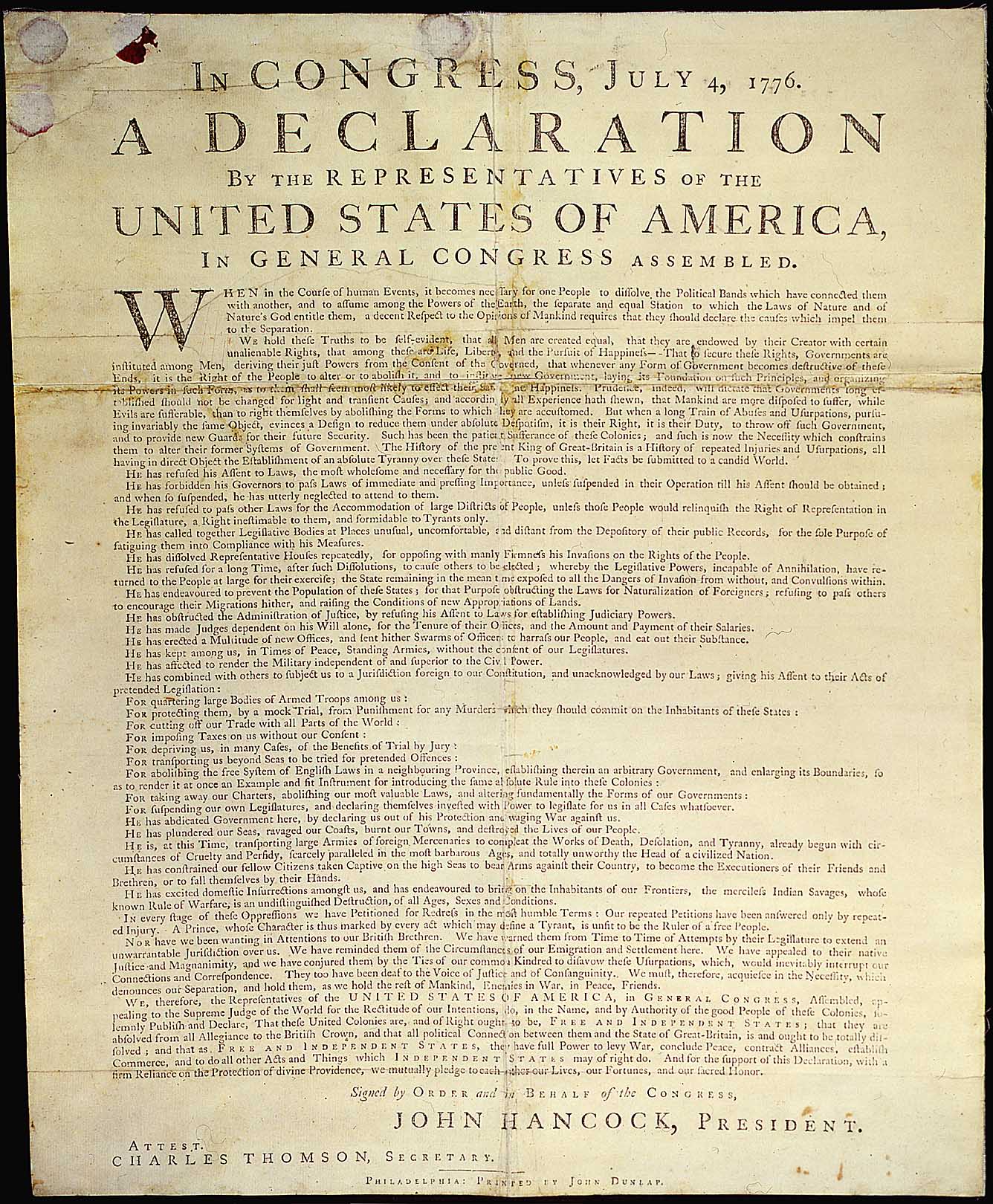
John Dunlap printed official broadsides of the Declaration of Independence for the Continental Congress, but other printers were issuing the same text in other forms.

And that was how the Congress wanted it. The point was to spread the news through newspapers, broadside reprints, and public readings, not to keep it confined.

Back on Tuesday, 2 July 1776, the Pennsylvania Evening Post was the first newspaper to report that the Congress had voted for independence. Since Benjamin Towne and his staff laid out and printed the last page of that paper in the afternoon, they could slip in one more line of fresh news:

This day the CONTINENTAL CONGRESS declared the UNITED COLONIES FREE and INDEPENDENT STATES.
The next morning, David Hall and William Sellers’s Pennsylvania Gazette shared the same item.

The only Philadelphia newspaper to publish on Friday, 5 July, was Heinrich Miller’s Pennsylvanischer Staatsbote, printed in German. Miller ran two paragraphs about independence and the Declaration being on the press at the start of his local reports.
On Saturday, 6 July, 250 years ago today, the Pennsylvania Evening Post ran the full text of the Declaration starting on the front page. Towne’s print shop had probably laid out that text the previous day since newspapers usually printed the front page first.
Only a few Americans saw the Dunlap broadside and other government publications, but thousands would read the Declaration text in newspapers over the following weeks.

Sunday, July 05, 2026

John Hancock’s Enclosures

The Continental Congress approved its edited text of the Declaration of Independence in the middle of the day on 4 July 1776.

The delegates moved on to other business while a clerk—most likely Timothy Matlack—wrote out the final text neatly.

John Hancock signed that document as Congress chairman. Charles Thomson signed as secretary. Then it went to printer John Dunlap.

Years later, a handful of Philadelphians recalled hearing the Declaration, or part of it, read to the crowd outside the Pennsylvania State House that afternoon. This wasn’t the official proclamation, just someone like Matlack sharing news.

Dunlap’s shop set the text in type and printed copies that evening and into the next day. Those broadsheets were to go to the delegates, the army, and the Patriot governments of the new states.

On 5 July, 250 years ago today, Hancock started to fulfill his duty of distributing copies. He wrote to the Pennsylvania Committee of Safety:
I do myself the Honour to enclose, in Obedience to the Commands of Congress, a Copy of the Declaration of Independence; which I am directed to request, you will have proclaimed, in your Colony, in the Way and Manner, you shall judge best.

The American States being now for ever divided from those who wished to destroy them, it has become absolutely necessary for their Security and Happiness to adopt some Government of their own. In this View of the Matter, the important Consequences, flowing from a Declaration of Independence, considered as the Ground & Foundation thereof, will naturally suggest the Propriety of proclaiming it in such a Mode, that the People may be universally informed of it.
On the same day Hancock put two of those three sentences into a letter to the New Jersey Convention that first discussed moving prisoners to York, Pennsylvania.

On 6 July, Hancock signed more letters. These went to the New York Convention, Gov. Jonathan Trumbull of Connecticut, Gov. Nicholas Cooke of Rhode Island, the Massachusetts General Court, and the New Hampshire Assembly:
Altho it is not possible to foresee the Consequences of Human Actions, yet it is nevertheless a Duty we owe ourselves and Posterity in all our public Counsels, to decide in the best Manner we are able, and to trust the Event to that Being who controuls both Causes and Events so as to bring about his own Determinations.

Impressed with this Sentiment, and at the same Time fully convinced that our Affairs may take a more favourable Turn, the Congress have judged it necessary to dissolve all Connection between Great Britain & the American Colonies, and to declare them free and independent States, as you will perceive by the enclosed Declaration, which I am directed by Congress to transmit to you, and to request you will have it proclaimed in your Colony in the Way you shall think most proper.

The important Consequences to the American States from this Declaration of Independence, considered as the Ground & Foundation of a future Government, will naturally suggest the Propriety of proclaiming it in such a Manner, that the People may be universally informed of it.
Hancock finished that task on 8 July, sending the Declaration to states to the south. His letter to Georgia has been sold a couple of times in the last decade.

TOMORROW: Publication.

Saturday, May 09, 2026

Declarations of Independence around Boston—Collect Them All!

To commemorate the 250th anniversary of the Declaration of Independence, multiple institutions in greater Boston have collaborated to lay out a Declarations Trail—exhibits of different significant copies of that document.

The Leventhal Map Center at the Boston Public Library has opened “Declarations: Printing a New Nation” with eight printings from broadsides and newspapers, along with maps showing the spread of that news. It will be up through 13 September. Shown here is the library’s copy of the Declaration as printed by Ezekiel Russell for the newly independent Massachusetts government.

The Boston Athenaeum exhibit “Imagined Nation” displays early printings in the context of such items as George Washington’s copy of Thomas Paine’s Common Sense, maps of the young republic, and World War II–era posters. That runs through November.

The Massachusetts Historical Society’s “1776: Declaring Independence” display, up through December, includes “handwritten copies of the Declaration by John Adams and Thomas Jefferson as well as multiple early printings, including a rare Dunlap broadside.” That was the first official presentation of the text, commissioned from printer John Dunlap by the Continental Congress in July 1776.

In Cambridge, three parts of the Harvard University library system are creating linked displays. The university archives is offering “Harvard and the American Revolution.” Next week the Harvard Map Collection will open “Charting Independence.” And starting on 18 May the Houghton Library will host “War of Words,” a display assembled by curator John Overholt to feature “the posters, pamphlets, newspapers, and images that brought news of the American Revolution to those who lived through it.”

In addition to the sites on the Declarations Trail, the Commonwealth Museum regularly displays Mary Katherine Goddard’s official reprinting of the Declaration signed by John Hancock and sent to the state in 1777.

And the “The Road to Revolution: Massachusetts and the Independence Movement” exhibit in Revolutionary Spaces’s Old State House, drawing on material from the M.H.S., includes a “rare 1776 Boston broadside printing of the Declaration of Independence.”

Most of those exhibits are free to the public. Many have special tours, talks, and workshops scheduled as well.

In a parallel initiative, five Revoloutionary-era institutions with admission fees—the Paul Revere House, Old State House, Old North Church, Old South Meeting-House, and King’s Chapel—have combined to offer visitors the Boston 250 Pass with a 10% on regular adult admission.

Sunday, May 19, 2024

“The taste of their fish being altered”

Just because the British Empire was sliding toward internal warfare in 1774, that was no reason to stop laughing about the news.

Here are a couple of items that appeared in New England newspapers 250 years ago.

The first must have originated in a London newspaper. The earliest North American reprinting I’ve found is in John Dunlap’s Pennsylvania Packet on 18 Apr 1774. Four days later it appeared in both Isaiah Thomas’s Massachusetts Spy and Timothy Green’s Connecticut Gazette of New London, followed by other papers.

Jan. 28. Letters from Boston complain much of the taste of their fish being altered: Four or five hundred chests of tea may have so contaminated the water in the harbour, that the fish may have contracted a disorder not unlike the nervous complaints of the human body. Should this complaint extend itself as far as the banks of Newfoundland, our Spanish and Portugal fish trade may be much affected by it.
Needless to say, even 340 chests of tea dumped off Griffin’s Wharf weren’t really enough to affect the New England fisheries.
Earlier this month artist Cortney Skinner shared this clip from the 9 May 1774 Boston Gazette. It appeared on page 3 right after a political essay and right before the many mercantile ads it resembled.

This notice reads:
WANTED immediately,
A long, strong BOOM,
that will reach from Cape-Cod to Cape-Ann.———
Any Person having such an One to dispose of, will meet with a good Price, by applying to
N***H.
N. B. The Distance is only 18 Leagues.
This was a poke at Lord North’s plan to close Boston harbor to shipping. Unofficial hints of the Boston Port Bill had started to arrive, and Edes and Gill wanted readers to laugh at the folly of that policy.

The same satirical ad appeared the next day in Samuel and Ebenezer Hall’s Essex Gazette of Salem.

Then the text was reprinted (though no longer looking like an advertisement) in the 16 May New-York Gazette, the 18 May New-Haven Post-Boy and Pennsylvania Journal, and the 23 May Newport Mercury. For readers without so much maritime experience, the capper became “The Distance only 54 miles.”

When the Royal Navy and Customs service really did shut down the port of Boston in June, though, suddenly the situation didn’t seem so laughable.

Tuesday, January 02, 2024

“Authentic advices from the Camp at Cambridge”

On 15 Jan 1776, John Dunlap’s Pennsylvania Packet newspaper in Philadelphia published a round-up of war news for its readers.

Here are some selections:
By authentic advices from the Camp at Cambridge, of the 3d and 4th instant [i.e., written on the third and fourth of this month], we learn, that the bay and harbour of Boston yet continue open; that a man of war is so stationed as to command the entrance of Salem, Beverly and Marblehead harbours.— . . .

An intellligent person got out of Boston on the 3d instant, who informed General [George] Washington that a fleet consisting of 9 transports, containing 360 men, were ready to sail under convoy of the Scarborough and Fowey men of war, with two bomb vessels and some flat bottomed boats; their avowed destination in Boston was to Newport, but it was generally supposed to be Long-Island or Virginia— . . .

This person also informs, that they have not the least idea in Boston of attacking our lines, but will be very thankful to be permitted to remain quiet—That before General [John] Burgoyne’s departure it was circulated thro’ the army, in order to keep the soldiery quiet under their distresses, that the disputes would soon be settled, and that he was going to England for that purpose— . . .

Our advices conclude with the following anecdote:—That upon the King’s Speech arriving at Boston, a great number of them were reprinted and sent out to our lines on the 2d of January, which being also the day of forming the new army, the great Union Flag was hoisted on Prospect Hill, in compliment to the United Colonies—

this happening soon after the Speeches were delivered at Roxbury, but before they were received at Cambridge, the Boston gentry supposed it to be a token of the deep impression the Speech had made, and a signal of submission—That they were much disappointed at finding several days elapse without some formal measure leading to a surrender, with which they had begun to flatter themselves.——

When these accounts came away the army were all in barracks, in good health and spirits—That 5000 Militia had taken the places of those soldiers who would not stay beyond their time of service; that they were good troops, and the whole army impatient for an opportunity of action.
This newspaper article is a crucial piece of evidence for the raising of the “Grand Union Flag” in Somerville each New Year’s Day, as shown above. No other source names Prospect Hill as the high point where that banner flew.

The British lieutenant William Carter wrote that the flag appeared on “Mount Pisga.” This hand-drawn map of the siege at the Massachusetts Historical Society shows that was the British officers’ term for the Continental fort on Prospect Hill.

One curious detail is that the Pennsylvania Packet article says the flag went up on 2 January, not New Year’s, when Somerville celebrates it.

The American commander-in-chief’s general orders seem clear that he considered New Year’s Day to be the launch of the new army—“new” in the sense that the men were enlisted and organized into regiments to serve for all of 1776.

Most historians have therefore concluded that the flag went up on the first of January, and somehow a dating error was introduced in the chain of communication from Cambridge to Dunlap’s print shop.

I’m going to do more analysis of this article over the next few days.

TOMORROW: From “great Union Flag” to “Grand Union Flag.”

Sunday, December 05, 2021

A Spatial Analysis of the Declaration of Independence’s Grievances

Jack Rakove’s comment on the different sorts of grievances in the Declaration of Independence, quoted yesterday, led me to explore more deeply into their lack of parallel grammatical structure, also discussed yesterday.

I took a closer look at every jot of the Declaration, exercising the “punctuation is a moral issue” attitude of a former book editor.

To start with, though the grievances in the official text are all formatted to start with the same indentation, the punctuation at the ends of the lines is different. Instead of ending with a period, all the “For…” items end with a colon. (As first printed by John Dunlap, that is. Timothy Matlack apparently left out a colon after one line on the handwritten parchment.)

We no longer use a colon that way, but it eighteenth-century style it signaled a pause of less weight than a period but more than a semi-colon. In other words, while the other grievances were full sentences in their own right, those “For…” grievances were all parts of a single sentence.

I then looked at earlier drafts, starting with the text that Thomas Jefferson shared with his colleagues on the Continental Congress’s Declaration-drafting committee, as shown here by the Library of Congress. Jefferson had some idiosyncratic style preferences, such as the possessive “it’s” and much less fondness for capital letters than his contemporaries. He ended the grievances with colons and semi-colons instead of periods and colons.

What’s important to this discussion is that Jefferson didn’t start a new line for his first “for…” clause. Rather, that phrase was a continuation after a comma of the preceding “He has…” clause. Jefferson also indented the following “for…” lines more than the “he has…” lines, and he ended them with semi-colons instead of colons.

Then there’s John Adams’s early copy from June 1776, at the Massachusetts Historical Society. Adams copied all the “for…” items as part of the “He has…” clause that preceded them in one long paragraph at the bottom of page 2, as shown above.

Jefferson also made a copy of the committee’s draft, now at the Massachusetts Historical Society. In this version the “he has…” lines end with periods. It’s ambiguous whether the first “for…” item is part of the preceding clause or not. But there’s no question that Jefferson put a larger indent before all the other “for…” lines before returning to “he has…”

The full Congress adopted different punctuation and capitalization, and it wasn’t careful about keeping Jefferson’s original spatial formatting. The officially adopted text made no typographical distinction between “He has…” sentences and “For…” sentence fragments. They all start flush left with a capital letter.

But the earlier drafts let us see what we might call the committee’s original meaning of those lines. The “For…” items were all subordinate parts of the preceding “He has…” clause, serving to spell out the “Acts of pretended Legislation”—i.e., laws enacted by Parliament despite the colonists having no representation in that body.

For logical clarity in the outline form, the published Declaration should have been formatted the way Jefferson wrote those lines, with two levels of indentation:
  • . . . He has affected to render the Military independent of and superior to the Civil power.
  • He has combined with others to subject us to a jurisdiction foreign to our constitution, and unacknowledged by our laws; giving his Assent to their Acts of pretended Legislation:
  • For Quartering large bodies of armed troops among us:
  • For protecting them, by a mock Trial, from punishment for any Murders which they should commit on the Inhabitants of these States:
  • For cutting off our Trade with all parts of the world:
  • For imposing Taxes on us without our Consent:
  • For depriving us in many cases, of the benefits of Trial by Jury:
  • For transporting us beyond Seas to be tried for pretended offences[:]
  • For abolishing the free System of English Laws in a neighbouring Province, establishing therein an Arbitrary government, and enlarging its Boundaries so as to render it at once an example and fit instrument for introducing the same absolute rule into these Colonies:
  • For taking away our Charters, abolishing our most valuable Laws, and altering fundamentally the Forms of our Governments:
  • For suspending our own Legislatures, and declaring themselves invested with power to legislate for us in all cases whatsoever.
  • He has abdicated Government here, by declaring us out of his Protection and waging War against us. . . .
Those laws start before the Coercive Acts with Britain’s imperial trade laws, Quartering Act, and the new taxes of the 1760s. Only the last five “For…” items relate directly to the laws of 1774. The grammatical outliers thus don’t map exactly onto one of Rakove’s three categories of grievances, though it’s still useful to look on them all as basically chronological.

So if the nine “For…” lines in the Declaration are actually part of the preceding “He has…” clause, does that mean the Declaration has only eighteen grievances?


Saturday, December 04, 2021

The Aspect of the Declaration of Independence that Bothers Me

For decades, something about the grievances in the Declaration of Independence has bothered me: They’re not grammatically parallel.

I know this problem might not look as weighty as one-sided descriptions of policy, piling all the blame onto King George, the hypocrisy of complaining about wartime measures the Continental governments had also taken, or the hollowness of those “self-evident” truths in practice, but it really did bother me.

The Continental Congress listed twenty-seven grievances, starting with “He has refused his Assent to Laws, the most wholesome and necessary for the public good” and ending with “He has excited domestic insurrections amongst us, and has endeavoured to bring on the inhabitants of our frontiers, the merciless Indian Savages, whose known rule of warfare, is an undistinguished destruction of all ages, sexes and conditions.”

As you see, the grumbling moves from a vague disagreement about policy and governance to incendiary language about non-white warriors killing women and children.

Along the way, the grammatical structure of those grievances changes. The first thirteen are complete sentences beginning “He has…” Then come “For Quartering large bodies of armed troops among us” and eight more similarly constructed phrases that are not even complete sentences. The list resumes the “He has…” for the last five complaints.

The first printing of the Declaration by John Dunlap, the first newspaper printing, and the official government transcript all format those grievances with the same indentation and emphasis.

The famous handwritten copy likewise makes no clear distinction among the grievances. That’s because none of those clauses are set out in separate paragraphs, scribe Timothy Matlack formatting the whole thing in just two blocks of text.

So if all those complaints are supposed to be parallel, why aren’t they worded in the same way?

Last month in a series of Twitter postings starting here, Jack Rakove, emeritus William Robertson Coe Professor of History and American Studies and professor of political science at Stanford, wrote:
The real structure of the DoI, once past its Preamble, has three distinct parts: a summary of longstanding grievances of imperial governance; a denunciation of all the recent acts adopted in response to the Boston Tea Party and other acts of intercolonial resistance; and a concluding set (I would say the last 5 listed) relating to the forms of military repression and violence directed against the colonists, obviously including but hardly limited to the invitation to insurrection on the part of the enslaved and indigenous peoples.
In other words, the first batch of grievances covered the years 1760 to 1773, the next batch the Coercive Acts of 1774, and the last bunch the British government’s decisions since the start of the war.

I wondered if those three categories mapped onto the three grammatically distinct groups of complaints. In the end, I concluded they don’t match up exactly, but Rakove’s observation got me thinking about how those groupings pointed in somewhat different directions rather than running in parallel.

TOMORROW: Sorting out the lists.

Friday, July 21, 2017

Colonial Newspaper Subscription Prices

Last month I posted twice about the cost of advertising in colonial American newspapers.

One source of those articles, the 1884 U.S. Census Office report “The Newspaper and Periodical Press” by S. N. D. North, also discussed what pre-Revolutionary newspapers charged their readers for subscriptions:
The colonial newspapers were sold at prices which varied according to the location and the currency of that location. The latter fluctuated so frequently in value that it is not always possible at this date to determine precisely the sum that the publisher regarded himself entitled to receive from his patrons; but there is sufficient reason to believe that this sum was a nearly uniform one in the respective colonies, and that it did not vary greatly in any one colony from the standard established in all the others.

John Campbell, when he founded the News-Letter in 1704, may be said to have established for his own and for subsequent generations the prevailing price of the weekly newspaper. He received the equivalent of $2 of our present currency, but did not think it worth while to advertise his price of subscription in the paper itself. This was a neglect to take advantage of an opportunity which found several imitators in the subsequent colonial newspapers. The Boston Gazette and Weekly Journal (1719) was sold for 16s. a year, and 20s. when sealed, payable quarterly, and at the value of currency at that time this was equivalent to $250 in our present money.

The American Magazine, a monthly periodical of 50 pages, founded in 1743, was sold for 3s., new tenor, a quarter, being at the rate of 50 cents, or $2 per annum. The Rehearsal, founded in 1731, was sold originally for 20s., but was reduced from that price to 16s. when [Thomas] Fleet took possession of it in 1733.

The Boston Advertiser was sold for 5s.4d. “lawful money”, and the Boston Chronicle (1767) for 6s.8d.—“but a very small consideration for a newspaper on a large sheet and well printed,” according to [Isaiah] Thomas, but likely to be regarded as a high price for a similar newspaper in these days.

The Christian History, weekly, 1743, was sold for 2s., new tenor, per quarter, but subsequently 6d. more was added to its price, “covered, sealed, and directed.” The American Magazine and Historical Chronicle, a monthly of 50 pages, sold for 3s., new tenor, per quarter, the equivalent of $150 per year.

Nevertheless, 6s.8d. appears to have been the ruling price at this period, for the Salem Essex Gazette (1768) and the Norwich Packet (1773) were vended at that rate. The New Hampshire Gazette (1756) was sold for “one dollar per annum, or its equivalent in bills of credit, computing a dollar this year at four pounds, old tenor”. The Portsmouth Mercury (1765) was sold for “one dollar, or six pounds o.t. per year; one-half to be paid at entrance”.

Thomas Fleet, who discontinued the Weekly Rehearsal in 1735 and began the publication of the Boston Evening Post on a half sheet of large foolscap paper, regarded the prevailing price for newspapers altogether too low, and in a dunning advertisement to his subscribers he declared:
In the days of Mr. Campbell, who published a newspaper here, which is forty years ago, Paper was bought for eight or nine shillings a Ream, and now tis Five Pounds; his Paper was never more than half a sheet, and that he had Two Dollars a year for, and had also the art of getting his Pay for it; and that size has continued until within a little more than one year, since which we are expected to publish a whole Sheet, so that the Paper now stands us in near as much as all the other charges.
In Pennsylvania the prices of newspapers were more uniform than in New England. The Philadelphia American Weekly Mercury, the first paper founded in that city, and the first outside of New England, being the third in the colonies, was sold for 10s. per annum. The Philadelphia Gazette (1733) was sold for the same price, as was also the Philadelphia Journal (1766), the Chronicle (1767), and the Ledger (1775). The Philadelphia Evening Post, founded in 1775, and issued three times a week, was sold at a price of two pennies for each paper, or 3s. the quarter. The Dutch [actually German] and English Gazette was sold for 10s. in 1749, when it was a weekly publication, and for 5s. in 1751, when it became a fortnightly publication.

The New York Weekly Journal (1733) was sold for 3s. the quarter. The Virginia Gazette (1766) was 12s.6d. per year [Purdie and Dixon offered that price in 1770, William Rind the same in 1771]. There was a notable increase in prices during the war in several cases, and the New Jersey Gazette, which was founded in 1777, fixed its price at 26s. per annum.
Supplementing North’s rundown, here are the subscription prices I found this spring:
  • New-England Courant under (nominally) Benjamin Franklin, 1723, 12s. per year or 4d. each issue.
  • New-York Mercury under Hugh Gaine, 1756, 12s. per year, rising to 14s. in 1757 to defray the cost of a provincial stamp tax, plus another 7s.6d. for delivery to Connecticut.
  • Massachusetts Spy under Zechariah Fowle and Isaiah Thomas, 1770, 5s. 
  • Massachusetts Spy under Thomas alone, 1774, 6s.8d. unsealed, 8s. “sealed and directed.” Thomas continued to charge that price after moving to Worcester in 1775.
  • Pennsylvania Packet under John Dunlap, 1771, 10s.
  • North-Carolina Gazette under James Davis, 1775, 16s.
  • New-York Packet under Samuel Loudon, 1776, 12s.

Monday, June 05, 2017

Colonial Newspaper Advertising Rates

In 1884 the U.S. Census Office published a report called “The Newspaper and Periodical Press” by S. N. D. North, who would become a leading statistician.

That essay offers answers to some difficult questions about the business of newspaper publishing in colonial America, starting with how much it cost to insert an advertisement:
In the colonial press it was rarely that a newspaper made any publication of advertising rates, it being customary to announce, instead, that advertisements would be “taken in” at “reasonable rates” or a “moderate price”. The inference is fair that the early printers were glad to get what they could for this kind of business, and it is certain that no such thing as a fixed standard of advertising rates was ever arrived at among them.

Some illustrations may be given: The Virginia Gazette announced that “advertisements of moderate length would be inserted for 3 shillings the first week and 2 shillings each week after”. [I looked in William Park’s Virginia Gazette in 1737, William Hunter’s paper of the same name in 1751, Purdie and Dixon’s rival paper of the same name in 1766, and William Rind’s rival paper in 1771—I found the same price information in all of them.]

The Maryland Gazette [in 1752] promised to publish “advertisements of moderate length for 5 shillings the first week and 1 shilling each time after, and long ones in proportion”. The New Jersey Gazette, as late as 1777, inserted “advertisements of moderate length for 7 shillings 6 pence for the first week, 2 shillings 6 pence for every continuance, and long ones in proportion”. 
Only in Philadelphia before the revolution was advertising a source of considerable profit to publishers. In both Bradford’s and [Benjamin] Franklin’s [Pennsylvania Gazette] papers it became such.
It’s not clear how North reached that last conclusion about profitability. I’m not even sure what North meant by “Bradford’s” paper since there were two printers in colonial Philadelphia named Bradford (Andrew and his nephew William) and they each published a newspaper (the American Weekly Mercury and the Pennsylvania Journal).

Knowing that the phrase “moderate length” was standard in announcements of advertising prices allowed me to find some additional examples from colonial American newspapers:
  • Hugh Gaine’s New-York Mercury, 1756: 5 shillings.
  • William Weyman’s New-York Gazette, 1759: 5 shillings.
  • John Holt’s New-York Journal, 1766: 5 shillings first week, 1s. for each further.
  • John Dunlap’s Pennsylvania Packet as announced in other newspapers, 1771: “Three Shillings each for one week, and One Shilling for each continuance”
  • John Carter’s Providence Gazette, 1771: “(accompanied with the Pay)…three Weeks for Four Shillings Lawful, and Ninepence for each Week after”.
  • James Davis’s North-Carolina Gazette, 1775: 3s. the first week, 2s. for each further week, same as the Virginia Gazette.
  • Samuel Loudon’s New-York Packet, 1776: 5s. for four weeks.
And what about Boston? When the Boston News-Letter was launched in 1704, its publisher promised advertising rates “from Twelve-Pence to Five Shillings, & not to exceed.” That’s a big range, with no statement about the size of ad or how long it would run. And I couldn’t find any Boston newspapers publicizing their advertising prices for the next seventy-two years.

UP AHEAD: More advertising rates.

Thursday, June 27, 2013

The Declaration of Independence and Big Capital

The folks at Seth Kaller, Inc., and the Robert A. Siegel Auction Galleries sent a report on a big sale:
The rare first newspaper printing of the Declaration of Independence we auctioned yesterday brought $632,500—a record price for any historic newspaper. . . . The July 6, 1776, edition of the Pennsylvania Evening Post was only the second printing of the Declaration in any form. The copy sold yesterday is one of just four issues of the Post’s Declaration printing that have appeared at auction in the past 50 years.
The purchaser was David Rubenstein, co-founder of the Carlyle Group. Six years ago he bought an antique copy of the Magna Carta, then loaned it to the U.S. National Archives while funding a large display facility for the agency. He’s also made multimillion-dollar gifts to benefit Monticello and the Washington Monument.

In its booklet announcing this sale, with good photographs of the newspaper for sale and other 1776 printings of the Declaration, the firm noted the typographical differences between Benjamin Towne’s Post printing and the earlier official broadside issued for the Continental Congress by Pennsylvania Packet printer John Dunlap (shown above).
Both versions capitalize the beginning of sentences, proper names, and words such as “God,” “King,” “Prince,” etc., but excluding those, Dunlap capitalzes an additional 291 internal words (within sentences). However, Towne capitalizes only two internal words.

This observation led us to compare two June 1776 working drafts of the Declaration, one in Thomas Jefferson’s hand, and one copied from Jefferson’s draft by John Adams. The Adams copy follows the same pattern, with Adams capitalizing many words that Jefferson has in lower case.
The firm suggests that there might have been multiple manuscripts of the Declaration in July 1776, one used by Dunlap and one by Towne—one perhaps from Adams and one from Jefferson.

I think this analysis is missing an important factor. Almost all the words capitalized in Dunlap’s broadside but not in Towne’s newspaper are nouns. The rest are adjectives preceding important nouns. In eighteenth-century English it was still common, though old-fashioned, to capitalize all nouns and noun phrases (while capitalizing and italicizing proper nouns). Dunlap followed that rule of style for his Declaration broadside; Towne chose the more modern style for his newspaper reprint. The differences between the two printings could thus arise from each printer applying a systematic rule to the same text.

Was Dunlap guided by John Adams’s style? I doubt that since Dunlap also published Adams’s Thoughts on Government in 1776, and that pamphlet didn’t capitalize most nouns, as this careful transcript shows. (I also checked images of the pamphlet, but I can’t link to them.) Adams did capitalize many nouns, though irregularly, in the letters leading up to that pamphlet. Thus, I conclude:
  • Dunlap didn’t conform to Adams’s capitalization when setting his manuscripts.
  • Dunlap didn’t always capitalize all nouns, even in serious publications like Adams’s pamphlet.
Dunlap also didn’t capitalize most nouns in his newspaper, and neither did Towne.

On the other hand, when the Congress issued a broadside on 10 Dec 1776 (about “the Army that now threatens to take Poessession of this City”), Dunlap reached into the capital case again. So it appears that someone important at the Congress in 1776 liked Big Letters for its major announcements.

I haven’t done a systematic survey, but I did see that when the Congress issued its “Address to the Inhabitants of the United States” in May 1778, with Henry Laurens as presiding officer, Dunlap did not use the extra capitals. And John Hancock had gone home.

Thursday, October 27, 2011

Was Three Shillings Too Much to Ask?

As I’ve discussed in recent postings, Bostonians of the early 1770s appear to have accepted that Phillis Wheatley wrote the poems ascribed to her; the people who voiced skepticism in surviving sources lived elsewhere. Her neighbors might still have refused to buy her first proposed book because of racism, of course. But I suspect there was another factor at work: cost.

In his early 1772 advertisements for the collection, printer Ezekiel Russell announced:
The Price to Subscribers, handsomely bound and lettered, will be Four Shillings.——Stitched in blue [i.e., paperback], Three Shillings.
Those prices were much higher than Russell’s usual offerings. My unsystematic sampling of his advertisements in the early 1770s found these titles and prices:
  • James Allen, The Poem Which the Committee of the Town of Boston Had Voted Unanimously to Be with the Late Oration (1772): 30 pages, “one Pistareen,” or about 1s.3d.
  • Death Realized; Or, Mr. Allen’s Dying Soliloquy (1773): 6d.
  • Isaac Skillman?, An Oration on the Beauties of Liberty (1773): 80 pages, 9d. at first, raised to 1s. ten days later.
  • Francis Hargraves, An Argument in the case of James Sommersett (1774): 56 pages, 1s.
[I can always use this reminder: “12d.” = 12 pence = 1 shilling = “1s.”]

Russell’s catalogue seems typical of Boston printers. In 1773, Isaiah Thomas printed A New Book of Poems for the Rev. Elhanan Winchester, Jr.; it filled 72 pages, and was priced at 1s.4d. I haven’t found the price for Jane Dunlap’s poems about the Rev. George Whitefield, but they ran to 20 pages.

In sum, Russell’s proposed price for Wheatley’s volume was two to three times as expensive as similar material he was offering. To be sure, her book was also supposed to be much larger than the other titles: “about 200 Pages.” So on a per-page basis, it might have offered more value. (Then again, Russell’s length estimate was way off. The London edition of Wheatley’s work, containing considerably more poems, came to only 128 pages.)

Three or four shillings for a book of poetry looks like an unusually hefty investment for Bostonians in 1772. Secular books were already a luxury item; Gloria T. Main’s study of New England probate inventories found that they were concentrated in the top fifth of estates.

In those years I found only one American poetry collection advertised in New England newspapers for a price higher than Wheatley’s. In September 1771, three Boston papers ran ads from Philadelphia printer John Dunlap seeking subscriptions for a collection of poems and other writing by the late Rev. Nathaniel Evans of New Jersey. The announced price for that book was five shillings bound.

Evans’s book had been a tough sell. His former teacher William Smith first proposed it in Philadelphia in January 1770, with a long extract in the Pennsylvania Chronicle. In March 1771, a notice in the Pennsylvania Gazette said the book was “ready to be committed to the Press.” Yet that fall printer John Dunlap was still soliciting orders in New York and Boston. He also printed special handbills.

Evans’s Poems on Several Occasions with Some Other Compositions was finally published in 1772, filling 188 pages. I don’t know how many Bostonians bought copies, if any. (Evans was an Anglican minister.)

It thus took more than two years and advertising in three American cities to collect the subscribers for Evans’s five-shilling collection. Phillis Wheatley and her supporters didn’t wait that long for three hundred orders. Less than a year after Russell started advertising her collection in the soon-to-fold Boston Censor, the Wheatleys had sent her manuscript to London.

A more thorough survey of sources about publishing in Boston in the early 1770s might produce more data and a better picture of how Wheatley’s proposal fit into that economy. But I don’t think we can overlook price as a factor in what her fan John Andrews called “the want of spirit to carry on any thing of the kind here.” And we should also credit Wheatley with as much desire as any other author to seek the best publishing opportunity.

TOMORROW: Phillis Wheatley’s book takes shape in England.

(Photograph of a hand-operated printing press above courtesy of the Printing Office of Edes & Gill, open to visitors in Boston’s North End.)