J. L. BELL is a Massachusetts writer who specializes in (among other things) the start of the American Revolution in and around Boston. He is particularly interested in the experiences of children in 1765-75. He has published scholarly papers and popular articles for both children and adults. He was consultant for an episode of History Detectives, and contributed to a display at Minute Man National Historic Park.

Subscribe thru Follow.it


•••••••••••••••••


Showing posts with label John Mackibbin. Show all posts

Thursday, February 06, 2020

“Agree for the Powder to be brought Down to the Mole”


The start of the Revolutionary War changed New London merchant Nathaniel Shaw, Jr.’s business environment.

For one thing, military supplies were much more valuable. On 25 Apr 1775 Shaw asked his connection in New York for “Five Hundred wt. of Powder, fifteen Hundred Flints and Eighteen Hundred weight of Lead.” But those things were already too scarce on the continent.

According to Robert Owen Decker’s The Whaling City: A History of New London, Shaw also urged the Connecticut government to order 400-500 barrels of gunpowder from him. He strongly supported the Patriot cause, even funding the colony’s delegates to the Continental Congress, but he also had a business to run.

On 11 May the colony treasurer placed its order: only 300 barrels. Shaw replied four days later, “you may Depend on my Supplying you with the Quantity of Powder you Mention.” He already had a captain in the Caribbean, John Mackibbin, with a line of credit and instructions to buy whatever gunpowder he could find.

The new book Two Revolutionary War Privateers, by William and Virginia Packwood, reports that on 29 May Shaw sent another captain, William Packwood, back out to the West Indies on the sloop Macaroni.

Mackibbin returned to Long Island Sound in the sloop Black Joke in July. He brought back “10000 Gallons Melasses, 15 Thousand wt. of Coffee, 26 Thousand of Sugar”—but no mention of gunpowder. Shaw dispatched him to Philadelphia on 12 July with “Orders to take the Sugar and Coffee on Shore without paying the Dutys and if it Can be avoided not to pay any for the Melasses.” Business as usual for Shaw so far.

But there was a new wrinkle. Shaw feared that after 20 July Mackibbin would not be able to “Clear out for N London” and perhaps not for any “Forreign Port.” The royal government was about to clamp down on trade with Connecticut for joining the attack on Boston.

Shaw therefore told his captain that his first course should be to load up with flour and barrel staves and sail for Haiti by 20 July. If Mackibbin couldn’t do that, he should try for some other port in the Caribbean, sell the ship for £300, or come home “in Ballast without Clearing out and Get me Two Thousand feet of Good Long Yellow Pine Plank.”

As for what Capt. Mackibbin should do in Haiti, Shaw wrote: “Purchase Gun Powder & Return as Soon as you Can. If that Article is not to be had Purchase Brown Sugar and Coffee. Dont keep this Letter on Board for Fear of Accidents but burn it.”

Five days later, Shaw sent another letter after Mackibbin:

I am Inform’d that there is a Large Quantity of Powder Arived at the Cape And I would have you in Case you Can Clear go Directly for the Cape and when you Arrive there you may Very Easily know wether you Can have Liberty to Trade there or not And if you Can Purchase Powder to the Amount of your Cargoe, and if you Cannot trade there you Can Agree for the Powder to be brought Down to the Mole
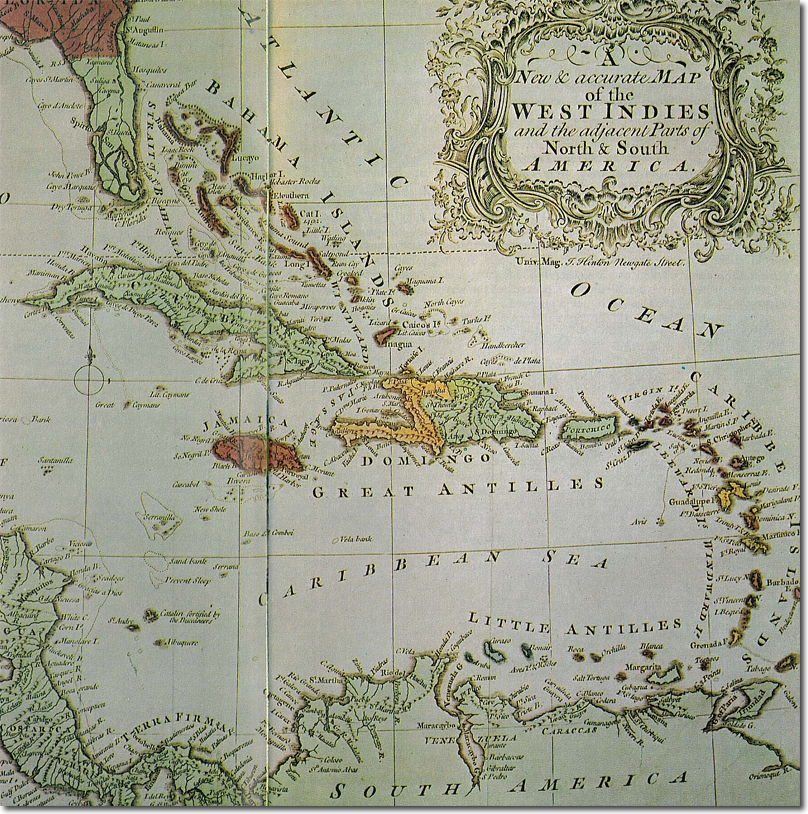
The “Cape” meant Cap-Haïtien and “the Mole” meant Môle-Saint-Nicolas at the end of the same peninsula. In other words, Shaw told Mackibbin that if he couldn’t load gunpowder openly at the main port, he should arrange to pick it up at a more secluded spot.

TOMORROW: Mr. Shaw’s new contact in Boston.

Wednesday, February 05, 2020

Trading for Gunpowder Just Before the War

Last year I wrote about the New London, Connecticut, merchant Nathaniel Shaw, Jr., and his many ways of evading Customs duties on molasses and other goods.

Shaw’s experience moving molasses from the Caribbean to mainland North America was useful as New England went to war in 1775. The army outside Boston needed gunpowder and weapons, things that were on sale in West Indies as long as Americans had money to pay for them and ships to carry them past Royal Navy patrols.

In fact, Nathaniel Shaw started to trade in military supplies even before the war began. On their website the authors of a new book, Two Revolutionary War Privateers: William and Joseph Packwood of Connecticut, describe the voyage that the older of those two brothers undertook on Shaw’s orders:
Capt. William set sail on 7 Feb 1775 on the Macaroni with orders to obtain as much gunpowder and arms as he could. He visited many Caribbean islands in his search. After a three-week time period, Capt. William was at Anguilla (British) which is 230 miles east of Puerto Rico. . . .

Unable to purchase gunpowder at most places he stopped, Capt. William made his way down the Leeward Islands to St. Eustatius (Dutch) on March 1, Martinique (French) on March 4, and Dominica (French until 1763, then British) on March 6. . . .

Capt. William then went to Guadeloupe (French) on March 7, back to St. Eustatius on March 9, and finally to Haiti (French) on March 15. During the last half of March, he went back and forth between two of the major trading ports in Haiti: Môle Saint-Nicolas on the northwest tip of the island and Cap-Haïtien (called Cap François at the time) on the north coast midway to the Dominican Republic, the Spanish part of the island. He returned to St. Eustatius on April 9 and then went back down to the Môle on April 16.
Back in Connecticut, Shaw was keeping a keen watch on the markets. On 6 April, he wrote to a merchant in Guadeloupe that gin was selling slowly in New York and “Nothing will command cash but Molas. and Powder.” Two days later, after a request that Samuel Holden Parsons passed on for Roger Sherman, Shaw ordered “fifteen Tons of Lead” from his usual trading partners in Philadelphia.

On 25 April, soon after New London received word of the fighting in Massachusetts, Capt. Packwood returned to port. Shaw immediately wrote to Gov. Jonathan Trumbull:
Agreable to your Desire I have Sent up Eighty Three Barrels of Powder to Colo. Jed. Huntington Containg about 108 Each

the Remainder is in this Town I hourly Expect Thirty Two Barrels more that I have Account of the Capt. having it on bord

the Remainder of what Moneys was in My hands Capt William Packwood left with Capt. Jno. Mckibbin who is in One of my Vessels in the West Indies to Lay out in the first Powder that Arives, he says that a large Quantity was Daly Expected

he purchased all that Could be had and thought it best to push home with this Rather than Tarry Longer—this Quantity he Obtain’d through the Influence of the Famous Palunkey (who was An Old Commander of a Private Tear the Warr before Lasts) who Prevailed with the Governour of the Cape to take it out of the Kings Store—

In Short Packwood Says the French Seem to be Disposed in the Islands to Assist in this way as Much as in their power, I Intend he Shall Sail Again for the Cape Next Week and I Don’t Imagine he will be Gone More than Six weeks If you Intend to have any more Money Laid out in that way it will be a good Oppertunity 
The same day, Shaw told his New York connection that Packwood had brought back “fifty One Hogsheads and Eleven Terses of Mollasses and four hogsheads of Cocoa.” That voyage wasn’t just about military supplies. And Shaw hadn’t lost his usual “hope you’l Save the Dutys” by evading the Customs men.

TOMORROW: Placing a bigger order.