J. L. BELL is a Massachusetts writer who specializes in (among other things) the start of the American Revolution in and around Boston. He is particularly interested in the experiences of children in 1765-75. He has published scholarly papers and popular articles for both children and adults. He was consultant for an episode of History Detectives, and contributed to a display at Minute Man National Historic Park.

Subscribe thru Follow.it


•••••••••••••••••


Showing posts with label Boston Port Bill. Show all posts

Thursday, March 12, 2026

“Without the leave of the Governor”

Earlier this month the Journal of the American Revolution ran an article by Ray Raphael about colonial Massachusetts’s constitution and how the royal government tried to curtail it.

Here’s a taste:
Of the four punitive acts passed in response to the Boston Tea Party, closing the port of Boston receives most attention in textbooks today—but at the time, with 95 percent of the colony’s population living outside Boston, it was “An Act for the Better Regulating the Government of the Province of the Massachusetts Bay”—known today as the Massachusetts Government Act—that sparked the people’s fury and led them to cast off British rule.

Under the 1691 Charter, “freeholders” could call a town meeting whenever they saw fit—but no longer: “Whereas a great abuse has been made of the power of calling such meetings, and the inhabitants have, contrary to the design of their institution, been misled to treat upon matters of the most general concern, and to pass many dangerous and unwarrantable resolves,” the 1774 act declared, “no meeting shall be called by the Selectmen, or at the request of any number of freeholders of any township, district, or precinct, without the leave of the Governor, or, in his absence, of the Lieutenant Governor, in writing, expressing the special business of the said meeting.”

Likewise, on the provincial level, power was wrested from the people. No longer would the incoming “general court or assembly” choose the Governor’s Council:
Whereas the said method of electing such counsellors or assistants. . . hath been so far from contributing to the attainment of the good ends and purposes thereby intended, and to the promoting of the internal welfare, peace, and good government of the said province, or to the maintenance of the just subordination to, and conformity with, the laws of Great Britain, . . . the said method of annually electing the counsellors or assistants . . . should no longer be suffered to continue . . .

Be it therefore enacted . . . that the council, or court of assistants, shall be composed of such of the inhabitants or proprietors of lands within the same as shall be thereunto nominated and appointed by his Majesty.
All other officers would also be appointed by the governor, who could remove them at will…
The voters of Massachusetts didn’t like to see Gov. Thomas Gage implement the new law. Soon they were protesting against it—and shutting down the colonial government to do so.
The next courts were scheduled for Springfield, shiretown of Hampshire County, two weeks later, on August 30—but some 1,500 citizens made sure they did not sit. One eyewitness, Joseph Clarke of Northampton, gave a vivid account: “The people of each town being drawn into separate companies marched with staves & musick . . . The trumpets sounding, drums beating, fifes playing and Colours flying, struck the passions of the soul into a proper tone, and inspired martial courage into each.”

The judges and justices of the peace offered no resistance to “the body of the county,” as Clarke called the men who marched with their town’s militia companies. When a committee asked them “whether they meant to hold their commissions and exercise their authority according to the new act of parliament for altering the constitution of the province,” they all said they would not.
One corrective for the article: The Boston Port Bill went into effect on 1 June 1774. The Massachusetts Government Act may have been drafted to start at the same time, but the final language said it took effect on 1 August. And then the text didn’t arrive in Salem until a few days after that.

In other words, it took only about two weeks from the start of the law for people in western Massachusetts to organize major protests and shut down a branch of the royal government. That’s how much people wanted to maintain their constitution.

Tuesday, March 11, 2025

Sconyers on Boston’s Street Lamps, 18 Mar.

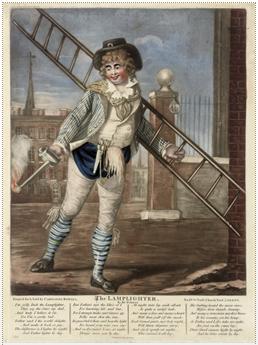
Old North Illuminated is living up to its name by hosting an online presentation by Jake Sconyers on the topic “They Burnt Tolerable Well: The Tea Party & Boston’s First Street Lamps” on Tuesday, 18 March.

The event description says:
In the 1770s, Boston was in a state of transformation and upheaval. While we mostly think of the American Revolution as the driver of this whirlwind of change, a technological revolution was happening at the same time. The introduction of street lamps in Boston had a profound effect on how people behaved at night.

The political revolution and the technological revolution were intertwined, with the effects of one impacting the other—including at pivotal moments like the Boston Massacre and the Boston Tea Party.

Sconyers will touch on these “burning” questions:
  • How did Boston’s very first street lamps survive a shipwreck and the Boston Tea Party?
  • Why did Boston decide to buy English oil lamps for the streets but fuel them with American whale oil?
  • Why did Boston vote to let its new street lamps sit dark after just a few months of illumination?
  • How did the Boston Port Act affect the cost of street lighting?
Not to mention how the events of April 1775 might have been different if Boston’s main streets had been lit up at night.

Jake Sconyers is the host of the HUB History podcast, formerly cohosted by Nikki Stewart, executive director of Old North. The podcast has discussed these lamps, but I don’t recall it addressing all these details.

Register for this online event with a donation of any amount to Old North Illuminated through this webpage.

Thursday, October 31, 2024

“The workmen all pack’d up their tools and left the barracks”

In late September 1774, as described by the Boston merchant John Andrews yesterday, towns neighboring Boston put pressure on their own citizens and on Bostonians to stop helping the British army build barracks.

As commander of all the British army in North American, Gov. Thomas Gage had faced that problem before back in 1768. Then the royal government had ended up renting buildings from willing owners and turning them into barracks. But in 1774 there were more regiments to house, and even more on the way.

Gage asked Boston’s selectmen to forestall what would amount to a labor strike. They replied that they actually wanted the troops grouped in barracks, but they had no power over rural towns’ policies.

The next day, 26 September, Andrews reported that Gage approached John Hancock directly. Since Hancock was one of the selectmen, he might already met with the general. Hancock was also the chair of the Massachusetts Provincial Congress, and thus might have had leverage with other towns, but Gage officially refused to recognize that extralegal body. Furthermore, at the start of August, the governor had dismissed Hancock as commander of the Company of Cadets, so coming to the man for a favor was quite a concession.

Andrews wrote:
Sometime this day the Governor had a conference with Col: Hancock, requesting him to use his influence with the Committee to re-consider their vote respecting the barracks.

The Colonel observ’d to him that he had taken every possible measure to distress us: that notwithstanding it was the Solicitor’s opinion that the [Boston Port] Act could be construed to prevent goods, &ca., being transported within ye. bounds of the harbour, yet he had not suffered it to he done, and the Ships of War had seiz’d whatever had been attempted to be transported in that manner.

He likewise told him that he had been threat’ned, and apprehended his person was in danger, as it had been gave out by some of his people that he deserv’d to he hang’d: upon which the Governor told him he might have a guard, if he chose it, to attend him night and day. You will naturally conclude that he declin’d accepting.
The work stoppage took hold the next day:
At four o’clock yesterday afternoon, the workmen all pack’d up their tools and left the barracks, frames, &ca.; so that I am apprehensive we in the town will feel ill effects of it, as it has been given out that the troops will force quarters next month, if barracks are not provided for ’em: neither should I blame them for so doing, as the nights are so cold already, that it’s impossible for ’em to sleep comfortable under their slight canvas tents. And as to empty houses, now since we have got so many [Loyalist] refugees among us, there is not half sufficient to hold what troops we have got already here.

After the carpenters had left off work, the General sent Col. Robinson [actually James Robertson] and Major [William] Sheriff to Mr. Hancock, to let him know if they would proceed with the barracks, he could suffer any thing to be transported within the limits of the harbour, under the sanction of King’s stores—but all would not avail; as they very justly suppos’d, that after the work was compleated he would withdraw the indulgence, as he deems it, though in justice it not be prevented at all.

They have got the Carpenters from the Ships of War, and have sent an arm’d Schooner to Halifax for all the Artificers they can procure from there. It’s possible they may be as averse to coming as the Yorkers.
New York’s Patriots had already voted not to cooperate with the British army in Boston, a move that reportedly inspired the rural towns’ decision.

On 29 September, the merchant reported:
In the course of a day or two past, the Roxbury people have burnt several load of straw that was bringing in here, which has enrag’d the soldiers to such a degree, that I am in continual apprehension we shall soon experience another fifth of March, which God forbid!
In those same days, Andrews described how the Royal Artillery, Boston’s Patriot leaders, and ordinary people were all maneuvering over the mortars, cannon, and other ordnance in the inventory of hardware merchant Joseph Scott. Meanwhile, other artillery pieces were being seized by one side or the other (the focus of my book, The Road to Concord). Andrews was not alone in fearing that violence could break out any day.

Thursday, August 01, 2024

“The Majority were four to One against them”

On 28 June 1774, the Boston town meeting witnessed “long Debates” about the committee of correspondence’s call for a non-consumption agreement, according to town clerk William Cooper’s record.

In his diary the merchant John Rowe confirmed, “The Debates very warm on both sides.” Unlike the previous day, alas, he didn’t record any of the speakers.

But the group urging a repudiation of the committee consisted mainly of major merchants, some with positions within the royal government. They worried that this boycott, on top of the Boston Port Bill, would doom the town’s economy.

The leaders of the Whigs, in reply, argued that standing up to Parliament’s Coercive Acts by not buying any more from Britain was their best way to force the repeal of those laws.

Eventually the meeting held a vote on the merchants’ motion to censure. Cooper recorded that “a great Majority” voted against repudiating the committee.

Rowe expressed disappointment, at least in his diary:
the Committee are wrong in the matter. The Merchants have taken up against them, they have in my Opinion exceeded their Power & the Motion was Put that they should be dismissed. the Gentlemen that made & supported this Motion could not Obtain their Vote, the Majority were four to One against them.

this affair will cause much evil one against the other. I wish for Peace in this Town I fear the Consequences.
The Whigs then sought to affirm the town’s support for the committee by offering their own motion:
That the Town bear open Testimony that they are abundantly satisfied of the upright Intentions, and much approve the honest Zeal of the Comittee of Correspondence & desire that they would persevere with their usual Activity & Firmness, continuing stedfast in the Way of well Doing
A “Vast” majority approved that.

After that, Samuel Adams returned to the chair, the committee on employing the poor said they were once again not ready to report, and the meeting adjourned until July.

That was the last attempt of the Boston Loyalists and/or merchants to curb the Whigs electorally, and they fell far short. Which wasn’t a surprise. The Whigs won every vote along the way, even on matters like which men would go ask if the gathering could move to the Old South Meeting-House.

The Boston town meeting would remain stalwart and implacably opposed to the royal administration until the war began.

COMING UP: Protests against the protest.

Tuesday, July 30, 2024

“Not a topsail vessel to be seen”

Dissecting the multiple texts of the Solemn League and Covenant boycott and following the Rev. Ebenezer Parkman’s uncomfortable wriggling around that issue in Westboro pulled me past the debate over that document in Boston.

So I’m going back to mid-June 1774. Many of Boston’s merchants thought the top priority should be finding a way to lift the Port Bill, even if that meant (as George Erving and John Amory proposed) raising money privately to pay the cost of the tea destroyed in December.

The town’s political leaders, on the other hand, felt that standing up to Parliament’s oppressive laws was more important than regaining some expedient advantages in business.

The merchant John Andrews, who normally supported the Whigs (albeit at an ironic distance), joined their opponents on this issue. He saw the town’s economic situation as dire, as he wrote in a 12 June letter to a relative in Philadelphia:
Our wharfs are intirely deserted; not a topsail vessel to be seen either there or in the harbour, save the ships of war and transport, the latter of which land their passengers in this town tomorrow.

Four regiments are already arriv’d, and four more are expected. How they are to be disposed of, can’t say. Its gave out, that if ye. General Court don’t provide barracks for ’em, they are to be quarter’d on ye. inhabitants in ye. fall: if so, am determin’d not to stay in it.
Only five days after Andrews wrote, Gen. Thomas Gage dissolved the Massachusetts General Court, as recounted here. That legislature never had a chance to provide quarters for the troops in Boston—or to refuse to.

Nonetheless, those soldiers were never housed in private homes, nor did Gage invoke the revised Quartering Act to put them into “uninhabited buildings” and taverns. Instead, the royal government built barracks and rented buildings from willing landlords, including warehouses empty because of the lack of trade.

Andrews still thought royal officials were being too strict:
The executors of the [Boston Port] Act seem to strain points beyond what was ever intended, for they make all ye. vessels, both with grain and wood, entirely unload at Marblehead before they’ll permit ’em to come in here, which conduct, in regard to ye. article of wood has already greatly enhanced the price, and the masters say they won’t come at all, if they are to be always put to such trouble, as they are oblig’d to hire another vessel to unload into, and then to return it back again, as they have no wharves to admit of their landing it on.

Nor will they suffer any article of merchandize to be brought or carry’d over Charles river ferry, that we are oblig’d to pay for 28 miles land carriage to get our goods from Marblehead or Salem. Could fill up a number of sheets to enumerate all our difficulties.
Nonetheless, at this time Andrews saved his worst criticism for Boston’s zealous Whigs, “those who have govern’d the town for years past and were in a great measure the authors of all our evils, by their injudicious conduct.” Now those men were supposedly threatening to finish off the town’s trade with the Solemn League and Covenant.

TOMORROW: Back to town meeting.

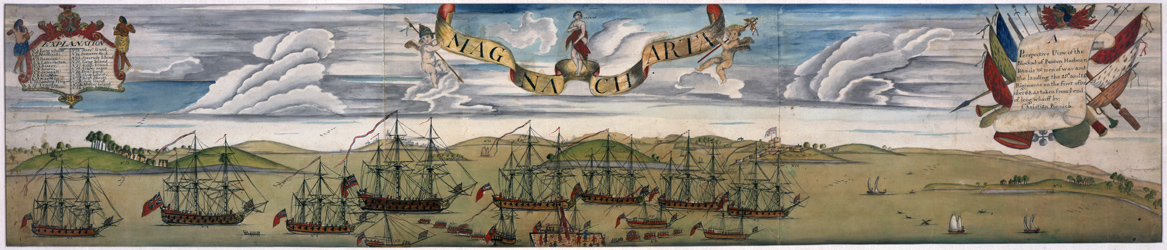
(The picture above, courtesy of the Massachusetts Historical Society, is one version of Christian Remick’s painting of the Crown fleet in Boston harbor as seen from Long Wharf in 1768.)

Saturday, July 13, 2024

“Many among us, who are for compromising matters”

John Andrews was another merchant who left a lively record of the discussions in Boston in spring 1774 as the business community grappled with the impending effects of the Boston Port Bill.

Andrews was more aligned with the Whigs than John Rowe, but still didn’t always see eye-to-eye with the radicals.

Andrews’s account appears in a series of letters to an in-law in Philadelphia, now in the collections of the Massachusetts Historical Society. On 18 May he wrote in the most dire tone:
Imagine to yourself the horror painted in the faces of a string of slaves condemn’d by the Inquisition to perpetual drudgery at the oar! Such is the dejection imprinted on every countenance we meet in this once happy, but now totally ruin’d town.
Andrews urged his correspondent to sign on to “an entire stoppage of trade, both to England and the West Indies, throughout the continent.” Any alternative would be to “acknowledge the right of parliament to d—n us whenever they please.”

Later that day Andrews added the news that “we have had advice from Salem, Newbury, etc’a., that they will haul up all their vessels, and stop every trade, provided it becomes general through the continent.”

If accurate, that news must have after the day’s town meeting session, where a committee reported merely that the selectmen of Marblehead and Salem had sounded sympathetic and promised to call meetings in their towns, too.

Note how the promise from those smaller Massachusetts ports was contingent on all the other ports in North America signing on to a boycott as well. That’s often how collective action has to be organized: promising party A that party B is ready to act if party A will, and promising party B that party A is ready to act if party B will.

Yet Andrews also reported some Boston merchants calling for a different approach:
At the same time, we have many among us, who are for compromising matters, and put forward a subscription to pay for the Tea.

George Erving has declar’d this day. that if it should be promoted, he is ready to put down two thousand pounds sterling towards it, and will take it upon himself to wait on Governor [Thomas] Gage and know what his demands upon us are—which circumstance Jno. Amory mentioned at ye. town meeting this day, which was in general rejected, though he urged the matter much.
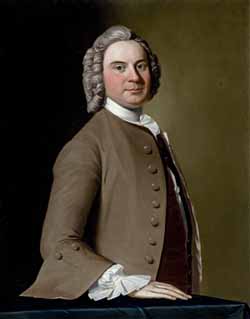
George Erving (1738–1806) and John Amory (1728-1803, shown above) were both Loyalists during the war. Amory ultimately returned to Massachusetts, and Erving’s son became a U.S. diplomat.

Though the Boston Tea Party had cost the East India Company over £9,000, five merchants pledging the amount Erving promised would have been enough to cover that sum. But the community “rejected” that idea.

At that point in late May 1774, Boston’s committee of correspondence may well have felt they had solid popular support for promoting a general boycott to protest the Port Bill. But when the committee drafted its “Solemn League and Covenant” and sent it to other towns and provinces, its members may have overplayed their hand.

TOMORROW: Going too far?

Thursday, July 11, 2024

“Spent most part of the Day with the Town Committee”

The merchant John Rowe had an unusual perspective on the crisis of the Boston Port Bill.

On the one hand, he cared most about his business and trimmed his politics accordingly. Gov. Thomas Hutchinson suspected him of being behind all sorts of nefarious deals, but the local crowd considered him “a great Tory.”

I suspect Rowe also liked being liked, “trimming” to play to his current audience. During the big public meetings on the ships full of East India Company tea, he made an offhand remark about mixing tea with saltwater. That got him applause, and the crowd believed he’d come over to the radicals. Privately Rowe was upset, but he didn’t try to clarify his stance.

In those same months Rowe was spearheading a complex and costly effort to import and install Boston’s first street lamps. He seems to have long hoped to be elected to public office, and here he was visibly serving the public. How long could he keep that up?

On 10 May 1774, the same day Boston reelected its representatives to the Massachusetts General Court, the town received the first shocking news of the new law. Rowe went back to that day’s diary entry to add: “The Harmony Capt. Shayler arrived from London & brings the Severest Act ever was Penned against the Town of Boston.”

Three days later, with the news confirmed, Rowe lamented the “Late Act of Parliament for Blocking up the Harbour of Boston which is & will be a Great Evill.”

On that day, Boston called a sudden town meeting, ultimately choosing a committee to recommend what to do. The citizens put Rowe on that committee. In fact, he was the second man named, right after Samuel Adams.

This committee of eleven included gentlemen from various groups:
There was, to be sure, some overlap in those groups, particularly the centrists and merchants.

To his credit, Rowe actually participated in the committee discussions. On 14 May he “Spent most part of the Day with the Town Committee at the Representatives Room” inside the Town House and then went back on 16 May. Boylston and Appleton didn’t attend either of those meetings, so Rowe was the merchants’ voice.

Not that the discussions was productive. On 18 May, the committee reported back to the town that they had received “several Proposals & plans” but hadn’t had time to digest them. The ongoing meeting pushed them to hurry and come up with solutions.

Rowe never recorded attending any more of those committee discussions. Instead, he began to pay more attention to other sources of authority in town. As I wrote back here, he declined an invitation to chair the town meeting, and expressed deep disagreement with it—privately, of course.

TOMORROW: Here comes the general.

Wednesday, July 10, 2024

A Sestercentennial Town Meeting in Old South

Tomorrow, 11 July, and then again on Thursdays every two weeks, Revolutionary Spaces’ Old South Meeting House will host programs based on the Boston town meeting that started on 13 May 1774.

In fact, two town meetings happened in Faneuil Hall that day. The first convened at 10:00 A.M., a continuation of Boston’s regular May meeting. That’s when men who met the property qualification voted on the town’s representatives to the Massachusetts assembly and then dealt with various other matters.

That May those other matters included “firing small Arms on the Neck,” a proposal for a well and pump in Dock Square, and so on. Most questions, like the schoolteachers’ salaries, were put off. The citizens formally adjourned until the first Monday in July.

But at 11:00 A.M. a new meeting officially started. News of the Boston Port Bill had arrived in town, and it presented an emergency.

The gathering chose Samuel Adams as the moderator; he’d served the same role in the earlier meeting (after being reelected to the legislature).

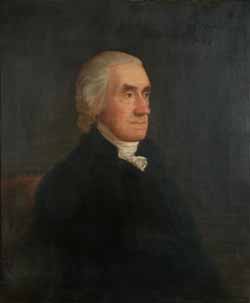
The first motion was to read the Port Bill, the second to ask the Rev. Dr. Samuel Cooper (shown above) to lead a prayer. He came to do so, after making sure the meeting understood “he was just returned fatigued from a Journey.”

Then came the inevitable proposal to form a committee, in this case to formulate a response to the new law. “After some Debate” on that, the meeting broke off for midday dinner and resumed at 3:00 P.M.

In the afternoon, everyone (with no dissenting votes) agreed to appoint a committee “to take the several Proposals, that have been made, & others that may be made, relative to our Conduct on the present Exigency, into their Consideration, & report, as soon as may be, their Opinion.” That’s a very vague mandate, probably recognizing a range of proposals and a lot of unknowns.

There were practical problems, like how to employ or support the many people who would lose work without the maritime trade. There were political considerations like assessing and strengthening support elsewhere—one action everyone agreed right away was communicating with other towns, especially the port of Salem and Marblehead. And finally, there was the choice posed by the Boston Port Bill itself: Should the town (or citizens) repay the cost of the tea destroyed in December?

The staff of Boston National Historical Park designed a program to recreate that discussion, 250 years ago in May. That program is usually offered in the big meeting space in Faneuil Hall, but that’s being refurbished. Like Boston’s overflow public meetings, therefore, these sessions have been moved to Old South.

The events will start at 5:30 P.M. on 11 July, 25 July, 8 August, and 22 August. They’re free, but registration is encouraged.

The programs last about half an hour—much less time than Boston’s town meeting that began on 13 May—and I don’t think was ever officially dissolved.

Tuesday, June 25, 2024

Boston’s “party who are for paying for the tea”

June 1774 was a tense time in Boston. At the start of the month the harbor was closed to trade, with Royal Navy warships enforcing that rule.

Army regiments were arriving: the 4th Regiment on 10 June, the 43rd Regiment on 15 June. These troops joined the men Gen. Thomas Gage had brought with him in May.

Many of the town’s merchants, fearing for their livelihood, were trying to devise a way to pay for the East India Company tea destroyed in December, compromising with the Crown and getting back to business.

The “no taxation without representation” crowd thought that would be giving in to an unjust power grab by Parliament.

Just as the Boston Whigs had organized opposition to landing that tea in meetings of “the Body of the People” rather than official town meetings, Boston’s business community had their own big but unofficial gathering.

Merchant John Rowe wrote in his diary on 15 June:
This Evening the Tradesmen of the Town met to Consult on the Distress of this Place

There were Upwards of eight hundred at this meeting – they did nothing being much Divided in Sentiment
Dr. Joseph Warren reported to Samuel Adams, who was in Salem with the Massachusetts General Court:
This afternoon was a meeting of a considerable number of the tradesmen of this town; but, after some altercations, they dissolved themselves without coming to any resolutions, for which I am very sorry, as we had some expectations from the meeting.

We are industrious to save our country, but not more so than others are to destroy it. The party who are for paying for the tea, and by that making a way for every compliance, are too formidable.

However, we have endeavored to convince friends of the impolicy of giving way in any single article, as the arguments for a total submission will certainly gain strength by our having sacrificed such a sum as they demand for the payment of the tea.

I think your attendance can by no means be dispensed with next Friday. I believe we shall have a warm engagement. . . .

You will undoubtedly do all in your power to effect the relief of this town, and to expedite a general congress; but we must not suffer the town of Boston to render themselves contemptible, either by their want of fortitude, honesty, or foresight, in the eyes of this and the other colonies.
Back on 30 May, the Boston town meeting had adjourned to Friday, 17 June. Warren wanted Adams back in Boston by then to chair that session. But Adams was busy pulling strings in Salem, and trying to keep those strings invisible from Daniel Leonard.

TOMORROW: Back in Salem, a plan comes together.

Monday, June 24, 2024

“It was known to all but Mr. Leonard”

Robert Treat Paine and Daniel Leonard were Taunton’s two representatives to the Massachusetts General Court in the spring of 1774.

Both Paine and Leonard were Harvard graduates and well regarded lawyers. Both men had, as I mentioned yesterday, courted Sarah White, with Leonard being successful and marrying her.

(Paine finally married Sally Cobb of Taunton in 1770, when he turned thirty-nine and she twenty-six. Losing no time, they had their first child two months later.)

On 9 June 1774, both Paine and Leonard were named to the assembly’s committee of nine members to consider how Massachusetts should respond to the Boston Port Bill.

Looking back after two decades, Paine described that period this way:
Mr. Leonard was a Gentleman of natural good Sence & Eloquence, polite & of engaging Adress & had been Chosen Several Years as member for the Town of Taunton, on the Idea of his being a firm & able freind to the Opposition in wch. his Town was so determined; but on the prevailing Address & Sollicitation of Govr. [Thomas] Hutchinson he had changed his principles, & considered himself now at Market to make the best of them;

all this was well known to the members of the Court & the rest of the Committee more especially to his Colleague the writer hereof; it was therefore considered unsafe for that committee to enter into the consideration of the State of the Province on principles of Opposition while he was present, & as it appeared by the Port bill that the only releif from the Continual Exn. of it was the payment for the Tea that was destroy’d, the Committee turn’d their whole Attention to that;

& as it was known to all but Mr. Leonard, that Another Committee of vastly more importance, form’d from Members of the house of Representatives by their own inclinations was beginning to operate in secret the committee of nine talkd very favourably of paying for the Tea, as a thing not to be compar’d with the Sufferings from the Port Bill:

it would be hard to discribe the Smooth & placid Observations made by Mr. S[amuel]. Adams, Saying that it was an irritating affair, & must be handled Cautiously; that the people must have time to think & form their minds, & that hurrying the matter would certainly create such an Opposition as would defeat the matter;

& many Observations of this kind, all tending to induce Mr. Leonard the Oblique Member of that Committee to think that matters would work terminate in Obedience to the Port Bill were made by Several other Members of the Committee, & then it was Observ’d that it was very hot, & that they had been engag’d in Court all day, & that it was unprofitable to set any longer at that time for the people must have time to bring their minds to a Compromise;

Proceedings of this kind took place on the PM & Evning of three days; as soon as the Committee on the State of the Province was adjournd, all the Members except Mr. Leonard immediately repaird to a retired room where the Self Created Committee before mention’d mett, & being cornpos’d of Such members only as had Signalized themselves in their Opposition to the British Aggressions of Tyrannick Govt., they Shut their Doors & entered freely & fully on all the Subjects of Grievances;…
Meanwhile, back in Boston some leading merchants were also arguing that the town should pay for the East India Company tea.

TOMORROW: Dr. Warren’s diagnosis.

Wednesday, June 12, 2024

Tea with Gen. Gage in Salem This Week

In June 1774, 250 years ago, Salem suddenly became more important.

Parliament’s Boston Port Bill took effect on 1 June, and the harbor of Salem and Marblehead became Massachusetts’s largest port open to trade from outside the colony. The Customs office moved there.

Also, Gov. Thomas Gage adjourned the Massachusetts General Court from Boston to Salem, following orders from London. That move didn’t require a new law since the royal governor already had the power to convene the legislature where he chose. That didn’t stop most of the new session being taken up with complaints about being in Salem.

When Gage moved to the region, renting a house in nearby Danvers, he also brought a contingent of British soldiers. There doesn’t appear to have been as much friction between those troops and the locals as in Boston in 1768–1770, but the town governments still raised concerns.

This week the city’s historical organizations are commemorating that period with some public events.

Thursday, 13 June, 7:00 P.M.
Tea’s Party: From Boston to Salem and Back Again
Salem Armory Regional Visitor Center

James R. Fichter speaks about how, despite the so-called Boston Tea Party of 1773, large shipments of tea from the East India Company were sold in North America. The survival of the Boston tea shaped Massachusetts politics in 1774, impeded efforts to reimburse the company for its losses, and hinted at the enduring conflict between consumer demand and political boycotts.

That tension was not confined to Boston. As Gen. Gage and the colonial government relocated to Salem in the summer of 1774, Essex County residents found committing to a boycott just as difficult as Bostonians had.

Fichter is Associate Professor in Global and Area Studies at the University of Hong Kong. He is the author of So Great a Profit: How the East Indies Transformed Anglo-American Capitalism and Tea: Consumption, Politics, and Revolution, 1773–1776.

This event is free. For directions, visit this page.

Saturday & Sunday, 15–16 June, 10 A.M. to 4 P.M.
Governor Gage Comes to Salem
Derby Wharf, Salem

The British army will encamp on the waterfront, with some of New England’s finest living history practitioners portraying soldiers, officers, legislators, and the Loyalist and Patriot citizens of Salem. Over the weekend, visitors can meet people from many walks of life: shoeblacks, teachers, merchants, tavern-keepers, midwives, and more. Activities to be reenacted include military drill, camp cooking, placing ads in a newspaper, and political debate at the tavern.

Here is the full schedule of events.

Sunday, 16 June, 9:00 A.M.
Join the Royal Governor at Church
St. Peter’s Church, Salem

Gen. Gage attended the local Anglican Church when he was in America. In Salem, that meant St. Peter’s, which will recreate an eighteenth-century service with the general occupying the same pew that he used in 1774.

Monday, May 20, 2024

“Better Regulating the Government of the Province of the Massachuset’s Bay”

On 20 May 1774, 250 years ago today, Parliament passed “An Act for the Better Regulating the Government of the Province of the Massachuset’s Bay, in New England,” or the Massachusetts Government Act.

In the same days that the American colonies were absorbing the ramifications of the Boston Port Bill, this final, even more far-reaching Coercive Act was put into place.

The closing of Boston’s port to intercolonial trade was intended as a temporary measure to force the town to repay the cost of the destroyed tea. The Massachusetts Government Act, in contrast, spelled out permanent changes to the provincial charter.

At The Pursuit of History’s recent “Rebellion in New England” weekend, several speakers described in different ways how people reacted to the new law. My presentation pointed out small inland towns had previously offered Boston merchants mostly tepid support on the import tarriffs, but now Parliament had given those farmers something to be really angry about.

After news of the act arrived, previously moderate Whigs like John Hancock started to act like radicals. Outside Boston, crowds massed in their militia companies, then started to strengthen the militia. People in other colonies wondered if their charters were in jeopardy of similarly unilateral amendments.

The Massachusetts Government Act made three big changes, recommended by Sir Francis Bernard and other former officials who had worked in the colony.

First, the Council, which was the upper house of the Massachusetts General Court, changed from an elected body to an appointed one (as most other North American colonies already had). The Council also lost some power to stymie the royal governor’s appointments. That would be the equivalent of turning the U.S. Senate in the House of Lords and no longer requiring Senate approval of judges.

Second, henceforth towns would need the governor’s advance approval before convening a second town meeting in any year. In practice, towns began to extend their meetings by adjournment, thus never needing to call a legally new one. Still, this was a clear strike at the local self-government that communities (well, white men of property) had come to expect.

The third area of government changed by the new law was the court system. In particular, jurors for the grand and petit juries would no longer be elected but summoned by the royally appointed sheriffs. I hadn’t realized until I looked at the text of the law that those judicial-branch provisions account for most of its words, spelling out procedural changes in legalese.

Almost immediately, the people responded to the Massachusetts Government Act with mass actions. In towns where the appointed Councilors lived, crowds gathered to pressure them to decline the seats or resign. Some did. Others stayed on the Council but moved into Boston for their safety.

Crowds also shut down the county court sessions, starting in the west at Great Barrington in Berkshire County. We can see those actions as directed against the changes to the legal system. But also the judicial branch was virtually the only part of the provincial government that operated in the inland towns. And in the eyes of most men in the province, the Massachusetts Government Act had rendered the royal government illegitimate. 

Sunday, May 19, 2024

“The taste of their fish being altered”

Just because the British Empire was sliding toward internal warfare in 1774, that was no reason to stop laughing about the news.

Here are a couple of items that appeared in New England newspapers 250 years ago.

The first must have originated in a London newspaper. The earliest North American reprinting I’ve found is in John Dunlap’s Pennsylvania Packet on 18 Apr 1774. Four days later it appeared in both Isaiah Thomas’s Massachusetts Spy and Timothy Green’s Connecticut Gazette of New London, followed by other papers.

Jan. 28. Letters from Boston complain much of the taste of their fish being altered: Four or five hundred chests of tea may have so contaminated the water in the harbour, that the fish may have contracted a disorder not unlike the nervous complaints of the human body. Should this complaint extend itself as far as the banks of Newfoundland, our Spanish and Portugal fish trade may be much affected by it.
Needless to say, even 340 chests of tea dumped off Griffin’s Wharf weren’t really enough to affect the New England fisheries.
Earlier this month artist Cortney Skinner shared this clip from the 9 May 1774 Boston Gazette. It appeared on page 3 right after a political essay and right before the many mercantile ads it resembled.

This notice reads:
WANTED immediately,
A long, strong BOOM,
that will reach from Cape-Cod to Cape-Ann.———
Any Person having such an One to dispose of, will meet with a good Price, by applying to
N***H.
N. B. The Distance is only 18 Leagues.
This was a poke at Lord North’s plan to close Boston harbor to shipping. Unofficial hints of the Boston Port Bill had started to arrive, and Edes and Gill wanted readers to laugh at the folly of that policy.

The same satirical ad appeared the next day in Samuel and Ebenezer Hall’s Essex Gazette of Salem.

Then the text was reprinted (though no longer looking like an advertisement) in the 16 May New-York Gazette, the 18 May New-Haven Post-Boy and Pennsylvania Journal, and the 23 May Newport Mercury. For readers without so much maritime experience, the capper became “The Distance only 54 miles.”

When the Royal Navy and Customs service really did shut down the port of Boston in June, though, suddenly the situation didn’t seem so laughable.

Wednesday, March 20, 2024

“Rebellion in New England” Now Open for Registration


I’m working with the Pursuit of History to produce a weekend filled with historical exploration of the “Rebellion in New England” 250 years ago this year.

As the year 1774 began, people in Massachusetts were worrying about how the royal government in London would react to the Boston Tea Party. Twelve months later, Massachusetts had a new governor and a revised charter, but most of the province was in open rebellion, preparing for war.

I explain more about our weekend exploring that history in the video above. The handsome Georgian building behind me is the Longfellow House–Washington’s Headquarters National Historic Site in Cambridge, our main host for this weekend.

“Rebellion in New England” will offer two full days of presentations, archive visits, and walking tours. On Friday and Saturday, 10–11 May, there will also be lunches with the speakers, plus a dinner for all attendees on Friday evening. On Sunday, we’ll have an optional extra session: a docent-led tour of the Museum of Fine Arts’s Early American galleries, including John Singleton Copley portraits of some of the people we’ll talk about.

I’ll lead the walking tours and speak about the “arms race” of late 1774. I’ve been recruiting other authors and scholars: Robert J. Allison on the royal government’s policy toward Massachusetts, Samuel Forman on the Patriots’ resistance organizing, Chris Beneke on how Massachusetts’s religious tradition affected its delegates’ reception at the First Continental Congress, Brooke Barbier on the rise of John Hancock. In the coming weeks I’ll announce the complete lineup (though I may preserve some surprises).

The Pursuit of History is the non-profit founded by Lee Wright which also organizes History Camp Boston. That event brings together hundreds of people to share presentations on a range of historical topics. This weekend is designed differently: only thirty seats, a focused subject, speakers recruited for their expertise, and visits to actual sites so we explore history where it happened. Go to this page for more detail and to register.

If “Rebellion in New England” is as much fun as we want, we’ll organize similar weekends in 2025 on the outbreak of the Revolutionary War and in 2026 on the departure of the British and the coming of independence.

Wednesday, March 13, 2024

“The house of Francis Shaw was assigned for quarters”?

Yesterday I quoted the story of Samuel Shaw’s interaction with British marine officers staying in his father’s house in late 1774 or early 1775.

People sometimes point to the Shaw family as an example of colonists forced to host the king’s soldiers in their home under the Quartering Acts of 1765 and 1774.

Author Josiah Quincy’s language, especially the use of the passive voice, pushed that reading:
…the officers of the army were billeted on the inhabitants. The house of Francis Shaw was assigned for quarters to Major [John] Pitcairn and Lieutenant [John] Wragg.
But that’s not the way Britain’s Quartering Acts worked. Those laws required communities to provide barracks and firewood for regiments stationed in their cities and towns. They empowered the army to use uninhabited buildings if necessary, eventually with the help of royally appointed magistrates. Military commanders didn’t actually want to disperse their soldiers into different households; that was a recipe for desertion.

Furthermore, the Shaw family hosted officers, and officers didn’t live in barracks. As gentlemen, they made individual arrangements with homeowners to rent rooms. And as gentlemen, paying in hard currency, they were desirable tenants, especially when the local economy had been stifled by the Boston Port Bill.

Quincy’s word “assigned” suggests there was some formal process for matching officers with homes. Any bureaucracy produces paperwork, but there’s no evidence of such assignments. Nor were there complaints in the newspapers, and Boston’s newspapers ran lots of complaints. Instead, military officers asked around about rooming possibilities and reached deals with willing homeowners.

But didn’t Bostonians have political objections to hosting army and marine officers? Some surely did. We have no anecdotes about Samuel Adams, John Hancock, and other activists agreeing to rent rooms to military men—nor of them being forced to do so.

(After the war began, many of those politicians had moved out of Boston and more troops arrived. During the siege, officers did move into empty private homes. But neither the Quartering Act nor the Third Amendment apply in wartime.)

TOMORROW: Shaw family politics.

Monday, July 17, 2023

“The vote of the town complying with his excellency’s proposal”

On Sunday, 23 Apr 1775, Boston’s emergency town meeting considered whether to accept Gen. Thomas Gage’s condition for letting people leave the besieged town: all Bostonians had to turn their firearms over to the selectmen to be stored in a central place.

Massachusetts’s militia law required most men to own and train with firelocks. Provincials were proud of that self-defense system. Indeed, they were now relying on it to resolve their dispute with Crown authorities.

Furthermore, Gen. Gage’s demand that men lock up their guns may have come as a surprise; that issue doesn’t appear on the records of the town meeting the day before.

Nonetheless, Bostonians wanted to get out of the town, to be away from the expected battles and food shortages.

As soon as the town’s committee put their understanding of the agreement with the governor in writing, the men at the town meeting acted on it:
Whereupon, Voted,
That the town accept of his excellency’s proposal, and will lodge their arms with the select men accordingly.

Voted, That the same committee be desired to wait upon his excellency the governor with the vote of the town complying with his excellency’s proposal, and the committee are desired to request of his excellency that the removal may be by land and water, as may be most convenient for the inhabitants.
The men at that meeting wanted out. Unlike the previous day’s vote on a promise not to attack the redcoats, this vote wasn’t recorded as unanimous. But it came quickly, and there’s no indication of any counterproposals.

The record published in the 26 June Boston Gazette doesn’t indicate how long the committee’s further consultation with Gage took, instead continuing:
The Committee appointed to wait upon his Excellency, report; that they accordingly waited upon him, and read the vote of the town, which was accepted by his Excellency; and at the same time his Excellency agreed that the inhabitants might remove from the town by land and water with their effects, within the limits prescribed by the Port Act:
Parliament had outlawed most sea voyages from Boston to ports outside of Massachusetts, and Gage felt he had to maintain that law.
…and also informed the committee he would desire the Admiral [Samuel Graves] to lend his boats to facilitate the removal of the effects of the inhabitants, and would allow carriages to pass and repass for that purpose: Likewise would take care, that the poor that may remain in Town should not suffer for want of provision after their own stock is expended, and desire that a letter might be wrote to Doctor [Joseph] Warren, chairman of the committee of the [Massachusetts Provincial] Congress, that those persons in the country who may incline to remove into Boston, with their effects, may have liberty so to do without molestation.

The town unanimously accepted of the foregoing report, and desired the inhabitants would deliver their arms to the Selectmen as soon as may be.
The townsfolk then voted to adjourn their meeting until “Tuesday morning the 25th of April, ten o’clock in the Forenoon.” And most of the men went home to find their guns.

TOMORROW: Implementing the agreement.

Saturday, February 25, 2023

Exploring the Sid Lapidus Collection Online

Princeton University announced this month that alumnus Sidney Lapidus had completed the gift of a large collection of pamphlets and other political material from the broadly defined Revolutionary Era.

Lapidus started his collection in 1959 as a recent graduate, well before entering what turned out to be the rewarding field of private equity. He first bought a copy of Thomas Paine’s The Rights of Man from a London bookshop. (Paine’s cottage in New Rochelle, New York, was across the street from Lapidus’s high school.)

The Sid Lapidus ’59 Collection on Liberty and the American Revolution at Princeton now includes “more than 2,700 original books, atlases, pamphlets, newspapers, and magazines relating to human and political rights, liberty, and independence around the time of the American Revolution.”

In addition, Lapidus provided funds to digitize the material and make the collection keyword-searchable for anyone.

I tried out the site by asking to see all the material that used the phrase “Intolerable Acts.” That search produced several hits, but the phrase didn’t appear in the original texts, only in the dealers’ descriptions and other metadata attached to those items. As I wrote years ago, the phrase “Intolerable Acts” didn’t become widely used until the late 1800s.

One writer in Revolutionary America who used the word “intolerable” a lot was the Rev. Thomas Bradbury Chandler, author of A Free Examination of the Critical Commentary on Archbishop Secker’s Letter to Mr. Walpole, published by Hugh Gaine of New York in 1774. Chandler was a Loyalist, and what he found intolerable wasn’t a stricter Parliament but the “Hardship” of an ocean voyage, the “Licentiousness” of a totally free press, and the writer he was responding to.

I also searched for all material published in 1774 and mentioning Boston. That brought up the official texts of Parliament’s new Coercive Acts, the responses from the First Continental Congress, sermons and almanacs with commentary on current events, and so on.

One item that caught my eyes was A Letter to a Friend. Giving a Concise, But Just, Representation of the Hardships and Sufferings the Town of Boston is Exposed to and Must Undergo in Consequence of the Late Act of the British-Parliament; Which, by Shutting Up It’s Port, Has Put a Fatal Bar in the Way of that Commercial Business on which it Depended for It’s Support, published by Joseph Greenleaf.

That pamphlet from the summer of 1774 is signed “T.W. A Bostonian.” However, it was widely known that the author was the Rev. Dr. Charles Chauncy. Usually ministers stayed out of secular political disputes, preferring to work behind the scenes or through sermons, but Chauncy felt no compunction when the economic well-being of his town was in danger.

On page 22 of this pamphlet Chauncy embarked on a long footnote complaining about a Customs service policy that required firewood ships signing into Marblehead to completely unload and reload before going on to Boston. So he really was writing about earthly concerns.

Now the text of this Letter to a Friend is already scanned and transcribed on the web. So the arrival of this digital version from Princeton isn’t a revelation. But anything that makes research easier is welcome.

TOMORROW: Charles Chauncy’s friends.

Tuesday, January 24, 2023

“Orders for the Lighting of the Lamps”

As I recounted yesterday, the official records of Boston’s selectmen from the end of August 1774 reveal that the town’s first street lamps, acquired at great expense and trouble just a few months before, were no longer being lit.

The immediate question was how the town would treat its contract with Edward Smith, hired back in March to oversee the lamplighters and maintain supplies. On 31 August the selectmen decided:
Whereas it was agreed with Mr. Edward Smith to take the care of the Town Lamps for twelve months he to receive the sum of Forty Pounds Sterg. for that term of time, and whereas £13–6–8– lawful mony has been paid him for one quarter, & another quarter expires this day; but by reason of the distress occasioned by the Boston Port Bill, the Lamps have not been light the last Quarter—therefore,

Voted, that mr. Smith have a draft for said last Quarter as tho’ the service had been performed he having engaged to perform said service in any future time when called upon for that purpose, it being his intention and agreement to perform the service at the rate he had engaged for a twelve month, when the Town shall think proper to have the Lamps again lighted; and to consider this 2d. Quarters pay as so much advanced on account of service, which remains still to be performed by him, when called upon for that purpose.

In the memo. Book he has signed his Name to such a Writing as the above.
The town was thus still spending money on the street lights even though they weren’t lighting anything—and in a difficult economic time, too. But the selectmen could justify that as a payment for future service, and they kept Smith satisfied.

The decision to stop lighting the lamps coincided with the return of British army regiments to the streets. The presence of those soldiers didn’t make Bostonians feel so secure they decided street lighting was unnecessary. Based on their memories of 1768, citizens expected that having hundreds more young men in town, especially entitled young officers, would bring more trouble, not less.

At a meeting on 3 November, the town endorsed a recommendation to “augment the Town Watch to the Number of Twelve Men in each Watch” instead of four—a huge increase in personnel and expense.

That same town meeting took this confusing series of votes:
Upon a Motion made, Voted, that the Selectmen be desired to give Orders for the Lighting of the Lamps, when they shall think it proper.——

Voted, that a Comittee be now chosen to procure Subscriptions for the Purpose of Lighting of the Town Lamps.

On a Motion made, Voted, that the above Vote respecting Subscriptions for lighting the Lamps be reconsidered
That appears to be the last recorded discussion of the street lamps before the war. Presumably they remained dark.

On 24 November, the selectmen chose one of their number, Timothy Newell, to “receive from John Rowe Esq. all the Lamps and Tin Plates which he has in his hands, and to deposite the same in the upper loft of Faneuil Hall.” Rowe (shown above) had chaired the committee to acquire and install the street lights, and now he was done with the project. The extra equipment went into Boston’s attic, not to be brought out until the lamps had been lit again.

Monday, January 23, 2023

When the Lights Went Out in Boston

The latest episode of the fine HUB History podcast focused on how Boston installed its first street lamps in 1773 and 1774, the effort hampered by the equipment being wrecked on Cape Cod along with some East India Company tea.

The discussion doesn’t end with those whale-oil lamps but traces the changes in illumination technology to today. Along the way, we learn that the “historic” street lamps now decorating certain Boston neighborhoods are far younger than most people assume.

The podcast’s story of the first street lamps draws heavily on the records of Boston’s town meeting and the journal of John Rowe, the merchant put in charge of the lamp committee.

Here’s another aspect of the story, preserved in the records of Boston’s selectmen. Each year’s first town meeting chose those seven officials to carry out ordinary business and deal directly with contractors.

On 1 March, those officials recorded:
It was agreed with Edward Smyth to have £40— Sterg. for one year, for overseeing the Lamps & Lamplighters & delivering the Oyle & Wicks & other necessary.
Smith (as the name was more often written) got paid £13.6.8 for the first quarter of the year, March through May. (No, I don’t know why the town paid Smith a third of his annual salary to cover a quarter of the year.)

Three months later, on 1 June, the selectmen met with the lamplighters themselves, named as “Messrs. Barker, Fowle, Stevens, Wm. & Thomas Sharp, Hoadly, & Ayres.” Those men “agreed with the Selectmen that they would continue Lamp Lighters thro’ the Winter.”

But bigger questions were roiling the town. On 13 May there was a meeting to hear the new Boston Port Bill and formulate a response to it. That discussion continued through meeting after meeting all summer. Almost everyone agreed that the Port Bill was a constitutional affront and an economic disaster. And, of course, alongside Parliament’s new law, companies of British army regulars were once again marching on Boston streets.

One response to the law was not to light those new street lamps after all. There’s no record of a decision, nor report in the newspapers. But on 24 August Edward Smith “apply’d to the Selectmen and acquainted them he expected to be paid according to Agreement although the Lamps had not been lighted the last Quarter.”

At the end of the month the selectmen’s records confirmed: “by reason of the distress occasioned by the Boston Port Bill, the Lamps have not been light the last Quarter.”

As the HUB History episode recounts, although the town governed the process of installing and maintaining the street lamps, it didn’t undertake to pay for them through taxes. Instead, Boston asked wealthy citizens to donate money for that effort. Enough money had come in the buy the lamps, install them, and hire staff to maintain them.

But with the Port Bill straining the town’s trade with Britain and other colonies, those wealthy citizens might have felt they couldn’t afford to pay for street lamps after all. Or perhaps people felt the illumination clashed with the somber, resentful mood of a town protesting arbitrary law and military occupation. Maybe the longer days of midyear made it easier to do without street lighting. With no visible decision point, it’s impossible to know for sure why the lamps weren’t lit and who made that choice.

(We do know that, since the lamps went dark in June, that decision had nothing to do with the ‘arms race’ that broke out in September, with Patriots trying to smuggle artillery and other weapons of war out of Boston and the British military trying to stop them. When I wrote about that conflict in The Road to Concord, I wondered if dark streets made moving cannon around at night easier, but that could only be conjecture.)

TOMORROW: Making choices in the dark.

Thursday, December 22, 2022

An Act to prohibit all Trade and Intercourse with the Colonies

On 22 Dec 1775, King George III approved the repeal of the Boston Port Bill, which Parliament had passed in early 1774.

His approval also repealed the Restraining Acts passed in early 1775. Those laws barred New England fishing ships from the rich grounds off Newfoundland and limited trade from nine North American colonies.

(Why only nine? The government in London was under the impression that New York, Delaware, North Carolina, and Georgia hadn’t singed onto the Continental Congress’s boycott of British goods.)

Those repeals were the good news. The bad news was that they were superseded by a stricter law:
An Act to prohibit all Trade and Intercourse with the Colonies of New-Hampshire, Massachusetts-Bay, Rhode-Island, Connecticut, New-York, New-Jersey, Pennsylvania, the three lower Counties on Delaware, Maryland, Virginia, North-Carolina, South-Carolina, and Georgia, during the continuance of the present Rebellion within the said Colonies respectively
The meat of this law was to make American ships legal targets of the Royal Navy and British privateers:
all ships and vessels of or belonging to the inhabitants of the said Colonies, together with their cargoes, apparel, and furniture, and all other ships and vessels whatsoever, together with their cargoes, apparel, and furniture, which shall he found trading in any port or place of the said Colonies, or going to trade, or coming from trading, in any such port or place, shall become forfeited to his Majesty, as if the same were the ships and effects of open enemies, and shall be so adjudged, deemed, and taken, in all Courts of Admiralty, and in all other Courts whatsoever.
Many pages of legislation followed, all concerned with setting up the rules and procedures for seizures at sea.

To be sure, there were a couple of exceptions. One was ships serving the Crown military and loyal territories:
such ships and vessels as shall be actually retained or employed in his Majesty’s service, or to such ships and vessels as shall be laden with provisions for the use of his Majesty’s fleets, armies, or garrisons, or for the use of the inhabitants of any town or place garrisoned or possessed by any of his Majesty’s troops, provided the masters of such ships and vessels respectively shall produce a licence in writing
The other exception was surprisingly close to the heart of the rebellion.

TOMORROW: The exception off the Massachusetts coast.