


J. L. BELL is a Massachusetts writer who specializes in (among other things) the start of the American Revolution in and around Boston. He is particularly interested in the experiences of children in 1765-75. He has published scholarly papers and popular articles for both children and adults. He was consultant for an episode of History Detectives, and contributed to a display at Minute Man National Historic Park.

Subscribe thru Follow.it


•••••••••••••••••


Showing posts with label Moses Brown. Show all posts

Thursday, January 18, 2024

Meeting Mary Vanderlight through Her Account Books
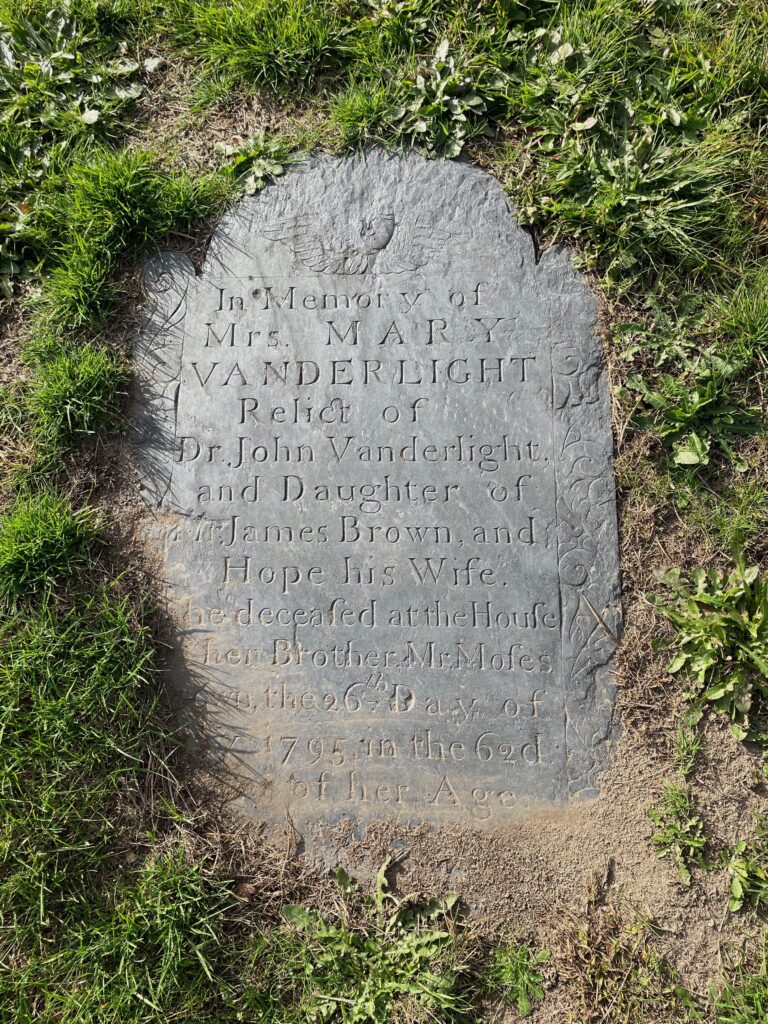
Hope (Power) Brown died in 1792 at the age of ninety. Her gravestone told visitors she was “The mother of Nicholas, Joseph, John, and Moses Brown.”

As Karen Wulf recently wrote at Commonplace, that left off Hope’s daughter, Mary (Brown) Vanderlight (1731–95).

“The Brown Brothers Had a Sister” shares what information survives about that member of the prominent Providence family:
She married David Vanderlight, a doctor and Dutch immigrant, in the early 1750s. Both her husband and their only child, a baby boy, died in February of 1755.

When she died in the spring of 1795, Mary Brown Vanderlight had been a widow for four decades, and lived on her own or with her mother. Like her mother, she remained a stalwart of the Baptist church that their forebears had helped found (though her brothers wandered to Quakerism and the Anglican church). Like her mother, she never remarried. Like her mother, she was the administrator of her husband’s estate, a complex job that came with significant legal and other practical responsibilities.
The main documentation for Vanderlight’s life is in account books—hers and other people’s. She started tracking her finances before her marriage, helped her husband manage his practice, and kept going as she had to support herself.
From the time David died, Mary continued the surviving account books. It looks like she also continued to serve patients at least by selling medicines but maybe also by practicing—or even teaching. As late as 1757 she was billing her neighbor Elisha Shearman for having trained his son in the “arts of apothicary.”

She also took up her husband’s role in the library [now the Providence Atheneum] and was listed as one of only two women among the nearly 150 “proprietors” who regularly paid to support—and use—it. . . .

She also kept investing. These investments included, according to a single notation in one of her brother’s accounts, helping to finance the infamous slaving voyage of the Sally.
Where did Mary Vanderlight learn to keep accounts? Wulf writes that she probably learned that skill from her mother, who for decades managed her own books and tracked who in the family owned what.

Monday, May 23, 2022

“All should be ready to yield Assistance to Rhode Island”

We can see the logic of the London government’s decision to try people suspected of attacking H.M.S. Gaspee on 10 June 1772 in Britain, not Rhode Island.

For one thing, the colony hadn’t convicted anyone for the similar torching of the Customs ship Liberty in 1769. Or for earlier assaults on government vessels.

For another, a couple of the men accused of helping to storm the Gaspee were county sheriffs, and others were highly influential merchants and office-holders. The Crown controlled none of the branches of the Rhode Island government.

But by deciding on that plan, to be backed up by the army and navy, secretary of state Dartmouth gave Rhode Island’s Whigs a threat they used to rally other colonial leaders to their cause.

At first, American politicians and printers had been reluctant about supporting a bunch of smugglers who’d attacked a naval vessel enforcing the law. But once the issue became every British citizen’s right to be tried in the county where the alleged crime took place, not three thousand miles away, then Whigs found their voice.

Around Christmas, four Rhode Island politicians wrote to “several gentlemen in North America” about what Lord Dartmouth had told their governor. Those four politicians were:
  • Darius Sessions, deputy governor, who months before had initiated official complaints about the Gaspee’s patrols.
  • Stephen Hopkins, chief justice and possibly author of the “Americanus” essay on the case published days before.
  • John Cole, attorney and former chief justice who would be called as a witness in the inquiry.
  • Moses Brown, wealthy merchant and brother of the alleged leader of the attack.
One recipient of the men’s letters was Samuel Adams, leader of the Massachusetts resistance. He wrote three letters in return, saying such thing as:
It should awaken the American Colonies, which have been too long dozing upon the Brink of Ruin. It should again unite them in one Band. . . . It has ever been my Opinion, that an Attack upon the Liberties of one Colony is an Attack upon the Liberties of all; and therefore in this Instance all should be ready to yield Assistance to Rhode Island.
And:
I beg just to propose for Consideration whether a circular Letr from your Assembly on this Occasion, to those of the other Colonies might not tend to the Advantage of the General Cause & of R Island in particular
Adams had helped to guide the Massachusetts legislature through its 1768 circular letter dispute. In November 1772 he had led the Boston town meeting to set up a standing committee of correspondence to exchange political letters with other Massachusetts towns. He saw the Crown’s reaction to the Gaspee affair as a cue to do the same with other colonies.

Richard Henry Lee might have been another of the men who received the Rhode Islanders’ letter. At any event, on 4 February he wrote to Adams, introducing himself and asking about details of the Gaspee matter; “this military parade appears extraordinary, unless the intention be to violate all law and legal forms, in order to establish the…fatal precedent of removing Americans beyond the water, to be tried for supposed offences committed here.” Adams wrote back, assuring Lee that the stories out of Rhode Island were true.

Meanwhile, no American was actually removed to Britain. The royal commission never collected enough strong evidence against anyone to bring charges. The investigation petered out in the spring of 1773. But by then it had helped to inspire a wider network of correspondence and a little more paranoia among the American Whigs.

TOMORROW: Remembering Gov. Wanton.

Monday, December 25, 2017

Moses Brown’s Malden Christmas

In December 1775, Moses Brown led a delegation of Quakers from Rhode Island up to the Boston siege lines to bring relief to the suffering poor.

Brown and his comrades went to Gen. George Washington in Cambridge and explained how they wanted to go into Boston with money they had collected. A siege is of course an attempt to deny resources to the enemy, so the commander-in-chief couldn’t have been enthused about this idea.

Quartermaster general Thomas Mifflin was even more negative, thinking that such charity would prove unpopular with the Massachusetts populace.

In consultation with Washington and members of the Massachusetts General Court, the Quakers decided they would meet some of their contacts at the siege lines and hand over the money. But Sheriff Joshua Loring and Maj. John Small came out and told them that the poor in Boston didn’t need money and the town had adequate food.

So the Quakers went off to hand out their money to the poor people they found in Marblehead, Salem, Lynn, Chelsea, and the smallpox hospital at Point Shirley.

Soon enough it was Christmas Day, as Brown described in his report on the journey:
We went to Malden and Lodged at —— where were the Select men upstairs on business and below a Noisey Company of Soldiers fidling and Danceing after supper.

David [Buffum] and I proposed to see the Select Men and Inform them of our Business went up stairs and I spoke to them of the Noise etc not being sufferable it was not only rong in itself but contrary to Every prospect of the present time and Even the Congress Discouraged it by Resolves.

They allowed it was not agreeable but thought as they were Soldiers it must be allowed. It was what they called a Christmas frolich and they had been up all the Night before, were principaly of the Riflemen.
As an eighteenth-century Quaker, Brown didn’t celebrate Christmas. Neither did most New Englanders. But these riflemen were from the Middle Colonies, many of them transplants from Britain, and they didn’t adhere to Puritan customs. And thus we discern the limits of Moses Brown’s charity.

Friday, January 25, 2008

Capt. Moses Brown and the Beverly Company

Boston 1775 reader Tom Macy sent a link to his handy online edition of the orderly book of Capt. Moses Brown of Beverly from January to May 1776. Brown’s company was part of the 14th Continental Regiment, stationed in Beverly to guard the first American privateers’ wharfs, supplies, and captured vessels.

Here’s what the regiment’s commander, Col. John Glover (shown here), issued as general orders on this date in 1776:

It is Coll’s Orders that the Captains see that the Soldiers under their Command be disciplined [i.e., trained] twice a day at least, and that they keep their Arms clean and fit for Use, also to divide them into Messes of Six Men each, and to visit their Barracks three times a week & order them to be swept clean, and that the Soldiers keep themselves Neat & Clean, shave once a Week at least – as their Health & Reputation much depends on this, it’s expected this Order is punctually obeyed.

And it is further ordered and directed that the Non-Commissnd Officers & Soldiers attend divine Service at the house of publick Worship, and that no one will presume to go to the house of God in an indecent rude or disorderly manner, or behave so while their, on penalty of being punished therefore agreeable to the Nature of his Offence, and in order to encourage and stimulate the Soldiers, Commissioned Officers will set the Example by going themselves.
Macy’s annotations explain the location of the barracks, the nearest meeting-house, and the local ministers who were paid as chaplains. He also wisely writes, “There must be a good story behind the order that no one should behave ‘in an indecent rude or disorderly manner’ at church.” Almost every time someone writes a rule against certain behavior, we can assume that someone else has been behaving in just that way. Likewise, some officers had probably not been setting the example the colonel wanted.

The website also includes Brown’s breakdown of his company by age, height, home town, and whether they brought their own muskets. Almost all these soldiers came from Beverly, so they were serving in their home town. One, Esop Hales, was African-American, confirming that Glover’s regiment was integrated.

Capt. Brown’s orderly book is on display with his sword at the Beverly Historical Society.