J. L. BELL is a Massachusetts writer who specializes in (among other things) the start of the American Revolution in and around Boston. He is particularly interested in the experiences of children in 1765-75. He has published scholarly papers and popular articles for both children and adults. He was consultant for an episode of History Detectives, and contributed to a display at Minute Man National Historic Park.

Subscribe thru Follow.it


•••••••••••••••••


Showing posts with label Basile Boudrot. Show all posts

Wednesday, February 18, 2026

A Last Word on Basile Boudrot

Whenever I recount a story at length, I like to add some new sources, connections, or interpretations. I don’t want to just repeat what other writers have said.

But when I started researching suspected murderer Basile Boudrot, I couldn’t find that sort of material. I felt so stymied that I thought I’d have to confine the story to my Ko-fi updates, where I’ve started to share loose ends and research in progress. 

Ultimately, I spotted enough sources to fill the past several postings. But like everyone else who’s written about this case, I hit a brick wall in August 1776, when the Continental Congress voted to send Boudrot to Massachusetts.

As my closing thoughts, I’ll offer this scenario for how the sources fit together. Bear in mind that this is only one possible reconstruction, perhaps tinged by a fiction writer’s search for plot twists, liable to be upended with a single new document. But here goes.

February 1772: Capt. Thomas Parsons and his eight-man crew sail a schooner (name unknown) out of Newburyport, headed for the Caribbean.

March 1772: Parsons’s ship founders in a storm that blows a lot of vessels north. Meanwhile, Basile Boudrot boards a ship in France, heading to Nova Scotia. Along the way he opens a letter from his relative Marguerite Landry to the D’Entremont family, describing where their relatives hid money as the British expelled Acadians almost twenty years before.

April 1772: Boudrot reaches Nova Scotia and registers for his land grant on St. Marys Bay. But first he follows the directions in the Landry letter and unearths “1004 pieces of money.” Meanwhile, people in Newburyport worry about Thomas Parsons’s ship; no one reports seeing it in the Caribbean.

May 1772: Boudrot visits the D’Entremonts in Pubnico, assuring them that Marguerite Landry and her family are in good circumstances in France. Then he takes off for the province of Canada, abandoning his land since he’s already found a fortune with much less work. Benoni d’Entremont gets suspicious and writes to Landry in Cherbourg.

Summer 1772: The D’Entremonts ask questions in Nova Scotia about Boudrot. Passing ship captains from Massachusetts, including Hector McNeill, ask questions about the missing schooner. Locals talk about Basile Boudrot suddenly having a lot of money and no good explanation for it.

Fall 1772: Folks in Newburyport piece together information and conclude that Basile Boudrot was behind the disappearance of Parsons’s schooner, that he got suddenly rich from plundering that ship after killing all its crew.

Spring 1773: Marguerite Landry writes to the D’Entremonts from Cherbourg, describing the buried money and reporting that French sea captains have spotted Basile Boudrot in North America. In Massachusetts, the Parsons family presses for an inquiry into the alleged attack on the schooner.

Late 1773: Basile Boudrot has spent through most of his windfall. He picks up whispers that the D’Entremonts and Yankee mariners are all hunting him. He adopts the alias “Dugan” to work on ships around Montréal, Lake Champlain, and points west.

Fall 1775: Americans invade Canada, besieging Québec. Massachusetts mariners Hector McNeill and William Farris leave the city and go to work for the Continental Army.

Spring 1776: As the Continentals withdraw to Montréal, McNeill spots “Dugan” working on another supply ship. McNeill identifies this man as Basile Boudrot and demands his arrest.

Summer 1776: The Continental Army holds Boudrot prisoner in New York City until the Congress endorses Gen. Samuel Holden Parsons’s plan to send him to Massachusetts to stand trial.

Fall 1776: Soon after Boudrot reaches Massachusetts, the authorities realize the accusation against him doesn’t hold water: he wasn’t even in North America when Thomas Parsons’s ship disappeared. Out of embarrassment, they drop the case and never mention it again. People in Newburyport persist in believing that Nova Scotians plundered the schooner. Basile Boudrot disappears once more.

[The photograph above shows Smuggler’s Cove park on St. Marys Bay, Nova Scotia. Nothing says “law-abiding maritime community” like naming a place Smuggler’s Cove.]

Tuesday, February 17, 2026

“A Difficult Case” in Late 1776

As recounted yesterday, in August 1776 the Continental Congress voted to send Basile Boudrot to Massachusetts to be tried for murdering Thomas Parsons and his crew or, failing that, to send him to Nova Scotia for trial.

There were some problems with that plan. As John Adams said, “It is a difficult Case.”

Yet the Congress had little choice. Just that month, its members had signed the Declaration of Independence, which complained about the king (among other things) “depriving us in many cases, of the benefits of Trial by Jury.” So the new American union had to provide Boudrot with a jury trial.

Was Essex County the right venue, even if Capt. Parsons had sailed from Newburyport? One fundament of British law was that the accused should be tried in the jurisdiction where the crime was allegedly committed. And the accusation against Boudrot was that he’d attacked Parsons’s ship up at St. Marys Bay.

Again, the Declaration might come into play. Another of its grievances was that the king was “transporting us beyond Seas to be tried for pretended offences.” The Continental Army had transported Boudrot out of Canada down to New York, and now was sending him to Massachusetts. But really he should be tried in Nova Scotia.

That of course raised practical problems. Would Nova Scotia authorities share the Continental leaders’ wish to try Basile Boudrot, pushed by the desire of the victim’s brother, Gen. Samuel Holden Parsons of the Continental Army? How would that conversation go?
“So you want us to take this man and put him on trial for plundering a ship from Massachusetts four years ago?

“Yes!”

“Will you also send us Captains Nicholasson Broughton and John Selman, who plundered our Charlottetown just last year?”

“Oh, no, no, no.”

“Ah.”

“That happened during the war, you see.”

“The war that’s still going on.”

“Yes. But our commander-in-chief didn’t let those two men back into our army!”

“So you have them in jail, awaiting trial?”

“Er, no. They’re officers in the Essex County militia.”
And speaking of practical matters, even as the Congress in Philadelphia laid out this plan for dealing with Boudrot, the Continental commanders in New York were seeing the harbor fill up with Royal Navy ships and army transports. On 27 August, the British and American armies clashed in the Battle of Brooklyn. About a month later, the redcoats were on Manhattan Island, and New York City was burning.

Given all that, it’s not so surprising that Basile Boudrot’s paper trail ends. American Patriots felt obliged to try him in the proper legal venue, but preserving the paperwork to get him there might not have been the highest priority.

I hold out hope that an archive in Massachusetts, or in Nova Scotia, contains more clues to Boudrot’s fate. Perhaps as “Boudreau,” or “Dugan” (his reported alias), or “the Acadian” (as American generals referred to him). But given the murky case, his use of aliases, the fog of war, and the passage of time, I don’t hold out much hope.

TOMORROW: One scenario.

Monday, February 16, 2026

“An Order to try one Basil Bouderot, Accused of Murther”

According to the New-York Journal article I quoted yesterday, on 10 July 1776 Basile Boudrot was sent from New York to Newburyport to stand trial for murdering Thomas Parsons and his crew in Nova Scotia four years earlier.

But it appears that rendition wasn’t official; it may never have happened at all. Although newspapers in Massachusetts reprinted the New York article, none confirmed that Boudrot actually arrived in the commonwealth.

Instead, the next document in this case is a letter from Thomas Parsons’s brother, Samuel Holden Parsons, to John Adams. The two men had been at Harvard College together. Parsons was now a respected colonel in the Connecticut Line of the Continental Army.

On 24 July, Col. Parsons wrote to Adams from New York:
The Unhappy Fate of my Brother about 4 Years ago occasioned my prefering a Memorial to Congress for an Order to try one Basil Bouderot, Accused of Murther and Robbery, in the Province of the Massachusetts Bay; The Propriety of the Application I am in some Doubt of; whither it should be to Congress or to your Provincial Legislature. I beg you Sir to take the Memorial, make such Alterations as you think proper, or if not proper to be Preferd to Congress advise me in what Way to proceed to Avenge my Brother’s Death.
That memorandum has been lost, alas. All we have in the Continental Congress’s records is that the file was referred to a committee of Thomas Jefferson, James Wilson, and Roger Sherman the next day.

On 3 August, Adams wrote back: “Your Memorial has been duely attended to, and is under Consideration of a Committee. It is a difficult Case.” But for several days, nothing happened except that Parsons was promoted to brigadier general.

On 16 August, Adams got himself “added to the Committee to whom were referred the Letters and Papers respecting the murder of Mr. Parsons.” Five days later, that committee offered its recommendation, which the Congress adopted:
Resolved, That Bazil Bouderot…be sent to the state of Massachusetts bay, and there delivered to the council of the said state, and that it be recommended to the said council to proceed against the said Bazil Bouderot according to the laws of their state; but, if they have no law by which crimes committed out of their state may be tried within the same, that then they confine the said Bazil Bouderot, until the situation of public affairs will admit his being removed to Nova Scotia, where the crime is alleged to have been committed, and there submitted to a fair trial, according to the ancient laws of that province.
That wording suggests that Boudrot had not actually been sent from New York in July, but would be now. Or maybe this resolve made an earlier action official, legally turning over the case, and the prisoner, to one of the new states. The Congress record thus offers another place to look for more documents, in the archive of the Massachusetts Council.

Because that’s where the trail ends. The Congress never took up the case again. The editors of the Washington Papers found no more traces. The editors of the Adams Papers wrote:
This episode remains a mystery. . . . The full story was in a memorial Parsons sent to Congress, but this has not been found, and the ponderous Life and Letters of Samuel Holden Parsons by Charles S. Hall, Binghamton, 1905, does not even mention the matter.
TOMORROW: A change of venue?

Sunday, February 15, 2026

“The Villain that murdered Colo: Parsons Brother is here”

Back here I described the family of the Rev. Jonathan Parsons of Newburyport, including his fourth son, Thomas Parsons, who disappeared in 1772.

The third son, Samuel Holden Parsons, became an attorney in Lyme, Connecticut. He prospered, getting elected to the colonial assembly, and then moved to New London. At the start of the Revolutionary War Parsons raised a regiment and marched north.

Parsons served through the siege of Boston and in the spring of 1776 led his troops south through Connecticut to defend New York.

Soon after Continental officers detained Basile Boudrot (alias Dugan) on suspicion of murdering Thomas Parsons and his crew, someone sent the news to Col. Parsons.

The next trace of Boudrot that we have is therefore Gen. Philip Schuyler’s 12 June letter from Albany to Gen. George Washington:
The Villain that murdered Colo: Parsons Brother is here. The Colo: desired Me to send him to New York I wait Your Excellency’s Directions.
Washington replied on 24 June:
As Colonel Parsons has requested you to send the Person who is supposed to have murdered his Brother, I have no objection to your doing it, if you judge it necessary. He, from what I have been told, designs to apply to Congress, for instituting some Mode of Trial for the Offence.
Schuyler (shown here) proceeded on that course. On 11 July, John Holt’s New-York Journal reported:
Last Sunday [7 July] one Bazel Bonderot, a native of Nova-Scotia, was brought to this city from Canada, charged with being a principal in the murder of Captain Thomas Parsons, and eight other persons, in Nova-Scotia, in February 1772.

Soon after this murder was perpetrated, he fled his country, and has been wandering from place to place ever since, till last April, when he was providentially detected by Captain Hector McNeil, properly secured, and sent forward to receive the just reward of his crimes.

He was yesterday sent on from this city to Newbury Port, the place where Captain Parsons last lived, for examination and trial.
That article was reprinted in several newspapers, and eventually in the 19 July Essex Journal of Newburyport.

That same issue of the Essex Journal reported:
This Morning, between 6 and 7 o’clock, departed this life after a long tedious illness, the Rev. JONATHAN PARSONS, in the 71st year of his age, and in the 31st of his MINISTRY in the PRESBYTERIAN Church, in this Town—His remains to be interred on Tuesday next, at three o’clock in the afternoon.
It’s not clear whether the minister heard about the capture of his son’s alleged killer before he died.

TOMORROW: Deliberations in the Congress.

Friday, February 13, 2026

“He Now Passes by the Name of Dugan”

On 29 Aug 1775, Capt. Hector McNeill arrived in Québec on board another captain’s ship from Dominica. He brought false news of a battle at Roxbury where “most of the light horse were killed.”

Having been born in Ireland and raised in Boston, McNeill was then living in Québec with his daughters while carrying on trade with New England. His son Hector, Jr., based in Marblehead, had enrolled in Col. John Glover’s regiment.

A few months later, Col. Benedict Arnold and Gen. Richard Montgomery arrived at the walls of Québec with Continental troops. Lt. Gov. Hector Theophilus Cramahé ordered all able-bodied men to help defend the city or leave. The captain made his way to Arnold and started to carry supplies for the Continentals.

Though we usually tell the story of the American invasion of Canada with a climax and swift end in December 1775, the campaign went on for several more months, so McNeill had lots of work to do.

In the spring of 1776, the captain recognized a man aboard another ship, presumably also working for the Americans. On 25 April, McNeill at Pointe-aux-Trembles sent an urgent message to Col. Arnold, who was on the same island at Montréal:
This will be handed you by Major [Zachariah] Dubois, and is to Request the favour of you to Arrest, & Confine in Jail a certain acadian Whose proper Name is Basiell Boudrott, he Now Passes by the Name of Dugan and is the Mate of the Schooner Providence Commanded by Capt. Palmer,

I am bold to charge this fellow above named with the Murder of Capt. Thomas Parsons of Newbury Port, & his whole Crew at or near Cape St Mary’s in the Bay of Funda in the Month of March 177[2], I have been upon the look out for this chap ever Since & Now Providentially have found him, I am Sure he is the Principall of that gang of Villians who murderd Capt Parsons, & his crew, 9 in Number, & plundered first, afterwards burnt his Vessell—

I hope I need not urge you to Confine, & keep him close untill he can be Sent to New England, as Piracy, & Murder are Crimes which all good Men Should Endeavour to Prosecute & punish, I inclose you a Letter for the Owners of Capt Parsons his Vessell Which I beg you will read, Seal, & forward to the place of its distination—

My William Farris is Saild for you I hope you will be kind to him—as for your Capt Palmer—he has Sickened Me; of all Men to dispatch or manage affairs I Never Mett with worse hands then himself & his Lieut,—

I hear your wound is broke loose Which gives Me real Sorrow—you Must be Carefull of it or it may yet cost you dear

For heavens Sake do not Neglect to Secure the aforementioned Basiell Boudrot, for he is a Vile Murderer

May heavens preserve you in that Nest of Tory Scoundrels & grant you Wisdom & Fortitude to mannage them as they deserve
McNeill sent the same request to Gen. David Wooster. On 26 April, Wooster assured him: “I shall write Genl Arnold concerning the Acadien & also to arrest Palmer.”

TOMORROW: Sailing for Arnold’s army.

Thursday, February 12, 2026

“Cast away upon the Isle of Sable”

There are a lot of unanswered questions about the disappearance of Capt. Thomas Parsons, his ship, and his crew in early 1772.

As colonial newspapers show, shipwrecks happened all the time. The rocky shores of Nova Scotia were notorious for their dangers.

For example, on 16 Sept 1773, the Massachusetts Spy ran this report from John Callahan, just arrived from London:
Capt. Callahan, last Thursday se’nnight, went on shore at Cape Sable, where he saw the Wreck of a Snow, New-England built, Pink Stern, called the Kitty, loaded with Lumber, had all her Cargo on board, but her Sails, Rigging and Crew gone.
That might seem mysterious, even suspicious. But back on 10 May the Boston Post-Boy had reported:
A Fisherman, who arrived here last Week, informs, that the Snow Katy, Capt. Major, from this Port for Newfoundland, is cast away upon the Isle of Sable: The Vessel and Cargo is entirely lost; the Captain and Mate, with great Difficulty saved their Lives, and the Remainder of the Crew, (five in Number) perished.
In the case of Capt. Parsons’s schooner, within a year New Englanders suspected he’d met with foul play. What led them to that conclusion? Unfortunately, our sources don’t say.

Those sources do raise some geographic questions about this voyage. One is why, if Capt. Parsons was heading from Newburyport to the Caribbean, he’d ended up far north. Perhaps that was a way of catching trade winds. Perhaps a storm had pushed his ship off course. Perhaps people didn’t remember his destination accurately. Or perhaps Parsons’s ship was returning from the islands and overshot Cape Cod because of weather.

The March 1773 news item quoted here said a schooner had been lost “near Cape-Sable,” which is the southernmost corner of the Nova Scotia peninsula. In Newburyport people came to believe Parsons had met his fate at “St. Mary’s,” which must mean St. Mary Bay’s at the westernmost corner. Was that close enough to count as “near Cape-Sable” to a New Englander?

Yet another mystery: Near the mouth of St. Mary’s Bay sits the village of Comeauville, where Basile Boudrot was granted 300 acres in May 1772. That was three months after Capt. Parsons reportedly left Newburyport, and in that season Boudrot was supposedly busy digging up buried money. Yet somehow the people of New England came to believe that Basile Boudrot was responsible for the death of Capt. Parsons and his crew.

TOMORROW: Spotting the culprit?

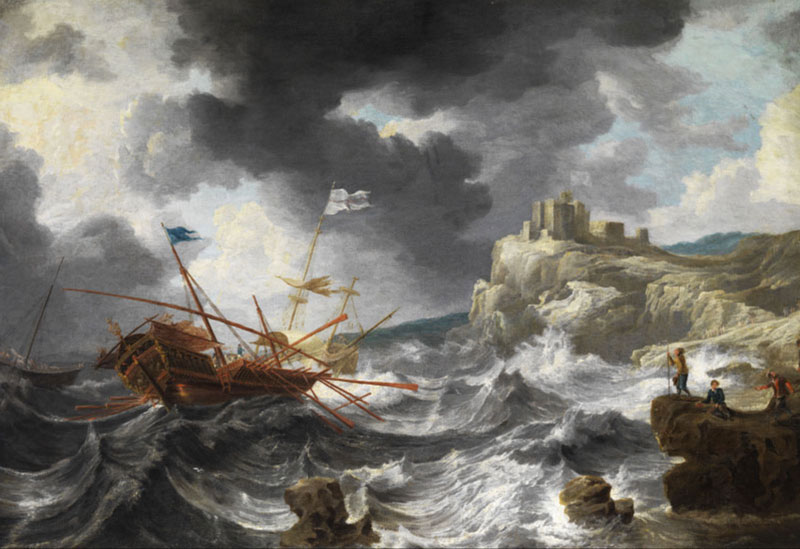
[The picture above is Bonaventura Peeters’s “Shipwreck,” ca. 1652, courtesy of the Journal of Historians of Netherlandish Art.]

Monday, February 09, 2026

Basile Boudrot and “1004 pieces of money”

According to the Musée des Acadiens des Pubnicos website, Basile Boudrot was born in 1739 in Port Royal, which the British had renamed as Annapolis Royal, Nova Scotia, in 1713.

War broke out between the British and French Empires in the 1740s and again in the 1750s. At some point the Boudrot family moved to Cherbourg, France. Basile’s father was a mariner, and the young man worked as a fisherman “now and then.”

In 1764 Basile married Magdelene d’Entremont in Cherbourg. She, too, had roots on Nova Scotia, in Pubnico on the southeastern shore.

Four years later, the lieutenant governor of Nova Scotia, Michael Francklin, signed a charter creating the settlement of Clare in the easternmost corner of the peninsula. That area was set aside for French-speaking Acadians.

Three important things happened to Basile Boudrot in 1772. First, the Musée des Acadiens des Pubnicos tells this story:
It was in April when he left [France] with a letter from his sister[-in-law] Marguerite Landry for her brother-in-law in Pubnico, asking him to send her the money which had been hidden at the “Cabanaux.”

On his way to Acadia, Basile opened the letter and went right straight to the spot indicated where the money had been hidden and unearthed “1004 pieces of money.”

Then he went to Pubnico and told the d’Entremont bothers that their relatives in France were well provided for, having received money from “the town-hall and a quarter out of two vessels.” Thus, he was going to keep the money. It is obvious that he did not give them Marguerite’s letter.

He left Pubnico on May 7 and disappeared forever. In a letter, we read that some captains from Cherbourg had seen him several times “in America” without saying exactly where.

A few days after Basile had left, Benoni d’Entremont wrote to his sister-in-law Marguerite Landry and told her about the visit that he and his brothers had received from Basile Boudrot. Marguerite answered April 20, 1773, telling of the letter she had entrusted him with and of the lies he had told of her being well provided for, and these the whole story of Basile’s “prevarication” came to light.
Benoni d’Entremont (1745–1841) had spent his adolescence in Marblehead, Medfield, and finally Walpole, Massachusetts, having been expelled from Acadia with his family after the capture of Louisbourg. His father died in 1759 and was reportedly buried in Roxbury. After years as “French neutrals,” the rest of the family returned to Nova Scotia.

Back to Basile Boudrot. According to Isaiah W. Wilson’s A Geography and History of the County of Digby, Nova Scotia (1900), in May 1772 the government of Nova Scotia granted him 300 acres on St. Mary’s Bay within the Clare settlement. Today the village of Comeauville claims him as a founder.

I have questions about how those events fit together, assuming all the details are correct. Did Boudrot use the money he unearthed to buy that land? The timing would be tight if he left France in April and completed the real estate deal by the end of May. Or did he return to Nova Scotia to settle on a land grant and as a bonus stumble onto buried treasure?

Pubnico and Comeauville are more than fifty miles apart, but there weren’t a whole lot of people living on eastern Nova Scotia at that time. Did the D’Entremonts really never hear about Boudrot living in the same province?

As for the third event in 1772, that’s coming up later this week.

TOMORROW: Parson Parsons’s sons.