J. L. BELL is a Massachusetts writer who specializes in (among other things) the start of the American Revolution in and around Boston. He is particularly interested in the experiences of children in 1765-75. He has published scholarly papers and popular articles for both children and adults. He was consultant for an episode of History Detectives, and contributed to a display at Minute Man National Historic Park.

Subscribe thru Follow.it


•••••••••••••••••


Showing posts with label Royall Tyler. Show all posts

Tuesday, August 03, 2021

The Poor Akley Family
Back in April, I started to look into the men Owen Richards sued for tarring and feathering him on 18 May 1770.

The first and easiest to track was Joseph Doble, both because he came from a fairly prominent maritime family and because he spelled his name only two ways.

The next name on my list, Joseph Akley, has been more difficult. I’ve found his family name spelled Akly, Akeley, Aikley, Aykley, and even Heakley. In later life he used Ackley, but his mother and his widow chose other forms. One influential source appears to have remembered him as Eckley. I’m going to stick with Akley just because I’ve already created a label for him under that spelling.

Joseph Akley’s story starts on 8 June 1750 when the Rev. Dr. Joseph Sewall married Francis Aikley (or Akley) and Tabitha Bull (or Buell) at Old South. I can’t find any period mention of Francis Akley’s profession. [ADDENDUM: It looks like he was a wheelwright.]

Francis and Tabitha started to have children on a regular basis. According to the New South Meeting-House records, its minister baptized:
  • Francis, Jr., on 19 May 1751
  • Joseph, 5 July 1752
  • Tabitha, 9 Dec 1753
  • Thomas, 25 May 1755
  • John, 4 Sept 1757
  • Sarah, 25 Mar 1759
  • Mary, 18 Jan 1761
  • Samuel, 13 May 1764
In addition, there was a William born in 1769.

The Akleys had trouble caring for all those children, which provides a second set of records about them—from Boston’s Overseers of the Poor.

The first sign of the family intersecting with those town officials was on 14 Oct 1762 when Joseph, aged ten, was bound out to Timothy Winship of Boston until 10 June 1773, which would be when he turned twenty-one.

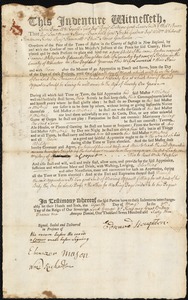
The following May, older brother Francis was indentured to Edward Houghton of Lancaster until 16 Mar 1772. He was to be trained as a cooper. That indenture appears above, courtesy of Digital Commonwealth.

The next year, the family needed more support. On 5 Jan 1764, Overseer Benjamin Dolbeare authorized the almshouse to take in “Tabitha Akley And 4 Children.”

In October the Overseers indentured the other two Akley boys. Thomas was sent to the Rev. Jason Haven of Dedham, probably as a household servant, to serve until 3 Oct 1777. This relationship was legally renewed on 6 Feb 1771 and then again in duplicate on 6 Nov 1771. Perhaps the Akleys or Haven grew dissatisfied and ended the arrangement but then went back to it. 

On 11 Oct 1764 the Boston Overseers bound seven-year-old John Akely out to Samuel and Lucy Williams of Springfield to work until 1 Apr 1779. Williams was identified as a gentleman, and he didn’t promise to teach John any trade, just “to Read Write & Cypher,” which suggests the boy was to be a household servant. Williams also promised to give John £13.6s.8d. when he came of age. The Akley children were being dispersed far across the province.

For the next four years the diminished family appears to have eked by, but on 1 Apr 1768 Overseer John Bradford sent “3. Children of Francis Akley” to the almshouse. Those three children were sent out of town in the following months:
  • In May, nine-year-old Sarah Akley was bound out to Joshua Clap of Scituate to learn housewifery until 1 Mar 1777.
  • In June, four-year-old Samuel was sent to John Merrill of Topsham, Maine, to be trained as a wheelwright until 17 June 1785.
  • In September, seven-year-old Mary was indentured to Edward Russel of North Yarmouth, Maine, to learn housewifery until 20 Dec 1780.
On 11 Aug 1769, “Tabitha Akley & Child” came into the house “from Workhouse.” On 20 August, Overseer Samuel Partridge sent “Willm. Akley a Child” there.

About a year later, on 17 Sept 1770, Overseer Royall Tyler authorized “Tabitha Akley & Child” to be admitted into the almshouse, and on 26 October Joseph Waldo did so again. On 7 Feb 1771, Edward Richardson “Discharg’d Tabitha Akley to Workhouse.” (This might have been the daughter Tabitha, who turned eighteen that year.)

On 16 Sept 1772, Overseer John Leverett admitted the father Francis Akley into the workhouse, designating him as “Lame.” On 23 Oct 1773 Tabitha Akley was moved from the workhouse to the almshouse by order of Overseer Samuel Whitwell.

The last mention of the family in the surviving Overseers of the Poor records came when those officials bound out William Akley from 6 Oct 1774 to 15 Feb 1790 to learn navigation from Capt. Shubael Downes. Back-calculating from his date of majority, William was then five years old; he had first entered the almshouse as an infant.

TOMORROW: Joseph Akley’s new master.

Sunday, June 06, 2021

“I told Cushing as Ruggles told Tyler”

Yesterday I quoted a long anecdote that John Adams wrote out in 1789 about a discussion between two Massachusetts politicians seventeen years earlier.

The specifics of Adams’s anecdotes aren’t always reliable when he was trying to make a point about politics or personalities or, in this case, both.

Adams dated that exchange to 1772. At that time one of the men he quoted, Timothy Ruggles, no longer had a seat in the Massachusetts General Court. He lived in Hardwick, in western Worcester County. The Boston merchant John Rowe recorded several encounters with Ruggles in the late 1760s but none in the early 1770s, suggesting he didn’t routinely visit the coast. So how likely was Ruggles to be socializing with Royall Tyler and other Boston Whigs in 1772?

As it turns out, however, Adams also left us solid evidence that he had heard (or heard about) that exchange between Ruggles and Tyler by the end of 1772.

On 1 Jan 1773, Adams recorded this event in his diary:
This Evening my Friend Mr. [Samuel] Pemberton invited me and I went with him, to spend the Evening with Jere. Wheelwright. Mr. Wheelwright is a Gentleman of a liberal Education about 50 Years of Age, and constantly confined to his Chamber by Lameness. A Fortune of about two hundred a Year enables him to entertain his few Friends very handsomely, and he has them regularly at his Chamber every Tuesday and Fryday Evening.
Wheelwright (1717-1784) was a wealthy heir who graduated from Harvard College in 1736. On receiving his master’s degree three years later, he delivered a speech against slavery, its effect diluted by being in Latin. After that he enjoyed a long life of wealthy obscurity, keeping out of religious and political controversies. Among Wheelwright’s properties were “the Hills at New-Boston,” which we now call the crest of the Beacon Hill neighborhood, and settlements in New Hampshire and Maine.

In Sibley’s Harvard Graduates, Clifford K. Shipton wrote:
About 1770 one of Wheelwright’s legs was so badly broken by the upsetting of his riding chair that he was confined to his chamber for the rest of his life. Having an income of about £200 a year, he moved into comfortable quarters in Newton from which, during his remaining years, he surveyed the world with intelligent curiosity.
Wheelwright kept notes on current events in his almanac diaries for more than forty-five years. Only one folder’s worth of that work survives at the Massachusetts Historical Society. He never married or had children.

Back to Adams’s diary entry, which describes a New Year’s visit to Wheelwright’s house. (Shipton identified “Mr. Swift” as John Swift, Harvard 1733; Adams doesn’t mention that man in his papers while Samuel Swift was a good friend and a link between him and Wheelwright, so I put Samuel Swift in this party.) Adams wrote:
The Speaker [Thomas Cushing], Dr. [Joseph] Warren and Mr. [Samuel] Swift were there— And We Six had a very pleasant Evening. Our Conversation turned upon the Distress of Rhode Island [during the Gaspee investigation], upon the Judges Dependency [salary grants from the tea tax], the late numerous Town Meetings, upon [William] Brattles Publication in [Richard] Drapers Paper [the Boston News-Letter] of Yesterday, and upon each others Characters. We were very free, especially upon one another.

I told Cushing as Ruggles told Tyler, that I never knew a Pendulum swing so clear.

Warren told me, that Pemberton said I was the proudest and cunningest Fellow, he ever knew.

We all rallied Pemberton, upon the late Appointment of Tommy Hutchinson [the governor’s son] to be a Judge of the common Bench, and pretended to insist upon it that he was disappointed, and had lost all his late Trimming, and Lukewarmness and Toryism.

Warren thought I was rather a cautious Man, but that he could not say I ever trimmed. When I spoke at all I always spoke my Sentiments. This was a little soothing to my proud Heart, no doubt.
Thus, by the time of this gathering Adams definitely knew that Ruggles got off a good line about Tyler and was happy to borrow it to tease Cushing. Perhaps the original conversation happened earlier than 1772, and perhaps it didn’t really start with Dr. Thomas Young, but it happened.

Now I can’t imagine anything more antsy for John Adams than waiting for his colleagues to tease him and having to chuckle about it.

Saturday, June 05, 2021

Adams on Ruggles on Young

On 8 Feb 1789, John Adams wrote to Dr. Benjamin Rush about the creation of Pennsylvania’s wartime constitution, which was too simple and radical for his tastes.

Adams listed Dr. Thomas Young, whom he had known in Boston, as one of the four men principly responsible for that constitution. He told Rush their characters “should be analyzed and developed in a manner that would give offence.” And to that end, he wrote:
Let me give you the character of one of them, (Young) in a conversation which really passed in 1772 between Timothy Ruggles, & Royal Tyler.
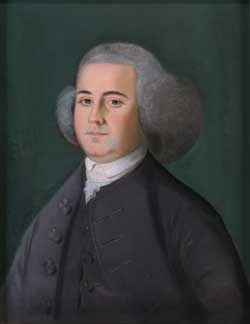
Ruggles (shown here) was a lawyer and legislator from Hardwick, a general in the provincial militia, chief judge of his county’s court of common pleas, and a one-time speaker of the Massachusetts house. He was charming enough to maintain friendships even when he differed from people politically.

In 1765 Ruggles chaired the Stamp Act Congress but refused to sign its protest against the law. From then on he was counted as a friend of the royal government. He maintained enough local popularity to be elected to the General Court as late as 1770, but after that he didn’t return to state government until the mandamus Council of 1774.

As for Royall Tyler, he was a Boston politician notorious for actually seeking votes, especially from tradesmen. While Tyler was generally populist in his politics, it was hard to pin him down on specific policies or actions, and he could loudly deny having said things that many people had heard him say. By the 1770s Tyler was on the Massachusetts Council, a thorn in the royal governors’ sides.

According to Adams, Ruggles and Tyler had this conversation about Dr. Young:
Ruggles. That Tom Young is a firebrand, an incendiary, an eternal fisher in troubled waters. Boston will never be in peace while that fellow is in it. He is a scourge, a pestilence, a judgement.

Tyler. come! come! dont abuse Dr. Young; He is a necessary man in the Town of Boston. He is in the city, what you are in the House of Rep: a useful man.

Ruggles. useful for what?

Tyler. I was yesterday in a watch makers shop, and looked over his shoulder while he put a watch together: The springs and wheels, were all clean, and in good order, every one in its place as far as I could see, but the watch would not go: the artist at length with his thumb and forefinger groping in the dust, upon his shop board took up a little dirty pin, scarcely visible to my naked sight, blew off the dust and screwed it into a certain part of the wheelwork, the watch then click’d in an instant, and went very well.—

This little dirty screw are you in the Legislature and Dr Young in the town of Boston.

Here was a loud roar of Laughter at Ruggles’s expence; but his wit has seldom failed him as his power of face; with all the gravity of a Judge he replied,

Ruggles. Since you are upon clock work, I’l tell you what: you resemble, the Pendulum—eternaly vibrating from one side to the other; but I must do you the justice to say, I never knew one swing so clear.

the answer hit the character so exactly, that the tide of laughter was now turned the contrary way.

We have had my dear sir, in all the States in the course of the late revolution, two many of these little Pins who have acquired the reputation of great wheels and main springs.
In 1970 David Freeman Hawke used the phrase “eternal fisher in troubled waters” in the title of an article about Dr. Young. The idiom “to fish in troubled waters” meant to wade into a troublesome situation, especially for one’s own advantage. Young wasn’t out for himself, but he didn’t shy from trouble.

TOMORROW: But did this conversation actually happen?

Thursday, December 31, 2020

“A determination to discourage a faithful Servant of the Crown”

For acting governor Thomas Hutchinson, the dispute between his Council and the provincial secretary Andrew Oliver was yet one more headache in 1770.

On 28 September, Hutchinson told the departed but still official governor, Sir Francis Bernard: “[Royall] T[yle]r is sowered by that deposition of the Secretarys which was published in England and it has hurt me every way.” (Bernard had been responsible for that publication, at least in part, but Hutchinson didn’t let on that he suspected that.)

Writing to John Pownall, an official in the Colonial Office, two days later, Hutchinson was more careful to avoid suggesting the controversy had hurt his effectiveness:
The Council except a few are…very friendly to me though there is some abatement of their friendship since the deposition of the Secretary taken by my order relative to the Affair of the Troops has been published. These publications & the sufference of the Letters to the Ministry of which a fresh parcel was sent by the last Ship to be made publick do infinite disservice.
Ironically, Hutchinson was just as upset about leaks as the Council—just different leaks.

There was also a private dimension to this dispute. On 10 October, while the Council was in the midst of collecting the depositions I quoted over the past couple of days, the acting governor’s son Thomas, Jr., married Sally Oliver, daughter of the secretary.

The families were already related by marriage. Thomas Hutchinson and Andrew Oliver had married sisters. In February 1770, Hutchinson’s daughter Sarah married Dr. Peter Oliver, son of Andrew Oliver’s brother Peter.

All three of those men were royal appointees. Thomas Hutchinson was lieutenant governor, thus acting governor, and also chief justice of Massachusetts. Andrew Oliver was secretary and was supposed to have been the stamp agent. Peter Oliver was a judge. Furthermore, other relatives were in the provincial government. John Cotton, the deputy secretary, was half-brother to the sisters who had married Hutchinson and Andrew Oliver. And Hutchinson had been trying to get his nephew Nathaniel Rogers appointed provincial secretary before the young man died.

Of course, there were family alliances on the other side of the political divide as well. James Bowdoin, the principal author of the complaint against Oliver, was a son-in-law of fellow Councilor John Erving, brother-in-law of fellow Councilor James Pitts, and father-in-law of Customs Commissioner John Temple, whom other royal appointees regarded as a snake.

Eighteenth-century society ran on such familial connections. People expected officials to look out for their relatives, and officials expected their relatives to be loyal assistants in government. Neither side was pure in this regard, and both sides complained about the other using family ties too much.

On 30 October, Hutchinson summed up his view of the controversy over Oliver’s description of the Council meeting in another letter to Pownall:
Unfortunately it has got published. Mr. Tyler denied that he made any mention of the Commissioners. I am sure I heard it from him but could not be certain whether that Day or a day or two before. Three or four Witnesses present swore, they heard it that Day. All the Council say they do not remember it.

They have not however directly charged the Secretary with false swearing but to a long Narrative drawn up by Mr. Bowdoin there is added divers Resolves declaring him guilty of a Breach of trust in taking the Minutes &c. The whole is a weak but malicious injurious performance which they have ordered to be recorded. . . .

I gave them my Opinion that these Resolves would be more resented than any thing which preceeded them as they plainly indicated a determination to discourage a faithful Servant of the Crown from doing his Duty as far as lay in their power.

These proceedings I hope will not pass without censure either in [privy] Council or when the State of the Province comes before the Parliament. Such a censure would mortify the party and being made matter of Record here would remove the reproach which otherwise will be transmitted to posterity upon the Secretarys Character.
In fact, the London government was already preparing to reward Andrew Oliver for his service. When Hutchinson officially became the royal governor, Oliver was promoted into his brother-in-law’s spot as lieutenant governor. And in 1772 Peter Oliver succeeded Hutchinson as chief justice.

(Hutchinson’s 1770 letters will appear in the Colonial Society of Massachusetts’s next collection of his correspondence, scheduled to be published in the new year.)

Wednesday, December 30, 2020

“The breach of a most essential privilege of this Board”

On 12 Oct 1770, eight members of the Massachusetts Council delivered their depositions about what had happened on 6 March, the day after the Boston Massacre.

Harrison Gray, who was also the provincial treasurer, dated his testimony 9 October while the other depositions were all dated on the 12th. Samuel Danforth, the senior Councilor present, and Royall Tyler provided solo accounts. Three men signed one deposition and two another, very similar, which doesn’t really add up to independent evidence.

The focus of controversy was provincial secretary Andrew Oliver’s report that Tyler had said of prominent men in Massachusetts, “they had formed their plan, and that this was a part of it to remove the Troops out of town, and after that the Commissioners.” And the main issues were—

1) Did Tyler really refer to the Customs Commissioners? Witnesses saying he did included Capt. Benjamin Caldwell, R.N.; deputy secretary John Cotton; and clerk Francis Skinner. Lt. Col. William Dalrymple said, “Something of that kind was mentioned by some Gentleman of the Council during the debates; but I cannot say whether it was by Mr. Tyler.” All eight Councilors said they had no recollection of that remark, some said they would definitely have remembered such a thing, and some argued that mentioning the Commissioners made no logical sense.

2) When Tyler spoke of a ”plan,” did he mean a plan formed before the shooting on 5 March or in the twelve to eighteen hours that had elapsed since it? Again, all the Councilors agreed that they didn’t see how anyone would take Tyler’s words to mean the first. To be sure, they had to work through some logical and semantic brambles to get there, as the scholarly Samuel Danforth showed:
whereas the mention made by Mr. Tyler of a plan that had been formed, (considering that the interval of time between those outrages and Mr. Tyler’s narration was scarce sufficient wherein to form such a plan and the knowledge of it to reach Mr. Tyler) may by some be understood to refer to a plan formed before those outrages were committed, this deponent testifies that nothing said by Mr. Tyler, in his hearing, did convey to him any idea of such a plan formed previous to those outrages; and how incautiously and madly so ever some individuals highly incensed, might have expressed themselves, and what apprehensions so ever Mr. Tyler (thro’ misinformation or otherwise) might then have of a plan formed for removing the troops from the town, in any other way than by prevailing with their officers to remove them, this deponent verily believes that no combination had ever been formed, or plan concerted for the purpose of removing the troops, either in the town of Boston or elsewhere; having never heard it suggested by any other person then Mr. Tyler either then or at any time since
On this point, witnesses Cotton and Skinner agreed that Tyler hadn’t appeared to mean a plan made before the Massacre. However, no one disputed that Tyler had spoken of a “plan.” 

3) Was Oliver wrong to send to London a description of the Council meeting that went beyond the official minutes? The secretary declared that he could, and indeed should, provide a full report on the Council to Sir Francis Bernard, still the official royal governor. The Councilors felt Oliver had broken a norm and cast the province in a bad light just like Bernard’s letters to London, exposed the year before.

That bad light was the real issue, of course. Especially since Bernard had Oliver’s account printed (not unlike how the Boston Whigs had published his letters). Massachusetts politicians had been trying to portray Boston as a peaceful, loyal British town unfairly maligned by royal officials and subjected to an unnecessary military presence. That argument was harder to make if the Council—the governor’s top local advisors—had been close to threatening armed rebellion.

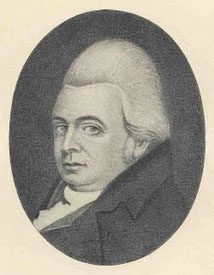
After collecting all the statements, on 16 October the Council named a committee to report on the matter. This consisted of five Councilors not present on 6 March: William Brattle; James Bowdoin (shown above); James Otis, Sr.; John Bradbury; and Stephen Hall.

According to acting governor Thomas Hutchinson, Bowdoin had already revealed his response to Oliver’s account by telling Thomas Flucker, “Why this Deposition of the Secretary has defeated every thing we aimed at by the Narrative & Deposition sent home.”

Sure enough, on 24 October the Council adopted a detailed report, penned by Bowdoin, that went over every disputed detail and ended in four resolutions:
I. RESOLVED unanimously, That Andrew Oliver, Esq; Secretary of this Province, by secretly taking minutes at Council, of what was said by the members of Council, in their debates, also by signing a paper containing those minutes, and further by giving his deposition to the truth of it, has in each and all those instances acted inconsistent with the duty of his office, and thereby is guilty of a breach of trust.

II. RESOLVED unanimously, That the said Andrew Oliver, Esq; inasmuch as such proceedings are destructive of all freedom of debate, is guilty of the breach of a most essential privilege of this Board.

III. WHEREAS the said Andrew Oliver, Esq; has suggested in his said deposition, that because his draft was allowed strictly to express the truth, it would not stand well on the Council records, and was therefore rejected by the Council; RESOLVED unanimously, That by such suggestion he has injured and abused the members composing that Council, and by so doing has reflected great dishonor on this Board.

IV. RESOLVED, That an attested copy of this report, and the petitions and depositions, to which it relates, be sent to Mr. Agent [William] Bollan, in order that he may make the best use of them he can, for the benefit of this Province.
Oliver responded with a letter protesting his honor and repeating that he’d reported the truth. The Council sent back a letter rejecting that claim and had the whole collection of documents printed as Proceedings of His Majesty's Council of the Province on Massachusetts-Bay, Relative to the Deposition of Andrew Oliver, Esq. Just one more dispute between the Massachusetts Whigs and the royal authorities with no resolution, just a feeling of grievance on both sides.

TOMORROW: A family feud?

Tuesday, December 29, 2020

The Massachusetts Council Investigates Itself

Yesterday we left off as provincial secretary Andrew Oliver’s sworn statement about what members of the Massachusetts Council had said on the day after the Boston Massacre made its way back to Massachusetts.

That statement was the final item in A Fair Account of the Late Unhappy Disturbance at Boston, published in London. Capt. James Scott, who worked for John Hancock, carried a copy of that pamphlet to Boston. Edes and Gill printed Oliver’s deposition without comment in the 24 September Boston Gazette.

The Whigs quickly leapt to the conclusion that Oliver’s description of the 6 March Council meeting was the latest move by royal appointees to misrepresent the province as rebellious.

And in a way they were right—the statement and its publication were part of a campaign by high officials. As Lt. Gov. Thomas Hutchinson later wrote (modestly referring to himself in the third person), they wanted to be sure the London government understood what they were dealing with:
he asked the secretary to recollect, as well as he could, what passed in the debate at council, and to commit it to writing, intending to send it to England, to shew in the fullest manner the reasons for the lieutenant governor’s complying with their advice, and not with any intention to set the council in general or any particular member, in an unfavourable light.

The secretary informed him, that, of his own mere motion, and for his private satisfaction, he had done it the evening before, while the debates were fresh in his mind.

After he had transcribed and corrected the minutes, he made oath to them; and they were transmitted at the same time with the copies of the votes or minutes of council, and other papers relative to the transaction, not to the secretary of state, but to governor [Francis] Bernard, who, at that time, continued governor of the province.
Oliver (shown above) made his oath before justice of the peace Foster Hutchinson, the acting governor’s cousin. 

Soon after the pamphlet arrived, the Massachusetts General Court started a new legislative session in Cambridge, with the Council meeting in Harvard’s Philosophy Chamber. On 4 October, the Council took up Oliver’s statement:
ONE of the Members of the Board having acquainted the Board that he had seen a Deposition signed Andrew Oliver, which was published in the Appendix to a Pamphlet lately printed in London; in which Deposition divers Gentlemen of the Council, which consisted of 8 Members then present, therein said to be convened on the 5th Day of March last, are represented as having made such a Declaration to His Honor the Lieutenant-Governor, respecting a plan formed by the People to remove the King’s Troops and the Commissioners of the Customs from the Town of Boston, as was likely to be attended with the most pernicious Consequences to this Province—He thereupon moved that the Board would make Enquiry of the Gentlemen of which said Council consisted, what Foundation there was for such a representation—

Which motion being seconded, the Board desired said Gentlemen, namely, Mr. [Samuel] Danforth, Mr. [John] Erving, Mr. [Thomas] Hubbard, Mr. [Harrison] Gray, Mr. [James] Russell, Mr. [Royall] Tyler, Mr. [James] Pitts, and Mr. [Samuel] Dexter, to prepare a true State of the Matter and lay the same before the Board as soon as may be.
Those were the eight Council members present at the 6 March meeting. Oliver had named five of them in his account. (To be exact, he had named three and referred to two more by title, and the London pamphlet had helpfully identified them in footnotes.)

The next day, Oliver asked for a chance to respond and to call witnesses to support his account of the discussion. The Council therefore accepted evidence on 9 October from Capt. Benjamin Caldwell of H.M.S. Rose, Lt. Col. William Dalrymple of the 14th Regiment, deputy secretary John Cotton, and clerk Francis Skinner.

All those witnesses basically agreed with Oliver’s description of what Royall Tyler had said about the town and countryside being angry enough to attack the troops if the governor didn’t remove them, and to drive the Customs Commissioners out of Boston as well. They also agreed that no other members of the Council had objected to Tyler’s statement.

Councilors bore down on Cotton and Skinner about one important detail. When Tyler said of the Whigs, “they had formed their plan, and that this was a part of it to remove the troops out of town, and after that the commissioners,” did he let slip news of a plan predating the Massacre? No, said those provincial employees; they didn’t think Tyler’s mention of a ”plan” on 6 March necessarily referred to any planning more than a day old.

TOMORROW: The Councilors’ contentions.

Monday, December 28, 2020

“To see the minutes made by the secretary”

Here’s another controversy from 1770 that I didn’t note on the exact 250th anniversaries of its notable dates since I had other topics at hand and, frankly, it was drawn out more than it really deserved.

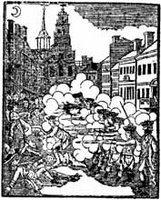
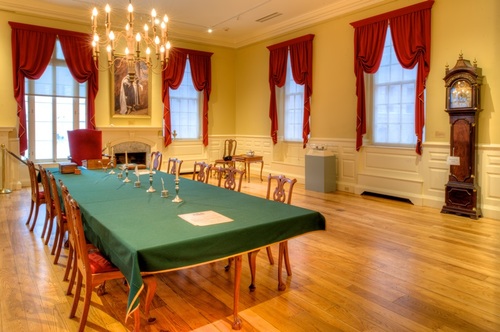
On 6 March, the day after the Boston Massacre, Lt. Gov. Thomas Hutchinson and his Council met in the Town House (now the Old State House museum, maintained by Revolutionary Spaces).

As I discussed back here, the town of Boston also had a meeting that day to urge the royal authorities into moving the army regiments out of town. Eventually Hutchinson and the army commander, Lt. Col. William Dalrymple, agreed to do that as long as the other took at least an equal share of the blame for conceding.

The provincial Secretary, Andrew Oliver, wanted the authorities in London to understand the pressures that Hutchinson—his friend, relative, and political ally—was under. So in his first draft of the official records of that Council meeting, Oliver wrote:
Divers gentlemen of the council informed his honour the lieutenant-governor, They were of opinion, that it was the determination of the people to have the troops removed from the town; and that this was not the sense of the inhabitants of the town of Boston only, but of other towns in the neighbourhood, who stood ready to come in, in order to effect this purpose, be the consequence of it what it may; unless they shall be withdrawn by the commanding officers, which, in their opinion, was the only method to prevent the effusion of blood, and, in all probability, the destruction of his Majesty’s troops, who must be overpowered by numbers, which would not be less than ten to one.
The next morning, however, the Council met again and asked “to see the minutes made by the secretary of this day’s proceedings set in order.” They thought Oliver’s summary sounded like a threat of rebellion and violence. The Councilors adopted new language instead:
That the people of this, and some of the neighbouring towns, were so exasperated and incensed, on account of the inhuman and barbarous destruction of a number of the inhabitants by the troops, that they apprehended imminent danger of further bloodshed, unless the troops were forthwith removed from the body of the town, which, in their opinion, was the only method to prevent it.
That text went into the official minutes.

But a week later, on 13 March, Oliver wrote out a more detailed description of what Councilors had told the governor. This time he named names, quoting one seasoned politician at length:
Mr. [Royall] Tyler had said, “That it was not such people as had formerly pulled down the lieutenant-governor’s house which conducted the present measures, but that they were people of the best character among us—men of estates, and men of religion: That they had formed their plan, and that this was a part of it to remove the troops out of town, and after that the commissioners: That it was impossible the troops should remain in town; that the people would come in from the neighbouring towns, and that there would be 10,000 men to effect the removal of the troops, and that they would probably be destroyed by the people—should it be called rebellion—should it incur the loss of our charter, or be the consequence what it would.”

Divers other gentlemen adopted what Mr. Tyler had said, by referring expressly to it, and thereupon excusing themselves from enlarging. Mr. [James] Russell of Charlestown and Mr. [Samuel] Dexter of Dedham, confirmed what he said respecting the present temper and disposition of the neighbouring towns; every gentlemen spoke of the occasion, and unanimously expressed their sense of the necessity of the immediate removal of the troops from the town, and advised his honour to pray that colonel Dalrymple would order the troops down to Castle William;

one gentlemen [Harrison Gray], to enforce it, said, ”That the lieutenant-governor had asked the advice of the council, and they had unanimously advised him to a measure; which advice, in his opinion, laid the lieutenant-governor under an obligation to act agreeably thereto.” Another gentlemen [John Erving] pressed his compliance with greater earnestness, and told him, “That if after this any mischief should ensue, by means of his declining to join with them, the whole blame must fall upon him; but that if he joined with them, and colonel Dalrymple, after that, should refuse to remove the troops, the blame would then lie at his door.”
Oliver swore to the truth of that account and put it on the next ship to London. There it was printed along with depositions about local hostility to the king’s soldiers in A Fair Account of the Late Unhappy Disturbance at Boston in New England. And then that pamphlet came back to Boston.

TOMORROW: More pamphlets.

Wednesday, October 14, 2020

A New Women’s History Podcast to Enjoy

Your Most Obedient & Humble Servant is a new podcast hosted by Kathryn Gehred, one of the editors working on the forthcoming scholarly collection of Martha Washington’s correspondence.

Each episode digs into one letter to or from a woman in the eighteenth or nineteenth century, highlighting the historical and personal context of that communication.

I like how Gehred and her guests are comfortable with the fact that one of the appeals of historical research is being able to read other people’s private mail.

Episode 5, “An Age of Discovery,” is a fine example. This conversation delves into a letter that Mary Cranch wrote to her younger sister Abigail Adams in 1786. As Gehred and her guest Rachel Steinberg discuss, Cranch crafted her letter to lead up to the juiciest piece of local gossip.

Go listen and come back. Or at least read the letter. Because I’m going to tack more gossip onto this episode.

Mary Cranch was married to Richard Cranch, as the podcast says. He came to America in 1746 with his sister Mary and her husband, Joseph Palmer. The Palmers and Cranches joined the locally grown Quincys and Adamses in making up north Braintree’s Whig gentry.

The Palmers’ eldest son was Joseph Pearse Palmer, who married Elizabeth Hunt across the border in New Hampshire in 1772. He was twenty-two, a recent Harvard graduate; she was seventeen. After the war, the Palmer family moved into Boston, but their fortunes fell through a combination of business failures, ill health, and general economic stress. The elder Joseph Palmer ended up in a dispute over debts with John Hancock before dying in 1788.

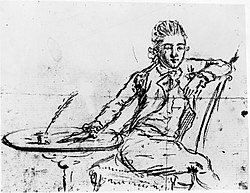
Joseph Pearse Palmer, through professional setbacks, psychological depression, and perhaps other personal issues, spent months at a time away from his family. Elizabeth Palmer took in boarders, including a young attorney and author named Royall Tyler (shown above).

Back in 1782, Tyler had settled in Braintree, boarding with the Cranches. During that time he wooed Nabby Adams, the Adamses’ eldest child. Her parents and the Cranches were more enthused about this than she was. Nabby put Tyler off until she sailed with her mother to Europe. There she met and married William Stephens Smith, the “Coll Smith” mentioned in this letter. Tyler came away with the first surviving volume of John Adams’s diary, eventually discovered among his papers, and looked around for new conquests.

That provided the conditions for the scene Mary Cranch described at the end of this letter, which must have taken place at Elizabeth Palmer’s boarding house in Boston. In the spring of 1786, Joseph P. Palmer had come home after many months to find his wife very friendly with boarder Tyler and a few months pregnant. The baby arrived in September 1786.

“I was determin’d to see” the newborn girl, Mary Cranch told her sister, to confirm that the baby had arrived full term. She saw Joseph P. Palmer, Elizabeth Palmer, and Royall Tyler all in a bedroom together, resolutely not acknowledging anything odd about the situation.

And this is the point I can’t stress enough: Joseph P. Palmer, the dupe of Mary Cranch’s story, was her own nephew.

Friday, July 10, 2020

A Meeting to Protect the Town’s Reputation

Back in late March 1770, the Boston town meeting had commissioned Capt. Andrew Gardner to carry its official report on the Boston Massacre and other documents to London.

Gardner arrived in the imperial capital in early May. That was a couple of weeks after Londoners had read the first newspaper reports about the shooting on King Street.

Furthermore, the captain discovered, Customs Commissioner John Robinson had reached London before him, carrying documents that reflected poorly on Boston. That material included:
  • Capt. Thomas Preston’s “Case,” describing how hostile the town had been to the army, and how people had provoked his soldiers into firing.
  • Several depositions collected by Loyalist magistrate James Murray in mid-March backing up that picture of the shooting.
  • Province secretary Andrew Oliver’s description of the Council meetings after the Massacre, accusing members such as Royall Tyler of almost openly threatening unrest if acting governor Thomas Hutchinson didn’t withdraw troops from town.
Most of Preston’s “Case” was printed in London newspapers by the end of April. The depositions and Oliver’s account went into the pamphlet titled A Fair Account of the Late Unhappy Disturbance at Boston.

Those publications offset the effect of Boston’s Short Narrative of the Horrid Massacre. In fact, the Fair Account was a direct response to the Short Narrative; its depositions were numbered starting with 97, where the first edition of the Short Narrative ended.

To be sure, London’s Whiggish printers quickly set about reprinting Boston’s report (as well as the Rev. John Lathrop’s sermon, Innocent Blood Crying to God from the Streets of Boston). But after all the Boston Whigs’ effort to present their town as innocently attacked, they had been scooped.

(My talk “Reporting the Battle of Lexington” discusses how Massachusetts Patriots were determined not to let that happen again in 1775. After the Battle of Lexington and Concord, the Provincial Congress rushed to collect depositions and spared no expense sending them to London. There was none of the delay and debate we see in the town meetings of 1770.)

Capt. James Hall brought the first news of trouble in London back to Boston on 18 June, as I discussed here. Capt. Gardner returned with confirmation on the evening of 6 July.

Bostonians seem to have felt particularly betrayed by Capt. Preston’s “Case” since he’d sent a short note to the Boston Gazette back in March to say he was being treated fairly. At the very same time, people now knew, he’d written this long message to London, warning that he might be lynched. When Preston’s “Case” became public, people worried about that danger even more—at least according to officials and friends of the royal government.

The Boston Whigs therefore had to respond, but only in the most legal, least violent way. Which meant calling a town meeting. At 9:00 A.M. on 10 July 1770, 250 years ago today, qualified white men assembled in Faneuil Hall to discuss “Sundry Letters received by Capt. Gardner Master of the Packet taken up by the Town, in answer to those by him to our Friends in England.”

The meeting took action by, of course, forming a committee. It consisted of Thomas Cushing (also moderator of that meeting), Samuel Adams, John Hancock, Richard Dana, William Phillips, William Molineux, Dr. Joseph Warren, Ebenezer Storer, and William Greenleaf. They were delegated to “draw up a true state of the Town, and the conduct of the [Customs] Commissioners.”

The news from London prompted another agenda item as well: “A Motion made that the printed Narratives of the late horred Massacre, which has been retained by order of the Town in the hands of the Committee; may now be sold by the Printers.” Benjamin Edes and John Gill had gone to the trouble and expense of printing copies of the Short Narrative, but the town had forbidden them to sell any copies locally to avoid complaints about tainting the jury pool.

Now that the Short Narrative was being reprinted in London, Edes and Gill no doubt argued, copies of that edition were coming into Boston. So there was no longer any point in forbidding them to sell their stock, right?

The town meeting disagreed. Town clerk William Cooper wrote that the question “Passed in the Narrative”—a psychological slip for “in the negative.” Edes and Gill were told to keep sitting on their copies.

The meeting then adjourned until Friday the 13th, when they would hear from the new committee. In practical terms, that probably meant Samuel Adams got busy writing the town’s response, if he hadn’t already drafted it.

Friday, March 06, 2020

A Town Meeting for a Town in Turmoil

After the shooting on King Street on 5 Mar 1770, townspeople raced to take the wounded to doctors and to demand justice.

British army officers struggled to get from their lodgings to their companies’ barracks. They feared that locals would gather weapons and counterattack. There were rumors of a tar barrel being moved to Beacon Hill to summon militiamen from neighboring towns, though there’s little evidence those things actually happened.

At the Town House, acting governor Thomas Hutchinson assured the crowd that the civil government would investigate the event and pursue charges. Magistrates started to interview witnesses.

Whig leader William Molineux arrived and urged Hutchinson to order all the troops back to their barracks. Reluctant to be seen as controlling the army, the lieutenant governor merely asked Lt. Col. Maurice Carr to issue that order on his own authority.

In the early morning, Sheriff Stephen Greenleaf brought in Capt. Thomas Preston for questioning. About 3:00 A.M., the justices sent him to the town jail. The next morning, they visited the main guard, examined the eight soldiers’ firelocks (one bayonet still showing traces of blood), and arrested them as well.

At 11:00 on the morning of 6 March, 250 years ago today, hundreds of Bostonians thronged Faneuil Hall, demanding a special town meeting “occasioned by the Massacre made in King Street”—the event’s label was already being established. Only town clerk William Cooper was there, however. The selectmen were all over at the Town House, meeting with Hutchinson and his Council. So William Greenleaf, the sheriff’s brother and eventual successor, went to alert them.

Many townspeople wanted to testify about hostile encounters with soldiers. Eventually the meeting appointed a small committee to take that evidence. (I’ll address those testimonies in a separate posting.) The gathering then chose a larger committee filled with prominent men—Thomas Cushing, John Hancock, Samuel Adams, William Phillips, Molineux, and so on—to tell Lt. Gov. Hutchinson:
it is the unanimous Opinion of this Meeting, that the Inhabitants and Soldiery can no longer dwell together in safety; that nothing can be rationally expected to restore the peace of this Town, and prevent blood and Carnage, but the immediate removal of the Troops
That committee proceeded to the Council Chamber of the Town House, overlooking the site of the shooting. Hutchinson and Lt. Col. William Dalrymple were trying to balance the orders that Gen. Thomas Gage had issued on the authority of the Crown, the need to keep public order, and the need to calm the populace. But most of all, each man was trying to ensure that the other bore the main responsibility for whatever decision came out of the meeting.

Dalrymple suggested that since Gen. Gage has instructed him to station some troops at Castle William, he was willing to order the 29th Regiment there and await approval from New York. No soldiers of the 14th had been involved in the shooting, after all. Would that satisfy the people?

At 3:00 P.M. the town meeting resumed and immediately moved from Faneuil Hall to the larger Old South Meeting-House. That meant there had to be thousands of men attending. Cooper read Hutchinson’s message: “It is not in my power to countermand those Orders” from Gage, but Lt. Col. Dalrymple had offered to remove the 29th to the Castle.

The meeting voted to reject that compromise with “but one dissentient.” The people chose a smaller committee to return to the Town House. Back in the Council Chamber, Samuel Adams told Hutchinson and Dalrymple, “If you can remove the 29th regiment, you can also remove the 14th; and it is at your peril if you do not.” (That’s the wording from the Rev. William Gordon, writing just a few years later. Later accounts have other language.)

In 1771, Adams told James Warren about Hutchinson’s immediate reaction: “if Fancy deceived me not, I observ’d his Knees to tremble. I thought I saw his face grow pale (and I enjoyd the Sight) at the Appearance of the determined Citizens peremptorily demanding the Redress of Grievances.”

But Hutchinson still held out, asking his Council for support. Those gentlemen urged withdrawal. Councilor Royall Tyler went farther and warned:
The people will come in from the neighboring towns; there will be ten thousand men to effect the removal of the troops, who will probably be destroyed by the people, be it called a rebellion, or occasion the loss of our charter, or be the consequence what it may.
That was just the uprising the royal authorities feared.

Lt. Col. Dalrymple was already dangling another suggestion. The acting governor could “desire” him to remove both regiments, and he’d do so. Hutchinson could thus avoid giving orders to the army. Dalrymple could tell Gage that he was simply responding to the local civil authority.

The Council accepted that approach. The committee accepted it. Back in Faneuil Hall, the town meeting accepted it and then voted “to have a strong Watch of our own for the protection of the Inhabitants in the Night, untill the troops would remove.”

However, nobody had settled how soon the two regiments would actually leave Boston.

Thursday, October 18, 2018

Maneuvers Around the Manufactory

When Gov. Francis Bernard finally convinced his Council to agree to let the army use the Manufactory building as barracks, he knew that wouldn’t be the end of the issue.

He reported to London:
The next thing to be done was to clear the Manufactory-House, the preventing of which was a great Object of the Sons of liberty. For this purpose about 6 or 7 weeks before, when the Report of Troops coming here was first Confirmed, All kinds of people were thrust into this building; and the Workhouse itself was opened & the people confined there were permitted to go into the Manufactory-House. This was admitted to be true in Council by one of the board who is an Overseer of the poor and a principal therein.
Royall Tyler (father of the playwright who took the same name) was the one member of the Council who was also a Boston Overseer of the Poor. He was a strong Whig and a canny politician. Tyler and his colleagues later insisted that he’d never said anything about moving poor people around. But that wouldn’t be the last time a royal appointee claimed Tyler had said something inflammatory in a Council meeting and he indignantly denied ever saying it.

Bernard continued:
And after the Order of the Council was known Sevral of the cheifs of the Faction went into the Manufactory-house, advised the people there to keep possession against the Governors order & promised them support. And when some of them signified their intention to quit the House, they were told that if they did so they must leave the Town; for they would be killed if they staid in it.
Bernard didn’t specify the source of his information on what the Whigs were doing and saying. I’ve seen no evidence to support the governor’s claim that poor families were moved into the Manufactory building in September and intimidated into staying. The only tenants to speak out were from the Brown family of weavers, who had rented their space for years.

As for the Whigs themselves, on 18 Oct 1768 they reported the Council’s vote and added: “Notwithstanding the restrictions of the above vote, it proves very disagreeable to the people, who are not a little apprehensive that the G——r who it was thought, in a manner dragooned them into the same, will not fail to improve [i.e., use] it to their disadvantage.”

The Whigs did repeat a veiled threat, not to the people inside the Manufactory but to anyone who might lay out money to help the army fix up barracks and expect to be repaid by the province:
At the above Council a worthy member in reply to what the G——r had observed to Gen. [Thomas] Gage, respecting the vote of the 5th inst. for billetting the troops, told the General, that the proviso in that vote, viz. “That the person nominated to provide billetting must risque his being repaid therefor by the next General Court,” was made with great deliberation and with express design to prevent such person from being deceived by that vote into an apprehension, that it was in their power to procure a reimbursement for such advancements, but that it must be wholly left to the next General Assembly to do thereon as they might think proper.

If the troops quartered themselves upon us, directly contrary to an act of Parliament, can it be thought then, that any Assembly will ever defray the charge of billetting such troops.
In other words, the lower house of the General Court would get around to reimbursing such expenses right after they approved paying Lt. Gov. Thomas Hutchinson for the damage to his house in 1765.

Sunday, April 02, 2017

The Tragedy of André

Speaking of William Dunlap’s tragedy AndrĂ©, my friend John W. Kennedy has created an online text of that play by transcribing the 1798 edition and annotating it. You can find it all here.

Kennedy writes:
William Dunlap (1766–1839) dominated American theatre in his day as no one else ever did but David Belasco. He was born in Perth Amboy, and the family later moved to New York City. There is a pretty, but questionable, legend to the effect that he may have seen some of the theatrical productions in occupied New York in which John AndrĂ© had a hand.

He traveled to England in 1784 to study with Benjamin West, as was practically de rigueur for aspiring young American painters, but seems to have chiefly fallen in love with the theatre there. Upon his return to America in 1787, his first thought was to write an imitation of Royall Tyler’s hit, The Contrast, and Dunlap’s The Modest Soldier or Love in New York was accepted, though never produced.

But he continued to write, and was soon successful enough to be asked in 1796 to become managing partner in the Old American Company, so called because it was the return of the American Company, founded in 1752, which had retreated to the West Indies in 1778 after Congress had outlawed theatrical performances as incompatible with the war effort. André is one of the plays of this portion of his career.
The result was a tragedy with a “curiously Greek construction—it is written in scenes for two or three, places all the physical activity offstage, takes place in only a few hours’ time, and really wants only a chorus to be perfectly Athenian.”

Dunlap’s blank-verse text is accompanied by several supplemental texts:
Here’s a sample from the play, as the character identified only as “the General” laments in Act 5 that he must let Maj. AndrĂ©’s execution proceed:
O what keen struggles must I undergo!
Unbless’d estate! to have the power to pardon;
The court’s stern sentence to remit;—give life;—
Feel the strong wish to use such blessed power;
Yet know that circumstances strong as fate
Forbid to obey the impulse. O, I feel
That man should never shed the blood of man.
And here’s a discussion by Elfin Vogel and Michael Bettencourt of the challenges of staging AndrĂ©.

Thursday, February 13, 2014

Judge Jacobs and His Dinah

Reading about Harvey Amani Whitfield’s new book on slavery lingering in Vermont even after being banned in the new republic’s 1777 constitution led me to this Vermont Today article from 2006 about a court case in the early 1800s.

All the parties agreed that Stephen Jacobs had bought a woman named Dinah as a slave in 1783, the same year he moved to Windsor, Vermont. A Yale-educated lawyer, Jacobs prospered eventually became a member of Vermont’s supreme court. As for Dinah, by the end of the century she had become “infirm, sick, and blind,” needing support.

But who had the responsibility to provide that support? New England towns had funds for their poor citizens, but Windsor felt that Dinah should be Jacobs’s charge alone. He insisted that he would pay his share of taxes for her support but no more.

In 1800 Jacobs’s lawyers got the case thrown out on the ground that the deputy sheriff who had served the action was also a citizen of Windsor and therefore had an interest in the case. The town appealed.

In 1802 the Windsor selectmen’s attorney argued that Jacobs had “discarded” Dinah two years earlier when she was no longer of value to him. Jacobs’s lawyers responded that “several of the inhabitants of Windsor…[had] inveigled her from her master’s family and service by the syren songs of liberty and equality” and that she had “spent the vigour of her life with these people.” The record is unclear about when that happened and how long Dinah had been away from Jacobs’s household.

The judge who decided the dilemma was Boston native Royall Tyler. He convinced his colleagues that the 1783 bill of sale for Dinah carried no legal weight under Vermont’s constitution and therefore the town could not introduce it as evidence that Jacobs legally owned the woman. No evidence, no case. I can’t help but get the sense that the state judiciary was looking for ways to decide in favor of their colleague.

Windsor paid for Dinah’s board in different houses over the next few years, for her medical care and burial. However, town records continued to refer to her as “Judge Jacob’s Dinah.”

Sunday, September 29, 2013

“Voucher for rations delivered at the Port of Williamston”?

Last month the Boston Globe reported on the opening of a vault in the Massachusetts State House. Officials found nothing earth-shaking inside, and the contents produced more small mysteries than they solved.
But perhaps the most intriguing item, provenance unknown, was a note inked in elaborate cursive script on a small piece of aged paper dated 1787: “Voucher for rations delivered at the Port of Williamston.”

Treasury staff members said they had no idea where the item was from or its significance. But that note and other historical documents from the safe are set to be examined this week by a specialist from the state archives.
That document is not among the items shown in the photo gallery accompanying the article, so I’m working with no more information than in those paragraphs. But here are some guesses.

Might “Williamston” be how this receipt writer spelled “Williamstown”?

Might “Port” actually be “Post” or “Fort”?

Why would Massachusetts have supplied food to a military post in Williamstown? There were forts built there when Englishmen settled the town in the 1750s, but they had long been put to other use by 1787.

That was the the year of the Shays Rebellion, however, when special militia regiments recruited in and around Boston marched west to confront an uprising of farmers and veterans. After a couple of skirmishes, the rebellion melted away (as did the militia, a few weeks later).

Some of the uprising’s leaders found refuge in Vermont, then an independent state. Militia officer Royall Tyler crossed the border to try to capture Daniel Shays in early 1787. He wrote home of “Driving 40 miles into the State of New York at the Head of a Party to apprehend Shay” and “closing the Pases to Canada.” Williamstown is at the border of Massachusetts, New York, and Vermont, so perhaps that was where Tyler’s militiamen were stationed and supplied for a while.

(Photograph courtesy of teacher Mr. Voelger.)

Saturday, April 06, 2013

“Turtius Bass and wife are parted.”

Who was the Braintree man that Abigail Adams called “Tertias Bass” in 1776? I was ready to give up that quest when I came across a letter that Abigail’s older sister Mary Cranch sent to her in 1785:
Turtius Bass and wife are parted. He has sold the House and land which his Sons liv’d in and divided his Estate into four parts, given his wife one fourth part, one half to his two Sons. The remainder he has taken to support himself and Nell Underwood in their Perigrinations to the Eastward [i.e., Maine] whither he is going he says to settle.

And as he is going into a new country, tis proper he should take a young person to help People it, and her abbillity to do it She has given ample proof off by presenting somebody (she swore them upon Leonard Clevverly [1758-1828]) with a pair of Twins last winter. She liv’d in Mr. Bass’s Family—but as they both dy’d she was at Liberty to pursue her Business as Housekeeper in some distant part of the State as well as at Braintree, and who would be Maid when they might be mistress?

Mr. Bass was so generious to the Girl, that he keept her in his house to lay in, and gave Mr. [Royall] Tyler a handsome Fee as Counsel for her in case Mr. Cleaverly should deny the charge which he did most solemnly. In this case the woman has the advantage in law. He was oblig’d to enter into Bonds, but the children dying, and Mr. Tyler not appearing, he took up his bonds and Mr. Bass was oblig’d to bear all the charges.

Mrs. Bass is in great trouble. Seth is mov’d into the House with her, and the other Son with his wife and child are mov’d seventy mile into the country out of all the noise of it—so much for Scandle.
This letter tells us that in 1785 “Turtius Bass” had a wife and two sons, at least one of them married with a child and the other named Seth. Page 55 of this 1835 genealogy indicates that “Turtius” was most likely the Samuel Bass born in 1737, son of Seth and Eunice Bass. He married Alice Spear in 1758 and had sons Jeriah in 1760 and Seth in 1761. That book says nothing of Nell Underwood. It also says nothing about when this Samuel Bass died, indicating that his relatives in Braintree had lost track, or chosen to lose track, of him.

But this biographical directory from 1897 suggests that Samuel Bass settled in Wilton, Maine, and his son Jeriah eventually brought his family there, too. After another century, their descendant George H. Bass was a leading local shoe manufacturer.

As for Alice Bass, neighbors John and Abigail Adams bought some of her land in 1788.

Friday, September 23, 2011

Royall Tyler in a Comic (sort of)

This week the Harvard Book Store in Cambridge published an anthology of comics called Minimum Paige. The first item is a little horror story that I scripted and Alex Cormack drew called “The Essex County Literary Wax Museum & Menagerie.” Last night we learned that the editors also awarded that story second prize among all the eligible entries in the book.

What does this have to do with Revolutionary War history? Hmmm.

The images of Judge Pyncheon from The House of Seven Gables in our story are based on pictures of the playwright and jurist Royall Tyler, who grew up in Revolutionary Boston. Nathaniel Hawthorne took some inspiration for that character from talks with Tyler’s disapproving in-laws; more on that connection here.

Also, I spent all of the prize money and a little more on Revolutionary history books from the store’s used-books basement.

And, um, Gen. George Washington slept in a house a couple of blocks from the store. For almost two weeks.

But really I just wanted to brag.

Saturday, February 26, 2011

James Otis Tries a New Type of Politics

In 1760, Boston’s four representatives to the lower house of the Massachusetts General Court were John Phillips, Royall Tyler (father of the author who took the same name), Thomas Flucker, and Samuel Welles.

In early 1761, Flucker moved to Charlestown. Phillips, who had served off and on for decades, apparently decided not to run again; he had by far the highest vote total in 1760, and I know no reason he wouldn’t have been reelected.

That opened up two slots for other gentlemen. At a town meeting in May 1761, the qualified voters chose:

Boston’s merchants, and the mariners and businessmen who depended on them, no doubt trusted Cushing and Otis to represent their interests.

Before that moment, Otis had filled appointive offices in the royal patronage system rather than elected offices that depended on maintaining popularity with the voters. These were two parallel tracks for rising within government in the eighteenth-century British Empire. As a brilliant, learned man who was sometimes snobbish and moody, Otis made a better fit for the patronage track. Royall Tyler reportedly had to give him tips on winning over voters.

But Otis had apparently soured on the patronage system when the new governor, Francis Bernard, had dismissed the previous governor’s promise to appoint James Otis, Sr., as chief justice. He resigned his royal appointment in the Vice Admiralty court system and offered his services to the Boston merchants. That party in return supported his election to the Massachusetts House, where the senior Otis was already a representative for Barnstable and the Speaker.

The legislative records aren’t as clear as we might want, but they say that the younger Otis began to serve on lots of committees, a sign of influence. Within a short time he was recognized as a leader of the “country party” or Whigs who usually opposed the royal governor’s policies. Cushing also rose in the House, becoming Speaker in 1766. (Oxenbridge Thacher, Otis’s co-counsel in the writs case, would join them in the House in 1763, but died in 1765 before the Revolutionary arguments really heated up.)

TOMORROW: The next round of the writs of assistance argument.

Saturday, September 19, 2009

The Legend of Watson’s Corner

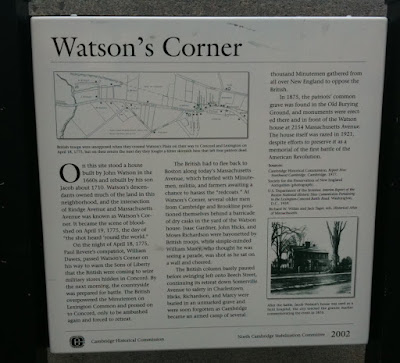
Check out Caitlin G. D. Hopkins’s examination at Vast Public Indifference of this historic plaque near her home in the Watson’s Corner neighborhood of Cambridge:

The language of the explanatory plaque is extraordinary. The central paragraph portrays the skirmish as a an encounter between innocent civilians and bloodthirsty soldiers. . . .

If I had to guess when this was written, I would guess 1875. I would be wrong — this sign was erected in 2002. Perhaps they just lifted the language from a 19th-century town history.
The language didn’t come from such an old book, but the details (except for the soldiers’ use of bayonets) did. Specifically, this account appears to be based on details collected in Lucius Paige’s History of Cambridge, published in 1877—so Caitlin was off by two years.

Paige names one of his sources as longtime Cambridge resident Royall Morse, saying in a footnote:
My informant was the late Mr. Royal Morse, born in 1779, whose memory of events which occurred during his life was remarkably comprehensive and accurate, and whose traditional lore was almost equivalent to authentic history.
That’s rather circular, isn’t it? I rely on Mr. Morse’s stories because those stories were reliable.

Our daily infusion of unabashed gossip: Morse was born out of wedlock to Katherine Morse, a woman who had the job of cleaning the Harvard dormitories. His father was said to be Royall Tyler.

Wednesday, June 10, 2009

“Apprehension that She Might Break Off in the Middle”

Late in life, Boston native Royall Tyler (1757-1826) tried rewriting his bestselling novel, The Algerine Captive, with new material, hoping for another success. He and his wife Mary lost the race to finish that task before he died of a terrible facial cancer. The patched-together manuscript, titled “The Bay-Boy,” was first published in The Prose of Royall Tyler in 1972.

Tyler’s manuscript is most valuable as a look back on upper-class Massachusetts just before the Revolution, the years when Tyler grew up as the son of a merchant and popular Boston official (whose name he took). Between the lapses of memory and the exaggerations of satire, I don’t think “The Bay-Boy” is an exact description of life in that society, but it certainly gives a flavor.

Here’s the narrator’s description of his mother, wife of the owner of a country estate:

The crown and cap sheaf of all her accomplishments was her performance on the spinet. I wish, reader, you could have seen her as she has been represented to me in all the pride and costume of her maiden glory, seated on her tent stitch joint stool as erect and attractive as a polished shaft from the quiver of Cupid, her hair craped on her lovely head—an operation which required the labor of the barber for only five hours—but no time was lost in the process, as the hair thus fashionably craped would continue five months without the application of the comb.

Upon the tip of this toupee a diminutive triangular cap, called a fly cap, cocked like a man’s hat, richly edged with point lace, was conspicuous; but what the cap lacked in its main structure was made up in its train, as from behind was depended two log pinners which reached halfway down her neck.

Her hair was turned up behind and secured to the back of her head by a tortoise shell comb resplendent with French paste, excepting one lock, called by the ladies a “favorite” and by the beaux a “love lock,” which was suffered to stray over the left shoulder, and wanton down her lovely neck—this with a black patch as big as a pea stuck under her right eye and another at the corner of her mouth gave an air of smartness to the fair one altogether irresistible to the eye of taste.

Her neck was clasped by a brilliant necklace with its dependent solitaire and of the same pattern were her earrings magnified by many a pendant and drop. Her negligee of rich brocade, with deep ruffle cuffs which, as she sat, almost touched the ground, these enclosing ruffles of the finest Brussels lace.

Her bust clasped by a stiff pair of stays which terminated in sharp angles at the bottom before and behind and so tightly laced as to excite apprehension that she might break off in the middle, but this was happily prevented by the busk; a silver stayhook set with jewels adorned her lap and served to confine the strings of her short apron; a pocket hoop and plumpers by their broad expanse served to relieve the slender circuitry of the waist.

Shoes of white satin ornamented on the instep by a broad fillet of silver lace and heels two inches and a half high were clasped with paste buckles. A pin cushion and scissors suspended by a silver hook and chain completed this attractive costume.
Consider this the equivalent of the satirical prints of the day, a caricature of something familiar.