J. L. BELL is a Massachusetts writer who specializes in (among other things) the start of the American Revolution in and around Boston. He is particularly interested in the experiences of children in 1765-75. He has published scholarly papers and popular articles for both children and adults. He was consultant for an episode of History Detectives, and contributed to a display at Minute Man National Historic Park.

Subscribe thru Follow.it


•••••••••••••••••


Showing posts with label Dorchester. Show all posts

Tuesday, June 23, 2026

The Significance of Breed’s Hill Instead of Bunker’s

For one last posting on the label “Breed’s Hill,” I’ll share some thoughts on whether that label matters.

These days, it’s mostly useful as a fact that people (mostly of the male variety, to be frank) deploy to show they know more than average: ‘Well, actually, the Battle of Bunker Hill was fought on Breed’s Hill.”

Which is true, though:
Even more trenchant, what difference did that name make to the outcome of the battle? How did the “Breed’s Hill” label affect the seizure of the Charlestown peninsula? Or the deaths or wounding of nearly 1,500 men?

Well, actually, there’s an argument that Col. William Prescott’s insistence on fortifying Breed’s Hill before Bunker’s Hill, as he understood his orders to specify, did shape the outcome of the battle. Could the provincials have prevailed if they’d had a strong fallback position?

I’m dubious. The goal of the Massachusetts command—the committee of safety, Gen. Artemas Ward, and his council of war—was to keep the British army from seizing the Charlestown and Dorchester peninsulas, as intelligence said the Crown would soon try to do. The New England army’s countermeasure was to seize those positions first.

The real challenge, as Gen. John Thomas indicated from Roxbury, was holding those positions against a British counter-countermeasure. Thomas didn’t think that was feasible and declined to go onto Dorchester Heights that June.

The geography of Charlestown was more welcoming for such an advance from the mainland, but it doesn’t look like the New England army was truly prepared to hold that ground. With only a couple of days to get organized, the provincials didn’t have all the tools, artillery, and reinforcements lined up to fortify and stay on those high points. We see that from the limited support the front-line troops got during the battle.

Even beyond that, the crucial problem for the New England army turned out to be gunpowder. That would have been a problem no matter which hill they fortified.

To be fair to Gen. Ward, he was worried about a possible second British advance in Roxbury or elsewhere along the siege lines. He couldn’t throw all the provincial resources into Charlestown. But the Continental operation to fortify Dorchester Heights in March 1776 shows how effective preparation could overcome adverse conditions.

I even wonder if fortifying Bunker’s Hill might have changed the British commanders’ thinking in a way that would have produced a worse outcome for the provincials. Gen. William Howe saw a small redoubt on a relatively short hill that was close enough for cannon to reach Boston and thus worth cleaning out. He focused on that spot, with disastrous results.

If Howe had seen fortifications on Bunker’s Hill also or instead, he might have decided on a more cautious strategy, focused on cutting the provincials off at the neck. That might have produced many more rebel casualties and fewer British ones. The New Englanders could have ended the day more dismayed, the regulars more chuffed, with a consequent effect on the larger siege.

Wednesday, March 18, 2026

“The next morning presented to the view of the enemy a regular fort”

Samuel Richards (1753–1841) came from Farmington, Connecticut. In May 1775 he marched north with his town’s company to the Boston siege lines.

According to the memoir he wrote for his family decades later, Richards went as a gentleman volunteer, not in the ranks, and in Roxbury, Gen. Joseph Spencer offered him a post as private secretary.

However, contemporaneous records show that the young man was a sergeant in Capt. Noadiah Hooker’s company from May to December 1775. Perhaps Richards preferred his family to consider him as always of genteel class. 

Those sources agree that when the Continental Army was enlisted for a second year, Samuel Richards signed on as an ensign—the lowest rank of officer.

Ens. Richards’s regiment served on the southern side of the siege. For a while they camped on Gen. William Heath’s family farm in Roxbury, then in barracks as close to the Neck as possible.

Richards and his company were part of the reinforcement that went onto the Dorchester peninsula on the morning of 5 Mar 1776 to prepare for an expected British counterattack. He left this account of what followed in his memoir, published in 1909:
the next morning at 8 oClock a relief was sent on—of which I was one—in passing the neck the tide having overflowed it I found my boots filled with mud and water, but we had no dry clothes with us, nor any time or opportunity for changing. . . .

I found a redoubt considerably advanced in a position well calculated for defence. Outside the parapet were casks filled with sand and so placed that a slight touch would set them rolling down the hill which was very steep on every side, and thus break the ranks of the enemy on their advance.
Those barrels had prompted a lot of discussion.
On the afternoon of the 6th we very plainly saw the enemy in motion in the town: dense columns of troops moving down the main street to the wharf and embarking on board the ships which moved down the harbor and formed in a kind of crescent at considerable distance from the hill.

most of the next day [still 6 March] was spent by those ships in beating up nearer to our post—the wind being a head:

we continued our work incessantly in compleating the redoubt, being urged to exertion by a full expectation of being attacked by the enemy’s troops we had seen embark on board the ships; we had no time to spare for reflecting on and counting the cost of the issue of the expected battle, we did not work litterally with arms in our hands, but they were lying by our sides, and it is presumed that every one ardently wished for the opportunity of shewing the enemy what freemen would do when contending for their just rights. No one needed stimulating to the performance of his duty as every one possessed the inclination.

As night approached an uncommonly severe South East rain storm came on with very high wind, and in that elevated situation, surrounded by the sea, it was felt in all its force, but the severity of the storm did not stop our work, which we pushed forward with the utmost alacrity. The next morning presented to the view of the enemy a regular fort, far advanced to completion—and to our view their ships below apparently in a very disorderly condition: the day passed without any thing worthy of particular notice.
In looking back, Ens. Richards skipped over the couple of days that passed before the next action.
At evening we broke ground on Nook, or Nuke point, a small hill very near the water oposite South Boston. The enemy could plainly hear the sound of our entrenching tools, on which they opened and continued an incessant cannonade with a general direction towards this point. I counted the number of discharges up to about 1500 during half an hour and then left off counting; this firing was continued through the night, and the morning shewed a novel sight; the ground all around where the work had been carrying on appeared as if it had been plowed irregularly, and a very great number of cannon balls were picked up: but strange as it may seem there was but a surgeons mate and two privates killed during the night.
Contemporaneous sources say a doctor and three Continental privates were killed.

TOMORROW: Marching into Boston.

(Richards’s portrait, as copied for another family member around 1890, appears above. It was auctioned in 2020.)

Monday, March 16, 2026

“Very lucky for us that we got possession of Nook Hill”

On 16 Mar 1776, 250 years ago today, Abigail Adams wrote from Braintree to her husband John in Philadelphia:
There has been no firing since Last twesday [12 March], till about 12 o clock last Night, when I was waked out of my sleep with a smart Cannonade which continued till nine o clock this morning, and prevented any further repose for me
That cannon fire from the north was prompted by the Continental Army moving again onto Nook’s Hill on the end of the Dorchester peninsula nearest Boston.

As related back here, the Continentals had started to fortify that strategic ground on 9 March, but the British artillery forced them back with the loss of four men. A few quiet days followed before Gen. George Washington became impatient with the speed of the British departure and ordered another try.

The next day, Adams was able to report more details she’d heard about the operation:
It was very lucky for us that we got possession of Nook Hill. They had placed their cannon so as to fire upon the Top of the Hill where they had observed our people marking out the Ground, but it was only to elude them for they began lower upon the Hill and nearer the Town. It was a very foggy dark evening and they had possession of the Hill six hours before a gun was fired, and when they did fire they over shot our people so that they were coverd before morning and not one man lost
Meanwhile, the British inside Boston would have been happy to be outside Boston. They were staying in town despite every effort to leave. On 15 March, Capt. John Barker wrote in his diary:
The Wind being fair at 12 oclock in the day, the Troops were order’d under Arms in order to embark; but after waiting some time returned to their Quarters, the Wind having shifted.
And then on the 16th: “Still detained by the Wind.”

Abigail Adams saw the new position on Nook’s Hill as forcing the British out: “the enemy no sooner discoverd [that fortification] than Bunker Hill [in Charlestown] was abandoned and every Man decamp’d as soon as he could.” But as with the entire siege, Gen. William Howe was responding to weather conditions as much as or more than his enemy’s maneuvers.

Saturday, March 14, 2026

Events on Dorchester Heights, 14 and 17 Mar.

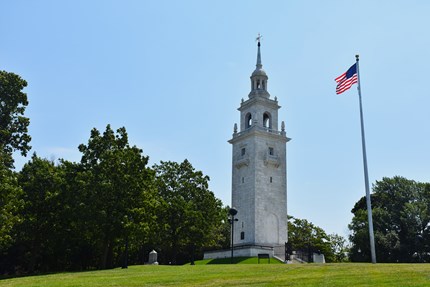
The National Parks of Boston reopened the Dorchester Heights monument this year and will welcome visitors to two commemorations there of the end of the siege of Boston this week.

Saturday, 14 March, 11 A.M. to 2 P.M.
Artillery Encampment

See authentic cannons up close and learn about the British evacuation in 1776. This hands-on, family-friendly program offers a vivid look at the technology and teamwork that helped change the course of American history. Visitors will also have the opportunity to climb the newly restored Dorchester Heights Monument for sweeping views of the harbor and city skyline.

Cannon firing demonstrations will take place at 12 p.m. and 1 p.m.

This year the South Boston St. Patrick’s Day/Evacuation Day parade is on Sunday, 15 March, for those who celebrate.

Tuesday, 17 March, 11 A.M. to 3 P.M.
Evacuation Day 250

This event is both a formal rededication of the monument and a commemoration of the day when British troops embarked from Boston and Continental troops marched into the town. It’s also the culmination of the Knox Trail events and of the Boston campaign for this Sestercentennial year. As such, I expect there will be speeches from lots of officials of different sorts.

The ceremony is scheduled from 11 A.M. to 1:30 P.M., and seating will be first come, first served. The monument will remain open for visitors until 3 P.M.

Monday, March 09, 2026

“The Firings Continued all Night”

With hindsight, we can see that 250 years ago the siege of Boston was basically over, with the British military preparing to leave.

At the time, however, Gen. George Washington couldn’t be completely sure that Gen. William Howe was pulling out. He had good indications from the letter I discussed yesterday and from some people who slipped out of Boston around the same time. But he still had to consider the possibility that Howe was deceiving him, or might change his mind.

On the night of 9 Mar 1776, the Continental troops moved to fortify another high point of the Dorchester peninsula: Nook’s Hill, also known as Foster’s Hill. It was on the tip closest to Boston, from which cannon could threaten the town.

Nook’s Hill wasn’t as high as the heights that Gen. John Thomas had first fortified. It was closer to the British artillery on the Neck and inside Boston. It was vulnerable.

Capt. John Barker of the Tenth Regiment described the action that day:
The Rebels having been deserned carrying Materials for making a Battery to Foster’s hill at Dorchester, the nearest of any to Boston; and at 8 o’clock in the evening it being reported they were at work there, our Batteries at the Blockhouse, the New Work at the Neck, and [John Rowe’s] Wharf began to play upon them, and kept it up all night so as to prevent their Working: they likewise fired at the Town from their different Batteries at Roxbury.
Sgt. Henry Bedinger of the Virginia riflemen described the experience from the American side:
About 2 hours after Dark the Enemy Began to fire on a part of our men who were throwing up a Breastwork on the Nearest point to Boston on Dorchester. They fired from a Small Vessel from Boston Neck, from the wharf, from Fort Hill, &c. Supposed they Fired 1000 Shott as it Lasted the whole Night. Our people Fired in Boston from Roxberry. The Firings Continued all Night. We had 1 Surgeon & Three men Kill'd.
The surgeon was Dr. Enoch Dole, buried in his native town of Littleton, as shown above and discussed here.

Ezekiel Price heard the cannonade out in Milton. In his diary for 10 March, he added that “some travellers from below [i.e., downriver]” had told him “Four men, some say five, were killed by the enemy’s cannon, and by one ball; they were sitting round a fire on the hill.”

Even during that exchange of fire, however, the British military really was preparing to leave. Barker also wrote: “All the Brass Artillery on board except a few small field pieces. Orders for all the sick Men and Wo[men to] be embarked before night.”

TOMORROW: Pressure.

Saturday, March 07, 2026

“A more interesting and bloody scene is apprehended”

The Rev. William Gordon’s account of the end of the siege of Boston continues, picking up (in the present historical tense) just after Gen. William Howe has spotted the Continental Army positions on the hills of the Dorchester peninsula:
The admiral [Molyneux Shuldam] informs him, that if the Americans possess those heights he cannot keep one of his majesty’s ships in the harbour. A council of war determines to attempt dislodging them.

General [George] Washington has settled his plan of defence and offence. Boston is so surrounded on every land side by neighbouring hills, that nothing can take place on the wharves or next to the water, but it may be noted by the help of glasses. Proper signals having been agreed on, by means of the hills, which are in view one of another, intelligence can be conveyed instantly from Dorchester heights to Roxbury, and from Roxbury to Cambridge and so the reverse. This mode of communicating information is the speediest and safest.

General Washington’s plan is, in case any number of the enemy leave Boston to attack the heights and are defeated, to communicate such defeat by the proper signal, when 4000 provincials are to cross over from Cambridge side, and attempt the town in the confusion that the regulars will be under. The boats are prepared, and the men paraded ready to embark. General [John] Sullivan commands the first division, and general [Nathanael] Green the second. Gen. [William] Heath objected to the command when offered, and remains in perfect safety with the troops left in Cambridge. The whole force which the commander in chief now has, including all the militia, is not much short of 20,000.

All is hurry and bustle in Boston. General Howe orders the ladders in town to be cut to ten feet lengths, that they may be fit for scaling. A large body of troops are to embark on board the transports, and to proceed down the harbour, with a view of landing in the hollow between the furtherest of the two fortified hills and the castle.

The men are observed by one, at whose door they are drawn up before embarking, to look in general, pale and dejected; and are heard to say, “It will be another Bunker’s Hill affair, or worse”—they have adopted the prevailing mistake of Bunker’s for Breed’s Hill. Some show great resolution and boast of what they will do with the rebels. When these troops, amounting to about 2,000, and designed to be under the command of lord Percy, are upon the wharves, and passing in the boats to the transports, the Americans expect they are intended for an immediate attack, clap their hands for joy, and wish them to come on.

General Washington happens at that instant to be on one of the heights; thinks with his men; and says to those who are at hand, “Remember it is the fifth of March, and avenge the death of your brethren.” It is instantly asked by such as are not near enough to hear, “What says the general?” His words are given in answer. They fly from man to man through all the troops upon the spot, and add fuel to the martial fire already kindled, and burning with uncommon intenseness.

The surrounding hills and elevations about Boston, affording a secure view of the ground on which the contending parties are expected to engage, are alive with the numerous spectators that throng them. A more interesting and bloody scene is apprehended to be just upon commencing, than what presented at Charlestown. They wait, as do the troops, officers and privates, the morning through; and till far into the afternoon, when they are convinced of the tide’s being so far ebbed, that no attack can be made by general Howe on the Tuesday, which indeed is not his intention, for he is preparing to do it on the Wednesday.

The transports go down in the evening toward the castle, a floating battery is also towed down, but the wind is unfavorable, and before they reach their destination blows up fresh, and forces three of the vessels ashore on Governor’s Island. A storm succeeds at night, such as few remember ever to have heard; and toward morning it rains excessively hard.

[March 6.] The design of general Howe was hereby frustrated, and a deal of bloodshed providentially prevented. A council of war, was called in the morning, and agreed to evacuate the town as soon as possible. The time that had been gained by the Americans for strengthening their works, before any attempt could be now made upon them, took away all hope of success…
And with that return to the past tense, Gordon signaled that the height of suspense was past. The siege would not end with a second mighty battle.

TOMORROW: When is an exchange of messages not an exchange of messages?

Friday, March 06, 2026

“By ten o’clock at night the troops have raised two forts”

Yesterday I quoted Gen. William Howe’s report on how he discovered and responded to the Continental Army fortifications on the heights of the Dorchester peninsula.

From the American side, one of the chroniclers closest to the action was the Rev. William Gordon of Roxbury. In his 1788 history he offered a detailed account of the Continental operation, which I’ll quote at length.

Folks who dislike historians describing events in the present tense may need to grit their teeth for a while.
All things being ready on Monday [4 Mar 1776]; as soon as the evening admits, the expedition goes forward. The covering party of 800 men lead the way; then come the carts with the intrenching tools; after them the main working body of about 1200 under general [John] Thomas: a train of more than 300 carts, loaded with fascines; hay in bundles of 7 or 800 weight, &c. close the martial procession.

The bundles of hay are designed for Dorchester neck, which is very low, and exposed to be raked by the enemy; and are to be laid on the side next to them [i.e., towards Boston], to cover the Americans in passing and repassing. Every man knows his place and business. The covering party, when upon the ground, divides; half goes to the point nearest to Boston, the other to that next to the castle.

All possible silence is observed. But there is no occasion to order the whips to be taken from the waggoners, lest their impatience, and the difficulty of the roads should induce them to make use of them, and occasion an alarm. The whips used by the drivers of these ox carts, are not formed for making much noise, and can give no alarm at a distance. The men in driving their oxen commonly make most noise with their voices; and now a regard to their own safety dictates to them, to speak to their cattle, as they move on, in a whispering note.

There are no bad roads to require an exertion; for the frost having been of long continuance, they are so hard frozen as to be quite good. The wind lies so as to carry what noise cannot be avoided by driving the stakes and picking against the ground, (still frozen above eighteen inches deep in many places) into the harbour between the town and the castle, so that it cannot be heard and regarded by any who have no suspicion of what is carrying on especially as there is a continued cannonade on both sides.

Many of the carts make three trips some four; for a vast quantitiy [sic] of materials have been collected, especially chandeliers and facsines [sic]. By ten o’clock at night the troops have raised two forts, one upon each hill, sufficient to defend them from small arms and grape shot. The night is remarkably mild, a finer for working could not have been sellected out of the three hundred and sixty-five. They continue working with the utmost spirit, till relieved the Tuesday morning (March 5.) about three. It is so hazy below the height that the men cannot be seen, though it is a bright moon-light night, above on the hills.

It is some time after day break before the ministerialists in Boston can clearly discern the new erected forts. They loom to great advantage, and are thought to be much larger than is really the case. General Howe is astonished upon seeing what has been done; scratches his head and is heard to say, “I know not what I shall do; the rebels have done more in one night, than my whole army would have done in months.”
That last remark is the sort that New Englanders liked to tell themselves the British commanders had made, not questioning how anyone on their side of the lines could know. And who knows? It may even be true.

TOMORROW: Does the empire strike back?

Thursday, March 05, 2026

“The enemy had thrown up three very extensive works”

Two hundred fifty years ago this morning Gen. William Howe looked across Boston harbor and saw that the Continental Army had erected fortifications on the heights of the Dorchester peninsula.

Those weren’t strong fortifications—they were primarily wooden, with fascines (bundles of sticks) lying between chandeliers (frames sticking up like the pickets of a fence). But Howe could see men at work strengthening those barriers with earth.

Sixteen days later, Howe described his response in a letter to the Earl of Dartmouth:
On the 2d instant [i.e., of this month], at night, the rebels began a cannonade upon the town from Roxbury and Phipps’s Farm [in Cambridge], and threw some shells from both places, without doing any personal damage, and but little to the buildings; the same was repeated on the evenings of the 3d and 4th, by which only six men were wounded; the fire being returned from our batteries, but at such a distance as to be very uncertain in the execution.

It was discovered on the 5th, in the morning, that the enemy had thrown up three very extensive works, with strong abatis round them, on the commanding hill on Dorchester Neck, which must have been the employment of at least twelve thousand men in a situation so critical.

I determined upon an immediate attack, with all the force I could transport. The ardor of the troops encouraged me in this hazardous enterprise; regiments were expeditiously embarked on board transports to fall down the harbor, and flat-boats were to receive other troops, making the whole two thousand four hundred men, to rendezvous at Castle William, from whence the descent was to be made, on the night of the 5th, but the wind unfortunately coming contrary and blowing very hard, the ships were not able to get to their destination, and this circumstance also making it impossible to employ the boats, the attempt became impracticable.

The weather continuing boisterous the next day and night, gave the enemy time to improve their works, to bring up their cannon, and to put themselves into such a state of defence that I could promise myself little success by attacking them under all the disadvantages I had to encounter; wherefore I judged it most advisable to prepare for the evacuation of the town, upon the assurance of one month’s provision from Admiral [Molyneux] Shuldham, who, in this emergency, as he has on every other occasion, offered all the assistance he could afford.
The Continentals had actually armed their new forts with cannon on that first night. They had even brought the makings of barracks so that hundreds of soldiers could man those positions all night. It was a very well planned operation, a great contrast to the brave but ultimately unsuccessful improvisation that marked the provincial move onto the Charlestown peninsula the previous June.

Howe wrote that report on board H.M.S. Chatham, floating off the Massachusetts coast. The siege of Boston was over.

Sunday, February 22, 2026

“Henry Knox’s Trek from Ticonderoga” in Acton, 26 Feb.

On Thursday, 26 February, I’ll return to the Acton 250 lecture series to speak about “Henry Knox’s Trek from Ticonderoga: Myths, Realities, and Results for Boston.”

Our event description says:
In early 1776, the young Continental Army colonel Henry Knox moved dozens of heavy cannons and mortars from Lake Champlain to the siege lines around Boston; one of the most famous stories from the Revolutionary War. And like many famous stories, it embodies a fair amount of legend and lore.

This talk sorts out what we know, what we only think we know, and what we should know about how Knox brought this “noble train of artillery” that helped to make all of Massachusetts independent.
The day on which I’ll speak will be the 250th anniversary of when Gen. George Washington informed the Massachusetts Council and the Continental Congress about the plan to fortify Dorchester Heights. On that same day the Boston official Ezekiel Price, then living as a refugee in Milton, wrote in his diary:
It is said that the heavy cannon which were left at Framingham are brought down to Cambridge;…every thing getting in readiness to make a push by our army.
For a month the fifty-eight artillery pieces which Col. Knox had managed to bring from Fort Ticonderoga had stayed in Framingham, being equipped with the necessary carriages and tools. Now they were moving forward to the siege lines. How would the Continentals use them?

This talk is scheduled to start at 7 P.M. in Room 204 of the Town Hall, 472 Main Street in Acton. It will also be shown live and recorded on Acton cable television.

(The photo above shows a cannon carriage being completed at the Hartwell Tavern in Lincoln. I took this photo during yesterday’s Minute Man Park/Fort Ti event.)

Saturday, January 31, 2026

Lunch with Maj. Thomas Musgrave, 6 Feb.

In last week’s talk about the end of the siege of Boston, I recounted the story of the British army raid on the Dorchester peninsula.

For action details I drew on Francis E. Blake’s 1899 article for the New England Historical and Genealogical Register, reprinted with additional realty information as a short book titled Dorchester Neck (Now South Boston): The Raid of British Troops, February 13, 1776.

In fact, most of that action happened in the early morning hours of 14 February. I quoted reactions to the raid in this posting from 2008.

Yet my favorite detail about the event is that Maj. Thomas Musgrave, who led a squad of elite troops across the ice from Boston Neck, was considered the best skater in the British force, as quoted here in 2010.

It was therefore intriguing to learn that the American Revolution Insitute will feature Maj. Musgrave in an online presentation on Friday, 6 February.

Here’s the event description:
Join the Institute’s museum collections and operations manager, Paul Newman, for a discussion of a 1780s manuscript account of the American Revolution by Lt. Col. (later made a General and Baronet) Thomas Musgrave, a British officer who served extensively throughout the war.

At the battle of Germantown, he commanded the British 40th Regiment of Foot that famously defended the Chew House against attacking American forces. Subsequently, he was restationed in the West Indies in 1778, before returning to New York as the last British commandant of the city.

Following the war, Musgrave authored a manuscript, housed in our library collections, that offers extensive details of his service throughout the Revolution.
The presentation will emphasize “the 40th Regiment of Foot at the Battle of Germantown.” But maybe there will some seasonal information about Maj. Musgrave on ice.

Thursday, January 22, 2026

Knox Trail Commemorations on 24–26 Jan.

By this date 250 years ago, Col. Henry Knox had checked in with his commander, Gen. George Washington, in Cambridge.

The artillery that Knox had moved from Fort Ticonderoga was, Gen. William Heath wrote, “ordered to be stopped at Framingham.”

Those guns needed to be mounted and equipped for use, a process that would take a few more weeks.

This weekend, the commemoration of Knox’s artillery train will continue with events in several Massachusetts towns.

Saturday, 24 January, noon to 2 P.M.
Demonstration of Knox’s Noble Train
Bidwell Park, Stockbridge

This display of costumed educators from Fort Ticonderoga, a non-firing reproduction cannon, and two friendly oxen is part of “A Day In Revolutionary Stockbridge (1775-1783),” which runs from 10 A.M. to 4 P.M. and marks several moments during the war.

The Mission House will be set up as a tavern with tea, hot chocolate, and baked goods. At the town library, Dennis Picard will discuss eighteenth-century food. Outside the library, Prado del Lana will show her Lincoln Longwool sheep. At the Bidwell Museum and Procter Gallery, museum staff will discuss cooking and other domestic tasks.

Multiple first-person historic interpretations are scheduled from 10 A.M to 1:30 P.M.:
  • Theodore Sedgwick preparing for the Elizabeth Freeman case (Bement Room)
  • Anna Bingham and Abigail Dwight discussing taverns and doing business as women (Red Lion Inn small parlor)
  • Thomas Williams, highest-ranking military officer from Stockbridge to die during the war, recounting the siege of Boston (various locales)
  • Timothy and Rhoda Edwards, storekeepers, community leaders, and relatives of Col. Aaron Burr (Mission House)
  • Members of the 2nd Massachusetts Regiment (various locales)
The afternoon will bring two larger presentations:
  • Stockbridge Committee of Safety court scenario (2 to 3 P.M. in the library lobby)
  • Gregg Duffek and JoAnn Schedler on Mohican Veterans (3 to 4 P.M. in the Bement Room)
Cards with a map and a list of programs will be available at the Stockbridge library and Red Lion Inn. For what’s currently planned, see this page.

Saturday, 24 January, 11 A.M.
Noble Train of Artillery: The Knox Expedition
Bartlett Park and Jacobs Hall Masonic Lodge, Marlborough

The Marlborough Historical Society commemorates Knox’s mission with the town’s own newly acquired cannon and J. Archer O’Reilly III portraying the general and secretary of war. Organizers ask attendees to register in advance so there will be enough refreshments for all.

Sunday, 25 January, 1:30 to 3 P.M.
“Were so lucky as to get the Cannon out of the River”: Henry Knox and His Noble Train of Artillery
Westford Museum

Alexander Cain will discuss Knox’s journey and its impact on the Continental Army’s firepower and the American cause. At Fort Ticonderoga, the colonel selected 58 artillery pieces, including immense 12-, 18-, and 24-pounders. Once they were ready, some of that artillery was positioned on Dorchester Heights, forcing the British evacuation of Boston. Cain explores Knox’s mission transformed the Continental Army’s firepower while embodying the ingenuity and determination that defined the American cause. Learn more about this presentation.

Sunday, 25 January, 4 to 6 P.M.
Henry Knox: Presentation and Cannon Firing
Martha Mary Chapel, Wayside Inn, Sudbury

Local writer Steven Glovsky explores the improbabilities and inconsistencies of Henry Knox’s story, leading up to his undertaking the transport of urgently needed cannon in the winter of 1775–76. The presentation will be followed by cannon fire from Crane’s Third Artillery.

Monday, 26 January, 7 to 8:30 P.M.
Ethan Allen, Benedict Arnold and the Gibraltar of North America
Aeronaut Brewing Company, Somerville

The Somerville Museum presents the first of two talks by Dan Breen on the subject of “Henry Knox and His Noble Train of Artillery” in the sociable space of a brew pub. This evening will cover the story of Fort Carillon/Ticonderoga, its improbable capture, and Col. Knox’s arrival six months later. The second installment, scheduled for 9 February, will complete the tale with “The Noble Train Arrives: Knox, Washington and the End of the Siege.”

Wednesday, October 08, 2025

Teachers’ Tour of the Siege of Boston, 4 Nov.

The Massachusetts Council for the Social Studies is offering a Sestercentennial tour of sites in the siege of Boston for teachers. I’ll be one of the folks riding along to talk about that history.

This tour will happen on Tuesday, 4 November, from 7:30 A.M. (when the bus is scheduled to pick up the first batch of participants) to about 4:30 P.M. That’s Election Day, when many schools close for staff training because the buildings are being used for voting.

Through site tours and rides, we aim to provide an overview of the siege from April 1775 to March 1776 that includes the perspectives of rank and file soldiers, free and enslaved Africans, Loyalists, and women.

After gathering at Castle Island, we plan to visit:
Three of those sites are part of the National Park Service, so access will be limited if the federal government is still shut down at that time. The grounds will probably be open but the buildings closed. We’re developing contingency plans to cover those sites or perhaps substitute others.

Registration cost is $30 for an individual, $100 for a team of four educators. Lunch will be provided. See this page for more information. Use this form to register.

Wednesday, March 19, 2025

“The procession of the old clergymen who filled our pulpit”

Back in January I quoted Dr. Oliver Wendell Holmes on one of the impressive clergymen who came to preach in his father’s pulpit in Cambridge while he was a boy.

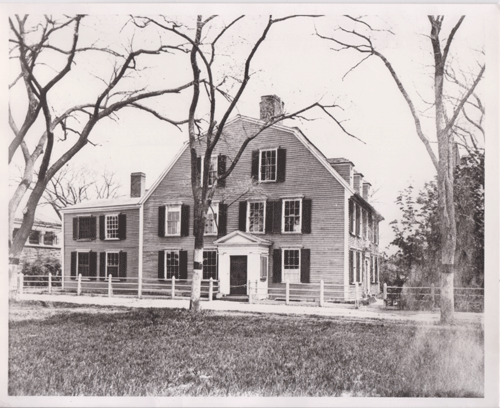
Young Oliver was born in 1809 in the house that had belonged to the Harvard College steward Jonathan Hastings. In 1775 the Massachusetts committee of safety and Gen. Artemas Ward took it over as the first rebel headquarters of the war.

In The Poet at the Breakfast Table, Holmes described some ministers whose names I know because they wrote recollections about the Revolutionary period when they themselves were boys.

Holmes recalled the Rev. Thaddeus Mason Harris (1768–1842) of Dorchester this way: “already in decadence as I remember him, with head slanting forward and downward as if looking for a place to rest in after his learned labors.”

The Rev. David Osgood (1747–1822) has made only one appearance in Boston 1775, guarding his privilege to perform all marriages in his town. Holmes recalled him as “the most venerable David Osgood, the majestic minister of Medford, with massive front and shaggy over-shadowing eyebrows.”

Holmes’s longest profile limned the “attenuated but vivacious little Jonathan Homer of Newton, who was, to look upon, a kind of expurgated, reduced and Americanized copy of Voltaire, but very unlike him in wickedness or wit.”

Homer (1759–1843) was minister of the first congregation in Newton, where Homer Street preserves his name. Holmes went on:
The good-humored junior member of our family [Holmes himself?] always loved to make him happy by setting him chirruping about Miles Coverdale’s Version, and the Bishop’s Bible, and how he wrote to his friend Sir Isaac (Coffin) about something or other, and how Sir Isaac wrote back that he was very much pleased with the contents of his letter, and so on about Sir Isaac, ad libitum,—for the admiral was his old friend, and he was proud of him.
Homer and Coffin had been classmates at the South Latin School, one becoming an American clergyman and the other a British admiral. Coffin’s recollections of life in that school were invaluable to me in writing about its culture.
The kindly little old gentleman was a collector of Bibles, and made himself believe he thought he should publish a learned Commentary some day or other; but his friends looked for it only in the Greek Calends,—say on the 31st of April, when that should come round, if you would modernize the phrase.
In other words, that magnum opus’s day of publication would never arrive.

Saturday, January 25, 2025

Hiring Freeze in National Parks May Curb 250th Events

Yesterday National Parks Traveler reported that the new administration has ordered the National Park Service to rescind seasonal job offers made to up to 1,400 people.

Per the Washington Post, the new administration’s hiring freeze was explicitly not supposed to include “seasonal employees and short-term temporary employees necessary to meet traditionally recurring seasonal workloads.”

The Park Service has long depended on seasonals and interns, as everyone in the federal government knows. Every year the agency hires more people to cover the busiest months. Even so, its staffing level is pretty skeletal.

The Post story, filed by an environmental reporter, focuses on the big nature parks like Yellowstone and Yosemite. But a hiring freeze will also affect the historic parks, which get less attention.

Here in Massachusetts, we have several Sestercentennial anniversaries coming up. Local governments and organizations are planning events for their communities and expecting large influxes of tourists. In most cases, those events involve or require fully staffed national parks.

The Salem Maritime National Historic Site will have an exhibit on “Leslie’s Retreat,” due to open on 15 February, to complement events around the city.

Minute Man National Historic Park offers a full slate of events about the Battle of Lexington and Concord, running from presentations on spies on 22 March through a Battle Road Anniversary Hike on 21 April—with the big military reenactment in between on 19 April, of course.

The weeklong series of events in Charlestown to celebrate the 250th anniversary of the Battle of Bunker Hill on 17 June will of course be centered around the Monument, under the care of the National Parks of Boston. Even before then, the parks are sharing events like this 27 February talk on how Boston harbor helped to shape that battle.

Longfellow House–Washington’s Headquarters National Historic Site in Cambridge is preparing to commemorate the anniversary of the arrival of Gen. George Washington in July.

Looking further ahead, we’re all eagerly awaiting the reopening of the Dorchester Heights Monument to people visiting that crucial site in the siege of Boston.

I don’t know how much each of those initiatives depends on seasonal hires. But I know some parks absolutely need augmented staffing to handle their ordinary schedules, much less special events for larger crowds in an anniversary year.

Nobody in Washington is saying how long this hiring freeze will last. Hopeful N.P.S. managers have told people who’d received offers for seasonal jobs only to see those yanked away that the positions might open up again. But of course those managers thought they’d finally gotten through the federal hiring process and found qualified and eager staffers, only to have to pull back. As of this evening, the only N.P.S. job openings at USAJobs.gov are in security, firefighting, and other public-safety departments.

Tuesday, November 19, 2024

The Good Properties of Richard Lechmere

Back here, in introducing a letter by Richard Lechmere, I wrote about him as leaving his country estate in Cambridge after accepting a seat on the mandamus Council and moving into Boston.

Charles Bahne, Cambridge historian and good friend of the blog, commented:
I question whether Richard Lechmere ever lived in what is now called East Cambridge. Certainly he owned a lot of land there, much of it inherited from his in-laws, the Phips family, and then he bought more parcels from other Phips heirs. And from this we get the names of Lechmere's Point, Lechmere Square, Lechmere station, and, at one time, the Lechmere Sales chain of department stores.

But my understanding is that the Phips mansion standing on that land in East Cambridge hadn't been occupied for some years prior to Lechmere's inheritance, and I don't think he ever lived there himself. It was in a remote location with no easy access, often becoming an island at high tide.

The Cambridge residence I associate with Richard Lechmere was the Tory Row house on Brattle Street, which he built circa 1761. In 1771 Lechmere sold that house to Jonathan Sewall, who still owned it in 1774-75. About the same time, Lechmere bought an estate residence in Dorchester, from Thomas Oliver, who had moved to Cambridge shortly before that. But it appears that Lechmere only owned that Dorchester house for about eight months, before selling it to an Ezekiel Lewis, who in turn quickly resold it to John Vassall [Jr.], another Tory Row resident. (And as you know, John, the Vassall, Oliver, Lechmere, and Phips families were all intermarried with each other.)

Lechmere may have purchased the Dorchester property with the intent of moving there, but since he resold it so quickly, he may never have actually occupied the estate. I believe he may already have relocated to Boston itself by 1772 or so. (I remember reading that somewhere, but can't track the source down right now.) He did own a large distillery in Boston.

The fact that the Phips mansion in East Cambridge was vacant in 1775 may well have been a reason why Gen. [Thomas] Gage chose that isolated area as the landing place for the Concord expedition on April 18. With no nearby residents, there wouldn't be any nosy neighbors to notice the troops' arrival.
There’s no dispute that Richard Lechmere owned a lot of property when he left Massachusetts. On 13 Oct 1784 he applied to the Loyalists Commission, seeking compensation for his losses. The commission’s records discuss “his House in Boston,” “his farm at Cambridge,” part of “a great Distillery at Boston,” “some Land at Muscongus” in Maine, and “property at Bromfield [Brimfield] & Sturbridge.”

But where did Richard Lechmere live? Some of those properties were real-estate investments. He may have moved between a couple of houses seasonally. But where was his legal residence? I went looking for period sources.

Lechmere’s name (as well as others’) is still attached to his 1760s home on Brattle Street in Cambridge, shown above. But according to Cambridge historian Lucius Paige, Lechmere turned that property over to royal attorney general Jonathan Sewall on 10 June 1771.

The 17 May 1770 Boston News-Letter contains an advertisement for the Dorchester house that had belonged to Thomas Oliver. That ad directed inquiries to “Richard Lechmere, of Cambridge,” meaning he didn’t move to Dorchester, just owned the property there while still living in Cambridge.

On 22 Aug 1773 the Boston Evening-Post contains another advertisement for a house in Boston on Hanover Street, “lately in the Occupation of Jacob Royall, Esq; deceased.” That directs inquiries to “Richard Lechmere, of Boston.” So by that date Lechmere presented himself as back in the town of his birth, no longer a Cambridge resident.

According to James Henry Stark’s Loyalists of Massachusetts, the Boston real estate confiscated from Lechmere was a house, land, and distill-house on Cambridge Street. He may have moved there from Hanover Street, or the house in that second advertisement was another property he managed. Cambridge Street was probably where Richard Lechmere was living when he became a mandamus Councilor—already safe from actual Cambridge residents.

Friday, May 17, 2024

“The pistols were not heard by a single person”

Yesterday I left Edward Rand dead on Dorchester Point. The man who had just killed him in a duel, Charles Miller, Jr., could have been arrested for murder, and their seconds were also open to criminal charges.

After a bare-bones report on the duel, the 16 June Columbian Minerva of Dedham reported:
Miller passed thro this town to the southward, on the morning of the same day, in a coach, attended only by his second.
That second was Lewis Warrington (shown here), a nineteen-year-old midshipman in the U.S. Navy. Warrington was the natural son of Donatien-Marie-Joseph de Vimeur, vicomte de Rochambeau, son and aide of the commander of French troops during the war.

Back in Dorchester, other people began to arrive on the scene. According to duel chronicler Lorenzo Sabine:
A gentleman who was at Fort Independence at the moment of the duel, and who, with three or four others, immediately after it jumped into a boat and rowed to the Point, informs me, that when he arrived Rand lay dead upon the beach, alone, with an empty pistol near him; that he was gayly dressed; and that he saw Mr. [Ebenezer] Withington of Dorchester (who, as coroner, came with a jury) take Miller’s acceptance of his challenge from his pocket.

This gentleman remarks, that a fishing-vessel was at anchor off the Point, and that some three or four hundred workmen, officers, and soldiers were at the Fort, but that, as far as he was ever able to ascertain, the reports of the pistols were not heard by a single person among them all.
Which should lead us to wonder why a handful of men had jumped into a rowboat immediately after Rand fell dead. I suspect no one wanted to testify to the authorities.

Massachusetts law allowed for those authorities to confiscate Rand’s body and turn it over to a surgeon for dissection. Instead, this profile of Charles P. Phelps, Rand’s business partner, cites his 1857 manuscript autobiography to state that he “was called upon to retrieve his partner’s body and helped to bury him in the Granary burying Ground late that night.”

Sabine (who’s best known for writing the first biographical guide to American Loyalists) went on:
Miller departed Massachusetts on the very day his antagonist fell. He was indicted for murder in the county of Norfolk, but was never tried or arrested. The indictment against him was missing from the files of the court as early as the year 1808 or 1809.

His home, ever after the deed, was in New York, where his life was secluded, though in the possession of an ample fortune. He lived a bachelor. He died in 1829, leaving an only brother.
The New York newspapers said this Charles Miller, formerly of Boston, died “suddenly” at age sixty.

The mercantile firm Charles Miller & Son continued to advertise in Boston newspapers for a couple of years after the younger man’s move. Eventually Charles Miller, Sr., retired to Quincy, where he had been born. In 1815 former President John Adams noted that foxglove (digitalis) had “lately wrought an almost miraculous cure upon our Neighbour Mr Charles Miller.” But the man died two years later, age seventy-five.

Thursday, May 16, 2024

“He fell lifeless on the ground!”

As I quoted yesterday, the Constitutional Telegraphe of 17 June 1801 was the only Boston newspaper to report on the duel between Edward Rand and Charles Miller, Jr., three days earlier.

I slyly broke off before the end of that passage: “…in which the latter was shot dead on the spot.”

Not that the duelists’ names necessarily appeared in the newspaper in the same order as the first paragraph of this posting.

So I’m still keeping the outcome of the duel from you.

The Federal Galaxy of Brattleboro, Vermont, went into more detail on 29 June:
Having agreed on seconds, they repaired to Dorchester Point early on Sunday morning last;—they then paced out the ground, and the lot was Rand’s to make the first fire; his fire, however, did no execution; Miller then discharged his pistol, the contents of which lodged in his antagonist’s heart, and he fell lifeless on the ground!
Decades later, in the 1859 edition of Notes on Duels and Duelling, Alphabetically Arranged (but not in the 1855 first edition), Lorenzo Sabine set down the story as he’d gathered it:
The late Governor [William] Eustis of Massachusetts (at that time a physician in practice) was on the ground as surgeon. Rand was accompanied by a brother; Miller, by Lieutenant [actually Midshipman] Lewis Warrington, who was subsequently a post-captain in the United States navy, and was distinguished in the war of 1812.

Rand was the challenger. Two shots were exchanged. Miller discharged his first pistol in the air, and then asked his antagonist “if he was satisfied.” The reply of Rand’s second was in the negative.

Miller—who had frequently amused himself with the pistol with the officers stationed at Fort Independence, and who had acquired a great reputation as a marksman—then said: “If I fire again, Mr. Rand will surely fall.”

The parties resumed their position, and at the word fired. Rand was shot through the right breast, and died upon the spot.
Under a 1784 Massachusetts law (follow the link here at HUB History), issuing or accepting a challenge to a duel was illegal, even if you never actually dueled. Anyone helping to arrange a duel was liable for up to £300 fine and six months in jail.

If you killed someone in a duel, you could be arrested and tried for murder. If you ended up convicted and hanged, your body could be dissected and/or buried without a coffin and with a stake through the heart. And the same went for the body of the person killed in the duel.

The picture above shows Dr. William Eustis, reportedly “on the ground as surgeon” during the exchange of shots. He would seem to have been at least arguably liable for abetting the duel. That’s especially striking for two reasons. First, in 1801 Eustis had just been elected to Congress. And second, his brother had died in a duel during the war.

TOMORROW: The aftermath.

Wednesday, May 15, 2024

“Terminated in a Duel…at Dorchester Point”

While looking for more ties between Charles Miller and the Boston Patriots, I came across this story from the next generation.

Boston’s Constitutional Telegraphe newspaper reported on 17 June 1801:
We hear, and are concerned to state, as we conceive it a painful task, which we consider to be our duty to perform, to announce to the public an unfortunate dispute between Mr. Charles Miller, jun. and Mr. Edward Rand, both of this town, which terminated in a Duel, early on Sunday morning last, at Dorchester Point…
Charles Miller, Jr., was baptized in King’s Chapel on 18 Nov 1770. So far as I can tell, he was the first and only child of Charles Miller, a younger son of Braintree’s Anglican minister, and his first wife, Elizabeth Cary of Charlestown.

Charles, Jr., followed his father into the mercantile business. Around the turn of the century there are lots of advertisements in Boston papers for goods offered by the firm of “Charles Miller & Son.”

Edward Rand was baptized in Boston’s New North Meetinghouse on 22 Aug 1773. He was the fourth child of Dr. Isaac Rand, Jr., a physician suspected of being a Tory but mostly tolerated because of his medical skills. (Dr. Isaac Rand, Sr., was an active Patriot, caring for soldiers with smallpox during the siege of Boston.) By the end of the 1700s the younger Dr. Rand’s reputation was solid enough that he was elected president of the Massachusetts Medical Society.

In April 1800, Charles P. Phelps (1772–1857) and Edward Rand announced that together they had rented a large store on Codman’s Wharf to sell imported fabric, hardware, and spermaceti candles. They offered to advance cash on consignments and sought “a Lad about 14 years of age” to work for them.

A duel between rising young men from such prominent families was bound to cause talk. In a letter to her youngest, Abigail Adams said: “it is reported that the Quarrel arose about a Female— this is the first instance of the Kind in our State.” Massachusetts had seen some duels before, but not that many involving locals.

The item in the Green Mountain Patriot of Peacham, Vermont, on 2 July avoided using the term “duel,” saying instead that the two men had met “for the purpose of honorably settling an honorable dispute.”

The Federal Galaxy of Brattleboro broke the full story on 29 June:
FATAL DUEL.

A report of a late duel in Boston has been current in town for ten days past—A letter dated Boston, June 17, received by the Editor, from his friend residing there, gives the following recital of the event:

“Some misunderstanding having taken place between Messr. Charles Miller, jun. and Isaac [sic] Rand, (respectable merchants in Boston) which originated respecting a certain young lady, to whom Miller had paid his addresses; after giving each other some hard words, Rand sent Miller a challenge, which was accepted. Having agreed on seconds, they repaired to Dorchester Point early on Sunday morning last;…”
Decades later, Rand’s business partner Phelps wrote in an unpublished memoir that the lady was “from Rhode Island,” but I located no source identifying her.

After describing the action, the letter in the Federal Galaxy stated:
“You will find no mention made of this affair in the Boston papers, as the several printers have been requested by the parents of Miller and Rand, not to notice it.”
And indeed the Constitutional Telegraphe’s article appears to be the only report printed inside Boston. It was, however, reprinted outside the town from Maine to Virginia.

TOMORROW: Who lived, who died, who told the story.

Saturday, March 30, 2024

Leafing through the “Davenport Letters”

The Museum of the American Revolution in Philadelphia has just unveiled a webpage displaying seventeen letters written by Continental soldiers Isaac How Davenport (1754–1778) and James Davenport (1759–1824) of Dorchester.

The original letters don’t survive, but a nephew copied them into a ledger book, which remains in the family.

The museum is sharing scans of those transcripts as well as P.D.F. files of their text in the raw and with modernized punctuation for easier reading.

I presume the older brother was the “Isaac Davenport” listed among the Dorchester men who responded to the militia alarm on 19 Apr 1775.

Middle names were rarely used in New England at this time. It looks like Isaac How Davenport received his father’s mother’s maiden name, sometimes spelled Howe, as his middle name. In nineteenth-century histories of Dorchester, that man’s name was misprinted as “Isaac Shaw Davenport.”

Isaac became a member of the commander in chief’s guard and then the dragoons under Col. George Baylor. He spent several months of 1777–78 at Valley Forge, where he wrote two of the letters in this collection. Isaac Davenport was among the Continental dragoons killed in a nighttime raid on their billets on 27 Sept 1778.

The younger brother, James, enlisted in the Continental Army in February 1777, when he was seventeen years old, leaving behind an apprenticeship to a shoemaker. He served for the rest of the war, rising to the rank of sergeant in 1780. In 1777–78 he was also at Valley Forge, but his surviving letters start in 1780, getting more numerous late in the war when there was less to do besides write home.

After the war James Davenport returned from New York to Dorchester and used his earnings to build a house, marry, and start a family. He lived long enough to apply for a pension in 1818, sending in copies of his promotion to sergeant and his discharge signed by Gen. George Washington. Many veterans didn’t have such documentation.

The U.S. government initially awarded Davenport a pension, but then rescinded it. I suspect the problem was that Davenport wasn’t poor enough; the pensions of that decade required applicants to show need, and he owned a farm, a house, and cash.

Davenport tried to present himself as in need: “my health is much impaired by my services in the Army,” “My House was built more than 30 years ago,” his wife Esther was prone to illness.

In the end, though, James Davenport’s best claim to public support was his service. He described himself as “engaged at the Capture of Burgoyne, Cornwallis, at Monmouth & always with my Regiment.” (His regiment wasn’t actually at Yorktown.) A later law would have let him keep his pension because it wasn’t need-based, but by then there were fewer veterans to pay for.

After James Davenport died in 1824, Dorchester’s minister, the Rev. Thaddeus Mason Harris, preached at his interment. The published sermon reportedly “included excerpts from a journal of his wartime experiences.”

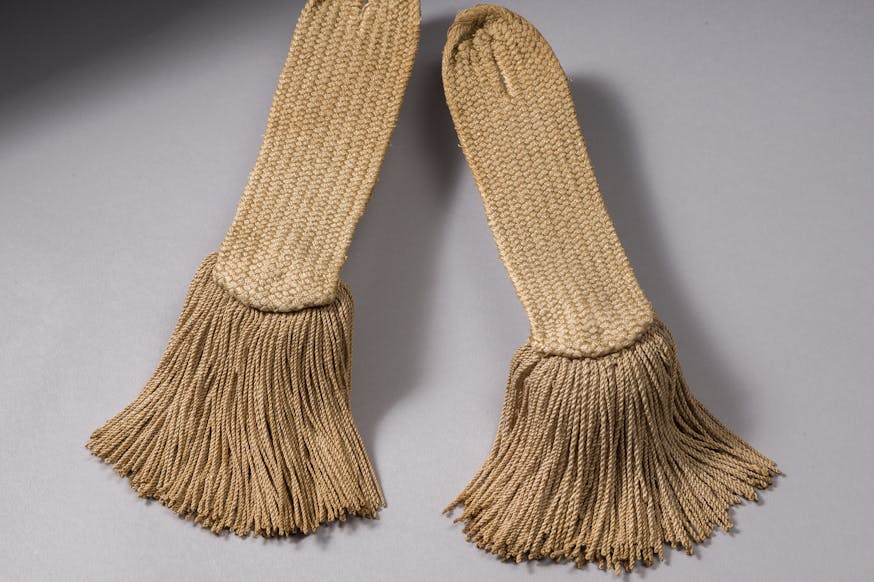
The Davenport family had not only preserved that journal until then and the texts of the letters, but also some mementos of James’s military service: a sword, epaulettes (shown above), and a pair of red wool baby booties reportedly made from a British coat. Those are now part of the Museum of the American Revolution’s collection, and can be viewed through the “Davenport Letters” webpage.

Sunday, December 31, 2023

Ending the Year by Burning Tea

In my write-up of the Charlestown tea burning, I mixed up the date of the town meeting when everyone agreed to stop selling tea (28 Dec 1773) with the date the townspeople burned their stocks of tea (31 December, or 250 years ago today).

That in turn led to misdating when a crowd from Boston confiscated Ebenezer Withington’s tea in Dorchester.

I’ve corrected those postings.

To my chagrin, I found that I’d actually flagged a source to discuss on this date, but while traveling during this holiday season I overlooked that draft.

So here is a timely account of the events of 31 Dec 1773 from our old friend, merchant John Rowe:
The People of Charlestown collected what Tea they could find in The Town & burnt it in the View of a thousand Spectators.

There was found in the House of One Withington of Dorchester About half a Chest of Tea

the People gathered together & took the Tea Brought it into the Common of Boston & Burnt it this Night about Eleven of Clock—

This is Supposed to be part of the Tea that was taken out of the Ships and floated over to Dorchester—
Rowe’s recounting (probably second-hand) adds a couple of details to the newspaper report: the large crowd in Charlestown and a more precise timing of the tea-burning on Boston Common.

Overall, these incidents show that, despite fears of how the London government would react to the destruction of East India Company property, Bostonians were closing out the year by getting more strict about enforcing their tea boycott on everyone.