J. L. BELL is a Massachusetts writer who specializes in (among other things) the start of the American Revolution in and around Boston. He is particularly interested in the experiences of children in 1765-75. He has published scholarly papers and popular articles for both children and adults. He was consultant for an episode of History Detectives, and contributed to a display at Minute Man National Historic Park.

Subscribe thru Follow.it


•••••••••••••••••


Showing posts with label Ralph Inman. Show all posts

Monday, June 17, 2024

Capt. John Linzee’s Ties to Boston

This is the anniversary of the Battle of Bunker Hill in 1775.

Among the Massachusetts Historical Society’s unique artifacts from that event are the crossed swords of Col. William Prescott from the provincial troops and Capt. John Linzee from the Royal Navy, as highlighted here.
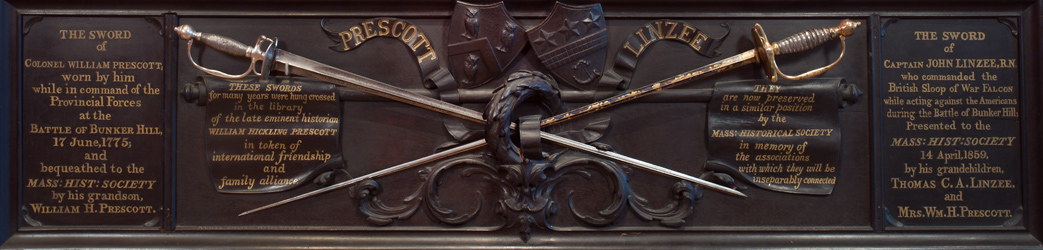
Those weapons were donated by the historian William Hickling Prescott, his wife Susannah, and her cousin. William was a grandson of the colonel. Susannah was a granddaughter of the captain.

Though born in England and serving the king, Capt. Linzee had strong ties to Boston. In 1772, while master of H.M.S. Beaver, he married Susannah Inman of Cambridge, favored niece of John and Hannah Rowe.

The Linzees started having children. The first was born in Plymouth, England; the second back in Boston during the siege; the third on the Delaware River, reportedly during a battle which it didn’t outlive.

The Linzees’ fourth child was born at Barbados, the next four in Plymouth. The captain had a busy war.

Susannah Linzee’s father, Ralph Inman, had left Boston in the evacuation of 1776. Her stepmother, Elizabeth (Murray Campbell Smith) Inman, never left. She kept hold of their property, which is how he could return to his Cambridge estate when the fighting died down.

John Rowe also never left. When that merchant died in 1787, he bequeathed Susannah Linzee some Boston property. She came back to America, and the Linzees’ ninth child was born in Boston in 1789.

The following September, Capt. Linzee sailed H.M.S. Penelope into Boston harbor, writing to Gov. John Hancock that he intended to salute the flag of the U.S. of A. with thirteen guns if the battery at the Castle would reciprocate.

Linzee’s letter also mentioned his “exceeding ill State of Health,” and indeed he was so sick the Penelope sailed away without him while he recuperated in his wife’s house. A few months later, however, Capt. Linzee was back “in perfect health” on his ship along with his two eldest sons.

In the following years, things started to go wrong for Capt. Linzee.

TOMORROW: A British officer in Boston.

Friday, March 24, 2023

“Genl. Putnam & Some Troops came into Town”

In his diary, the merchant John Rowe noted that Sunday, 17 Mar 1776, was “St. Patricks Day” with “Pleasant Weather.”

He appears to have started his entry in the wee hours of the morning, perhaps before second sleep, then added to it later:
The Provincials are throwing up a Battery on Nook Hill on Dorchester Neck, which has occasioned much Firing this night.

This morning The Troops evacuated the Town & went on board the Transports at & about Long Wharff

they sailed & got most part of them into King Road

about Noon Genl. [Israel] Putnam & Some Troops came into Town to the Great Joy of the Inhabitants that Remained behind

I din’d at home with Mr. [Ralph] Inman Mrs. [Elizabeth Murray Campbell Smith] Inman, Mr. [Jonathan] Warner Mrs. Rowe & Jack Rowe—

I Spent the Evening at home with Major Chester Capt. Huntington Mr. [Samuel] Parker Mr. Warner Mrs. Rowe & Jack Rowe.
Once again, Rowe was distancing himself emotionally from “the Inhabitants that Remained behind,” though he undoubtedly was part of that group.

The Inmans had been separated by the siege lines, which strained their marriage. Back in July 1775 Ralph and the Rowes were talking about sailing to Britain together, and Elizabeth had responded with “pointed remarks.” This was the Inmans’ first dinner together in about a year, and it might have been tense.

Maj. John Chester (1749–1809, shown above) and Capt. Ebenezer Huntington (1754–1834) were Continental Army officers from Connecticut. They were also brothers-in-law, Chester having married Huntington’s sixteen-year-old sister Elizabeth in 1773.

Rowe’s diary gave no hint about how much pressure he felt to host officers from the conquering army, but he was making a quick transition to being friendly to the Revolutionary cause.

The first full day of independent Boston, 18 March:
Major Chester and Capt. Huntington Lodgd at Our house

The Town very quiet this night. Severall of my Friends came to see Mee from the Country
And the second:
Numbers of People belonging to Boston are dayly coming in—

Genl. [George] Washington & his Retinue were in Town yesterday I did not hear of it otherways Should have paid my Respects & waited on him—

This afternoon the King’s Troops burnt the Blockhouse at the Castle & the Continental Troops A throwing up a Battery on Forthill

Most all the Ships are gone from King Road into Nantasket Road—
TOMORROW: Royal Navy off the coast, Continental generals in the town.

Friday, March 17, 2023

John Rowe Near the End of the Siege

On 17 Mar 1776, the last ships carrying British soldiers and Loyalists pulled away from Boston’s docks.

John Rowe wasn’t on one of those evacuation vessels. That might have surprised some people because that merchant was a native of England, an Anglican, and, according to the crowd inside Old South Meeting-House on 30 Nov 1773, “a good Tory.”

But Rowe was what people called a “trimmer,” adjusting his political stances to what seemed popular and advantageous. On 16 Mar 1775 he wrote disapprovingly in his diary about a Thanksgiving called by the Massachusetts Provincial Congress, and then at some point he went back and wrote in new words to make it look like he was fine with that, as I quoted here.

That said, I come away from reading Rowe’s diary with the feeling that whatever he wrote at the time he really meant. Maybe he’d change his position in a few weeks, but when he sat down of an evening to record the day’s events he was sincere. Rowe’s emotions come through when he wrote about himself, even as he tries to suppress them like a good eighteenth-century gentleman.

So I’m going to recount the evacuation of Boston through John Rowe’s eyes. His journal has been published in edited form twice, in the Massachusetts Historical Society Proceedings in 1895 and again with more accurate misspellings in 1903. It’s now available in full digitally through the Massachusetts Historical Society’s website.

Rowe almost obsessively recorded whom he dined with at midday and whom he spent the evening with. He often described the weather, and every Sunday included details about the church service he attended. A lot of that detail was repetitive and left out of the printed editions. Here, for example, is Rowe’s full entry for 1 Mar 1776, with the words printed in the published editions in boldface:
Primo March 1776 Fryday very Cold WNW—blows fresh

My Brigg Sukey went down in Order to Proceed to Oporto—


I dind at home with Mrs. Rowe & Spent the Evening at home with Richd. Green & Mrs. Rowe
Rowe was still trading across the Atlantic—and not just within the British Empire since Oporto was in Portugal.

The next daily entry doesn’t appear in either of the printed editions despite—or probably because of—how it recorded an interesting event:
2d. March 1776 Saturday A Pleasant morming WSo.W—

This morning Capt. Johnson of the Minerva drown’d himself

I dind at home with Mr. [Ralph] Inman Mrs. Rowe & Jack Rowe—

& Spent the Evening at home & at the Possee
The “Possee” was Rowe’s usual club or circle of friends.

So far that month, life was going on normally—or not going on, in the case of Capt. Johnson. Despite the fact that Rowe was living in a besieged town during a civil war.

TOMORROW: The shooting starts.

Friday, December 25, 2020

A “very Cheerfull” Christmas at the Rowes’

The merchant John Rowe was one of Boston’s leading Anglicans, so he celebrated Christmas while his Congregationalist neighbors generally ignored the holiday.

Here’s how Rowe described 25 Dec 1770 in his published diary, 250 years ago today:
Christmas Day — I dined at home with Capt. John Linzee Mr. John Lane, Dr. Miller Joseph Golthwait Mr. Inman, Mrs. Rowe, Miss Lucy Flucker & Sucky Inman — The same Company staid & spent the afternoon & evening & wee were very Cheerfull.
That’s a lot of different surnames, but I can map close relations among many of those people. “Mrs. Rowe” was the diarist’s wife, of course, the former Hannah Speakman.

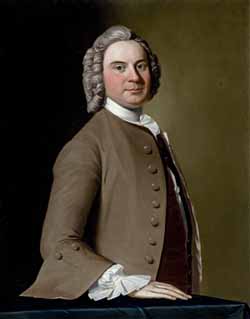
Before Hannah’s sister Susannah died in 1761, she had married Ralph Inman (1713-1788, shown above courtesy of the Harvard Art Museums). The Inmans’ daughter “Sucky” or Susannah (1754-1792) lived in Boston with her aunt and uncle Rowe, and her father had come in from Cambridge for this holiday.

John Linzee (1743-1798) was a captain in the Royal Navy who would spend increasing time at the Rowes’ house in 1772. Finally that summer he married Susannah Inman, then eighteen years old. Later he participated in the Battle of Bunker Hill and some other naval actions during the siege of Boston.

Lucy Flucker (1756-1824) was probably at this party as a teen-aged friend of Sucky Inman. She spotted Henry Knox in a militia parade in 1773 and married him the next year. She thus got to see the war from the other side.

Joseph Goldthwait (1730-1779) was a former major in the provincial army who became commissary to the royal troops in 1768 and filled other posts in military administration afterward. He died of illness in New York during the war.

John Lane was a London merchant and “Old Friend” of Rowe’s. Depending on what “Old Friend” meant, they may have met as young men when Rowe was still in England or recently when “John Lane, jun.” visited Boston and New York in 1764-65. Lane came back to Boston in August 1769 “in the Nassau very unexpected,” Rowe wrote, and he stayed until July 1771, regularly appearing in Rowe’s diary. In March 1771, for example, Rowe came home to find Lane and another man singing and playing his niece’s spinet.

Lane’s family firm, called Lane, Son & Fraser in this period, did a lot of business with Rowe and other New England merchants. They even owned ships together, including the Eleanor, one of the vessels at risk in the Boston Tea Party. After Capt. Linzee married Sucky Inman, Rowe wrote: “I gave Capt. Linzee a Letter with Orders to draw on me every New Years Day Twenty Pounds Sterling, taking the money of Messrs. Lane Son & Fraser for my acct.”

In 1786 John Lane came back to Boston with his son, apparently planning to settle permanently. In 1790 Lane, “now resident at Boston,” filed a lawsuit to seize a vessel that Lane, Son & Fraser had invested in. But the next mention of the firm in the Boston newspapers, in the 14 June 1793 Argus, said the firm had gone bankrupt in London.

Dan Byrnes has striven to collect and parse information about Lane, Son & Fraser because of an Australian connection, as this webpage shows, but it doesn’t make anything clearer for me. It’s likely there were two or three generations of men named John Lane (Jr.) who have to be sorted out.

That leaves only Dr. Miller to be accounted for. That name doesn’t appear among the local physicians of this period. It’s possible he was a surgeon attached to the Royal Navy or even the 14th Regiment of Foot, stationed at the Castle.

Sunday, July 12, 2020

The Speakman Brothers at War

When we left the Barnes and Speakman families in Marlborough in the fall of 1770, they appear to have arrived at some sort of truce.

Henry Barnes continued to run a potash manufactory and general store. Older brother William Speakman probably managed the farming land while younger brother Gilbert Warner Speakman set up a tannery.

Four years later, in the summer of 1774, Parliament’s Coercive Acts radicalized the Massachusetts countryside far more than it had been before. Marlborough held a town meeting to endorse the Solemn League and Covenant, the strictest boycott yet on British goods and people selling them in America.

On 8 July, John Rowe, uncle and mentor of the Speakman brothers and then trimming toward the Crown, wrote in his diary:
I heard of the bad behaviour of the people at Marlborough; its said the Speakmans were concerned; if it proves so, they have not only behaved ill, but contrary to my sentiments, and forfeited my regard in future for them.
Then came the “Powder Alarm” of 2 September, when thousands of Middlesex County militiamen poured into Cambridge, spurred by Gen. Thomas Gage’s seizing of gunpowder from a provincial storehouse and false rumors of British military atrocities. The Marlborough militia companies were prominent in that action according to Boston merchant John Andrews:
Though they had an account at Marlborough of the powder’s being remov’d, last Thursday night, yet they were down to Cambridge (which is thirty miles) by eight o’clock Fryday morning, with a troop of horse and another of foot, both under the command of Gib. Speakman, a young fellow who serv’d his time with John Rowe.
When the real war came in April 1775, William Speakman marched with the Marlborough militia infantry. (That is, in fact, the last record I’ve found of him.)

Gilbert Warner Speakman became a captain in Col. John Glover’s regiment, drawn mostly from Marblehead, at the start of 1776. On 17 March, the British military evacuated Boston, taking many Loyalist families with them, including Henry and Christian Barnes.

The Speakmans’ uncles, John Rowe and Ralph Inman (shown above, courtesy of the Boston Athenaeum), stayed behind to tough out the change in political power. Just one week after the evacuation, with the British fleet still massed off shore, Rowe wrote in his diary:
I dined at Mr. Inman’s with him, Mrs. Inman, Genl. [Nathanael] Green, Mrs. [Catherine] Green, Tuthill Hubbard, Mrs. Forbes, Mr. Lowell [?], Mrs. Rowe, and Capt. Gilbert Speakman.
Rowe had regained his regard for his nephew, now that that nephew was on the winning side.

In May 1776, Capt. Gib Speakman advertised for deserters from his regiment. Those newspaper notices provide valuable descriptions of how Marblehead soldiers were dressing.

The next year, Capt. Speakman transitioned to being commissary of military stores at Springfield and then commissary of ordnance for the ill-fated Penobscot expedition of 1779. He offered damning testimony in the court-martial of Paul Revere. Revere was acquitted while Speakman was still petitioning the Massachusetts legislature for reimbursement for that mission in 1798.

The Speakmans expected to marry within the same class and religion, as their aunts had done by marrying Rowe and Inman. That became more difficult after the evacuation of so many genteel Anglican families as Loyalists. Gib Speakman and his sisters Hannah and Sarah all ended up marrying siblings in the Minot family of King’s Chapel, including historian George Richards Minot.

Saturday, July 11, 2020

Family Business and Politics in Marlborough

Personal finance and politics intersected for the Speakman family and their neighbors in the summer of 1770.

As I started to discuss back here, Thomas Speakman acquired property in Marlborough before being killed on the Lake Champlain battlefront in 1757.

His widow Mary was living in that town in the late 1760s, and their son William (Billy) apparently moved out there after a health scare in late 1768.

By that time both mother and son had become attached to Whig politics, even though they were upper-class Anglicans, a group more likely to side with the Crown. That irked Mary Speakman’s Loyalist friend and neighbor Christian Barnes, who nonetheless concluded that the widow was not acting ”from any Self interested Motives.”

In those years the family’s second son, Gilbert Warner Speakman, was in Boston working for his uncle, merchant John Rowe. But that young man, called Gibby or Gib by his family, came of age in 1768 and needed to establish himself independently in some way.

In the same long letter from the summer of 1770 that I quoted about political disturbances in Marlborough, Christian Barnes wrote in late June:
Mrs. Speakman went to Boston last week and Mr. Rowe ask’d her what she intended to to [sic] do with Gibby for he had no longer any ocation for him and could not afford to pay him wages

She told him her last resort was New Boston [New Hampshire, where the family had invested in land] and if she could be put into business there she should like to take her whole family with her,

he made no reply to this and she return’d from Boston in very low Spirits but last Night she received a letter from Gibby informing her that his uncles Row & [Ralph] Inman had agree’d he should go to New Boston with goods and there make Pearl & Pott Ash
Christian Barnes’s husband Henry happened to own a potash manufactory in Marlborough. To be sure, that building had recently had its windows smashed, and a rumor was going around town that Billy Speakman was sparking such vandalism to get Henry to finally adhere to non-importation. But that didn’t stop Gibby from asking his mother’s neighbor for advice:
he sent to Mr. Barnes for an estimate of the Cost of the Works and desires to know if this is a proper Season to cut down Timber to build a House

you see these are all things at a distance and may possibly blow off in Air However it has given Mrs. Speakman new Spirits
That month, two effigies of her husband, a threatening letter, and news of attacks on other Loyalists made Christian Barnes increasingly anxious. And then came a small-town betrayal.

Christian Barnes’s 13 July letter reported that Mary Speakman was preparing for her son to go into business in competition with Henry Barnes. The people of Marlborough would no longer have to buy general goods from an importer or travel to another town. Political, commercial, and personal factors were intertwining as Christian Barnes wrote of the rift between the families:
even Mrs. Speakman has deserted me, and takeing the advantage of our distress’d situation has made aplication to Mr. Row and he has consented to send up Gibby and open a Store at her House and he is now actuly here makeing preparation for the reception of his goods[.] he has brought his Mistress with him and they have past a Week in the greatest Mirth and festivity.

The only excuse they have to make for this ungreatfull proceeding is that as Mr. Barnes has advertized his Estate for Sail but whatever Motive Mr. Barnes might have for advertizeing his Place Mrs. Speakman has told me more than twenty times that she was convinced he has no intention of leaving Marlborough, so you see what the New Boston Scheem is come to but it must end in that finily, or something worse for I am well assured that a Store of Good put into their hands and by Mr. Row must prove their distruction, and at the same time will be injuring us to such a degree as I think ought not to be forgiven.
By this point Christian Barnes had dropped all her skepticism about the Speakman brothers encouraging the attacks on her husband. “I know they have both been very active in all the riots in Boston and they may Posibly find some dareing Sons of Violence who may be willing to assist them in any interprize they shall propose.”

To get away from the local unrest, Barnes went to stay with friends. On 17 September she described developments she found on coming back home:
when I returned from Cambridge (after an absense of five Weeks) I found the Peoples Minds were more composed[.] a Party had apear’d in our favor and some of them had Publicly declared they would act in opposition to any one that should molest us

they remain’d quiet till the time approach’d for takeing out our licence [to sell liquor.] Mr. Barnes then waited on the Select Men for their approbation but was refused

Mrs. Speakman (who is still determin’d to circumvent us in our trade if possible) had no doubt but she should obtain it but she did not gain her Point and Mr. Barnes put in a Petition to the Court which was then siting at Concord and they very readily granted him a license tho there was great opposition made by some People in the Town who were at the expence of feeing a Lawyer upon the ocation

they now begin to make it a party affair among themselves and the Tory Party (as they are call’d) talk of erecting fire Works by way of triumph upon our gaining the licence
Soon, however, the non-importation controversy settled down. Gib Speakman opened a tannery instead of directly competing with Henry Barnes.

Of course, the larger political issues remained unresolved.

TOMORROW: When war came.

[The picture above is an eighteenth-century engraving of a potash kiln, courtesy of the Wellcome Collection.]

Sunday, November 18, 2012

What Upset Deborah Putnam?

After Gen. George Washington organized the Continental Army into brigades in late July 1775, Gen. Israel Putnam moved into the Ralph Inman mansion in east Cambridge. He had already stationed his son Daniel there with instructions to see that Elizabeth (Murray Campbell Smith) Inman wasn’t harassed.

Soon, however, Inman moved to the estate she had inherited in Milton, and the army finished filling her Cambridge farm with barracks and fortifications. At some point Gen. Putnam’s wife Deborah joined him, as shown by some letters he exchanged with the Cambridge committee of safety in 1776.

After leaving Massachusetts, on 22 May Putnam sent back a letter that “remonstrated against the treatment that Mrs. Putnam had received from an agent of this committee.” The only surviving excerpt, probably with its spelling and punctuation cleaned up, offers a sense of that letter’s tone:

Pray did not I labor and toil night and day, through wet and cold, and venture my life in the high places of the field, for the safety of my country, and the town of Cambridge in particular? For it was thought we could never hold Cambridge, and that we had better quit it, and go back and fortify on the heights of Brookline. I always told them we must hold Cambridge; and pray did not I take possession of Prospect Hill the very night after the fight on Bunker Hill, without having any orders from any person? And was not I the only general officer that tarried there? The taking of said hill I never could obtain leave for before, which is allowed by the best judges was the salvation of Cambridge, if not of the country.
On 18 June the committee replied that Putnam’s conduct
while in Cambridge, in every respect, and more especially as a general, (without having it set forth,) we hold in the highest veneration, and ever shall. . . .

Nothing was ever aimed at treating you or yours unbecoming the many obligations that we are under for the extraordinary services you have done to this town, which must always be acknowledged with the highest gratitude, not only by us, but by rising generations.
Richard Frothingham quoted from those letters in his History of the Siege of Boston, thanking “J. Harlow, Esq.” for a look at the original documents. As a historian he was mostly interested in the question of what role Putnam played in the Battle of Bunker Hill. Frothingham avoided stating why the general had complained to the committee about “the treatment that Mrs. Putnam had received.”

The best evidence we have about the root of that conflict, and it’s a tradition without a cited source, appears in Old Cambridge and New by local historian Thomas C. Amory, published in 1871. He wrote that:
Mrs. Putnam took her airings in the [Inman] family coach. The Cambridge selectmen, provoked at this by them unwarranted appropriation of confiscated property, had the presumption, when she was some distance from home, to compel her to alight. The general was not of a temper to submit very meekly to such an affront, and his indignation was expressed with sufficient force to have become historical.
That appears to be based on local memory rather than documents. It mixes up the selectmen and the committee of safety (though they probably overlapped). But the fact that Frothingham saw letters referring to a dispute means something serious must have happened.

It’s conceivable that Deborah Putnam tried to take the coach not for “airings” but for her journey south at the end of the siege. That could explain why the general wrote back to the committee rather than storm into their meeting-place and cuss them out, which would be more his style. It also fits the legal issues involved: Patriot committees were happy to let the army use local Loyalists’ property during the siege but didn’t want it permanently removed or damaged without legal authorization.