J. L. BELL is a Massachusetts writer who specializes in (among other things) the start of the American Revolution in and around Boston. He is particularly interested in the experiences of children in 1765-75. He has published scholarly papers and popular articles for both children and adults. He was consultant for an episode of History Detectives, and contributed to a display at Minute Man National Historic Park.

Subscribe thru Follow.it


•••••••••••••••••


Showing posts with label James Jackson. Show all posts

Friday, January 11, 2019

The Brazen Head and a Bridge in Newbury

An item one could buy at the Sign of the Brazen Head in 1759, but which Mary Jackson didn’t list in her advertising, was a lottery ticket.

We know that from an ad that appeared in the Boston Evening-Post on 30 April:
The Drawing of Newbury Lottery
(the Second Part) will punctually commence at the Town-House in Newbury, on Thursday the last Day of May next, there being a Subscription for the Tickets then unsold, if any there shall be.———

[pointing hand] Tickets to be had of Ebenezer Storer, Esq; Messrs. Timothy Newell, William Jackson and James Jackson, in Boston; Capt. Bowen and Mr. Chipman in Marblehead; Mr. Pyncheon in Salem; Mr. Symonds in Danvers; Daniel Gibbs, Esq; and Mr. Daniel Sargent in Gloucester; Major Epes, Capt. Staniford, and Mr. William Dodge in Ipswich; James M’Hard Esq; and Mr. Joseph Badger in Haverhill, and of the Managers in Newbury.

Note, But two Blanks to a Prize.
What was all that about? The town of Newbury wanted to build a bridge over the Parker River to replace a ferry that had operated for over a century. In fact, the town had wanted to build such a bridge since 1734, according to John J. Currier’s “Ould Newbury” (1896). In that year the town meeting had voted to approve such a bridge on certain conditions:
  • It had to be wide enough for coaches.
  • Its main arch had to be tall and wide enough for boats laden with hay to pass through.
  • It wouldn’t cost the town of Newbury anything.
  • It would be free to use.
  • It had to be built within ten years.
It may not be surprising that no one undertook to fulfill all those conditions.

But the idea remained. In 1750 the Newbury town meeting and the Massachusetts General Court again approved of the idea of building a bridge. The legislature was involved because this time the planners proposed financing the bridge with a lottery, and the law needed provincial approval. The development team received authority to raise £1,200 that way.

In 1758 Ralph Cross finished building the bridge. It was 26 feet wide, 870 feet long, and had eight wooden arches. That structure no longer exists, but the present Parker River Bridge, built mainly in 1853 with stone arches, stands at the same spot.

Even after the bridge opened, however, the men behind it were still raising money. In fact, in April 1760 the legislature authorized a second lottery, and in February 1763 a third, to finish paying for the bridge and then to pay for its maintenance. Ads in the Boston newspapers for lottery tickets continued to direct customers who felt lucky to William and James Jackson, especially William.

When managers announced such lotteries, they had to be open about the terms. For example, the 1760 Newbury lottery stated that there were 5,000 tickets costing $2 apiece. One ticket would win $500, four would win $100, five $50, six $40, ten $30, fourteen $20, forty-five $10, seventy-five $8, and 1,495 tickets $4. The remaining 3,345 tickets were “blanks,” meaning their holders won nothing.

In all, just under one-third of all the tickets in the Newbury Lottery gave back more than a ticket-buyer had invested. That’s what the ad above meant by “Note, But two Blanks to a Prize.”

The goal of the 1760 lottery was to bring in $10,000. Of that sum, $9,000 was earmarked for prizes and the rest for the bridge. But raising a full £1,000 meant selling through the whole run of tickets, and that was a challenge. The 1759 drawing advertised above depended on some people promising “a Subscription for the Tickets then unsold.” As of March 1761 there were still unsold tickets for the second lottery, and the Newbury town meeting was asked what the town should do about it.

Today’s state lotteries operate under different rules, but one thing hasn’t changed: the expectation value of a ticket is still less than its price.

TOMORROW: Technical info.

[Above: A 1765 ticket from the long-running Faneuil Hall lottery signed by one of the managers, John Hancock.]

Thursday, January 10, 2019

“To be sold by Wholesale and Retail, By James Jackson”

As I research Mary Jackson and her family, I must say it would be a lot easier if they weren’t named Jackson. And if they hadn’t kept choosing first names like James, William, and Mary. But of course they weren’t the only family in eighteenth-century New England who set traps for researchers that way.

As I reported before, James and Mary Jackson had their second son baptized James at King’s Chapel on 8 May 1735. Boys named Jackson were admitted to the South Latin School in 1740 and 1742. Unfortunately, those school records don’t include full names. It’s possible that those boys were William and/or James Jackson, who would have been aged nine and seven respectively. If so, like most boys who started at a Boston grammar school in the 1700s, they never graduated, probably shifting to a writing school for better education in business skills.

This is just a guess based on their later paths, but I suspect William spent his adolescence helping Mama at the Brazen Head while James clerked for another import merchant. I’m even ready to guess that businessman was William Rand (1716-1758), who sold cloth and other dry goods “in Cornhill, The Corner Shop on the North side of the Townhouse,” per the 24 June 1751 Boston Evening-Post. In other words, very close to the Brazen Head.

This shopkeeper William Rand is often mixed with Dr. William Rand (1689-1759), who was an apothecary and a town tax collector. To confound matters further, that doctor had a namesake nephew, who in this period was a Harvard student and medical trainee and later was a counterfeiter. But I digress.

James Jackson came of age in May 1756. Already the town’s ministers were reading a notice that he intended to marry Sarah Rand—possibly the baby sister of shopkeeper William Rand, born in Charlestown in 1729. On 27 May, the couple wed at King’s Chapel. (The record there gives Sarah’s first name as Mary, just to add to the genealogical muddle. But that’s clearly an error, judging by the intention of marriage and later records of the couple.)

James Jackson thus married at an unusually young age, perhaps to a woman six years older. However, there’s no indication Sarah Rand was pregnant when they married, as many New England brides were. Instead, he seems to have been mature for his years.

James and Sarah Jackson had their own little baby James baptized at King’s Chapel on 26 June 1757, with his mother Mary standing as one of the sponsors. Five years later, on 10 Mar 1762, their son William was baptized in the same church; grandmother Mary and uncle William Jackson were sponsors.

On 26 Feb 1759 the Boston Evening-Post ran this advertisement:
Just Imported from LONDON, in the Brigantine Hannah, John Ayers Master, and to be sold by Wholesale and Retail,
By James Jackson,
At his Shop opposite Ebenezer Storer, Esq; and Son’s Warehouse in Union-street, BOSTON, very reasonable for ready Money,

A Great Variety of European and India GOODS, consisting of such a Number of Articles as would be tedious to the Reader. Likewise, a fine Assortment of Cutlery Ware, English Shoe Soles, Writing Paper, Looking Glasses, Raisins, Currants, Starch and Spices.
A similar ad followed in the Boston Post-Boy. Young Jackson had opened his own shop in the North End and was importing from Britain and beyond.

In March, the Boston town meeting elected James Jackson as one of twelve Clerks of the Market, alongside such peers as the silversmith Nathaniel Hurd. That was an entry-level elected position which the community usually gave to a young man seen as reliable and on his way up.

TOMORROW: Taking a chance with the Jackson brothers.

Wednesday, January 09, 2019

A New Owner at the Brazen Head

By 1756, Mary Jackson had been running her shop at the Sign of the Brazen Head in central Boston for over twenty years.

She had started as a suddenly widowed mother of two young children and for a few years had a male business partner, but then he died, too. For over a decade, Jackson had been the sole proprietor.

On 23 August, Mary Jackson’s Boston Gazette advertisement disclosed big news about the business. She had a new partner: her son William.

For folks who love historic hardware and retailing, here’s a full transcript of that ad. For anyone else, feel free to skip down to the discussion of the Jackson family.
Imported from LONDON and BRISTOL, and to be sold by
Mary and William Jackson,
At the Brazin-Head in Cornhill, by Wholesale and Retail. And as ready Money is a great Inducement, they will sell cheap for Cash. Viz.

BRASS kettles, skillets, warming-pans, frying-pans, iron dripping-pans, iron pots, kettles & skillets, powder, lead & shot of all sizes, London dishes, plates and cream-pots, spoons, pewter measures, porringers, bed and close-stool pans, turrenes, tea-kettles, & copper coffee-pots, kettle-pots, brass & copper sauce-pans, copper drinking pots, andirons, shovel and tongs, fire-pans, brass & iron candlesticks, iron chafin-dishes, flat-irons, skimmers, ladles, bellows & box-irons, nails, brads, tacks & hob nails of all sorts, coffin bullions, tin tax, double and single spring chest locks, stock locks, egg nob locks and other door locks, H & HL hinges, pew hinges, hooks and hinges, and garnets, chest hinges, door latches, compasses, hammers, firmers, gimblets, hand-saws, plows, hallow and rounds, sugars, rules, plastering & brick trowels, splinter and black pad-locks, brass nails, post pepper-mills, brass cocks, an assortment of files, desk & book-case furniture, viz. handles & scutcheons of various sorts, desk and book-case locks, book-case hinges, scutcheons and bolts, prospect hinges, schutcheons and locks, desk buttons, brass pins, clock case hinges, furniture for tea-chests, brass & iron table ketches, London glue, screws, brass & iron desk hinges, rule joint table hinges, square butts, dovetails, three barr’d, plain and crooked stirrup irons, women stirrup irons, white setts, black buckles, saddle heads, turf nails, bridle kitts, rings and staples, girt web, saddler’s billions, jobents, spurs, tinn’d curry-combs, &c. case-knives and forks, jack-knives & pen-knives, coat and sleeve buttons, swords & belts, brass and leather ink-pots, shoe & knee buckles, scissars & shears, London needles, pocket-compasses, ivory & horn combs, razors & hones, dutch spectacles, brass & iron thimbles, bath metal thimbles with steel tops, fountain pans, brass, iron, steel & japann’d snuffers, black glass necklaces, stay-hooks, snuff-boxes, powder-flasks, pewter tea-spoons, flints, money-scales and weights, jews-harps, fish-lines and hooks, gun-locks, an assortment of shoemakers tools, knives, hammers, sowing & pegging and blades, aul-hafts, rasps & knippers, tax, punches, spinnel, white wax, with a great variety of other London, Birmingham, and Sheffield cutlery wares.

Also, Good Connecticut PORK and BEEF.

N.B. Any Person in the Country, by sending a Letter, shall be as well used as if present themselves. Old Brass, Copper, Pewter, Lead and Bees-wax, will be taken in Exchange the same as Cash.
The timing of this advertisement raises a couple of questions. William made his debut in the very first installment of The Saga of the Brazen Head, when he was baptized on 13 July 1731 at King’s Chapel. That meant he came of legal age in 1752. But it took another four years before William’s mother made him her legal partner.

In fact, William arrival in the newspaper advertising coincided with his little brother James coming of age in the late spring of 1756. I’m not sure what to make of that. Was it just coincidence, or was Mary sorting out both her sons’ futures at once?

It also seems significant that Mary Jackson continued to be the senior partner in the family firm, her name listed first in the advertisements. Indeed, after 1758 the Brazen Head ads usually appeared under the name of “Mary Jackson & Son,” not even naming William.

TOMORROW: How was the younger James Jackson keeping busy?

[The photo above shows an HL hinge, courtesy of Williamsburg Blacksmiths.]

Thursday, January 03, 2019

Settling James Jackson’s Estate

The last installment of The Saga of the Brazen Head ended on 12 Sept 1735 with James Jackson drowning on a trip home from Maine. He left his wife Mary with two sons under the age of five.

James left no will, so on 25 September a probate judge appointed three people to administer the estate: William Speakman, baker; John Deacon, blacksmith; and Mary Jackson, widow. Speakman and Deacon’s names don’t appear in the probate file again.

Mary Jackson in turn appears to have hired Leonard Jarvis, whose gravestone at Copp’s Hill illustrates this posting, to inventory the estate and settle some debts.

In January 1736, Jackson submitted a six-page inventory of her husband’s property. He owned no real estate. The hardware in the store started with “36 Pair of Large Brass Candlesticks” and totaled £1,469.11.8, plus about £100 of founder’s tools and raw metals. The household goods included a mahogany card table, an “old fashioned” looking glass, and 39 pieces of pewter tableware. All told, Jackson valued her late husband’s property at a little over £1,700.

That wasn’t the end of the probate process by a long shot, however.

In August 1737 the probate judge questioned five men about the Jackson estate, asking if they knew of any property not included in the inventory. From three of those men came news of:

  • “old Iron & old brass carried into the Cellar to the value of one hundred weight”
  • “some brass Patterns which were never shown to the Apprizers by William Who is run away”
  • “old Cocks that came to be mended & a pair of old Hinges”

In November 1737 the court summoned Richard Fry, then back in Boston and feuding with Samuel Waldo. Fry owed money to the Jackson estate, with the security being a parcel of paper—“but it being So Bad that its for ye most part unvendible.” For papermaking fans, this parcel consisted of reams of “Large bag paper,” “Small Capp,” “Best Sorted Whited Brown,” “Whited Brown,” and a “Bundle.” Mary Jackson had sold most of the bag paper and best whited brown. The probate court empowered a committee to examine and value the rest.

The court had already commissioned those same men to sort out the debit side of the estate. On 24 July 1738, the Boston Gazette ran this notice:
The Commissioners to Examine the Creditors Claims to the Estate of Mr. James Jackson, late of Boston Founder, deceased, will meet once a Month at the usual time and place for Four Months longer, to Receive said Claims, of which the Creditors are to take notice.
The commissioners filed their report in October 1738. They found that the James Jackson estate owed eighty-four creditors a total of £2,696.5.10. The biggest creditor, with over £1,650 due, was the wealthy merchant Charles Apthorp. The second largest, owed only £228, was James Bowdoin.

In yet another document for the probate court, Mary Jackson reported the total amount due to her husband as £1,787.6.9, and that she had collected £221 and a penny since his death. In that filing Jackson also included a list of expenses since her husband’s death, including payments to the commissioners and others who helped settle the estate, wages for a nurse, “weeds” for mourning, and necessary household expenses. That was enough for the judge to declare the estate settled in 1739.

Mary Jackson’s expense list reveals some details of her husband’s brazier business. She paid rent to William Dummer for the shop, separate from other rent, probably for where the family lived. She reported “the Expence of maintaining 7 persons during the Shops being shut up wch. was 4 Weeks.” I’m guessing those seven people included the five men interrogated about things removed from Jackson’s estate, plus the elusive William.

The four weeks’ closure sheds new light on this advertisement that had appeared in the Boston Gazette on 27 Oct 1735:
MARY JACKSON, the Widow of the late James Jackson Founder, at the Brazen Head in Cornhill Boston, sells all sorts of Founders Ware, and all sorts of bright Braziers Ware, and likewise Casteth all sorts of Mill Brasses.
Having kept the Sign of the Brazen Head closed for a month, all the while paying the skilled staff to stay on, Mary Jackson had opened for business again.

TOMORROW: Mary Jackson, businesswoman.

Sunday, December 30, 2018

“Overset in the Storm near the Isle of Sholes”

In the Boston newspapers printed on Thursday, 15 Sept 1735, we can watch the maritime town struggle to gather and digest news of a calamity at sea. First, the Boston Post-Boy:
Last Monday Night we had a hard Storm, the Wind from N. E. to S. E. in which sundry Vessels were drove on Shoar in the neighbouring Ports . . .

We hear, that a Sloop belonging to Newbury, one Offin Boardman Master, bound from Casco-Bay to this Place, having a Raft of Masts at her Stern, was overset in her Passage, on Monday Night last, and thirteen People drown’d, being all the Persons on board, Nine of them were Passengers; she was carried into the Isle of Shoals last Wednesday.
This Offin Boardman (1698-1735) was the grandfather of a man of the same name who commanded a privateer during the Revolutionary War and lived on Historic New England’s Spencer-Pierce-Little Farm after 1796.

Here’s the 15 Sept 1735 Boston Gazette:
Monday Night last in the Storm Offin Boreman bound from Casco to Newbury in a Sloop laden with Lumber, was overset in the Storm near the Isle of Sholes she had on board 8 or 10 Passengers, some belonging to this Town, among whom were three Married Women, all lost; we have heard the Names of some of ’em but not with the certainty as to mention ’em. Mr. Boreman has left a Wife and 3 or 4 Children, and had on board with him a valuable Negro.
That evening came the Boston Evening-Post:
Monday Night last we had a very severe Storm of Wind at N. E. which did some Damage to the Shipping in our Harbour . . .

The same Night a Sloop coming from Casco-Bay, Offin Boardman of Newbury Master, was overset near the Isle of Shoals, and all the People drowned. ’Tis said there were on board, (besides Three Men belonging to the Sloop,) Ten Passengers, some of which belonged to this Town, but tho’ several Sloops came in Yesterday from Casco-Bay, yet we cannot get a particular Account of their Names. We hear that the Sloop has been since found, and is towed into the Isle of Shoals.
A week later, the 22 Sept 1735 Boston Post-Boy finally provided specifics:
We have now certain Information, That in the Sloop which was overset in the violent Storm we had last Monday Night was Se’n-night, as mention’d in our last, there were but Eight Persons, all of whom were drowned, viz. Offin Boardman, Master, Thomas Coker and Edmund Pilsbury, all of Newbury; a Man belonging to the Sloop, whose Name was cannot learn; Mr. James Jackson of Boston, Founder; the Wife of Nathaniel Lock, the Wife of John Sweet, and the Wife of William Bucknam, all of Casco-Bay.
At the Sign of the Brazen Head in Boston, Mary Jackson was left a widow with two sons. William was four years old, and James was only four months.

COMING UP: Picking up the pieces.

Saturday, December 29, 2018

“Brown Paper made at Mr. Fry’s Mill”

In 1734 Richard Fry finally set about making paper at the mill built for him in Stroudwater outside Falmouth (now Portland), Maine, by real-estate developers Samuel Waldo and Thomas Westbrook. Fry sublet some of that facility to another English papermaker named John Collier.

On 14 October, Fry addressed his old neighbors in yet another hortatory advertisement in the New-England Weekly Journal:
To the INHABITANTS of the GREAT TOWN of BOSTON;

It is now almost Three Years, since I Published an Advertisement, to shew you the excellent OEconomy of the Dutch, in the Paper Manufactory, in order to induce you to follow so laudable an Example; but I am sorry to say, I have had but small Effects of it as yet; when Gentlemen have been at great Expence to serve the Public, as well as their own Private Interest, it is the Duty of every Person, as much as in them lies, to help forward so useful a Manufactory; Therefore I intreat all those that are Lovers of their Country, to be very careful of their Linnen Rags, and send them to Joseph Stocker in Spring Lane, BOSTON, and they shall receive ready Money for the same.

Richard Fry.
That plea highlights what seems like a fundamental flaw in the plan to run a paper mill on the Presumpscot River. A frontier settlement didn’t have nearly as many rags as a big old port like Boston. Nor did it have printers, newspapers, attorneys, or many businessmen in need of lots of paper. Waldo was still busy recruiting settlers, as this broadside shows. But aside from supply, demand, and labor, Fry’s enterprise had great prospects.

Meanwhile in Boston, as I quoted a couple of days ago, James Jackson first advertised himself as making and selling brass goods at the sign of the Brazen Head. On 8 May 1735, James and his wife Mary had their second son, James, Jr., baptized at King’s Chapel.

After another two months, on 7 July 1735, the New-England Weekly Journal announced:
Brown paper, TO BE SOLD, for ready Money, by James Jackson, at the Brazen Head in Cornhill, Boston.

P.S. There will be no more Brown Paper made at Mr. Fry’s Mill at Stroudwater, at Casco-Bay
I’ve found no clue about how Fry and Jackson linked up. Why would a shop full of brass hardware be a good outlet for brown paper? Perhaps the two men felt some affinity as recent arrivals from England making their way among established Yankees.

In any event, at the end of that summer James Jackson took a trip up to Casco Bay. He might have been delivering or installing brass fixtures in a mill or other new building. He might have been picking up more paper to sell. Jackson might even have been exploring the possibility of joining Waldo and Westbrook’s settlement, moving his small family to the Maine coast.

He never came back.

TOMORROW: “a very severe Storm of Wind.”

Thursday, December 27, 2018

“Next Door to Brazen Head”

Yesterday I related how the brazier James Jackson came to Boston from London and by December 1734 opened a shop called the Brazen Head, after its brass-covered sign.

That November, Benjamin Franklin directed a letter “To Mr. Henry Price At the Brazen Head Boston, N.E.” Price, a tailor, had come to Boston from England in 1723. Ten years later he founded the town’s first Freemasons’ lodge, having been named “Provincial Grand Master of New England and Dominions and Territories thereunto belonging” during a trip home. Franklin was writing on Freemasonry business.

I’ve found no other links between Price, the Brazen Head, and Jackson. Six years later Price advertised under the sign of “the Golden Fleece, in Kingstreet,” which was appropriate for his work as a tailor. It’s conceivable that Franklin just mixed up his mythological metallic signs. It’s also possible that Price and Jackson lived close together, and the Brazen Head was already a neighborhood beacon useful for directing mail.

Certainly it’s no surprise that a shiny brass head hung out on the town’s main street would become a landmark. Within five years, neighboring shopkeepers used Jackson’s shop sign to direct customers to their own businesses.

Here, for example, is an advertisement from the 7 Sept 1736 New-England Weekly Journal:
Several Sorts of Glass Bottles, as also good velvet Corks, To be Sold by Mr. Belthazar Bayard, next Door to Brazen Head in Cornhill, Boston.
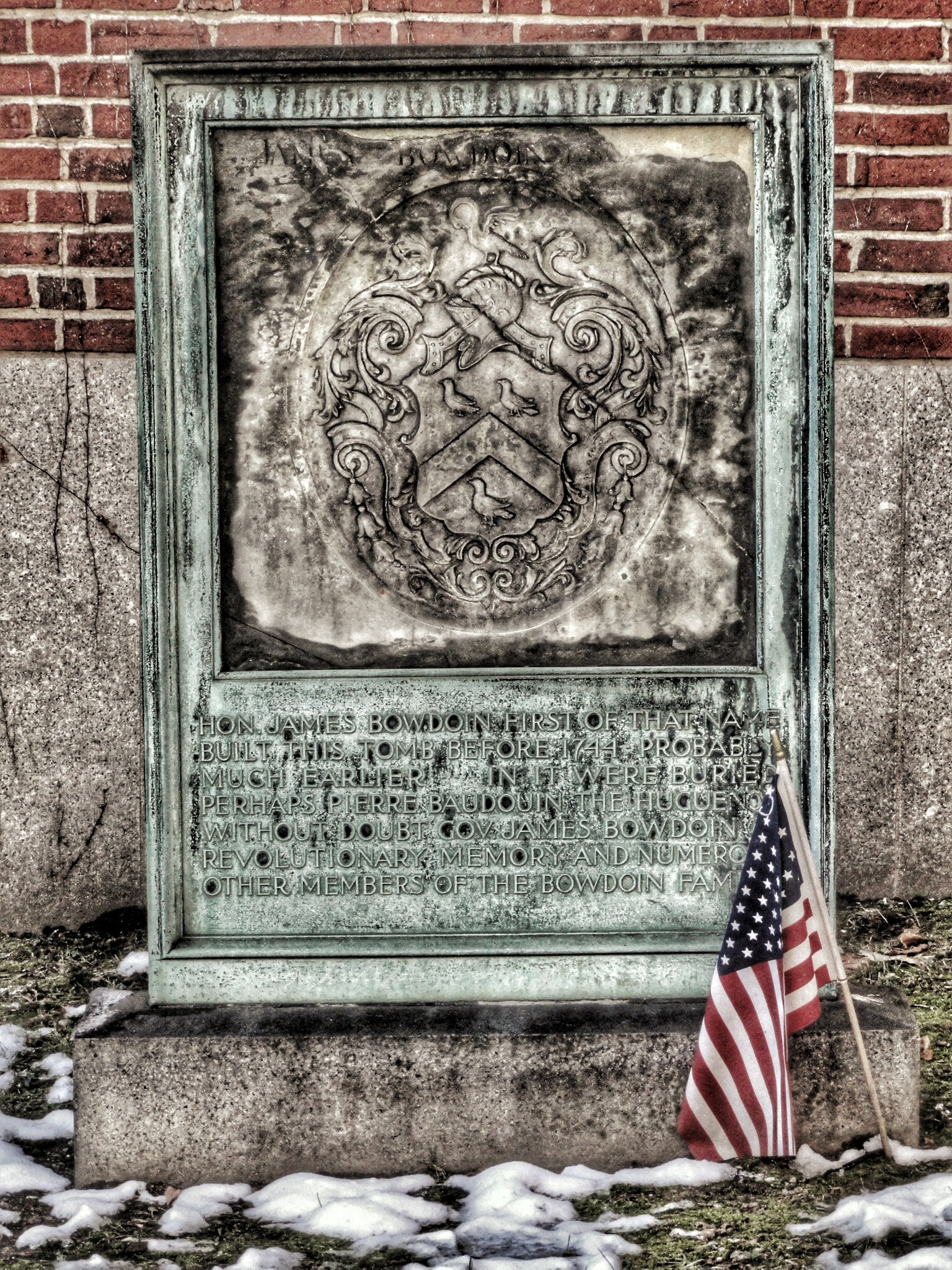
Bayard married Mary Bowdoin, and the couple were both eventually buried in the Bowdoin family tomb in the Granary Burying-Ground, shown here. Mary was a first cousin of Gov. James Bowdoin, commemorated on the plaque now affixed to that tomb.

Back to the Brazen Head. Here’s another advertisement from the 12 Nov 1739 Boston Evening-Post:
Just published,
An excellent SERMON on Regeneration, Preached to a numerous Audience, by George Whitefield, A.B. of Pembroke College, Oxford. Printed in London; Reprinted in Boston, and Sold by Charles Harrison, over-against the Brazen Head in Cornhill.
The eye-catching shop sign also meant that Jackson had less occasion to advertise his main business of brasswork. But, as was standard for Boston shopkeepers, he undertook to sell other things and needed to promote those goods. For example, the Boston Gazette for 23 June 1735 ran this notice:
JAMES JACKSON, Founder,
At the Sign of the Brasen Head in Cornhill Boston makes and sells all sorts of Founders’ Wares, also Mends, Tinns, Buys or Exchanges all sorts of Copper, Pewter, Brass, Lead or Iron by wholesale or retail. Likewise a two Wheel’d Chaise well finish’d, and lin’d with Scarlett broad Cloth, with a good Harness, also a Chair lin’d with red Morocco Leather, with a good Harness, and both new, to be Sold reasonably by said Jackson.
A couple of weeks later, on 7 July 1735, the New-England Weekly Journal announced:
Brown paper, TO BE SOLD, for ready Money, by James Jackson, at the Brazen Head in Cornhill, Boston.

P.S. There will be no more Brown Paper made at Mr. Fry’s Mill at Stroudwater, at Casco-Bay
Which brings us to papermaker Richard Fry, one of Massachusetts’s more contentious characters in the 1730s and ’40s.

TOMORROW: The controversies of Richard Fry.

Wednesday, December 26, 2018

“At the Brazen Head in Cornhill Boston”

One of the landmarks of pre-Revolutionary Boston was the Brazen Head—a carved head covered in bronze. It hung outside a shop near the center of town, right across from the Town House.

Earlier this year I found that several histories say the Sign of the Brazen Head was a tavern. Charles Warren did so in Jacobin and Junto (1931), and Carl Seaburg in Boston Observed (1971). More recent examples include webpages from the usually reliable Massachusetts Historical Society and the Adverts 250 Project.

I’m hoping to cut off that misconception. Dublin may have had a Brazen Head Tavern, but Boston didn’t. The bronze head hanging on Cornhill street in Boston was the shop sign of a family of braziers, or makers and sellers of brass hardware.

What’s more, that family went through a lot of drama over the course of the 1700s, so over the next few days I’ll start telling The Saga of the Brazen Head.

The first page of that story is an advertisement in the 27 Apr 1730 New-England Weekly Journal:
To be Sold by the Maker from London, a quantity of double refin’d hard metal Dishes and Plates, as also, sundry other things of the same metal, by Wholesale, or Retale, at Reasonable Rates, the Owner designing for London, in a Weeks time; to be seen at Mr. James Jackson, Founder, next Door to Mr. Stephen Beautineau in Cornhill, Boston.
It looks like Jackson was referring to himself as both the goods’ “Maker from London” and their “Owner designing for London.” In other words, he had brought Boston the metropolis’s best brasswork, was ready to sell it for good prices, and then planned to return home.

But something changed. On 10 September James Jackson married Mary Hunter in King’s Chapel. I haven’t found out anything more about her, unfortunately. If she wasn’t Anglican before, she was now.

On 22 Feb 1731, Jackson placed a new ad in the New-England Weekly Journal with no hint of impending departure:
Brass Pump Chambers and large Brass Cocks, and all sorts of Founders Ware Cast, made or mended, at reasonable rates, by James Jackson Founder from London near William’s Court in Cornhil Boston: Likewise Exchanges or buys old Copper, Brass, Pewter, Lead or Iron.
On 13 July, James and Mary Jackson baptized their first son William at King’s Chapel.

Jackson’s two advertisements located his place of business on Cornhill in central Boston, but I’m not sure if they specified different sites or the same site in different ways. By the time of his next ad, however, Jackson had settled on a shop location and found a way to make it stand out. In the 16 Dec 1734 Boston Gazette he announced in his largest notice yet:
James Jackson Founder from London, at the Brazen Head in Cornhill Boston, makes and sells all forms of Brass Work, as Brass Hearths, Stove Grates, Fenders, Tongs & Shovels, Andirons, Dogs, Candlesticks, Snuffers & Stands, Plate Warmers, Brass Knockers for Doors, all sorts of Brass Work for Coaches or Chaises, or for Saddlers, Casts Mortars large and small, Brass Chambers for Pumps, brasses for Mills or Cranes, brass Cock Gun Work, small Bells, or any other sort of Cast Work; also sells London made pewter and Brasiers Ware, Brass Kettles large and small, Brass and Copper Warming-pans, of the best sort, Copper Tea Kettles, Coffee pots, Chocolate pots, Boiling-pots, Stueing and Frying pans, brass Skillets, Chafing Dishes, Steel Tongs and Shovels, London and Country made Jacks, Box Irons, Flat Irons, brass Nails by the Thousand, Iron Nails, Files, Melting pots, Gun powder and Shot, Swords & Belts, Horse pistoles, Cabinet Work Chamber & Kitchen Bellows, and sundry other sorts of Brasiers Ware, also Buys or Exchanges, or mends any sort of Copper, Pewter, Lead or Iron, at Reasonable Rates.
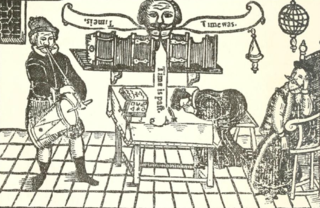
Using the symbol and name of the Brazen Head was a, well, brazen move for the Londoner. According to a legend that New England Puritans no doubt disdained, the thirteenth-century monk Roger Bacon had invented a “brazen head”—a mechanical head that answered any yes-or-no question. That device showed up in a popular Elizabethan comedy (as shown above), and Daniel Defoe’s 1722 Journal of the Plague Year stated that a brazen head was one of the common symbols of a fortune-teller.

For James Jackson, however, the shiny head probably just symbolized his brassware. And for the next forty years his Brazen Head shop would be a landmark near the center of Boston.

TOMORROW: A local landmark.