


J. L. BELL is a Massachusetts writer who specializes in (among other things) the start of the American Revolution in and around Boston. He is particularly interested in the experiences of children in 1765-75. He has published scholarly papers and popular articles for both children and adults. He was consultant for an episode of History Detectives, and contributed to a display at Minute Man National Historic Park.

Subscribe thru Follow.it


•••••••••••••••••


Showing posts with label William Samuel Johnson. Show all posts

Wednesday, December 08, 2021

“I fear’d young HAMILTON’S unshaken soul“
As David Humphreys and his fellow Hartford Wits composed the early installments of their Anarchiad, states were deciding whether to send delegations to a constitutional convention in Philadelphia.

The stated purpose of that convention was to revise the Articles of Confederation, but many people hoped—or worried—that the gathering might make very deep revisions indeed.

The Hartford Wits supported big change. Their fellow citizens of Connecticut were not so sure. The middle installments of the Anarchiad spent a lot of lines attacking James Wadsworth, state comptroller and a strong opponent of a new national constitution.

In March 1787 Humphreys wrote to his former boss George Washington that Connecticut might not send a delegation to Philadelphia at all. But most other states had committed by then, so the poets saw reason for optimism.

The 5 April installment of the Anarchiad depicted the villain Anarch lamenting his defeat, as in these lines:
Ardent and bold, the sinking land to save,
In council sapient as in action brave,
I fear’d young HAMILTON’S unshaken soul,
And saw his arm our wayward host control;
Yet, while the Senate with his accents rung,
Fire in his eye, and thunder on his tongue,
My band of mutes in dumb confusion throng,
Convinc’d of right, yet obstinate in wrong,
With stupid reverence lift the guided hand,
And yield an empire to thy wild command.
Allegorically this referred to New York’s choice to name a delegation, as Alexander Hamilton championed. The Hartford Wits thus lauded Hamilton’s political speeches in verse more than two centuries before Lin-Manuel Miranda.

On 12 May, Connecticut finally voted to send William Samuel Johnson, Oliver Ellsworth, and Erastus Wolcott to Philadelphia. Wolcott declined, citing fear of smallpox, so four days later the legislature chose Roger Sherman instead. Their mandate was “for the Sole and express Purpose of revising the Articles of Confederation.”

The Hartford Wits saw that as a win, and the Anarchiad lines published on 24 May expressed Hesper’s hopes for a better future. But there were still dire warnings about what might happen if people didn’t support significant change:
Yet, what the hope? The dreams of Congress fade,
The federal UNION sinks in endless shade;
Each feeble call, that warns the realms around,
Seems the faint echo of a dying sound;
Each requisition wastes in fleeting air,
And not one State regards the powerless prayer.

Ye wanton States, by heaven’s best blessings curst,
Long on the lap of softening luxury nurst,
What fickle frenzy raves! what visions strange
Inspire your bosoms with the lust of change,
And flames the wish to fly from fancy’s ill,
And yield your freedom to a monarch’s will?
The Anarchiad’s last installment appeared in September 1787 as the Constitutional Convention was wrapping up. Because of the body’s secrecy, no one yet knew the scope of the changes it would recommend. Sherman and Ellsworth had proposed the critical “Connecticut Compromise,” and Hamilton maneuvered to make the final vote appear unanimous.

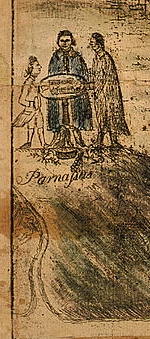
In November, the Connecticut government called a state convention to discuss whether to ratify the new and very different U.S Constitution. During that debate Amos Doolittle issued a year-end-review cartoon titled “The Looking Glass for 1787.” In one section it showed three Hartford Wits on a hill labeled “Parnassus” reading their “American Antiquities”—the supposed fragments of The Anarchiad. At least in Connecticut, they had been a prominent voice of the debate.

Wednesday, September 09, 2015

“Since we are doomed to Stamps and Slavery”

As I wrote yesterday, Jared Ingersoll opposed the Stamp Act as one of the Connecticut colony’s agents in London, but once the law passed he gladly accepted the job of collecting that tax.

In the summer of 1765, other Connecticut men tried to get in on the same action by telling Ingersoll they were ready to be his deputies for their parts of their colony. One such plea came from William Samuel Johnson (1727-1819, shown above), who wrote on 3 June:
Since we are doomed to Stamps and Slavery, & must submit, we hear with pleasure that your gentle hand will fit on our Chains & Shackles, who I know will make them set easie as possible. . . . .

If you propose to have a Subaltern in every Town, I shall be at your service for Stratford if it be agreeable.
Johnson also delivered and endorsed a similar request from Nathaniel Wales, Jr., of Windham, dated 1 June:
Notwithstanding my small acquaintance yet as I understand you are betrusted with the afair of the Stamp Duty I beg Leave to hint that if in ye. plan you should want a person in Each County town to dispose of Blanks or paper I should be glad to be improved for ye purpose, if it should suit you & you can confide in me; and as I keep an office in the Center and dont practise Riding abroad can doubtless serve you. 
But those men and others wrote their letters before New Englanders heard (in exaggerated form) about the Virginia Burgesses’ resolutions against the Stamp Act, and before Bostonians had their first public protest and riot on 14 August. Public sentiment shifted from resignation to resistance.

Five days after the disturbances in Boston, Wales wrote to Ingersoll again:
I receved yours and observe its Contence, and for answer must say that I wrote my first to you without much Consideration and while matters were much undigested both in my and other peoples minds; but on further Consideration I am of opinion that the Stamp Duty can by no means be Justifyed, that it is an imposition quite unconstitutional and so Infringes on Rather destroys our Libertys and previlidges that I Cant undertake to promote or Encorage it without acting dirictly Contrary to my Judgment and the true Intrest of my own native Country; and tho I would be a Loyal Subject yet that I may be & not Endeavour to promote that Law which in my privit Judgment is not Right, as ye case may be, I must therefore on the whole refuse accepting—if offered—any trust relative to Distributing the Stamps, nor would I accept thereof had I thousand pounds annexed to the trust. So that what trouble I have given you I must beg your pardon for
Wales wrote that letter a week before the people of Windham hanged and burned Ingersoll in effigy. For all we know, Wales might even have been involved in that demonstration—he was an active Whig by 1768.

Likewise, Johnson went on to represent Connecticut at the Stamp Act Congress, formed to protest the law he had once offered to administer. He sought compromise at the start of the Revolutionary War, which his neighbors found suspicious, but over time regained enough influence to be sent to the Constitutional Convention of 1787.

TOMORROW: The people of Connecticut are not satisfied.