J. L. BELL is a Massachusetts writer who specializes in (among other things) the start of the American Revolution in and around Boston. He is particularly interested in the experiences of children in 1765-75. He has published scholarly papers and popular articles for both children and adults. He was consultant for an episode of History Detectives, and contributed to a display at Minute Man National Historic Park.

Subscribe thru Follow.it


•••••••••••••••••


Showing posts with label Benedict Arnold. Show all posts

Saturday, February 14, 2026

“Appointed to the command of the Schooner Isabella”

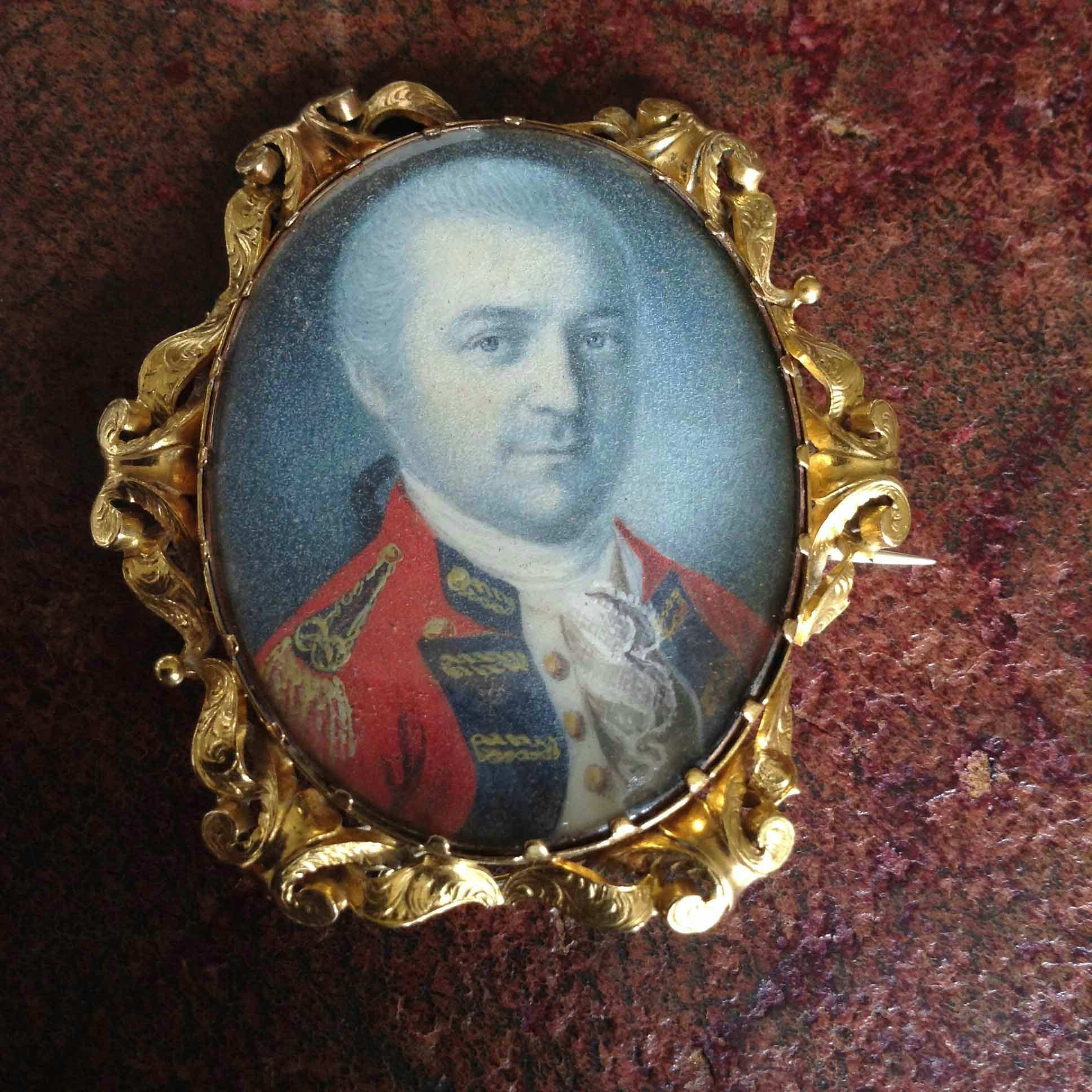
In the April 1776 letter from Capt. Hector McNeill to Col. Benedict Arnold (shown here) that I quoted yesterday is the line, “My William Farris is Saild for you I hope you will be kind to him.”

William Farris was twenty-three years old that year, having been born in Belfast in 1753. He came to Newburyport at the age of twelve. Then he went to sea.

In an 1832 pension application, quoted in John J. Currier’s History of Newburyport, Mass.: 1764-1905, Farris described what he did at the start of the war:
he was at Quebec as first officer of the Ship Mary Ann, belonging to Boston, in the summer of the year 1775, and there made arrangements with Captain Hector McNiel, and was under further engagement with him for a voyage and as first Officer of a vessel, in the Merchants service with him, and while thus engaged, and before the lading of the vessel, information was received of an expedition undertaken by General Arnold, in the service of the United States, who was then on his way through the woods.

To the best of his remembrance, General Arnold appeared with his Army in the month of November of that year [14 Nov 1775], and immediately thereupon a proclamation was issued by Lieutenant Governor Crambries [Hector Theophilus Cramahé] requiring every Individual in the City to take arms in its defence, or depart therefrom within three days, and declaring all who did not thus manifest their allegiance Rebels and Spies.

Your petitioner did not hesitate to make his election, but immediately procured a passport, leaving all his effects behind him, excepting only such few articles as were necessary for a change, and those contained in a single handkerchief, left the City, and proceeded to join the standard of his country, under General Arnold, who was then at about thirteen miles distance; he was favorably received by the General, and was immediately stationed by him at a place called Point aux Trembles, and there given in charge the care of several vessels, which had been captured from the British, and placed in a small creek at that place; from these vessels various articles which were considered useful and necessary for the American Army were selected and sent down from thence by land.

At this place he was stationed during the whole of the following Winter, having with him an officer from General Arnold’s Army, and a few soldiers, for the protection of this property. On the breaking up of the ice in the spring following, he was sent across the river to direct some Canadians, who were employed for that purpose, in making a number of sweeps, or large bars, for the use of gondolas, which were to be employed in transporting heavy cannon, and as soon as the Ice was sufficiently cleared away he was appointed to the command of the Schooner Isabella, one of the prises which had been captured from the British, mounting four carriage guns, and with this vessel was ordered for Montreal, as a transport, with supplies for the American army.

On arriving at said Montreal, it was found that General Arnold had been superceded in the command at Quebec [by Gen. David Wooster], and that information had been received of the arrival of a British fleet, upon which General Arnold immediately ordered all the materials which were considered useful and proper for the American Army to be selected, and these were laden and put on board the said Schooner, which was then under the command of your petitioner, and General Arnold, Colonel [Aaron] Burr, and several other officers of the American Army took passage in said Schooner with him and went down to the River Sorcel, where reinforcements for the Army were arriving, and at that place said Schooner was hauled in near the banks, and the General and all his officers continued on board several days, having no convenient place on shore for their accommodation.

When it became necessary to leave the said Schooner, there appearing no further use for her, or for the services of your petitioner at that place, he procured a passport from Colonel Burr, with which about the middle of June, 1776, he proceeded for the United States, with a view of entering the Navy, having been employed in the service of the United States, having the charge of said prises, and in the command of said Schooner, the full term of seven months.
I quote that at length because it offers a picture of the environment in which Capt. McNeill spotted the man he identified as Basile Boudrot.

In addition, Farris offers a link between McNeill, his mentor in Québec, and Newburyport, the port that Thomas Parsons had sailed from on his last voyage.

TOMORROW: Transporting the prisoner.

Friday, February 13, 2026

“He Now Passes by the Name of Dugan”

On 29 Aug 1775, Capt. Hector McNeill arrived in Québec on board another captain’s ship from Dominica. He brought false news of a battle at Roxbury where “most of the light horse were killed.”

Having been born in Ireland and raised in Boston, McNeill was then living in Québec with his daughters while carrying on trade with New England. His son Hector, Jr., based in Marblehead, had enrolled in Col. John Glover’s regiment.

A few months later, Col. Benedict Arnold and Gen. Richard Montgomery arrived at the walls of Québec with Continental troops. Lt. Gov. Hector Theophilus Cramahé ordered all able-bodied men to help defend the city or leave. The captain made his way to Arnold and started to carry supplies for the Continentals.

Though we usually tell the story of the American invasion of Canada with a climax and swift end in December 1775, the campaign went on for several more months, so McNeill had lots of work to do.

In the spring of 1776, the captain recognized a man aboard another ship, presumably also working for the Americans. On 25 April, McNeill at Pointe-aux-Trembles sent an urgent message to Col. Arnold, who was on the same island at Montréal:
This will be handed you by Major [Zachariah] Dubois, and is to Request the favour of you to Arrest, & Confine in Jail a certain acadian Whose proper Name is Basiell Boudrott, he Now Passes by the Name of Dugan and is the Mate of the Schooner Providence Commanded by Capt. Palmer,

I am bold to charge this fellow above named with the Murder of Capt. Thomas Parsons of Newbury Port, & his whole Crew at or near Cape St Mary’s in the Bay of Funda in the Month of March 177[2], I have been upon the look out for this chap ever Since & Now Providentially have found him, I am Sure he is the Principall of that gang of Villians who murderd Capt Parsons, & his crew, 9 in Number, & plundered first, afterwards burnt his Vessell—

I hope I need not urge you to Confine, & keep him close untill he can be Sent to New England, as Piracy, & Murder are Crimes which all good Men Should Endeavour to Prosecute & punish, I inclose you a Letter for the Owners of Capt Parsons his Vessell Which I beg you will read, Seal, & forward to the place of its distination—

My William Farris is Saild for you I hope you will be kind to him—as for your Capt Palmer—he has Sickened Me; of all Men to dispatch or manage affairs I Never Mett with worse hands then himself & his Lieut,—

I hear your wound is broke loose Which gives Me real Sorrow—you Must be Carefull of it or it may yet cost you dear

For heavens Sake do not Neglect to Secure the aforementioned Basiell Boudrot, for he is a Vile Murderer

May heavens preserve you in that Nest of Tory Scoundrels & grant you Wisdom & Fortitude to mannage them as they deserve
McNeill sent the same request to Gen. David Wooster. On 26 April, Wooster assured him: “I shall write Genl Arnold concerning the Acadien & also to arrest Palmer.”

TOMORROW: Sailing for Arnold’s army.

Monday, January 12, 2026

Online Lectures from the National Parks of Boston

The National Parks of Boston and the Boston Public Library are teaming up to offer some online lectures for the Sestercentennial.

The announcements of these events don’t names the speakers, but they’re usually N.P.S. rangers and other experts who have researched the topics thoroughly.

Wednesday, 14 January, 6 to 7:30 P.M.
Benedict Arnold: The Trials and Contributions of an Early Patriot
Register here

Before his name is booed across the land, Benedict Arnold was an avid supporter in the Patriot cause. In order for his name to be so reviled he first had to make an impact to the cause. This program will explore the contributions made by Benedict Arnold in the early stages of the Revolutionary War and shed light on the complexities of a man who has become synonymous with betrayal.

Wednesday, 28 January, 6 to 7:30 P.M.
In the Shadow of the Declaration: Boston’s Hidden Architects of American Freedom
Register here

Explore how the Declaration of Independence reshaped Boston by examining the experiences of communities often excluded from its promises. Look at how Black Bostonians organized and petitioned for freedom while women questioned their exclusion from political and social rights. Together, these perspectives reveal how independence sparked debates over who truly benefited from the Revolution, showing 1776 Boston as a place where the ideals of freedom were contested, expanded, and reimagined.

Wednesday, 25 February, 6 to 7:30 P.M.
“Donation People”: Refugees from the Siege of Boston
Register here

The talk will examine the experience of the poor and ill forced out of Boston during the 1775-1776 siege. The refugees, known as donation people, bore the brunt of the American Revolutionary war in Boston, yet their treatment by the people of Massachusetts represented a spirit of welfare in the new nation.

Wednesday, 11 March, 6 to 7:30 P.M.
The Siege of Boston: An Ending and Beginning
Register here

This talk will explore the Siege of Boston – its origins, impacts, and conclusion – and how the departure of the British Military from Boston would influence the pivotal year of 1776 and what became the Revolutionary War.

Wednesday, 25 March, 6 to 7:30 P.M.
Remembering Revolution: Protest and Celebration of the Bicentennial
Register here

This talk will explore how the Bicentennial was celebrated in Boston. Learn how through protest, reenactments, and celebrations, Bostonians claimed the legacy of the Revolution for themselves 50 years ago.

In addition, the central library’s exhibit “Revolution!: 250 Years of Art & Activism in Boston” is open to all in-person visitors through 21 April. “Featuring over 100 artworks and documentary materials from the Boston Public Library’s Special Collections…this exhibition brings to light both familiar and lesser-known stories about America’s ongoing struggle for freedom, civil rights, and belonging for all.”

Thursday, January 08, 2026

Lehman on “The Burning of New London” in Essex, Connecticut, 11 Jan.

I had a fine time speaking to the Essex Historical Society and guests in Connecticut last Sunday, and that Sestercentennial series of programs will continue this weekend.

On Sunday, 11 January, Eric D. Lehman will speak to the society on “The Burning of New London,” perhaps the most famous fight inside Connecticut during the Revolutionary War.

Lehman, author of Homegrown Terror: Benedict Arnold and the Burning of New London, will discuss the life of the complicated Connecticut native who led the September 6, 1781, attack on his home state. A force of 1,600 British soldiers and Loyalists captured Fort Griswold and burned down the town of New London. This dramatic story sheds light on the ethics of the dawning nation and the way colonial America responded to betrayal and terror.

Lehman is a professor of English at the University of Bridgeport and the author or editor of 22 books, including New England Nature, A History of Connecticut Food, and the award-winning Becoming Tom Thumb.

All the society’s Winter Lecture Series talks are free and open to the public in Hamilton Hall at the Essex Meadows community, 30 Bokum Road in Essex. Doors open at 3 P.M., with the talk scheduled to begin at 3:30. Seating is on a first-come, first-served basis, and the society asks attendees to register in advance.

Monday, December 08, 2025

Examining the American Attack on Québec

Even as Col. Henry Knox was moving cannon south from Lake Champlain, Gen. Richard Montgomery was besieging Québec.

The American Revolution Institute is offering two online events about that invasion this week, two hundred fifty years later.

Tuesday, 9 December, 6:30 to 7:30 P.M.
The Battle for the Fourteenth Colony
Mark R. Anderson

Anderson examines the American colonies’ efforts to bring Quebec into the Continental confederation and free Canadians from British “tyranny.” He offers new insight into the key political and military factors that ultimately doomed America’s first foreign war of liberation and resulted in the Continental Army’s decisive expulsion from Canada on the eve of the Declaration of Independence.

Mark R. Anderson is a retired U.S. Air Force officer, having earned his M.A. in military studies from American Military University, with a concentration in early American land warfare. He is the author of several books, including The Battle for the Fourteenth Colony: America’s War of Liberation in Canada, 1774–1776 (2013), The Invasion of Canada by the Americans, 1775–1776: As Told through Jean-Baptiste Badeaux’s Three Rivers Journal and New York Captain William Goforth’s Letters (2017), and Down the Warpath to the Cedars: Indians’ First Battles in the Revolution (2022).

Anderson will be speaking at the American Revolution Institute in Washington, D.C. Register for the livestream of his talk through this webpage.

Friday, 12 December, 12:30 to 1 P.M.
The Revolution’s First Winter: Loyalist Thomas Ainslie’s Account of the 1775 American Assault of Quebec
Thomas Lannon

With unrest spreading in the southern colonies, British leaders worried rebellion might cross into Canada. That fear was justified, and Canada figured prominently in the American strategy for an opening campaign in the Revolution. Congress authorized the invasion in 1775, with the expectation that French Canadians would embrace union with the colonies.

At the center of this Lunch Bite presentation is a letter authored by Quebec’s Collector of Customs, Thomas Ainslie, preserved in the institute’s collections. Ainslie’s recollections provide a reliable day-to-day record from inside Quebec City during the American siege until British reinforcements arrived. The presentation will also explore the crucial role Loyalists played in defending the city, the uncertain loyalties of French Canadians, and the constant British fear that revolutionary fervor might spill over the border.

Lannon is the institute’s library director. Sign up to hear his virtual presentation here.

Tuesday, September 16, 2025

Commemorating the 1775 Expedition to Québec in Newburyport

This weekend the town of Newburyport will commemorate the 250th anniversary of when Col. Benedict Arnold and his Continental volunteers passed through the town on their way to Québec.

There are multiple events on the schedule. It looks like the Custom House Maritime Museum at 25 Water Street is the main base, open 10 A.M. to 4 P.M. all three days, but the Museum of Old Newbury and several churches are involved.

Friday, 19 September, 12 noon
Newburyport’s Bells Ring Out!

Three of the town’s oldest churches will ring their bells to herald the coming of the Continental troops.

Friday, 19 September, 7 to 8:30 P.M.
Through a Howling Wilderness: 1775 March to Quebec
Tom Desjardin
St. Paul’s Church, Newburyport

In September 1775, Arnold commanded eleven hundred Colonial soldiers on a daring, top-secret mission: to march and paddle nearly 200 miles through the untamed wilderness of Maine and Quebec to seize British-held Quebec City. It was a journey marked by hypothermia, disease, starvation, hurricanes, and blizzards. Dozens perished; survivors endured eating everything from dogs to lip salve before reaching their target. Though the attack ultimately failed, Arnold’s expedition helped pave the way for America’s eventual victory. Through a Howling Wilderness tells this gripping story of endurance, sacrifice, and leadership before Arnold’s name became synonymous with treason.

Tom Desjardin holds a Ph.D. in U.S. History and is the author of multiple acclaimed books. A former archivist and historian at Gettysburg National Military Park, he has taught at Bowdoin College, advised film and television productions (including Gettysburg and Gods and Generals), and appeared on the History Channel, A&E, Discovery, PBS, and CSPAN. He is a former Commissioner of Education for Maine and director of the Maine Bureau of Parks and Lands.

Saturday, 20 September, 10 A.M. to 4 P.M.
Revolutionary Living History Experience: Bringing 1775 to Life
Downtown Newburyport

A special one-day living history event featuring reenactors, tactical demonstrations, and engaging historical interpretation, this immersive celebration brings 1775 to life and honors the city’s pivotal role in America’s fight for independence. The day’s schedule will begin with Col. Arnold reviewing his troops. He will address them about their orders at around 3:30 P.M.

Saturday, 20 September, 10:30 A.M.
A Moment of Resolve: Reenactment of the Dedication Service
First Parish Church, 20 High Road

Commemorate the 250th anniversary of the Quebec Expedition with a powerful reenactment of the 1775 dedication service for departing troops. Reverend Samuel Spring, portrayed by Edward Speck, delivers the historic sermon that inspired courage and faith, honoring the spiritual strength that sustained Newburyport’s patriots on their journey to liberty.

Saturday, 20 September, 11 A.M. to 4 P.M.
Revolutionary Newburyport
Museum of Old Newbury, 98 High Street

Tours starting every hour highlight objects linked with the American Revolution not usually on display. Buy tickets and reserve spaces through this page.

Saturday, 20 September, 1:00 P.M.
DAR America 250 Patriots Marker Dedication
Old South Presbyterian Church, 29 Federal Street

The Brigadier General James Brickett–Old Newbury Chapter, N.S.D.A.R., will dedicate an America 250 Patriots Marker in Newburyport. This ceremony honors Revolutionary War patriots with reflections from civic leaders and descendants, preserving their legacy for generations to come.

Saturday, 20 September, 1:30 P.M.
Walk to the River: A Tribute to Newburyport’s Revolutionary Departure
Federal Street to Water Street

Following the dedication of the America 250 Patriots Marker, attendees are invited to join a commemorative walk through downtown Newburyport to the riverfront. The walk will conclude near the original embarkation site with brief remarks honoring the 1775 departure of local patriots on their daring expedition to Quebec.

Saturday, 20 September, 2 to 4 P.M.
Discover Your Family’s Story: Genealogy Drop-in Clinic
Museum of Old Newbury, 98 High Street

Discover your roots and deepen your community connection at this engaging genealogy workshop. Participants will learn how to trace family history, uncover ancestral ties to early settlers and patriots, and explore Newburyport’s revolutionary and colonial past. Trained genealogists will be available to assist with family history research.

Sunday, 21 September, 10:00 A.M.
Burying Ground Tour: Old Hill and Newburyport’s Road to Revolution
Old Hill Burying Ground, 25 Greenleaf Street

Join Newburyport historian Ghlee Woodworth on a captivating cemetery tour honoring Revolutionary War patriots. Explore gravestones, hear stories of bravery and sacrifice, and discover how these local heroes shaped America’s fight for independence. A fascinating journey connecting past to present through tales of courage, resilience, and Newburyport’s rich revolutionary heritage.

Sunday, 21 September, 11 A.M. to 4 P.M.
Revolutionary Newburyport
Museum of Old Newbury, 98 High Street

Tours starting every hour highlight objects linked with the American Revolution not usually on display. Buy tickets and reserve spaces through this page.

Sunday, 21 September, 1 P.M.
Faith and Freedom: Old South Presbyterian Church and the Revolution
Old South Presbyterian Church, 29 Federal Street

Explore Old South Presbyterian Church and uncover its rich Revolutionary War history on this guided tour. Learn about its role in 1775 as a gathering place for patriots, hear stories of prominent figures connected to the church, and discover how faith and freedom intertwined in Newburyport’s fight for independence.

Sunday, 21 September, 3 P.M.
The 1775 Quebec Expedition from Newburyport: Following Their Footsteps
Central Congregation Church, 14 Titcomb Street

On September 19, 1775, over 1,100 men departed Newburyport on a secret mission to capture Quebec—led by Benedict Arnold and planned with George Washington. Join Jack Santos as he recounts the stories of Newburyport’s patriots on this daring expedition through the wilderness as we celebrate its 250th anniversary.


Monday, July 07, 2025

“The Colony of Connecticut must raise 6,000”

As I quoted last week, on 23 Apr 1775 the Massachusetts Provincial Congress resolved to raise an army of 30,000 men, 16,400 of them coming from outside the province.

In this Journal of the American Revolution article from last year, I discussed how early in 1775 the congress had set up liaisons with the governments of Connecticut, Rhode Island, and New Hampshire in case war broke out.

The Massachusetts Patriots had alerted their colleagues in those colonies about the fighting on 19 April. And now they asked for troops.

In Connecticut, Gov. Jonathan Trumbull supported the Patriots. As soon as he heard the news from Lexington, he agreed to call the legislature into session to take official action. On 21 April, William Williams, the Connecticut assembly speaker and Trumbull’s son-in-law, wrote with two other politicians to the Massachusetts congress:
Every preparation is making to Support your Province— . . . the Ardour of Our People is such that they can’t be kept back;—The Colonels are to forward part of the best men & most Ready, as fast as possible; the remainder to be ready at a Moments warning
Some militia officers were already on the move. Israel Putnam was in Concord on 21 April as the Massachusetts congress met. He wrote back:
I have waited on the Committee of the Provincial Congress, and it is their Determination to have a standing Army of 22,000 men from the New-England Colonies, of which, it is supposed, the Colony of Connecticut must raise 6,000, and begs they would be at Cambridge as speedily as possible, with Conveniences; together with Provisions, and a Sufficiency of Ammunition for their own Use.
Col. Benedict Arnold and his volunteers left New Haven on 22 April and arrived in Cambridge one week later. On 23 April a letter from Wethersfield to New York said:
We are all in motion here, and equipt from the Town, yesterday, one hundred young men, who cheerfully offered their service; twenty days provision, and sixty-four rounds, per man. They are all well armed, and in high spirits. . . . Our neighbouring Towns are all aiming and moving. Men of the first character and property shoulder their arms and march off for the field of action. We shall, by night, have several thousands from this Colony on their march. . . .

We fix on our Standards and Drums, the Colony Arms, with the motto, “qui transtulit sustinet,” round it in letters of gold, which we construe thus: “God, who transplanted us hither, will support us.”
On 27 April the Connecticut legislature voted to enlist 6,000 soldiers—six regiments of about a thousand men each. Joseph Spencer was appointed general of this army with Putnam next in seniority. (David Wooster remained in Connecticut to oversee defending its coast or New York as needed.)

Notably, Connecticut asked men to enlist in its army only until 10 December, not the end of the year as other New England colonies did. That became a problem when December rolled around and lots of Connecticut companies wanted to leave early (as Gen. George Washington viewed it) or on time (as their enlistment papers said). I discussed that conflict back here.

TOMORROW: Rhode Island’s observers.

Thursday, March 27, 2025

The Short Military Career of Lt. Col. Thomas Williams, Jr.

The Journal of the American Revolution just published Tim Abbott’s article about Lt. Col. Thomas Williams, Jr. (1746–1776), of Stockbridge.

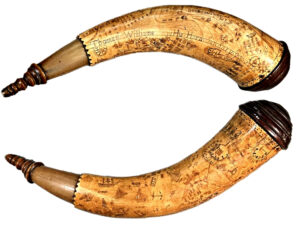
Williams left behind an engraved powder horn, now in the collection of the Stockbridge Library Museum and Archives. It shows Boston landmarks.

(This is different from the Dr. Thomas Williams powder horn recorded by Rufus Alexander Grider in 1888 and now lost.)

The siege lines around Boston contained some professional horn carvers selling their work to men who wanted souvenirs of military service. I suspect the Williams horn is one like that. As an officer and as a lawyer in civilian life, he probably didn’t have the time or inclination to do his own carving.

As Abbott’s article recounts, Williams was one of two minute company captains who responded to the Lexington Alarm from Stockbridge. The other company included a score of men from the town’s Native community and thus gets more attention.

As the troops besieging Boston organized themselves into an army enlisted through the end of the year rather than an emergency militia force, Williams became part of Col. John Paterson’s regiment. In September he volunteered for Col. Benedict Arnold’s expedition through Maine to Québec.

However, Williams was in the rear guard led by Lt. Col. Roger Enos (1729–1808), who in late October decided to turn back. That was controversial. Enos was tried and acquitted in a court-martial. He was probably lucky to go through that procedure before the army at Cambridge received “Colonel Arnolds evidence,” as Gen. George Washington reported.

Williams left Paterson’s regiment at the end of 1775, but on 9 Jan 1776 he became lieutenant colonel of a new regiment under Col. Elisha Porter to be sent up to Québec along Lake Champlain and the St. Lawrence River. This time Williams made it to the outskirts of the city, but smallpox was weakening the Continental forces.

Those Americans were trying to inoculate and fight the war at the same time. Abbott writes:
The timing for the deliberate exposure of Porter’s Regiment to smallpox could not have been worse. The inoculation process required effective quarantine for three to four weeks, during which the men were both weak and contagious. Even for those under treatment, severe cases could still develop and mortality rates under the best conditions still ran 1 to 2 percent. Porter’s men had no more than three days in hospital after they were inoculated before the siege was dramatically lifted by the arrival of a British fleet on May 6 and the American forces were soon driven back upriver in full retreat. Not only were they exposed to physical stress while they developed smallpox symptoms, but they became a significant vector for the spread of the disease to others in its more deadly form.
The American commander, Gen. John Thomas, died on 2 June. Lt. Col. Williams led his men back to Crown Point, New York, before falling ill. He didn’t make it home to Stockbridge.

Williams doesn’t appear to have left behind his own diary or letters—his powder horn might have been his only personal record of military service, and it probably wasn’t his own creation. Abbott has therefore done the work of reconstructing his career by weaving together official records and other officers’ accounts.

Thursday, January 02, 2025

The Many Books of James Kirby Martin

This week brought the news that James Kirby Martin has died at the age of eighty-one.

Earning his doctorate at the University of Wisconsin, which used to have a huge American history department, Martin taught at Rutgers before moving to the University of Houston.

In 2018, more than thirty years later, he retired as the Hugh Roy and Lilli Cranz Cullen University Professor of History. He’d held visiting appointments along the way, of course.

When I started researching the actual war part of the Revolution, I knew I was going to use James Kirby Martin’s books. His biography Benedict Arnold, Revolutionary Hero: An American Warrior Reconsidered is an excellent scholarly dig into well-trodden ground, and his edition of Joseph Plumb Martin’s memoir, titled Ordinary Courage, is probably the best.

Martin and Mark Edward Lender wrote A Respectable Army: The Military Origins of the Republic, 1763-1789, as well as Drinking in America: A History, 1620-1980, and they edited Citizen Soldier: The Revolutionary War Journal of Joseph Bloomfield.

Then I found Martin was also coauthor with Joseph T. Glatthaar of Forgotten Allies: The Oneida Indians and the American Revolution. Collaboration seems to have been one of his skills.

And those are just some of his books. His oeuvre extends from Men In Rebellion: Higher Governmental Leaders and the Coming of the American Revolution to Insurrection: The American Revolution and Its Meaning, as well as edited collections. One of his retirement projects was a novel written with Robert Burris about an entirely different period of history.

At the time of his death, Martin was still working. His Revolutionary War projects included a book about Fort Ticonderoga and a study of just war theory. I hope collaborators can complete those projects.

It wasn’t till after I’d read some of James Kirby Martin’s books that I had the pleasure of meeting him at a conference produced by America’s History, L.L.C. Later I also saw him at the Fort Plain Museum conference. Because he studied the actual war part of the Revolution, Jim Martin knew that his work attracted a lot of interest outside the academy, and he was happy to chat with readers and researchers from all walks of life. We’ll miss him.

Thursday, November 14, 2024

“You will have doubtless have an account of their surprizing Ticonderoga”

One striking feature of Richard Lechmere’s 22 May 1775 letter to Henry Seymour Conway, partially transcribed here, is how well informed the Loyalist merchant was about events outside besieged Boston.

Lechmere wrote to the British politician:
you will have doubtless have an account of their surprizing Ticonderoga in which Fort, there was upwards of One hundred pieces of Cannon, and some Mortars, these they are bringing down, and a Considerable train are expected to arrive from Providence to Morrow...
Col. Ethan Allen had led the takeover of Fort Ticonderoga on 10 May, only twelve days before. Lechmere not only had that news, but also an estimate of how many artillery pieces the rebels would find there.

Lechmere understood that ordnance was to be brought to the siege lines around Boston. The Massachusetts committee of safety’s orders for Col. Benedict Arnold also stated that possibility. It wasn’t some wild brainstorm of Henry Knox later in the year.

The letter also refers to “a Considerable train…from Providence.” On 8 May the Rhode Island government had commissioned John Crane as a captain of an artillery company. However, he brought only four small cannon to the siege lines. Those weren’t “Considerable,” even by Rhode Island standards, though they did double the number of brass artillery pieces available to the Continentals. Most artillery in Rhode Island was, I suspect, being held back for privateering.

But that wasn’t all Lechmere had heard about. He had heard news from Pennsylvania:
Mr. [Benjamin] Franklyn & General [Charles] Lee are Arriv’d at Philadelphia the former chosen a Delegate to the Congress & most probably the Latter may be appointed Generalissimo of the Rebel Army. Birds of a feather flock together
Lechmere probably had only a dim awareness, if any, of George Washington from Virginia. Lee, on the other hand, was a celebrated veteran of the British army who had come through Massachusetts the previous year. Lechmere wasn’t the only contemporary to mention him as a candidate to be commander-in-chief.

Monday, September 09, 2024

Reardon on Benedict Arnold’s New London Raid, 10 Sept.

Matthew Reardon will speak at the Ledyard, Connecticut, Public Library on 10 September about his new book, The Traitor’s Homecoming: Benedict Arnold’s Raid on New London, Connecticut, September 4-13, 1781.

The background:
By 1781, the war in North America had reached a stalemate. Throughout the summer the combined Franco-American armies of Generals George Washington and Jean-Baptiste comte de Rochambeau deceived British General Sir Henry Clinton into believing they were about to lay siege to New York City. When in fact, they were moving south toward Yorktown, Virginia, in a bid to trap Lord Cornwallis’ army against the sea.

Clinton, falling for the deception, dispatched former American General Benedict Arnold to attack New London, hoping the move would derail militia reinforcements and supplies headed from Connecticut to the allied armies outside New York City, as well as destroy the privateers which operated out of its harbor.

Situated in southeastern Connecticut, New London was the center of the state’s wartime naval activities. State and Continental naval vessels operated out of its harbor, which doubled as a haven for American privateers. Arnold landed on September 6 and, in a textbook operation, defeated local militia, took possession of the town, harbor, and forts, and set New London's waterfront ablaze.

But that is not how it is remembered. The Connecticut governor’s vicious propaganda campaign against the British and Arnold, who was already infamous for his treachery, created a narrative of partial truths and embellishments that persist to this day. As such, most of the attention remains on the bloody fighting and supposed “massacre” at Fort Griswold. There is much more to the story.
Based on years of research, this book dismantles myths that have cemented around Arnold’s raid and offers a major reinterpretation of what’s significant about it.

Matthew Reardon is a native of northeastern Connecticut with degrees from Sacred Heart University. He served as executive director of the New England Civil War Museum & Research Center for more than fifteen years. He currently works as a middle school teacher in Vernon and serves as a command historian for the Connecticut Military Department.

Thursday, March 07, 2024

Fort Plain Museum’s 2024 Conference in the Mohawk Valley, 14–16 June

The Fort Plain Museum’s Revolutionary War Conference 250 in the Mohawk Valley will take place this year on 14–16 June in Johnstown, New York. Registration is open.

The scheduled speakers are:
  • James Kirby Martin and guest host Mark Edward Lender having a fireside chat about the American Revolutionary War, its Sestercentennial, and their legacies as historians
  • Nancy Bradeen Spannaus, “Alexander Hamilton’s War for American Economic Independence Through Two Documents” (supported by the Alexander Hamilton Awareness Society)
  • Gary Ecelbarger, “‘This Happy Opportunity’: George Washington and the Battle of Germantown”
  • Shirley L. Green, “Revolutionary Blacks: Discovering the Frank Brothers, Freeborn Men of Color, Soldiers of Independence”
  • Mark Edward Lender, “‘Liberty or Death!’: Some Revolutionary Statistics and Existential Warfare”
  • Shawn David McGhee, “No Longer Subjects of the British King: The Political Transformation of Royal Subjects to Republican Citizens, 1774-1776”
  • James Kirby Martin, “The Marquis de Lafayette Visits the Mohawk Valley, Again and Again”
  • Kristofer Ray, “The Cherokees, the Six Nations and Indian Diplomacy circa 1763-1776”
  • Matthew E. Reardon, “The Traitor’s Homecoming: Benedict Arnold’s Raid on New London, September 4-13, 1781”
  • John L. Smith, “The Unexpected Abigail Adams: A Woman ‘Not Apt to Be Intimidated’” (supported by the Dr. Joseph Warren Foundation)
  • Bruce M. Venter, “Albany and the Stamp Act Crisis of 1765”
  • Glenn F. Williams, “No Other Motive Than the True Interest of This Country: Dunmore’s War 1774”
  • Chris Leonard, Schenectady City Historian, “Storehouse Schenectady: Depot and Transportation Center for the Northern War”
  • David Moyer, “Recent Archaeology Discoveries on the Site of Revolutionary War Fort Plain”
There will also be a bus tour of Revolutionary sites in the area with the theme of “1774: The Rising Tide.” In that year Schenectady saw a violent Liberty Pole riot while the British Indian agent Sir William Johnson passed away in July.

For more information, visit this page.

Wednesday, March 06, 2024

The Eleventh America’s History Conference on the Revolution, 15–17 Mar.

America’s History, L.L.C., is hosting its eleventh annual conference on the American Revolution on 15–17 March.

In past years this gathering has brought history buffs to Williamsburg, Virginia, but the 2024 conference will be at the Virginia Crossings Hotel in Glen Allen, close to Richmond.

The speaker lineup, recruited by head of faculty Edward G. Lengel, includes:
  • Mark R. Anderson, “Down the Warpath to the Cedars: Indians’ First Battles in the Revolution”
  • Friederike Baer, “Incomprehensible Friends and Rebellious Enemies: German Soldiers in the American Revolutionary War”
  • Brooke Barbier, “King Hancock: The Radical Influence of a Moderate Founding Father”
  • Stephen Brumwell, “Turncoat: A Fresh Interpretation of Benedict Arnold and the Crisis of American Liberty”
  • Iris De Rode, “A New Perspective on the Yorktown Campaign: Revelations of the Unpublished Private Papers of François-Jean de Chastellux”
  • William Anthony Hay, “‘We Live on Victory’: British Military Strategy and Decision-Making in the American Revolution, 1774-1781”
  • Ricardo “Rick” Herrera, “Projecting Power Continental Army Style: George Washington and the Armed Camp at Valley Forge”
  • Paul Lockhart, “Drillmaster of the Revolution: The Baron de Steuben and the Making of the American Army”
  • Daniel Murphy, “The Revolutionary War’s Other Cavalryman: William Washington, America’s Light Dragoon and the Myths of Hobkirk’s Hill”
  • Kevin J. Weddle, “America’s Turning Point: Leadership in the Saratoga Campaign of 1777”
That’s a range of authors with some excellent books, new and old. There will also be a tour of Revolutionary sites in Goochland County led by Dr. John Maass, historian at the new National Museum of the U.S. Army at Fort Belvoir.

For more information and to register, go to this site.

Tuesday, February 06, 2024

Two Online Archeology Events on 15 Feb.

Two online events about archeology are coming up next Thursday, 15 February.

The Lake Champlain Maritime Museum will host its third annual Virtual Archaeology Conference that afternoon from 1:00 to 4:00 P.M., with staff speaking about various work going on at and around the museum.

The scheduled presentations are:
  • Patricia Reid, “Legacy Collection: Leege Collection Artifacts from Arnold’s Bay”
  • Cherilyn Gilligan, “Arnold’s Bay Artifacts: Conservation and Context”
  • Chris Sabick, “The Excavation and Documentation of the Revolutionary War Row Galley Congress
  • Paul Gates, “Site Formation Processes: Defining the Theoretical Process of Archaeology for the Revolutionary Warship Congress
Those will be followed by a live question-and-answer session.

Go to this webpage for more details on the museum’s program and to register.

That same evening, starting at 7:00 P.M., the Shirley-Eustis House Association will host an online lecture by Boston City Archaeologist Joe Bagley on “Archaeology at Shirley Place.”

Bagley will share new information learned about the eighteenth-century enslaved inhabitants of the estate and new insights into the former location of the 1747 Shirley-Eustis House. The presentation will include artifact discussions and digital reconstructions of the historic property before it was developed in the nineteenth century.

Go to this page to register for the Shirley-Eustis House’s event.

Both of these online events are free, but donations to the hosting organizations are welcome.

Wednesday, August 02, 2023

“To pass unmolested into the town of Boston”

On Sunday, 30 April, the Massachusetts committee of safety:
  • heard from Col. Benedict Arnold of Connecticut about artillery up along Lake Champlain.
  • ordered Maj. Timothy Bigelow to move weapons from Worcester to the siege lines.
  • hired an express rider.
  • urged its subcommittee of Azor Orne, Richard Devens, and Benjamin White to “form a plan for the liberation of the inhabitants” of Boston now that Gen. Thomas Gage was allowing them to leave.
So this committee wasn’t idle.

Probably after being stung by the letter from the Massachusetts Provincial Congress quoted yesterday, the committee appointed its chair, Dr. Joseph Warren, along with Joseph Palmer and Orne, to take their resolution out to that body in Watertown.

The committee’s recommendation was:
Whereas, proposals have been made by General Gage to the inhabitants of the town of Boston, for the removal of their persons and effects into the country, excepting their arms and ammunition:

Resolved, that any of the inhabitants of this colony, who may incline to go into the town of Boston with their effects, fire-arms and ammunition excepted, have toleration for that purpose, and that they be protected from any injury or insult whatsoever. This resolve to be immediately published.

The following orders were delivered to Col. Samuel Gerrish:
You are hereby empowered, agreeably to a vote of the Provincial Congress, to grant liberty, that any of the inhabitants of this colony, who may incline to go into Boston with their effects, fire-arms and ammunition excepted, have toleration for that purpose; and that they be protected from any injury or insult whatsoever, in their removal to Boston.

The following form of a permit is for your government, the blanks in which you are to fill up with the names and number of the persons, viz.:
Permit A. B., the bearer hereof, with his family, consisting of persons, with his effects, fire-arms and ammunition excepted, to pass unmolested into the town of Boston, between sunrise and sunset. By order of the Provincial Congress.
Dr. Warren signed that report “clerk pro tem.,” indicating he had taken on yet another job.

The committee of safety addressed only the question of how to reciprocate to Gen. Gage’s decision and let Loyalists enter Boston. It left the bigger question of how to help refugees who had left their homes in that town up to the congress.

The provincial congress made some amendments to the committee’s recommendation, so this is what went out officially:
In PROVINCIAL CONGRESS, Watertown, April 30, 1775.

Whereas an agreement has been made between General Gage and the inhabitants of the city of Boston, for the removal of the persons and effects of such of the inhabitants of the town of Boston, as may be so disposed, excepting their fire arms and ammunitions into the country:

RESOLVED, That any of the inhabitants of this colony, who may incline to go into the town of Boston with their effects, Fire-Arms and Amunitions excepted, have toleration for that purpose; and that they be protected from any injury and insult whatsoever, in their removal to Boston, and that this resolve be immediately published.

P. S. Officers are appointed for the giving permits for the above purposes; one at the sign of the Sun at Charlestown, and another at the house of Mr. John Greaton, jun. at Roxbury.

Ordered, That attested copies of the foregoing resolve be forthwith posted up at Roxbury, Charlestown and Cambridge.

Resolved, That the resolution of Congress, relative to the removal of the inhabitants of Boston, be authenticated, and sent to the selectmen of Boston, immediately, to be communicated to general Gage, and also be published in the Worcester and Salem papers.

Ordered, That Doct. Taylor, Mr. Bailey, Mr. Lothrop, Mr. Holmes and Col. Farley, be a committee to consider what steps are necessary to be taken for the assisting the poor of Boston in moving out with their effects to bring in a resolve for that purpose; and to sit forthwith.
The congress delegates, having given up their whole Sunday waiting for the committee, then adjourned for the day.

By the time the congress’s resolve was published in the 3 May Massachusetts Spy, the Rev. John Murray had stepped down as its president pro tempore and James Warren of Plymouth had declined the post. So the resolution was published over the name of the new president pro tem., Dr. Joseph Warren. As if he didn’t already have plenty to do.

TOMORROW: Spreading out the refugees.

Tuesday, February 07, 2023

“To transport these Men to Kennibeck”

When Dr. Benjamin Church wrote his intelligence report on 24 Sept 1775, the latest big event along the Continental lines was the departure of volunteers heading north.

Those men were under the command of Col. Benedict Arnold (shown here), respected for his part in taking Fort Ticonderoga and other Crown positions along Lake Champlain.

Church knew Arnold. In fact, the doctor had been the ranking member of the Massachusetts Committee of Safety who had signed Arnold’s orders for that mission to Ticonderoga on 3 May. In August he headed the committee to review the colonel’s expenses, an interaction that didn’t go so smoothly. (Ironic moments, since Church was already supplying the Crown with secrets and Arnold would do so later.)

In late August, Arnold met with Gen. George Washington and gained approval for a quick thrust through Maine to Québec, meeting up with Gen. Richard Montgomery’s force advancing from New York. The commander’s general orders for 5 September called for “such Volunteers as are active woodsmen, and well acquainted with batteaus,” to march under Arnold’s command. About a thousand men responded, and most of them left Cambridge on 13 September.

Although the destination of that column was supposed to be secret, lots of people suspected. For example, on 13 September Jesse Lukens, a volunteer from Pennsylvania, wrote:
Col. Arnold having chosen one thousand effective men, consisting of two companies of riflemen, (about one hundred and forty,) the remainder musqueteers, set off for Quebec, as it is given out, and which I really believe to be their destination. I accompanied on foot as far as Lynn, nine miles.
Starting on 20 September, newspapers in New York and Philadelphia reported on Arnold’s departure for Québec, citing reports from Cambridge. New England newspapers were more cagy about his destination, but the secret was out.

Dr. Church mentioned the overall Canada campaign three times in his letter, starting with the second sentence and ending just before his request for money:
The fifteen hundred Men that you had news of going to Quebec are going to Halifax (I believe) to destroy that place, . . .

An Express from Ticondiroga, says that they had been Ambushed but foursed their way through with the loss of 13 Men and they on their advancing forward found on the ground ten Indians dead, that the Army was within one Mile and a half of St. Johns, on which they sent a party of Men to Cut of the Communication between Montreal and the Fort. . . .

The Vessells I mentioned that was fiting at Salem was to transport these Men to Kennibeck as I find since, I am not Certain they are gone to Halifax but it is thought and believed they are.
This letter shows that even the British commanders inside Boston had received word of “fifteen hundred Men…going to Quebec” and asked Church about it. But the doctor suspected they were headed to Nova Scotia. When he began this dispatch he was certain about that; by the end, he wasn’t so sure but still thought that was most likely.

In fact, the Continental generals had talked about an attack on Halifax. Immediately after hearing about the shortage of gunpowder on 3 August, Washington and his council of war discussed raiding Crown outposts with powder stores. Col. John Glover leased a schooner called the Hannah.

By mid-September, however, plans had changed. Washington had ordered the Hannah to try attacking British supply ships instead. He wrote to the merchant Nathaniel Tracy to arrange for several more ships to carry Arnold’s one thousand men from Newburyport up to the mouth of the Kennebeck River.

Church’s expectation of an attack on Halifax might have been accurate at one point, but not any longer.

COMING UP: More details from the Continental camp.

Saturday, December 10, 2022

Keagle on “Henry Knox” in Lake George, 19 Dec.

On Monday, 19 December, the Lake George Battlefield Park Alliance and the Warren County Historical Society will host a talk on “Henry Knox and the Hunt for Heavy Artillery” by Dr. Matthew Keagle, Curator at the Fort Ticonderoga Museum.

The event description says:
Keagle will explore the Continental Army’s need for heavy cannon in 1775 and how it informed not only Henry Knox’s famous 300-mile expedition from Ticonderoga to Boston, but the broader plans for the campaign of 1775 in the Lake George and Lake Champlain region.

The presentation will explore questions such as: did Knox think up the plan to get cannon from Fort Ticonderoga? did he strip the fort of its artillery? and how did Benedict Arnold aid Knox’s efforts and anticipate the Continental Army’s ongoing needs?
This may be a spoiler, but the answers to the first and third questions are related.

This program will begin at 7:00 P.M. at the Holiday Inn Lake George, 2223 Canada Street. It is free and open to the public. To register for a seat, email info@lakegeorgebattlefield.org.

Saturday, August 20, 2022

The Details in the Devil

For the Washington Post, University of Delaware history professor Zara Anishanslin wrote about the roots of far-right accusations that the Devil is involved in American politics reach down deep to the Revolutionary protest movement.

Devils were a crucial element of American protests against the Stamp Act, including the August 1765 effigies hanging from what became Liberty Tree, the subsequent processions modeled on that event in other colonies, and even Isaiah Thomas’s little stamps on the Halifax Gazette.

I’d push that form of politics back even further because the Stamp Act protest borrowed imagery from New England Pope Nights, which always included the Devil and multiple imps. Since that holiday was part of the British Empire’s loud stance against Roman Catholicism and the Stuart claimants to the throne, using a religious figure of evil made sense.

And Pope Night was always political as well. The Stuart claimants were contemporary figures, and Charles Edward Stuart almost came within striking distance of the British throne in 1745. A 1750s Pope Night was recalled as lambasting Adm. John Byng, another contemporaneous villain. So the shift to using Pope Night–like effigies against men associated with the Stamp Act wasn’t all that big.

Likewise, after Benedict Arnold defected in 1780, Americans resurrected the Pope Night imagery, largely suppressed while leaders sought alliances with the Québecois and French, to show their enmity to him. The details might change, but the Devil did not.

Anishanslin also writes:
How the devil looked was important. And in Colonial and revolutionary era America, the devil was often portrayed as a Black man. Illustrations of the devil in Cotton Mather’s account of the Salem Witch Trials and Paul Revere’s prints alike both showed the devil with black skin. Such depictions played into the racism and fear of slave revolt that undergirded much of the revolution.
That made me take a closer look at figures of the devil in American printing. The first thing I noticed is a difference between the depictions in woodcuts and in more expensive engravings, such as Revere’s “A Warm Place—Hell.” Engravings could show more detail, but they couldn’t depict solid black. The devils and demons on those pages tend to look like dark, hairy monsters.

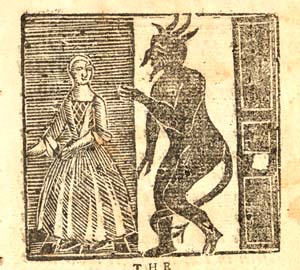
In contrast, woodcuts like the one above usually did show the devil as almost a black silhouette. Often that silhouette had a tail, long pointed nose, and spiky horns or hair—different from how artists of the time showed a generic “Black man.” While the symbolism of blackness itself in British-American culture can’t be denied, I don’t think British-American artists were depicting the Devil in the form of either a man or an African. 

Tuesday, July 26, 2022

“Mr. and Mrs. Curtis loaned their specie to the Colony”

Continuing my analysis of what an 1869 family history said about Obadiah Curtis (1724–1811), I reach the statement:
When the expedition against Canada was fitted out under Arnold, Mr. and Mrs. Curtis loaned their specie to the Colony, and took their pay in Continental paper.
That sentence appears to be the ultimate basis for this statement on the Boston Tea Party Ships & Museum website:
He was also a personal aid to General Arnold and assisted him on his expedition to Canada.
Readers might reasonably interpret those words to mean Obadiah Curtis was an aide de camp to Benedict Arnold and accompanied him across Maine to Québec. And that would be mistaken.

Arnold was a colonel, not a general, during his 1775 expedition to Canada. He therefore didn’t have the budget for aides. The muster rolls listing all the men on that mission, published by Stephen Darley in Voices from a Wilderness Expedition, don’t include Obadiah Curtis.

That’s because Curtis spent the siege in Rhode Island, not in the Continental Army. The Curtis family claimed that their ancestors aided Arnold with money, not that Obadiah was a military aid(e) or was “on his expedition to Canada.”

But is it true that, “When the expedition against Canada was fitted out under Arnold,” Obadiah and Martha Curtis loaned specie to the colony of Massachusetts? Arnold’s expedition was funded by Gen. George Washington as commander-in-chief from Continental funds. Though specie was always in short supply in the British colonies, there was no special collection for the Canada mission, and a couple living in Providence would be an odd source to tap.

We do know that Obadiah Curtis loaned money to the state of Massachusetts sometime between 1777 and 1779. He is listed (along with hundreds of other people) in an 1899 publication of the Massachusetts D.A.R. titled Honor Roll of Massachusetts Patriots Heretofore Unknown. That loan was supposed to pay 6% interest, though of course inflation of paper currency and the need for cash caused problems for the lenders.

I’m guessing that the Curtises’ decision to risk some of their savings on risky war bonds was remembered within the family, and Arnold’s celebrated mission got attached later.

It’s notable that the family tradition credited both Obadiah and Martha Curtis with this financial action, though officially the loan came from him. Both Curtises died in 1811, her a few months earlier, so that recollection was not the result of descendants hearing stories from the widow. Martha came from a wealthy Framingham family and ran a store in the South End, so she was probably involved in, if not the manager of, the family finances.

TOMORROW: Obadiah Curtis in Rhode Island.

Thursday, April 07, 2022

The Deep Roots of New England’s Pope Night

The Journal of Religious History recently made Luke Ritter’s article “Pope's Day and the Language of Popery in Eighteenth-Century New England” open for all here in the Wiley Online Library.

While eventually focusing on New England, this article begins with the reason eighteenth-century Britain celebrated the 5th of November. Unfortunately, that explanation mixes up dynasties:
The paradox of papist ambition and secrecy became powerfully instantiated in the commemoration of Guy Fawkes Day, celebrated in England annually after 1605 on 5 November. A Catholic by the name of Guy Fawkes and several other Jacobite conspirators desired to usurp the Hanoverian, Protestant monarch, James I, to restore a contending Stuart, Catholic family line. Englishmen who supported James I called the Stuart claimant a “pretender.”
James I was a Stuart—indeed, founder of the Stuart dynasty. His grandson, James II, was also a Stuart but not also a Protestant, causing Parliament to replace him with Protestant Stuarts. When that supply ran out in the early 1700s, Parliament invited in the line of Georges from Hanover. That’s when Stuart pretenders started to pose a continental, Catholic, and “Jacobite” threat to the Hanoverians.

The error, though unfortunate, is actually an apt reflection of the shifty nature of England’s established religion over two busy centuries. While the celebration of the 5th of November was rooted in the early 1600s, it took off as a holiday in New England more than a century later. Until then, the region was too often at odds with the British monarchy and Parliament to get behind celebrating their deliverance. But once the causes of anti-Catholicism, imperial pride, and respect for the king were firmly united, New Englanders were all in.

Ritter’s article digs up lots of evidence about the intellectual environment in which the holiday flourished. One of the values that united most Britons in the 1700s was that Roman Catholicism was a Bad Thing. (British Catholics didn’t hold that view, of course, but British law literally excluded them from full participation in British society.) New Englanders, with their culture’s Puritan roots, held that idea even more strongly.

As a result, during theological and political disputes New Englanders on both sides tended to accuse the other of acting too like the Catholics. Ritter quotes a New Light pioneer, the Rev. Elisha Williams, complaining in 1742 that traditionalists displayed the “true Spirit of Popery” by imposing their “Determinations on all within their Power by any Methods which may appear most effectual…in Matters of Religion.” Meanwhile, the Rev. Charles Chauncy, an Old Light leader, said even “POPERY itself han’t been the mother of more and greater blasphemies and abominations” than the New Light revivals.

As Ritter describes, Guy Fawkes was never really the focus of how New England celebrated Pope Night. Indeed, one surviving broadside about the holiday from the early 1760s misdated the Gunpowder Plot to 1588, showing how little people cared about those ancient details. Rather, the New England holiday came to lambaste contemporary enemies, starting with the Pope (not that many revelers could have told you what the current pope’s name was) and Stuart Pretender.

Eventually the “Pretender” became the name for the villain of the year being hanged in effigy. Boston’s “Pretenders” in the 1750s and 1760s included Admiral John Byng, Customs Commissioner Charles Paxton, and Governor Thomas Hutchinson. Thse effigies in turn offered meme for the Stamp Act protests of 1765 and the nonimportation pickets of 1770.

Ritter focuses a lot of attention on Massachusetts and Boston laws meant to keep Pope Night revelry from becoming too rowdy and violent, citing “tensions between elite Massachusetts-Bay legislators” and the celebrants.

While civic leaders undoubtedly worried about the violence and social disorder of Pope Night—a child was killed in 1764, after all—it’s significant that they never tried to end the celebration entirely, simply to keep it within bounds. And from the other side, I think it’s a mistake to see the holiday’s appeal for young males simply as upending authority. Rather, it was a day of misrule sanctified by also being both patriotic and pious.

As the article notes at the end, Pope Night lost its respectable rationale during the Revolutionary War. It was no longer patriotic to praise king and Parliament, and no longer politic to complain about everything Catholic when France was helping win the war. Pope Night imagery proved useful when Americans wanted to show their contempt for Benedict Arnold, but that tradition faded fast.

Mid-autumn misrule still had its appeal, though. Some Pope Night rituals hung on long enough to evolve into Halloween. But that vastly popular American holiday never regained an overt political or religious justification, despite the best efforts of UNICEF.