J. L. BELL is a Massachusetts writer who specializes in (among other things) the start of the American Revolution in and around Boston. He is particularly interested in the experiences of children in 1765-75. He has published scholarly papers and popular articles for both children and adults. He was consultant for an episode of History Detectives, and contributed to a display at Minute Man National Historic Park.

Subscribe thru Follow.it


•••••••••••••••••


Showing posts with label James Barrett. Show all posts

Saturday, April 19, 2025

Counterfactual 4: If No One Had Died at Lexington or Concord

Building on my counterfactual of what might have happened if Paul Revere and William Dawes had never brought their warning to Lexington, I reached the moment when the militiamen of Concord saw smoke rising above their town.

Under the scenario so far, the lack of urgent alerts out of Boston had no effect on the safety of John Hancock and Samuel Adams (who were never in great danger, despite their worries) or the quantity of military supplies the redcoats found (since James Barrett and his crew had already moved most of that stuff).

But that counterfactual situation would have delayed the response from towns around Concord, meaning fewer militia companies would have joined the local men on the hill overlooking the North Bridge.

We know those men were of two minds about confronting the regulars. They stayed on that hill for about two hours, marching down only after thinking other soldiers had set fire to the center of town. Then, after a fatal exchange of fire had chased the company from the bridge, they pulled back for another couple of hours.

Given those real-life details, I posited yesterday that the militia men would have been more wary about marching down on the bridge if there had been fewer of them. And eventually the smoke from town would have stopped, lessening the urgency.

In real life, after the shooting the militia companies moved around the north side of Concord and then massed east of the town. At Meriam’s Corner, once the regulars had left the most populated area, the provincials started to shoot at the column. Would that have happened the same way in this what-if scenario?

The very big difference in this counterfactual is that no one has yet been killed. There was no shooting in Lexington or at the North Bridge. Neither side had seen deaths to avenge. As long as the two groups of armed men remained at a distance, neither would have felt themselves to be under imminent threat.

In that case, the afternoon might have proceeded like the end of Lt. Col. Alexander Leslie’s raid on Salem in February: with the regulars marching in order back to where they came from while the local militia regiments watched sullenly to be sure they left. Lt. Col. Francis Smith’s men would have met Col. Percy’s reinforcement column somewhere in west Cambridge, and they would all have returned to Boston.

As it happened in April 1775, the bloodshed along the Battle Road motivated a militia siege of Boston. The committee of safety and its generals didn’t have to choose that policy; it came about naturally as militia companies massed off the peninsulas of Boston and Charlestown. Without deaths, the provincials wouldn’t have felt so much fervency, so the situation might have remained as it was: no military siege, but the countryside beyond Boston outside of royal control.

In the ensuing days, the Patriot press would have made the most of the army incursion into people’s homes while also trumpeting how the raid had found so little. The newspapers would have celebrated the escape of Hancock and Adams. They would have lauded the strong unified response of the Massachusetts militia.

As for Gen. Thomas Gage, he would have been pleased not to lose any men but frustrated at not capturing all the artillery pieces and other weapons he wanted to destroy. And how would he explain the mission to his superiors in London after they’d advised him to do something else?

Of course, that scenario doesn’t include any of the near-random events that can ignite violence, like the first shot at Lexington. What if British troops and Massachusetts militia did bump into each other somewhere? What if military patrols stopping Revere or Dawes before they got to Lexington meant that one of those popular Bostonians had wound up dead?

And even if the 18–19 April expedition did end without bloodshed, the conflict and tensions in Massachusetts would have remained unresolved. Gen. Gage’s next mission could have started the war instead, just a few weeks later.

Friday, April 18, 2025

Counterfactual 3: If Prescott Hadn’t Alerted Concord

Continuing my speculation about what might have happened if Paul Revere and William Dawes hadn’t alerted Lexington about the regulars coming out, I’m now going to look at Concord.

This post was prompted by the suggestion in Kostya Kennedy’s book The Ride that if Revere hadn’t ridden out on 18 April “the munitions at Concord could have been seized.”

That’s mistaken because militia colonel James Barrett, his helpers, and his family had started moving the most valuable military supplies out of town days before the British army march. In part because Revere had brought a warning from Boston on an earlier ride. 

On 6 April, James Warren was in Concord for a meeting of the Massachusetts Provincial Congress, and he wrote to his wife Mercy: “This Town is full of Cannon, ammunition, stores, etc., and the Army long for them and they want nothing but strength to Induce an attempt on them.”

But when the redcoats arrived, Ens. Henry DeBerniere said, they “did not find so much as we expected.” Specifically, he reported:
Capt. [Mundy] Pole of 10th regiment…knock’d the trunnions off three iron 24 pound cannon and burnt their carriages; they also destroyed a quantity of flour, and some barrels of trenchers and spoons of wood for their camp.
At Barrett’s farm the soldiers burned some more carriage wheels. But the town was obviously no longer “full” of military stores. And that change had taken days, not a few hours.

If the British expedition hadn’t paused in Lexington but marched straight through, as I posited yesterday, the vanguard would probably have arrived in Concord less than half an hour earlier. Some of the local militia might have been on alert, but without Dr. Samuel Prescott’s warning, it probably wouldn’t have been at full force.

But would that have mattered at first? When the regulars approached the town, the Concord militia marched away and took a position on a hill west of the North Bridge. Other men and then other town companies joined them there while the redcoats searched both the town and Barrett’s farm.

Without the earlier alerts from Revere riding west from Medford to Lincoln and the Prescott brothers riding out of Concord, those militia companies from other towns wouldn’t have joined the Concord companies as quickly as they did. It’s thus possible there would have been significantly fewer men on that hill when smoke began to rise from the center of town, where redcoats were burning carriage wheels (and, briefly, the town house).

The Concord men might have been just as upset by the sight of that smoke, but might not have felt their numbers were strong enough to do anything about it. And eventually the smoke would have dissipated as people in town succeeded in dousing the fire. So the provincials might never have made their fatal march down to the bridge, with the Acton company in the lead.

TOMORROW: The battle that never was.

Saturday, February 22, 2025

Zannieri and Martello on Paul Revere in Concord, 25 Feb.

On Tuesday, 25 February, the Concord Museum will host a lecture on “Paul Revere: The Man, the Myth, the Legacy.”

This presentation will be delivered jointly by:
  • Nina Zannieri, Executive Director of the Paul Revere Memorial Association, which operates the Paul Revere House in the North End of Boston.
  • Robert Martello, Professor of the History of Science and Technology at Olin College of Engineering and author of Midnight Ride, Industrial Dawn: Paul Revere and the Growth of American Enterprise.
Revere is, of course, best known for his ride on 18–19 Apr 1775, spreading word of the British army march. He did indeed do that, but his prominence in American culture derives from Henry W. Longfellow turning him into a legend in 1861. The Paul Revere House has to help visitors sort out the history from the myth.

Because the history is even more interesting, if not as poetic. Before the war Revere was a political activist, among the most prominent from the mechanics class. Afterwards, he was a leader in Massachusetts’s business community and an early factory owner, the portion of his life that Prof. Martello studies.

This situation produces a paradox: Revere deserves to be remembered and studied in American history. But he’s a household name for actions that he did only part of, and which may not have been that crucial in history.

For an example on a smaller scale, generations of American schoolchildren have heard Longfellow’s lines:
It was two by the village clock,
When he came to the bridge in Concord town.
But Revere never made it to Concord on 19 April, much less to the North Bridge. He did, however, visit the town in the preceding week, carrying news that helped James Barrett decide to move the cannon and other ordnance on his farm farther away from Boston, and that stymied the British operation.

This event is scheduled to start at 7 P.M. It is free for Concord Museum members (though those seats might be sold out) and $10 for others. But it’s free to anyone who wants to tune in online.

Monday, April 08, 2024

Peering into the Josiah Austin Story

Back in 2020 the Spared & Shared website, which usually presents documents from the U.S. Civil War, published the transcript and scans of an account of events on 19 Apr 1775.

Attributed to Josiah Austin, “formerly of Charlestown now of Salem,” this narrative describes the effort of driving a wagon load of “powder & balls” from Concord as the British army closed in.

Indeed, according to this document, regulars actually found the wagon disabled on the road, only to ignore the men with it as “affrightened ‘Yankees,’ returning from market.”

Earlier this year, Alexander Cain at Historical Nerdery did a fine job of pointing out the holes in this account.

The transcription quotes Austin stating “he was at Concord with Col. Barrett and others on the 18th of April 1775 having in charge ammunition &c.” We know that James Barrett was storing a large amount of the Massachusetts Provincial Congress’s military supplies on his farm—until a couple of days before, when the family and friends started to move that stuff to better hiding-places.

Alex Cain points out that those hiding-places were naturally to the west, further away from Boston and any expedition coming from there. Yet Austin said his wagon went east “toward Lexington.” Why the hell would anyone drive a wagon of secret ammunition toward the military search party?

We also have the names of men employed by the Massachusetts Patriots to help Barrett gather and prepare military supplies. One man was John Austin. None was named Josiah Austin.

The British expedition stopped several young men riding out on the roads on the night of 18–19 April, sometimes detaining them for hours. (One, Asahel Porter, was killed in the shooting on Lexington common.) Cain notes it would therefore be quite odd for some soldiers to come across a wagon in the vicinity of the place they had been ordered to search and pass by without examining the cargo.

Finally, Austin claimed that the British soldiers he met were “pioneers,” but none of those specialized soldiers were assigned to the march to Concord.

I have nothing to add to Alex Cain’s cutting analysis of the document’s content. But I’ll make an observation about its form. The first six lines refer to “Col. Barrett” twice—but only after editing.


Spared & Shared’s scans of the handwritten document show that originally the transcriber wrote another name, possibly “Butler.” Sometime after the original writing, that name was crossed out and replaced with “Barrett.” We don’t know how much later that change was made. We don’t know if someone looking up Barrett’s name in historical sources prompted that change as a correction.

But we do know that whoever first told this story didn’t initially remember the name “Barrett,” even though Josiah Austin was supposed to have worked with Col. Barrett and traveled on the ammunition wagon with Barrett’s son.

That’s just one more reason to deem this account dubious. Josiah Austin might have been telling an exaggerated story to a credulous transcriber, or the entire document might have been concocted.

Sunday, April 07, 2024

Heading into Patriot’s Day 2024

With yesterday’s posting, Boston 1775 has entered the Patriot’s Day season for 2024.

It’s hard to find a complete posting of Patriot’s Day events because so many towns and organizations have their own celebrations. But a good place to start is the calendar on the front page of Revolution 250.

Among the new commemorations this year is Tavern Week in Arlington, known as West Cambridge or Menotomy in 1775. The Massachusetts Provincial Congress’s committee on safety and supplies met in the Black Horse Tavern on what’s now Massachusetts Avenue on 18 April. Three members planned to spend the night but bolted out the back door when the redcoat column approached.

The Arlington Historical Society is also offering tours of the Jason Russell House, site of the bloodiest fighting of the day, on Saturday, 13 April, and Monday, 15 April, noon to 4 P.M.

Also on 13 April, Michael Lepage will portray Paul Revere at the Paul Revere House in Boston while the Minute Man National Historical Park hosts its annual big tactical demonstration and reenactment of events along the Battle Road.

Some of the towns planning local Patriot’s Day remembrance events include Billerica, Danvers, Somerville, Hanover, and Lynnfield. Others will send traditional contingents to the event in Minute Man Park.

All outdoor events of course depend on welcoming weather. We had snow last week, and flooding forced the cancellation of an event at James Barrett’s farm in Concord today. So let’s hope for sunshine and cool breezes for the next two weeks!

Saturday, April 06, 2024

The British March to the 1/88th of a Mile

So far this month I’ve been looking at the publishing history of Lt. Col. Robert Donkin’s Historical Collections and Remarks, particularly the removal of an incendiary footnote and how that might have affected the publishing schedule.

There are other significant blanks in the book, not made by a knife but left by the author.

On page 170, Donkin discussed the British troops’ march to Concord on 18–19 Apr 1775.

Donkin’s praise for the redcoats’ endurance would have been more impressive if he’d actually stated how long they marched. Instead, he left blanks: “the space of     hours,” “about     miles,” “less than     hours!”

Did Donkin just forget, and Hugh Gaine’s print shop never told him? Did he expect to write those figures in after printing, only to be caught up in the footnote brouhaha and capturing Philadelphia?

However it came about, Donkin didn’t tell readers how long the march to Concord was, in space or time. Just that it was impressive, believe him.

Frank Warren Coburn undertook the measurement in his 1912 study, The Battle of April 19, 1775. He had the advantage of bicycle with a cyclometer that measured distance to the 88th of a mile, or 60 feet. Coburn calculated that the companies who went all the way to James Barrett’s house and back to Bunker’s Hill traveled 39 and 71/88 miles. That’s over five miles more than the troops who stopped in central Concord.

As to time, which was measured less exactly in the eighteenth century, David Hackett Fischer rounded up all the reports and estimates of when things happened in Appendix L of Paul Revere’s Ride (1995), and Derek W. Beck further analyzed those in Appendix 7 of Igniting the American Revolution (2015).

Based on those analyses, the figures Donkin was looking for were:
  • the troops were under fire for eight hours, from leaving Concord at noon to reaching Charlestown around 8 P.M.
  • on average, the soldiers who went to Concord marched about 36 miles.
  • if we time that march as starting in Cambridge at 2 A.M. and ending in Charlestown, then the whole mission took 18 hours.
However, if we start the clock when the troops got into boats to cross the Charles River and end it with those troops coming back across the river from Charlestown, that was about 24 hours.

Tuesday, April 04, 2023

The Patriots’ Day 2023 Season at Minute Man Park

The Patriots’ Day 2023 season starts this upcoming weekend, well before Patriots’ Day (17 April this year), much less the actual anniversary of the Battle of Lexington and Concord on 19 April.

The Friends of Minute Man Park has a good rundown of events planned in and around that national park, all of them free. Check the park’s own site for updates. Here are some highlights.

Saturday, 8 April, 11:00 A.M. to 2:00 P.M.
Meriam Open House
Nathan Meriam House, 24 Old Bedford Road, Concord
Parking is available at the Meriam’s Corner Lot at 751 Lexington Road in Concord.

Saturday, 8 April, 1:00 to 2:00 P.M.
Meriam’s Corner Exercise
Meriam’s Corner, 24 Old Bedford Road, Concord

Saturday, 8 April, 3:00 to 4:00 P.M.
Paul Revere Capture Ceremony
Paul Revere Capture Site, 180 North Great Road, Lincoln
Additional parking at the Minute Man Visitor Center at 210 North Great Road, Lincoln.

Saturday, 15 April, 9:30 to 11:45 A.M.
Hartwell Tavern and Smith Open House
North Great Road, Lincoln

If you had to leave your home in a hurry, uncertain of your return, what would you take with you? Learn about the locals who struggled to save their families and belongings from the path of war.

Saturday, 15 April, 11:15 to 11:45 A.M.
Trepidation, Fever and Rushing to Arms
Captain William Smith House, North Great Road, Lincoln

See alarm riders in action, militia marching to the scene of battle, and civilians preparing to leave home. The Ladies Association of Revolutionary America will tell the stories of the common people who experienced the horrors of war first-hand.

Saturday, 15 April, 12:45 P.M.
Battle Road Tactical Demonstration
Meet at the Minute Man Visitor Center, North Great Road, Lexington

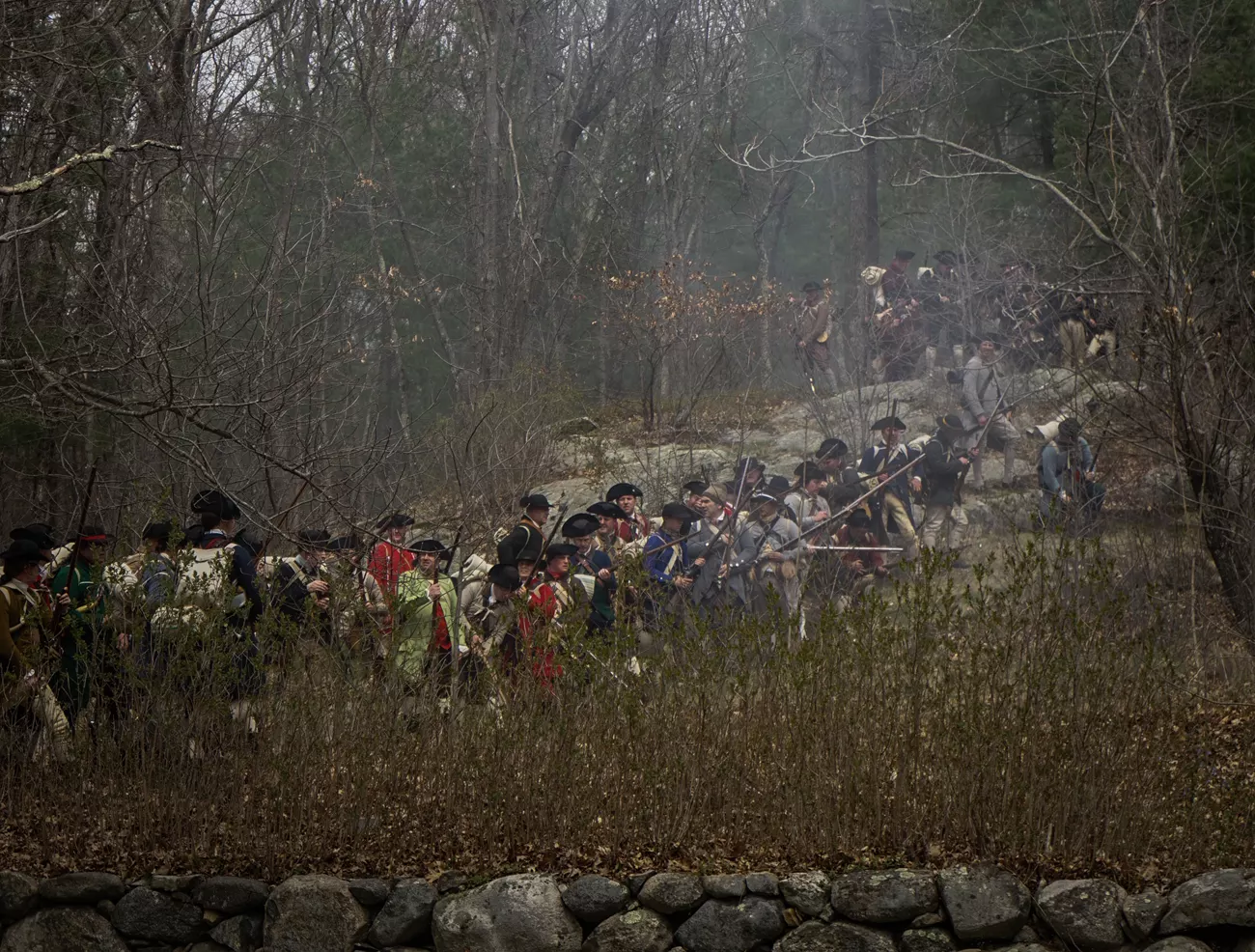
Watch hundreds of British and Colonial Reenactors engage in a battle demonstration showing the running fight that took place along this deadly stretch of road on the border of Lincoln and Lexington.

Parking is available in the Hartwell Tavern and Minute Man Visitor Center parking lots. There’s about a mile and a half between those sites, so people planning to attend this whole series of events should be ready to walk twice that distance.

Saturday, 15 April, 2:30 to 3:30 P.M.
Explore the Elm Brook Hill (Bloody Angle) Battle Site
Meet at Hartwell Tavern, 136 North Great Road, Lincoln

Edmund Foster, a militiaman from Reading, Massachusetts (portrayed by park volunteer Ed Hurley), will lead a tour to this key battle site where he fought on 19 April 1775, joined by Lincoln historian and author Don Hafner.

Sunday, 16 April, 1:30 to 4:30 P.M.
The Search of the Barrett Farm
Colonel James Barrett House, 448 Barrett’s Mill Road, Concord

Talk with costumed park rangers and volunteers about colonial military preparations. Around 3:30 P.M. British soldiers will arrive to search the property, as they did in 1775.

Monday, 17 April, 8:30 A.M.
North Bridge Fight Commemoration
North Bridge, Monument Street, Concord

This dramatic battle demonstration involving colonial minute men, British regulars, and musket fire marks what R. W. Emerson dubbed the “shot heard ’round the world.” The roads in Concord close at 8:30 A.M.

Tuesday, 18 April, 7:45 P.M.
Patriot Vigil
Lantern light procession from the North Bridge Visitor Center, 174 Liberty Street, Concord, to the North Bridge

As darkness descends upon the North Bridge battlefield, reflect on the events of 1775 and the meaning of liberty. This ceremony will feature a lantern-light procession, poetry, music, and a recitation of the names of the men who gave their lives on that “ever-memorable” 19th of April.

To participate in the procession, leave weapons at home and bring your own enclosed candle lantern–real candles only, no flashlights or LED lights.

Friday, August 19, 2022

The Mysteries of Fortune Freeman

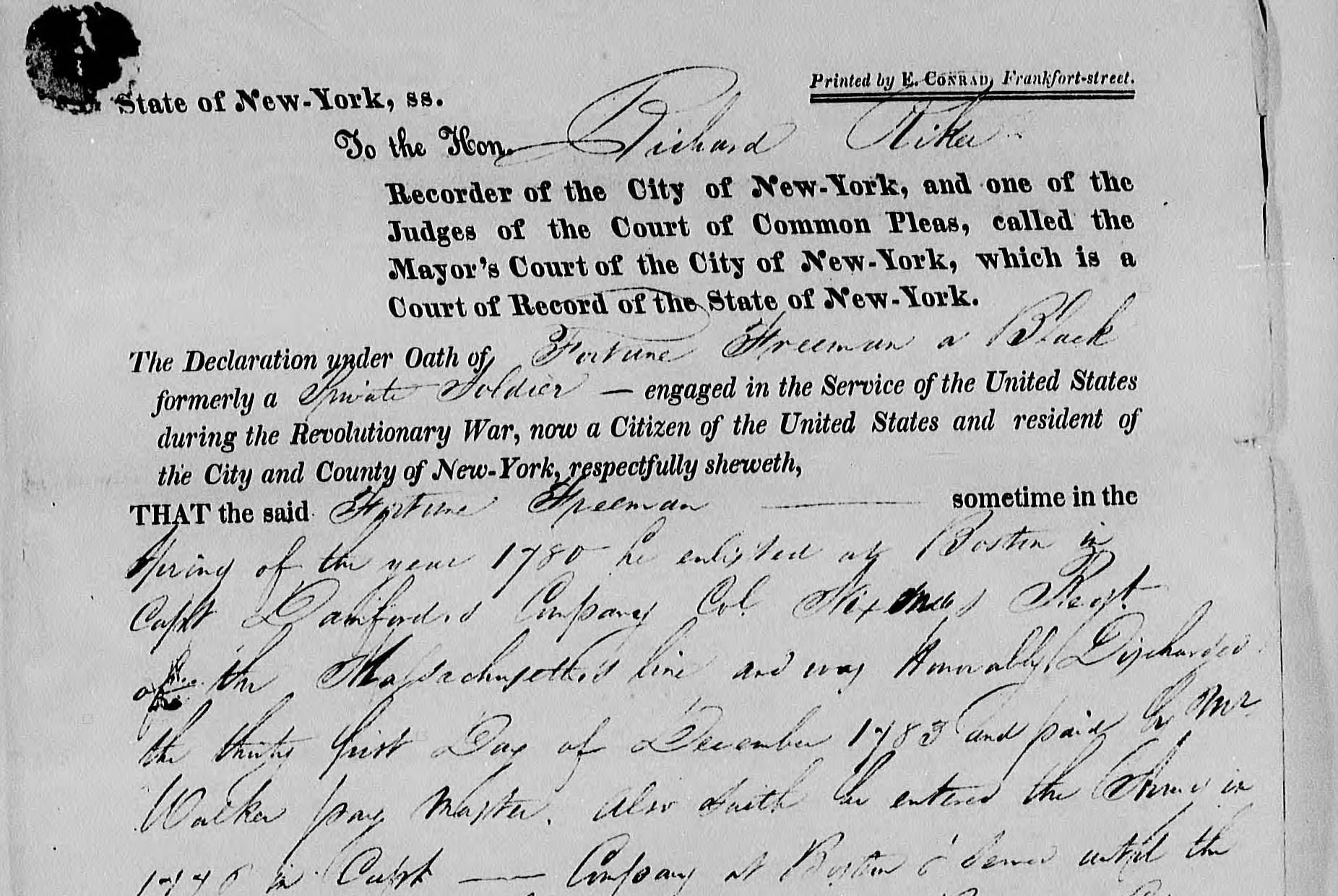
Earlier this year Boston National Historical Park shared a research article by Anjelica Oswald about an African-American Revolutionary War pensioner. It starts with this scene:
In the spring of 1818, an old man named Fortune Freeman…swore to the court that he served as a soldier in the Revolution, and applied for a veteran’s pension for some relief. Arriving to the court with merely the clothes on his back, Freeman provided few details about his personal life in his statement. Aside from his own declarations, few records of his life exist before or after the war. Only one of these precious few records remained in his possession when he approached the court: a discharge paper from the 4th Massachusetts, issued to him at the close of the Revolutionary War in 1783.
Because many veterans similarly lacked paperwork, and because the U.S. War Department had suffered a fire in 1800, the pension process for aging Revolutionary War veterans relied on applicants’ memories. That makes the pension files detailed historical sources but also leaves them riddled with gaps and contradictions.

In Fortune Freeman’s case, his memories didn’t match the remaining paper trail in several ways.
Freeman claimed to have first enlisted in Boston in 1776 in Captain Elijah Danforth’s company, Colonel Thomas Nixon’s regiment, later designated the 6th Massachusetts Regiment in 1779. He stated that he continued to serve in the same regiment until his honorable discharge in 1783. However, when looking through muster rolls, there is no record of a “Fortune Freeman” enlisting in 1776 in Danforth’s company. In fact, there is no record of a “Fortune Freeman” in Danforth’s company at all.
Capt. Danforth was from Billerica, serving from the first day of the war. But he left the army in March 1779. So whom commanded Fortune Freeman after that?

Freeman also testified to having been wounded at the Battle of Brandywine and to witnessing the surrender of Gen. John Burgoyne at Saratoga. Those two major battles took place in the same season hundreds of miles apart, so no army units were at both.

Freeman’s pension application thus shows some of those gaps and contradictions. However, Oswald also found that in May 1777 Col. James Barrett mustered a Billerica man named Fortune (or “Forten”) Conant into Capt. Danforth’s company. This man served in that Massachusetts regiment until 1780. Then there’s no further record of him.

But there is a record of a man named Fortune Freeman enlisting into the 4th Massachusetts regiment in 1781 and serving until the end of the war two years later. Those details matched the discharge paper Freeman presented with his pension application decades later.

Oswald’s essay explores the likelihood had Fortune Conant and Fortune Freeman were the same man, with some details dovetailing, others (like his later commanding officer) left aside, and a few (either Brandywine or Saratoga) embellished.

It also uses the record of the units Conant and Freeman were linked to, and later civilian records, to fill in the big holes of his/their life. Was Fortune Conant born enslaved, perhaps to the Conant family of Billerica? Did Fortune Freeman return to Massachusetts after being discharged? The U.S. government continued to pay his pension until 1824, so is that when this veteran died? The article is a detailed read, careful to distinguish evidence from supposition.

Wednesday, April 13, 2022

Capt. William Browne’s War

William Browne received his commission as a captain in the British army on 24 June 1771. He must have enlisted at a lower rank a few years earlier, but because his name was so common and because officers moved from one regiment to another for promotions, I’m not sure when his military career began.

While the 52nd Regiment was in Boston, Capt. Browne commanded its light infantry company. That means he led those men out to Concord on 18–19 Apr 1775.

Browne had been to Concord before. On 20 March, he and Ens. Henry DeBerniere visited the town in civilian guise to confirm a local informant’s reports to Gen. Thomas Gage that militia colonel James Barrett was amassing arms there, including four cannon spirited out of Boston armories.

The two army officers did confirm that the Patriots had those four brass cannon “concealed in some place behind the town, in a wood.” That wording suggests they didn’t see the hiding-place but were told where it was. One source of information was probably the local lawyer Daniel Bliss, who felt so unsafe having suspicious visitors in his house that he went into Boston with Brown and DeBerniere. (Gage’s original informant remained in town.)

Browne, DeBerniere, and Bliss returned as part of the army expedition to Concord on 18–19 April. In fact, we know from other officers’ reports that Capt. Browne and his light infantrymen were among the three companies who went all the way to Barrett’s farm, a mile past the North Bridge (shown above).

Those redcoats didn’t find significant amounts of ordnance at that farm. On their way back, they did find some of their fellow soldiers killed at the bridge. That was the start of the column’s difficult fight back to Boston.

The 52nd Regiment was also in the Battle of Bunker Hill two months later. According to one source, the regiment ended that day camped closest to the provincial lines on the isthmus of the Charlestown peninsula. Capt. Browne was listed among the wounded.

On 1 August, the British command in London made Capt. Browne a brigade major, an administrative post with a corresponding rise in pay. Gen. William Howe announced that promotion in his orders from Halifax the following May. In 1778, the 52nd Regiment was drafted, meaning its men were distributed to other regiments and it began to recruit new soldiers.

Around that time, Browne was promoted to be the major of the 49th Regiment. Later in 1778 that unit took part in the British conquest of St. Lucia from the French. In 1780 the 49th moved to Ireland. Around the start of 1783 Browne became a lieutenant-colonel in the army. Henry Lawes Luttrell, then serving in the Irish Parliament, told that legislature that:
Colonel Brown was one of the best officers in the army, that he had distinguished himself on service, and was remarkable for a strict observance of discipline in the regiment, and an excellent corps of officers emulated his example—
If only that praise had come from a more respectable man.

That’s as far as I can trace William Browne. Again, his common name makes him easy to lose in a crowd.

Sunday, April 25, 2021

Ens. DeBerniere’s Last Trip to Concord

Ens. Henry DeBerniere went back to Concord on the British army expedition of 18-19 April.

Indeed, DeBerniere probably served as a close advisor to the mission’s commander, Lt. Col. Francis Smith (shown here). The young officer had been to the town the previous month, had learned about the cannon at James Barrett’s farm, and was in Smith’s own 10th Regiment.

After the column reached central Concord, DeBerniere led Capt. Lawrence Parsons of the 10th Regiment with “six light-companies” farther across the North Bridge to Barrett’s. The ensign wrote afterward, “we did not find so much as we expected, but what there was we destroyed.”

The serious action, DeBerniere came to learn, was back at the bridge, where Capt. Walter Sloane Laurie of the 43rd, whom he called “Capt. Lowry,” and three companies “were attacked by about 1500 rebels.” (As usual, people tended to overestimate the enemy’s numbers.)

In that fight, “three officers were wounded and one killed” along with three soldiers DeBerniere didn’t name. He counted Lt. Edward Hull of the 43rd as “killed.” In fact, Hull was merely wounded at the bridge but wounded again while riding in a carriage to Boston. He finally died in provincial custody on 2 May, which suggests that DeBerniere wrote his account at least two weeks after the battle.

During that exchange of fire at the bridge, Parsons, DeBerniere, and those six companies were still up at Barrett’s farm, searching. The ensign wrote of the local militia:
they let Capt. Parsons with his three companies return, and never attacked us; they had taken up some of the planks of the bridge, but we got over; had they destroyed it we were most certainly all lost; however, we joined the main body.
Actually, Laurie’s men had taken up planks of the bridge. But it’s true that those provincial companies didn’t try to cut off the search party, waiting until all the British forces had left the center of Concord before attacking. (Parsons reported that at least one of the soldiers killed at the bridge was “scalped,” but DeBerniere said nothing about that.)

Elsewhere in Concord, Ens. DeBerniere noted, that “Capt. [Mundy] Pole of 10th regiment…knock’d the trunnions off three iron 24 pound cannon and burnt their carriages.” These guns were the only provincial artillery left in Concord, possibly because they belonged to the town and possibly because they were just too darn big to move.

DeBerniere’s report continued with a description of the British withdrawal under fire; “there could not be less than 5000…rebels,” he now guessed.
we at first kept our order and returned their fire as hot as we received it, but when we arrived within a mile of Lexington, our ammunition began to fail, and the light companies were so fatigued with flanking they were scarce able to act [as flankers], and a great number of wounded scarce able to get forward, made a great confusion;

Col. Smith (our commanding-officer) had received a wound through his leg, a number of officers were also wounded so that we began to run rather than retreat in order—the whole behaved with amazing bravery, but little order; we attempted to stop the men and form them two deep, but to no purpose, the confusion increased rather than lessened:

At last, after we got through [into] Lexington, the officers got to the front and presented their bayonets, and told the men if they advanced they should die: Upon this they began to form under a very heavy fire
Finally Col. Percy arrived with fresh troops and two field-pieces. That changed the balance of power, and the regulars resumed withdrawing east in more orderly fashion. But there was heavy fighting in Menotomy:
out of these houses they kept a very heavy fire, but our troops broke into them and killed vast numbers; the soldiers shewed great bravery in this place, forceing houses from whence came a heavy fire, and killing great numbers of the rebels.
Around seven o’clock, DeBerniere wrote, the army column reached Charlestown. There the soldiers “took possession of a hill that commanded the town,” the soon-to-be-famous Bunker’s Hill. The town’s selectmen, who were strong Whigs but didn’t want their homes consumed by fire and sword, sent a message to Col. Percy saying
if he would not attack the town, they would take care that the troops should not be molested, and also they would do all in their power for to get us across the ferry;

the Somerset man of war lay there at that time, and all her boats were employed first in getting over the wounded, and after them the rest of the troops; the piquets of 10th regiment, and some more troops, were sent over to Charlestown that night to keep every thing quiet, and returned next day.
Thus ended Ens. DeBerniere’s third and last journey into the Massachusetts countryside.

COMING UP: DeBerniere’s papers.

Monday, February 15, 2021

The Guns that Didn’t Bark

One of my big unanswered questions about the Battle of Lexington and Concord on 19 Apr 1775 is why the provincial forces didn’t deploy any of the cannon they had just spent months collecting and preparing for a fight.

The guns that James Barrett had been overseeing in Concord were probably unavailable after being rushed into hiding-places in other towns. But what about the rest?

We can assume that the men of Lexington and Cambridge, towns along the British route, didn’t want to see an all-out battle along one of their main roads, with houses and possibly civilians nearby. Better to hurry the redcoats along than to make them desperate and angry with artillery.

But what about Watertown, which had actually deployed two cannon on 30 March, according to a British army captain? Jonathan Brown was “captain of the train”—Watertown’s own militia artillery company. The town wasn’t on the regulars’ route but was close enough to reach the road from Concord with mounted cannon. But there’s no mention of the Watertown guns coming out.

What about Newton, where a shot from one of the two cannon John Pigeon had given to the town summoned the militia company on 19 April? Those men reportedly gathered beside the cannon and then marched off to confront the king’s troops, leaving their most powerful weapons behind.

Other towns had also formed artillery companies, but those men marched out with muskets. Lt. Edward Thoroton Gould reported hearing cannon used as alarm guns during the march west, but neither he nor any other British officer saw them.  

Indeed, out of the scores of Massachusetts militia units that mustered independently on 19 April, sometimes zealously and sometimes after long conversations among local leaders, I haven’t found any that brought out their cannon as well. I haven’t read even a mention of that as a possibility under discussion.

Uncounted numbers of veterans of the 19th of April left descriptions of that day, some immediately and some decades later. In 1775 there may have been pressure not to mention the province’s artillery because that would acknowledge the countryside had prepared for war. Eventually, however, men did speak of topics that had been politically awkward before. Yet no one talked about cannon.

One possible explanation is that those artillery pieces weren’t as ready for combat as people had been saying. Back in February, representatives from four towns described the four iron cannon as “Nearly Compleated,” but 99% done isn’t done, especially if you’re going into combat. Provincial records show people were still scrambling to finish equipping some pieces in late April and May.

In particular, militia officers may have felt they didn’t have enough gunpowder for an artillery engagement, and the supply they did have was better divvied out to infantrymen. Or they might not have had the horses necessary to drag iron cannon across country and into battle—which farmer was willing to risk his livestock? For that matter, did the provincials dare to risk the guns themselves when there was probably bigger fighting ahead?

I suspect another factor is that on 19 April the men of Massachusetts weren’t yet ready to make an all-out attack on the king’s soldiers. Did they really want to wipe out hundreds of their fellow subjects? Instead of halting and capturing the expedition, wasn’t it better to keep it moving back toward Boston? Like a dog chasing a car, the Massachusetts militiamen wouldn’t have known what to do with that column if they’d caught it.

Sunday, February 14, 2021

“Two peices of Cannon Brought From Watertown to ye Towns”

The 3 Feb 1775 petition to the Massachusetts Provincial Congress’s committee of safety about eight iron cannon can’t answer the question of what happened to those guns.

Did the congress assume control of them and add them to their other weapons? Or did they remain under the control of the four towns that had undertaken to equip them for use?

Or did the congress and the towns come to some sort of compromise, in which the towns continued to assume responsibility for those guns but expected the province to pay for the work eventually?

We don’t appear to have enough records from two of the four towns to provide definite answers. For Lexington, Alex Cain has written:
Unfortunately, what became of the guns after February 1775 is unknown. Lexington’s town meeting minutes from the Spring of 1775 were stolen years ago. Records from December 1775 through the remainder of the war do not mention the cannons.
The Weston town records show no payments related to cannon in 1775. In March 1776 the town treasurer’s account for the preceding year includes 12 shillings “Recd. of Capt. Samel. Baldwin for the Use of two Guns Belonging to the Town,” but that price suggests those were muskets, not artillery.

On the other hand, we know there were mounted cannon in Watertown on 30 March. On that day, Col. Percy led troops in a march that was part springtime exercise, part an attempt to get the provincials used to seeing redcoats come through their towns. Capt. John Barker wrote in his diary:
The 1st. Brigade marched into the Country at 6 oclock in the morning; it alarmed the people a good deal. Expresses were sent to every town near; at Watertown about 9 miles off, they got 2 pieces of Cannon to the Bridge and loaded ’em but nobody wou’d stay to fire them; at Cambridge they were so alarmed that they pulled up the Bridge.
Lt. Frederick Mackenzie noted that march, as well as another on 10 April: “The 38th. and 52ed. Regiments marched out this Morning as far as Watertown.” Later, just after the war began, he wrote: “The 38th & 52ed Regiments marched once to Watertown, which indeed occasioned some alarm, and Cannon were fired, bells rung, and expresses sent off, to give the alarm.” So not only did the Watertown militia company have two cannon, but its men could move, load, and fire those guns, and the British army knew about them.

As for Concord, we have the documentation from James Barrett of what ordnance and other material he was storing for the provincial congress. That included:
Two peices of Cannon Brought From Watertown to ye Towns
Eight Peices of Cannon Brought to ye Town by Mr Harrington
Four Peices of Brass Cannon & Two Mortar from Col Robertsons [sic—Lemuel Robinson]
Thus, when Barrett wrote this note, he controlled two iron cannon secured by William Molineux in 1774, sent out to Watertown, and then sent on to Concord for mounting. But he also had the Boston train’s four brass cannon, the two mortars that James Brewer claimed to have smuggled out of Boston, and eight more guns from some guy named Harrington (which is a whole other mystery for me). And in March more ordnance arrived from Salem.

No wonder James Warren wrote to his wife Mercy from Concord on 10 April: “This Town is full of Cannon…” A royal spy specified there were twelve cannon mounted around the Concord courthouse under twenty-four-hour guard, three 24-pounder siege guns in the courtyard of the prison, plus the brass field-pieces from Boston back at Barrett’s farm.

In mid-April, after warnings from Boston, Barrett and his family and neighbors began to move those artillery pieces even farther away. Four cannon reportedly went to the neighborhood of provincial congress receiver-general Henry Gardner in Stow. But four remained behind in Concord at the courthouse, according to Gen. Thomas Gage’s local informant. I suspect those were owned by the town, and it didn’t want to let them go.

I still don’t know who Gage’s spy was, but one candidate is Duncan Ingraham, the merchant captain who had retired to Concord a couple of years before. As described back here, his son had sold four iron cannon to Molineux in October 1774. Those comprised half of the artillery pieces that the 3 Feb 1775 petition discussed. In other words, there was a 50% chance that the pair of cannon assigned to Barrett had come from Ingraham. Had the captain spotted what he still considered his own property rolling through town?

Once again, my thanks to Joel Bohy of Bruneau & Co. and Antiques Roadshow for sharing the document from the Massachusetts archives that added new clues to this inquiry.

TOMORROW: The cannon that didn’t bark.

Friday, February 12, 2021

Four Representative Men

I’ve been analyzing a letter about cannon sent to the Massachusetts Provincial Congress’s committee of safety in February 1775.

This posting looks at the four men who signed that letter, in order of their signatures.

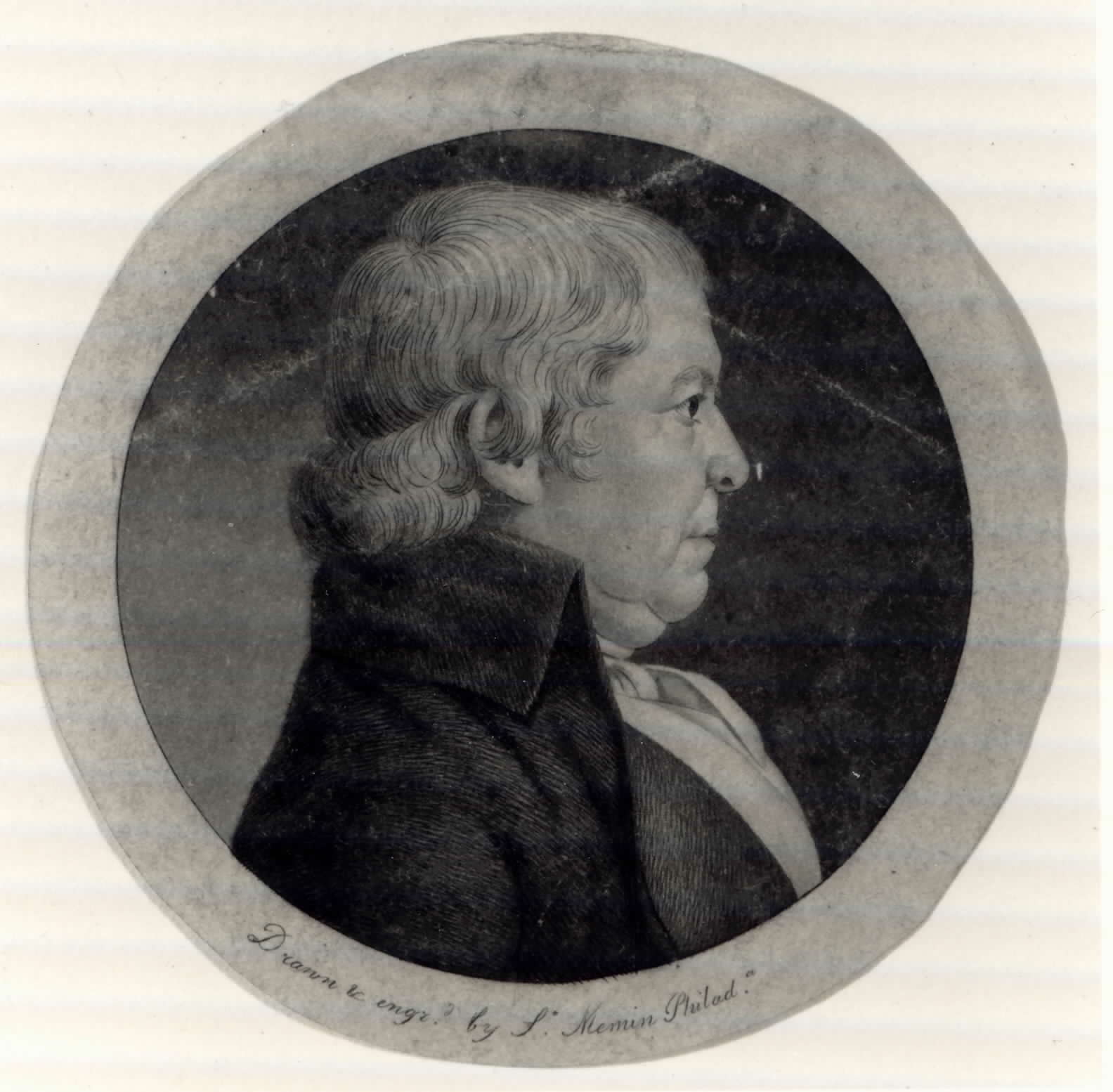
James Barrett (1710-1779) of Concord is already a big presence in The Road to Concord and on Boston 1775. He was a sixty-five-year-old farmer, patriarch, and community leader. In the fall of 1774, the town made Barrett a militia colonel and a representative to the Massachusetts Provincial Congress.

Secretly, Barrett oversaw the collection of provincial military supplies in Concord in the early months of 1775. This letter is one piece of evidence about that effort. Barrett’s lists of weapons, equipment, and food survive in the collection of the American Antiquarian Society. His farmhouse was the furthest target of the British march in April 1775, and that building is now part of Minute Man National Historical Park.

Jonas Stone (1710-1790) was born in Concord, grew up in Sudbury, and then established himself on land his father had purchased in Rutland. In 1751 Stone moved back east to Lexington, having inherited a family estate there. He soon married his second wife in that town.

Starting in 1755, Stone served in many Lexington offices, including treasurer, selectman, and assessor. In the 1770s he became the town’s representative to the Massachusetts General Court and Provincial Congress. Stone was also a deacon and member of the committee of correspondence.

The letter addresses Lexington’s work to prepare two iron cannon for use in 1775. Stone himself may not have been personally involved in that work but rather speaking for neighbors. He didn’t hold an officer’s rank in the militia and did only four days’ of duty himself in May 1775. But his son Jonas, Jr., was among the local militiamen on the town common on the morning of 19 April.

Braddyll Smith (1715-1780) was a long-time town official in Weston. He was clerk of the town militia company in the 1750s and captain by 1774, a selectman from 1758 to 1771, town clerk from 1758 to 1768, and treasurer from 1771 to 1773.

Smith was also a wealthy man. The town’s 1759 tax list, made in part by himself, said he owned more personal property and far more real estate than anyone else on the north side of town. Three men on the south side had larger fortunes, and Elisha Jones (the only “Esquire” on the list) owned more valuable land. In 1773 Smith also held title to two enslaved people, as many as anyone else in Weston; one was named Salem Middlesex, but this seems to have been a different man from the man who became Peter Salem of Framingham.

Smith had several children by his first wife, Mary Hagar, before she died. He remarried to Sarah White of Medford in 1763 and again to widow Ruth Flint of Lincoln in 1766—finding wives in the upper echelon of other towns.

In January 1774, as I mentioned yesterday, Braddyll Smith led a group that petitioned the town meeting to “To Chuse a Committe to take into Consideration the circumstances of our Publick affairs and to Corrospond with the NEIGHBOURING Towns and to Consider what is Best to be Done that our Injured Rights and Priviledges may be Restored and Secured”—i.e., to form a committee of correspondence and participate in Massachusetts’s political resistance. Under the influence of militia colonel and General Court representative Elisha Jones, the town rejected that idea.

But after the Boston Port Bill, Massachusetts Government Act, and other royal measures, local histories say that on 29 September Weston voted to form that committee and to send representatives to the first Massachusetts Provincial Congress. The voters replaced Jones as the town’s representative with none other than Braddyll Smith. Jones soon moved into Boston. By the end of the year Smith replaced Jones as militia colonel and was overseeing the town’s preparations for defense—including cannon.

Jonathan Brown (1724-1797) of Watertown was captain of the town’s military company at Lake George in 1758. When he returned, he began serving in town offices as clerk, treasurer, justice of the peace, and representative to the General Court starting in 1772.

In 1774 Brown as clerk kept the town records showing himself elected to the provincial congress. On 12 December, Watertown also chose him to be “Capt of the train”—the artillery company. That was a couple of weeks after the town had voted to equip two of the eight cannon brought out from Boston that fall.

During the war, Brown remained in town, working in civil posts. He kept busy recruiting soldiers, paying them for their service, and collecting supplies. He continued to represent Watertown in the Massachusetts legislature until 1786.

All four of these men were thus elders in their communities; the youngest was fifty years old. They were all farmers, not professionals and not college-educated, but well off. They had served in town offices for years, and now those civic responsibilities included representing their neighbors in an illegal legislature and preparing for war with the Crown.

TOMORROW: Who will pay for it all?

Thursday, July 30, 2020

“America’s Summer Road Trip,” 1 Aug.

When History Camp Boston and then other History Camps had to be canceled this year because of the pandemic, the organizers of The Pursuit of History looked for another way to share historical information with the public.

Lee Wright and Carrie Lund have been conducting online interviews with authors every Thursday. I was the first interviewee as we all figured out what we were doing. (As a board member of The Pursuit of History, as well as a friend of Lee and Carrie, it felt fair for me to be a test pilot.)

Another new enterprise from The Pursuit of History is “America’s Summer Road Trip,” the first excursion scheduled for this Saturday, 1 August. You can watch preview videos and sign up for this streaming event here. It’s free.

For Saturday, twelve historic sites across the country have prepared longer video visits. Personnel at each site will speak live and answer questions. This should be a fun way for history fans not only to mentally get out of the house, but also to check out places and topics that you’ve never visited (yet).

Once again I’m involved, this time working with Ranger Jim Hollister at Minute Man National Historical Park to talk about the James Barrett farm in Concord. We talk about what the fighting on 19 Apr 1775 looked like from there. This property is a crucial part of that history, but it wasn’t part of the park until a few years ago and not many tours cover it. So even if you’ve been to Minute Man, this corner of the park might be new to you.

“America’s Summer Road Trip 2020” streams from 9:00 A.M. to 9:00 P.M. Eastern Time on Saturday at AmericasSummerRoadtrip.org and the Facebook page. The recorded content will also be archived on that Facebook page. Here’s the whole schedule.

9:00 A.M.: Historic New Bridge Landing, River Edge, New Jersey – The Bergen County Historical Society introduces this battleground, encampment, and intelligence outpost, with a building that served as Gen. George Washington’s headquarters in 1780.

10:00: Rebecca Nurse Homestead, Danvers, Massachusetts — The only home of a victim of the 1692 Salem Witch Hunt preserved and open to the public.

11:00: National Underground Railroad Freedom Center, Cincinnati, Ohio — Opened in 2002, its mission is to “reveal stories of freedom’s heroes, from the era of the Underground Railroad to contemporary times.”

12:00 noon: Minute Man National Historical Park, Lexington, Lincoln, and Concord, Massachusetts — Site of the first fatal battle of the Revolutionary War in April 1775.

1:00 P.M.: Faneuil Hall and the Printing Office of Edes & Gill, Boston, Massachusetts — Faneuil Hall has been the site of historic meetings, speeches, and debates for 275 years. At Edes and Gill, the documents that led to the origin of the nation are recreated on a colonial-era printing press.

2:00: Molly Brown House, Denver, Colorado — Margaret “Molly” Brown was a labor activist, suffragist, and advocate for social justice who survived the tragedy of the Titanic; her ornate Victorian-era mansion interprets her story.

3:00: Thomas Edison National Historical Park, West Orange, New Jersey — Thomas Edison’s Laboratory Complex shows the development of such innovations as the phonograph, incandescent lamps, and motion picture cameras while his home, Glenmont, is a 29-room estate with verdant grounds.

4:00: Chaco Culture National Historical Park, Nageezi, New Mexico — The ruins at Chaco Culture National Historical Park are more than 1,000 years old and offer insight into the largest and most advanced ancient Pueblo villages in the Southwest.

5:00: American Heritage Museum at the Collings Foundation, Stow, Massachusetts — This museum focuses on America’s military engagements from the Revolutionary Way to today, with an extensive collection of vehicles from the World Wars.

6:00: Heart Mountain Interpretive Center, Powell, Wyoming — More than 14,000 Japanese-Americans were confined here during World War II; this site both preserves the remains of the camp and tells the stories of the people forced to move there.

7:00: Wright Brothers National Memorial, Kill Devil Hills, North Carolina — The museum and grounds at this National Park Service site describe the Wrights’ methodical experimentation to achieve the first successful, sustained, powered flights.

8:00: Marshall Gold Discovery State Historic Park, Coloma, California — This California State Historic Park marks where James Marshall discovered gold in 1848, prompting the Gold Rush to California.

Friday, May 17, 2019

Whatever Happened to James Marr?

As quoted yesterday, in 1835 the Revolutionary War veteran Thaddeus Blood told Ralph Waldo Emerson that he doubted the deposition published over the name of Pvt. John Bateman really came from that prisoner.

Bateman, Blood said, was too badly injured on 19 Apr 1775 to give testimony. He believed instead that “It was probably Carr’s or Starr’s deposition.” But there’s no one named Carr or Starr in this story.

There was, however, a Pvt. James Marr, another British soldier captured on the first day of the war and held in Concord. Marr also gave a deposition to provincial magistrates and spoke to the Rev. William Gordon. I suspect Blood remembered that man but not exactly.

Blood saw Bateman’s deposition reprinted in “Dr. R’s History”—A History of the Fight at Concord, by the Rev. Dr. Ezra Ripley, first published in 1827. Blood knew Ripley well; the minister provided a character reference when the veteran applied for a pension.

Ripley’s book focused on whether the Lexington militiamen had fired back at the redcoats on 19 April in some significant way. It did not cite or reprint James Marr’s deposition, which was about the fight at the North Bridge.

Bateman thus had no reminder about Marr’s name in front of him. He also didn’t see how every time Patriots recorded Bateman’s testimony in 1775, they took down Marr’s testimony the same day. In other words, there was no motive for them to put Marr’s words into Bateman’s mouth since it would have been easier just to credit those words to Marr.


Blood had a vivid memory of Bateman when he was dying in Concord; “his wounds stunk intolerably,” the old man recalled sixty years later. But before the infection set in, Bateman was probably well enough to testify. Blood also must have remembered Marr, but less exactly, as a cooperative prisoner, the kind who would give testimony against his own army. Why would Blood recall Marr that way?

One clue appears in Lemuel Shattuck’s history of Concord, published the same year that Blood spoke to Emerson. Shattuck listed a James Marr among the men from Middlesex County whom Col. James Barrett enrolled in the Continental Army for three years starting in January 1777.
This may be the same James Marr(s) who is recorded as serving during the 1780s out of Groton, according to documents transcribed in Samuel Abbott Green’s Groton During the Revolution. Volume 25 of the Proceedings of the Worcester Society of Antiquity likewise lists James Marr in Capt. Sylvanus Smith’s company but doesn’t state a home town.

Massachusetts Soldiers and Sailors of the Revolutionary War puts James Marr of Groton in Capt. Sylvanus Smith’s company, Col. Timothy Bigelow’s regiment. He was 5'9" tall and turned 24 years old at the end of 1780, which would make him 18 when the war began. This Marr was even promoted to sergeant. But his name never appeared in the Groton vital records, and there’s no clue about where he settled after the war.
To be sure, the James Marr from Groton might not have been the former prisoner. (There was at least one other James Marr from Massachusetts serving in the Continental Army, a man from Scarborough and Limington, Maine.) But I suspect the James Marr who cooperated with the provincials in April 1775 did even more cooperating in the years that followed.

Monday, April 29, 2019

A Prisoner at Reuben Brown’s

At the end of the day on 19 Apr 1775, the British commanders inside Boston had no idea what had happened to 2d. Lt. Isaac Potter of the marines.

For days Potter was listed as missing—the only officer whose fate was unaccounted for. Just before sending his report on the battle to London, Gen. Thomas Gage added at the bottom:
N.B. Lieutenant Isaac Potter reported to be wounded and taken prisoner.
Yesterday I followed Ellen Chase in guessing that Potter was traveling back to Boston in a chaise ahead of the withdrawing column, which suggests he had been wounded back in Concord. It’s also possible he was wounded and captured during the withdrawal. Whatever happened, it must have been chaotic for his fellow officers to have lost track of him.

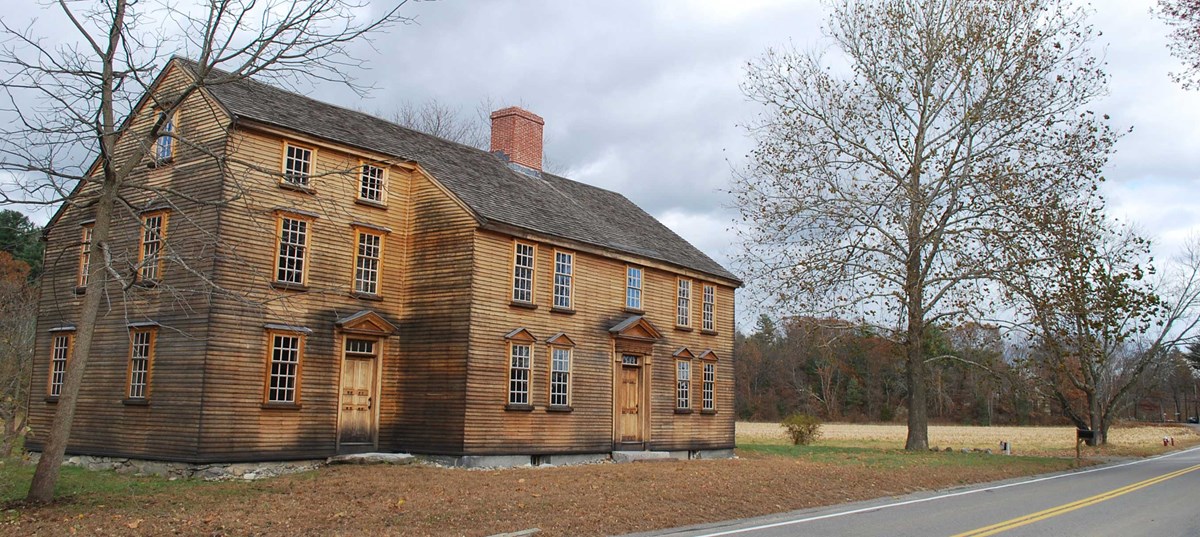
The evidence suggests the provincials captured Potter in Menotomy and then sent him back to Concord, to the house shown above. That was the home of Reuben Brown, a maker of harnesses, saddles, and other leather gear. It stood beside a large workshop on the main road. Brown’s business helps to explain why the regulars took a chaise from his yard to transport their wounded.

The harness-maker lived until 1832 and evidently loved to tell stories about the opening of the war. After he died, the New England Farmer reprinted an obituary from the Boston Courier which said of Brown on that morning:
his wife with her infant children [was] instructed to manage for herself in the woods north of the town, with many other females and infirm people of the place. Mr Brown then mounted his horse again, it being now about day-break, and commenced the task of alarming the neighboring country. And his efforts will need no comment when we say that he rode that day about 120 miles in the performance of this noble duty.
Likewise, the author of a profile of Gen. Benjamin Lincoln published in The National Portrait Gallery of Distinguished Americans in 1865 mentioned:
The writer has frequently conversed with a venerable citizen of Concord [named in a footnote as Brown], since deceased, then an artisan in the village, who, having at the first news of the approach of the enemy some time before day-break, commenced the voluntary labor of alarming the neighboring country, actually rode on horseback more than one hundred miles during the next twenty-four hours…
Apparently Brown wasn’t even home for most of the day of the battle. It’s therefore unclear why Lt. Potter ended up in Brown’s house.

But he was there within a couple of days. According to Lemuel Shattuck’s 1835 history of Concord:
Lieutenant Isaac Potter, of the marines, was taken prisoner, and confined some time at Reuben Brown’s. Colonel [James] Barrett was directed, April 22d, to give him liberty to walk round the house, but to keep a constant guard of three men, day and night, to present his being insulted or making his escape.
David Mason was in Concord working with Barrett to prepare cannon for the provincial army. Mason wrote “Lieut Potter of the Marines” in a notebook, so he must have crossed paths with the prisoner, too.

TOMORROW: Lt. Isaac Potter, house guest.

Friday, April 26, 2019

“Drive them British from that bridge”

As I discussed yesterday, the militia companies from the western side of Sudbury were better equipped than those on the east side. Under Lt. Col. Ezekiel How, Capt. Aaron Haynes, and Capt. John Nixon, they responded first when the alarm arrived on 19 Apr 1775.

Among those west Sudbury men was Josiah Haynes, a farmer born in 1696. He had served as a selectman and became a deacon in 1733. At age seventy-eight, Haynes no longer required to do militia duty—he was getting too old for that stuff. Nevertheless, on the morning of 19 April he turned out with his neighbors.

According to Lemuel Shattuck’s 1835 history of Concord, the two companies “received orders from a person stationed at the entrance of the town for the purpose of a guide, to proceed to the north instead of the south bridge.” That Concord man was later identified as Stephen Barrett (1750-1824), son of Col. James Barrett, commander of a Middlesex County militia regiment.

J. H. Temple’s 1887 History of Framingham said that the first order for Capt. Nixon’s Sudbury minutemen was to halt within sight of the South Bridge. At mid-morning British regulars showed up to hold that choke point as others searched designated properties in town.

Some Sudbury men wanted to attack those soldiers. Deacon Haynes reportedly told the captain, “If you don’t go and drive them British from that bridge, I shall call you a coward!” Nixon replied, “I should rather be called a coward by you, than called to account by my superior officer, for disobedience of orders.” Eventually orders arrived for the Sudbury men to march on the North Bridge by a roundabout route that took them past the Barrett farm.

Stephen Barrett’s father was on horseback with the Concord companies, which had withdrawn as the British column arrived and massed on the far side of the North Bridge on Punkatasset Hill. Barrett was also the principal custodian of the Massachusetts Provincial Congress’s artillery and other supplies in town. [See The Road to Concord for more details.]

Stephen’s mother, Rebeckah, was at the family home, watching British soldiers search the place for those weapons. Thanks to hard work by the Barretts and their neighbors in recent days, all of that ordnance had been hauled away and hidden. The regulars found only some carriage wheels, which they set about burning.

The Sudbury companies passed within sight of the Barrett farm while the British were at work. Lt. Col. How reportedly looked at the scene and said, “If any blood has been shed, not one of the rascals shall escape.” Shattuck wrote that he rode on alone to find out for sure, “disguising himself”—which might just have meant leaving his weapons behind so he looked like an ordinary farmer.

According to an 1875 account in Harper’s Magazine, How went all the way to Barrett’s farm and even talked with some of the British officers. Stephen Barrett also returned home around this time. Soldiers realized he was a Barrett and put him under arrest. Rebeckah Barrett intervened, pointing out that Stephen was her son, not her husband.

How rejoined the Sudbury men and they moved on, avoiding a clash with British troops for the second time that morning. But as they neared Punkatasset Hill, the provincials and the regulars started trading shots. The Sudbury companies hurried forward and joined in pushing the regulars away from the North Bridge before withdrawing again.

All the provincial companies that had arrived in Concord moved east, skirting the town center and taking positions to attack the British soldiers as soon as they left the populated area. That was the real start of the battle. The Sudbury militiamen joined in that fight, following the regulars east.

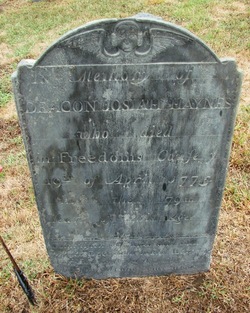
Somewhere in Lexington, old Deacon Haynes was shot and died. Here is his gravestone in Sudbury, courtesy of Find-a-Grave.

The inscription reads:
In Memory of
DEACON JOSIAH HAYNES
who died
in Freedoms Cause ye
19th of April, 1775.
In the 79th
Year of his Age.

Come listen all unto this call
Which God doth make today
For You must die as well as I
And pass from hence away

Wednesday, April 17, 2019

“Paul Revere never made the midnight ride”?

A lot of legend grew up around the American Revolution in the late 1800s, and Henry W. Longfellow’s poem “Paul Revere’s Ride” made the events of 18-19 Apr 1775 especially famed and susceptible to mythologizing.

In the early 1900s the pendulum swung the other way, toward debunking and skepticism. This is when the story of Boston’s stolen militia cannon dropped out the standard telling—that story seemed too dramatic to be true. Sometimes debunking went too far.

Here’s another example from the 29 Nov 1908 New York Times—a story headlined “Paul Revere’s Ride Is Fiction, He Says”:
Walter Benjamin, publisher of The Collector, has in his possession a letter which he believes proves conclusively that Paul Revere never made the midnight ride attributed to him by Longfellow and tradition.

The document is a letter from John Hancock to Elbridge Gerry, dated Lexington, April 18, 1775, at 9 o’clock. . . . The message reads:
Dear Sir: I am much obliged for your notice. It is said the officers are gone along the Concord Road, and I will send word thither. I am full with you that we ought to be serious, and I hope your decision will be effectual. I intend doing myself the pleasure of being with you tomorrow. My respects to the committee. I am your real friend, JOHN HANCOCK.
Mr. Benjamin says that it Hancock of the Committee of Safety, knew at 9 o’clock that the troops had gone along the Concord road and hoped they would be “serious,” that Lexington and Concord were fully aroused to the danger of the coming of British troops, and that there would be no need for Paul Revere. . . .
The article noted that a version of this letter had been published in the 1828 biography of Gerry, but without the time included. Benjamin argued that the omission of “at 9 o’clock“ meant people hadn’t realized its significance.

On the other hand, the Times continued, “the learned professors…did manage to find a plain prose version of Paul Revere among the old manuscripts of the Massachusetts Historical Society papers.” The article summarized Revere’s own account, which the M.H.S. had published in 1798 and certainly wasn’t hiding from view.

The Times story concludes:
However, the historians are not altogether satisfied with the Revere letter, for he wrote it in 1798, twenty-four years after the ride, and, conceding his honesty, his memory might easily have been bad. Considering the many doubts which the learned have come to have of Paul Revere’s ride, Mr. Benjamin believes that the evidence contained in the Hancock-Gerry letter shows that it never happened at all, outside Longfellow’s poems.
Benjamin made a couple of errors in interpreting the document he’d bought. First, Gerry and Hancock exchanged notes about a squad of “officers,” not the full “coming of British troops.” Those officers were mounted scouts with a mission of stopping messengers from getting out of Boston and into Concord. The hundreds of grenadiers and light infantrymen who followed the scouts presented a much bigger threat. About three hours after Hancock wrote his note, Revere reached Lexington with news of that column.

Benjamin’s second error was concluding that the letter showed “Lexington and Concord were fully aroused to the danger of the coming of British troops” before Revere arrived. They were only partially aroused. James Barrett’s household was busy moving the most valuable weaponry off his Concord farm. The sight of the mounted officers caused Sgt. William Munroe to summon a guard at the Lexington parsonage. But again, news of the much larger column of soldiers increased the alert level in both towns, producing the full militia alarms.

It looked like this debunking was itself quickly debunked and didn’t affect early-20th-century recountings of the Battle of Lexington and Concord. The letter itself appears to have stayed in private collections because authors continued to quote the published version only.

Then in 2014, Hancock’s letter to Gerry was displayed in an excellent exhibit at the Concord Museum. I saw it there and grabbed a brief quotation for The Road to Concord. (My transcription varies a bit from both the Gerry bio and this Times article, but not meaningfully.)

Saturday, April 07, 2018

Patriots’ Day Season at Minute Man Park, 7-21 Apr.

The Patriots’ Day season is upon us, so I’ll focus for several days on details and commemorations of the Battle of Lexington and Concord and the start of the Revolutionary War.

Minute Man National Historical Park has a bunch of free events lined up, starting today. For additional information, check its website. In addition, there are commemorations and events not on park land but in nearby towns such as Lexington, Bedford, and Arlington; visit the Battle Road website for those.

Saturday, 7 April, 1:00 P.M. 
Meriam’s Corner Exercise
737 Lexington Road, Meriam’s Corner, Concord
The Town of Concord, joined by area minute companies, fife and drum units, and the Concord Independent Battery, pay remembrance to the fight at Meriam’s Corner that marked the beginning of the six-hour running battle back to Boston.

Saturday, 7 April, 3:00 P.M. 
Paul Revere Capture Ceremony
Paul Revere Capture Site, 200 North Great Road, Lincoln
The Lincoln Minute Men and the Town of Lincoln, joined by other reenactment units, observe the historic capture of Paul Revere with fife and drum music and a musket fire salute.

Saturday, 14 April, 7:00 A.M.
Tough Ruck and Captain Brown’s Company of Minute Men
Step off at The Old Manse field, adjacent to North Bridge, Concord
Minute Man National Historical Park is honored to once again host the “Tough Ruck,” military personnel marching in memory of our fallen soldiers. Support our soldiers and veterans in this 26.2-mile hike along the historic Battle Road Trail. The ruck will kick off with a musket volley from the North Bridge.

Saturday, 14 April, 9:30 A.M. to 5:30 P.M.
Life at Hartwell Tavern
136 North Great Road, Lincoln
Park staff, Lincoln Minute Men, and living history volunteers will be demonstrating various aspects of life in Massachusetts at the beginning of the American Revolution.

Saturday, 14 April, 10:00 A.M. to 12:00 noon and 2:00 to 5:00 P.M.
Visit Whittemore House 
Behind Minute Man Visitor Center, Rte. 2A, Lexington
Whittemore House will be staffed by costumed park volunteers demonstrating what life was like in 1775. Try on colonial children’s clothing, gather ingredients for a meal, and listen to stories of the Whittemore family and their experience of April 19, 1775.

Saturday, 14 April, 10:30 A.M.
Explore Bloody Angle with Edmund Foster
Hartwell Tavern, 136 North Great Road, Lincoln
Edmund Foster, a volunteer from Reading, Massachusetts (portrayed by Park Volunteer Ed Hurley), will lead a tour to this key battle site where he fought in 1775.

Saturday, 14 April, 11:30 A.M.
1st Michigan Colonial Fife and Drum Corps
Amphitheater, Minute Man Visitor Center, Rte. 2A, Lexington
Listen to military music of the American Revolution and get into the spirit of Patriots’ Day!

Saturday, 14 April, 9:30 A.M. to 12:15 P.M.
Caught in the Storm of War: Civilians of April 19th
Captain William Smith House, 136 North Great Road, Lincoln
What would you take with you if you had to leave your home in a hurry, uncertain of your return? Learn about the local civilians on April 19, 1775. Once the refugees leave the Smith house, you may encounter them along the Battle Road Trail heading towards Lexington and the Minute Man Visitor Center just prior the the Parker’s Revenge Battle Demonstration. The Smith house will remain open until 4:00 P.M.

Saturday, 14 April, 1:00 P.M.
Parker’s Revenge Battle Demonstration
Battle Road Trail behind Minute Man Visitor Center, Rte. 2A, Lexington
Hundreds of British and colonial reenactors will engage in a tactical weapons demonstration with musket firing and fast-paced battle action along a stretch of the actual Battle Road of 1775. This is one of this year’s major events, newly informed by archeological findings.

Sunday, 15 April, 1:00 to 4:00 P.M.
Warlike Preparations: British Soldiers Search the Barrett House
Colonel James Barrett House, 448 Barrett’s Mill Road, Concord
In 1775, Colonel James Barrett of Concord was responsible for safeguarding all the military supplies in town, and his house was searched by British soldiers during their mission to Concord. Visit the Barrett House and learn about the intense military preparations that helped launch America into the Revolutionary War. Around 3:00, redcoats will arrive and search the property for arms and supplies.

Sunday, 15 April, 2:00 P.M.
Revolutionary Dogs: “Paws for the Cause!”
Minute Man Visitor Center, Rte. 2A, Lexington
Join Park Ranger Roger Fuller for a walk on the Battle Road to explore the lives of dogs in colonial America and in the Revolution. The 45-minute walk starts at Minute Man Visitor Center and is open to all, including well-behaved, friendly dogs on leashes.

Monday, 16 April, 8:45 A.M. 
Commemoration of the North Bridge Fight and Concord Parade
North Bridge, Concord
British reenactors will be joined by the Acton Minutemen and other local companies for a special commemoration of the North Bridge Fight featuring musket volleys. The Concord Parade will arrive at North Bridge around 9:30 A.M. All of the roads in the center of town are closed to vehicles beginning at 8:30 A.M.

Wednesday, 18 April, 7:50 to 8:45 P.M.
The Patriot Vigil
North Bridge, Concord
As darkness descends upon the North Bridge battlefield, we invite you to come and reflect on the events of April 19, 1775, and the meaning of liberty. The evening ceremony will feature a lantern-light procession stepping off from North Bridge Visitor Center at 7:50, poetry, music, and a recitation of the names of Patriots who gave their lives on that “ever-memorable” 19th of April. (To participate in the procession, bring an enclosed real candle lantern; no flashlights or L.E.D. bulbs.)

Thursday, 19 April, 6:00 A.M. to 12:00 noon
Salutes from the Bridge
North Bridge, Concord
A series of musket and cannon salutes from the bridge at various times of the day. 6:00 A.M.: The Concord Minute Men and the Concord Independent Battery. 10:00 A.M. (approximately): The Molly Cutthroats, a living-history group dedicated to the role of women in the Revolution. 11:30 A.M.: The Sudbury Companies of Militia and Minutemen. 12:00 noon (approximately): Sons of the American Revolution, Henry Knox Color Guard.

Saturday, 21 April, 4:30 - 8:30 p.m.
After the Battle: The War Has Begun
Hartwell Tavern, 136 North Great Road, Lincoln
War between the people of Massachusetts and Gov. Thomas Gage and the British regulars has just broken out. Thousands of men are preparing to leave home for the front lines around Boston. Whole communities are faced with numerous challenges demanded by this frightening new reality. Step back into the year of 1775 and get involved. Recommended donation: $5 per person, $10 per family. Children wearing a Junior Ranger badge (which can be earned on 14 or 21 April) admitted free.