J. L. BELL is a Massachusetts writer who specializes in (among other things) the start of the American Revolution in and around Boston. He is particularly interested in the experiences of children in 1765-75. He has published scholarly papers and popular articles for both children and adults. He was consultant for an episode of History Detectives, and contributed to a display at Minute Man National Historic Park.

Subscribe thru Follow.it


•••••••••••••••••


Showing posts with label James Madison. Show all posts

Friday, July 03, 2026

“They unanimously pressed on myself alone to undertake the draught”

A few days after Timothy Pickering delivered an Independence Day oration in Salem in 1823, casting doubt on Thomas Jefferson’s importance in drafting the Declaration of Independence, Joseph E. Sprague (1782–1852) sent the text of that speech to Jefferson himself:
Supposing you might feel some little curiosity to see Col Pickering unwilling & ungrateful tribute to the illustrious Author of the Declaration of Independence I have taken the liberty to enclose it to you
Sprague was a postmaster and a Jeffersonian politician between terms in the Massachusetts House, so he had time to stir up trouble.

Near the end of the month Jefferson shared his version of the drafting story with his good friend and ally James Madison:
You have doubtless seen Timothy Pickering’s 4th of July Observations on the Declaration of Independance. if his principles and prejudices personal and political, gave us no reason to doubt whether he had truly quoted the information he alledges to have recieved from Mr [John] Adams, I should then say that, in some of the particulars, mr Adams’s memory has led him into unquestionable error. at the age of 88. and 47. years after the transactions of Independance, this is not wonderful.

nor should I, at the age of 80, on the small advantage of that difference only, venture to oppose my memory to his, were it not supported by written notes, taken by myself at the moment and on the spot.

he says ‘the Committee (of 5. to wit, Dr [Benjamin] Franklin, [Roger] Sherman, [Robert R.] Livingston and ourselves) met, discussed the subject, and then appointed him and myself to make the draught; that we, as a subcommittee, met, & after the urgencies of each on the other, I consented to undertake the task; that the draught being made, we, the subcommittee, met, & conned the paper over, and he does not remember that he made or suggested a single alteration.’ now these details are quite incorrect.

the Committee of 5. met, no such thing as a subcommittee was proposed, but they unanimously pressed on myself alone to undertake the draught.

I consented; I drew it; but before I reported it to the committee, I communicated it separately to Dr Franklin and mr Adams requesting their corrections; because they were the two members of whose judgments and amendments I wished most to have the benefit before presenting it to the Committee; and you have seen the original paper now in my hands, with the corrections of Doctor Franklin and mr Adams interlined in their own hand writings   

their alterations were two or three only, and merely verbal. I then wrote a fair copy, reported it to the Committee, and from them, unaltered to Congress. this personal communication and consultation with mr Adams he has misremembered into the actings of a sub-committee.
Jefferson didn’t write to Madison because he thought his friend might need convincing about this story. Rather, he was writing for posterity, putting his version of history on paper for us.

Though Pickering quoted John Adams’s letter, Jefferson took pains to excuse Adams of any fault but poor memory. By this time the two men had been corresponding amicably for over a decade. Indeed, Jefferson praised Adams in his letter:
had mr Adams been so restrained, Congress would have lost the benefit of his bold and impressive advocations of the rights of revolution. for no man’s confident & fervid addresses, more than mr Adams’s, encoraged and supported us thro’ the difficulties surrounding us, which, like the ceaseless action of gravity, weighed on us by night and by day. . . . he supported the declaration with zeal & ability, fighting fearlessly for every word of it.
Jefferson was less respectful of the arch-Federalist Pickering, though:
Timothy thinks the instrument the better for having a fourth of it expunged. he would have thought it still better had the other three fourths gone out also, all but the single sentiment (the only one he approves) which recommends friendship to his dear England, whenever she is willing to be at peace with us.
TOMORROW: Doctor’s advice.

Sunday, May 31, 2026

“Declaring Independence: Declaration to Constitution” in Boston, 1 June

On Monday, 1 June, the Massachusetts Historical Society will host a panel discussion titled “Declaring Independence: Declaration to Constitution.” The guiding question will be whether the promises of the Declaration of Independence shaped the Constitution.

The event description says:
America’s founding documents have echoed throughout global history and culture for more than two centuries. Join us to learn more about how these two documents are related—and how they differ. Why did revolutionaries like John Adams and his peers draw on the past as they drafted the Declaration and crafted the Constitution? What ideas shaped the United States’ working definition of liberty, and how did that translate to audiences abroad? Explore how “we the people” imagined a new political vocabulary to interpret the American experiment, which we continue today.
The panelists will be:
  • Emily Sneff, author of When the Declaration of Independence Was News
  • Mary Sarah Bilder, professor at Boston College Law School and author of Madison’s Hand
  • Sara Georgini, series editor at the Adams Papers, moderator
For in-person attendees, the evening will start with a chance to view the exhibit “1776: Declaring Independence” and a reception starting at 5:30 P.M. The conversation and its livestream will begin at 6 P.M.

Register from this page. Attending in person costs $10, free for M.H.S. members and Card to Culture participants. Listening in online will be free, and the society usually posts recordings of its events on YouTube a few days afterward.

Saturday, July 19, 2025

Nominees for the 2025 George Washington Book Prize

The finalists for the 2025 George Washington Book Prize, all history titles published last year, have been announced.

In alphabetical order of the author’s surname, they are:
  • Jane E. Calvert, Penman of the Founding: A Biography of John Dickinson (Oxford University Press)
  • Francis D. Cogliano, A Revolutionary Friendship: Washington, Jefferson, and the American Republic (Harvard University Press)
  • Michael D. Hattem, The Memory of ’76: The Revolution in American History (Yale University Press)
  • Tyson Reeder, Serpent in Eden: Foreign Meddling and Partisan Politics in James Madison’s America (Oxford University Press)
  • Cara Rogers Stevens, Thomas Jefferson and the Fight against Slavery (University Press of Kansas)
The sponsors of this prize are Mount Vernon, the Gilder Lehrman Institute of American History, and Washington College. Mount Vernon will host an event featuring all the authors on 12 August, and the winner will be announced at a gala dinner in New York on 8 October.

Thursday, January 23, 2025

“To regulate the collection of duties”

As the U.S. House of Representatives discussed its first significant law, establishing import tariffs, the members took up two closely related challenges:

  • how to actually collect those duties.
  • a “tonnage” tax on ships entering American harbors.
On 21 April the House took up the latter question as a committee of the whole with James Madison proposing “a duty of six cents per ton on all vessels built in the United States” or owned by U.S. citizens as “necessary for the support of light-houses, hospitals for disabled seamen, and other establishments incident to commerce.”

That was a pretty low tax, but the legislators went on to consider vessels owned or partly owned by foreigners, whether those foreigners were from countries allied to the U.S. of A., and so on. These ships were to be charged five to eight times more. A bill was proposed on 7 May and approved on 29 May.

As to collecting the new taxes, the House as a committee started discussing that on 18 May. Members noted that the federal government’s approach had to be equal in all states. The next day, Elias Boudinot proposed establishing executive branch departments including a “Secretary of Finance,” soon changed to a Treasury. By British precedent, the collection of duties would fall under that department.

On 27 May, Rep. Thomas Fitzsimons of Pennsylvania presented his committee’s proposal “to regulate the collection of duties.” The House got down to details on 2 June, listing U.S. ports of entry (skipping Narragansett Bay since Rhode Island wasn’t yet participating in the federal government). A week later, the House agreed that the government should appoint a collector, naval officer, and surveyor for the nine biggest ports.

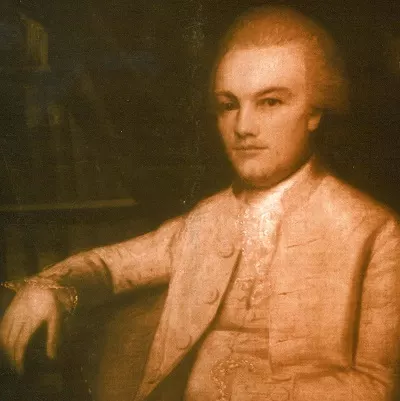
On 29 June Rep. Benjamin Goodhue (1748–1814, shown here) of Massachusetts reported that the committee had “prepared an entire new bill” to incorporate all the proposed changes.

On the first day of July, the House voted 31–19 in favor of the tonnage bill. The Senate concurred on 7 July. The House approved the bill on collecting duties on 14 July, the Senate two weeks later. Those bills went to President George Washington, who signed them on 20 and 31 July, respectively.

Disregarding the initial law that established oaths of office, those were the second and fourth laws of the new U.S. government. (The third established a Department of Foreign Affairs.)

Thus, the collection of revenue from goods imported into the U.S. of A. was the first substantive action of the first Congress, the first meaningful law signed by the first President. The U.S. government has been collecting tariffs on imported goods for over two centuries. There’s a system in place.

The current President appears ignorant of that history, ordering that three Cabinet officers “investigate the feasibility of establishing and recommend the best methods for designing, building, and implementing an External Revenue Service (ERS) to collect tariffs, duties, and other foreign trade-related revenues.”

Of course, that current President has long shown ignorance of how tariffs work. As the New York Times reported, “Trade experts said that, despite the name ‘external,’ the bulk of tariff revenue would continue to be collected from U.S. businesses that import products.” The members of the first U.S. Congress, having gone through a war with its roots in a conflict over tariffs, understood how those taxes worked.

Tuesday, January 21, 2025

“Power To lay and collect Taxes, Duties, Imposts and Excises”

The U.S. Constitution, in Article I, Section 7, states:
All Bills for raising Revenue shall originate in the House of Representatives; but the Senate may propose or concur with Amendments as on other Bills.
The next section begins:
The Congress shall have Power To lay and collect Taxes, Duties, Imposts and Excises,…but all Duties, Imposts and Excises shall be uniform throughout the United States;…
Under that Constitution, men elected to the U.S. House of Representatives met for the first time on 4 Mar 1789. They quickly saw they didn’t have a quorum. Those men gathered six days a week until 1 April, when finally enough Representatives arrived.

For the next couple of weeks, the House got itself organized: electing a speaker (Frederick Muhlenberg), choosing a clerk and other staff, establishing an oath of office, and composing rules. On 6 April members participated in counting the electoral votes. (Spoiler: George Washington won.)

On Wednesday, 8 April, the House “resolved itself into a Committee of the Whole on the state of the Union.” That bland language meant the legislators were taking themselves off the official record in order to discuss something that could be controversial—in this case, those import duties that the Constitution empowered them to enact. This was the first substantial issue the House took up, the first potential law that affected more than the workings of the government itself.

According to Debates in Congress, compiled decades later, Rep. James Madison of Virginia was first to speak on this subject “of the greatest magnitude.” He suggested starting with the “propositions made on this subject by Congress in 1783,” at least as “the temporary system.”

Madison read off the list of imported goods that the Continental Congress proposed should be taxed. Elias Boudinot of New Jersey endorsed that proposal. The next day, John Laurance of New York argued that an across-the-board duty would be easier and quicker than enumerating what to tax and how much. But there was general agreement that the federal government should start collecting import duties.

Meanwhile, messages started to come in from interest groups: manufacturers in Baltimore, shipwrights in Charleston, and so on. Domestic manufacturers wanted higher tariffs to help their businesses. Merchants wanted lower tariffs to keep down their costs. Ship builders and owners wanted preferential treatment for American vessels. As for consumers, who would ultimately pay higher prices, they weren’t really organized.

On 28 April, a House committee proposed a series of duties on various imported commodities and goods, from Jamaica rum and cheese to millinery and walking-sticks. There were higher tariffs on distilled spirits from “any State or Kingdom not in alliance with the United States” and on teas brought in on ships owned by foreigners. On 5 May, the committee presented the text of a law to enact those duties.

Tariffs have thus been part of American legislation from the beginning of the federal government—even before, considering how Madison was calling on a precedent from the preceding Congress. Those taxes were in fact the main source of revenue for the national government for many decades. But the first Congress understood two things:
  • As revenue measures, those tariffs had to originate in the House, not be imposed by the executive.
  • Imposing tariffs required discussion and careful balancing of the benefits and costs.
TOMORROW: Making law.

Saturday, December 28, 2024

False Witness about What James Madison Wrote

Earlier this year, the Louisiana legislature passed a law requiring all public schools in the state to display a particular edited version of the Ten Commandments in a particular size starting on 1 Jan 2025.

A federal judge has blocked that law from taking effect on the grounds that it clearly violates the U.S. Constitution’s First Amendment bar on governments establishing religion.

In attempting to justify itself, the law cites some historical facts about earlier invocations of religion in American civic life, though not the Ten Commandments. The law’s only citation specifically mentioning those supposedly foundational rules is:
History records that James Madison, the fourth President of the United States of America, stated that “(w)e have staked the whole future of our new nation . . . upon the capacity of each of ourselves to govern ourselves according to the moral principles of the Ten Commandments”.
That is, however, a lie. The editors of the James Madison Papers have said that those words don’t appear in his writings, and that idea is antithetical to what Madison did write about the basis of the Constitution and the place of religion in government.

Three books published in 1989 attributed those words to Madison:
  • George Grant, Trial and Error: The American Civil Liberties Union and Its Impact on Your Family.
  • Mark A. Belilies and Stephen McDowell, America’s Providential History.
  • David Barton, The Myth of Separation.
All three were written by fundamentalist Christian ministers publishing through fundamentalist Christian presses (in Barton’s case, through his own organization).

As his source for the Madison quotation, and for other claims, Grant pointed to Harold K. Lane’s Liberty! Cry Liberty! (Boston: Lamb & Lamb Tractarian Society, 1939). Beliles and McDowell offered no citation. Barton cited Beliles and McDowell.

In his 1992 reissue of The Myth of Separation, Barton changed his citation to match Grant’s Liberty! Cry Liberty! and added a 1958 issue of Progressive Calvinism, itself citing that year’s calendar from the Spiritual Mobilization organization.

Authors defending Barton and themselves against the charge of lying about the quotation point to Liberty! Cry Liberty! as evidence that people have attributed those words to Madison since 1939. Except that citation also appears to be a lie.

Chris Rodda has detailed her unsuccessful quest to find a copy of Liberty! Cry Liberty! anywhere. It’s not in the Library of Congress or Harvard University, the nation’s two largest repositories. The book has no entry in WorldCat. Nor is there other evidence of the publisher or author existing. Grant has never supplied a copy or explained where he saw one.

Rodda has made a convincing case that the real source of this “quotation” are speeches that law school dean Clarence Manion delivered in the early 1950s in support of the Bricker Amendment. Manion interspersed accurate quotations from Madison with his own exegeses, which of course reflected his own ideas of politics and religion and which many Madison experts disagree with. Later in that decade, it appears, people assembling non-scholarly religious publications assigned Manion’s words to Madison himself.

After that, a series of authors saw a “quotation” from a famous Framer that confirmed their existing belief and repeated it without checking for an original source, all the way to the Louisiana law. So is this a simple chain of error, the authors to be blamed for no more than carelessness?

I don’t think the idea of simple mistakes is tenable. For one thing, someone came up with that suspicious citation of Liberty! Cry Liberty!, and many other people have repeated it without anyone apparently confirming the publication even existed.

Secondly, scholars pointed out the falsehood of the Madison quotation decades ago. The Madison Papers editors addressed it in 1993. Robert S. Alley published about it in the William & Mary Bill of Rights Journal in 1995. The Washington Post published a letter about it in 1999. Chris Rodda wrote out her investigation in 2016.

Even Barton and his organization now acknowledge that the Madison quotation is “unconfirmed” after more than twenty years of zealous searching. (I’ve discussed other obvious errors from Barton here and here. And we mustn’t forget how Barton’s effort at publishing through a religious press with higher standards was recalled in 2012.)

In sum, the Louisiana legislature used a false claim to justify promulgating a particular religious text to schoolchildren. That claim had been publicly shown to be false before the parents of some of those children were even born. The lack of evidence for that claim can easily be found through a simple web search, including at the website of the author most responsible for spreading the falsehood. That doesn’t add up to simple carelessness. That’s educational negligence.

TOMORROW: What The New England Primer says about the Ten Commandments.

Saturday, November 02, 2024

“Apprehensive, that the Government of these States, may in future times, end in a Monarchy”


Last month the Journal of the American Revolution published Ray Raphael’s article “A Kingly Government?: Benjamin Franklin’s Great Fear.”

Franklin and James Madison were among the most vocal of the men at the Constitutional Convention wary of assigning too much power to the executive branch, or investing too much of that power in one man.

Ray Raphael writes:
Madison opened the bidding. Wouldn’t it be “proper,” he asked, “before a choice should be made between a unity and plurality in the Executive, to fix the extent of the Executive authority?” Madison proposed minimal powers: “to carry into execution the national laws” and “to appoint offices in cases not otherwise provided for.” With little dissent, state delegations agreed. Executive authority was subservient to legislative demands, save only for some lesser appointments. Most significantly, he/they would not possess the “powers of war and peace.”
Later the debate turned to whether there would be a single executive and how long one man would hold that office:
Franklin stewed over the prospect of a single executive serving for seven years. “Being very sensible of the effect of age on his memory,” he told the Convention the next morning, he carefully wrote down his objections. Saddled with a weakened voice and failing eyes, he would find it difficult to read aloud what he had just penned, so James Wilson offered to read it for him:
It will be said, that we don’t propose to establish Kings. I know it. But there is a natural inclination in mankind to Kingly Government. It sometimes relieves them from Aristocratic domination. They had rather have one tyrant than five hundred. It gives more of the appearance of equality among Citizens, and that they like. I am apprehensive therefore, perhaps too apprehensive, that the Government of these States, may in future times, end in a Monarchy.
I’d like to refute Franklin’s belief in “a natural inclination in mankind to Kingly Government.” However, too many people speak of U.S. Presidents as solely responsible for laws, court decrees, wars, and other actions that the Constitution explicitly assigns to other branches. And a smaller but still too large number of people are attracted to obvious strongmen.

Back in 1787, as the convention went on, however, most delegates seem to have let those worries subside a bit. The example of George Washington in the chair probably had an influence. No better solutions presented themselves.
We know that Franklin and Mason opposed a single executive, fearing the extent of his powers. They had sounded the alarm at the outset of the convention, and [George] Mason’s opposition to ratification would highlight the dangers of a single executive as well as the absence of a bill of rights. But Madison’s concern has received scant attention. A chief architect of the Constitution’s checks and balances, he failed to gain traction for this protection against an executive who put himself over country. Convention fatigue might well have played a role.
The Constitution did explicitly reserve “powers of war and peace” for the legislature, and limited the single executive to a four-year term. While the British Crown could veto legislation, a U.S. President’s veto could be overridden. Still, the fear of a President taking on monarchical powers and the rest of the government being unable or unwilling to stop it remained.

Ray Raphael’s article ends with Franklin’s exchange with Elizabeth Powel, as recorded by James McHenry:
Well Doctor what have we got a republic or a monarchy. A republic replied the Doctor if you can keep it.
(I’ve discussed that anecdote at length since 2017.)

Friday, November 01, 2024

“Whether societies of men are really capable or not, of establishing good government”

From the first “Publius” essay, written by Alexander Hamilton and published on 27 October 1787 in the Independent Journal of New York:
It has been frequently remarked, that it seems to have been reserved to the people of this country, by their conduct and example, to decide the important question, whether societies of men are really capable or not, of establishing good government from ref[l]ection and choice, or whether they are forever destined to depend, for their political constitutions, on accident and force.

If there be any truth in the remark, the crisis, at which we are arrived, may with propriety be regarded as the æra in which that decision is to be made; and a wrong election of the part we shall act, may, in this view, deserve to be considered as the general misfortune of mankind.. . . .

…a dangerous ambition more often lurks behind the specious mask of zeal for the rights of the people than under the forbidden appearance of zeal for the firmness and efficiency of government. History will teach us that the former has been found a much more certain road to the introduction of despotism than the latter, and that of those men who have overturned the liberties of republics, the greatest number have begun their career by paying an obsequious court to the people; commencing demagogues, and ending tyrants.
In 1788 most of those essays were collected as The Federalist: A Collection of Essays, with eight more appearing in the New York newspapers after that.

A French edition of 1792 named the authors behind “Publius” as Hamilton, James Madison, and John Jay.

In the late 1800s authors began to refer to the essays as “the Federalist papers,” and eventually they came to have the title most people use for them now: The Federalist Papers.

Thursday, September 26, 2024

Copy of the Proposed New Constitution for Sale in North Carolina

Document dealer Seth Kaller alerted me to an unusual artifact up for sale through Brunk Auctions on Saturday, 28 September.

At the end of the Constitutional Convention, that body sent its report to the Confederation Congress, then meeting in New York. That report took the form of the draft constitution.

The Congress accepted that report and had 100 copies printed on 28 Sept 1787. Charles Thomson, the Congress’s secretary, sent official copies to the states with the invitation to convene ratification conventions.

In North Carolina, Gov. Samuel Johnston presided over a convention in Hillsborough from 21 July to 4 August 1788. In the end they voted 184 to 84 to…reach no decision. The Anti-Federalist contingent insisted on a Bill of Rights, among other things. But they weren’t ready to reject the document outright.

All of the other states but Rhode Island did approve the new Constitution, however—some linking that approval to a Bill of Rights (saying “yes as long as…” rather than “no unless…”). The new federal government formed with only eleven states participating.

On 10 May 1789, Gov. Johnston and the North Carolina Council approved an address to George Washington, congratulating him on becoming President. That letter expressed hope that Congress would start the process of adding to the Constitution to “remove the apprehensions of many of the good Citizens of this State for those liberties for which they have fought and suffered in common with others.”

Washington was too ill to reply right away, but on 19 June he wrote back that he was “impressed with an idea that the Citizens of your State are sincerely attached to the Interest, the Prosperity and the Glory of America.”

In a letter to Rep. James Madison, Johnston responded, “Every one is very much pleased with the President’s answer to our Address. I have agreeably to your Wishes published them…” The exchange appeared in the State Gazette of North Carolina and in a broadside.

On 25 September, Congress approved twelve amendments to the Constitution. In November, North Carolinians gathered for another discussion of ratification, once again under Gov. Johnston. Public opinion had swung in favor of the new form of government, or at least not being left out of it. This time the vote was 194 to 77 for the Constitution.

Johnston then resigned as governor to become one of North Carolina’s first two U.S. Senators. On leaving Congress in 1793, he moved to another plantation, leaving his Hayes Farm in the hands of his son, James Cathcart Johnston. While having children with an emancipated mistress, Johnston never married, and in 1865 he bequeathed the property to his friend Edward Wood.

In recent years the Wood descendants started the process of turning that estate into a public historic site. In 2022, people cleaning the house looked through a file cabinet and found:
  • A copy of the printed Constitution signed by Thomson and evidently sent to North Carolina. This is one of only seven such copies known and the only one in private hands. The last time a copy was sold was in 1891.
  • A 1776 printing of the proposed Articles of Confederation.
  • A printing of the proceedings of the Hillsborough Convention, the one that rejected the Constitution. 
  • A copy of the broadside promulgating North Carolina’s letter to Washington and the new President’s reply.
I happen to be in Mecklenburg County, North Carolina, as I type this, so I could conceivably attend this auction on Saturday. But since I’m here for another event, and since the opening bid for the printed and signed Constitution is $1,000,000, I won’t be in the bidding.

Wednesday, December 07, 2022

Charles Pinckney in Hindsight and the Supreme Court

Yesterday I was struck by Pema Levy’s article at Mother Jones about a false document being cited to the U.S. Supreme Court.

Levy based her article on September essay at Politico by Ethen Herenstein and Brian Palmer, and by briefs that have been filed with the court since.

Levy writes:
Three decades after the Constitution was drafted in Philadelphia, Secretary of State John Quincy Adams set about assembling the government’s official Journal of the Convention. Missing from the records was the proposal submitted by Charles Pinckney of South Carolina [shown here]. So Adams wrote him to request a copy. Pinckney replied with an extraordinary document: a draft that so closely resembled the final Constitution that he would have to have been clairvoyant to have written it. . . .

“At the distance of nearly thirty two Years it is impossible for me now to say which of the 4 or 5 draughts I have was the one,” he replied to Adams’ request in 1818, “but enclosed I send you the one I believe was it.” Oddly, the document was written on paper with a 1797 watermark, matching his accompanying letter. Nonetheless, Adams published it.

The debunkings came fast. James Madison, the convention’s most meticulous notetaker, soon wrote to friends that the draft was inaccurate. Years later, Madison discredited Pinckney’s fraud in writing, explaining the document contained language that had only been arrived at after weeks of debate and could not have been divined before the convention began. Madison, convinced it was a fake, detailed how Pinckney’s supposed draft contradicted a more contemporaneous account of the South Carolinian’s actual proposal.
Max Farrand included the Pinckney document in his comprehensive twentieth-century compilation of documents related to the U.S. Constitution, but with a note and additional documents making quite clear that it was not a reliable historical source. A genuine contemporaneous copy of Pinckney’s actual plan survived in the papers of James Wilson and was published in 1904.

Advocates for the “Independent State Legislature” theory have seized on one small detail in the post-Constitution Pinckney document, arguing that it shows the Framers (not just Pinckney) planned at the start of the Constitutional Convention (not two to four decades later) to give states unlimited power over federal elections.

Levy says:
there is no evidence that the framers of the Constitution intended to give legislatures such authority over federal elections. Nor is there any record this interpretation was accepted in the republic’s early years. In fact, history shows that the independent state legislature theory is a modern invention. . . .

It’s possible that the lawyers…who cited the version of the document in Farrand’s 1911 compendium, simply failed to read past the plan to the historian’s conclusion that it was a fake, and that they likewise failed to read Madison’s public takedown or his private letters expressing doubts, all of which were included by Farrand. Whether they meant to or not, they hung their argument on a fake document because it offered a glimmer of originalist evidence to back up their case.
Historians and legal scholars, including some on the political right, have filed briefs arguing against reliance on this document in particular and the theory being espoused in general.

The response has been legal tap-dancing:
the lawyers filed a new brief defending their use of the Pinckney plan. They argued that the plan was not technically “a fake” because it is “undisputed” that Pinckney wrote it, and allege that the generations of historians who discredited the document were hoodwinked by Madison’s “campaign to diminish the significance of [Pinckney’s] role at the convention.”
Justices on the Supreme Court today have been willing to deny photographic evidence and ignore decades of legal and historical precedent in order to reach the verdicts they want. In this case, a majority could adopt the “Independent State Legislature” theory without mentioning one problematic document. But if the final decisions do mention Pinckney, that will be yet more evidence that the “originalists” on the court aren’t interested in the original Constitution at all.

Saturday, October 22, 2022

Following News Stories about Historical Memory

In August, I passed on news about the sudden closing of a small post office near James Madison’s Montpelier.

The stated reason was an exhibit on segregation in another part of the building, though that exhibit has been up for years. The action came shortly after a dramatic change of leadership at Montpelier.

The latest report from that part of Virginia is that the post office has reopened as suddenly as it closed.

Another story about how we publicly remember the Revolutionary era that I’ve followed involves the far-from-hagiographic murals about George Washington in San Francisco’s George Washington High School. This month N.P.R. ran a story by Jon Kalish about the choices schools face with those and other historic murals which people find problematic for different reasons.

In addition, a documentary on the Washington High School controversy by Deborah Kaufman and Alan Snitow called “Town Destroyer” premiered in California. Here’s the movie’s trailer.

Closer to home (my home), Christ Church in Cambridge is currently the home for an art installation titled “Here Lies Darby Vassall.” It remembers a man born enslaved in one of the “Tory Row” mansions along Brattle Street before the Revolution. He reportedly met Washington when the general moved into the house where his parents were working.

As an adult Darby Vassall maintained a business in Boston and was active in the local abolitionist movement. He died on the eve of the Civil War and was buried in the tomb of the family that once owned him and his own family.

Nicole Piepenbrink’s art installation “Here Lies Darby Vassall” can be viewed from 6:00 to 8:00 P.M. until 6 November.

Sunday, August 14, 2022

Another Dispatch from James Madison’s Montpelier

The Culpepper Star-Exponent is reporting on an odd wrinkle in the already public conflict over historical interpretation at Montpelier, James Madison’s slave-labor plantation.

The U.S. Postal Service closed the small post office near that historic site on short notice in June because, as Allison Brophy Champion reports, “it objected to a historical exhibit there.” The small building that housed the post office is part of the property of the Montpelier Foundation.

A spokesperson told the newspaper, “Service at Montpelier Station was suspended after it was determined the display at the site was unacceptable to the Postal Service.”

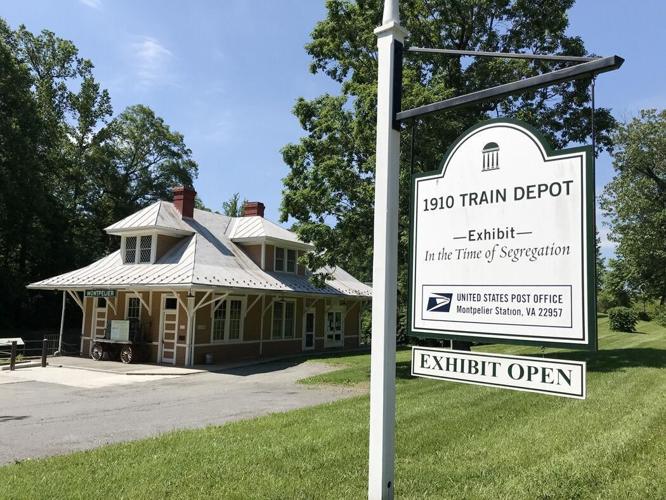
The display at issue consists of one panel on the outside of the building and several more inside—through a door separate from the one that went to the working post office.

The exhibit is titled “In the Time of Segregation,” and it describes segregation at that post office, opened in 1912, and in other services in the Jim Crow states.

Now one might at first guess that this display was a project of the new management at Montpelier. In May, as I described here and here, the Montpelier Foundation resolved months of internal controversy by seating eleven new members representing descendants of people enslaved at that plantation and others nearby, and installing new top management. The organization seemed poised to focus more attention on the site’s history of slavery and segregation.

In fact, the “In the Time of Segregation” exhibit was installed twelve years ago when the post office building reopened after Montpelier restored it. Only in June, within a month of the Montpelier Foundation management change, did some U.S. Postal Service manager deem that presentation of history “unacceptable.”

The post office’s local spokesperson declined to offer any more information and also claimed, “we attempted to address the issue with the property owner.” The head of the Montpelier Foundation told the Star-Exponent, “The U.S. Postal Service did not contact the current CEO or chief of staff, nor did it contact the previous CEO or chief of staff.”

The closure doesn’t affect Montpelier alone. About a hundred people had boxes at that post office because they don’t get mail delivered to their houses nearby. They “were supposed to get temporary postal boxes in Orange,” about four miles away, but that hasn’t happened. The Postal Service also promised a public meeting, but there’s no report of one taking place.

Furthermore, the area’s representative in Congress has told the U.S.P.S. district manager that “To close a post office, the agency is required to make its determination in writing, made available to the customers served by the office, and may not close it until 60 days afterward.” That clearly didn’t happen.

Saturday, June 25, 2022

“The escape of our friend from the most critical danger”

As I’ve been recounting, in the spring of 1790 Edmund Randolph felt torn between his family responsibilities and his duties to the new federal government.

On the one hand, his wife Elizabeth was carrying an apparently dead fetus and fearing she might die.

On the other hand, Edmund had just become the first attorney general of the U.S. of A., and President George Washington was expecting him to return to New York as fast as possible.

On 27 April, Randolph wrote to his friend James Madison, who was in the capital as a member of Congress: “I see no other alternative, than this; that I must surrender the office, if my absence cannot be dispensed with.”

Randolph had asked Madison to tell the President why he couldn’t immediately come to New York. Well, not “tell” exactly. The younger men seem to have been squeamish about informing Washington frankly about Elizabeth Randolph’s medical condition.

On 6 May, Madison tried to assure his friend:
I can not suppose that under your circumstances any criticism can be made on your absence from this place, or that you are under the least necessity of deciding on the alternative which you state.
But he still didn’t report that he’d told the President what was happening, or what the man’s response was.

Fortunately, fate provided a way out of the dilemma. Washington himself got sick! On 19 May, Madison wrote:
The President has been critically ill for some days past, but is now we hope out of danger. His complaint is a peripneumony, united probably with the Influenza. Since my last I have found that I did not go too far in intimating that the cause of your delay would forbid the smallest criticism on it. I earnestly pray that you may no longer have occasion to plead that apology.
And on the same day the situation in Virginia resolved itself as well as could be expected. Well before he got Madison’s news about the President, Randolph wrote on 20 May:
Very unexpectedly a diminished fœtus appeared; manifesting, that it had lost every energy of life for more than four months. The gloom of our house is converted into general satisfaction, at the escape of our friend from the most critical danger.

I have this moment informed the president, that I shall accompany my family by sea, or the head of the bay; and that we shall have no delay, but what may be necessary for Mrs. R. to recover from her temporary weakness.
Elizabeth Randolph did recover, make the trip north, and live for another twenty years. She may not have had another pregnancy after this one; capsule biographies say the Randolphs had six children, but I find lists of only five, the last born in 1788.

TOMORROW: Randolph looks back.

Friday, June 24, 2022

“To intimate the circumstances which you wish him to know”

As I recounted yesterday, in March 1790 Edmund Randolph wrote from Williamsburg, Virginia, to Rep. James Madison (shown here) in New York.

The sad news was that Randolph’s wife Elizabeth appeared to have lost the unborn child she was carrying.

The more dire news was that Randolph wouldn’t be able to come back to New York to resume his job as U.S. attorney general until Elizabeth had passed the fetus and was out of danger—and he wanted Madison to tell that to President George Washington.

On 23 March, Randolph sent Madison his third letter in the space of two weeks: “My dear wife is not better, than when I wrote to you last. I expect something determinate in a few days.”

The mail was unusually slow, so Madison didn’t respond to any of Randolph’s missives until 30 March:
Your favr. of the 15. which requests an immediate acknowledgment, by some irregularity did not come to hand till I had recd. that of the 18, nor till it was too late to comply with the request by the last mail. I have been so unlucky also as to miss seeing the President twice that I have waited on him in order to intimate the circumstances which you wish him to know. I shall continue to repeat my efforts until I shall have an opportunity of executing your commands.
As the end of April approached, Elizabeth Randolph still had the unmoving fetus inside her, and Edmund was feeling even more torn. On 27 April he told Madison:
I have been looking most anxiously for the second communication, which you promised me, as soon as you should have had an interview with the President.

Many times have I endeavoured to break in an easy way to my wife the necessity of my return to N. Y; in order to try her spirits, should I go off. As often has she been thrown into an agitation of real agony.

Prepared as I am, I would have entered upon the journey long ago; and were her indisposition of a common kind, or her situation no more than an usual approach to the increase of our family, I should quit her without hesitation. But she is impressed with a belief, that she cannot escape death, and, altho’ tolerably lively now, would sink, I suspect, into despair, were I to leave her.

What am I to do?
Stay with a wife who’s afraid she’s about to die or hurry back to President Washington? A tough choice for an eighteenth-century American gentleman!

TOMORROW: Can this marriage be saved?

Thursday, June 23, 2022

“The situation of my wife was very alarming”

In February 1790, Edmund Randolph (1753–1813) became the first attorney general of the U.S. of A.

As a young lawyer, Randolph had been one of Gen. George Washington’s first aides de camp to during the siege of Boston. He didn’t stay long, however. The death of his uncle Peyton Randolph in October 1775 took him back to Virginia to manage family affairs.

The next year, Randolph married Elizabeth Nicholas. He remained in Virginia during the war, serving in political posts, and won a term as governor in 1786.

At the Constitutional Convention of 1787, Randolph declined to sign the document. Nonetheless, as chair of his state’s ratifying convention, Randolph convinced some fellow skeptics to vote for the document while hoping for amendments.

President Washington pressed Randolph to join him in setting up the federal government in New York. Randolph started work as attorney general, then returned to his home in Williamsburg, Virginia, to fetch his family. On 10 March, he wrote back to a fellow Virginian in the capital, James Madison:
After a fatiguing journey we arrived here on sunday evening, when I found all my family well, except my wife, who, I fear, is incumbered with a dead fœtus of more than seven months old. I am endeavouring to ward off by medical aid the consequences of this event. She is now in good spirits, and therefore I trust, that the mischief will not be fatal.
Five days later, the attorney general wrote with more anxiety about Elizabeth Randolph:
When I came home, I found my family in a really deplorable condition. Not to mention my children, most of whom were sick, the situation of my wife was very alarming. She gave every symptom of a painful and dangerous abortion being at hand. It is now a fortnight since she was first confined to her room, and every appearance grows more and more critical. It is almost certain, that the fœtus, now about six months old, is dead.
At this time “abortion” meant what we call a miscarriage; it could be either natural or induced. [I came across these letters while searching for what the correspondents on Founders Online had to say about what we call abortion.]

Randolph had something else on his mind: what would Washington think of his extended absence? And how to tell him?
Altho’ I know your readiness to sympathize with me, I should not have troubled you with this detail, were it not for a wish, that the outlines of it should be conveyed to the ears of the president. I would write to him; but the subject does not become an official letter, to be filed away in the public archives; and a private letter, does not seem adviseable, when the design is to premonish him of the cause of any delay, which may occur in my return. But I do not mean by this, that it is improbable that my return should be by the stipulated day; for if an abortion should take place, or there is a likelihood of a mature delivery, or in short if my absence would not precipitate her death I shall leave home, without any hesitation, that my family may follow in the summer.

I feel this request, not a little awkward to me, by being perhaps not less so to you. But the peculiarity of my situation will, I hope, apologize for the intrusion. Let me have a single line from you, as soon as you receive this.
But no response came for weeks.

TOMORROW: Madison’s advice at last.

Thursday, May 26, 2022

Resolution at James Madison’s Montpelier

Yesterday, sometime after my posting about the election of new board members at the Montpelier Foundation, there were more dramatic announcements.

The board elected a new chair: local business executive James French, who previously led the Montpelier Descendants Committee.

The board also accepted the resignation of the Foundation president for the past two years, who sided with the previous board chair during the controversy.

As interim president, the Foundation board appointed Elizabeth Chew, who was executive vice president and chief curator until last month when the previous administration fired her.

Though this spring’s news reports about tensions within the Montpelier governing bodies tended to be vague about the focus of those tensions, one or two made clear that the main conflict was between the previous board chair and French as a board member. With the new board members elected last week, one possible outcome I imagined was that both those antagonists would step back and the expanded group would find a compromise leader.

The election of French, departure of the president, and return of Chew make clear that the position of the Montpelier Descendants Committee and its supporters has prevailed.

In addition, the Montpelier Foundation elected other new officers:
  • as vice chair, Stephanie Meeks, former head of the National Trust for Historic Preservation, which formally owns Montpelier and opposed the Foundation’s recent moves to limit the Descendants Committee’s influence.
  • as vice chair, Hasan Kwame Jeffries, professor of history at Ohio State and author of Bloody Lowndes: Civil Rights and Black Power in Alabama’s Black Belt.
  • as secretary, Joshua D. Rothman, professor of history at the University of Alabama and author of Notorious in the Neighborhood: Sex and Families Across the Color Line in Virginia, 1787–1861 and The Ledger and the Chain: How Domestic Slave Traders Shaped America.
  • as treasurer, Peter McHugh, a retired travel industry executive and previously vice chair.
There’s undoubtedly a lot of work to do at Montpelier, as at any major historical site. It will be very interesting to watch how the organization moves forward.

Wednesday, May 25, 2022

An Easing of Frictions at James Madison’s Montpelier

I’ve been passing on monthly news from Montpelier, the Virginia mansion that was once the center of James Madison’s slave-labor plantation.

The property is owned by the National Trust for Historic Preservation. However, it’s managed as a tourism and education site by an organization called the Montpelier Foundation, founded in 1998.

Last June the Foundation announced a pioneering agreement with the Montpelier Descendants Committee to make it co-equal in governing the site. That committee is “devoted to restoring the narratives of enslaved Americans at plantation sites in Central Virginia, including but not limited to James Madison’s Montpelier.”

The first step was adding more descendants of enslaved Americans were on the governing board. Under that agreement, the Descendants Committee named three new members and the Foundation board chose two more.

But this March, the Foundation board voted to end that arrangement, citing frictions with Descendants Committee leaders over issuing statements about recent events. The Foundation chair and its president insisted that they still wanted to reach the goal of having half the board be descended from enslaved people, but they wanted the board to choose those people unilaterally.

Most members of the Montpelier staff, the National Trust, and many in the history professions criticized the board’s vote as betraying its commitment. In April the Foundation fired four top staff members because of their public position on the controversy. Naturally, that only increased the criticism.

On 16 May, the Montpelier Foundation named eleven new members of the board, all drawn from a list drawn up by the Montpelier Descendants Committee. (The committee had proffered a long list of candidates months ago.) That group includes many people of national standing in their fields, including history. This achieves the goal of parity at the board level.

The Foundation chair seen as behind this spring’s reversal is stepping down after four years. The Montpelier Foundation president, who arrived in 2020, appears to remain. The head of the Montpelier Descendants Committee also remains on the board, as does a former head of the National Trust. I see no news about the fired staffers.

Tuesday, April 19, 2022

More Frictions at James Madison’s Montpelier

Late last month I passed on news that the Montpelier Foundation had changed its bylaws to reverse an earlier decision assigning the Montpelier Descendants Committee authority to name three members to the foundation board.

The Descendants Committee, made up of people who claim descent from the workers enslaved at Montpelier in the late 1700s and early 1800s, protested that decision. Most of the Montpelier staff joined them.

Yesterday the Washington Post reported that the foundation had fired four top staffers for publicly objecting to the bylaw change. Among the people removed were:
  • executive vice president and chief curator Elizabeth Chew
  • director of archaeology Matt Reeves, who has worked at the site for twenty-two years
  • director of communications Christy Moriarty
  • events manager Alex Walsh
Two other employees involved in the archeology program have been suspended.

The Montpelier Descendants Committee added that foundation president Roy Young fired those employees “After making repeated public statements that the Foundation would not retaliate against staff for opposing the Board’s abandonment of its commitment” to work with the committee.

The Montpelier Foundation manages the property, once owned by President James Madison and then his widow Dolley Madison, for its actual owner, the National Trust for Historic Preservation. The trust already criticized the bylaws change. In response to the firings, it issued a statement:
The National Trust strongly condemns these actions against highly regarded and nationally recognized professionals, which will impede the effective stewardship of Montpelier and diminish important public programming at this highly significant historic site. . . . these and other recent actions by the Foundation lead us to question whether a resolution is possible under the current leadership of the Foundation.
Those current leaders of the Montpelier Foundation continue to state that they are proceeding with the plan announced last year to have half the board of directors be descendants of enslaved workers. The Descendants Committee doesn’t stand in the way of that plan, which it helped to develop; it supports that goal and proposed many possible board members.

Indeed, the board can have up to twenty-five members, or nine more than currently. The present board could appoint nine new members from among the descendants, with or without the support of the three board members originally nominated by the Descendants Committee, and immediately achieve the stated goal of parity.

Instead, at this point the site’s management appears to be decimating its respected staff, alienating the historical community, and turning off a fair proportion of potential visitors.

Monday, March 28, 2022

Frictions at James Madison’s Montpelier

Back in June 2021, I noted a news story that the Montpelier Foundation was changing its bylaws to ensure that descendants of people enslaved at the plantation would be on its board.

Under that change, the sixteen-member board has included five descendants of enslaved people, two chosen by the Foundation and three by the Montpelier Descendants Committee, formed by people whose ancestors were enslaved at the site. At the time, that was widely hailed as a progressive step by the site and its supporters, ahead of any other former slave-labor plantation linked to a famous Founder.

Last week the Washington Post reported that the Montpelier Foundation was preparing to unilaterally alter that arrangement after frictions between the Foundation’s current leadership and the Descendants Committee.

Under the new arrangement, the Montpelier Descendants Committee would no longer choose any new board members. The Foundation board says it will still consider the committee’s nominations and still work toward a goal of half of board members being descendants of enslaved people—but only descendants of the board’s choosing.

According to the Post article, the Montpelier Descendants Committee’s lawyer submitted the names of forty prospective board members whom that group would support, but the Foundation still wants to cut the committee out of the process.

The Post added, “Outside mediators brought in last year eventually quit, criticizing the foundation for taking actions ‘entirely inconsistent’ with a commitment to seek board parity.”

The National Trust for Historic Preservation, which actually owns Montpelier, urged the Foundation not to proceed with this change. Most of the site’s full-time employees signed a petition against the change, made public at a new website.

On Sunday, the Montpelier Foundation announced that it had gone ahead with the vote, which it termed a “broadening” of the pool of descendants of Montpelier’s enslaved eligible to be on the board. Of course, everyone had been eligible before—the only change is that the Descendants Committee can’t choose board members.

The Foundation’s press release quoted one anonymous member of the site’s staff in support of the change and led with a supportive statement from “the Jennings family of Montpelier,” no individual identified. Presumably these people are descended from Paul Jennings, who published a memoir about being enslaved to James and Dolley Madison in 1865.

Saturday, January 01, 2022

“Fair the year of glory lies”

It’s a Boston 1775 tradition to post a period poem for New Year’s. Usually I’ve chosen verses written and sung by young news carriers, but this year I’m picking up on this month’s thread of poetry debating the new U.S. Constitution.

“A POEM, Addressed to the PEOPLE of VIRGINIA, on New-Year’s Day, 1788” appeared in the Virginia Journal and Alexandria Advertiser dated 10 Jan 1788. Since that newspaper isn’t in the database I can access, I’ve transcribed the version reprinted in the Pennsylvania Packet on 25 January.

Despite the poem being reprinted in several more newspapers and the American Mercury magazine, it really is meant for a Virginia readership. It boasts about the state’s geographic bounties and drops the names of more than a dozen state politicians in a way that would make John Adams grumble, “You know Virginian geese are always swans.”

So far as I can tell, this poem was not included in the Documentary History of the Ratification of the Constitution, perhaps because it was published several months before the Virginia ratifying convention got under way.

Still, there’s no question what the anonymous poet was on about.
A POEM, Addressed to the PEOPLE of VIRGINIA, on New-Year’s Day, 1788.

FAIR VIRGINIA, ever dear,
See arriv’d th’ important year!
While the annual song I pay,
Truth inspires the patriot lay:
Wake!—too long thy sons have dream’d—
Where’s the sister state, that beam’d
Fairer in the dawn of fame,
Glowing with a purer flame?
Shall the ancient wreaths you gain’d
By thy latter deeds be stain’d?
Shall not fed’ral conduct crown
All thy acts of old renown?
Union into ruin hurl’d,
Shall a Tyrant grasp a world?
Or shall sep’rate Unions grow,
Endless source of war and woe?
Or, if Anarchy ensue,
Who hath more to lose than you?

Shall we basely sell the boon,
Bought with so much blood, so soon?
Oh! the muse a tale could tell,
How our heroes fought and fell—
Must our Empire’s short-liv’d reign
Prove they fought and bled in vain?

Blest Virginians, sum the cost!
Shall the price of blood be lost?
Lost the blessings ye possess,
Freedom and the pow’r to bless?
Your’s are planted plains and farms,
Villas fair in rural charms;
Lovely girls and prattling boys,
All the bliss of home-born joys;
When the soothing voice invites
Guests to hospitable rights.—
Your’s th’ illimitable waste,
Flow’ry meads and valleys vast;
Your’s stupendous cliffs that rise,
Bosom’d high in fleecy skies;
Your’s the Alleganian hills,
Spouting forth in num’rous rills.
List ye, how, from many a shore,
Distant sons of ocean roar?
Rivers broad to you belong,
Yet to run in deathless song—
Fair Ohio gently roves
Through the sweet Acasian groves;
Rappahannock (sounding name)
And Fluvanna, slow to fame;
Pohawtan superbly rolls;
Great Potomack, void of shoals;
Mississippi’s waves will gain,
Spite of fraud, for you, the main;
Harvests, by your fields supplied,
Then may float on ev’ry tide.

Go, thou miscreant, from whose tongue
Accents of DISUNION rung;
At the shrine of self, in lies,
Every blessing sacrifice!
Bid the kindling beacons far
Light the realms to civil war;
Bid the drum’s obstrep’rous sound
Rumbling run along the ground;
Bid the trumpet sing to arms,
Swell the cannon’s dread alarms;
Wake the clang of steel again;
Purple every flood and plain;
Make the sick’ning harvest die,
Burning cities scorch the sky:
Heav’n for this shall on thy head
Chosen bolts of vengeance shed.
Round our forests, on our coast,
We have nobler names to boast—
Liberal souls, by none surpast,
Names with time itself to last.
Hail Virginia’s patriot sons.
Griffin, Blair, M’Clurg and Jones!
Join the Pages firm and just:
Steward faithful to his trust:
Maddison, above the rest,
Pouring from his narrow chest
More than Greek or Roman sense,
Boundless tides of eloquence:
Withe, who drank the source of truth,
Skill’d in lore of laws from youth:
Thruston’s mind of ample reach;
Innis, fraught with powerful speech:
Too reluctant to engage:
Pendleton with locks of age,
Mild his eye with wisdom beams,
Lent from other worlds he seems;
Heav’n, resume not such a loan,
Ere we make his choice our own.
Erst the Lees, a glorious band,
For their country made a stand.
Wise and brave, unapt to yield.
In the council or the field;
Why asunder are they torn?
Why his* loss must millions mourn,
Who, to glad th’ astonish’d earth,
Spoke an empire into birth?
The footnote explains, “R. H. Lee made the motion in Congress for the declaration of Independence, July 4, 1776.” In late 1787 Lee publicly objected to the lack of specified rights in the new Constitution, though not to a restructured federal government. This poet thought Lee was undercutting his earlier actions while he, of course, felt he was acting on the same principles as before.
While the awful hour demands
Ablest heads and purest hands.
Him, in vain, we call from far,
Second splendor, other star,
Light and glory of the age,
Jefferson, the learned sage!
Yet a name adorns our state,
Great as modest, good as great;
Though unnam’d, illustrious far,
PRIDE of PEACE and STRENGTH of WAR!

Though a FEW, or false or blind,
Strive to taint the public mind;
Trust the muse’s Heav’n-taught strain,
All the noise, the labour’s vain—
Numbers vast will own the plan,
That secures the rights of man;
Gives the States their destin’d place,
High amidst the human race:
Our illustrious hero then,
(First of sages, best of men)
Will the nation’s cares assume,
And again avert its doom.

Bards! your wreaths immortal twine:
Brighter days begin to shine.
Come, ye freemen! Patriots, come!
Read with me Columbia’s doom—
Lo! involv’d in yonder skies,
Fair the year of glory lies.
Ravish’d far, in vision’d trance,
I behold, with mystic glance,
Towns extend on many a bank,
Late with darkling thickets dank,
And the gilded spires arise,
Grateful to propitious skies—
Arts, refinements, morals blest,
Claim perfection in the WEST—
Peace, with commerce in her train,
Brings a golden age again—
While our woven wings unfurl’d
Sail triumphant round the world.
Among the prominent Virginians not named in these lines were Patrick Henry, Edmund Randolph, and George Mason, all known to oppose the new Constitution.

Also unnamed, but only because he was too “Great” to need specifying, was George Washington.

(The photograph above shows Virginia’s capitol building in Richmond, designed by Jefferson and under construction in 1788.)