J. L. BELL is a Massachusetts writer who specializes in (among other things) the start of the American Revolution in and around Boston. He is particularly interested in the experiences of children in 1765-75. He has published scholarly papers and popular articles for both children and adults. He was consultant for an episode of History Detectives, and contributed to a display at Minute Man National Historic Park.

Subscribe thru Follow.it


•••••••••••••••••


Showing posts with label Dedham. Show all posts

Monday, April 13, 2026

Caleb Wheaton “industriously vindicating the Measures of the Ministry”

In yesterday’s discussion of how the Massachusetts legislature dealt with Loyalists captured on the Elizabeth in April 1776, I left out Caleb Wheaton and his sons: Caleb, Jr.; Joseph; and John.

That’s because their story is complex and detailed enough to deserve a few postings on their own. And even then there will be holes and mysteries.

Vital records of Rehoboth show Caleb Wheaton born there in 1713. There were lots of Wheatons in that region, however, including across the nearby border in Rhode Island. Unfortunately for us, that means there were other men with the same name moving in and out of the eighteenth-century record.

Documents in Caleb Wheaton’s filing to the Loyalist Commission in 1784 show that he served in the Massachusetts army raised by Gov. William Shirley to hold Annapolis Royal in 1744. Later he was “Commandant of St. George’s Fort in the Eastern Part of the Province of Massachusetts,” now Thomaston, Maine.

Customs Commissioner Charles Paxton certified that his agency made Wheaton “a preventive Officer at Machias in which he conducted himself faithfully and diligently to the Acceptance of the Board.” That couldn’t have been a full-time position, given the size of trade in the region.

By 1774, Wheaton owned 200 acres in Machias, Maine, where he lived, and 173 more acres in Dedham. Capt. Solomon Smith wrote that he “was Situated in the most advantagest place for traid in the harbour of Machias.” Wheaton’s family consisted of a wife and nine children, some grown.

That year, Caleb Wheaton testified, he was “obliged to fly from his Estate and Property…on Account of his Attachment to the British Government.”

The 13 Feb 1775 Newport Mercury ran these two articles:
Rehoboth, February 3, 1775.

A Number of the Inhabitants of this Town assembled on Monday last [28 January], to enquire into the Conduct of Mr. Caleb Wheaton, who lately came here from the Eastward, and who had rendered himself obnoxious, by openly espousing & vindicating the Plan of Despotism now carrying on against the Colonies. A Committee was appointed to wait on him, and after making an Acknowledgment of his Villany, asking Forgiveness, and promising Amendment, he was ordered to depart the Town in twelve Hours. . . .

PROVIDENCE, Feb. 4.

Mr. Caleb Wheaton, who some Time since was obliged to quit this Town for industriously vindicating the Measures of the Ministry, returned here from Rehoboth the Beginning of this Week, which Place he had likewise been obliged to leave; and Yesterday a Number of the Inhabitants paid him a second Visit, to remind him of their former Request, when he thought proper to make a precipitate Flight.—So many all the Enemies to America become destitute of a Resting-Place for the Soles of their Feet.
The reference to “the Eastward” makes me think these items referred to Caleb Wheaton, Sr., from Maine.

Like other New England Loyalists, Wheaton found protection in army-occupied Boston. Gen. Thomas Gage certified that “he was employ’d as an Officer of Guides in the Kings Service.” According to E. Alfred Jones’s Loyalists of Massachusetts, “By orders of General Sir William Howe he pulled down the Old North Meeting House,” which happened on 16 Jan 1776.

TOMORROW: The Wheaton brothers.

Monday, September 15, 2025

Revolutionary Talks This Week in Dedham and Westford

Here are a couple more Revolutionary lectures coming up this week.

Wednesday, 17 September, 7:00 P.M.
Bullet Strikes from the First Day of the American Revolution
Joel Bohy
Dedham Museum, 612 High Street

In 2013, Joel Bohy began a collaboration with conflict archaeologist Dr. Douglas Scott to better understand the ammunition found during archaeological investigations on former battlegrounds. This morphed into live-fire research and the study of the extant battle-damaged structures and objects from April 19, 1775.

From the Elisha Jones house in Concord, through Lexington and the Jason Russell house in Arlington, Massachusetts—where Dedham soldiers fought—the two carefully studied all the surviving bullet strikes and bullet-struck objects. Using modern forensic techniques adapted to historical studies and live-fire validation, Bohy and Scott tell the story of the brutality of the fighting on the first day of the American Revolution as British forces retreated to Boston.

Joel Bohy is the owner of J.Bohy Historical Consulting. He is an arms & militaria specialist at Blackstone Valley Auctions and an appraiser on the PBS TV series Antiques Roadshow.

Admission is $10, free to museum members. This event will be recorded by C-SPAN for its America 250 series and by DedhamTV.

Thursday, 18 September, 7:00 P.M.
The Plight of the Loyalist in Massachusetts
Larry Kerpelman
Westford Museum, 2 Boston Road

It’s been said that history is written by the victors, so it’s not surprising that the story of Loyalists to the Crown who lived in the American colonies is not as widely known as that of the Revolutionary War’s victors, the Patriots. As the drumbeat to independence grew louder, Loyalists faced their Patriot neighbors’ scorn and the agonizing decision of whether or not to flee their towns and homes. Various historians have estimated that between 60,000 and 100,000 people fled the colonies by the time “America’s first civil war” ended. Dr. Kerpelman will present a picture of how ordinary Massachusetts Loyalists and their Patriot neighbors interacted with one another during the fraught period between the 1750s and the 1790s.

Larry C. Kerpelman, Ph.D., is a freelance writer and communications professional from Acton, Massachusetts. Upon retiring as Vice president and Director of Corporate Communications after 30 years with the Cambridge public policy research and consulting firm Abt Global, he turned to researching, writing, and speaking on singular moments in American history. His work has appeared in American History, American Heritage, The Boston Globe, The Rochester Review, and The Chronicle of Higher Education, among other publications. He holds a B.A. from the Johns Hopkins University and a Ph.D. from the University of Rochester.

Suggested Donation for this lecture of $10 per person.

Thursday, September 19, 2024

Kenneth Lockridge and the New Social History

Kenneth A. Lockridge died last month at the age of seventy-nine. He was Professor Emeritus of History at the University of Montana, having previously taught at the University of Michigan and the University of Illinois, Chicago.

Lockridge’s first book, published in 1970, was A New England Town: The First Hundred Years: Dedham, Massachusetts, 1636–1736.

It was one of a bevy of studies of rural New England communities published in the 1970s, including John Demos’s A Little Commonwealth, Michael Zuckerman’s Peaceable Kingdoms, and Philip J. Greven’s Four Generations.

Robert A. Gross applied and extended that approach in The Minutemen and Their World, about Concord in the Revolutionary period.

This “new social history” focused on the lives of ordinary men and women rather than political elites, on long-term social and economic trends rather than individual narratives. Eventually it was no longer new, and younger historians developed other approaches, such as looking at the experiences of people who weren’t ordinary because of race, sex, or other factors.

Lockridge went on to write such books as Literacy in Colonial New England, Settlement and Unsettlement in Early America, and On the Sources of Patriarchal Rage: The Commonplace Books of William Byrd and Thomas Jefferson and the Gendering of Power in the Eighteenth Century.

He also published studies of Sweden, his wife’s home, and after retirement moved to that country to be with family.

The University of Montana has named its workshop for historical works in progress after Lockridge.

Friday, August 30, 2024

Commemorating the Suffolk Resolves in Milton, 31 Aug.

On 6 July 1774, sixty men from towns in Berkshire County met in Stockbridge as a county convention.

On the colony’s western end, that gathering was far from the royal governor’s troops, and also beyond the powerful Loyalists of the Connecticut River valley.

I don’t think those men had been elected by their towns, so this might have been a self-appointed group of activists. They endorsed the Solemn League and Covenant boycott, and they provided a model for a new form of resistance.

County conventions thus became another way to protest Parliament’s Coercive Acts. Like court closings, they moved from west to east, moving closer to Boston and the redcoats.

The Massachusetts Government Act arrived during that time, putting new restrictions on town meetings. But that law said nothing about county meetings because there hadn’t been any before.

On 16 August 1774, men from “Every Town & District in the County of Suffolk, Except Weymouth, Cohasset, Needham & Chelsea” met at Thomas Doty’s tavern in Stoughton. (That part of town later became Canton.) At that time Suffolk County included not only Boston but also all of modern Norfolk County extending to the Rhode Island border.

However, those men decided not to proceed formally “as Several Towns Had not Appointed Delegates for the Special Purpose of a County Meeting.” Instead, they issued a call for all towns to send such delegates to a meeting “at the House of Mr. Woodward Innholder in Dedham on Tuesday the Sixth day of September.”

The owner and likely manager of that inn was actually Richard Woodward’s wife, formerly Mrs. Deborah Ames. She had run the place as a widow from 1764 to 1772, and would run it again after she and Woodward divorced in 1784.

On 6 September, the Suffolk County delegates convened and named a large committee headed by Dr. Joseph Warren, one of the several Boston delegates, to write its resolutions. Warren was a practiced newspaper essayist, and he could also build on the resolutions adopted by Berkshire, Worcester, and Middlesex Counties.

On 9 September, the Suffolk County Convention met in Milton “at the house of Mr. Daniel Vose”—another tavern. The delegates unanimously approved the resolutions Dr. Warren had drafted.

Warren then had Paul Revere carry Suffolk County Resolutions to Samuel Adams and his other colleagues in Philadelphia. There the Continental Congress had been startled by the “Powder Alarm” scare, and its members no doubt welcomed Revere’s confirmation that Boston wasn’t in ashes and was still resisting. They endorsed the resolutions, elevating that document above the other Massachusetts county declarations.

Of the three taverns associated with the Suffolk County Convention, only the Vose house survives, albeit in a different place. It’s now headquarters of the Milton Historical Society and is called the Suffolk Resolves House. 

On Sunday, 31 August, the Milton Historical Society, the Massachusetts Freemasons, and the Dr. Joseph Warren Foundation will commemorate the 250th anniversary of the Suffolk Resolves with guided tours of the Vose house, speakers, and reenactors. This event is scheduled to run from 9:00 A.M. to 4:00 P.M. Tickets are $10 per adult, $20 for a family of two adults and children under eighteen. Proceeds will benefit the Milton Historical Society.

Friday, May 17, 2024

“The pistols were not heard by a single person”

Yesterday I left Edward Rand dead on Dorchester Point. The man who had just killed him in a duel, Charles Miller, Jr., could have been arrested for murder, and their seconds were also open to criminal charges.

After a bare-bones report on the duel, the 16 June Columbian Minerva of Dedham reported:
Miller passed thro this town to the southward, on the morning of the same day, in a coach, attended only by his second.
That second was Lewis Warrington (shown here), a nineteen-year-old midshipman in the U.S. Navy. Warrington was the natural son of Donatien-Marie-Joseph de Vimeur, vicomte de Rochambeau, son and aide of the commander of French troops during the war.

Back in Dorchester, other people began to arrive on the scene. According to duel chronicler Lorenzo Sabine:
A gentleman who was at Fort Independence at the moment of the duel, and who, with three or four others, immediately after it jumped into a boat and rowed to the Point, informs me, that when he arrived Rand lay dead upon the beach, alone, with an empty pistol near him; that he was gayly dressed; and that he saw Mr. [Ebenezer] Withington of Dorchester (who, as coroner, came with a jury) take Miller’s acceptance of his challenge from his pocket.

This gentleman remarks, that a fishing-vessel was at anchor off the Point, and that some three or four hundred workmen, officers, and soldiers were at the Fort, but that, as far as he was ever able to ascertain, the reports of the pistols were not heard by a single person among them all.
Which should lead us to wonder why a handful of men had jumped into a rowboat immediately after Rand fell dead. I suspect no one wanted to testify to the authorities.

Massachusetts law allowed for those authorities to confiscate Rand’s body and turn it over to a surgeon for dissection. Instead, this profile of Charles P. Phelps, Rand’s business partner, cites his 1857 manuscript autobiography to state that he “was called upon to retrieve his partner’s body and helped to bury him in the Granary burying Ground late that night.”

Sabine (who’s best known for writing the first biographical guide to American Loyalists) went on:
Miller departed Massachusetts on the very day his antagonist fell. He was indicted for murder in the county of Norfolk, but was never tried or arrested. The indictment against him was missing from the files of the court as early as the year 1808 or 1809.

His home, ever after the deed, was in New York, where his life was secluded, though in the possession of an ample fortune. He lived a bachelor. He died in 1829, leaving an only brother.
The New York newspapers said this Charles Miller, formerly of Boston, died “suddenly” at age sixty.

The mercantile firm Charles Miller & Son continued to advertise in Boston newspapers for a couple of years after the younger man’s move. Eventually Charles Miller, Sr., retired to Quincy, where he had been born. In 1815 former President John Adams noted that foxglove (digitalis) had “lately wrought an almost miraculous cure upon our Neighbour Mr Charles Miller.” But the man died two years later, age seventy-five.

Wednesday, March 02, 2022

Massacre Commemorations in Dedham and New Bedford, 6 Mar.

The final events of the Dr. Joseph Warren Foundation’s commemoration of the Boston Massacre will be on Sunday, anniversary of the doctor’s second memorial oration.

Sunday, 6 March, 1:00–3:00 P.M.
Boston’s Revolutionary Martyrs: Those Involved & Those Forgotten
Dedham Historical Society and Museum
612 High Street, Dedham

On March 5, 1770, British troops fired on protestors in a skirmish that became known as the Boston Massacre. In this in-person program a panel of scholars will discuss one of the most recognized events in American history and some of the pivotal individuals involved—Who died? Who witnessed the violence? Who shaped the memory?

J. L. Bell will discuss Crispus Attucks, a man of mixed race killed at the riot, and how he has been remembered at different points in history. Katie Turner Getty will share her research into women and children who witnessed the deadly interactions between colonists and British soldiers. Christian Di Spigna will reveal new discoveries about Dr. Joseph Warren and his pivotal role in the Massacre's aftermath and its enduring legacy. Finally, there will be an opportunity for discussion and book sales.

A fifer and drummer will perform outside the museum’s entrance, welcoming guests in celebration of the museum’s first in-person event since March 2020. Inside the hall attendees can view some relics of Dr. Warren’s life and Dedham’s history.

Admission will be $15 to benefit the Dedham Historical Society. Reserve seats through this page.

Sunday, 6 March, 7:00–9:00 P.M.
Boston’s Revolutionary Martyrs
Masonic Hall
435 County Street, New Bedford

The Massachusetts Freemasons host this final event, which will feature two presentations followed by a question-and-answer session.

“Boston Massacre and Its Place on the Road to American Independence”: What was it about that “Horrid Affair in King Street” that led to the Boston Massacre having an enduring place in American memory and historical thought? Jonathan Lane will discuss how a violent affray in the streets of Boston led to a propaganda coup on behalf of the Sons of Liberty; the unlikely defense of the British soldiers by John Adams and Josiah Quincy; and how their successful legal defense led to the foundational American principle of the rule of law.

Lane is currently coordinator of Revolution 250, a consortium of more than 70 organizations across the commonwealth, working together on the commemoration of the 250th Anniversary of the American Revolution. He is the author of numerous small monographs and editor of From the Potomac to the Etowah, the Civil War Correspondence of Alonzo Hall Quint.

“The Martyr & the Massacre: The Story of Dr. Joseph Warren”: The Boston Massacre stands as one of the most memorable events in American History. Yet often overlooked is the man who helped immortalize the event—Dr. Joseph Warren. Discover Warren's pivotal role in the Massacre's aftermath as we highlight new discoveries and deconstruct why he remains a forgotten figure even though his fingerprints left an indelible mark on the Massacre's enduring legacy.

Christian Di Spigna is the author of Founding Martyr: The Life and Death of Dr. Joseph Warren, the American Revolution’s Lost Hero. He graduated summa cum laude with a degree in History from Columbia University and is currently the Executive Director of the Dr. Joseph Warren Foundation.

This event is free, but the host asks attendees to register in advance here.

Co-sponsors of this series of events including the hosting organizations, Revolution 250, the Massachusetts Freemasons, the National Society of the Sons of the American Revolution, and the Henry Knox Color Guard.

Friday, August 20, 2021

Thomas Akley and “a military Road over the Green Mountains”

The third Akley boy was Thomas, baptized at King’s Chapel on 25 May 1755. When he was nine years old, the Boston Overseers of the Poor sent him to live with the Rev. Jason Haven in Dedham.

In 1832 Thomas Akley applied for a Revolutionary War pension. He was then living in Brattleboro, Vermont. He said he was 77 years old and had been “born in Boston, Mass. in the year 1755,” confirming the match.

Thomas Akley testified that he marched in Dedham’s minuteman company on 19 Apr 1775, and:
A few days after Lexington Battle I inlisted for eight months under Capt. [Joseph] Gild and Col. [John] Greaton. . . . Served that term of eight months, at Roxbury, Dorchester and Cambridge, and was dismissed at Cambridge at the end of the term, without any written discharge.

also served one month more in the same company after the said eight months had expired, to supply the place of some recruits who did not arrive in camp as expected.
When asked about officers he recalled serving under, Akley said that from that year he “remembers Col. [John] Patterson’s regment, remembers General [Artemas] Ward.”

Akley moved to Vermont in 1776, and in the middle of that year he joined another unit alongside Phinehas Mather:
we enlisted into a company to go & open a military Road over the Green Mountains from Charlestown (N.H.) or No. 4. to the Lake, so that the New Hampshire & other eastern militia could march over to Fort Independence & the Lake

I enlisted at Guilford, Vt. on or about the first day of June AD 1776 and marched thro’ Brattleboro’, Dummerston, Putney, Westmoreland & Walpole, to said Charlestown, under Capt. [Samuel] Warriner & Maj. John Shepardson.

From Charlestown, I went to Springfield (Vt.) to Col [John] Barrets, who provided for us. Thence to Cavendish, where we were encamped awhile & employed on said Road, the bridges &c.

We repaired or opened the Road over the Green Mountains & when we got to Rutland, were billetted out some time, working upon the said Road & bridges. We made a Bridge at Rutland, over Otter Creek River.

While there there was an Alarm or Two by the movements of the Enemy on the Lake, and we marched thro’ Castleton & Hubbardston to Mount Independence. Genl [Benedict] Arnold was on the Lake about this time, and being compelled to retreat & leave the lake, is said to have burnt his ship before he gave up.

As near as I can recollect, our time expired the first of December 1776 & we returned thro’ Cavendish, Springfield, & so down the River as we went, to our homes. We were then under New York State, & probably called New York troops. . . . We were armed with Guns & tomahawks.
Several documents in Akley’s pension file are arguments that this road-building was an army project, not a civilian effort, and thus should count toward his military service.

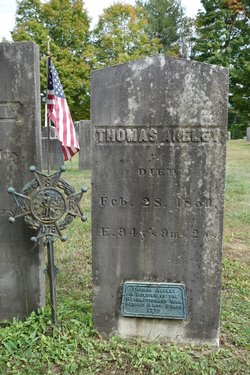
Thomas Akley settled in Brattleboro and married Abigail Wilder in 1783. They had fourteen children between 1783 and 1808. Abigail died in 1840. Thomas survived until 28 Feb 1850, dying at ninety-four. Shown above, courtesy of Find a Grave, is Thomas Akley’s gravestone in the West Brattleboro Cemetery.

TOMORROW: More Akleys.

Thursday, June 24, 2021

More to See at History Camp America 2021

Yesterday I shared the video preview of my presentation at History Camp America 2021, coming up on 10 July.

There are seven more video previews of sessions at this page, ranging from Fort Ticonderoga in the north to the Buffalo Soldier National Museum in ths south.

Here are more scheduled History Camp America sessions with some link to Revolutionary New England:
  • Video tour of Fort Ticonderoga
  • Video tour of Buckman Tavern in Lexington
  • “Reimagining America: The Maps of Lewis and Clark” by Carolyn Gilman
  • “The Amphibious Assault on Long Island August 1776” by Ross Schwalm
  • “Saunkskwa, Sachem, Minister: native kinship and settler church kinship in 17th and 18th-century New England” by Lori Rogers-Stokes
  • “‘Thrown into pits’: how were the bodies of the nineteen hanged Salem ‘witches’ really treated?” by Marilynne K. Roach
  • “Black Flags, Blue Waters: The Epic History of America’s Most Notorious Pirates” by Eric Jay Dolin
  • “Inconvenient Founders: Thomas Young and the Forgotten Disrupters of the American Revolution” by Scott Nadler
  • Slaves in the Puritan Village: The Untold History of Colonial Sudbury” by Jane Sciacca
  • “Surviving the Lash: Corporal Punishment and British Soldiers’ Careers” by Don Hagist
  • “Saving John Quincy Adams From Alligators and Mole People” by Howard Dorre
  • Lafayette’s Farewell Tour and National Coherence – The Lafayette Trail” by Julien Icher
  • “Boston’s Green Dragon Tavern: The Headquarters of the Revolution” by Andrew Cotten
  • “The Fairbanks House of Dedham: The House, The Myth, The Legend” by Stuart Christie
  • “First Amendment Origin Stories & James Madison Interview” by Jane Hampton Cook & Kyle Jenks
  • “Historic Marblehead – A Walking Tour” by Judy Anderson
  • “The Second Battle of Lexington & Concord: re-inventing the history of the opening engagements of the American Revolution” by Richard C. Wiggin
  • “To Arms: How Adams, Revere, Mason, and Henry Helped to Unify their Respective Colonies” by Melissa Bryson
Plus, there are a hefty selection of other sessions about history farther afield, before and after.

Again, registration costs $94.95, and for another $30 folks can receive a box of goodies from History Camp sponsors and participating historical sites. Registrants can watch videos and participate in scheduled live online discussions on 10 July, and will have access to the entire video library for a year.

Sunday, January 10, 2021

The Mystery of Dr. Martyn

As I described yesterday, in the late 1760s Nathaniel Martyn held a respected position in rural Massachusetts society.

Youngest son of the minister at Northborough, he had become a physician and landowner in Harvard and married a young woman from Bolton. They had two young children. When they needed household help, the Harvard selectmen had assured Boston officials that Dr. Martyn was a suitable person to raise an orphan boy from the port town.

And then Dr. Martyn ran away. The Rev. Ebenezer Parkman of Westborough, who had seen Nathaniel Martyn grow up, wrote in his diary on 16 Aug 1770 that the physician had “absconded.” His wife had returned to her parents with the two little children.

When I read that in the excellent Ebenezer Parkman Project website, I hoped to find other sources that filled out the Martyn family’s story. Was there another woman? Another man? Money troubles? Religious conversion? Psychiatric difficulty? I’m sad to say that I haven’t found any further comment on why Dr. Martyn left his family.

I unearthed only two tenuous leads. In the 1921 book Northborough History, the Rev. Josiah Coleman Kent wrote that Nathaniel Martyn “resided for a time in Harvard, and later went south.” That could refer to the family’s move to Bolton, just south of Harvard, or it could refer to a longer journey. This statement came with no indication of its source, and of course Kent was publishing a century and a half after the event.

That statement is, however, consistent with the one other reference to a Dr. Nathaniel Martyn in North America that I’ve found after 1770. In 1775 Robert Hodge and Frederick Shober of New York published a collection of theological essays by the Rev. Dr. Hugh Knox, and the list of subscribers included Dr. Nathaniel Martyn of Hertford, North Carolina.

As for the family Martyn left behind, information about his wife Anna and son Nathaniel is sparse. But in 1790 his daughter, then twenty-three years old, married George Caryl from the Harvard College class of 1788. Caryl was like Pamela’s father in a couple of ways: youngest son of a town minister and trained in medicine, in his case under Dr. Samuel Willard of Uxbridge.

But unlike Nathaniel Martyn, Dr. George Caryl was firmly attached to his native soil. He brought his bride home to his father’s house in the part of Dedham that would become the town of Dover in 1836. Caryl was the only doctor in that district for a long time, and he also had patients in neighboring towns.

George and Pamela Caryl had nine children between 1797 and 1808, four surviving to adulthood. Inheriting the family homestead, Dr. Caryl lived and worked in Dover until 1829. His widow lived on until 1855.

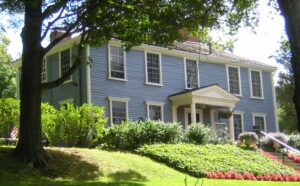
The Caryl family house, shown above, is now owned by the Dover Historical Society.

TOMORROW: What about the orphan boy?

Friday, November 27, 2020

Finding Jurors for the Boston Massacre Trial

On 27 Nov 1770, 250 years ago today, the second trial for the Boston Massacre got under way.

It was supposed to start a week earlier, but the court had trouble finding twelve jurors who were ready to sit on what promised to be an unusually long, unusually charged trial.

The defense team was giving the jurors extra scrutiny. Acting governor Thomas Hutchinson wrote to Gen. Thomas Gage in New York:
My great concern is to obtain an unbiased Jury and for that purpose, principally, I advised Captain [Thomas] Preston to engage one of the Bar, over and above the Council to conduct the Cause in Court, in the character of an Attorney who should make a very diligent inquiry into the characters and principles of all who are returned which he has done and it may be to good purpose, but after all it will be extremely difficult to keep a Jury to the Rules of Law.
That appears to be the reason that the young solicitor Sampson Salter Blowers joined John Adams and Josiah Quincy, Jr., on the defense team. (Blowers appears above later in life, when he was a judge in Nova Scotia.) Robert Auchmuty, senior counsel for the defense in Preston’s trial, saw his job as done.

The defense lawyers challenged every potential juror from Boston as too close to the case. After all, the town was paying Robert Treat Paine to be a special prosecutor. And the judges accepted those challenges. As a result, the jurors all had to come from other towns in Suffolk County (which at that time included all of present-day Norfolk County as well as Hingham). 

The trial record, which is unusually thick for the eighteenth century and published in volume 3 of The Legal Papers of John Adams and thus on Founders Online, shows the difficulty in seating a jury of twelve. The men called were: 
  • Samuel Williams, Roxbury, challenged for cause.
  • Joseph Curtis, Roxbury, challenged for cause.
  • Nathaniel Davis, Roxbury, sworn.
  • Joseph Mayo, Roxbury, sworn.
  • Abraham Wheeler, Dorchester, sworn.
  • Edward Pierce, Dorchester, sworn.
  • William Glover, Dorchester, challenged peremptorily.
  • Isaiah Thayer, Braintree, sworn.
  • Samuel Bass, Jr., Braintree, challenged peremptorily.
  • James Faxen, Braintree, challenged peremptorily.
  • Benjamin Fisher, Dedham, sworn.
  • John Morse, Dedham, challenged peremptorily.
  • James White, Medway, challenged peremptorily.
  • Nehemiah Davis, Brookline, challenged peremptorily.
  • Samuel Davenport, Milton, sworn.
  • Joseph Houghton, Milton, sworn.
  • James Richardson, Medfield, challenged peremptorily.
  • John Billings, Stoughton, challenged peremptorily.
  • Joseph Richards, Stoughton, challenged for cause.
  • Consider Atherton, Stoughton, sworn.
  • Abner Turner, Walpole, challenged peremptorily.
The clerk then called the Boston men whose names were at the bottom of that list, and the defendants challenged them all.
  • John Brown, Boston, challenged for cause.
  • Joseph Barrell, Boston, challenged for cause.
  • Silas Aitkins, Boston, challenged for cause.
  • Harbottle Dorr, Boston, challenged for cause.
The judges had Sheriff Stephen Greenleaf bring in more men, and the process resumed.
  • Samuel Sheppard, Boston, challenged peremptorily.
  • John Goldsbury, Boston, challenged for cause.
  • Samuel Peck, Boston, challenged for cause.
  • William Gouge, challenged for cause.
  • Joseph Turrell, Boston, challenged for cause.
  • Jacob Cushing, Jr., Hingham, sworn.
  • Josiah Lane, Hingham, sworn.
  • Jonathan Burr, Hingham, sworn.
Finally, the court officers did a little legal maneuvering to ensure the last three men from Hingham were indeed eligible, and the opening arguments began.

Joseph Mayo (1721-1776) of Roxbury was named foreman of the jury. He owned a large farm a little past the intersection of modern Washington Street and South Street in Roslindale. A veteran of the Louisbourg expedition of 1745, he was a captain of his town’s militia company. Mayo had also served on town committees to promote non-importation and to instruct the Massachusetts General Court representatives to stand up for the province’s charter rights. But the defense team felt, based on their inquiry, that he could assess the case fairly.

Monday, September 03, 2018

The Powder Alarm Viewed from Westborough

Earlier in the summer I took note of the online edition of the diary of the Rev. Ebenezer Parkman of Westboro.

One of the events Parkman lived through and recorded was the “Powder Alarm” of September 1774. In fact, by writing down news at different times, the minister preserved the rumors that motivated that militia uprising.
1774 September 2 (Friday). This morning was ushered in with Alarms from every Quarter, to get ready and run down to Boston or Cambridge. The Contents Magazine of Powder at Winter Hill had been carryed off — namely [550?] Barrells; by Treachery; etc. This is told as the Chief Affair.

72 of our Neighbours marched from Gales (tis said) by break of Day; and others are continuely going. My young man goes armed, with them.

About 5 p.m. Grafton Company, nigh 80, under Capt. Golding, march by us.

N.B. Squire Whipple here. Says he is ready to sign etc. It is a Day of peculiar Anxiety and Distress! Such as we have not had — Will the Lord graciously look upon us; and grant us Deliverance — for we would hope and trust in His Name! We send for Mrs. Spring and her two Children to be here with us, while her husband is gone with the People.

Breck returned from Lancaster. At Eve we have most sorrowful News that Hostilitys have commenced at Cambridge, and that Six of our people are killed; that probably Some at least may be of Westborough. Joshua Chamberlin stood next (as it is related) to one that was slain. We have many Vague accounts and indeed are left in uncertaintys about Every Thing that has occurred.

Sutton soldiers — about 250, pass along by us — but after midnight are returning by reason of a Contrary Report. Mr. Zech. Hicks stops here. Breck is employed in the night to cast Bulletts. A Watch at the Meeting House to guard the Town stock etc. Some Towns, we hear, have lost much of theirs, as Dedham, Wrentham etc.
The initial report of the king’s soldiers taking hundreds of barrels of gunpowder from the provincial storehouse in Charlestown (shown above) on 1 September was correct. The later rumor of six men killed by those troops was entirely false. In his diary entry we can see Parkman struggling to make sense of the news he was hearing from different directions.

Many towns besides Westboro became anxious about their local supplies of gunpowder and other ordnance immediately after the alarm. After all, no one knew what would come next. The towns were preparing for war; descriptions like Parkman’s read very much like descriptions of the more famous Lexington Alarm of April 1775.

The next day the minister gradually realized the crisis had passed:
1774 September 3 (Saturday). Capt. Benjamin Fay came here between 2 and 3 o’Clock in the morn in much Concern and knew not what to do. After Light and through most of the forenoon, vague uncertain Reports. Sutton men that had gone to Deacon Wood, came back to go down the Road again.

My son Breck with provisions, Bread, Meat, etc., Coats, Blanket etc., for it was rainy, rides down towards Cambridge to relieve Asa Ware, Mr. Spring, and others who were unprovided.

About noon the Sutton Companys come back again and go home, Rev. Chaplin among them. So do the Grafton men.

Mr. Abraham Temple relates to me, that he, having been as far as to Cambridge and himself Seen many of the Transactions, that there were no Regulars there, no Artillery, no body Slain — but that Lt. Gov. [Thomas] Oliver, Messrs. [Samuel] Danforth, Joseph Lee, Col. [David] Phips (the high Sheriff) had resigned and promised that they would not act as Counsellors — that Mr. Samuel Winthrop computed there were about 7000 of the Country people had gathered into Cambridge on this Occasion — that it was probable, as he (Mr. Temple) conceived, that the Troubles would subside.

N.B. When the Sun run low, Our Company returned (consisting of Horse and Foot about 150). With them were my Son and my young man — all without any Evil Occurrance. To God be Praise and Glory! I Suppose Capt. Maynard and those who were with him are returned also.
The estimate of “7000 of the Country people” is high, but both Lt. Gov. Oliver and Dr. Thomas Young guessed there were 4,000 militiamen in Cambridge that day.

I started The Road to Concord with the “Powder Alarm” because it marked a turning point in Massachusetts’s conflict with the Crown. That was the moment that Gov. Thomas Gage lost control of most of the province, and the moment that people began to turn to military solutions for the political conflict.

Friday, July 13, 2018

Watching the Native Northeast Portal Grow

The Native Northeast Portal is still in early development but offers great promise. It addresses the challenge of how many primary-source documents about New England Native communities are unpublished, scattered, and difficult to access. As the website explains:
The Portal represents a scholarly critical edition of New England Native American primary source materials gathered presently from the partner institutions into one robust virtual collection, where the items are digitized, transcribed, annotated, and edited to the highest academic standards and then made freely available over the Internet, using open-source software. By providing annotated transcriptions, the Project’s editors provide the Series users with useful information within a well-researched and balanced context necessary to understand the complexities of the historical record.
As an example of this portal's resources, here's a petition from Jonathan Capen seeking the release of Isaac Williams from the Suffolk County jail in December 1776. Crisp images of the document with the Council's response written on it are accompanied by a transcription and a map showing the pertinent location.

Other sources fill out the story. Williams was "a Molatto" from Dedham who enlisted in Capt. Joseph Guild's company in May 1775 and served until the end of the year. Early that November Williams married Elizabeth Will, a member of the Punkapoag community in Stoughton.

Williams must have reenlisted in the Continental Army or was drafted for it in some way because on 14 Aug 1776 he was listed as a deserter from Guild's company. He was then said to be twenty-three years old and 5'10" tall. The army still listed him as coming from Dedham.

Apparently Williams had gone to his wife in Stoughton because the selectmen of that town had him arrested as a deserter and put in the Suffolk County jail. (That didn't mean the jail in Boston since Suffolk County then included all of modern Norfolk County.)

Capen was the agent for the Punkapoag community in its dealings with the government, so he petitioned on behalf of Elizabeth Williams. Capen wrote that her young husband was "in a very poor State of Health," which might well be why he had left the army. The Massachusetts Council approved that petition and ordered the selectmen to release Williams.

As for the end of Williams's story, I'm pleased to report that he recovered. According to genealogists David Allen Lambert and Jennifer Pustz, he lived until 1831. The Stoughton Historical Society owns the pieces of his gravestone. Elizabeth Williams lived until 1848, long enough to apply for a pension as a Continental Army widow. (Her application doesn't mention any service or arrest in 1776.) Among the people supporting the Williams pension claim with a shaky signature was Jonathan Capen, evidently the elderly son of the man who filed the 1776 petition.

Sunday, May 27, 2018

When Gov. Bernard Went Negative

Yesterday we left Gov. Francis Bernard on 25 May 1768 with a Council newly selected by the Massachusetts legislature—which was largely hostile to him.

On the first day of their term, the legislators had pointedly passed over Lt. Gov. Thomas Hutchinson and removed two of Bernard’s political allies from the Council while adding seven others. The newly named gentlemen were:


Under Massachusetts’s provincial charter, the royal governor could “negative,” or veto, anyone named to the Council whom he didn’t want to work with. In practice, governors were reluctant to knock off Councilors who were already sitting because gentlemen could see that as an affront. So this moment was Bernard’s best chance to get an advisory board to his liking.

James Otis, Sr., had been the lower house’s speaker in 1761 and 1762 and then served three years on the Council. But during that time he was also in a bitter feud with Bernard because the governor hadn’t fulfilled his predecessor’s promise to put Otis on Massachusetts’s high court. (Instead, Bernard had appointed Hutchinson.) In 1766 the governor had finally gotten sick of Otis’s opposition and negatived him from the Council.

Bernard had issued hints about letting Otis back on the board if the legislators chose Hutchinson as well. But Otis himself opposed such a deal, and his son was the most powerful member of the lower house, so it didn’t happen. By electing Otis, the legislators were simply poking Bernard again.

Likewise, Bernard had negatived Bowers, Dexter, Gerrish, and Sanders in 1766 and then again in 1767—and here they were again.

This was the first year the legislators put Ward up for the Council. But he had already built a reputation in the House for being one of the sternest rural voices against Parliament’s new laws. In 1766 Gov. Bernard had “superseded” Ward’s commission as a militia colonel. And on this Election Day Ward took the place that Hutchinson had expected to win.

Finally, there was Hancock, by far the youngest of the new potential Councilors. He had entered politics only three years before as a Boston selectman. He had served as a town representative as well since 1766. And he had proven to be another vocal opponent of the royal party.

In sum, Gov. Bernard had little reason to accept any of those men on the Council. But as a bit of a surprise, on 26 May he approved one: Samuel Dexter. In a letter to the Earl of Hillsborough (available through the Colonial Society of Massachusetts’s invaluable website), Bernard explained: “I accepted one whom I had negatived before, having Reason to think he was tired of his Party.”

As it turned out, Dexter remained a moderate Whig. He usually voted against the royal governor. Looking back on his legislative career in 1795, he wrote two letters to the Rev. Jeremy Belknap which are valuable sources on the debate over the slave trade and slavery in Revolutionary Massachusetts.

However, Dexter didn’t agree with the most radical Whig actions, worrying about attacking the British military in 1775. A few months after the war started, he quit the Council and moved back to his home colony of Connecticut because people were calling him a “Royalist.” Later he lived in Weston and Mendon, but he never reentered politics.

Saturday, April 29, 2017

“Paddocks Coach was shut out of Boston”

We left Sarah Deming and her family on the morning of 21 Apr 1775 at the house of the Rev. William Gordon in Roxbury, relieved that the British army had not attacked that site as feared.

Nevertheless, Deming and her female companions decided they had to get farther away from the siege lines. Her description of those efforts includes some more familiar names:
Miss Sarah Mason & I took our stand in turns, & sometimes together, at or without the door to try if we could get any conveyance to Dedham, which was six miles farther from Boston. At last we lit on a one horse Cart, & the driver was willing to take us all in, & carry us to [Dr. Nathaniel] Ames’s.

We toss’d in our bundles, & one of us had clim’d into the Cart, when Capt. [Lemuel] Child of the Peacock [tavern] came by, & told us that [Adino] Paddocks Coach was shut out of Boston, & he would engage it for us, to carry us as far as we would—that it was at but a quarter of a mile distant from us, & we should be more comfortable in that than in a cart—Out of which our things were then taken, & we began to see & acknowledge a kind providence.
“Paddocks Coach” wasn’t coachmaker Adino Paddock’s personal vehicle, I believe. Rather, in his yard near the Common he hosted a “genteel Berlin Coach, commodious for six Persons,” which Isaac Wendell offered to drive “in Town or out, on moderate terms” in a 9 Jan 1772 Boston News-Letter advertisment. That vehicle was now stuck outside the British lines, and the coachman was taking the best fares he could find.

Deming continued:
Mr. Gorden was abroad we knew not where—but he was coming for us. He knew we wish’d for nothing so much, in our deplorable circumstances as to be gone from his hospitable house. He had been to see, & comfort as well as he could, Mrs. [Josiah?] Waters & her children—He had found Paddocks Coach drawn by only two horses, & had agreed with his man to take us all in, together with Mrs. Gorden whom he was to call for at Mrs. Havens, & carry us to Providence for 12 Dollars. This agreement was made before Capt. Child came up to the Coach-man. But the business was done just as he appeared only Mr. Gorden had aded Mrs. Waters & her family to our company.
The minister gave Deming and her company midday dinner at his house before they set off for safety. At one point on the journey, Deming wrote, they
were now 12 in number; drawn by two horses; viz 9 within the Coach, consisting of Mrs. Gorden, Miss Mason, Mrs. Waters within two months of lying in (She is since delivered of a daughter) her three children, & fat maid, Sally & myself—without [i.e., outside] a man on the box with ye driver, & Lucinda behind
Lucinda, we recall, was Deming’s enslaved maid.

Sunday, April 16, 2017

“About one a clock the minute men were alarmed”

Samuel Haws of Wrentham, Massachusetts, was one of the militiamen called out on 19 Apr 1775 who left a journal of his experiences.

Haws’s journal would be consulted even more if he’d seen actual fighting that day. But Wrentham is on the Rhode Island border—too far for its militia company to hear of the regulars’ march, to assemble, and to hike all the way to the battle road. Instead, Haws and his comrades saw a lot of taverns and eventually made their own action.

Here’s an extract from Haws’s diary as it appeared in its second publication, in the New England Historical and Genealogical Register for 1976. The annotations are by editor Richard Brigham Johnson and me:
About one a clock the minute men were alarmed and met at Landlord [David] Mann’s.

We marched from there the sun about half an our high towards Roxbury for we heard that the regulars had gone out and had killed six men and had wounded Some more that was at Lexinton then the kings troops proceded to concord and there they were Defeated and Drove Back fiting as they went. They got to charlstown hill that night.

We marched to headens [Jonathan Hidden’s] at Walpole and their got a little refreshment and from their we marched to Doctor [Samuel] cheneys [still in Walpole] and their we got some victuals and Drink and from thence we marched to Landlord ellises at Dedham and their captain parson [Samuel Payson?] and company [from Stoughton?] joined us and then we marched to [Benjamin] Gays and their captain [John] Boyd and company [from Dedham] joined us and we marched to Landlord [Daniel] Whitings [still in Dedham]

we taried their about one hour and then we marched to [Nathaniel] richardes [in west Roxbury, shown above] and Searched the house and found Ebenezer aldis and one pery who we supposed to Be torys
The Wrentham militiamen no doubt recognized Ebenezer Aldis as one of their neighbors. In fact, he even was a cousin of sorts to Samuel Haws. (I can’t identify “Pery”; Aldis’s wife was a Penniman, so it’s conceivable that man was one of her relatives and Haws wrote the name inaccurately.)

Haws’s report might dovetail with a tradition that came down in the family of Nathaniel Richards and was eventually published in Abner Morse’s A Genealogical Register of the Descendants of Several Ancient Puritans, vol. 3. That story focused on the landlord’s new son-in-law (and cousin) Solomon Richards:
On the morning of the battle at Lexington, he was met, on his way to Boston, with the report that the British were on their march to Concord; and as he was turning his course for Dover, to rally men to the scene of conflict, up rode a man direct from Boston, contradicting the report.

Capt. R. instantly marked him for a tory, took him prisoner, bound him upon his own horse, and escorted him to the Peacock tavern at Jamaica Plain, and detained him until the truth could be known. In the meantime a body of soldiers arrived, and demanded the tory, that they might hang him during their halt.
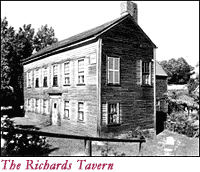
Morse believed that the Richards family owned the Peacock Tavern, but he was mistaken—its landlord was Lemuel Child. The Peacock Tavern was at the corner of Allandale and Centre; Nathaniel Richards’s tavern was further out along Centre where the West Roxbury post office now stands. The Richards family understood that Solomon Richards took his suspicious prisoner to his father-in-law’s tavern, and it looks like Morse inserted the Peacock Tavern name by mistake.

TOMORROW: Did the Wrentham company hang Ebenezer Aldis?

Sunday, December 20, 2015

The Stamp Act as a Marriage Tax

Genealogists, historians of marriage, and other experts might correct me on this, but in provincial Massachusetts a new couple didn’t obtain a certificate of marriage.

Rather, they got a certificate of their intention to marry from their town clerk, who certified that the engagement had been announced from the pulpit for the requisite fifteen days (three Sundays) beforehand.

Then they could take that paper to the minister or justice of the peace (ministers seem to have become the default choice by the eighteenth century) for the actual marriage.

I looked for examples of certificates of intent to marry from eighteenth-century Massachusetts, and the closest I got, courtesy of Access Genealogy, was the example above from 1806. But hey, it’s signed by William Cooper, who was Boston’s town clerk from 1761 to 1809. So he would have signed the equivalent document in the 1760s.

[To folks at the Massachusetts Historical Society: If my notes are correct, the Willard (Knox) Papers contain the certificate that Cooper filled out for Henry Knox and Lucy Flucker on June 23, 1774. That might make a nice Object of the Month.]

I did find a number of transcriptions from town clerks’ records, showing they didn’t all follow the same linguistic formula in noting down who planned to marry in their towns. Here’s an example from Stoughton:
The Intention of Marriage Betwen Mr. Ezra Morse of Stoughton & Mrs. Susanna Guild of Walpole Entred April ye 13th 1765
From Dover:
October 1st 1786. The intention of marriage between Mr David Fuller Jr of the District of Dover and Miss Sally Gay of Dedham is this day entered with me and a certificate given that the said intention of marriage hath been made public agreeable to law

Joseph Haven District Clerk
The text of a certificate from Westfield:
This may certify that the Intention of Marriage between Mr. Zenas Noble, of Washington, and Mrs. Margaret Granger, of Westfield, hath been published in the manner the Law directs; and their names entered with me fourteen Days previous to the Date.

Westfield, Oct. 24th, 1791
Attt. P. WHITNEY, Town-Clerk.
Some clerks noted when couples registered their intention but never came to pick up their certificates, and were therefore not supposed to have gotten married.

The text of the Stamp Act makes no explicit mention of marriage, but it includes this clause:
For every skin or piece of vellum or parchment, or sheet or piece of paper, on which shall be ingrossed, written, or printed, any appeal, writ of error, writ of dower, Ad quod damnum, certiorari, statute merchant, statute staple, attestation, or certificate, by any officer, or exemplification of any record or proceeding in any court whatsoever within the said colonies and plantations (except appeals, writs of error, certiorari, attestations, certificates, and exemplifications, for or relating to the removal of any proceedings from before a single justice of the peace) a stamp duty of ten shillings.
Evidently the term “certificate, by any officer,” covered certificates of intent to marry. As a result, the Stamp Act put a ten-shilling tax on the legal act of marrying.

TOMORROW: Tax avoidance in 1765.

Monday, November 19, 2012

A Schoolmaster During the Siege

I’ve shared reminiscences from Benjamin Russell and Harrison Gray Otis of how their Boston public schools closed in April 1775 with the outbreak of war (and how their stories got intertwined). That was the end of town-sponsored education in Boston until after the British military left the next March. Families probably kept up lessons for little kids, teaching them to read—which had always been a private responsibility. But I didn’t think anyone was teaching the handwriting, business math, or Latin and Greek of the public schools.

Then I found a mention of Elias Dupee in Zechariah Whitman’s 1842 history of the Ancient & Honorable Artillery Company. That eventually led me to this sentence in Caleb Snow’s 1828 History of Boston:
During the siege, the town schools were suspended: a few children attended the instructions of Mr. Elias Dupee, who remained in Boston, and gratuitously devoted himself to his employment of a teacher, in which he took peculiar delight.
A number of other books repeat that statement, sometimes in different words but without additional details. Oliver A. Roberts’s later history of the Ancients & Honorables says that Dupee was a Freemason and held several town offices, including tax collector and constable. From 1764 to 1769 he regularly advertised in Boston newspapers that he was selling goods in a “New Auction-Room,” which moved around a bit; in February 1769 he was “over Mr. John Dupee, Mathematical Instrument Maker’s Shop.”

Poking around for more information about Dupee’s pedagogical career, I found that on 9 Apr 1776 private-school teacher John Leach wrote from Boston to one of the public-school masters, John Tileston, then staying at Windham, Connecticut:
The Selectmen have been so busy that I have not had opportunity to see them in a Body. The people are flocking into Town very fast, and there are great Numbers already Come in. I see Mr. Webb, and Mr. Holmes, and Mr. Parker, and several of our Friends, and they are all of opinion that you had better return to your school as soon as you can. . . . Martin [Master? Samuel] Hunt is in Town, and Dupee still continues at your Schoole
So during the siege Dupee used the North Writing School, owned by the town. The selectmen voted to reopen the public schools on 5 June. Tileston was back by then, and the records don’t mention Dupee.

At some point Dupee set up his own school in the Sandemanian meeting-house off Middle Street (now Hanover) in the North End. The Sandemanians were a Christian sect out of Scotland that had won over some locals in the decade before the Revolution. Many left with the British troops. On 5 Oct 1785, selectmen Moses Grant and John Andrews became “a Committee to treat with Mr. [Isaac] Winslow respecting a Schoolhouse lately improved by Mr. [Elias] Dupe known by the Name of Sandemons Meeting house.”

Within a month, the selectmen and Winslow on behalf of the Sandemanians agreed to a rent of £20 per year, minus what “three indifferent Persons” judged to be the fair cost of the town’s repairs “to the Wood House & Necessarys.” That suggests Dupee may not have been teaching in that building very recently; he was the latest user, but perhaps not a recent one.

That building became known as the Middle Street Writing School and was assigned to Master Samuel Cheney. Tileston was still at the North Writing School, so it looks like the North End’s youth population was growing enough to require two schools in that part of town. In 1789 Boston undertook a big education reform, and the next year the town gave up the lease and built new schools for itself. Elias Dupee never became one of Boston’s public schoolmasters.

The 27 Dec 1800 Constitutional Telegraphe of Boston reported at the top of its list of deaths: “Suddenly, on Wednesday last at Dedham Mr. Elias Dupee, formerly a Schoolmaster in this town, Aged 74.” Dedham town records say he died “of old Age” at the house of Daniel Baldwin, where he was boarding, and was aged 76. Some sources say Dupee had been born in 1716, and was thus 84.

TOMORROW: The Constitutional Telegraphe?!

[The thumbnail above shows the historical marker for the site of teacher John Tileston’s house in the North End, courtesy of Leo Reynolds’s Flickr stream under a Creative Commons license.]

Thursday, September 27, 2012

The End of Bundling in Dedham

In 1827 Erastus Worthington published his History of Dedham, an early example of a local history. Among the stories he told was one about how the Rev. Jason Haven, minister in the town from 1756 to 1803, had ended the practice of bundling.

When Haven arrived in Dedham, people wishing to join the meeting had to confess their sins in front of the congregation. Since parents wanted to join the church to have their babies baptized, and since those sins often involved conceiving the child, there was a bit of a race to conclude the process.

Worthington described the usual custom and the response to it:
The church had ever in this place required of its members guilty of unlawful cohabitation before marriage, a public confession of that crime, before the whole congregation. The offending female stood in the broad isle beside the partner of her guilt. If they had been married, the declaration of the man was silently assented to by the woman. This had always been a delicate and difficult subject for church discipline. The public confession, if it operated as a corrective, likewise produced merriment with the profane.
“Revolutionary times having produced a disposition to investigate all the former principles and opinions of men,” Worthington said, Haven convinced the Dedham meeting to institute a new rule. “In 1781, the church gave the confessing parties the privilege of making a private confession to the church, in the room of a public confession.”

That made the confession easier, and perhaps the acts to be confessed as well. Worthington stated that church records show that in the quarter-century before 1781 there was one public confession per year. In the next ten years, there were fourteen—a 40% increase. But still, that’s only four more couples over ten years. The same period saw the end of the war and economic turmoil, and perhaps there were other factors.

In any event, the minister decided to address the problem:
Mr. Haven, in a long and memorable discourse, sought out the cause of the growing sin, and suggested the proper remedy. He attributed the frequent recurrence of the fault to the custom then prevalent, of females admitting young men to their beds, who sought their company with intentions of marriage. And he exhorted all to abandon that custom, and no longer expose themselves to temptations which so many were found unable to resist.

The immediate effect of this discourse on the congregation, has been described to me, and was such as we must naturally suppose it would be. A grave man, the beloved and revered pastor of the congregation, comes out suddenly on his audience, and discusses a subject on which mirth and merriment only had been heard, and denounces a favorite custom. The females blushed, and hung down their heads. The men too hung down their heads, and now and then looked out from under their fallen eye brows, to observe how others supported the attack.

If the outward appearance of the assembly was somewhat composed, there was a violent internal agitation in many minds. And now, when forty-five [sic] years have expired, the persons who were present at the delivery of that sermon, express its effect by saying, “How queerly I felt!” “What a time it was!” “This was close preaching indeed!!”

The custom was abandoned. The sexes learned to cultivate the proper degree of delicacy in their intercourse, and instances of unlawful cohabitation in this town since that time have been extremely rare. What sermon or eloquent address can be pointed out, that has produced such decidedly good effects.
I don’t know if anyone has analyzed data on how soon after marriage first children were born in Dedham before or after 1791. But Haven’s sermon and the congregation’s apparent acceptance of it, rather than resistance, suggests that sexual mores were changing in the new republic.

COMING UP: The newspaper debate over bundling.

Friday, September 14, 2012

“Inn-keeping was a favorite occupation”

Earlier this month, Dr. Sam Foreman shared a draft of the Suffolk Resolves, written mostly by Dr. Joseph Warren. That document is headed:
At a Convention of the Representative Comtees of the Several Towns & Districts of the County of Suffolk in the Province of Massachusetts Bay in New England, on Tuesday the 6th day of Septemr 1774, at the House of Richard Woodward in Dedham,
The “House of Richard Woodward in Dedham” was a tavern at a major crossroads in the town, as shown in the map above from the Dedham Historical Register.

But does Richard Woodward deserve to have all the credit for hosting the Suffolk County Convention on that important day?

In the mid-1700s that tavern was owned by Dr. Nathaniel Ames, a physician and almanac-writer. He had won the property from relatives of his short-lived first wife in a long court battle. In 1740 he married Deborah Fisher, and they had five children, including boys named Nathaniel, Jr., and Fisher. Three of the five boys had gone or were going to Harvard when the doctor died in 1764. Deborah then became proprietor of the tavern.

Meanwhile, Richard Woodward’s wife had died in 1763, leaving him with sons of his own. The Woodwards and Ameses were both prominent Dedham families. In February 1772, eight years after the doctor’s death, Richard Woodward married Deborah Ames. A man named John Whiting wrote in his diary, “after a Long and Clost Siege, he took her.” That was how the tavern became “the House of Richard Woodward.”

In January 1773 Richard and Deborah Woodward carried on her first husband’s tradition by suing some of her relatives over an estate. Their lawyer was John Adams.

Shortly after Deborah Ames remarried, her son Nathaniel, by then a physician like his father, wrote in his diary: “Dick Woodward cuts a flash Bridegroom.” But soon his mentions of his new stepfather took a turn.
May 9 [1773]. Old Dick Woodward struck me with his saw.

May 12. Dick Woodward fined for striking me & bound to good Behavior.
On the flyleaf of a 1774 almanac:
Old Richard Woodward has declared that he will fleece our Estate as much as possible & accordingly Oct. 12 carried off several Loads of unthrashed Rye & carried off all the last years Corn & threatens to carry away the Hay out of the Barn In defiance of Law & Equity threatens to strip & waste as much as possible.
But Nathaniel fought back:
29 [Jan 1775]. Hay put into my Barn out of old Woodward’s way.
It was in that period that the Suffolk County Convention met at Woodward’s tavern—with Deborah Woodward probably doing a lot of the hosting. A Fisher family genealogy says of her:
She was a very shrewd and sensible woman, of a strong and singular cast of mind. She took a hearty interest in politics, and [in the early Federal period] hated the Jacobins devoutly. Inn-keeping was a favorite occupation with her, and she carried matters with a high hand.
Two items in the New-England Chronicle newspaper in February 1776, one an advertisement for two horses lost since “some time last September,” confirm that Richard Woodward was still officially keeping a public house in Dedham. But on 22 Mar 1784 the Independent Ledger referred to “the house of Mrs. Woodward, innholder in Dedham.”

What had happened to Richard? Over a century later Dr. Azel Ames wrote:
Deborah…had the bad taste and worst fortune to marry…one Richard Woodward, who succeeded, as there are only too many evidences, in making life miserable for her, himself and everyone else, until their separation.
Unfortunately, I haven’t found “too many evidences” of when that separation occurred, how legalized it was, or when Richard Woodward died. But by 1784 he was definitely out of the picture.

A biography of the two Dr. Nathaniel Ameses said Dedham’s oldest residents remembered Deborah Wooward’s tavern this way:
The room at the left of the entrance…was evidently the “tap room” in ancient times—the windows being screened on the inside with wooden shutters as would be proper—an heart-shaped opening being cut in each to admit the light. When the room was lighted at night, these “heart openings” were made more distinct, and “late-at-night” neighbors journeying homeward would remark, “See the light shine through Mrs. Woodward’s heart.”
Deborah Woodward continued to keep that inn, her sons living nearby as shown on the map above, until she died at the age of ninety-four. At that point the old building was torn down.

Tuesday, March 06, 2012

The Trail of Sally Edwards

Yesterday I shared some details about how a woman named Sally Edwards—possibly still in her teens, with no husband in sight—gave birth to a baby, also named Sally Edwards, in Dedham in June 1775.

There are two big problems in tracking that mother and child much further. One is that people probably took steps to keep them from being tracked. The other is that their name was not uncommon—and looking for “Sarah Edwards” as well brings up possibilities all over the place.

According to Dr. Sam Forman in his new biography Dr. Joseph Warren, which unearthed this event, the baby remained in Dedham for another three years, with Warren’s former medical students paying the bills for her support.

The mother—to innkeeper Dr. Nathaniel Ames’s relief—returned to Boston after the siege in mid-1776. Forman cites letters from Warren’s fiancĂ©e Mercy Scollay to say that a “Mrs. Charles Miller” took in both Sally Edwards and Dr. Warren’s oldest child Betsey in 1776.

The most prominent Charles Miller around at the time was a Boston merchant whom the Massachusetts Provincial Congress had appointed deputy commissary general in May 1775. After the Continental Congress took over the war, he worked under commissary general Joseph Trumbull for the rest of the siege. In 1776, Miller stayed in Massachusetts as Trumbull’s deputy in the work of collecting and shipping food to the Continental Army.

That Charles Miller was born in 1742 at Braintree, son of the region’s Anglican minister. In 1769 he married Elizabeth Cary, daughter of prominent Charlestown merchant Richard Cary, in King’s Chapel, Boston’s most prestigious Anglican church.

That religious affiliation may help to explain why Sally Edwards had her baby baptized by an Anglican minister in Dedham—and they were scarce on the ground in New England outside Boston during the siege. Did she come from an Anglican family? Was she feeling more support from the Millers than from anyone else in her life?

I have no further clues about either Sally Edwards, mother or daughter. As has been discussed previously on Boston 1775, some families have claimed descent from Dr. Joseph Warren through an undocumented daughter. In one case that daughter was said to be named “Sarah Warren.” However, I haven’t seen evidence to support those traditions, and Sarah was (as I said above) a very common name.