J. L. BELL is a Massachusetts writer who specializes in (among other things) the start of the American Revolution in and around Boston. He is particularly interested in the experiences of children in 1765-75. He has published scholarly papers and popular articles for both children and adults. He was consultant for an episode of History Detectives, and contributed to a display at Minute Man National Historic Park.

Subscribe thru Follow.it


•••••••••••••••••


Showing posts with label flags. Show all posts

Wednesday, March 25, 2026

“Near or quite fifty Sail are got out to Sea”
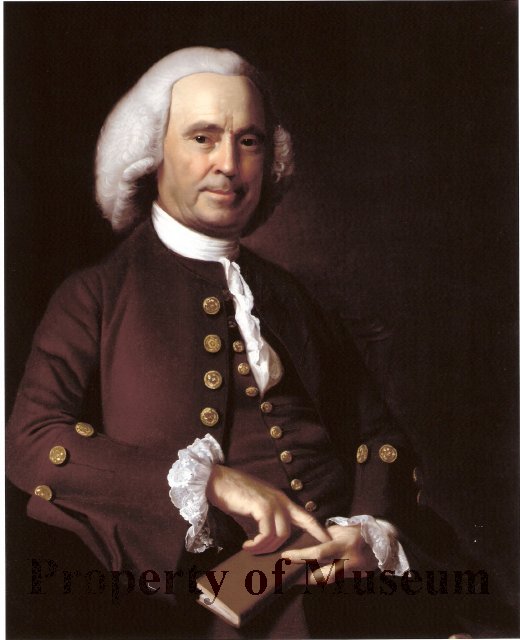
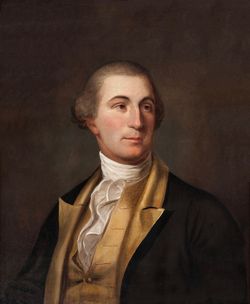
Lt. Nahum Ward, son of Gen. Artemas Ward, carried Gen. George Washington’s letter (quoted yesterday) to Josiah Quincy, Esq. (shown here), of Braintree on 24 Mar 1776.

The squire, encouraged, started to make detailed notes about what the British fleet was doing out on the Nantasket Road, the shipping channel in the outer harbor.

“The Admiral [Molyneux Shuldam] has a Signal now flying at his main top mast Head,” Quincy wrote the next day, 250 years ago today. “I wish it was in my Power to construe it.” Yes, that would have been more helpful.

But then he saw movement.
11 OClock. This Moment an Explanation of the above Signal occurrs: Part of the Fleet are come to Sail: I shall proceed, journalwise, to inform your Excellency of their Movements, ’till the Bearer, who is gone to see Colo. [Benjamin] Tupper, returns.

1 OClock They are still coming to sail: near or quite fifty Sail are got out to Sea; about half of them Brigs, Schooners, and Sloops; one or two Frigates, and the remainder Transport Ships; their Course shaped for Cape Cod: May not this Division be bound for Martha’s Vineyard, and the Islands in that Sound to procure fresh Provision for the Fleet, which is to rendevous at Hallifax, and from thence to proceed to Quebec?

3 OClock My Servant, who was directed to take an Account of the Number that have sailed, informs me, there are in all fifty two: One transport Brig: is just arrived: . . .

5 OClock The Adml has just now hoisted another Signal a Pendant under his Flagg two more Ships are under Sail going out of the Harbor: 7 O’Clock, Mr Ward & Colo. Tupper are just arrived: They are of Opinion, that the Ships which sailed to Day, have carried off the Tories, and are bound with them to Lewisburgh.

Tuesday Morng [26 March] Mr Ward’s tarrying in Town, gives me a further Opportunity to inform your Excellency that the Fleet, consisting of about 100 Sail, chiefly large Ships, remain as they were last Night.

10 OClock The same Signal is now flying at the Admiral’s Main top mast Head as was hoisted yesterday morning: Scarce hoisted before it was lower’d again, & in abt ½ an hour a blew [blue] flag is flying at mizen Top mast Head and a Pendant at his mizen Peek.

11 O’Clock The above Signals are changed, for a red Ensign hoisted just under his Mizen Yard: A signal is just now hoisted upon the Top of the Light House, for Vessels in the Offing; and immediately followed, by a blew broad Pendant from the middle of the Tower: In less than 10 Minutes the Signal first mentioned vizt a Pendant is flying from his main top mast Head.

12 O’Clock A red Ensign is now flying at his mizen top mast Head; a blew Ensign at his starboard mizen Shrouds, and a pendant thrown out between, by hand, & immediately taken in again.

2 OClock The 60 gun Ship in King Road is come to Sail & going down to Nantasket: The Admiral’s red Ensign is struck; the blew one remains: a large transport Ship and a Brig are just arrived within the Light.
Quincy wasn’t sure all that detail could be useful, but he promised Washington he’d keep sending it until the general said otherwise. He really wanted to be part of the effort to defeat the British.

About half of the fleet had moved off, heading for the safe port of Halifax, Nova Scotia. Most of the rest would follow by the end of 26 March. A few warships stayed behind to patrol Boston harbor.

TOMORROW: Aboard one of those ships.

Thursday, March 19, 2026

“The gratifycation of being selected to carry the American flag”

Ens. Samuel Richards had a unique perspective on the Continental Army’s entrance into Boston after the British evacuation on 17 Mar 1776.

The young Connecticut officer was chosen (I don’t know how) to lead the troops in with his regiment’s flag.

He recorded his memories for his family many decades later:
By the enemies inactivity for several succeeding days we concluded they had abandoned the idea of attacking our fort. This comparative inactivity continued untill the 17th of the month when the whole of our troops were paraded and commenced our march into Boston, it being announced that the enemy were evacuating it. I had the gratifycation of being selected to carry the American flag at the head of the column which entered from the Roxbury side.

When arrived in the town numerous incidents crouded upon our view: I can particurize but few of them. The burst of joy shown in the countenances of our friends so long shut up and domineered over by an insulting enemy: the meeting and mutual salutations of parents and children and other members of families having been seperated and continued seperated by the sudden shuting up of the town after the battle of Lexington: the general delapidation of the houses: several churches emptied of all the inside work—and turned into riding schools for their cavalry [that actually happened in only one church, the Old South Meeting-House]: all the places which had been previously used for public resort torn to pieces: and at the stores around the wharves groceries—particularly salt—were in a state of destruction.

As I had no particular command I rambled at my pleasure—and being the carrier of the flag attracted some attention, was almost constantly pressed with invitations to “call in and take a glass of wine with me”

I saw the last boat of the enemy put off and proceed to the shiping.
Richards did some sightseeing, first visiting the fortifications left behind in Charlestown.
The next day I went and viewed the works on Castle island, the enemy had endeavored to blow up every usefull part of the works; in many instances they had succeeded, in others but partially, they had broken off the trunnions of all the heavy cannon, and in addition had spiked them up. In general every thing was mutilated and rendered useless.

I was invited to take lodgings at the house of a respectable widow lady Mrs. C. and treated with the utmost hospitality during the few days of my stay in the town.

On the 25th of the month the troops began their march by regiments toward New York, and by the 4th of April 21 regiments had moved on, ours being one of the number: five regiments being left to garrison the town…
Richards remained in the Continental Army through the year 1780, becoming a captain. He returned to Farmington and worked as the postmaster for two decades. In retirement he followed a daughter to Wilkes-Barre, Pennsylvania, where he died at age eighty-eight.

Thursday, March 12, 2026

“Without the leave of the Governor”

Earlier this month the Journal of the American Revolution ran an article by Ray Raphael about colonial Massachusetts’s constitution and how the royal government tried to curtail it.

Here’s a taste:
Of the four punitive acts passed in response to the Boston Tea Party, closing the port of Boston receives most attention in textbooks today—but at the time, with 95 percent of the colony’s population living outside Boston, it was “An Act for the Better Regulating the Government of the Province of the Massachusetts Bay”—known today as the Massachusetts Government Act—that sparked the people’s fury and led them to cast off British rule.

Under the 1691 Charter, “freeholders” could call a town meeting whenever they saw fit—but no longer: “Whereas a great abuse has been made of the power of calling such meetings, and the inhabitants have, contrary to the design of their institution, been misled to treat upon matters of the most general concern, and to pass many dangerous and unwarrantable resolves,” the 1774 act declared, “no meeting shall be called by the Selectmen, or at the request of any number of freeholders of any township, district, or precinct, without the leave of the Governor, or, in his absence, of the Lieutenant Governor, in writing, expressing the special business of the said meeting.”

Likewise, on the provincial level, power was wrested from the people. No longer would the incoming “general court or assembly” choose the Governor’s Council:
Whereas the said method of electing such counsellors or assistants. . . hath been so far from contributing to the attainment of the good ends and purposes thereby intended, and to the promoting of the internal welfare, peace, and good government of the said province, or to the maintenance of the just subordination to, and conformity with, the laws of Great Britain, . . . the said method of annually electing the counsellors or assistants . . . should no longer be suffered to continue . . .

Be it therefore enacted . . . that the council, or court of assistants, shall be composed of such of the inhabitants or proprietors of lands within the same as shall be thereunto nominated and appointed by his Majesty.
All other officers would also be appointed by the governor, who could remove them at will…
The voters of Massachusetts didn’t like to see Gov. Thomas Gage implement the new law. Soon they were protesting against it—and shutting down the colonial government to do so.
The next courts were scheduled for Springfield, shiretown of Hampshire County, two weeks later, on August 30—but some 1,500 citizens made sure they did not sit. One eyewitness, Joseph Clarke of Northampton, gave a vivid account: “The people of each town being drawn into separate companies marched with staves & musick . . . The trumpets sounding, drums beating, fifes playing and Colours flying, struck the passions of the soul into a proper tone, and inspired martial courage into each.”

The judges and justices of the peace offered no resistance to “the body of the county,” as Clarke called the men who marched with their town’s militia companies. When a committee asked them “whether they meant to hold their commissions and exercise their authority according to the new act of parliament for altering the constitution of the province,” they all said they would not.
One corrective for the article: The Boston Port Bill went into effect on 1 June 1774. The Massachusetts Government Act may have been drafted to start at the same time, but the final language said it took effect on 1 August. And then the text didn’t arrive in Salem until a few days after that.

In other words, it took only about two weeks from the start of the law for people in western Massachusetts to organize major protests and shut down a branch of the royal government. That’s how much people wanted to maintain their constitution.

Monday, February 02, 2026

Flagging a Call for Presentations at the 2026 HistoryFest in Westfield

In the summer and fall of 1774, New England towns competed to put up Liberty Poles, the taller the better.

On 28 July, Ephraim Potter and Edward Lawrence brought such a flagpole into Deerfield, though they didn’t have time to set it up that day. Young Dr. Elihu Ashley estimated that it was “about fifty feet.”

Dr. Ashley got a good look at that pole because that evening he sawed through it with the help of some friends.

The next day, Ashley wrote in his diary, the talk of the town was “nothing but Liberty, and ye Poles being Sawd.” Soon “ye Liberty Pole was set up and also a Tory Pole as they in their infinite wisdom are pleased to call it.” I wonder if together those poles measured fifty feet.

On 30 July, an anonymous public letter was posted in town. It declared Potter, Lawrence, and their comrades to be “a pack of ignorant villains.” Also, whoever wielded the saw was “some Malicious Person, Inimical to his Country”—though that was meant ironically, since it’s now thought the anonymous letter came from Dr. Ashley. It went on:
Where are things going, that so sensible people as you know the Town of Deerfield are, should suffer these Rascals to carry matters on so. I cannot help feeling, and very sensibly, when I think what the Consequences of these things will be & have no reason to think but that they will issue in blood…
Today Deerfield’s Liberty Pole is commemorated in a stone marker and in a flagpole in Historic Deerfield, as I photographed it above last year. (It was flying a version of the Taunton flag.)

That’s just one Revolutionary story from the Connecticut River valley, also called the Pioneer Valley.

On 11 April, the Pioneer Valley History Network and the Westfield State University History & Philosophy Department will host their 2026 HistoryFest in Westfield. Like History Camp Boston, this is a chance for local chroniclers and researchers to share their work with other people curious about history.

The organizers say:
Our Homespun History Conference thrives on the stories, ideas, and passions of people who care deeply about the history of the Pioneer Valley, Massachusetts, and the many ways history connects to museums, historical societies, and community life today. Whether your focus is local history, material culture, public history practice, education, preservation, or an untold story waiting to be shared, we invite you to submit a proposal to present.
That process starts with their invitation to propose a session through this form.

The organizers say they aren’t necessarily looking for formal “experts” but for:
  • Fascinating stories and fresh perspectives
  • Practical or thought-provoking workshop topics
  • Case studies, community projects, or works-in-progress
For people with questions, they have scheduled some brief Zoom information sessions at different times of the day on 3, 13, and 19 February. For more details, click on the proposal link above.

Saturday, August 30, 2025

Hic incipiat

The Commonwealth of Massachusetts’s Seal, Flag, and Motto Advisory Commission started meeting in July 2021, blowing past its original deadline but gaining approval last year to change those state symbols.

Earlier this year, the commission invited citizens to suggest designs for a new commonwealth seal, flag (no longer necessarily just showing the seal), and motto.

This week it unveiled the results—more than a thousand responses (some repeated), which anyone can thumb through in this download.

The commission sent “23 seals, 48 flags, and 32 mottos” to a second round. (For some reason, those are shared as a PowerPoint file.)

The whole collection includes lots of allusions to Revolutionary history, as we might expect. Some are obvious, like Minuteman figures, messengers on horseback, a pair of lanterns (or just one), lots and lots of pine trees, anachronistic teabags, even a Crispus Attucks.

One person suggested simply returning to the seal carved during the Revolutionary War by Paul Revere, with a figure of a Minuteman. Others combined a Minuteman with an Indian, as on the early colony and later state seals. Several proposed versions of the “Bunker Hill” or “New England” flag with a pine tree canton over the English cross.

Some allusions to the Revolutionary era are more subtle. At least a couple of designs used the nine vertical red and white stripes of the “Sons of Liberty flag.” I don’t think that’s an authentic Revolutionary relic, but I do like the idea of the state acknowledging the political activity of Samuel “Rat-trap” Adams.

Since 2005 Massachusetts’s official state colors are blue, green, and cranberry, and those show up in lots of designs, but many more people used the blue, white, and gold of the current flag. To me the gold looks awfully buff, recalling the “buff and blue” of the British Whigs and thence the Continental Army uniform modeled by Gen. George Washington.

Many of the flag designs include five-pointed stars, like the one on the current seal/flag, but the number of those stars varies widely. Six stars was the most common count. I was baffled by what that number represented. Usually stars refer to the number of things making up an entity, as with the fifty states of the union, and I didn’t think Massachusetts has six of anything.

Then I read that six stars refer to Massachusetts being the sixth state to ratify the Constitution. But that ratification was not, as many submitters believed, when Massachusetts joined the United States. The country had been formed a few years earlier as states signed onto the Articles of Confederation, and Massachusetts was the ninth state to do so.

Of course, the commonwealth has a lot more history than the Revolution. The proposed designs also include lots of Mayflowers, both the ship and the flower. Many nod to the state’s educational, technological, and maritime heritages. At the commission’s urging, lots of designers incorporated animals, plants, or landscapes that have some connection to Massachusetts.

The commission’s top three choices in each category are on this page. I don’t like any of the seals, and I don’t love any of the flags. In the larger group, nothing stood out for me as obviously right either, but I thought some worked better than those selected. (Massachusetts also has an official governor’s flag and an official naval ensign, so there’s room for runners-up.)

I did think a few people came up with the right motto: “Let it begin here.” It’s punchy and understandable, forward-looking enough to evoke innovation. It nods to the state’s false claim to be the real start of the American nation and its more arguable claim to provide the cradle of liberty. It definitely derives from a story of the fight at Lexington.

Unfortunately, that proposed motto didn’t get past the first round. The commission evidently wants something in Latin. (One submitter did translate the words attributed to John Parker into Latin: Hic incipiat.)

Friday, May 23, 2025

“When the stakes are as significant as life and liberty”

Earlier this week the president of Yale, Marie McInnis, offered inspiration to the graduating class from a work by much earlier graduate.

Here’s an article from the university:
A Yale-trained art historian, McInnis turned to an artwork from the Yale University Art Gallery collection for answers, focusing on John Trumbull’s celebrated painting “The Battle of Bunker’s Hill.” The canvas marks that moment, 250 years ago in June, when a band of American rebels stood their ground on a hillside in Charlestown, then just north of Boston, against the might of the British military.

In Trumbull’s painting, the scene unfolds beneath acrid plumes of smoke as British forces breach the revolutionaries’ lines. Joseph Warren, an American major general, lies mortally wounded in the arms of a comrade. A redcoat tries to bayonet the fallen general — but British Major John Small has stepped in to stop him.

“In that moment, one man preserves the dignity of a dying foe with an unexpected gesture of compassion amid chaos,” McInnis said. “One man, taming the passions of war, chooses mercy. Chooses to see the man who was his friend, instead of the general of an opposing force.”

In highlighting Small’s intervention, McInnis said, Trumbull invites viewers to recognize a frequently overlooked kind of courage: The ability to show compassion to a bitter adversary.

“Compassion, as I suspect Major Small understood, is not the absence of conviction. It is not weakness,” she said. “And it is certainly not retreat. It is, in fact, an act of radical strength in its rarest form. It is the idea that even in our most consequential disagreements — that even when the stakes are as significant as life and liberty — we must find ways to recognize our common humanity.”

And displaying compassion does not mean avoiding conflict or denying differences, McInnis said.

“In a vibrant, pluralistic society, disagreement is inevitable, indeed welcomed,” she said in her speech, titled “Overcoming divides and embracing our shared humanity.”

“But what I would like to impress on you today is that compassion can coexist with our most deeply held beliefs.”
Here’s the full text of President McInnis’s speech.

Historically, I have to point out that Trumbull constructed his scene to convey just such a message. According to Alexander Garden, Maj. Small himself said that the artist “paid me the compliment of trying to save the life of Warren; but the fact is, that life had fled before I saw his remains.”

Also, Trumbull produced multiple copies of this scene with subtle differences. The image shown above from Yale is one of his preliminary studies. The university also owns a finished, full-color version, as do the Boston Museum of Fine Arts and the Wadsworth Athenaeum. (Notably, the colors aren’t the same on those two canvases, particularly in the flags Trumbull inserted into the scene.)

Thursday, December 26, 2024

Grand Union Flag Raising Commemoration in Somerville, 1 Jan.

On Wednesday, 1 Jan 2025, the city of Somerville will observe its annual Grand Union Flag Raising, 249 years after Gen. George Washington had a new flag flown in the fortifications atop Prospect Hill.

The program will begin at 11:30 A.M. with a procession from the City Hall to Prospect Hill. The public is invited to participate in this walk along with city officials and guests.

From noon to 1:00 P.M. there will be a ceremony on the hill in the shadow of the present monument. It will feature:
  • A reenactment of George III’s message to the rebellious colonies delivered by gentlemen from His Majesty’s 10th Regiment of Foot. This will presumably be part of the king’s speech to Parliament in the fall of 1775, which arrived in Massachusetts around the same time as the flag-raising.
  • Remarks from people interpreting Martha Washington, wife of the Continental commander-in-chief, and the poet Phillis Wheatley, who several weeks before had sent Washington a complimentary poem.
  • Members of the Ancient and Honorable Artillery Company.
  • A portrayal of Gen. Washington leading the ceremony to raise the new flag, usually interpreted to be the new Continental Navy flag: thirteen red and white stripes for the thirteen colonies at the Continental Congress with the Union Jack in the canton.
Attendees should be prepared for cold weather; this event takes place on a hill during the New England winter. Hot drinks will be available. Participants will also have a choice between small Grand Union flags to wave or blank flags to decorate.

If the weather cooperates, the tower on Prospect Hill will be open to the public following the ceremony. The Somerville Museum will be on hand with souvenirs representing the city’s historic assets.

Friday, October 11, 2024

Searching for Revolutionary Charlotte

Large tree knocked onto graves in the Settler’s Cemetery in Charlotte, North Carolina, after Hurricane Helene
I was in western North Carolina when Hurriance Helene blew through at the end of September.

Fortunately for me, I was in Charlotte, away from the worst damage by wind and flooding.

After speaking at a convention, I’d planned to spend another day and a half in the Asheville area, just relaxing. Well, that became impossible.

I made new arrangements and saw more of Charlotte. In particular, I checked out the markers along what the city calls its Liberty Walk, obviously inspired by Boston’s Freedom Trail.

Sidewalk marker for the Liberty Walk in Charlotte, North Carolina
Signs, linked by tablets in the sidewalk, mark the locations of long-gone buildings and events. The walk doesn’t pass the sort of historic houses, churches, or civic structures that Boston has preserved. Instead, the city is quite new, with lots of construction and recent skyscrapers styled to recall earlier decades. To be sure, the Settler’s Cemetery, where I took the photo above, dates back to the eighteenth century.

About half of the markers along the Liberty Walk refer to one of two events:
In the battle, the markers say, the militia succeeded in delaying Cornwallis’s advance guard. However, there appears to have been no larger effect of such a delay. The Crown forces took the town, camped there, and left after learning that another part of the army had lost at Kings Mountain.

As for the Mecklenburg Declaration, that’s a myth that only people from North Carolina speak up for. Since it’s referred to on the state flag, though, everyone is brought up believing in it.

The strong historical consensus outside of North Carolina is that a Mecklenburg County convention on 31 May 1775 issued twenty radical resolutions, printed in newspapers that same year. There’s no historical dispute about that event, but it gets only one marker on the trail instead of several.

Imperfect memories of that gathering, tinged by later events, grew into a claim in 1819 that locals had made a full-throated declaration of independence from British government on 20 May 1775. There’s no contemporaneous documentation of that putative event. The reconstructed “Declaration” actually provides evidence that it was composed later.

The Liberty Walk has some other miscellaneous markers, such as one for a soldier of African ancestry named Ishmael Titus. However, I couldn’t find that marker, and the audio tour gave no details about what it called Titus’s “remarkable life” after he was born enslaved in 1759.

I therefore looked up information about Ishmael Titus after getting home. That webpage gives an earlier birth year and states that he lived to be about 112. In later life Titus lived in Savoy and Williamstown, Massachusetts. William Cooper Nell described him in The Colored Patriots of the American Revolution. That passage and an application for a Revolutionary War pension (rejected) are the two big sources on Titus’s life, and they don’t always mesh.

Statue of Queen Charlotte of Great Britain and her two dogs in Charlotte, North Carolina
Most of the stops on the Liberty Walk are just metal or stone signs, such as one reporting that Gen. Nathanael Greene took command of the Continental Army’s southern forces in Charlotte.

But there is a fully modeled, though less than full-sized, statue of Queen Charlotte with two little dogs. A main avenue through the city still bears the name of Gov. William Tryon, who moved on to New York in 1771. So the royal government still has a presence in the “Queen City.”

Also in Charlotte, the university library where I spoke displays N. C. Wyeth’s painting of Patrick Henry bathed in heavenly inspiration.
N. C. Wyeth painting of Patrick Henry orating on display in the library of the University of North Carolina at Charlotte

Monday, January 08, 2024

Who Was the “person out of Boston last Night”?

The Pennsylvania Packet article describing the flag on Prospect Hill in January 1776 also reported that the British inside besieged Boston had misinterpreted it:
…the Boston gentry supposed it to be a token of the deep impression the [king’s] Speech had made, and a signal of submission—That they were much disappointed at finding several days elapse without some formal measure leading to a surrender, with which they had begun to flatter themselves.——
This is bunk. According to the article’s own timing, the flag went up on 2 January and the latest news from Cambridge was written on 4 January, so “several days” had not elapsed.

This newspaper anecdote is thus too good to be true. Joseph Reed, who most likely supplied the article, must have been tickled with the idea of the royalists falsely thinking the Continental Army was ready to give up.

In fact, no sources created inside Boston show the royal authorities thinking the rebels were about to surrender. The two British mentions of the flag later that January correctly interpreted it as a signal of colonial unity. So where did the story come from?

The first version appeared in Gen. George Washington’s 4 January letter to Reed:
we had hoisted the Union Flag in compliment to the United Colonies, but behold! it was receivd in Boston as a token of the deep Impression the Speech had made upon Us, and as a signal of Submission—so we learn by a person out of Boston last Night
That person might have had an idiosyncratic interpretation of the flag. More likely, I suspect that person described initial perplexity inside the town on seeing the new flag, which Washington preferred to interpret in the way that made his enemy seem most foolish.

So who was that person who arrived at Cambridge headquarters on 3 January?

On the same day that Washington wrote to Reed, he sent a more formal letter to John Hancock as chairman of the Continental Congress. In that report the general wrote:
By a very Intelligent Gentleman, a Mr Hutchinson from Boston, I learn that it was Admiral [Molyneux] Shuldhum that came into the harbour on Saturday last . . .

We also learn from this Gentleman & others, that the Troops embarked for Hallifax, as mentioned in my Letter of the 16—were really designed for that place . . . 

I am also Informed of a Fleet now getting ready under the Convoy of the Scarborough & Fowey Men of War, consisting of 5 Transports & 2 Bomb Vessels, with about 300 marines & Several Flat bottom’d Boats—It is whispered that they are designed for Newport, but generally thought in Boston, that it is meant for Long-Island . . .
Washington sent that same information to Reed, and it went into the newspaper.

Also, at “8 o’clock at night” on “the 3d.” of January, Washington’s aide Stephen Moylan wrote to Reed:
a very inteligent man got out of Boston this day, says, two of the Regiments of the Irish embarkation pushed for the River of St. Lawrence . . .

he allso says that it was generally thought in Boston that Nova Scotia was in our possession——
Reed didn’t include that last tidbit in his digest for the newspaper—probably because he knew it was false.

Thus, although Gen. Washington mentioned “others,” his headquarters’ main source for information from inside Boston in those two days was “Mr Hutchinson.” Both letters called him “intelligent,” which Dr. Samuel Johnson described as meaning both “knowing” and “giving intelligence.”

A footnote in the Washington Papers says, “Mr. Hutchinson has not been identified.” So let’s do something about that.

On Tuesday, 9 January, the Rev. Dr. Samuel Cooper wrote in his diary:
I din’d at Mr. [Edward] Payne’s with Mr. Shrimpton Hutchinson, Deacon [Ebenezer] Storer, [Joseph] Barrell &c.
The transcription of Cooper’s diary published in the American Historical Review in 1901 doesn’t identify the men Cooper dined with. But at this time Cooper and his family were living in Waltham, and Edward Payne’s son later wrote that during the siege his father “lived at Medford and at Waltham.” Payne, Storer, and Barrell all came from the top echelon of Boston businessmen, and they all appeared several times in Cooper’s diary before this date.

Shrimpton Hutchinson (1719–1811, gravestone shown above) was another well established Boston merchant. As an Anglican and a cousin of Gov. Thomas Hutchinson, he had reasons to become a Loyalist. But instead he kept out of politics, even as a justice of the peace. We know he lived in Boston after the war, becoming one of the leaders of the King’s Chapel congregation.

I’ve looked for other signs of Shrimpton Hutchinson’s movements during 1775 and 1776 without success. Therefore, I can’t say for sure that he had left Boston just a few days before his dinner at Payne’s, which was the first time Cooper mentioned him. But he was the sort of older, upper-class, well-connected man that Gen. Washington and his aides would have respected as a valuable intelligence source.

TOMORROW: The missing copies of the king’s speech.

Sunday, January 07, 2024

Joseph Reed’s Third Source?

I’ve been analyzing the likely sources for the 15 Jan 1776 article in John Dunlap’s Pennsylvania Packet about the flag on Prospect Hill and other information from Cambridge.

It’s clear one source was muster-master general Stephen Moylan’s letter to Joseph Reed, dated 2–3 January. Another was Gen. George Washington’s letter to Reed on 4 January. But the article contained some details not from either of those documents.

One possibility is that Reed received yet another letter from his Cambridge contacts dated 3 or 4 January which he added to the mix. But Reed and his family appear to have been conscientious about preserving his papers, and no such letter survives. I think the key to that mystery lies in Joseph Reed himself.

Reed was a leading Philadelphia lawyer before the war, with top contacts in London. He was also one of the city’s active Whigs, though not a member of the Continental Congress.

When the Congress commissioned Washington as its generalissimo, Reed decided to accompany the Virginian on the first leg of his journey north. Then on the second leg. Then all the way to Cambridge to help set up a headquarters.

At each of these stages, Reed wrote back to his wife, Esther, saying he’d be home soon. And then finally he had to break the news that Washington had convinced him to stay on as military secretary.

Reed worked alongside Washington in Cambridge from early July to late October. He drafted the general’s most important official correspondence, took notes on the top councils, and managed such initiatives as launching armed schooners against British supply ships. As part of the last task, Reed established Connecticut’s “Appeal to Heaven” banner as the flag those schooners should fly in battle.

In November Reed returned to his wife and young children. But he kept up a busy correspondence with the commander-in-chief and with other aides and officers he knew in Cambridge. The general hoped Reed would return as his secretary, so he didn’t give Robert Hanson Harrison that job on a permanent basis until 16 May 1776.

In the winter of 1775–76, Reed continued to serve Washington, unofficially. He was the general’s ears in Philadelphia; “you cannot render a more acceptable service, nor in my estimation give me a more convincing proof of your Friendship,” Washington wrote, “than by a free, open, & undisguised account of every matter relative to myself.”

Reed promoted Washington’s interests in the Philadelphia press. As one example of this work, the general sent a copy of the laudatory poem that Phillis Wheatley had written for him. After the British evacuated Boston, those lines appeared in the Pennsylvania Magazine. Reed probably spoke up for the commander in private conversations among politicians as well.

Even more important (and unusual) for Washington, Reed became an epistolary confidant. The general’s letters to his late secretary were more personal, emotional, even confessional than to almost any other colleague. Washington wrote about his frustrations, doubts, and personal wishes. Those letters said things that the general never expressed so bluntly to the Congress or never would have wanted to be public.

As for Reed’s side of that correspondence? We don’t know. In the dark days of late 1776, Washington opened a letter from Reed, who by then had been lured back into the military establishment as adjutant-general, to Gen. Charles Lee, thinking it might have vital military information. That letter revealed that Reed and Lee had been criticizing Washington behind his back. After that, the commander-in-chief was never so friendly with Reed, or practically anyone else. And Reed’s side of their personal correspondence in late 1775 and early 1776 disappeared.

Thus, we have Washington’s 4 January letter to Reed, as saved by Reed and his heirs, but we don’t have the 23 Dec 1775 letter from Reed that Washington was responding to, or any of Reed’s following responses.

In the absence of those documents, I’ll proffer three speculations about what Reed wrote.

First, the details about the Continental troops being “all in barracks, in good health and spirits,” and “impatient for an opportunity of action” came from Reed himself. They were what he as a Patriot politician wanted the people of Philadelphia to think. He certainly wasn’t going to publicize Washington’s actual gloomy assessment of the situation.

Second, the details about how the British had delivered copies of the king’s speech to the Continental lines in Roxbury and how the Continentals had raised their new flag on Prospect Hill before that speech reached Washington’s headquarters also came from Reed. Because he had worked in Cambridge for months, Reed knew how the two warring armies communicated. He knew where the big flagpole along the American lines stood. He could read Washington’s anecdote and fill in the blanks about how and where events unfolded.

Lastly, the new Continental flag that article referred to probably also came from Reed. I posit that he had sent a large version of the Congress’s new naval banner up to Cambridge, knowing there was a flagpole at Prospect Hill. Reed did that as Washington’s liaison in Philadelphia, and because he was concerned about naval banners.

Washington in turn sent back his anecdote about that flag, knowing his former secretary would be interested. And because Reed knew the size of that standard, his account for the Pennsylvania Packet referred to it as “the great Union Flag.” It was a form of Union Flag, not only adapted with the Congress’s thirteen stripes but also notably big.

As I said, those are all speculations. It’s possible that letters from Reed or others will come to light showing I’m all wrong. But I think these suggestions fit the evidence we have now.

TOMORROW: Another mystery in the flag anecdote.

Saturday, January 06, 2024

Joseph Reed’s Second Source

As I discussed yesterday, Joseph Reed (or someone close to him) adapted a 4 Jan 1776 letter from Gen. George Washington into part of an article that appeared in John Dunlap’s Pennsylvania Packet on 15 Jan 1776.

That article started by announcing its sources: “authentic advices from the Camp at Cambridge, of the 3d and 4th instant”—i.e., letters sent on 3 and 4 January. That meant it was based on at least one other source.

The second major source was Stephen Moylan’s letter to Reed dated 2–3 January, particularly the later pages penned on the 3rd. That document has been digitized by the New-York Historical Society.

Reed knew Moylan in Philadelphia before the war. The two men worked together in Cambridge as Washington’s military secretary and muster-master general. When Reed went home to his wife, he passed off a lot of his tasks to Moylan. So it was natural for those two men to correspond.

The Pennsylvania Packet article contained many items of intelligence, in addition to the general’s anecdote about the new flag. Here are those topics, and in whose letter that information appeared:

  • Boston’s harbor was open. (Moylan)
  • A British warship was outside Salem, Beverly, and Marblehead harbor. (Moylan)
  • 500 British soldiers arrived from Ireland, later identified as from the 55th and 17th. (Moylan, Washington)
  • Two British regiments had been sent to Halifax. (Moylan, Washington)
  • Two more regiments were moving up the St. Lawrence River to Québec. (Moylan)
  • Admiral Molyneux Shuldam arrived in Boston. (Washington)
  • H.M.S. Scarborough and Fowey would lead nine transport ships and other vessels south; they were said to be headed to Newport, but more likely were going to Long Island or Virginia. (Washington, Moylan slightly different)
  • British ships were taking on drinking water and biscuits. (Washington, Moylan slightly different)
  • The British army had no intention of attacking the Continental siege lines. (Moylan)
  • The redcoats were grumbling, so they were told that Gen. John Burgoyne had headed home to Britain to help settle the whole colonial dispute. (Moylan)
  • Four ships had sailed from Hispaniola with arms and ammunition. (Moylan)
  • The Continental “army were all in barracks, in good health and spirits.”
  • Five thousand militiamen were filling in for soldiers who had gone home when their enlistments ran out. (Washington)
  • The “whole army [was] impatient for an opportunity of action.”
Thus, almost every piece of information in the article came from one or both of those letters. The few exceptions were details of the anecdote about the flag, as listed yesterday, and positive descriptions of Continental soldiers being “all in barracks, in good health and spirits,” and “impatient for an opportunity of action.”

In fact, Gen. Washington had written gloomily about how few troops he had left after the end of 1775 and what he could now expect:
for more than two Months past I have scarcely immerged from one difficulty before I have plunged into another—how it will end God in his great goodness will direct, I am thankful for his protection to this time. We are told that we shall soon get the Army compleated, but I have been told so many things which have never come to pass, that I distrust every thing.
But of course Reed would never have those thoughts printed in a Patriot newspaper. In fact, sections like that are probably why he edited the general’s letter for public consumption.

Likewise, Moylan wrote a lot about how George III’s uncompromising speech to Parliament should impel the Continental Congress into seeking help from foreign powers like Spain—a big step toward independence which top politicians were not yet ready to go public with. His 2–3 January letter is becoming famous for containing the earliest appearance of the phrase “the United States of America,” months before the Congress adopted that moniker.
In the quest to find out more about the flag on Prospect Hill, however, Moylan’s letter is a dead end. He wrote nothing about the banner, and therefore didn’t provide the details that appeared in the Pennsylvania Packet without first appearing in Washington’s letter. Did Reed draw on another source?

TOMORROW: My theory that belongs to me.

Friday, January 05, 2024

“Our advices conclude with the following anecdote”

It’s easy to identify the main source of the report in John Dunlap’s Pennsylvania Packet about the new Continental flag on Prospect Hill.

That source has long been recognized as Gen. George Washington’s 4 Jan 1776 letter to his erstwhile military secretary, Joseph Reed (shown here). The commander-in-chief wrote:
We are at length favourd with a sight of his Majesty’s most gracious Speech, breathing sentiments of tenderness & compassion for his deluded American Subjects; the Eccho is not yet come to hand; but we know what it must be; and as Lord North said, & we ought to have believed (& acted accordingly) we now know the ultimatum of British Justice.

the Speech I send you—a volume of them was sent out by the Boston Gentry—And, farcical enough, we gave great Joy to them (the red Coats I mean) without knowing or intending it, for on that day, the day which gave being to the New Army (but before the Proclamation came to hand) we had hoisted the Union Flag in compliment to the United Colonies, but behold! it was receivd in Boston as a token of the deep Impression the Speech had made upon Us, and as a signal of Submission—so we learn by a person out of Boston last Night—by this time I presume they begin to think it strange that we have not made a formal surrender of our Lines.
Here’s a recap of the pertinent portion of the Pennsylvania Packet article, with phrases taken directly from Washington’s letter in boldface:
Our advices conclude with the following anecdote:—That upon the King’s Speech arriving at Boston, a great number of them were reprinted and sent out to our lines on the 2d of January, which being also the day of forming the new army, the great Union Flag was hoisted on Prospect Hill, in compliment to the United Colonies—this happening soon after the Speeches were delivered at Roxbury, but before they were received at Cambridge, the Boston gentry supposed it to be a token of the deep impression the Speech had made, and a signal of submission—That they were much disappointed at finding several days elapse without some formal measure leading to a surrender, with which they had begun to flatter themselves.
It therefore seems certain that Reed adapted or helped in adapting Washington’s letter for public consumption—a common way of spreading news in colonial America.

However, the article’s retelling also included details not in the general’s letter, including:
  • that events occurred on 2 January.
  • the king’s speech was delivered through Roxbury.
  • the flag went up on Prospect Hill.
  • the phrase “great Union Flag.”
So where did those details come from? Was there a second source for the Pennsylvania Packet article that could tell us more about the flag?

TOMORROW: Looking for clues in the longer article.

Thursday, January 04, 2024

A January 1776 Sketch of the Flag on Prospect Hill

We have two remarks from British observers inside besieged Boston about the flag the Continentals raised on Prospect Hill in what’s now Somerville in January 1776.

Peter Force’s American Archives included a letter from the captain of a British ship to his employers in London, dated 17 January, which says:

I can see the rebels’ camp very plain, whose colors, a little while ago, were entirely red; but on the receipt of the king’s speech, which they burnt, they hoisted the union flag, which is here supposed to intimate the union of the provinces.
Richard Frothingham’s History of the Siege of Boston quoted a British officer:
Lieut. [William] Carter...was on Charlestown Heights, and says, January 26: “The king’s speech was sent by a flag to them on the 1st instant [i.e., of this month]. In a short time after they received it, they hoisted an union flag (above the continental with the thirteen stripes) at Mount Pisgah; their citadel fired thirteen guns, and gave the like number of cheers.”
Back in 2006 in the vexillogical journal Raven Peter Ansoff argued that if the “union flag” meant the British flag, then perhaps “the continental with the thirteen stripes” was a second banner flown below it.

In 2013 Byron DeLear responded in favor of the traditional understanding that the army was flying the new Continental Navy banner, including examples of “union flag” as a blanket term for many banners with a Union Jack canton.

Fortunately, we also have an image from a British officer of the flag flying over the Continental fortification. It’s dated 4 Jan 1776—the same day that Gen. George Washington wrote about the flag to his former military secretary, Joseph Reed.

That image was sketched by Lt. Archibald Robertson as part of a multi-page panorama view from his posting on Bunker’s Hill. His notebook is now owned by the New-York Public Library, which digitized those pages. Back in 2015 Boston 1775 reader Marc Shelikoff pointed out how Robertson had shown Prospect Hill.

And here is the sketch:
That’s a detail from this page.

No wonder the British in Boston thought the Continentals were ready to surrender—they were flying a white flag!

Well, not really. Obviously Robertson simply sketched the outline of the union flag that others mentioned. He was an engineer, interested in topography and fortifications rather than flag design.

But Robertson’s drawing still contributes to our understanding of the Prospect Hill flag. First of all, this strongly suggests it was a single banner, not one over another. Second, it was big! That’s probably what Washington meant when he referred to a “great Union Flag.”

TOMORROW: The Pennsylvania Packet sources.

Wednesday, January 03, 2024

“The grand union flag of thirteen stripes was raised…”

In 1852 the British magazine Notes and Queries published a letter asking about the origin of the U.S. flag and then a response from America.

In addition to answering the first letter’s question, that response described earlier American flags:
ORIGIN OF THE STARS AND STRIPES.

(Vol. ii., p. 135.) [the original query]

JARLTZBERG wishes to know the origin of the stars and stripes in the American flag. . . .

The grand union flag of thirteen stripes was raised on the heights near Boston, January 2, 1776. Letters from there say that the regulars in Boston did not understand it; and as the king’s speech had just been sent to the Americans, they thought the new flag was a token of submission.

The British Annual Register of 1776 says: “They burnt the king’s speech and changed their colours from a plain red ground, which they had hitherto used, to a flag with thirteen stripes, as a symbol of the number and union of the colonies.”

A letter from Boston about the same time, published in the Penna Gazette for January, 1776, says: “The grand union flag was raised on the 2nd, in compliment to the united colonies.” . . .

T. WESTCOTT.
Philadelphia, U. S. A., June 5, 1852.
I believe this letter came from Thompson Westcott (1820–1888), a lawyer, journalist, and local historian.

This was, as far as I can tell, the first use of the phrase “grand union flag.” Westcott appears to have come up with that phrase by mistake. He cited the Pennsylvania Gazette, and indeed on 17 Jan 1776 that newspaper reprinted the item from the Pennsylvania Packet that I quoted yesterday. But that article said “great Union Flag.”

Later in 1852 Westcott was probably pleased to see his Notes and Queries letter reprinted in Arthur’s Home Magazine, based in Philadelphia, and in several American newspapers.

The text made the newspaper rounds again in 1857, also appearing in Things Not Generally Known: A Popular Hand-book of Facts Not Readily Accessible in Literature, History, and Science by David A. Wells (1857).

The article was handy patriotic filler for editors, so it even showed up in The American Mining Gazette and Geological Magazine (1866) with no credit to the original source.

In 1872 George Henry Preble (1816–1885, shown above) published Our Flag: Origin and Progress of the Flag of the United States of America. Without citing the Notes and Queries letter, which he might not have seen directly, Preble quoted and paraphrased it in his discussion of the 1776 flag.

One of those uses was: “A letter from Boston in the Pennsylvania Gazette, says: ‘the grand union flag was raised on the 2d, in compliment to the United Colonies,’…” Preble thus replicated Westcott’s error in transcribing the newspaper article, replacing “great” with “grand.”

Preble also wrote:
An anonymous letter, written under date Jan. 2, 1776, says: “The grand union flag of thirteen stripes was raised on a height near Boston. The regulars did not understand it, and as the king’s speech had just been read as they supposed, they thought the new flag was a token of submission.”
No one has found the original of that letter from 1776 because it wasn’t written in 1776. Those are Westcott’s own words for Notes and Queries, stating his findings.

Preble thus both relied on the Notes and Queries letter and mangled it. To his credit, he also collected other sources about the 1776 flag, including Gen. George Washington’s letter to Joseph Reed, observations by British officers, and a passage from Carlo Botta’s History of the American Revolution (1809).

Soon after that, around the Centennial of 1876, newspaper editors summarizing Westcott and/or Preble began to capitalize “Grand Union Flag.” That became the semi-official name for the design the Continental Congress had actually established for its new navy. Based on the misquotations, people believed the term was used in 1776, but it was really only a quarter-century old.

TOMORROW: A British officer’s sketch of the flag on Prospect Hill.

Tuesday, January 02, 2024

“Authentic advices from the Camp at Cambridge”

On 15 Jan 1776, John Dunlap’s Pennsylvania Packet newspaper in Philadelphia published a round-up of war news for its readers.

Here are some selections:
By authentic advices from the Camp at Cambridge, of the 3d and 4th instant [i.e., written on the third and fourth of this month], we learn, that the bay and harbour of Boston yet continue open; that a man of war is so stationed as to command the entrance of Salem, Beverly and Marblehead harbours.— . . .

An intellligent person got out of Boston on the 3d instant, who informed General [George] Washington that a fleet consisting of 9 transports, containing 360 men, were ready to sail under convoy of the Scarborough and Fowey men of war, with two bomb vessels and some flat bottomed boats; their avowed destination in Boston was to Newport, but it was generally supposed to be Long-Island or Virginia— . . .

This person also informs, that they have not the least idea in Boston of attacking our lines, but will be very thankful to be permitted to remain quiet—That before General [John] Burgoyne’s departure it was circulated thro’ the army, in order to keep the soldiery quiet under their distresses, that the disputes would soon be settled, and that he was going to England for that purpose— . . .

Our advices conclude with the following anecdote:—That upon the King’s Speech arriving at Boston, a great number of them were reprinted and sent out to our lines on the 2d of January, which being also the day of forming the new army, the great Union Flag was hoisted on Prospect Hill, in compliment to the United Colonies—

this happening soon after the Speeches were delivered at Roxbury, but before they were received at Cambridge, the Boston gentry supposed it to be a token of the deep impression the Speech had made, and a signal of submission—That they were much disappointed at finding several days elapse without some formal measure leading to a surrender, with which they had begun to flatter themselves.——

When these accounts came away the army were all in barracks, in good health and spirits—That 5000 Militia had taken the places of those soldiers who would not stay beyond their time of service; that they were good troops, and the whole army impatient for an opportunity of action.
This newspaper article is a crucial piece of evidence for the raising of the “Grand Union Flag” in Somerville each New Year’s Day, as shown above. No other source names Prospect Hill as the high point where that banner flew.

The British lieutenant William Carter wrote that the flag appeared on “Mount Pisga.” This hand-drawn map of the siege at the Massachusetts Historical Society shows that was the British officers’ term for the Continental fort on Prospect Hill.

One curious detail is that the Pennsylvania Packet article says the flag went up on 2 January, not New Year’s, when Somerville celebrates it.

The American commander-in-chief’s general orders seem clear that he considered New Year’s Day to be the launch of the new army—“new” in the sense that the men were enlisted and organized into regiments to serve for all of 1776.

Most historians have therefore concluded that the flag went up on the first of January, and somehow a dating error was introduced in the chain of communication from Cambridge to Dunlap’s print shop.

I’m going to do more analysis of this article over the next few days.

TOMORROW: From “great Union Flag” to “Grand Union Flag.”

Tuesday, October 03, 2023

The Seals of Massachusetts

As I discussed yesterday, state flags weren’t a big deal in the early decades of the U.S. of A. They weren’t official symbols. Indeed, since flags were national emblems, raising a state flag usually signaled an attempt to break away from the nation.

In contrast, colonial and state governments needed seals to make laws and other government documents official. State seals were therefore a big deal from the start.

The Massachusetts Bay Colony received authority to use a seal in its charter from King Charles I in 1629, and it continued to use the same seal design long after Charles lost his head.

That first seal included a figure of a Native American, clad only in leaves, carrying a bow and arrow pointed to the ground. This man even had a word balloon twirling from his mouth: “Come over and help us,” based on Acts 16.

That picture nodded to the Massachusett people the colony took its name and land from, and to the Puritans’ self-appointed mission to convert those locals. The downward-pointing arrow symbolized peace.

Massachusetts received a new charter in 1692, making it officially a province instead of a colony. The official seal then became the royal coat of arms.

When in July 1775 the Massachusetts General Court took on the role of governing most of the colony without the input of Gov. Thomas Gage, it needed a new seal. After all, Gage and his appointees had the old one inside besieged Boston.

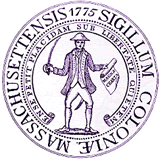
The legislature turned to the most prominent Patriot engraver: Paul Revere. He produced the image the lawmakers requested: a typical contemporary Massachusetts man holding a sword and the Magna Carta. That was Massachusetts’s official seal from 1775 to 1780.

At the end of 1780, the state had a new constitution and a new governor, and the General Court adopted a new seal. Or rather, it returned to the old figure of a Native American man with a bow and arrow. Nathan Cushing proposed the design, and Revere was once again the first engraver. Over the years, there were many little variations on that basic design.

An 1885 law went much further in specifying the details of the seal, including:
an Indian dressed in his shirt and moccasins, holding in his right hand a bow, and in his left hand an arrow, point downward, all of gold; and in the upper corner above his right arm, a silver star with five points. The crest shall be a wreath of blue and gold, whereon is a right arm, bent at the elbow, and clothed and ruffled, the hand grasping a broadsword, all of gold.
Heraldically, the man and the arm aren’t part of the same scene. However, brandishing a broadsword over the head of someone representing the original people of the region doesn’t make for a peaceful look. Not as awkward as the long-used seal of Whitesboro, New York (which was considerably changed a couple of years after this posting), but still.

Massachusetts’s flag is one of many state flags created simply by putting the state seal on a solid field. And in our case, that field is plain white. So the state flag isn’t terribly imaginative or eye-catching, even beyond the question of appropriating a Native American figure and then waving a sword over him.

In May 2022 a Massachusetts commission recommended changing the state’s seal to better reflect its values. That in turn would change the flag, or open the door for a new flag design. However, the commission couldn’t agree on an alternate proposal before its legal mandate ran out. So by default we’re sticking with an Indian whose presence goes back to 1629 and an arm with a sword perhaps borrowed from Paul Revere’s Patriot of 1775.

Monday, October 02, 2023

State Flags and the Questions of Loyalty

Last month the Washington Post published an article by Gillian Brockell about seven state flags that have little-known ties to the Confederacy.

Four of those flags contain symbols that invoke the colonial or Revolutionary periods. So how could they have roots in the era of the U.S. Civil War?

Back in January I looked at another article by Brockell, one about Robert R. Livingston, and concluded that she had been misled by what appear to be authoritative online sources. So, I wondered, what evidence was behind this one?

The key to the conundrum is that most states didn’t have flags before the Civil War. Flags were national emblems, required by law for warfare at sea. States that had at one point been independent nations, particularly with naval ships or privateers, may have established flags before 1860. But once the U.S. of A. was established, those banners lost their official status. The very idea of a state flag was a sign of national disloyalty.

In the months leading up to the Civil War, several southern states seceded from the U.S. of A. They were briefly independent nations before helping to form the Confederate States of America. And in those months South Carolina, Virginia, and North Carolina adopted the flags they still basically use.

Notably, all three of those flags incorporated details associated with the Revolutionary War:
  • South Carolina adopted the gorget (often taken to be a crescent moon) and palmetto tree from the Battle of Sullivan’s Island in 1776.
  • Virginia slapped its state seal, designed principally by George Wythe and showing Liberty killing a tyrant with the motto “Sic Semper Tyrannus,” onto a blue background.
  • North Carolina created a flag highlighting the dates May 20, 1775 (the mythical Mecklenburg Declaration), and April 16, 1776 (the genuine Halifax Resolves), as important moments when the state made steps toward independence.
Obviously, the secessionists adopting those memes were claiming their states’ Revolutionary heritage.

In Virginia, that claim didn’t go uncontested. Men in the western portion who didn’t want to break away (or who broke away from the breaking away) took the same seal-based flag design and changed the motto to “Liberty and Union.”

I was surprised to learn that there was a similar but smaller dispute over California’s bear flag. It was designed in some version back in 1846, but flew only a short time before the U.S. Army arrived. (Incidentally, the federal officer who pulled down the bear flag and replaced it with the U.S. flag was Lt. Joseph W. Revere, descendant of Paul Revere named after Dr. Joseph Warren.)

California didn’t have a state flag for more than a decade after that. Again, flags were seen as national symbols. But in 1861, in the “several months before the firing on Fort Sumpter,” some southern Californians flew the bear flag to show their opposition to the U.S. government, according to George H. Tinkham’s California: Men and Events (1915).

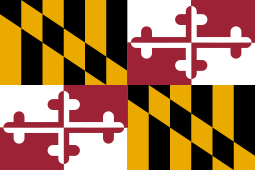
Maryland’s official flag dates from 1904, decades after the Civil War. It reflects the heraldic arms of Cecil Calvert, the second Baron Baltimore, proprietor of the colony in the seventeenth century. Maryland never seceded. So what ties to the Confederacy might its flag have?

According to Brockell, back in the early 1860s:
Union Marylanders flew the black-and-gold Calvert flag, the heraldry of the Calvert family that founded the Maryland colony. Confederate Marylanders flew the white-and-red Crossland flag, believed to be the heraldry of the Crossland family, from which George [actually Cecil] Calvert’s mother descended.
Marylanders and eventually their state legislature adopted a flag that incorporated both those patterns as a symbol of reconciliation. Of course, that was reconciliation among white men. Black Marylanders were subject to the Jim Crow laws of that time.

Brockell’s article is arranged from least to most obvious links to the Confederacy. The last two state flags it discusses are those of Arkansas, which includes a star explicitly added to commemorate the Confederacy, and Georgia, which is based on the Confederate national emblem. So those ties aren’t really debatable.

In contrast, we can ponder whether the actions of the South Carolina slaveholders of 1861 taint the symbols they adopted from the South Carolina slaveholders of 1776. Or whether the same combination of patterns as on Lord Baltimore’s seventeenth-century coat of arms can acquire a new meaning as the post-Reconstruction settlement among whites swept injustice under the national rug. But we’re mistaken to assume those state flags actually go back to the Revolution or before.

Brockell’s article starts by quoting Jason Patterson, interim deputy director of Washington College’s Starr Center for the Study of the American Experience. He wants more people to understand the meaning of the Maryland flag. However, Patterson “doesn’t want to change the flag, which is particularly beloved by Marylanders. But he doesn’t think its Confederate ties should be ignored either.” Are people willing to do that? 

This article told me stuff I didn’t know, and prompted me to look up more, so I’m grateful for it.

TOMORROW: Massachusetts’s seal.