J. L. BELL is a Massachusetts writer who specializes in (among other things) the start of the American Revolution in and around Boston. He is particularly interested in the experiences of children in 1765-75. He has published scholarly papers and popular articles for both children and adults. He was consultant for an episode of History Detectives, and contributed to a display at Minute Man National Historic Park.

Subscribe thru Follow.it


•••••••••••••••••


Showing posts with label Francis Dana. Show all posts

Wednesday, January 18, 2017

“The Child whom you used to lead out into the common”

In April 1785, seventeen-year-old John Quincy Adams had finished his first job, as secretary and translator for American minister Francis Dana in the court of Catherine the Great.

Young J. Q. Adams returned to France, where his family was living during another diplomatic mission. He prepared to sail home to Boston and enter Harvard College.

On 27 April, John Adams wrote a letter for his son to hand to their cousin Samuel:
The Child whom you used to lead out into the common to see with detestation the British Troops and with Pleasure the Boston Militia will have the Honour to deliver you this Letter. He has since seen the Troops of most Nations in Europe, without any Ambition I hope of becoming a military Man. He thinks of the Bar and Peace and civil Life, and I hope will follow and enjoy them with less Interruption than his Father could.

If you have in Boston a virtuous Clubb, such as We used to delight and improve ourselves in, they will inspire him with Such sentiments as a young American ought to entertain, and give him less occasion for lighter Company. I think it no small Proof of his Discretion, that he chooses to go to New England rather than old [i.e., to a British university]. You and I know that it will probably be more for his Honour and his Happiness in the result but young Gentlemen of Eighteen dont always See through the same Medium with old ones of fifty.

So I am going to London [as U.S. minister to the Court of St. James]. I suppose you will threaten me with being envyed again. I have more cause to be pitied, and al[though I will] not say with Dr Cutler that “I hate [to be] pitied” I dont know why I should dread Envy.—I shall be sufficiently vexed I expect. But as Congress are about to act with Dignity I dont much fear that I shall be able to do something worth going for. If I dont I shall come home, and envy nobody, nor be envied. if they send as good a Man to Spain as they have in [John] Jay for their foreign department and will have in [Thomas] Jefferson at Versailles I shall be able to correspond in perfect Confidence with all those public Characters that I shall have most need of Assistance from and shall fear nothing.
The editors of the Adams Papers report that in his letters John Adams twice quoted “old Dr. Cutler” saying that he hated to be pitied. They posit that was an allusion to the Rev. Dr. Timothy Cutler (1684-1765), longtime minister at Christ Church (Old North) in Boston. I haven’t found any other source for the remark, nor confirmation, but Cutler was a well-known figure in New England, recognized for being haughty, so it seems like a good guess.

TOMORROW: Helicopter parenting from the land of the balloon.

Friday, October 21, 2016

Abigail Adams at a Birthday Ball in Boston

In February 1797, the U.S. of A. made plans to celebrate George Washington’s last birthday as President. Some parts of the country were also eager to celebrate the new President who would take office in March, John Adams.

On 17 February, Abigail Adams received an invitation to a banquet and ball in Boston, along with one for her niece Louisa Catherine Smith. The next day, Abigail asked her daughter Nabby to pick out a new dress cap, “a good one proper for me, not a Girlish one.”

“I presume yu will have a Splnded Birth Day,” Abigail wrote to John in Philadelphia; “there are preparations making in Boston to celebrate it. . . . the Note from the Managers requested me to honour them with my attendance, which they should esteem a particular favour, as it is the last publick honour they can Shew the President. thus circumstanced I have determined to attend.”

The ball took place at the Federal Street Theatre, converted into “a magnificent saloon; sumptuously decorated with tapestry hangings; elegantly illuminated with variegated lamps; and fancifully embellished with festoons of artificial flowers.”

Gov. Samuel Adams didn’t attend, and I doubt anyone expected him to; he’d already expressed his disapproval of Boston’s flowering post-independence social scene. Lt. Gov. Moses Gill was deputed to escort in Mrs. Adams at noon. She reported, “His Honours politeness led him to stay untill he had conducted & Seated me at the Supper table. he however escaped as soon after as he could.”

All in all, however, Abigail was pleased with the event:
I do the Managers but Justice when I say, I never saw an assembly conducted with so much order regularity & propriety, I had every reason to be pleased with the marked respect and attention Shewn me. col [Samuel] Bradford, who is really the Beau Nash of ceremonies even marshalld his company [of Cadets], and like the Garter King at Arms calld them over as they proceeded into the Grand Saloon, hung with the prostrate Pride, of the Nobility of France.

[James] Swan had furnishd them with a compleat set of Gobelin Tapresty, as the Ladies only could be Seated at Table with about 20 or 30 of the principle Gentlemen the rest were requested to retire to the Boxes untill the Ladies had Supped, when they left the Table & took their Seats in the Boxes whilst the Gentlemen Sup’d all was order and Decency about half after one, the company returnd to the Ball Room, and I retired with those who accompanied me to the Ball. most of the rest of company remaind untill 4 oclock. . . .

the Seat assignd to the Lady of the President Elect was Hung with Gobeline Tapestry, and in the center of the Room, conspicuous only for the hanging, on my Right the manager placed the Lady of Judge [John] Lowel. and on my Left the Lady of Judge [Increase] Sumner. Judge [Francis] Dana, but not his Lady was present, when I was conducted into the Ball Room the Band were orderd to play the President March.

the Toast were only 6 in Number. . . . every toast save one made the Saloon resound with an universal Clap and a united huza. that was the vice President Elect, I was sorry it was so cold and faint,
Despite the Adamses’ political differences with Thomas Jefferson, Abigail still considered him a personal friend. She didn’t make her break with him until 1804 when she read James Thomson Callender’s revelations of how Jefferson had orchestrated press attacks on her husband while assuring the couple he did no such thing.

One lady, Abigail said, didn’t have a good time at the ball, feeling “mortified & placed in the back ground. . . . how could she expect any thing else?” That was “Mrs [Dorothy] Scott,” the remarried widow of the late governor John Hancock, no longer wife of the state’s most acclaimed politician.

TOMORROW: What President Adams thought of the Philadelphia ceremonies.

Monday, February 09, 2015

Missing Stamp Act Sources

Yesterday I quoted an extract from Jared Ingersoll’s letter of 11 Feb 1765, about the House of Commons debate over the Stamp Act, as it appeared in the 27 May Boston Post-Boy. Researching that text was a good reminder of how spotty the historical record remains.

When the Newport Mercury published that same text on the same day, its printer datelined the item “New London, 10 May.” That strongly suggests the text first appeared in print in the 10 May issue of the New-London Gazette. But no copies of that newspaper are known to have survived. Thus, the publication that sparked the “Sons of Liberty” movement is apparently lost.

The same situation applies to other descriptions of the debate. The 13 May Newport Mercury and 13 May Boston Gazette both contained a long description of the discussion in the House of Commons, paraphrasing opposition member Isaac Barré’s speech at length (but not emphasizing the same points as Ingersoll’s letter).

The 13 May article from Newport indicates that its source for that description was the New-York Gazette, or Weekly Post-Boy, published on Thursdays. But the run of that newspaper is not available for 1765. (That article also included the claim that there was “a majority of about forty voices in favour of the bill.” In fact, the vote was 245-49, so that report wasn’t completely reliable.)

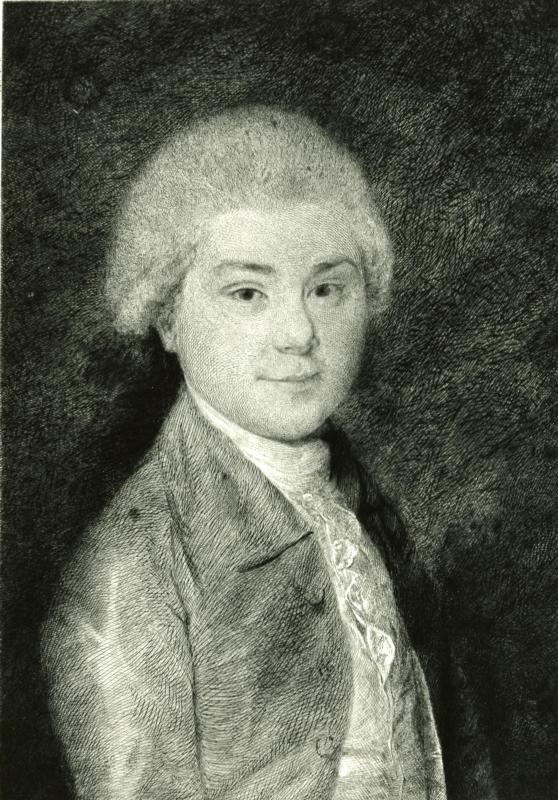
Finally, in 1852 the historian Jared Sparks (shown above as a young clergyman) reported that Francis Dana (1743-1811) of Boston had “heard Barré’s speech, and wrote home an account of it at the time.” As far as I can tell, that letter has never been published. Does its text survive in the Sparks Manuscripts at Harvard (MS Sparks 44)? The Dana family papers at the Massachusetts Historical Society? Or nowhere? How did it accord with the other accounts?

In digging around I was also struck by how Boston shopkeeper Harbottle Dorr began his personal newspaper archive in 1765. Apparently he decided that something big started that year.

Saturday, November 24, 2012

The End of the Constitutional Telegraphe

When we left off with John S. Lillie on Tuesday, he was feeling triumphant about the election of Thomas Jefferson as President in 1800. His Constitutional Telegraphe newspaper had strongly supported the Jeffersonian party, though—given how Massachusetts had a favorite son in the race and was already awarding all its Electoral College votes to whoever won the state—that hadn’t actually affected the election.

But Federalists were still in power in New England. And Americans were still working out their understanding of a free press. In February 1801 Chief Justice Francis Dana convinced a jury to indict Lillie for printing an anonymous piece that called him “Lord Chief Justice of the Common Law of England” and cast other aspersions on his integrity. Dana had been trying to apply English libel law in Massachusetts as a way to stamp out “sedition.”

Lillie announced in his 18 February paper that he “prefers to remain for a short time incog.” Too short a time, since state authorities brought him to court in August. Lillie produced the handwritten essay he had published about Dana. People recognized the writing of John Vinal—I suspect this was the man born in 1761 who taught in Boston’s Writing Schools and not his namesake father.

Both Lillie and Vinal were tried in the spring of 1802. For his attorney Lillie had George Blake, who had published essays about the case in the Independent Chronicle and had just been appointed U.S. Attorney for Massachusetts. Vinal had Harrison Gray Otis and John Quincy Adams. That team argued that handwriting wasn’t legal evidence—and indeed it wasn’t yet. So Vinal was acquitted for lack of proof.

There was no question, however, that Lillie’s name appeared on the Constitutional Telegraphe’s masthead. And the U.S. hadn’t established our current understanding of protected political speech. So Lillie was convicted of libel and sentenced to three months in jail and a $100 fine. At the end of March 1802, nineteen days into his term, he published an angry account of the proceedings from his cell and announced he was giving up the newspaper.

A printer named John Moseley Dunham took over, soon changing the paper’s title to the Republican Gazetteer. (The fad for Telelgraphe newspapers had passed.) Later it got new owners and became the Democrat. Dunham went into the ink business before moving to Ohio.

On 12 Oct 1803 Lillie wrote to President Jefferson, enclosing a bill for $4.50 for sending him the Constitutional Telegraphe for six months (October 1801 to April 1802). He explained:
When I was Editor of the News Paper called the Constitutional Telegraphe, I sent it on to you, as did Doctr. [Samuel S.] Parker, who was the original Editor of that Paper. I should not at this late period have thought of forwarding my Bill to you, which I have inclosed in this Letter, but for my misfortunes. I have suffered, Sir, very much in consequence of my too ardent zeal in the Republican cause, & am willing, if it should be necessary, still to suffer more, neither the neglect of my Republican friends, nor the contumely or contempt of my federal enemies, will, I trust, ever induce me to alter my political creed. Perhaps my zeal in the Republican cause when I edited the Telegraphe, made me rather imprudent; I certainly meant well, & my concience does not reproach me with an intention, to injure, either directly, or indirectly, the private character of any man. The distress of my family was great during my unfortunate imprisonment for a supposed libel on Judge Dana; at that time, two of my Children lay at the point of Death, particularly, the youngest, who has the honor to bear your name . . .

You no doubt will recollect Sir, that the Constitutl. Telegraphe, was, at one time, the only decided Republican Paper in this State. and if I know my own heart, when I became its Editor, I had no other view, than the good of my native Country, in the promotion of Republicanism in your Election to the Chief magistracy of the nation, and to this single point I exerted with pleasure all the abilities which I possessed, & had the inexpressible satisfaction to find the cause triumphant
Lillie got what look like federal patronage jobs in the U. S. Loan Office and the U.S. Bank. In 1802 he also inherited the “the old Franklin house on Milk Street”—the Benjamin Franklin birthplace—from his uncle. However, he enjoyed that house for only eight years before it burned down. Lillie died at age 76 in 1842.

Thursday, April 26, 2012

Henrikson on J. Q. Adams and the Ghent Treaty, Quincy, 30 Apr.

John Quincy Adams entered the American diplomatic service in 1781 at the age of fourteen. He was the French-speaking secretary of Francis Dana, the U.S. of A.’s first designated minister to Russia.

That mission wasn’t a success. Catherine the Great, ever canny, avoided meeting Dana to accept his credentials, thus keeping her empire out of western Europe’s argument over whether the British colonies should be independent. In 1783, Dana and Adams headed back west.

Adams went on to other posts, including American minister to Holland, Portugal, Prussia, Russia (for reals this time), and Great Britain. Eventually he was Secretary of State under James Monroe. But his most important diplomatic service to America was as chief negotiator of the treaty to end the War of 1812.

The keen mind for details that served Adams well as a politician, and the total stubbornness that usually didn’t, allowed him and his colleagues to wear down the British negotiators. The U.S. hadn’t been doing well in the war, but its diplomats pulled out an advantageous peace.

Prof. Alan Henrikson of the Fletcher School of Law and Diplomacy at Tufts University will deliver an illustrated lecture on “John Quincy Adams in Ghent: The Diplomacy of the War of 1812” at the Adams National Historical Park in Quincy on Monday, 30 April. In addition to his expertise as the school’s Director of Diplomatic Studies, Henrickson photographed many of the sites in Belgium where Adams and the other delegates worked.

This lecture, which starts at 7:00 P.M, is free and open to the public. For more information, visit the park site.

Friday, June 18, 2010

Twitter Feed, 9-16 June 2010

  • RT @KevinLevin: "Myths That Should By Now Be History" from your friends at Colonial Williamsburg bit.ly/9eL9Q9 #historyteacher #
  • RT @WilliamHogeland: Mindblowing digital #WilliamBlake archive: www.blakearchive.org/blake/main.html #
  • Tonight at NEHGS in Boston, 6:00: Maureen Taylor speaks on her book LAST MUSTER, collecting photos of Revolutionary War Generation #
  • Tonight at Folsom Tavern in Exeter, NH, 7:00: Ben Z. Rose talks about Gen John Stark #
  • Tonight at Shirley-Eustis House in Roxbury, 5:00: Prof Robert Allison concludes lecture series on Massachusetts in the British Empire. #
  • Tonight at my house, about 8:00: collapsing from a surfeit of historical events to choose from. #
  • RT @Britannica: "Founders envy" leads to foundering politics. Let's move beyond it, says Joe Lane. bit.ly/dszZe6 #
  • The British Consul in Boston is surprisingly tall. I'm just saying. #
  • Wiley's NON SEQUITUR comic strip takes on constitutional originalism: www.gocomics.com/nonsequitur/2010/06/10/ #
  • Historic New England's searchable database of collections and artifacts: bit.ly/9SJtBM #
  • Review of Rachel Hope Cleves's book on political response to French Revolution in USA: bit.ly/b6m8xP #
  • John Dixon, sentenced to die for burglary in 1784, and (at first) refusing to play the condemned man's expected role: bit.ly/cuCOCT #
  • Actual tea from the Boston Tea Party, collected from the salt water: bit.ly/dgsiUM #
  • Looking at a life sentence through eighteenth-century American eyes: bit.ly/bKEIMq #
  • RT @historyfaculty: Rare photo of slave children found in NC attic: bit.ly/dodvGm #
  • RT @historyfaculty: D.C.'s Jefferson Memorial is Sinking: bit.ly/9JPfpz // Actually just the sea wall out front. Or is water rising? #
  • RT @PaulRevere1734: This day 1768: Customs officials seized John Hancock's sloop Liberty on charge of landing undutied goods. #
  • RT @history_book: War at Sea Under Queen Anne 1702-1708 - by John Hely Owen. amzn.to/a7AgBe #
  • RT @history_book: Bookseller of the Last Century: Being Some Account of the Life of John Newbery - by Charles Welsh amzn.to/c505kr #
  • RT @SecondVirginia: Charleston SC gets new historical marker commemorating the 1780 siege and surrender bit.ly/9WLSoB #
  • RT @rjseaver: #scgs10 Maureen: last living RevWar widow died in 1906. Esther Damon married Noah Damon when he 75, she 20 #
  • Doubts about reported photo of enslaved kids from @KevinLevin bit.ly/aML9eN and Tim Abbott bit.ly/c70v4i #
  • RT @myHNN: What lies beneath: the fakes, mistakes and discoveries at the National Gallery bit.ly/96DiJc #
  • RT @amhistorymuseum: Today in 1743: Francis Dana, member of the 1777 Continental Congress, is born. His silk waistcoat: ow.ly/1WRGM #
  • Francis Dana became USA's first minister to Russia, but Catherine the Great refused to receive him and his young asst, John Quincy Adams. #
  • Early ballooning in London via @lucyinglis: bit.ly/9Xg90c A Bostonian gets in on the action: bit.ly/bWizji #
  • Gravestone showing the frightened soul of Elizbeth Huntington, Windham, CT, 1729: bit.ly/95zdn1 #
  • In ad, Alabama GOP candidate complains about taxation to faux Samuel Adams, ignorant that Adams was tax collector: bit.ly/9oIy9F #
  • RT @WilliamHogeland: #JohnAdams:"What a poor, ignorant,crapulous mass is #TomPaine's Common Sense." // Tell us how you feel, John! #
  • RT @alberkes: Here's a lovely article in the New York Times about TJ's travels in Burgundy. bit.ly/98O2uO #
  • RT @TJMonticello: We need your help to solve an honest-to-goodness historical mystery from Jefferson's weather records: bit.ly/aoRXEL #
  • RT @franceshunter: Botany, history, spies & the fate of early America - plus a book giveaway. All this week - bit.ly/c2tvAf #
  • RT @WilliamHogeland: "calls G. Washington, as distiller, a 'small businessman'? (Whiskey rebels would have laughed.)" // Amazing ignorance. #
  • .@historianess But for candidates like this one, it appears that representation counts only if his choice wins and does what he says. #
  • @WilliamHogeland I THINK he means that IRS employees aren't directly elected, but that doesn't help his case on the stupid meter. #
  • Historian Laurel Thatcher Ulrich popularizes material history in the DESERET NEWS: bit.ly/9RqAYi #
  • This weekend in Deerfield, MA: Dublin Seminar/Costume Society of America conference on "Dressing New England": bit.ly/9IJdP0 #
  • Mini American Revolution summarizes capture of Fort Ticonderoga in nine blog entries: bit.ly/aTmKIv #
  • Pvt James Cuffe managed to desert from His Majesty's 62d and 22d Regiments AND the 12th Massachusetts: bit.ly/9JI38Y #
  • RT @classroomtools: Questioning How is history used to deceive in this political ad youtu.be/6iQ7ZDUutU4 is critical thinking #

Thursday, March 27, 2008

Quizzing John Adams: The Answers

Yesterday I offered thumbnail descriptions of four dramatic moments in episode 3 of the John Adams miniseries, and asked which of them never actually happened to John Adams. Here they are again, with documentation for my answers.

  • On his first trip to Europe as a diplomat for the U.S. of A., John’s ship met an armed British vessel. The American captain asked John to go below for his own safety, but he quietly came back up on deck with his gun.
That anecdote was published as early as 1822 in Hezekiah Niles’s Principles and Acts of the Revolution in America and repeated in A Selection of Eulogies, Pronounced in the Several States, in Honor of Those Illustrious Patriots and Statesmen, John Adams and Thomas Jefferson, published in Hartford in 1826:
[Capt. Samuel] Tucker saw a large English ship showing a tier of guns, and asked Mr Adams’ consent to take her; this was granted. Upon hailing her, she answered by a broadside. Mr. Adams had been requested to retire to the cock-pit—but Tucker looking forward, observed Mr. Adams among the marines, with a musket in his hand, having privately applied to the officer of the marines for a gun, and taking his station among them.

At this sight, Capt. Tucker became alarmed, for he was responsible for the safety of Mr. Adams, and walking up to the ambassador, desired to know how he came there; upon which the other smiled, gave up his gun, and went immediately below.
The miniseries showed John sneaking back up to the deck with his own gun, and even firing the first shot of the encounter. What really happened wasn’t that dramatic, but John did go on deck to help in the fight. The other vessel was not a Royal Navy warship but an armed merchantman, and Capt. Tucker was able to cow its captain into surrendering without much resistance.

  • John assisted during an emergency shipboard surgery, helping to hold down a wounded man while his leg was sawed off.
From John Adams’s autobiography, describing an event between 11 and 20 Mar 1778:
Mr. Barrons our first Lieutenant, attempting to fire a Gun as a Signal to the Brigg, the Cannon burst, and tore in pieces the right leg of this worthy officer so that the Surgeon was obliged to amputate it, a little below the Knee.

I was present at this afflicting Scene, and, together with Captain Tucker, held Mr. Barron in our Arms, while the Doctor put on the Turnequett and cutt off the Limb. Mr. Barron bore it with fortitude, but thought he should die, and his principal concern seemed to be for his family.
The miniseries showed a man wounded in the sea skirmish mentioned above, and the amputation taking place as the fighting goes on. John’s autobiography is clear that Barron was wounded at least two days later as a cannon burst during a salute to a friendly ship. Once again, John really did have this experience, but the television script altered details to make it even more dramatic. (As for Mr. Barron, he didn’t survive.)

  • During his posting in Paris, John was unpleasantly surprised to learn that the Congress had appointed Franklin as the first American minister plenipotentiary to France.
John had actually recommended that Congress name Franklin to this ambassadorial post, so the news did not come as a surprise to him. On 12 Feb 1779 he wrote in his diary:
But this Day, Dr. Winship arrived here, from Brest, and soon afterwards, the Aid du Camp of Le Marquis de Fayette, with Dispatches, from Congress, by which it appears that Dr. Franklin is sole Plenipotentiary, and of Consequence that I am displaced.

The greatest Relief to my Mind, that I have ever found since the Appearance of the Address [by Silas Deane]. Now Business may be done by Dr. Franklin alone. Before it seemed as if nothing could be done.
But just because Franklin’s appointment wasn’t a surprise doesn’t mean it was pleasant. Over the next week John tried writing at least five letters to Abigail, and only on 20 February managed to express the news and what he really felt about it:
A new Commission has arrived by which the Dr. [i.e., Franklin] is sole Minister. Mr. [Arthur] Lee continues Commissioner for Spain, but I am reduced to the Condition of a private Citizen. The Congress has not taken the least Notice of me. On the 11. of September they resolved to have one Minister only in France, on the 14 they chose the Dr., in October they made out his Commission, the Alliance sailed in 14 Jany. and in all that Interval, they never so much as bid me come home, bid me stay, or told me I had done well or done ill.
Soon John sailed back home to Massachusetts, only to return to Europe before the end of the year to start negotiating a peace treaty with Britain. The miniseries left out that round trip, presumably to simplify its story.

  • Because he could speak French, John Quincy Adams was made secretary to the U.S. minister to Russia, which entailed traveling more than a thousand miles across Europe, even though he was only fourteen years old.
John Quincy was born 11 July 1767. Here’s a portion of his letter from St. Petersburg in September 1781 to his old tutor John Thaxter:
We arriv’d here the 16th of August old stile, (which is universally used yet, all over this Country;) having left Berlin, the 2d. of the same month, new stile, and rode the whole way, day and night, stopping only at the principal towns which lay in our way, viz: at Dantzic, three days, at Konigsberg, one, at Memel, one night, at Riga, four days, and at Narva, two: between these places, which are distant from one another, from one to four hundred English Miles there is hardly a Village to be seen. The whole route from Berlin here may be call’d a barren desart...
At fourteen years old, John Quincy was at the age when Boston boys left the town schools (if they attended at all) and started work in their chosen professions or went to that college in Cambridge. John Quincy and his younger brother Charles had already begun studying at the University of Leyden in January 1781. So the Adamses didn’t consider it odd to send their son away so young. Nonetheless, all the way to Russia was quite a distance.

Shown above is a handsome embroidered waistcoat owned by Francis Dana, the dipomat John Quincy accompanied to Russia. Dana family tradition says he brought it to wear when he presented his credentials to Catherine the Great. However, the czarina, hedging her bets about this new republic in North America, never granted him an audience. Dana, the waistcoat, and John Quincy returned after a few frustrating months. In 1809, President James Madison appointed John Quincy Adams the U.S. minister plenipotentiary to Russia, and this time he was received. As for the waistcoat, it became part of the collections of the Longfellow House in Cambridge.

So as I score this quiz, only one of the four dramatic moments I described never happened. A couple more were goosed up a little. But John Adams really did have a dramatic life.