J. L. BELL is a Massachusetts writer who specializes in (among other things) the start of the American Revolution in and around Boston. He is particularly interested in the experiences of children in 1765-75. He has published scholarly papers and popular articles for both children and adults. He was consultant for an episode of History Detectives, and contributed to a display at Minute Man National Historic Park.

Subscribe thru Follow.it


•••••••••••••••••


Showing posts with label disabled. Show all posts

Sunday, May 17, 2026

“There is something off about this sword”

Earlier this year the Sandwich Enterprise shared a story by Cearra O’Hern about the identification of an artifact at the Pilgrim Hall Museum.

The article focuses on Michael L. Welch, Jr., who uses first-person interpretation of Revolutionary figures in teaching history at the Sandwich Middle School.

The article explains:
Welch primarily portrays Major General James Warren, a leading revolutionary in Massachusetts who also served as president of the Massachusetts Provincial Congress during the American Revolution. Welch heard that the Pilgrim Hall Museum in Plymouth had Warren’s sword

“I connected with the curator, who was very helpful in lining up a time to go in and look at the sword,” Welch said. “I was given the attribution of the sword, how the sword was passed down through the Warren family and donated. I photographed it extensively, I scanned it, I made a 3D rendering of it, and the whole time I am looking at this sword, I am like, ‘There is something off about this sword.’”

Welch had seen a sword like Warren’s before, which was believed to date back to 1764-1765. As he continued to examine its pommel, guard and counter-guard, Welch determined the sword was not a general’s sword; it was a mass-produced sword made much later, after the American Revolution.

Welch identified the sword as a Model 1796 Hanger carried by British sergeants, a discovery that “broke his heart,” as he did not want to say anything to the Pilgrim Hall Museum.
The photo above, which the museum shared on social media a few weeks before this article appeared, may show one of those awkward moments when Welch looked at the sword and wondered about sharing doubts with curator Anne Mason.

After confirming his assessment with an expert, Welch did indeed discuss those findings with Mason and her colleagues. The museum will add that information to its files and assess how it displays the hanger. As Welch points out in the article, the fact that this sword was made in 1796 doesn’t mean it wasn’t owned by James Warren; his son James, Jr. (1757–1821), a Continental Marine officer who lost a limb in 1781; or another member of the family. It just doesn’t go back as far as the Revolution.

Saturday, May 02, 2026

“Inspector of all Boats, Letters, Goods and Passes”

In the fall of 1777, as recounted yesterday, John Hill and his family were released from captivity in Boston as part of a prisoner exchange.

I haven’t been able to find more about that deal—who arranged it, what prisoners of the Crown went free, and so on. To the Hills, those details probably didn’t matter.

Soon John and Elizabeth Hill and John’s daughter were inside British-held New York City. Before the war, they had run an inn there. Had that building survived the fire of 1776? Was it awaiting their return?

Later, in describing his services to the Crown, Hill simply said that he joined a volunteer militia company commanded by David Mathews, the city mayor.

But his major service began, he said, in July 1779 when he “was appointed Inspector of the Ferry, at Brooklyne; near New York, a place of great Trust, and received 10 shillings New York Currency, per Day.”

The Royal Gazette announced that appointment on 14 August:
JAMES PATTISON, Esq; Commandant of the city of New-York and Major General of his Majesty’s Forces in North-America, has been pleased to appoint JOHN HILL, Inspector of all Boats, Letters, Goods and Passes, at Brooklyn-Ferry.
John’s brother Richard, another evacuee from Boston, held the same post, perhaps earlier. In May 1780, Richard broke his thigh bone and had to use crutches, but he appears to have continued in the job.

On 10 Nov 1779, John Hill’s daughter (unnamed) married “Lieut. Cunningham, of the Legion,” at Brooklyn. As I wrote before, this officer might have been Ralph Cunningham, killed the next year in South Carolina.

As ferry inspector, John Hill ran periodic notices in the newspapers announcing lost property. For example, on 11 Dec 1779 he put a notice in the Royal Gazette that he was holding “a Vellice with a Marque, marked Capt. Knight, 43d regiment, with some small articles.” That was presumably Henry Knight, by then major in the 45th.

Hill also sold Richard Speaight’s “Royal Bitter Tincture, for the Fever and Gue,” that franchise being arranged “For the conveniency of the Inhabitants of Long-Island.”

But Hill’s main job was to keep watch for deserters and spies.

TOMORROW: Counterespionage.

Thursday, September 25, 2025

Boston’s “Sedan for Removing the Sick”

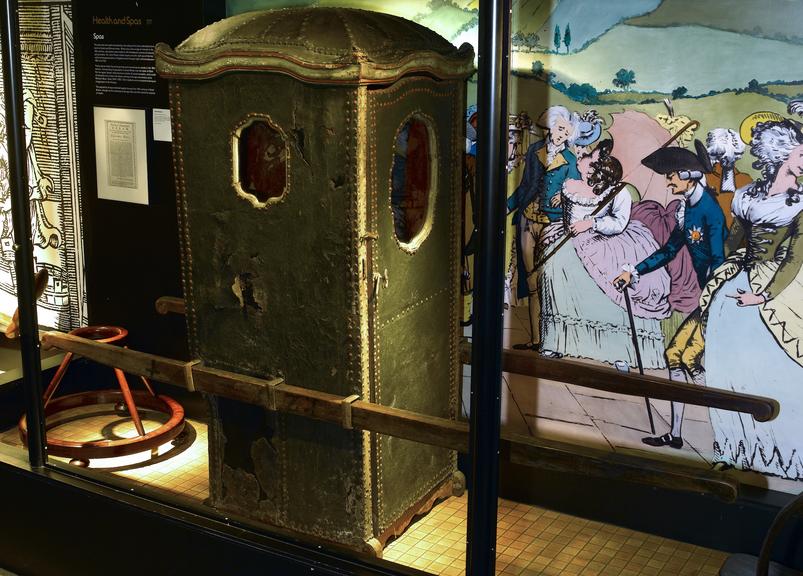
Lining up the sparse mentions of sedan chairs in colonial Boston reveals a clear pattern: they were used to transport sick people.

In 1674 the Rev. John Oxenbridge of the First Meetinghouse suffered a stroke while preaching the Thursday Lecture and “was carried home in a Cedan.”

Thirteen years later, Judge Samuel Sewall wrote in his diary: “Capt. Gerrish is carried in a Sedan to the Wharf and so takes Boat for Salem, to see if there he may find amendment of his Distemper.”

In May 1715, the newly reappointed governor Joseph Dudley was bed-ridden with gout. At the end of the month, Sewall wrote, he came to Boston and “was carried from Mr. Dudley’s to the Town-House in Cous. [William? Jeremiah?] Dummer’s Sedan: but twas too tall for the Stairs, so was fain to be taken out near the top of them.”

Yesterday I listed five times sedan chairs were advertised for sale in eighteenth-century Boston newspapers. I don’t think it was coincidence that four of those ads were estate sales, and the fifth seller died within two years. Those men might have acquired sedans as they or their wives became too ill to walk around.

Boston also had a public sedan chair, operated by the town itself. In March 1739, the Boston selectmen took note of “A Sedan, or Chair belonging to the Hon. Edward Hutchinson Esqr. which the Town has had the loan of for a considerable time.” One of those local elected officials was Thomas Hutchinson, and the sedan owner was his uncle. The selectmen decided that the chair “be effectually Repaired, and made fit for Use, in the best and frugal manner.”

That sedan chair became part of Boston’s public-health infrastructure. On 4 Jan 1757 the selectmen voted “that the Sedan for Removing the Sick be broke to Peices” and “Mr. [Isaac] Cazneau make a good Serviceable Sedan at the Charge of the Town.” Cazneau was a saddler.

In 1760 the Massachusetts General Court bought land in the sparsely populated western point of the Boston peninsula called “New Boston” for a new hospital. Four years later, the town suffered a serious smallpox epidemic. That appears in the selectmen’s records with an uptick in orders for the sedan chair to carry people to that hospital.
  • 16 Jan 1764: “Information was given the Select men by Dr. [Phillip] Cast, that One Hallet who came from Newfoundland a Month past, and Boards at Mrs. Nicholsons in Fitches Alley, has the Symptoms of the Small Pox upon him whereupon the Select men endeavour’d to perswade him to consent to his being removed, and having obtain’d such consent, he was accordingly removed in the Sedan to the Province Hospital at New Boston.”
  • 20 Jan 1764: “The Select men having prevailed with Mr. Adams to consent that his Child should be removed from his House to the Hospital at New Boston, they at about 12. OClock that Night took Mr. Williston and a number of hands with the Sedan to said House, when they received the Wet Nurse and Child and carried them to said Hospital”.
Similar entries appeared through August of that year.

TOMORROW: “Mr. Williston.”

(The picture above shows a sedan chair used to carry medical patients in La Paz, Bolivia, now in the Wellcome Collection in London.)

Tuesday, August 12, 2025

“He hobbled into battle on his wooden leg”

Jacob Chapman’s 1882 Genealogy of the Folsom Family: John Folsom and His Descendants, 1615-1882 devoted an apprendix to Jonathan Folsom, sharing this bit of family lore:
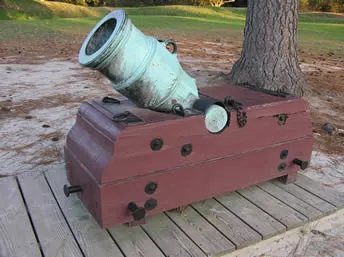
when the Revolutionary war commenced, he set out for another campaign, and found his way to Bunker Hill. Here he hobbled into battle on his wooden leg, and took charge of a mortar

It is said that at the second shot he threw a bomb upon the deck of a British man-of-war, which led her to draw off as soon as possible into safer quarters.
There’s no supporting evidence for this story. No other American account says the provincial forces at Bunker Hill had a mortar. (They had six four-pounder cannon, though only one trained gun crew at the height of the battle.)

No American veterans described a man with one leg amputated above the knee joining the fight. Nathaniel Folsom didn’t mention his brother in the letters he sent back to New Hampshire.

No British naval sources complained about provincial mortar fire or blamed a shell for pulling back from the battle.

One source for this tale, if not the only one, was Jonathan Folsom’s granddaughter Betsey, born in 1792. She could have known her grandfather directly since he died around 1800. Betsey Folsom married a man named Daniel Durgin and then outlived him by three decades, dying in 1878. Her son Mark William Franklin Durgin of Medford appears to have been one of Chapman’s sources on the family.

After the Chapman book, the story of Jonathan Folsom firing a mortar at Bunker Hill appeared in a few publications of the Sons of the American Revolution. Though Lt. Folsom’s service in the French & Indian War was well documented, descendants joining that organization needed to say he fought in the next war as well.

TOMORROW: Versifying.

Monday, August 11, 2025

“Having loaded a Swivel that had lain buried near 25 Years”

Last month I quoted in passing how “Ensign Jonathan Folsom was shot through the shoulder” in the Battle of Lake George in 1755.

According to some family historians, this Jonathan Folsom (1724–1800?) had also served in the Louisburg campaign ten years earlier.

However, the man of that name was already a lieutenant in 1744, and he was listed as “Decd.” on 20 Jan 1745 in New Hampshire records. So I think that was probably a relative.

By 1758 the former ensign Folsom had recovered from his shoulder wound enough to be serving as a first lieutenant. (His younger brother Nathaniel Folsom rose much higher in provincial military rank.)

The 2 June 1766 Boston Post-Boy ran this article:
We hear from Exeter, that great Rejoicings were made there on Monday last, upon receiving the News of the Repeal of the Stamp-Act, by Ringing of Bells, Firing of Cannon, Illuminations, Fireworks, &c.

The following Accident happened last Monday at Newmarket, to Lieut. Jonathan Falsom of that Town—he having loaded a Swivel that had lain buried near 25 Years, it burst in Pieces, one of which struck him in the Breast and several others in one of his Legs which split the Bone thereof to Pieces, on which the Surgeons thought proper to cut it off above the Knee.
The first paragraph was the summary of an item in the 30 May New-Hampshire Gazette from Portsmouth, the second a word-for-word transcription of a later paragraph from that paper.

The timing strongly suggests that Folsom decided to fire the old swivel gun (a small cannon designed to be mounted on fortification walls or ship rails) to celebrate the Stamp Act repeal. And that turned out to be a poor decision.

That history wasn’t always transmitted accurately, though. One genealogy for this family, Nathaniel Smith Folsom’s Descendants of the First John Folsom (1876), said the accident happened during “rejoicings over the recent capture of Louisburg.” Everything pointed back to Louisburg.

TOMORROW: More Folsom family lore.

Tuesday, July 15, 2025

“I have pleased myself with the thought of serving under you”

As discussed yesterday, sometime in the first week of May 1775 the Rhode Island legislature appointed Nathanael Greene to be the brigadier general of its army of observation.

In his biography of his grandfather, George Washington Greene wrote:
There is a tradition, but I will not vouch for it, that the first choice fell upon an Episcopalian, who declined; the second, on a Congregationalist, who also declined; and that, when the third vote was announced as having fallen on Greene, he rose in his place, and said: “Since the Episcopalian and Congregationalist won’t, I suppose the Quaker must.”
That’s about as tepid an endorsement for a “tradition” as a nineteenth-century biographer could provide. And the religious terms “Episcopalian” and “Congregationalist” weren’t standard in 1775, suggesting it wasn’t exact.

One recent biographer of Nathanael Greene has suggested that those first two candidates for command declined on religious grounds. I think that’s a misreading of the tradition. The first two faiths mentioned weren’t pacifist. That was the point of the anecdote—the irony of a (lapsed) Quaker leading an army instead of men from sects that didn’t object to military action. And the story might have some validity, though I doubt it happened in a legislative session.

The legislature’s first choice probably was Simeon Potter, already major general of the colony militia. At least, the body couldn’t ignore him. And Potter was an Anglican, even if he’d punched his minister in the face back in 1761. (Incidentally, the Rev. John Usher died on 30 Apr 1775, just as these discussions about the Rhode Island army were under way.)

Another candidate for command whom G. W. Greene and later biographers mentioned is James Mitchell Varnum (shown here), captain of the Kentish Guards. He’d grown up in Dracut, Massachusetts, as what people would later term a Congregationalist. That said, there were many others of that faith in Rhode Island as well, some probably quite senior to the twenty-six-year-old Varnum.

Varnum and Greene had worked together in the fall of 1774 to form the Guards, an independent militia company based in East Greenwich. Varnum, a rising young attorney, was chosen as the first captain. Encouraged by a cousin, Greene put his name forward to be a lieutenant, only to learn that some members thought his limp meant he didn’t look good marching in an elite company at all.

Sometime in October, it appears, Greene wrote to Varnum:
If I conceive right of the force of the objection of the gentlemen of the town, it was not as an officer, but as a soldier for that my halting was a blemish to the rest. I confess it is my misfortune to limp a little, but I did not conceive it to be so great; but we are not apt to discover our own defects. . . .

I have pleased myself with the thought of serving under you, but as it is the general opinion that I am unfit for such an undertaking, I shall desist. I feel not the less inclination to promote the good of the company, because I am not to be one of its members. I will do anything that's in my power to procure the charter.
Apparently Varnum had spoken of leaving the company himself if Greene was forced out because the letter continued:
Let me entreat you, Sir, if you have any regard for me, not to forsake the company at this critical season for I fear the consequences—if you mean to oblige me by it, I assure you it will not, I would not have the company break and disband for fifty Dollars
Varnum stayed with the company and apparently convinced Greene to do the same.

On 29 October, the legislature, with Greene as a delegate, issued a charter for the Kentish Guards. Its act listed the dozens of men who had petitioned for that charter, starting with Varnum and the other three designated as officers, including Christopher Greene. The fifth name on that list was Nathanael Greene. So officially he was a leading member.

It’s conceivable that some fallout from that affair influenced the choice of Greene as general in May 1775. If the legislature did approach Varnum, he may have thought it was Greene’s turn to lead. Or perhaps, with a real war looming, organizational skills seemed a lot more important than a slight limp.

TOMORROW: Hidden factors in the decision.

Tuesday, June 24, 2025

“The only one now living of those who acted as aids-de-camp to General Howe”

Thomas Hyde Page (1746–1821) graduated top in his class from the Royal Military Academy at Woolwich in 1769, winning a gold medal from the king.

Page became a lieutenant in the Corps of Engineers and arrived in Boston in the spring of 1775. During the Battle of Bunker Hill he served as one of Gen. William Howe’s aides.

Richard Frothingham quoted the 11 Jan 1776 London Chronicle as saying:
A few days ago arrived in town, from Boston, Lieutenant Page, of his majesty’s corps of engineers, on account of the wounds he received the 17th of June, in the action of Charlestown. This gentleman is the only one now living of those who acted as aids-de-camp to General Howe, so great was the slaughter of officers that day. He particularly distinguished himself in the storming of the redoubt, for which he received General Howe’s thanks.
Page was back in London because he had been wounded in the leg, badly enough to require some sort of amputation.

Capt. John Montresor wrote to Page from Philadelphia on 17 June 1778 noting the “disagreeable memory” of the date. “I hope you are able to saunter without a stick.”

In his journal, however, Montresor grumped about his lack of a pension and wrote, “Page served Eleven days and was then wounded and return’d home and had ten shillings per diem settled for life.” (Of course, Montresor still had both his legs.)

Page continued to work on various engineering projects for the British military. Promotion was slow in that branch of the service, but between 1781 and 1783 he became a captain. That summer he received a double honor: he was elected to the Royal Society and knighted. A couple of years later he shifted to the invalid corps.

In 1790, Lt. Col. John Small, who had been Gen. Robert Pigot’s brigade major, wrote to Page:
The interesting position we were placed in side by side at the memorable Battle of Bunker’s Hill will never be forgotten, and will ever excite the most anxious emotions in the breast of the fellow campaigner who has now the honor of addressing you; who witnessed in the most trying moments, your innate worth, your professional Intrepidity and skill, and was most seriously affected when at your side he saw you ffall from a very dangerous wound, receiv’d when displaying your exertions in the ffield, when your cool and manly example, and sound judicious advice, contributed much to acquire success and victory.
I wish I had more of that letter to understand who was asking what favor.

Using surveys by Montresor and others, Page published very good maps of Boston harbor and the town of Boston. His 1793 “Plan of the Action at Bunkers Hill” is still the most useful source on the topography of the Charlestown peninsula in 1775—though it’s also notable in switching the labels of Bunker’s Hill and Breed’s Hill.

Most of Page’s engineering work involved drainage, harbors, canals, and other civil projects rather than fortifications. James Northcote’s portrait of Page above shows him “holding a Plan of Fort Landguard and seen in the distance.” Page didn’t build that fort, but he engineered its tricky well. (Once apparently at Boston, that painting is now on display at the Tyntesfield estate in North Somerset.)

Sir Thomas Hyde Page remained active all around Great Britain for decades and finally retired to Boulogne, France, where he died.

Thursday, June 05, 2025

More Talks on the Battle of Bunker Hill and Its Aftermath

Here are more upcoming talks that look ahead to the Sestercentennial of the Battle of Bunker Hill.

Tuesday, 10 June, 6:00 P.M.
Courage and Resolve in Nation and Institution Building
Massachusetts General Hospital and online

Major General Joseph Warren’s death at the Battle of Bunker Hill on June 17, 1775, secured his legacy as a Revolutionary War hero. Lesser known is his role as an advocate for organized healthcare for the poor and needy. Both he and his brother John advanced American medicine during the Revolutionary and Early Republic eras. In the early 1800s, John’s son Dr. John Collins Warren would build upon those ideals through his own role in co-founding the Massachusetts General Hospital. Biographer Dr. Samuel Forman explores the lives of these three men and their continued influence on current health care.

This free event will take place in the hospital’s Paul S. Russell, M.D., Museum of Medical History and Innovation at 2 North Grove Street. Register for a seat or a link here.

Thursday, 12 June, 5:30 P.M.
General James Reed and the Battle of Bunker Hill
Main Street Studios, 569 Main Street

The Fitchburg Historical Society says, “Join us for fun discussion,” part of a series on “Local Stories from the American Revolution.” It looks like society officials will provide the basic information.

Continental Army general James Reed (1722–1807) lived in Fitchburg when it was part of Lunenburg and again in the last decade of his life. He was born in Woburn, however, and starting in 1765 led a settlement in Fitzwilliam, New Hampshire. After war broke out, Reed returned to Massachusetts as colonel of a New Hampshire regiment and fought alongside Col. John Stark at the rail fence. In mid-1776 Reed was assigned to the Northern Department, helping the retreat from Canada. He contracted smallpox, lost his sight, and retired from the army.

Friday, 13 June, 10:00 A.M.
Rebels, Rights & Revolution: Battle of Bunker Hill
Massachusetts Historical Society, Boston

Join Chief Historian Peter Drummey for a gallery talk on the exhibition, “1775: Rebels, Rights & Revolution,” which charts major Massachusetts events in the first year of the American Revolution. Drummey will discuss the impact of the Battle of Bunker Hill using items on display. Visitors are invited to explore the rest of the exhibition and ask questions.

Tuesday, April 01, 2025

“Merely a private individual traveling for curiosity”

As recounted yesterday, over champagne Julien-Alexandre Achard de Bonvouloir divulged to a British secret agent that he’d been meeting with the French ambassador to Britain, the Comte de Guines.

The young Frenchman had just come from Massachusetts, where war had broken out months before. He offered to be a liaison between the French government and the American rebels.

De Guines consulted by letter with the Foreign Minister of France, the Comte de Vergennes (shown here—that letter is reproduced and translated in B. F. Stevens's Facsimiles of Manuscripts in European Archives Relating to America, 1773-1783). The two officials agreed to send Bonvouloir back to North America as their own secret agent.

The terms were:
  • De Guines and Bonvouloir agreed the young man would present himself as “a merchant of Antwerp,” then part of the Austrian Netherlands.
  • The French government would pay Bonvouloir a “salary of two hundred louis.”
  • Bonvouloir couldn’t tell his family what he was up to, not even “His brother, an officer in the Lyons regiment, [who] was in London at the time.”
The mission was just as restricted. Bonvouloir was to meet with delegates to the Continental Congress in Philadelphia, but he couldn’t confirm that he was an emissary of the French government and he couldn’t make any promises of aid. According to the historian Edwin Erle Sparks, he could “assure the American leaders that France had no intention on Canada”—though of course a promise from “merely a private individual traveling for curiosity” carried no weight.

The whole episode reads very much like a modern spy novel—not an Ian Fleming type but the more cynical sort like John Le Carré’s The Looking-Glass War. Bonvouloir was hungry to make his mark, to rise above his status as a younger, disabled son sent off to the colonies, to do something for his country. His government took advantage of that eagerness.

Almost a year later, on 16 June 1776, De Guines wrote another letter to Vergennes about Bonvouloir. By this time the British royal authorities in America were hunting for him. His French government contacts weren’t sure how to get him off the continent, or whether it would be worth it. De Guines had to prod Vergennes into authorizing the payment of another year of salary as promised. The ambassador planned to ask Bonvouloir’s brother to write to him via Québec, but he assured the minister “he and his brother are always liable to be disavowed if any inconvenience should result from their action.”

Not aware of that future, in October 1775 Bonvouloir sailed for Philadelphia “in the ‘Charming Betsy,’ Captain John Farmer.” That information comes from another document in the Earl of Dartmouth’s papers—evidence that the British government was already tracking this operation.

I plan to return to Bonvouloir later in the year, around the 250th anniversary of his meetings in Philadelphia.

Monday, March 31, 2025

“Some Vin de Champagne produced the desired effect”

I’ve been quoting from the report of a British secret agent on his—or possibly her—conversations with Julien-Alexandre Achard de Bonvouloir and the Chevalier d’Amboise at their hotel in London in the summer of 1775.

Those were aristocratic Frenchmen who had spent a few weeks in New England. Based on that deep knowledge, they told their acquaintance that all the fighting in Massachusetts could be settled:
Lastly, that it appears to them both, the Americans had no settled, regular, well digested plan, that there exists among their Chiefs more Jealousy than unanimity: that many of the Settlers, and mostly all the Commercial people of Substance, begun to be tired of the present situation, and that they (the two french Officers) thought it probable Government would fall on Methods to disunite them, which if employed with success, would necessarily facilitate a reconciliation.
The agent thought there was more to find out, though. These two Frenchmen were happy to talk about the British colonists in New England, but what about their own secrets? What were they really up to?

The agent used a time-honored method: “stimulating the pride of Monsieur Le Comte de Beauvouloir in the moment that some Vin de Champagne produced the desired effect on his prudence.” The powerful combination of alcohol and flattery.

Bonvouloir then divulged that “he had had two Audiences of Le Comte de Guines,” the French ambassador to the British government (shown above). He boasted “that his Excellency had made him great offers of Service and had asked him twice to dinner.” As the younger son of a French nobleman, disabled enough that his military appointments were basically honorary, Bonvouloir yearned for recognition from such an important official.

The agent told whichever British Secretary of State he or she worked for (probably the Earl of Rochford though the report survives in the papers of the Earl of Dartmoouth):
My Opinion is that the two french Officers are at this Instant in the Service of the Rebel Americans, and are paid by them; that they came over either with proposals to the Courts of France and Spain, or some other Commission in the American Interests, and that they intend to return to their Employers by means of some English Ship.
In fact, there’s no surviving evidence that anyone in New England had even noticed Bonvouloir and D’Amboise, much less sent them to Europe with “proposals to the Courts of France and Spain.”

The situation was quite the reverse. Bonvouloir was trying to become an emissary of his own government.

TOMORROW: Diplomatic missions.

Friday, December 27, 2024

Christopher Machell and the Additional Companies

Earlier this month I wrote about Capt. Christopher Machell of His Majesty’s 15th Regiment of Foot.

Some sources have said that British officer was wounded at the Battle of Bunker Hill, and I knew his regiment wasn’t even in North America at that time. Apparently more reliable sources said he was wounded in the “Battle of New York,” but when that was remained a mystery.

Also a mystery: Why if Machell lost an arm in 1776 did he remain on the regiment’s rolls through the end of the war?

I was pleased but not surprised to receive answers from Don Hagist, author most recently of
Noble Volunteers: The British Soldiers Who Fought the American Revolution and editor of the Journal of the American Revolution.

Here’s Don Hagist as this month’s guest blogger, plugging the holes in that short series about Capt. Machell:


During the American Revolution British regiment on service in America maintained a cadre of officers and non-commissioned officers in the British Isles for recruiting. Called “Additional Companies”, these were not companies in a structural sense, but financial vehicles to allow for the expenses of the recruiters, and for the recruits.

Every so often, when enough recruits had been raised and trained, they were sent to America under care of one of the Additional Company officers, and an officer in America returned to Britain to join the recruiting service.

As the war progressed, it was quite common for wounded officers to return to Britain to recover, and joining the Additional Companies was a way to keep them at full pay and working while they convalesced.

Captain Christopher Machell commanded the 15th Regiment’s light infantry company, and was wounded at the battle of Harlem Heights on “New York Island” on 16 September 1776. Because he was no longer fit for that company’s active service, he was transferred into a battalion company, then the following June joined the Additional Companies in Great Britain, where he remained for the rest of the war.

Thanks, Don!

Tuesday, December 24, 2024

Tales of the Cochran Family

The 8 Sept 1845 Exeter News-Letter followed up the tale of James Cochran’s captivity and return with remarks about his son—though it got that man’s name wrong.

The 8 November Portsmouth Journal of Literature and Politics reprinted the first paragraph of that account, correctly naming the man as John Cochran:

He led a sea-faring life in his younger days, and sailed out of Portsmouth a number of years, as a ship-master, with brilliant success. A short period before the war of the Revolution broke out, he was appointed to the command of the fort in Portsmouth harbor. The day after the battle of Lexington, he and his family were made prisoners of war by a company of volunteers under the command of John Sullivan, afterwards the distinguished Major General Sullivan of the Revolution, President of New-Hampshire, &c. Captain Cochran and his family were generously liberated on parole of honor.
That paragraph, flattering to both Cochran and Sullivan, now came with the endorsement of one of John and Sarah Cochran’s daughters, who had moved back to Portsmouth, New Hampshire.

It was, however, wrong. The move on Fort William and Mary led by John Sullivan (shown above) happened four months before the Battle of Lexington and Concord, not the day after. And to read John Cochran’s own accounts from December 1774, it was much less friendly than this retelling describes.

The Portsmouth Journal didn’t name the Cochran daughter or state her age, so we don’t know if she was old enough to recall these events herself or had heard about them from her parents and older siblings.

She provided some new anecdotes:
Not far from this time Gov. J[ohn]. Wentworth took refuge in the Fort, and Captain Cochran attended him to Boston. In his absence the only occupants of the fort were Mrs. Cochran, a man and a maid servants [sic], and four children.

At this time all vessels passing out of the harbor, had to show their pass at the Fort. An English man-of-war one day came down the river, bound out. Mrs. C. directed the man to hail the ship. No respect was paid to him. Mrs. C. then directed him to discharge one of the cannon. The terrified man said, “Ma’am I have but one eye, and can’t see the touch-hole.” Taking the match, the heroic lady applied it herself; the Frigate immediately hove too [sic], and showing that all was right, was permitted to proceed.

For this discharge of duty to his Majesty’s Government, she received a handsome reward.
Again, the timing of this event seems off. Sarah Cochran appears to have been on the family farm rather than at the fort when Gov. Wentworth departed in August 1775. The New Hampshire Patriots would hardly have let her take charge of the guns, and there was little gunpowder left anyway. If something like this story happened, it was probably earlier, under royal rule.

The daughter’s account continued:
It was thought by some of the enemies of Gov. Wentworth that he was still secreted at the fort, after he had left for Boston. A party one day entered the house in the Fort, (the same house recently occupied by Capt. Dimmick), and asked permission of Mrs. Cochran to search the rooms for the Governor.

After looking up stairs in vain, they asked for a light to examine the cellar. “O yes,” said a little daughter of Mrs. C. “I will light you.” She held the candle until they were in a part of the cellar from which she well knew they could not retreat without striking their heads against low beams, when the roguish girl blew the light out.

As she anticipated, they began to bruise themselves, and they swore pretty roundly.—The miss from the stairs in an elevated tone cried out, “Have you got him?” This arch inquiry only served to divide their curses between the impediments to their progress and the “little Tory.”
Was this “little daughter” the same one telling the story or an older sister of the narrator? Was this an anecdote from the militia raids on the fort in December 1774 or truly a search for the departed governor months later?

The Portsmouth Journal then returned to the text from the Exeter News-Letter, adding only one parenthetical correction:
Captain John Cochran, (who was a cousin, and not the father, as has been stated, of Lord Admiral Cochran) immediately joined the British in Boston; and, as it was believed, being influenced by the double motive of gratitude towards a government that had generously noticed and promoted him to offices of honor, trust, and emolument, and for the sake of retaining a valuable stipend from the Crown, remained with the British army during the war. It is due to his honor to state, however, that he was never known to take an active part in the conflict.

At the close of the war, he returned to St. Johns’, New-Brunswick, lived in the style of a gentleman the remainder of his days, and died at the age of 55.
John Cochran’s sister and then his daughter, both living in America, apparently didn’t want people to think he was too fervent in his loyalty to the Crown. Therefore, they insisted he was “never known to have taken an active part in the conflict.”

That’s a direct contradiction to what Sarah Cochran told the Loyalists Commission back in 1787. She described her husband as working for both the British army and the Royal Navy, including in the invasion of Rhode Island, and Abijah Willard backed her up.

The stories offered to American readers in 1845 didn’t say anything about Patriots taking the Cochrans’ property, or the years of separation on opposite sides of the war, or the journey of Sarah Cochran and her chldren to New York.

The tale of Sarah Cochran forcing a British warship to “hove to” and show a pass may also have been shaped to appeal to American readers. Though she reportedly “received a handsome reward” from the Crown for that action, that anecdote depicted a woman in America bossing around a frigate.

Sarah Cochran had told the Loyalists Commission about her husband’s debilitating strokes. Again, a fellow refugee in New Brunswick confirmed that. But John Cochran’s sister, followed by his daughter, didn’t mention his health at all, instead emphasizing how he had “lived in the style of a gentleman.”

Much of the Portsmouth Journal’s article went into Lorenzo Sabine’s compendium of stories on American Loyalists. It was thus an early source on the Patriot raids on Fort William and Mary, but not a very reliable one.

Thursday, December 19, 2024

“No Civil Authority as yet Established”

John and Sarah Cochran and their family arrived in Saint John, New Brunswick, in July 1783, as I recounted yesterday.

Unlike Halifax, Nova Scotia, where the Loyalists from Boston found refuge in the spring of 1776, Saint John was a small port without a lot of resources.

In fact, it wasn‘t even Saint John until 1785, when the Crown united the settlements of Parrtown and Carleton on opposite sides of the harbor into Canada’s first incorporated city.

The influx of Loyalists made that possible but also brought troubles as those people had to figure out how and where to live.

By 14 December, John Cochran had recovered enough from his second stroke to write to his old patron, John Wentworth:
there is no Civil Authority as yet Established to prevent any One from doing what he thinks best in his Owne eyes. Upon the whole they appear at present to be in a State of Anarchy and will Continue so untill there is the Civil law put in force.

I pity the Officers of the discharged Regmts. They are more liable to be insulted than any others. Among the whole there is nothing but Murmering and discontent on Account they were promised land but as yet they have not been able to obtain any excepting a few who has Purchased and there does not appear any likelyhood of their Getting any Except it is the disbanded Regiments.
David Bell quoted that letter in Early Loyalist Saint John: The Origin of New Brunswick Politics, 1783-1786.

Ultimately, the Cochrans were among the families who received a land grant. They settled at what Sarah called “Mahogany.” I believe that was on or near Mahogany Island, now called Manawagonish Island. It appears in the picture above as “Meogenes Island.”

In 1787 Sarah went back to Saint John to testify to the Loyalists Commission on her husband’s behalf. Because of his strokes, she explained, “he could hardly be understood” by strangers and “His memory is gone.” A local apothecary, the Boston native Adino Paddock, Jr., confirmed that condition.

Abijah Willard endorsed John’s loyalty, as did letters from former governor Wentworth and Gen. Sir William Howe. It looks like the commission did grant John Cochran a pension in exchange for his losses and his service in the Revolution, but I don’t know the details.

John Cochran died in 1790, about sixty years old. According to Loyalist Trails, the household goods in his estate were valued at £134 and included a cribbage board and a “Baggammon” table. The family was doing their best to maintain a genteel life on the edge of the empire.

TOMORROW: Leaving New Hampshire.

Wednesday, December 18, 2024

“Perfectly Loyal, no one more so & very active”

As recounted yesterday, as of May 1777 John Cochran was on British-held Long Island in New York while his wife Sarah was still back home in Londonderry, New Hampshire.

(We know that because the Patriot authorities who intercepted a letter from John to Sarah were gracious enough to print it in the New-Hampshire Gazette that month for everyone to read.)

Documents published in the Parliamentary Papers show that John Cochran was continuing to collect ten shillings per day as captain of Fort William and Mary, plus “rations of provisions and fuel.”

In return, Cochran did various tasks for the king’s military. Sarah later told the Loyalists Commission:
He was occasionally employed in the Navy. Went on a Voyage as Pilot on Board the Lively. He Continued with the Army; always ready to give them his assistance by Land or Sea.

He was employed by Genl. [Richard] Prescot [shown above] on Rhode Island to attack an Enemies out Post, which he performed & took ye Picket. He was on a Cruise with Mr. [George] Leonard. Went with Dispatches from Rhode Island to New York, and was employed on various occasions.
Abijah Willard confirmed this service, telling the commission that Cochran “was very forward in giving Intelligence. Joined the Brit. very early.” The Loyalist colonel said he considered the man “perfectly Loyal, no one more so & very active.”

Cochran was also a lieutenant in a Loyalist militia company.

In June 1779, the state of New Hampshire moved to confiscate John Cochran’s property. If Sarah had been staying on the farm to forestall that move, it hadn’t worked. Maybe that’s what finally drove her away. By 1783, the whole Cochran family was in New York.

Sometime that year John suffered “a paralytic stroke.” Sarah described him as “not capable of doing any Business,” with “no more strength or understanding than a Child.”

When the order came to evacuate New York City, John’s militia company was assigned to the ship Bridgewater. Sarah got her husband and their four children aboard along with three dependents, including an eleven-year-old black boy named Adam who was indentured until he turned twenty-one, according to this article from Loyalist Trails.

That fleet left New York in June and arrived at Saint John, New Brunswick, on 5 July. John was still “not capable of doing any Business,” and then suffered another stroke about two months later.

TOMORROW: Life in a new province.

Wednesday, December 11, 2024

Christopher Machell and Crackenthorpe Hall

This post is about the life of British army officer and disabled artist Christopher Machell, mostly because I can’t resist the chance to type the phrase “Lancelot Machell of Crackenthorpe Hall.”

That was the name of the officer’s grandfather. The Machell family seat was that big manor house in Crackenthorpe (shown here), a village in the western English county of Westmorland (now Cumbria).

The Machells had owned that property since the late Middle Ages, rebuilding and remodeling it multiple times in the 1600s.

Lancelot Machell and his wife Deborah had fourteen children between 1708 and 1726, ten of them girls. Of the four boys, three died while still very young.

That left Richard Machell, born in 1713, as the heir to Crackenthorpe. He married Mary Gibson in 1732, and they soon started to have children. But Richard followed an unusual path for a landed gentleman: he joined the church and in 1739 became rector of St. Peter’s Church in Great Asby.

The elder Lancelot Machell and his wife Deborah both died in 1767. While retaining his ecclesiastical post, the Rev. Richard Machell moved into Crackenthorpe Hall with his family. The following year, he joined in an agreement to divide Crackenthorpe common among seventeen proprietors, coming away with 238 of its 526 acres.

The minister’s first son Hugh had died after a day. His oldest surviving son and heir was another Lancelot Machell, born in 1741. Among the younger children was Christopher, born in 1746. He needed a profession, and at age twenty-two he became an ensign in His Majesty’s 15th Regiment.

I discussed what I could find of Christopher’s military career yesterday. He was a lieutenant as of 1771, a captain in 1775, and deployed to America in 1776. Later sources say he was wounded in the “Battle of New York” and lost his left arm, but he remained on the regimental roll until 1789, when he retired with the rank of major.

Christopher Machell married Ann Scott in late 1783. According to Irish Watercolours and Drawings by Anne Crookshank and the Knight of Glin, Maj. Machell was in Ireland in the mid-1780s, painting landscapes “in monochrome or grisaille” with “no interest in figures.” His pictures of the land around Dublin, County Antrim, and County Down are in the National Gallery of Ireland.

The Rev. Mr. Machell died in February 1786. Lancelot Machell became the owner of Crackenthorpe Hall and that big estate. But not for long. In August, he advertised the manor and its attendant properties for sale. An agent for the Earl of Lonsdale bought everything for £12,000.

Family tradition would say Lancelot “lost a bet to Lord Lonsdale of nearby Lowther Castle and put the estate up for sale to pay for it.” The first Earl of Lonsdale does have some crazy stories attached his name (keeping his late mistress’s body in her bed until the smell became so bad he had it put in a glass-topped coffin, fighting a duel with a guard captain because he didn’t like being told to stay away from a London riot), but gambling doesn’t loom large.

Maj. Christopher Machell reportedly objected to this sale and asked his brother to sell him Crackenthorpe Hall and a bit of land around it. (There was no way he could have matched the earl’s price for all the property.) But it was too late. Lancelot moved onto property he inherited from his mother and died in April 1788, leaving most of his remaining wealth to Christopher.

Maj. Machell settled his family in Beverley, in the county of Yorkshire. (In other words, he moved clear across England, but across the narrowest part of England.) As I wrote yesterday, Machell gained the rank of lieutenant colonel as an inspector of militia in 1807, so his descendants remembered him as “Colonel Machell.” An article in the 1886 Transactions of the Cumberland and Westmorland Antiquarian & Archaeological Society quoted one of his sons recalling him this way:
He was highly endowed with mental and personal qualities of no slight pretension, an admirable draughtsman, a good musician, a skilful botanist, and possessing a wonderful amount of varied and accurate information. In person he was above the ordinary standard being 6 foot 2 inches in height, and built in fair proportion, so that his strength and activity were very great, and even up to the time of his death he never was bowed down by decrepitude, nor did his sight fail him.
The Historical Account of the Herbarium of the Yorkshire Philosophical Society describes a painting of “the gallant colonel seated, and resting his arm upon a volume of his ‘Hortus Siccus’,” or plant list. A biography of his grandson, explorer Thomas Machell, by Jenny Balfour-Paul describes the colonel’s “armless sleeve pinned up” in this portrait. He died in 1827 at the age of eighty.

Christopher and Ann Machell had five sons who reached adulthood. Three joined the British army, and a fourth was a banker. The fifth tried the Royal Navy but then followed his grandfather’s path, became a minister, and produced the family’s only male heirs.

One of that man’s younger children, James Octavius Machell, proved to be a very successful racehorse breeder. So successful that he made enough money to buy back Crackenthorpe Hall from the latest Earl of Lonsdale in 1877. He added another wing to the manor, called the “Victorian Wing” but shaped along Georgian lines to blend with the rest.

If you’re Anglophilic enough to have enjoyed this trip through one line of British landed gentry, you may be interested to know that that wing of Crackenthope Hall is available for rentals and occasions.

Tuesday, December 10, 2024

Christopher Machell: Not Wounded at Bunker Hill

Earlier this month I saw a Bluesky posting about a disabled artist named Christopher Machell, who had lost an arm at the Battle of Bunker Hill.

Perhaps because the name was unfamiliar to me, I assumed that was an enlisted man. I sought more information since sources on the experiences of British privates are hard to come by.

I soon realized that Machell was an officer, not a private. The Annual Report of the Yorkshire Philosophical Society for 1907 stated:

Christopher Machell was born in 1747. He was Lt.-Colonel in the 15th Regiment of Foot, and served with the British Forces under General [Thomas] Gage in the American War of Independence. the 17th June, 1775, he was present at the Battle of Bunker’s Hill, and in that fiercely contested and sanguinary engagement the gallant Colonel lost an arm.
The source of this information was Machell’s grandson. Unfortunately, he was wrong on several counts.

First, the 15th Regiment wasn’t in Boston in 1775.

Second, Machell wasn’t a lieutenant-colonel during the war. British Army Lists show that he was a lieutenant when the fighting began and promoted to captain on 9 Oct 1775.

In the 1775 Army List, Machell was the least senior captain in the regiment. In 1783 he was the most senior captain because all of the others had been promoted, died, or retired.

According to Robert John Jones’s History of the 15th (East Yorkshire) Regiment, Machell received a promotion to major in June 1783 and retired at that rank in 1789.

So how did Machell come by the rank of lieutenant colonel? Because in 1807 he was on the War Office’s list of “Persons appointed INSPECTING FIELD OFFICERS of Yeomanry and Volunteer Corps in GREAT BRITAIN, with the Rank of Lieutenant-Colonel in the Army while so employed.” In other words, he was an army veteran called in to inspect militia units. I don’t know whether there was any actual work in that appointment or it was just a courtesy.

What about that wound? According to Burke’s Landed Gentry, Capt. Machell “lost his arm in the battle of New York.” The 15th Regiment was indeed part of the Crown’s New York campaign in 1776, fighting in the Battles of Brooklyn, White Plains, and Fort Washington.

When Machell was wounded is unclear. He wasn’t listed among the casualties in Gen. Sir William Howe’s 27 August report, and the British army and press were much better at reporting wounded officers than wounded privates. It’s conceivable Machell was wounded not in any of the big memorable battles but in the ongoing skirmishing around New York.

The 15th Regiment remained in North America through 1778, when it was moved to the Caribbean. In 1781 the French captured the 15th on St. Eustatius, setting them free the next year. The brief profiles of Machell don’t say anything about him being a prisoner or war, hinting he may not have been with the regiment then.

All that raises the question of why, if Capt. Machell actually lost an arm in the first three years of the war, he remained on the regiment’s roll through the end. Jones’s History of the 15th may contain an answer, but I don’t have access to the whole book.

TOMORROW: Arguing over Crackenthorpe.

Monday, October 28, 2024

Darius Parkhurst, “deprived of Sight and hearing”

On 27 May 1774, the Rev. Ebenezer Parkman of Westboro wrote in his diary about a trip to Boston:
At Mr. Joseph Coollidge’s bought me a new pair of Gold Buttons, and paid him for them 8£ 6/. Undertook my Journey home. Called at Mr. [most likely the minister Amos] Adams’s at Roxbury where I saw Mr. [blank] of Woodstock [Connecticut], who was blind and deaf. The way to Converse with him, was by writing in his hand.
Parkman had forgotten the name of the deaf and blind man he met, and mistaken his home town. But the minister still remembered that encounter months later because on 12 August he wrote:
Mr. [the minister Aaron] Putnam of Pomfret and his Sister Bethiah dined here.

N.B. He gave me a further account of Mr. Darius Parkhurst of Pomfret (whom I saw at Mr. Adams’s at Roxbury last May) and his accomplishments though deprived of Sight and hearing about 11 AEts [i.e., age eleven]. Is now about 34. You must write in his hand, with your or his finger, to convey your meaning. Blessed be God for my sight and hearing! May I have grace to improve them!
Those details about the man match genealogical records of a Darius Parkhurst born in Pomfret on 7 June 1739 and dying there on 12 May 1792. His gravestone appears above, courtesy of Find a Grave.

Now it’s possible there was a cousin or other man of the same name and approximate age in Pomfret, but I haven’t come across one. So for the rest of this posting I’m going to assume that all the sources refer to one man. There are no mentions in newspapers, but he does appear in government records.

In September 1776 Darius Parkhurst of Pomfret married Joanna (sometimes called Anna) Sabin. Darius’s mother had also been a Sabin, but I can’t trace the family link to his wife.

The Parkhursts started having children, including a little Darius (1777–1778) memorialized on the same stone as his father. There were three more kids by 1785: Darius, Simeon, and Sarah.

In 1783, the town paid Darius Parkhurst for “keeping Seth Sabin.” That might have been Joanna’s father, then nearing seventy.

Joanne Pope Melish’s Disowning Slavery mentions another member of the household:
In 1790, when Jacob Dresser of Thompson, Connecticut, apprenticed “a Negro Girl Named Peggy” (apparently a child of his slave) to Darius Parkhurst of Pomfret, he wrote, “During the aforesd term Sd Dresser Doth fully impower Sd Parkhurst to Control, order & command said Peggy in all Respects, and to all Intents & Purposes a sthrough She were born his Servant.”
This reflected Connecticut’s slow move away from slavery. If Peggy had been born after 1784, she was legally free and would become a free adult at the age of twenty-one. Until that time, however, she was a child (of an enslaved woman, furthermore), and therefore not free but in need of both care and governance.

Remarkably, none of those local and legal records say anything about Darius Parkhurst himself being disabled. (Once again, assuming there was only one man in town by that name.) Legally Darius was the recipient of the town’s relief payments and the master of Peggy, but it seems likely that Joanna provided most of the care and oversight. In fact, the household might have received that money and that indentured child because people knew Darius couldn’t do ordinary farm work.

Still, Darius Parkhurst must have had some way to support himself since he did inherit land, marry, raise kids, travel as far as Roxbury, and so on. His minister told Parkman about “his accomplishments.” Yet he doesn’t seem to have been remembered in any local history. Without Parkman’s diary entries, we’d have no way of knowing that he’d lost his sight and hearing.

Monday, February 12, 2024

“Command of a vessel without arms, and with but one eye”

Aside from having several children, what did Sylvanus Lowell do after being so badly injured at the Marblehead smallpox hospital in 1773?

First he returned to the maritime business, as shown by this advertisement from the 23 Mar 1774 Essex Journal, published in Newburyport:
For NEWFOUNDLAND,
THE Schooner ROSE, JACOB LOWELL, master, now lying at Marquand’s wharf, will sail by the first of April.—For Freight or Passage apply to Robert Jenkins, or Silvanus Lowell.
Newbury Port, March 21st, 1774.
Shortly after that, Parliament closed the port of Boston to most trade from outside Massachusetts, thus making secondary ports like Newburyport more important for about a year.

But then the war began, and sailing out of any Massachusetts port put ships at risk for being seized by the Royal Navy. At the same time, the province needed military supplies, and there was money to be made in privateering.

Sylvanus Lowell, despite his injuries, went back to sea. As the Newburyport Herald copied from the Saco Democrat in 1830:
No better evidence of his enterprising spirit is watnng, than the fact of his obtaining command of a vessel without arms, and with but one eye. It is said he was enabled to do much of his own writing, by screwing a pen into the hook attached to his arm.
In February 1777, the Massachusetts board of war commissioned Lowell to sail to St. Eustatia to trade for salt and these goods:
500 Effective Fire Arms, fit for Soldiers, with Bayonets —
500 Soldiers Blankets —
50 Barrels Gun-powder
200 ps Ravens Duck or Tent Cloth —
300 lb Twine —
25 Casks 20d Nails —
30 do 10d do
15 do 4 do
If the above Articles are not to be got, bring the proceeds in Russia Duck, Cordage from 4½ Inches downwards, Coarse Checks & Linnens —
He commanded a crew of at least nine men. The captain was back by July, when he bought a house in Newbury for his growing family.

In 1779 Lowell became captain of a privateering brig listed as the Porgee (also Porgee and Pauga), with a letter of marque from New Hampshire. Though descendants recalled it as “a large war-ship,” the American War of Independence at Sea website says it carried only four guns and eleven men.

Nonetheless, the Porgee managed to capture a ship called the Lively, as shown by a legal notice in the 17 July 1780 Boston Gazette. AWIatsea.com says the ship then received a Massachusetts letter of marque and went out under another captain.

In 1781 Capt. Lowell invested in a privateering sloop named the Betsey, and reportedly he commanded other privateers himself. According to his 1830 obituary:
About 3 days before Peace was concluded, he was captured by the British; but by the time they reached the shore, this news was received, and he was liberated and sent home.

After this, he followed the sea 7 years, as master of a vessel out of Newburyport, in the employ of Tristram Dalton.
Dalton had backed many privateers during the war, including the Betsey.

Levi Mills of Newburyport sailed under Capt. Lowell to Richmond on the “good ship Diana” one winter in the mid-1780s. According to an item about Mills’s journal published by the Colonial Society of Massachusetts, this tobacco-buying trip meant navigating the ice and shoals of the James River.

In 1791, as I wrote yesterday, Lowell’s second wife Elizabeth died. By the end of the year he married a third wife, also named Elizabeth. It also appears that the captain’s remaining eye started to fail around this time, eventually leaving him totally blind.

Lowell “quit the sea,” sold that Newbury house, and moved his whole blended family up to Maine, where some of his siblings had already settled. His stepdaughter Fannie later described the part of Biddeford where they made their new home as “then a wilderness.”

I’m not sure how Sylvanus Lowell supported his family after that, but reportedly the children grew up “in comfort.” In Biddeford the captain was “greatly esteemed.” Around 1825 Lowell “was visited with a severe shock of the numb palsy,” and he died on 21 July 1830, aged 86. His third wife survived him for another nine years.

Sunday, February 11, 2024

The Families of Sylvanus Lowell

Looking at the vital records from various Massachusetts towns helps to fill in the details of the life of Sylvanus Lowell, the ship’s captain maimed by a cannon in December 1773.

But those records also show some gaps and mysteries.

The vital records of Amesbury show the future mariner born to Moses and Francis (usually spelled Frances) Lowell on 2 May 1746. His name was apparently spelled as “Salvenas,” which looks more like church Latin than classical. He had siblings named Sarah, Thomas, Moses, Affea, Daniel, and Willebe (Willoughby). Their mother died when Sylvanus was two.

The vital records of Bradford say that on 2 Aug 1770 “Silvanus Lowell of Amesbury” married Hannah Hopkinson, daughter of Ens. Solomon Hopkinson of Bradford. That marriage is also noted, without an exact date, in the Amesbury records.

The Bradford records add that Hannah Lowell died on 20 Sept 1771, or possibly 26 September, “in her 26th year.” Thus, Sylvanus Lowell quickly became a widower.

There’s no child listed of that marriage in Amesbury or Bradford. However, the Bradford records are notably sparse if you weren’t named Kimball. The next sign of the family appears in the vital records of Newburyport, which say that Hannah Lowell, daughter of Sylvanus and Hannah, was baptized there on 20 June 1775. Was this a daughter of the captain’s first marriage, baptized at about age four? There’s no answer.

Likewise, I’ve found no answer about Sylvanus Lowell’s second marriage to a woman named Elisabeth. She pops up in the Newburyport records as mother of several children by him:
  • Elisabeth, baptized 6 Oct 1776 and buried 3 Sept 1777.
  • Elisabeth, baptized 12 Apr 1778.
  • Harrison, baptized 30 Jan 1780, probably died young.
  • Sylvanus, baptized 12 Aug 1781.
  • Sally, baptized 2 Feb 1783.
  • Thomas, baptized 11 Sept 1785 and buried 3 Sept 1786.
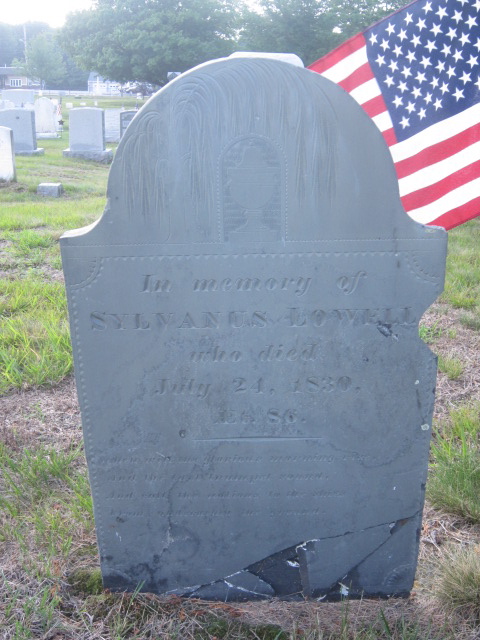
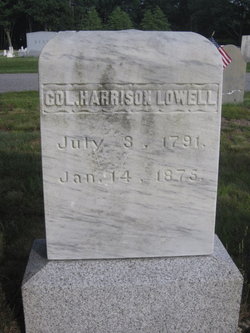
Newburyport also recorded the baptism of Harrison Lowell, son of Capt. Sylvanus and Elisabeth, on 29 Jan 1799. This may be the Maine legislator Harrison Lowell whose gravestone (shown above) gives his birthdate as 3 July 1791—though, again, that baptism would have been delayed.

Even more mysteriously, on 9 Mar 1791, Newburyport’s Essex Journal reported: “Died, Mrs. Lowell, wife of Capt. Silvanus Lowell of this town.” The vital records say that Elizabeth Lowell was buried that day. Obviously, she couldn’t have given birth to a son in July. Maybe the second Harrison was actually born in 1789 or 1790, and both the baptismal record and gravestone are off?

On 10 Oct 1791, just a few months after being widowed for the second time, Capt. Sylvanus Lowell married a widow about thirty-six years old named Elizabeth (McCard) Barriere or Berryer. She had a daughter, Fannie, from her first marriage.

I haven’t found any sign of Sylvanus having children by his second wife named Elizabeth. Each brought young children to the marriage to raise. Several of those children grew up, married, and had long lives. Both parents lived into their eighties.

This genealogical data shows Capt. Sylvanus Lowell having a fairly typical life for a New England patriarch of his time. Looking just at his three marriages and possibly eight children over more than a decade, one wouldn’t know that he’d come close to dying and lost significant portions of his body just before the Revolutionary War.

TOMORROW: What did you do in the war, Papa?

Saturday, February 10, 2024

“Of these injuries he was confined some time”

You may have noticed that the two newspaper articles I’ve quoted about Sylvanus Lowell’s injuries and recovery didn’t state his full name.

The Boston and Newburyport newspaper printers referred to him only as “Captain Lowell” of Newburyport, trusting readers to know who that was if they really deserved to know.

Last fall I decided to fill in that missing name by looking for other sources mentioning such an unusual accident.

Not only did I luck out in finding references to the captain, but his given name turned out to be Sylvanus. There were other Sylvanus Lowells in New England during his lifetime, of course, but the combination was rare enough to track him further.

Among the sources that named Capt. Lowell are:
  • Delmar R. Lowell, The Historic Genealogy of the Lowells in America (1899): “Capt. Sylvanus…On ‘Cat Island,’ in Boston Harbor, he lost his two arms and one eye while firing a cannon.”
  • Biographical Sketches of Representative Citizens of the Commonwealth of Massachusetts (1901): “Captain Sylvanus Lowell, who shortly before his marriage lost both his arms by the accidental discharge of a cannon, the right one being taken off just below the elbow, and the left just above it, and also lost the sight of one eye.”
  • John J. Currier, paper delivered to the Historical Society of Old Newbury (1911): “Sylvanus Lowell…was a sea captain, and while firing a salute on one of the islands in Boston harbor had the misfortune to injure both arms so that amputation was necessary, and at the same time lost the sight of one eye.”
The earliest source to provide a full name, and also more detail about the injury (not necessarily more accurate), was the captain’s obituary in the 7 Aug 1830 Newburyport Herald:
In 1773, he, with many others, were at Cat Island, in Boston harbor [sic], to be inoculated for the Small Pox—the physicians directed that two cannon should be taken to the Island for their amusement and recreation.—

Capt. L. was engaged in loading one of these, and while ramming down the cartridge, the piece went off—his left arm was blown off above the elbow, and his right just above the wrist; the right of one eye was entirely destroyed, and he was otherwise injured.

Of these injuries he was confined some time.
As you can tell from the date of that obituary, Capt. Lowell lived more than fifty-five years after his accident, even though most people felt he would die soon after.

But what sort of life did Lowell have, given his lack of hands and damaged sight? He had been a ship’s captain before, but how did he make his living afterward?

TOMORROW: Plus, a war broke out about a year later.

(Contrary to what those quoted sources say, Cat Island wasn’t in Boston harbor but off the coast of Marblehead. It’s legally part of Salem. In the 1850s the Salem Steamboat Company developed a seaside resort on the island. Because some of the investors were from the city of Lowell, they renamed their property Lowell Island. Thus, for several decades the site of Capt. Lowell’s injury shared his name. The resort didn’t last, though. The place is now home to a day camp and officially called Children’s Island. Presumably there are no working cannon for the children’s “amusement and recreation.”)