J. L. BELL is a Massachusetts writer who specializes in (among other things) the start of the American Revolution in and around Boston. He is particularly interested in the experiences of children in 1765-75. He has published scholarly papers and popular articles for both children and adults. He was consultant for an episode of History Detectives, and contributed to a display at Minute Man National Historic Park.

Subscribe thru Follow.it


•••••••••••••••••


Showing posts with label Robert Patterson. Show all posts

Thursday, April 09, 2020

“In like manner killed by two balls”
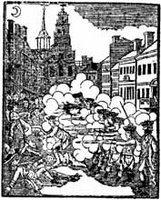
As discussed yesterday, there’s good evidence that Crispus Attucks was the first person shot at the Boston Massacre.

There’s even stronger evidence that he was hit with two musket balls.

The 12 Mar 1770 Boston Gazette reported that Attucks was “killed instantly; two balls entering his breast one of them in special goring the right lobe of the lungs, and a great part of the liver most horribly."

Dr. Benjamin Church did an autopsy and wrote in even more detail:

I found two wounds in the region of the thorax, the one on the right side, which entered through the second true rib within an inch and a half of the sternum, dividing the rib and separating the cartilaginous extremity from the sternum, the ball passed obliquely downward through the diaphragm and entering through the large lobe of the liver and the gall-bladder, still keeping its oblique direction, divided the aorta descendens just above its division into the iliacs, from thence it made its exit on the left side of the spine. This wound I apprehended was the immediate cause of his death.

The other ball entered the fourth of the false ribs, about five inches from the linea alba, and descending obliquely passed through the second false rib, at the distance of about eight inches from the linea alba…
Church’s main point in all that Latinate anatomy was that “from the oblique direction of the wounds, I apprehend the gun must have been discharged from some elevation”—i.e., from the windows above the soldiers. His deposition was part of the Whigs’ argument that the Customs service was involved in the shooting.

But the angle of the musket balls was affected by how Attucks was standing. John Danbrook testified, “The Molatto was leaning over a long stick he had, resting his breast upon it.” With Attucks leaning forward, musket balls shot level into his chest would probably have exited at lower points on his back.

Danbrook and other witnesses agreed that Attucks fell quickly after the first musket shot, before they heard another gun fire. He didn’t continue standing long enough to be shot by a second gun. That strongly suggests he was hit by two musket balls at once, both coming from one discharge.

I’ve previously noted how Edward Crafts reported Cpl. Hugh McCann telling him that on a British army patrol that night “every man [was] loaded with a brace of balls.” There are many other examples of muskets reported to fire two balls at once in this period.

It’s also significant that the coroner’s jury decided that Attucks was killed by “the discharge of a Musket or Muskets loaded with bullets, two of which were shot thro’ his body.” Those men didn’t see the two wounds as necessary evidence of two guns.

What’s more, Attucks wasn’t the only man wounded twice. Immediately after him on the newspaper’s list of victims was:
Mr. James Caldwell, mate of Capt. [Thomas] Morton’s vessel, in like manner killed by two balls entering his back.
Danbrook’s testimony even suggests that Caldwell was killed by the same shot that killed Attucks, meaning the balls went through one man’s body and then another. There’s not as much evidence to support that, however, as that both men fell immediately after being hit with two balls.

The third man to die quickly, Samuel Gray, was shot in the head. Witnesses observed only one wound on his body, but it was a big one.

In addition, sailor Robert Patterson testified about how “the sentinel up with his gun and fired, the balls going through my lower right arm.” However, the Boston Gazette reported only that “a ball went through his right arm, and he suffered great loss of blood.” So the evidence of multiple balls in Patterson’s case seems ambiguous.

In the cases of Attucks and Caldwell, on the other hand, by far the most likely explanation of their double wounds is that each was hit by two balls fired from one gun.

Saturday, March 21, 2020

Robert Patterson’s Memory of the Massacre

On 20 Mar 1770, 250 years ago yesterday, a sailor named Robert Patterson testified to his memory of the Boston Massacre.

Patterson was one of the men wounded in that shooting—badly wounded in one arm. Furthermore, he had also been at the Christopher Seider shooting eleven days earlier, so close that pellets from Ebenezer Richardson’s musket had cut through his baggy sailor pants.

Patterson was unable to sign his testimony, possibly because of the injury to his right hand. (He was disabled from his wound.) Dr. Elisha Story, perhaps the sailor’s physician, attested to his mark.

Here is Robert Patterson’s story, as published in Boston’s Short Narrative report:
…on Monday night, the 5th current, being at Capt. [Hector] McNeill’s at the North End, heard the bells ring and “Fire!” cried. I immediately ran till I got into Royal Exchange lane, it being about a quarter after 9 o’clock. I saw a number of people in the lane. I asked what was the matter? They told me that the soldiers were going to kill all the inhabitants.

I immediately went through the lane, and stood in the middle of King street about ten or eleven minutes (the sentinel then standing leaning against his box), when I saw an officer with seven or eight soldiers coming from the main-guard, clearing the way with their guns and bayonets, go below the sentinel box, and turn up and place themselves around it, facing the people standing opposite Royal Exchange lane; when I saw a man with a light colored surtout at the Custom-house door, the door being wide open, there standing with his shoulder against the side; then I heard the officer order the soldiers to load, which they did.

After that I heard the people say, ”Damn you, why don’t you fire?” In about a minute after I heard the word “Fire!” (but from whom I cannot say) which the soldiers did. Looking round I saw three men lay dead on the snow; the snow being at that time near a foot deep. Immediately they loaded again.

The people then gave three cheers, and cried out, “Let’s go in upon them, and prevent their firing again;” upon which they put on their hats and advanced towards them. My hand being raised to put on my hat, still advancing towards the soldiers, the sentinel up with his gun and fired, the balls going through my lower right arm, my hand immediately falling; and finding myself wounded, made the best of my way home with help.
Patterson’s oath was certified by Justice John Hill and Justice John Ruddock, one of the more confrontational Whigs and Dr. Story’s father-in-law.

The Whigs assembling the Short Narrative inserted Patterson’s testimony in the midst of the three witnesses I quoted back here, all supporting the idea of people shooting down from the Customs House. That might have been because of the figure Patterson described in the Customs House door, who might even have given the order to “Fire!”

What really stands out in Patterson’s testimony, however, is his description of the final shot coming after significant activity: three men falling dead, the soldiers all reloading, the crowd cheering and moving toward the soldiers, and the sentinel—Pvt. Hugh White—shooting Patterson in the arm. (It’s not clear what the crowd did after that point, but Patterson wisely left to find help.)

Patterson thus described the shooting as more than a panicked chain reaction—all the soldiers got ready to shoot again, and one did. He also described the crowd as more determined in that same moment, moving toward the troops instead of panicking. However, no one else on King Street described that sequence of events.

Other witnesses mentioned Patterson in their testimony. Josiah Simpson, joiner, said:
The deponent then standing by Warden and Vernon’s shop on the south side of King street, with his back to the soldiers; immediately after heard the word present, at which word he stooped down. A little space of time ensued, and then he heard the words, “Damn you, fire;” the sound of which words seemed to proceed from the left of all the soldiers, and very near to the sentry box; upon this order, he judged two guns were discharged, and immediately three more, and then two more—one of the two last guns went about five or six inches over the deponent’s back—after which he stood up, and another gun was discharged which wounded one Robert Patterson in the arm, and the blood was sprinkled upon the deponent’s hand and waistcoat. After the firing the deponent saw four persons drop; then looking towards the soldiers, the deponent saw them making towards the inhabitants with their fixed bayonets; upon which he retired down Quaker lane…
John Wilson stated:
Some small boys coming up made a noise to the soldiers, on which the officer said to them, “Why don’t you fire? Damn you, fire!” They hereupon fired, and two men fell dead in my sight. I then left the place, and went over the street and assisted Patterson the wounded man in getting home.
It’s notable that neither of those witnesses describe the same series of events as Patterson. Simpson did agree that there were several shots, a pause, and then a final shot that hit the sailor’s arm. But no reloading, no three cheers. If in fact the crowd gave three cheers, if all the soldiers reloaded, other people must have participated in, heard, and seen those actions—but no one else testified to them.

One witness mentioned seeing a soldier working with his gun before firing the last shot. That was William Wyatt, captain of a coasting vessel based in Salem, whom Donna Seger just profiled at the Streets of Salem. Wyatt told the magistrates:
…the second man on the left wing fired off his gun, then, after a very short pause, they fired one after another as quick as possible, beginning on the right wing; the last man’s gun on the left wing flashed in the pan, then he primed again, and the people being withdrawn from before the soldiers, most of them further down the street, he turned his gun toward them and fired upon them.
So here’s how I reconcile Patterson’s testimony with the rest of the witnesses. There was a burst of shots, starting with Pvt. Edward Montgomery. Then a couple of seconds with no firing. Patterson, Simpson, and others stood up, thinking the danger was over. Patterson may have even thought about moving forward to disarm the troops.

But then one soldier primed his firelock again and fired the ball that hit Patterson’s arm. In his anger and confusion, Patterson enlarged people straightening up into the whole crowd giving three cheers and advancing, and that one soldier fixing his musket into the whole line reloading.

Of course, the Massacre was a sudden, chaotic, confusing event involving scores of people in a heightened emotional state. There are a lot of discrepancies between different witnesses’ testimony, and at times even between the records of a single witness’s testimony. (Patterson, unlike Simpson and Wyatt, wasn’t called to testify at the trials, so we have only one account from him.) This is how I piece together the overall evidence about the shot that hit Robert Patterson.

Monday, March 04, 2013

Charles Bahne on the Scene of the Massacre

As we approach the anniversary of the Boston Massacre on 5 March, Charles Bahne, author of The Complete Guide to Boston’s Freedom Trailkindly shared this essay analyzing what may be our earliest visual source on the question: What did the Boston Massacre look like?

Besides the depositions and testimony given by eyewitnesses to the Boston Massacre, we have two contemporary pictorial depictions of the incident. Better known of the two is the copperplate print of “The Bloody Massacre”, “Engrav’d Printed & Sold by Paul Revere, Boston.” As discussed here, Revere’s print of the Massacre was copied—some say plagiarized—from an almost identical image by Henry Pelham.

The Revere/Pelham print is an accurate portrayal of the setting for the Massacre — the buildings, the starry night with its crescent moon, the overall streetscape. But its depiction of the events is far less accurate; issued as part of the radicals’ propaganda efforts, it contains some deliberate distortions. And to compress the entire action into one image, the perspective was foreshortened, placing the victims in much closer proximity than they really were.

For a more accurate depiction, we look to the above image, also attributed to Paul Revere, but with less certainty, since it’s unsigned. (Mellen Chamberlain, who gave this document to the Boston Public Library, said that the handwriting matched Revere’s.) Unlike the more famous print, which was fairly widely distributed, this image existed only in manuscript and wasn’t circulated publicly until over a century later.

We’re looking at a plan or map of the action that evening, drawn from an overhead perspective. North is at right, west at top. In the upper center the Town House (Old State House) is prominently marked. Rows of buildings line either side of King Street (State Street), with other streets branching off to right and left.

But while this plan is a more accurate portrayal of the Massacre events, it also has its limitations. Four bodies lie in the street, some drawn in intricate detail, along with six circles, which apparently show the injured townsfolk. That makes a total of ten victims, but eleven people were actually shot—five dead and six wounded.

At extreme upper right is a seventh circle, unlabeled by the artist and unnoticed by any earlier commentator. Could this be the eleventh victim, or is it something else entirely, being so remote from the rest of the action?

All four bodies, and five of the circles for the wounded, are labeled with letters. Two letters clearly match the names of the slain: A for Attucks and G for Gray. But the other two bodies are marked C and G, only a partial match with the other martyrs, Caldwell, Carr, and Maverick. The circles are labeled with three Ps and two Ms; the six wounded citizens were Payne, Patterson, Parker, Monk, Clark, and Green.

Some discrepancy may have been caused by the belated deaths of Patrick Carr and Samuel Maverick. Was one of them considered wounded, rather than killed, when the plan was drawn?

Still, there are just nine letters in this plan. With eleven known victims, we’re missing two Cs; while a G and an M appear to have been switched between the injured (Green) and the deceased (Maverick).

At lower right, in front of the Custom House, stands a curved line of seven soldiers—not the eight who were actually there. Some historians have theorized, partly on the basis of this plan, that one of the regulars may have stood behind the others, not in line with his colleagues.

Unfortunately, the meaning of the letters, numbers, and circles must remain a matter of speculation. If a key to the plan was created, it’s been lost. Some say that a key was written on the back of the paper, which has since been glued to a board, permanently obscuring whatever it may once have said.

In their recent books about the Massacre, Neil York and Richard Archer both attempt to match the bodies and circles with the names of the fallen citizens—and they disagree. (Neil York consulted with me on this, and cites me in his book.)

The bottom line is that we know with some certainty where Crispus Attucks and Samuel Gray fell, next to the soldiers, and where Edward Payne was hit, standing on his doorstep at lower left. James Caldwell is one of the other bodies shown on the plan, probably the prominent one in the middle of the intersection. As for the other victims, we can only guess who fell where.

TOMORROW: How the scene looks today.

Friday, February 22, 2013

The First News of Christopher Seider’s Death

On Thursday, 22 Feb 1770, the Boston News-Letter contained this item in italics at the bottom of its local news:
This Instant we hear that one Richardson having attempted to destroy some Effigies in the North End, the Lads beat him off into his House, and broke his Windows, upon which he fired among them, mortally wounded one Boy, & slightly wounded two or three others. Richardson is now under Examination.
The issue of the Boston Chronicle dated 19-22 Feb 1770 closed its local news this way:
This forenoon, a boy of about 14 years of age, was mortally wounded, and two others slightly wounded by a shot from a musket, fired out of a house at the north end.—Two persons, who were in the house from whence the gun was fired, are now under examination at Faneuil Hall.

*** The Western Post not arrived at 2 o’Clock
The wounded lad, who would die later that afternoon, was Christopher Seider. He wasn’t fourteen, as the Loyalist Chronicle guessed, but only about eleven. His wound was indeed mortal, as both newspapers said. There was only one other person wounded, Samuel Gore, though a sailor named Robert Patterson complained that pieces of shot went through his pants.

Because Ebenezer Richardson shot at the boys mobbing his house on Thursday, one of the two days when newspapers were printed in Boston, this is a rare example of being able to read a local news story written as it broke.

Furthermore, this story tells us a couple of things about the newspapers themselves. The Chronicle dated 19-22 February was published at the end of that stretch; in chronological indexes that issue’s often pegged to the start date. Furthermore, the Chronicle’s note that the printer was still waiting for mail at 2:00 show that newspapers were printed in the early afternoon of the date on their front pages. They weren’t ready first thing in the morning, at least these editions.

At the time, the Chronicle was being supported by the Customs service with stationery orders, advertising, and leaks. And it appears the newspaper’s printer, then John Fleeming, reciprocated by not mentioning Richardson even by last name: he was a Customs employee, and a notorious one.

Wednesday, May 07, 2008

Robert Patterson: disabled sailor

As he testified in March 1770, Robert Patterson was wounded in the right arm during the Boston Massacre—one of several Bostonians injured in that shooting on top of the five killed. Patterson evidently suffered such damage that he became unable to do the physically demanding work of a sailor.

On 30 Jan 1771, selectmen John Hancock and Jonathan Mason and Overseer of the Poor Royall Tyler signed the paperwork to allow Patterson to stay in the Boston workhouse. The Boston town records say:

Mr. Paul Farmer Keeper of the Alms house was directed to receive into the Alms house to be supported at the Province Charge one Robert Patterson a Stranger and not an Inhabitant of any Town in this Province, being Poor & having lost the use of his Right Arm on the 5 of March last in the Massacre made by the Soldiers.
It’s not clear how long Patterson remained there.

As I recounted last week, starting in 1774 young Christopher Monk was the beneficiary of donations collected at the oration Boston commissioned on each anniversary of the Massacre. In 1781, after Monk died, Patterson evidently feared all that charitable instinct would go to waste, so he asked if he could start receiving the donations instead. The town records for 5 Mar 1781 say:
a Petition of Mr. Robert Patterson setting forth, “that he received a wound in his Right Arm on the 5th. of March 1770. by a Shot from [Capt. Thomas] Prestons Party, whereby he has entirely lost the use of it; and that since the death of Mr. Monk he is the only one of the unhappy number then badly wounded, that survive,” and therefore praying the Charity of the Town—was read, whereupon

Voted, that a Collection be made at the close of this Meeting, for the said unhappy Sufferer, and Boxes were placed at each Door to receive the Collections

The Collection made for the said Mr. Patterson, amounted to the Sum of
And the blank was never filled in. Instead, two days later selectman John Scollay told his colleagues:
that the Money Collected for Mr. Patterson at the Town Meeting the 5th. of March in consideration of the wounds he received the 5 of March 1770 from Prestons Party, amounted to £326’15’4. Old Money & 4/ & 1/2 hard Money—

Mr. Scollay was desired to retain the Money belonging to Mr. Patterson, till further enquiry can be made respecting him which was accordingly done
Bostonians seem to have been clearing out their old, devalued paper currency but parting with few hard coins. Patterson presented the same petition in January 1782, and the town meeting again approved it. That March, the selectmen’s minutes recorded:
There was Collected for James Patterson, who was wounded the 5 of March 1770, the Sum of Seven Pounds twelve Shillings,—and the same has been put into the hands of Capt. William Mackay, for the use of the said Patterson, & his Wife
Nearly £8! Obviously, Patterson’s public image wasn’t as heart-tugging as Monk’s had been. And town clerk William Cooper even got his name wrong.

In 1783, Patterson’s cause suffered further. First, another surviving Massacre victim turned up, asking for cash. The town records say:
A Petition of John Green one of the Persons wounded on the Evening of the 5th. of March 1770 also the request of Mr. Patterson who lost the use of one of his Arms on that, memorable Night—was read—and considered—

A Collection was made for the aforenamed Persons amounting to the Sum of and put into the hands of the Selectmen to be distributed as they may Judge proper
John Green’s name didn’t appear on the first published list of Massacre victims, but the Boston Gazette that followed named him and said he was a tailor. (A young man named John Green had run to fetch soldiers when a crowd threatened the sentry outside the Customs house, but I doubt this was the same man who was shot since that would have been too ironic not to be mentioned somewhere.)

In 1783, Green and Patterson probably split the few pounds collected, their last chance to do so. It was already clear that the war was coming to a close, and the Massacre remembrances no longer had propaganda value. Boston voted to shift its annual oration to Independence Day. I don’t know what happened to Robert Patterson after that.

Tuesday, May 06, 2008

Robert Patterson: riotous sailor

Robert Patterson was a sailor. Since Boston was the third largest port in North America, there were many sailors in town over the winter of 1769-1770. But Patterson stood out by standing on the front line of riotous crowds.

On 22 Feb 1770, a mob of boys attacked Customs official Ebenezer Richardson’s house after he tried to break up their anti-importer demonstration. Richardson fired a musket-full of birdshot down at the crowd. Some of those pellets cut Patterson’s pants. (As a sailor, he wore baggy shin-length trousers rather than closely fitted leather or cloth breeches.) Patterson must therefore have been standing close to Christopher Seider and Samuel Gore, the two boys wounded (one fatally) by Richardson’s shot.

Judicial authorities made Patterson agree to a £50 bond to ensure he’d be available to testify against Richardson. They may have thought that necessary because the sailor wasn’t a legal inhabitant of the town and might have gone to sea at any time. We don’t have complete records for that trial, but notes kept by special prosecutor Robert Treat Paine summarize Patterson’s testimony this way:

I went up to R[ichardson], and I saw R fire the Gun, from within the House. The Boy fell. The Shot went thro’ my Trowsers.
One might think that such a close call would have prompted Patterson to stay home quietly the next time there was trouble. But no. Here’s what he did on the night of 5 March, in his own words:
I, Robert Patterson, of lawful age, testify and say, that on Monday night, the 5th current, being at Capt. [Hector] McNeill’s at the North End, heard the bells ring and “Fire!” cried.

I immediately ran till I got into Royal Exchange lane, it being about a quarter after 9 o’clock. I saw a number of people in the lane. I asked what was the matter? They told me that the soldiers were going to kill all the inhabitants.

I immediately went through the lane, and stood in the middle of King street about ten or eleven minutes (the sentinel [Pvt. Hugh White] then standing leaning against his box), when I saw an officer [Capt. Thomas Preston] with seven or eight soldiers coming from the main-guard, clearing the way with their guns and bayonets, go below the sentinel box, and turn up and place themselves around it, facing the people standing opposite Royal Exchange lane; when I saw a man with a light colored surtout at the Custom-house door, the door being wide open, there standing with his shoulder against the side; then I heard the officer order the soldiers to load, which they did. After that I heard the people say, “Damn you, why don’t you fire?”

In about a minute after I heard the word “Fire!” (but from whom I cannot say) which the soldiers did. Looking round I saw three men lay dead on the snow; the snow being at that time near a foot deep.

Immediately they loaded again. The people then gave three cheers, and cried out, “Let’s go in upon them, and prevent their firing again;” upon which they put on their hats and advanced towards them. My hand being raised to put on my hat, still advancing towards the soldiers, the sentinel up with his gun and fired, the balls going through my lower right arm, my hand immediately falling; and finding myself wounded, made the best of my way home with help.
Patterson signed this deposition with his mark; perhaps his right arm was disabled, or perhaps he never could sign his name. Dr. Elisha Story attested to that mark, so he might have been caring for the sailor. Then again, Story might have been on the scene to help his father-in-law, Justice of the Peace John Ruddock, take the deposition.

The historical consensus is that there were not two volleys of shots from the soldiers as Patterson described; instead, the Boston Massacre resulted from an irregular series of shots. Though the soldiers reloaded, they didn’t fire a second time. There’s also no corroboration for Patterson’s recollection of a civilian in the Customs house doorway at the time of the shooting—a detail that would have implicated royal revenue officials in the incident. Paine didn’t call Patterson to testify at the soldiers’ trial, and Pvt. White was ultimately acquitted.

TOMORROW: What the future held for Robert Patterson.

Thursday, March 08, 2007

The First Newspaper Reports on the Massacre

In colonial Boston, some newspapers published each Monday, and some each Thursday. Because the Boston Massacre occurred on a Monday evening, the first press reports appeared on Thursday the 8th—237 years ago today. The Massachusetts Gazette and Boston News-Letter listed the casualties this way:

Mr. Samuel Gray, Ropemaker, killed on the Spot, the Ball entred his Head broke the Skull.

A Mollatto Man, named Johnson, who was born in Framingham, but lately belonging to New-Providence, and was here in order to go for North-Carolina, killed on the Spot, two Balls entering his Breast.

Mr. James Caldwell, Mate of Capt. Morton’s Vessel, killed on the Spot, two balls entering his Breast.

Mr. Samuel Maverick, a promising Youth of 17 Years of Age, Son of the Widow Maverick, and an Apprentice to Mr. Greenwood, Joiner, mortally wounded, a Ball went through his Belly, and came out at his Back: He died the next Morning.

A Lad named Christopher Monk, about 17 Years of Age, an Apprentice to Mr. Walker, Shipwright; Mortally wounded, a Ball entered his Side and came out of his Back; apprehended he will die.

A Lad named John Clark, about 17 Years of Age, whose Parents live at Medford, and an Apprentice to Capt. Samuel Howard of this Town; Mortally wounded, a Ball entered just above his Groin and came out at his Hip, on the opposite side, apprehended he will die.

Mr. Edward Payne, of this Town, Merchant, standing at his Entry Door, received a Ball in his Arm, and shattered some of the Bones.

Mr. John Green, Taylor, coming up Leverett’s Lane, received a Ball just under his Hip, and lodged in the under Part of his Thigh, which was extracted.

Mr. Robert Patterson, a Seafaring Man, who was the Person that had his Trowsers shot thro’ in [Ebenezer] Richardson’s affair, wounded; a Ball went thro’ his right Arm.

Mr. Patrick Cole, about 30 Years of Age, who work’d with Mr. Field Leather- Breeches-maker in Queen-Street, wounded, a Ball entered near his Hip and went out at his Side.

A Lad named David Parker, an Apprentice to Mr. Eddy the Wheelwright, wounded, a Ball entered his Thigh.
What seems off about this list? Well, for one thing, though people expected apprentices Christopher Monk and John Clark to die shortly, neither did. Monk remained disabled by his wound for several years before dying, so he’s not memorialized among the standard five Massacre victims.

The Boston Gazette, published the same day, ran a similar list, emphasizing the three wounded apprentices ahead the working-men. The Gazette also gave different names for two men. The first was Patrick Carr, an Irish-born laborer I’ll have more to say about soon. While the two apprentices survived, Carr turned out to have been mortally wounded.

The Gazette also reported the one name people today are most likely to connect to the Boston Massacre: Crispus Attucks. Apparently he was living in Boston under the alias “Michael Johnson,” the name on the coroner’s report on his death (now in the collections of the Old State House Museum). Both the News-Letter and the Boston Chronicle reported the mulatto sailor’s name as Johnson. But the Boston Gazette had the name that appeared on all the subsequent legal proceedings, the name that’s come down in history.

Oddly enough, however, the News-Letter and Gazette had the same description of the man’s history: born in Framingham, working as a sailor out of the Bahamas, in Boston between voyages. Both identified him as mulatto, and therefore didn’t grant him the honorific title of “Mr.” In the 1850s historians found a newspaper ad that implied Attucks had escaped from slavery in Framingham twenty years before, which would explain why he used an alias while back in his home province. But how Bostonians discovered the history of that dead man, and how details reached one newspaper before the others, is still a gnawing mystery.

Thursday, February 22, 2007

Boston's First Revolutionary Death, 237 Years Ago

For a couple of days I’ve been discussing how in early 1770 Boston was aboil with conflict over a “nonimportation” of goods from Britain to protest the Townshend duties. Most of the town supported this boycott, and Whigs were pressuring the handful of merchants and shopkeepers who refused to sign on.

Part of that pressure in early February were crowds of boys marching outside importers’ stores; these protests appeared every Thursday morning when there was no school. On 22 Feb 1770, these young Whigs focused their attention on small merchant Theophilus Lillie. They set up their “Pageantry” on Union Street: a hand pointing to his shop with the word IMPORTER, and an effigy of Lillie’s head on a pole.

Along came Ebenezer Richardson, a Customs service employee. As I described in a New England Ancestors article available online, Richardson had become notorious in his home town of Woburn for having impregnated his wife’s sister and letting blame fall on the town’s minister for several months. He then moved to Boston and made his living as a confidential informer, first for the Attorney General and then for the Customs service. When that work was exposed in the early 1760s, Richardson became even more unpopular, and started to work openly for Customs since no one else would employ him.

The Customs establishment opposed the nonimportation movement, and Richardson apparently took it upon himself to break up the boys’ protest of Lillie’s shop. First he tried to persuade two farmers in Boston for market day to knock down the carved head with their wagons. The drivers refused. Whig gentlemen watching the action laughed at Richardson’s efforts. He stomped off to his nearby home, shouting, “Perjury! Perjury!”

It’s unclear what Richardson was referring to, but, as the Boston Evening-Post reported, “The Boys on hearing the words began to gather round, and call him an informer.” Richardson and his wife Kezia (the same woman he had impregnated and eventually married years before) shooed them away. The boys said, “they would not, Kings high Way”—meaning they had every right to be on the street.

Richardson flourished a stick. The boys ran around “with the squeeling and noise they usually make on such occasion,” said the newspaper. The young mob, now numbering at least “60 or 70 Boys,” left Lillie’s shop and started pelting Richardson’s house with “Limon Peels,” witnesses later testified. The boys hit Kezia Richardson with an egg. Someone inside the house tossed out a brickbat, striking a sailor. He threw it back through a window.

A low-level Customs employee named George Wilmot came to the house and offered help. According to one of the Richardsons’ daughters, “Wilmot asked [my father] if he had any Gun.” Both men armed themselves with muskets.

Richardson came out his front door and yelled at the boys, “as sure as there was a G[od] in heaven, he’d blow a Lane thro ’em.” He “snapped” his gun—firing it with powder but no ball, like a blank shot. The boys scattered and came back again, no longer tossing “light rubbish of one kind or another” but throwing stones through windows.

Richardson reappeared with his musket at an upper window. The boys continued to throw rocks. Richardson fired his musket again. This time he had loaded it with buckshot pellets, “about the bigness of large peas.”

Some of those pellets sliced through the baggy pants of a sailor named Robert Patterson. A few pierced the right hand and thigh of a nineteen-year-old painter named Sammy Gore. Eleven pieces flew into the chest of Christopher Seider, a servant boy just about eleven years old, who was “stooping to take up a Stone.”

The wounded boys were taken into a nearby house. As the violence continued outside, Dr. Joseph Warren, Dr. Thomas Young, and other surgeons examined them. Christopher’s chest was gradually filling with blood. People brought his parents, poor German immigrants, from their little home at the far end of Boston Common. Clergymen came to pray with the family. Christopher Seider died around nine o’clock on the night of 22 February, the first death of Boston’s Revolutionary conflict.