J. L. BELL is a Massachusetts writer who specializes in (among other things) the start of the American Revolution in and around Boston. He is particularly interested in the experiences of children in 1765-75. He has published scholarly papers and popular articles for both children and adults. He was consultant for an episode of History Detectives, and contributed to a display at Minute Man National Historic Park.

Subscribe thru Follow.it


•••••••••••••••••


Showing posts with label William Wirt. Show all posts

Sunday, June 25, 2023

Three Ways to Misquote John Adams
There are a number of problems with the claims in The Memoirs of Gen. Joseph Gardner Swift (1890), quoted back here, about the last months of the general’s grandfather, Samuel Swift.

That book told a dramatic story of Swift starting to organize an uprising against the British troops inside besieged Boston, only to be punished by being kept from his family and dying of illness as a result. It also credited that story to John Adams, a highly respected source who definitely knew Swift.

According to the section of that book in Joseph G. Swift’s own voice, Adams told him on 8 Oct 1817 about his grandfather: “I have written to Mr. [William] Wirt my opinion of the merits of that Whig, who fell a martyr to the fury of [Thomas] Gage.”

Adams’s first letter to Wirt did indeed mention Samuel Swift. However, Adams didn’t write that letter until 5 Jan 1818, three months after J. G. Swift’s well documented visit to Quincy.

Indeed, according to this letter from Thomas Cooper to Thomas Jefferson, as of 30 September Wirt’s biography of Patrick Henry was still in press; “about 100 pages are printed.” That was one week before Swift was in Quincy, leaving not enough time for Adams to get that book, read it, and resolve to write to the author.

J. G. Swift’s memory of what Adams said (or genealogist Harrison Ellery’s rendition of that memory) must therefore have been shaped by later knowledge of Adams’s letter, which was published in 1819.

As quoted back here, the general wrote to Adams in 1824, asking for any details about his grandfather. That shows he hadn’t heard the story of the uprising by then. But there’s no evidence that Adams ever wrote back, much less sent the dramatic story printed in that family memoir. At the time Adams was busy telling stories about heroic Boston lawyers in the Revolution, yet none of his other letters includes this story about Swift, either.

The Memoirs of Gen. Joseph Gardner Swift was sloppy about citing Adams in other ways. In the genealogical section Ellery wrote that Adams called Samuel Swift “a martyr to freedom’s cause.” But the J. G. Swift memoir says Adams actually said “martyr to the fury of Gage.” The “martyr to freedom’s cause” phrase came from A. K. Teele’s History of Milton. (Neither phrase appears in the surviving Adams Papers.)

Not that Teele’s book was on more solid ground. It followed James M. Robbins’s 1862 address on the history of Milton by quoting Adams this way: “Among the illustrious men who were agents in the Revolution must be remembered the name of Samuel Swift.”

In fact, Adams’s 1818 letter to Wirt said [emphases added]:
And in imitation of your example I would introduce Portraits of a long Catalogue of illustrious Men, who were Agents in the Revolution

Jeremiah Gridley the Father of the Bar in Boston and the Preceptor of Prat Otis Thatcher Cushing and many others; Benjamin Prat Chief Justice of New York James Otis of Boston Oxenbridge Thatcher Jonathan Sewal Attorney General and Judge of Admiralty Samuel Quincy Solicitor General, Daniel Leonard, Josiah Quincy Richard Dana and Francis Dana his Son, Minister to Russia and afterwards Chief Justice, Jonathan Mayhew D.D. Samuel Cooper D.D. James Warren and Joseph Warren, John Winthrop Professor at Harvard Colledge, And Member of Counsal, Samuel Dexter the Father John Worthington of Springfield Joseph Hawley of Northampton, Governors Huchenson Hancock Bowdoin Adams Sullivan and Gerry Lieutenant Governor Oliver Chief Justice Oliver, Judge Edmund Trowbridge Judge William Cushing, and Timothy Ruggles ought not to be omitted. The Military Characters Ward Lincoln Warren Knox Brooks & Heath &c must come in of Course. Not should Benjamin Kent, Samuel Swift or John Read be forgotten.
Adams named thirty-eight prominent men, some of them Loyalists and all but one occurring to him before he came to Samuel Swift.

[I’m not going to bother adding H.T.M.L. links for all those guys.]

TOMORROW: Examining the legend itself.

Wednesday, June 21, 2023

“My opinion of the merits of that Whig”

In 1817, Gen. Joseph G. Swift (1783–1865), the U.S. Army’s chief of engineers, accompanied the new President, James Monroe, on a tour of fortifications and battlefields in the northern states.

On 8 July, Monroe and his company stopped in Quincy to meet former President John Adams (who was also the father of Monroe’s secretary of state).

Gen. Swift wrote in his memoir:
Mr. Adams at first mistook me for the son of his brother lawyer, Samuel Swift, and poured out his commendation, saying: “I have written to Mr. [William] Wirt my opinion of the merits of that Whig, who fell a martyr to the fury of [Thomas] Gage.”

I replied: “It was my grandfather, and you gave me my cadet’s warrant eighteen years ago,” upon which he was pleased to subjoin some civil commendation. The conversation naturally attracted the attention of the whole dinner party; and it was a scene of deep interest to hear the old man scan the days of his life in Congress, when he nominated Washington, etc.
In fact, Thomas Johnson of Maryland was the Continental Congress delegate who had nominated George Washington to be commander-in-chief. Adams told a great story about making that nomination, but the Congress’s records contradict it.

As for the mention of William Wirt, in this period Adams was on a campaign to undercut Wirt’s biography of Patrick Henry, which he felt gave too much credit for the Revolution to that legislator and Virginians as a whole. (Awkwardly enough, Wirt was President Monroe’s attorney general.) The former President was writing long letters to other authors laying out his version of history and encouraging William Tudor, Jr., son of his former law clerk, to write a biography of James Otis, Jr.

Seven years later, having retired from the army to become a civil engineer, Swift wrote back to the former President about his family:
When I had the honour to be at your residence in 1817 (while accompanying President Monroe) I was gratified by some account which you were pleased to give me, of my Grand Father Samuel Swift, formerly a Lawyer of Boston, whom you designated as a friend of yours & as the “Widows friend”—& whose name you had before mentioned, in some Printed Letters, as a distinguished Whig:—It is natural &, with just views, it is commendable in man to reflect with interest upon the conduct & character of his progenitor.—

I have heard that my G. Father was a zealous & a effective Whig—that he died in 1775 a Prisoner & Martyr under the Tyrrany of Gage,—that he was foremost & useful in Public Meetings in urging his fellow Citizens to resist oppression & especially to resist Gages call to the Bostonians to deliver up their Arms:—The premature death of their G Father led to the dilapidation & final loss of his Property while Boston was a Garrison,—This then Young family driven to various parts of this Country & made Poor, were dispersed, & thus we know little of this G. Father except from tradition.—

If you will at a leisure moment cause an amanuensis to note to me any information of the Character & Conduct of Saml. Swift & especially as touching the great struggle for Independence, it will be received as a distinguished favour,—One of my objects in taking this liberty is to be Enabled to tell my Six Sons what share their progenitor may have had in contributing to bring about that War which made a nation Free & Happy!—
If Adams wrote back over the next two years before his death, that letter doesn’t survive. But Swift’s letter certainly lays out the image of his grandfather that he wanted to confirm.

TOMORROW: Swift family sources.

Saturday, August 26, 2017

“Very fit for a Saturday morning’s declamation”

Yesterday we left William Wirt at about age thirteen in 1785 or so, chafing at an unjust accusation and physical punishment by his school’s usher, or assistant master. Wirt was living with the master of his school, the Rev. James Hunt, and from his books had already developed literary ambitions.
Our youth was an author, be it remembered. and that is not a race to take an injury, much less an affront, calmly. The quill, too, was a fair weapon against an usher, and by way of vent to his indignation at this and other continued outrages, but with no view to what so seriously fell out from it in furtherance of his revenge, he indited some time afterward an ethical essay on Anger.

In this, after due exhibition of its unhappy effects, which, it may be, would have enlightened Seneca, though he has himself professed to treat the same subject, he reviewed those relations and functions of life most exposed to the assaults of this Fury. A parent with an undutiful son, said our moralist, must often be very angry;—a master with his servant, an inn-keeper with his guests;—but it is an usher that must the oftenest be vexed by this bad passion, and, right or wrong, find himself in a terrible rage; and so he went on, in a manner very edifying, and very descriptive of the case, character and manner of the expounder of Cicero.

Well pleased with his work, our author found a most admiring reader in an elder boy, who, charmed with the mischief as much as the wit of the occasion, pronounced it a most excellent performance, and very fit for a Saturday morning’s declamation. In vain did our wit object strenuously the dangers of this mode of publication. The essay was “got by heart,” and declaimed in the presence of the school and of the usher himself, who, enraged at the satire, demanded the writer, otherwise threatening the declaimer with the rod.

His magnanimity was not proof against this, and he betrayed the incognito of our author, who happened the same evening to be in his garret when master usher, the obnoxious satire in hand, came into the apartment below to lay his complaint before his principal. Mr. Hunt’s house was one of those one-story rustic mansions yet to be seen in Maryland, where the floor of the attic, without the intervention of ceiling, forms the roof of the apartment below, so that the culprit could easily be the hearer, and even the partial spectator, of the inquisition held on his case.

“Let us see this offensive libel,” said the preceptor, and awful were the first silent moments of its perusal, which were broken, first by a suppressed titter, and finally, to the mighty relief of the listener, by a loud burst of laughter. “Pooh! pooh! Mr. ——, this is but the sally of a lively boy, and best say no more about it; besides that, in foro conscientia, we can hardly find him guilty of the ‘publication.’”

This was a victory; and when Mr. Hunt left the room, the conqueror, tempted to sing his “Io triumphe” [a Roman cheer of victory] in some song allusive to the country of the discomfited party, who was a foreigner, was put to flight by the latter's rushing furiously into the attic, and snatching from under his pillow some hickories, the fasces of his office, and inflicting some smart strokes on the flying satirist, who did not stay, like Voltaire, to write a receipt for them. The usher left the school in dudgeon not long afterward… 
The literature that Wirt recalled from Hunt’s library included the classical historian Josephus, poet Alexander Pope, essayist Joseph Addison, and Lord Kames’s Elements of Criticism (1762), which seems to have been quite progressive in its time.

From “a carpenter in the employ of Mr. Hunt” young Wirt borrowed less formal literature: the play Guy, the Earl of Warwick and probably some of Tobias Smollett’s novel The Adventures of Peregrine Pickle.

[The image above comes from an 1857 elocution textbook. It shows the correct stance and gesture for an orator making an “indignant appeal.”]

Friday, August 25, 2017

William Wirt’s Schooldays

William Wirt (1772-1834) was an author, biographer of Patrick Henry, lawyer, and U.S. Attorney General for nearly twelve years.

Shortly before dying, Peter H. Cruse (1795-1832) wrote a biographical sketch of Wirt that was published in a volume of early newspaper essays. It included the following anecdote from Wirt’s schooldays.

At the age of eleven, Wirt had started to study with the Rev. James Hunt (1731-1793) in Montgomery County, Maryland. By reading the minister’s books, the young scholar discovered literature—and literary ambitions.
The discovery that [Alexander] Pope began to compose at twelve years of age, begat in our student the same sort of emulation as the like example in [Abraham] Cowley did in Pope. He reproached himself for his backwardness when he was now already thirteen.

The first attempt was a little discouraging. It was in verse, and he was embarrassed as usual by the awkward alternative of sacrificing the rhythm to the thought, or (which is the usual preference in such cases,) the thought to the rhythm. He came to the disappointing conclusion that he was no poet, but indemnified himself by more lucky efforts in prose, one of which falling into the hands of Mr. Hunt, he expressed his favourable surprise, and exhorted the adventurer to persevere, who thus encouraged became a confirmed reader and author.

One of these juvenile essays was engendered by a school incident, and was a piece of revenge, more legitimate than schoolboy invention is apt to inflict when sharpened by wrongs real or imaginary. There was an usher [i.e., assistant master] at the school, and this usher, who was more learned and methodical than even-tempered, was one morning delayed in the customary routine by the absence of his principal scholar, who was young Wirt himself. In his impatience he went often to the door, and espying some boys clinging like a knot of bees to a cherry-tree not far off, he concluded that the expected absentee was of the number, and nursed his wrath accordingly.

The truth was, that the servant of a neighbour with whom Wirt was boarded at the time, had gone that morning to mill, and the indispensable breakfast had been delayed by his late return. This apology, however, was urged in vain on the usher, who charged in corroboration the plunder of the cherry-tree; and though this was as stoutly as truly rejoined to be the act of an English school hard by, the recitation of master Wirt proceeded under very threatening prognostics of storm.

The lesson was in Cicero, and at every hesitation of the reciter, the eloquent volume, brandished by the yet chafing tutor, descended within an inch of his head, without quailing his facetiousness however, for he said archly, “take care, or you’ll kill me.” We have heard better timed jests since from the dexterous orator, for the next slip brought a blow in good earnest, which being as forcible as if Logic herself, with her “closed fist,” had dealt it, felled our hero to the ground.

“I’ll pay you for this, if I live,” said the fallen champion, as he rose from the field.

“Pay me, will you?” said the usher, quite furious; “you will never live to do that.”

“Yes, I will,” said the boy.
TOMORROW: Billy Wirt’s revenge.

Saturday, August 09, 2014

Founders’ Favorite Quotations, part 3

Here’s the final run of “quotations” from America’s founders as chosen by some current tech company founders earlier this year. I put “quotations” in quotation marks because not all of them are, in fact, quotations from the people said to have said them.

I’m not holding these sayings to the original standards of punctuation, capitalization, or spelling, but I do want to see all the same words in the same order for them to qualify as quotations.

“Tyranny, like hell, is not easily conquered; yet we have this consolation with us, that the harder the conflict, the more glorious the triumph.” –Thomas Paine
From Paine’s The American Crisis.

“I have but one lamp by which my feet are guided, and that is the lamp of experience.” –Patrick Henry
From Henry’s 23 Mar 1775 speech to the Virginia Convention, the same that includes the phrase “Give me liberty or give me death”—at least as reconstructed by Henry’s biographer William Wirt in 1817. But a lot of Henry’s contemporaries thought Wirt’s work was bogus.

“Fear is the passion of slaves.” –Patrick Henry
Henry said this in a speech to Virginia’s ratifying convention in 1788. At the time he was arguing against the new U.S Constitution.

“The circulation of confidence is better than the circulation of money.” –James Madison
Madison said this in a speech to Virginia’s ratifying convention in 1788. At the time he was arguing for the new U.S. Constitution.

“Things may come to those who wait, but only the things left by those who hustle.” –Abraham Lincoln
This use of the word “hustle” would have been anachronistic for Lincoln, and he was, again, not a Founder.

“Happily for America, happily, we trust, for the whole human race, we pursued a new and more noble course: We accomplished a revolution which has no parallel in the annals of human society.” –James Madison
Madison wrote something like this in The Federalist, Number 14, in 1787. However, this misquotation says “we pursued” and “We accomplished” when Madison wrote “they,” referring to “the leaders of the revolution.” Madison was only twenty-four when the Revolutionary War began and didn’t claim to be a leader of that movement.

“Tell me and I forget, teach me and I may remember, involve me and I learn.” –Benjamin Franklin
Oh, please—that’s not eighteenth-century style. This appears to be a modern translation of a Chinese proverb, but that could be a myth as well.

“Lost time is never found again.” –Benjamin Franklin
Poor Richard’s Almanac for 1748. Franklin later elaborated on this sentence in “The Way to Wealth,” so I’m willing to give him credit even if he had a habit of quoting old sayings.

“The advancement and diffusion of knowledge is the only guardian of true liberty.” –James Madison
Someone took a longer sentence that Madison wrote to a friend in 1825 and stitched together this short sentence; at the very least there should be an ellipsis mark after “knowledge.”

“Diligence is the mother of good luck.” –Benjamin Franklin
Poor Richard’s Almanac for 1736. But the Oxford Dictionary of Quotations dates it to the late 1500s.

Out of these ten statements, five are correctly attributed to prominent American Founders, though one of those attributions has been debated since it appeared. Two more are significantly changed from what a man wrote, one is a much older saying, and two are falsehoods.

So what have we learned? First, for generations Americans have been attributing pithy things to Benjamin Franklin that he didn’t write or didn’t originate. More recently, we’ve been doing the same with Thomas Jefferson—not just on political matters but also lifestyle wisdom.

Finally, as the dueling speeches from Henry and Madison about the Constitution show, we can’t expect to treat the Founders as a single bloc of wise folk when they had hearty disagreements and temperamental differences among them.

Friday, March 11, 2011

John Adams Sums Up

As I described yesterday, John Adams didn’t like how William Wirt’s 1817 biography of Patrick Henry gave the Virginian credit for sparking the American Revolution. Adams wanted Massachusetts to get the credit for being first.

The only problem was that Henry really did deliver incendiary remarks against the Stamp Act in the Virginia House of Burgesses on 29 May 1765. Wirt’s version of that speech ended, “If this be treason, make the most of it!” That may not be accurate, but there was no doubt that Henry attacked the Stamp Act months before Boston’s big public protests in August.

So the only way for Adams to win back Massachusetts’s primary role was to argue that the Revolutionary conflict had begun even earlier than that—with the writs of assistance case in 1761. On 29 Mar 1818 Adams sent his former law clerk William Tudor a long, detailed, and dramatic—at times melodramatic—description of the case, ending:

But [James] Otis was a flame of Fire! With a promptitude of classical allusions, a depth of research, a rapid summary of historical events and dates, a profusion of legal authorities, a prophetic glare of his eyes into futurity, and a rapid torrent of impetuous eloquence he hurried away all before him.

American independence was then and there born. The seeds of patriots and heroes to defend the Non Sine Diis Animosus Infans; to defend the vigorous youth were then and there sown. Every man of an immense crowded audience appeared to me to go away as I did, ready to take arms against writs of assistance. Then and there was the first scene of the first act of opposition to the arbitrary claims of Great Britain. Then and there the child Independence was born. In fifteen years, i.e. in 1776, he grew up to manhood and declared himself free.
Adams allowed that letter to be published in newspapers and a new collection of his “Novanglus” essays, thus making it available to historians just as the fiftieth anniversary of independence approached.

In March 1818 the North American Review printed young Jared Sparks’s critique of Wirt’s Patrick Henry, saying it relied too much on “tradition” instead of “truth.” The article listed several ways that Massachusetts instigated the Revolution. (That magazine was, after all, based in Boston.) Sparks went on to edit the first collection of George Washington’s writings.

Over the next couple of years Adams convinced the editor of that magazine, William Tudor, Jr., to write the biography of Otis that he had imagined. The Life of James Otis, of Massachusetts appeared in 1823, quoting heavily from Adams’s letters to the author’s father.

Thus, before he died on 4 July 1826, John Adams had managed to establish a historiography of the American Revolution that starts in Boston in 1761, with James Otis, Jr., delivering the opening speech. Or was that, as Adams had complained about Wirt’s book, largely “a romance”?

Thursday, March 10, 2011

“Jealous, very jealous, of the honour of Massachusetts”

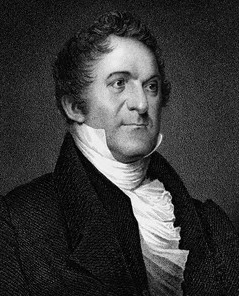
The Virginia lawyer and politician William Wirt (1772-1834, shown here courtesy of the Library of Virginia) had two big accomplishments in 1817. First, he finally published Sketches of the Life and Character of Patrick Henry, a biography that he’d been working on for years. Second, he was appointed Attorney General of the United States. He remained in that post for twelve years, through the administrations of James Monroe and John Quincy Adams.

Wirt’s biography of Henry is the earliest source for many anecdotes about the Virginia politician’s life, and for many of his famous quotations, including “Give me liberty or give me death!” Nobody recorded those speeches at the time, the author complained, so he had to do extra work reconstructing them as they ought to have been.

Some of Henry’s contemporaries (and occasional rivals) noticed. Thomas Jefferson, who had been one of Wirt’s sources, said privately that the biography was “a poor book, written in bad taste.” But it was also a successful book, and one of the foundation stones of the literature of the American South.

Up in Massachusetts, John Adams borrowed a copy. On 5 Jan 1818, before he had even finished reading, he sent a letter to Wirt, damning the book with faint praise as “rich entertainment.” He went on:

If I could go back to the age of thirty five, Mr. Wirt, I would endeavour to become your rival; not in elegance of composition, but in a simple narration of facts, supported by records, histories, and testimonies, of irrefragable authority. I would adopt, in all its modesty, your title, “Sketches of the life and writings of James Otis, of Boston.” . . .

I envy none of the well merited glories of Virginia, or any of her sages or heroes. But, sir, I am jealous, very jealous, of the honour of Massachusetts.

The resistance to the British system, for subjugating the colonies, began in 1760, and in the month of February, 1761, James Otis electrified the town of Boston, the province of Massachusetts bay, and the whole continent, more than Patrick Henry ever did in the whole course of his life. If we must have panegyrics and hyperboles, I must say, that if Mr. Henry was Demosthenes, and Mr. Richard Henry Lee, Cicero, James Otis was Isaiah and Ezekiel United.
Wirt replied on 12 January with a complimentary copy for Adams and assurance that he didn’t mean to set off a regional rivalry. In Constructing American Lives: Biography and Culture in Nineteenth-Century America, Scott E. Casper called this “an unconvincing assertion from an author who had asserted the Old Dominion’s preeminence in the Revolution.”

Wirt’s book continued to rankle Adams. The fourth Josiah Quincy recalled one visit to the former President’s house in Braintree on 6 Sept 1820 with some men from Virginia:
His visitors asked him his opinion of Patrick Henry, and whether he was not the greatest orator he had ever heard.

His reply was: “No, gentlemen. Much of Wirt’s life of him is a romance. Why, I have heard that gentleman’s father (pointing to one who was present [probably the third Josiah Quincy, son of the Patriot lawyer]) speak in a strain of eloquence to which Patrick Henry could never pretend. . . . You know Virginian geese are always swans.”

Notwithstanding these remarks, the gentlemen seemed very much pleased with their visit.
This wasn’t the first time Adams had grumbled about Virginians saying all their geese are swans, but not seeing Massachusetts credited with coming first in the Revolution really rankled him.

TOMORROW: John Adams strikes back.