J. L. BELL is a Massachusetts writer who specializes in (among other things) the start of the American Revolution in and around Boston. He is particularly interested in the experiences of children in 1765-75. He has published scholarly papers and popular articles for both children and adults. He was consultant for an episode of History Detectives, and contributed to a display at Minute Man National Historic Park.

Subscribe thru Follow.it


•••••••••••••••••


Showing posts with label teaching the Revolution. Show all posts

Sunday, May 17, 2026

“There is something off about this sword”

Earlier this year the Sandwich Enterprise shared a story by Cearra O’Hern about the identification of an artifact at the Pilgrim Hall Museum.

The article focuses on Michael L. Welch, Jr., who uses first-person interpretation of Revolutionary figures in teaching history at the Sandwich Middle School.

The article explains:
Welch primarily portrays Major General James Warren, a leading revolutionary in Massachusetts who also served as president of the Massachusetts Provincial Congress during the American Revolution. Welch heard that the Pilgrim Hall Museum in Plymouth had Warren’s sword

“I connected with the curator, who was very helpful in lining up a time to go in and look at the sword,” Welch said. “I was given the attribution of the sword, how the sword was passed down through the Warren family and donated. I photographed it extensively, I scanned it, I made a 3D rendering of it, and the whole time I am looking at this sword, I am like, ‘There is something off about this sword.’”

Welch had seen a sword like Warren’s before, which was believed to date back to 1764-1765. As he continued to examine its pommel, guard and counter-guard, Welch determined the sword was not a general’s sword; it was a mass-produced sword made much later, after the American Revolution.

Welch identified the sword as a Model 1796 Hanger carried by British sergeants, a discovery that “broke his heart,” as he did not want to say anything to the Pilgrim Hall Museum.
The photo above, which the museum shared on social media a few weeks before this article appeared, may show one of those awkward moments when Welch looked at the sword and wondered about sharing doubts with curator Anne Mason.

After confirming his assessment with an expert, Welch did indeed discuss those findings with Mason and her colleagues. The museum will add that information to its files and assess how it displays the hanger. As Welch points out in the article, the fact that this sword was made in 1796 doesn’t mean it wasn’t owned by James Warren; his son James, Jr. (1757–1821), a Continental Marine officer who lost a limb in 1781; or another member of the family. It just doesn’t go back as far as the Revolution.

Friday, May 08, 2026

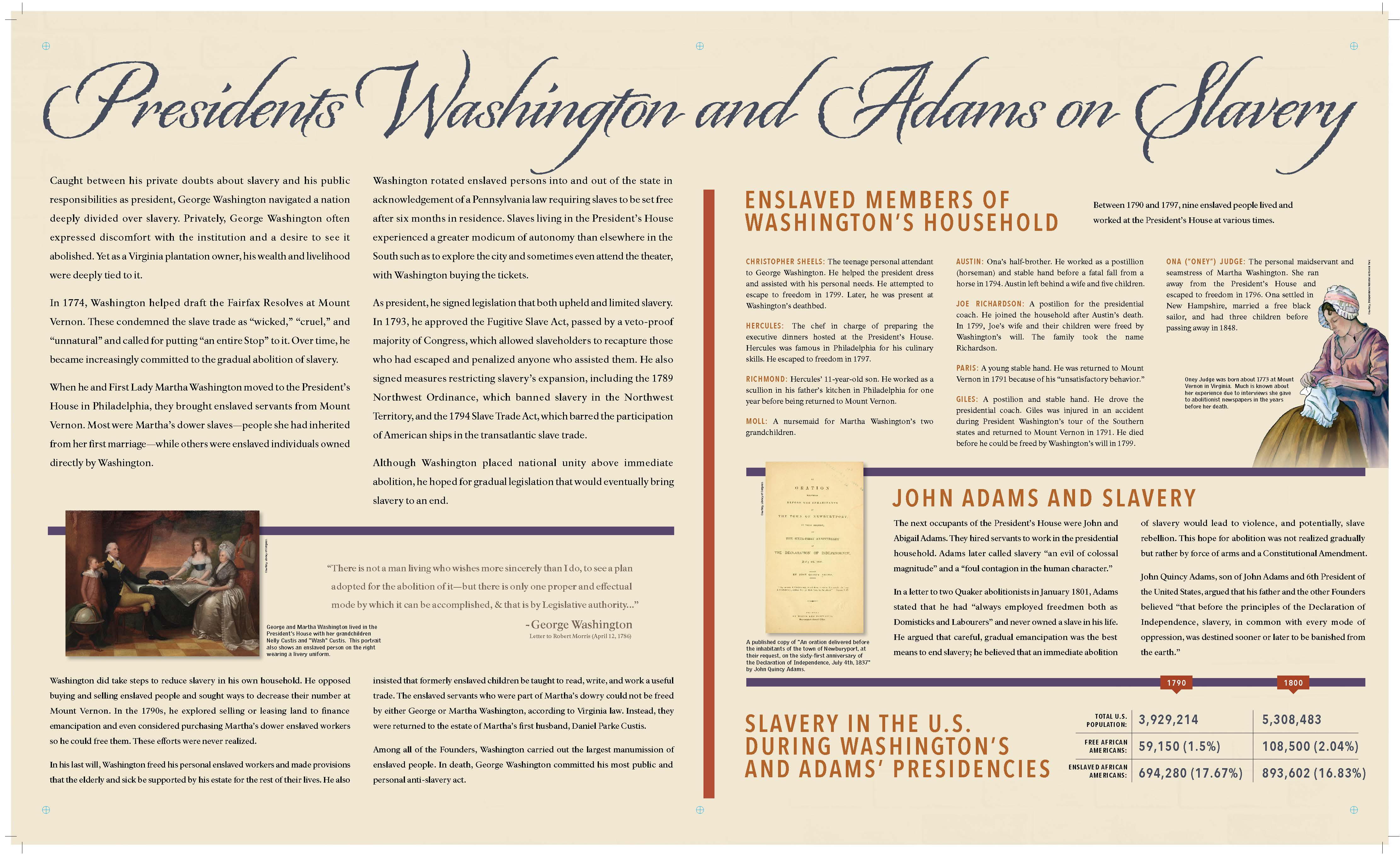
“The only ‘emancipation’ relevant to this site was Ona Judge’s own”

On 21 April, the Philadelphia Inquirer shared an opinion piece about the President’s House exhibit by Sharon Ann Holt, a public historian recently retired from Penn State Abington.

Holt was previously director of education and interpretation at the Historical Society of Pennsylvania and director at the Sandy Spring Museum in Maryland. She’s the author of Freedom Pay: North Carolina Freedpeople Working for Themselves, 1865–1900.

The web headline for Holt’s essay is “We can’t give in to the Trump administration’s attempts to make the history of slavery invisible in Philadelphia.” I don’t know if it appeared in the newspaper’s print edition, and the webpage now behind a paywall unless one has a guest link. So here’s an extended extract:
The digital images posted on the Park Service’s website make it clear that, under Donald Trump, the first priority of the Park Service seems to be to make enslaved people and slavery itself as invisible as possible. Panels that discussed the lives of urban enslaved people, Philadelphia’s free Black community, the Washingtons’ enslaved “family,” fugitives from enslavement (and the laws Washington signed to reclaim them) have all disappeared. The rich biographies of Christopher Sheels, Hercules, Richmond, Austin, Giles, Ona Judge, Joe Richardson, Moll, and Paris have shrunk to single sentences. . . .

So what stories are they telling? George and Martha’s determination to flout Pennsylvania’s six-month limit on holding people in slavery is reframed as a lovely gift of theatre tickets rather than their cynical move to get enslaved people across the river to New Jersey, thus restarting the six-month residential countdown. I’m surprised the Park Service left out the Washingtons’ “kind” willingness to let enslaved workers visit their families left behind in Virginia, which worked the same trick.

If Park Service bureaucrats value relevance, I challenge them to explain the transformation of the story about 18th-century slavery at the President’s House into a puzzling evocation of the Emancipation Proclamation of the 19th century and the Civil Rights Movement of the 20th century. Is it that, to them, all stories having to do with African Americans belong in the same place? They must think so, because they have randomly added completely irrelevant references to Frederick Douglass, the Civil War, the Rev. Dr. Martin Luther King Jr., the Underground Railroad, and Abraham Lincoln to the history of the President’s House.

Worse, the Park Service has embraced sentimental claims that Washington, Thomas Jefferson, and James Madison all “had their doubts” about slavery from the beginning.

None of those “doubts” persuaded the Founders to end slavery when they could have, either in our founding documents or in their own personal lives. None of the 19th- and 20th-century stories that the Park Service has shoehorned into their new panels ever involved the President’s House at all. The only “emancipation” relevant to this site was Ona Judge’s own self-liberation — the very story the Park Service has all but erased.

Speaking of irrelevance, the opening panels are even more laughable. Park Service interpreters have decided to feature discussions of the 1876 Centennial, the 1926 Sesquicentennial, and the 1976 Bicentennial, all of which happened long after the President’s House had been remodeled into oblivion or entirely demolished. . . .

If the judges choose these new panels to replace the ones taken down earlier this year, they will disparage millions of Americans who have struggled since 1776 to improve on the shaky foundations the founders laid. The President’s House should honor those struggles, alongside the nine people enslaved there by George and Martha Washington.
While Holt directs her critique at the National Park Service, which produced this revised signage, it’s clear that agency was working under directives from the White House. Based on what sort of historical presentations the White House has produced on its own, N.P.S. historians undoubtedly worked hard to drag this material into the realm of historical fact, even if it’s far from complete and relevant.

Tuesday, March 03, 2026

“Touch-screen displays, Revolutionary War artifacts, and A.I. slop”

Among the Trump administration’s Sestercentennial initiatives are modern gladiatorial games outside the White House on the President’s birthday. Less decadently imperial are the Freedom Trucks mentioned yesterday.

These trucks were clearly inspired by the Freedom Train that traveled the country in 1947–49, giving citizens a look at 127 documents from the National Archives and other artifacts.

The most detailed list of those documents that I found is a Huntington Library catalogue description of “Heritage of Freedom,” the booklet given out to explain those items to visitors. The selection didn’t include the handwritten Declaration of Independence, Articles of Confederation, or Constitution, but it did have the Congress-approved Bill of Rights, George Washington’s copy of the printed Constitution, and various letters and pamphlets from the Founding era. The display went back as far as the Magna Carta and Christopher Columbus, and as recently as the surrender of Germany and Japan.

The 1940s Freedom Train previously inspired the American Freedom Train of the Bicentennial period, 1975–76. This one carried Washington’s copy of the Constitution again, the original Louisiana Purchase, and other documents, but also one of Judy Garland’s dresses from The Wizard of Oz, Martin Luther King Jr.’s pulpit, and a Moon rock. It was like a rolling Smithsonian.

What will be in the Freedom Trucks? The New York Times reported:
The truck exhibits were designed in collaboration with Hillsdale College, a conservative school in Michigan, and PragerU, a company that makes conservative educational materials. . . . The trucks prominently feature quotes from Mr. Trump and a video he filmed inside the Oval Office.
On 27 February, the New Yorker offered a story by Jessica Winter about PragerU’s projects:
Last year, PragerU unveiled the Founders Museum, a “partnership” with the White House and the U.S. Department of Education featuring A.I.-generated video testimonials from luminaries of the American Revolution. These include a digitized John Adams who ventriloquizes the words of the right-wing influencer Ben Shapiro, almost verbatim: “Facts do not care about our feelings.”

PragerU is also supplying the multimedia content for the Freedom Truck Mobile Museums, a travelling exhibition of touch-screen displays, Revolutionary War artifacts, and A.I. slop that will chug across the country on tractor-trailers throughout 2026, in celebration of the two-hundred-and-fiftieth anniversary of the Declaration of Independence. It seems that the battle over who defines good and evil—or, at least, over who defines American history—will be waged, in part, from the helm of an eighteen-wheeler. . . .

Prager’s nonprofit is just one of dozens of conservative organizations, many of them Christian, that are named as “partners” in the America 250 Civics Education Coalition, which is overseen by Linda McMahon, the Education Secretary. The coalition has the secular task of developing programming for America’s birthday, such as PragerU’s Founders Museum and the Freedom Trucks, the latter of which received a fourteen-million-dollar grant from the federal Institute of Museum and Library Services. (In March, President Trump signed executive orders to dismantle both the I.M.L.S. and the D.O.E.; they remain alive, albeit in shrunken, ideologized versions of their former selves.)

Other America 250 partners include both of the major pro-Trump think tanks (the America First Policy Institute and the Heritage Foundation), a Christian liberal-arts school (Hillsdale College), the Supreme Court’s favorite conservative-Christian legal-advocacy group (the Alliance Defending Freedom), the Christian-right-aligned church of Charlie Kirk (Turning Point USA), and something called Priests for Life.
Another notable detail from the New York Times: “Both institutions [Hillsdale and Prager U] said that they had not received any of the $10 million in taxpayer money and that they had funded their work with private donations.” That $10 million, you may remember from yesterday, was shifted by the White House from the Institute of Museum and Library Services to America250 and then to Freedom 250, ostensibly for these very trucks. What pocket is that money sitting in now?

TOMORROW: Up in the air.

Tuesday, January 27, 2026

“This rule narrows the concept of patriotism and patriotic education…”

Back in September, the U.S. Secretary of Education, former wrestling entertainment magnate Linda McMahon, announced that “Patriotic Education” would be a “supplemental priority” in the department’s grants.

The department’s press release defined that as “a civic education that teaches American history, values, and geography with an unbiased approach.”

However, the Federal Register’s proposed rule for this initiative, which carries more legal weight, offered a different definition of “Patriotic education”:
a presentation of the history of America grounded in an accurate, honest, unifying, inspiring, and ennobling characterization of the American founding and foundational principles; a clear examination of how the United States has admirably grown closer to its noble principles throughout its history; and the concept that commitment to America’s aspirations is beneficial and justified.
Words like “ennobling,” “admirably,” and “beneficial and justified” are obviously value judgments, contradicting the press release’s claim to seek “an unbiased approach.”

I believe the U.S. of A.’s founding principles are indeed inspiring and ennobling, and I wish the country had done and would do a better job of following those principles. It certainly hasn’t done so “throughout its history,” implying there have been no reverses. Not everyone shares my idea of those principles, furthermore.

The federal government invites citizens to comment on proposed rules. Many historical organizations spoke out about this one and urged their members to do so. I’ll quote the American Historical Association’s talking points because I think they’re sensible and well put.
Students deserve an honest and full account of US history. This funding priority promises to support the teaching of “accurate and honest” content. We consider this goal profoundly important, and this is why we are concerned about efforts to scrub historical content from federal websites, remove factual signage at historic sites, and attack curatorial decisions at Smithsonian museums, alleging that this history is insufficiently celebratory in its depiction of the United States. . . .

We do not need to think alike in order to find common purpose; the founders of the United States found common purpose amid multiple conflicts and divisions. The proposed Department of Education priority states that “a shared understanding of our political, economic, intellectual, and cultural history—including our national symbols and heroes” is a prerequisite for informed patriotism. The founding generation of the United States did not have a shared understanding of their history, their symbols, or their heroes; nor have subsequent generations. US patriotism is diverse and multifaceted and it is capacious enough to include even those who are critical and skeptical about patriotism.

The Department of Education’s rule asserts that there can only be one interpretation of an event, an assertion that runs contrary to the practice of history and the importance of allowing people to engage in civil deliberations. Disagreement also is a strength of our political system and not a flaw. The US Constitution’s First Amendment recognizes this when embracing freedom of assembly, petition, press, religion, and speech. . . .

This rule narrows the concept of patriotism and patriotic education, with a disproportionate focus on the Founding Era, a period when most Americans could not vote, when many were enslaved, and before the US Constitution explicitly embraced “equal protection.” American history does not stop in 1800, and it should be presented in a way that allows students to explore multiple periods, consider various perspectives, and draw their own informed conclusions. . . .

The commemoration of the 250th anniversary of American independence must provide opportunities for all Americans to learn from our shared history, one that includes recognition of the complex challenges, aspirations, and struggles across this history to enact a more perfect union.
The comment period has passed, though this federal website says citizens are still posting their responses. In fact, it looks like most comments have arrived this month. I don’t know when the department might issue a rule and apply it to educational grants.

Tuesday, October 28, 2025

“The history that does work in the world”

At the end of 1929 Prof. Carl Becker (1873–1945) of Cornell University addressed the American Historical Association as its president.

Among Becker’s previous books were The History of Political Parties in the Province of New York, 1760–1776; The Eve of the Revolution: A Chronicle of the Breach with England; and The Declaration of Independence: A Study in the History of Political Ideas.

He tended to study the formal political history of legislation and pamphleteering, though with a slightly jaundiced eye about what good that activity did.

The title of Becker’s talk in 1929 was “Everyman His Own Historian,” and it addressed the gap between the academic historian’s approach to the past and that of “an ordinary citizen without excess knowledge” or representative of “every normal person,” Mr. Everyman. (The norm, of course, being male.)

Becker said:
Mr. Everyman has a wholesome respect for cold, hard facts, never suspecting how malleable they are, how easy it is to coax and cajole them; but he necessarily takes the facts as they come to him, and is enamored of those that seem best suited to his interests or promise most in the way of emotional satisfaction. The exact truth of remembered events he has in any case no time, and no need, to curiously question or meticulously verify.

No doubt he can, if he be an American, call up an image of the signing of the Declaration of Independence in 1776 as readily as he can call up an image of Smith’s coal wagons creaking up the hill last summer. He suspects the one image no more than the other; but the signing of the Declaration, touching not his practical interests, calls for no careful historical research on his part.

He may perhaps, without knowing why, affirm and hold in memory that the Declaration was signed by the members of the Continental Congress on the fourth of July. It is a vivid and sufficient image which Mr. Everyman may hold to the end of his days without incurring penalties. Neither Brown nor Smith has any interest in setting him right; nor will any court ever send him a summons for failing to recall that the Declaration, “being engrossed and compared at the table, was signed by the members” on the second of August.

As an actual event, the signing of the Declaration was what it was; as a remembered event it will be, for Mr. Everyman, what Mr. Everyman contrives to make it: will have for him significance and magic, much or little or none at all, as it fits well or ill into his little world of interests and aspirations and emotional comforts.
But of course Becker concluded with a slightly jaundiced view of his own profession’s work:
Berate him as we will for not reading our books, Mr. Everyman is stronger than we are, and sooner or later we must adapt our knowledge to his necessities. Otherwise he will leave us to our own devices, leave us it may be to cultivate a species of dry professional arrogance growing out of the thin soil of antiquarian research. Such research, valuable not in itself but for some ulterior purpose, will be of little import except in so far as it is transmuted into common knowledge. The history that lies inert in unread books does no work in the world.

The history that does work in the world, the history that influences the course of history, is living history, that pattern of remembered events, whether true or false, that enlarges and enriches the collective specious present, the specious present of Mr. Everyman. It is for this reason that the history of history is a record of the “new history” that in every age rises to confound and supplant the old.

It should be a relief to us to renounce omniscience, to recognize that every generation, our own included, will, must inevitably, understand the past and anticipate the future in the light of its own restricted experience, must inevitably play on the dead whatever tricks it finds necessary for its own peace of mind.

Saturday, October 18, 2025

“Who Cares About the Midnight Ride?” in Boston, 21 Oct.

On Tuesday, 21 October, the Paul Revere House and GBH Forum will host a panel discussion on the topic “Who Cares About the Midnight Ride?: Perspectives on an American Legend.”

The event description says:
What does Paul Revere’s Midnight Ride mean today, and who does it matter to? In this panel, a university professor, a high school teacher, and a public history content creator will discuss how the Midnight Ride resonates (or doesn’t) with their audiences. They will compare perspectives on societal trends that influence whether a historical event like this feels relevant today.
The panelists will be:
  • Ahsante Bean, creator of Bean Thinking, a YouTube channel exploring American politics through history, psychology, and ideology. She is a recent Us@250 Fellow with the New America Foundation.
  • Eileen Ka-May Cheng, associate professor of history at Sarah Lawrence College and author of The Plain and Noble Garb of Truth: Nationalism and Impartiality in American Historical Writing, 1784-1860
  • Kerry Dunne, now in her fifth year as the head of the History/Social Studies Department at Lexington High School and an adjunct instructor of education coursework at area universities.
  • Noelle N. Trent (moderator), a public historian has worked with the National Park Service and the Smithsonian Institution’s National Museum of African American History and Culture.
This discussion will start at 6:30 P.M. in the Commons on the 5th floor of Suffolk University’s Sargent Hall, 120 Tremont Street in Boston. It will also be streamed lived on the GBH Forum Network and recorded for later viewing.

Speaking of which, my own talk earlier in this series can be viewed on this page.

Sunday, October 12, 2025

Studying Henry Knox with Fort Ti

The Sestercentennial of Col. Henry Knox’s mission to Lake Champlain in the winter of 1775–76 is coming up, and Fort Ticonderoga is on it.

That site naturally feels some ownership of that saga since some of the artillery pieces Knox hauled to the siege of Boston came from there. Some, however, came from other fortifications along the lakes, such as Crown Point. Fort Ti is the best restored and most active of those historic locales, so it gets almost all the attention.

For more on that ordnance, I recommend this video with Fort Ti curator Matthew Keagle. He describes how Continental authorities moved artillery around in the summer and fall of 1775, preparing for Gen. Richard Montgomery’s push into Canada and also laying the ground for an idea that Benedict Arnold had floated back in the spring—trucking some of those guns toward Boston.

In addition, Fort Ticonderoga is offering a free virtual teacher institute on the topic “Noble Train!: Henry Knox and the Siege of Boston” on Saturday, 15 November, from 10 A.M. to 2 P.M.

The presentations will include:
  • “Henry Knox: Beyond the Noble Train of Artillery” by Fort Ticonderoga’s Director of Academic Programs, Rich Strum
  • “The Revolutionary Lives and Letters of Lucy and Henry Knox” by Dr. Phillip Hamilton from Christopher Newport University
  • “The Ticonderoga Soldiers Project” by Kate Tardiff, Archivist at Fort Ticonderoga
  • “The Siege of Boston and Evacuation Day” by Dr. Robert Allison from Suffolk University
  • “Real Time Revolution®: Bringing Henry Knox into the Classroom” by Tim Potts from S.U.N.Y. New Paltz and Rich Strum
Participants must register in advance, though the session is free for educators. 

Wednesday, October 08, 2025

Teachers’ Tour of the Siege of Boston, 4 Nov.

The Massachusetts Council for the Social Studies is offering a Sestercentennial tour of sites in the siege of Boston for teachers. I’ll be one of the folks riding along to talk about that history.

This tour will happen on Tuesday, 4 November, from 7:30 A.M. (when the bus is scheduled to pick up the first batch of participants) to about 4:30 P.M. That’s Election Day, when many schools close for staff training because the buildings are being used for voting.

Through site tours and rides, we aim to provide an overview of the siege from April 1775 to March 1776 that includes the perspectives of rank and file soldiers, free and enslaved Africans, Loyalists, and women.

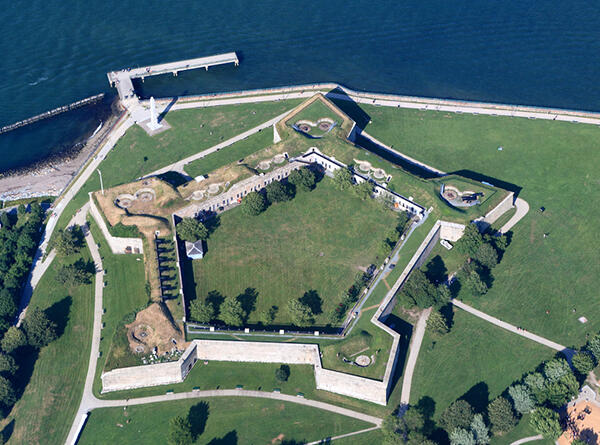
After gathering at Castle Island, we plan to visit:
Three of those sites are part of the National Park Service, so access will be limited if the federal government is still shut down at that time. The grounds will probably be open but the buildings closed. We’re developing contingency plans to cover those sites or perhaps substitute others.

Registration cost is $30 for an individual, $100 for a team of four educators. Lunch will be provided. See this page for more information. Use this form to register.

Friday, May 16, 2025

“Our tour was about the American Revolution”

Nick DeLuca’s article “When Is History Advocacy?” at the Contingent Magazine site begins like this:
“Excuse me,” a visitor asked as they tapped my shoulder. I was leading a tour group for the National Parks of Boston. We were standing inside Faneuil Hall and just about to hit the Freedom Trail.

Faneuil Hall was the social, political, and commercial heart of colonial Boston. It also was an arena for action and resistance before, during, and after the American Revolution. The visitor inquired, “Is this one of those woke tours?”

I paused. I thought he was joking at first but he waited for a response. “What do you mean?” I replied.

He asked if the tour was “political.” I told him that our tour was about the American Revolution in Boston, so yes.
DeLuca is a longtime seasonal ranger at Boston National Historical Park.

He’s also a longtime student of the political background of the National Park Service, as he discussed years back in this History News Network article.

It’s of course impossible to discuss history without touching on politics, especially at a site that was created for a political purpose and preserved because of political activity. And even if, say, Abolitionism is no longer controversial, its principles and arguments echo in today’s issues.

Furthermore, because the National Park Service is a government entity, it’s inescapably political. The fact that the overwhelming majority of American citizens approve of the agency doesn’t change how it was created through a political process and answers to politicians.

National Parks employees understand the responsibilities that go along with their jobs. They’re very careful to avoid political advocacy—far more so than the politicians above them or than we the people have to. But that can’t mean misrepresenting history or science.

DeLuca’s story of meeting this anti-“woke” visitor ends happily because he did his job. Unfortunately, the current administration has been moving to cut lots of jobs from the National Park Service, and perhaps cut parks as well, in order to reduce taxes on rich people and leave a mark on history. 

Friday, April 25, 2025

Reviewing the Constitution with Ray Raphael

My friend and fellow author Ray Raphael has launched a YouTube channel called “Our Constitution—If We Can Keep It.”

There are six episodes up so far, ranging in length from four to nine minutes. They cover some of the Constitution’s bigger changes from the U.S. of A.’s previous form of government, such as the choice to create a new framework at all and the establishment of the Presidency.

Ray went into much greater detail on these topics in his books Mr. President: How and Why the Founders Created a Chief Executive, Constitutional Myths, and The U.S. Constitution—Explained, Clause by Clause, for Every American Today, plus lesson plans for the Constitutional Sources Project.

A teacher for many years, Ray is aiming to serve an audience of students and the casually curious with these videos. They clarify the Constitution’s eighteenth-century legal language as in, for example, the episode on “Presidential Powers…and Responsibilities,”
There will be no emoluments. That’s any kind of payment for favors granted. Gifts of any kind have to be disclosed. Congress can either approve them or not, but there will be no under-the-table profiteering. This restraint applies to all federal officials, but the President is singled out for special attention.
Obviously, much about the Constitution was controversial, then and now, and these early episodes brush lightly against the fundamental controversies without getting into the weeds. But if they find an audience, there’s plenty of potential for deeper discussion.

Four more episodes are mapped out for this first “season,” with another eleven after that to cover the Amendments.

Thursday, April 03, 2025

“Our goal is neither criticism nor celebration; it is to understand”

The American Historical Association has once again responded to a dubious and harmful White House executive order with a statement on behalf of its members and other historical organizations.

The A.H.A. message is:
The Executive Order “Restoring Truth and Sanity to American History,” issued on March 27 by the White House, egregiously misrepresents the work of the Smithsonian Institution. The Smithsonian is among the premier research institutions in the world, widely known for the integrity of its scholarship, which is careful and based on historical and scientific evidence. The Institution ardently pursues the purpose for which it was established more than 175 years ago: “the increase and diffusion of knowledge.” The accusation in the White House fact sheet accompanying the executive order claims that Smithsonian museums are displaying “improper, divisive, or anti-American ideology.” This is simply untrue; it misrepresents the work of those museums and the public’s engagement with their collections and exhibits. It also completely misconstrues the nature of historical work.

Historians explore the past to understand how our nation has evolved. We draw on a wide range of sources, which helps us to understand history from different angles of vision. Our goal is neither criticism nor celebration; it is to understand—to increase our knowledge of—the past in ways that can help Americans to shape the future.

The stories that have shaped our past include not only elements that make us proud but also aspects that make us acutely aware of tragedies in our nation’s history. No person, no nation, is perfect, and we should all—as individuals and as nations—learn from our imperfections.

The Smithsonian’s museums collect and preserve the past of all Americans and encompass the entirety of our nation’s history. Visitors explore exhibitions and collections in which they can find themselves, their families, their communities, and their nation represented. They encounter both our achievements and the painful moments of our rich and complicated past.

Patriotic history celebrates our nation’s many great achievements. It also helps us grapple with the less grand and more painful parts of our history. Both are part of a shared past that is fundamentally American. We learn from the past to inform how we can best shape our future. By providing a history with the integrity necessary to enable all Americans to be all they can possibly be, the Smithsonian is fulfilling its duty to all of us.
At the Bulwark, Grand View University history professor Thomas Lecacque also wrote in response:
Trump is mad about the Smithsonian American Art Museum exhibition “The Shape of Power: Stories of Race and American Sculpture” because it “claims that ‘sculpture has been a powerful tool in promoting scientific racism’ and promotes the view that race is not a biological reality but a social construct, stating ‘Race is a human invention.’” This is about as honest as the Trump administration has ever been. “Museums in our Nation’s capital,” the order preaches, “should be places where individuals go to learn—not to be subjected to ideological indoctrination or divisive narratives that distort our shared history.” Apparently, that shared reality is centered on the idea that race is a biological fact. This is not true historically or scientifically or in any other way outside the miserable, backwards swamp logic of white supremacy. . . .

The risk is not that Americans will be misled on particular matters of fact, but that they’ll lose their respect for the idea of the truth—will capitulate to the cynical lies. This, in turn, engenders a cultural atmosphere that is inhospitable to dreams and ideals and hopes. It would be to give up our birthright of earnest optimism and our sense that we can always improve our lot and that of the world.
In the Guardian, Wellesley College professor Kellie Carter Jackson wrote:
Trump’s executive order is not about restoring the truth. Quite the opposite. It creates false narratives and myths that promote the supremacy of whiteness. This executive order has the potential for harm because erasure is violence; it robs the public of the truth. Because there is no way to explain slavery and segregation as not “inherently harmful and oppressive”, Trump would rather not explain it at all. . . .

It was impossible to separate the story of Black military service and valor from racial discrimination and violence. Similarly, one cannot separate out the “good” from the “bad” in creating an honest narrative about the United States. Accordingly, the [National Museum of African American History and Culture] holds a special place in America, one where the complexity of George Washington and Thomas Jefferson are recognized as founding fathers and slaveholders. There is no abolitionist movement without slavery. There is no suffrage movement without women’s denial. There is no civil rights movement without racism and oppression. These are the facts. Museums exist to collect, preserve and exhibit the past as it happened. Archivists and curators care deeply about their mission to be accurate and authentic.
And author David M. Perry in Foreign Policy:
…the United States has already entered a multiyear cycle commemorating the 250th anniversary of the American Revolution, but it’s about to intensify as the calendar turns to April, taking the country from celebrations of Paul Revere’s ride (April 18-19, 1775) to the signing of the Declaration of Independence (July 4, 1776). The executive orders targeting the Smithsonian strongly suggest that the Trump administration will bleach the story of American history in a way that tries to claim legitimacy for our current post-constitutional order.

The ritual anniversary moments intensify national mythmaking, moving the story to the formation of the nation, with the new authoritarians controlling any and all official narratives in ways that emphasize not the rebellion against a British king, but a submission to the new American one. As historical claims go, trying to make Trump into the culmination of the American Revolutionary War is no more intellectually serious than those executive orders, but mythmaking doesn’t have to be true to be effective.

As historians, as Americans, as teachers and students, we’re going to need to engage these false narratives not just with fact-checking, but with better, truer storytelling of our own. And we don’t need to make myths to claim patriotism for our side. Looking clearly at the past—whether recognizing the truth about the local historical concentration camp or the much bigger story about the long struggle to put ideals about multiracial democracy into true practice—is patriotic.

Friday, February 21, 2025

Believing in “No More Kings”

In September 1975, as America was celebrating its Bicentennial, ABC launched a new season of Schoolhouse Rock interstitials titled “America Rock.”

The first of those ten cartoons was “No More Kings,” featuring a song by Lynn Ahrens that moved rapidly from the Pilgrims at Plymouth to American independence.

It made enough of an impact that a 1990s pop band called itself No More Kings.

The last cartoon in that series, also with a Lynn Ahrens song, was “Three-Ring Government,” about the division between legislative, executive, and judicial branches.
Looking back, historians’ big criticism of “America Rock” was how it presented a simple narrative of constant progress, elevating the perspective of propertied white men and largely ignoring Americans who dissented or lost out.

Seeking to avoid criticism, the producers had avoided current controversies and also tamed the controversies of the past. They reflected a version of national history that the overwhelming majority of Americans in that era could agree on.

Such as “No More Kings” and “Three-Ring Government.”

Sunday, February 09, 2025

“The narrator of our most powerful stories, told authentically”

This is an extract of a statement from Jonathan B. Jarvis, director of the National Park Service from October 2009 to January 2017:
The NPS is the steward of America’s most important places and the narrator of our most powerful stories, told authentically, accurately, and built upon scientific and scholarly research. The Park Ranger is a trusted interpreter of our complex natural and cultural history and a voice that cannot be suppressed.

Edicts from on-high have directed the NPS to not talk about “national policy”, but permission is granted to use social media for visitor center hours and safety. The ridiculousness of such a directive was immediately resisted and I am not the least bit surprised.

So at Martin Luther King Jr. National Historic Site in Atlanta should we not talk about his actions to secure the rights to vote for African Americans in the south, or is that too “national policy”? At Stonewall National Monument in New York City, shall we only talk about the hours you can visit the Inn or is it “national policy” to interpret the events there in 1969 that gave rise to the LGBT movement?

Shall we only talk about the historic architecture of the Washington, DC home of Alice Paul and Alva Belmont or is it too “national policy” to suggest their decades of effort to secure the rights of women can be linked directly to the women’s marches in hundreds of cities last weekend? And as we scientifically monitor the rapid decline of glaciers in Glacier National Park, a clear and troubling indicator of a warming planet, shall we refrain from telling this story to the public because the administration views climate change as “national policy”?

These are not “policy” issues, they are facts about our nation, it is how we learn and strive to achieve the ideals of our founding documents. To talk about these facts is core to the mission of the NPS. During the Centennial of the National Park Service, we hosted over 300 million visitors (now that is huge) to the National Parks and most came away inspired, patriotic and ready to speak on behalf of the values we hold most dear. The new Administration would be wise to figure out how to support the National Park Service, its extraordinary employees and their millions of fans.
As I noted before, the new administration’s hiring freeze meant offers for N.P.S. seasonal jobs were yanked back from successful applicants and new hires are on hold. Since the agency saves money by hiring lots of people only for its busy seasons, and since the federal employment process has a lot of steps to protect the public interest, that freeze is harming normal operations. And around here, many historical parks were planning more than normal operations to commemorate and interpret the Sestercentennial of the start of the Revolutionary War.

In addition, Politico reports, “The Trump administration ordered NPS to report all of its employees currently within a standard one-year probationary period, as well as those hired with money from the Inflation Reduction Act and those employed in programs related to diversity, equity, inclusion and accessibility. Interior last week gave itself 30 days to end those programs, and Trump has ordered a layoff of people working in those programs across the federal government.” As in other policy areas, this administration is taking a position in favor of homogeneity, inequity, exclusion, and inaccessibility.

The first Trump administration never appointed a permanent director for the N.P.S., producing the longest stretch the agency ever went without steady leadership. It repeatedly proposed large cuts to the N.P.S. budget. I don’t believe the recurrent administration is acting for the benefit of the agency or the American people as a whole.

Saturday, February 08, 2025

Telling the Truth about Teaching History

Earlier this week, the American Historical Association and the Organization of American Historians released a joint statement joined by dozens of other historical and educational organizations.

Here’s an extract:

The presidential executive order “Ending Radical Indoctrination in K–12 Schooling,” signed on January 29, 2025, grossly mischaracterizes history education across the United States, alleging educational malpractice—teachers supposedly “[i]mprinting anti-American, subversive, harmful, and false ideologies on our Nation’s children.” The order uses this caricature to justify sweeping and unprecedented federal interventions in public education.

This inflammatory rhetoric is not new. For the past four years, the same largely fabricated accusations have provided justification for efforts by some state legislatures to prohibit “divisive concepts” in history and social studies education, along with other extreme restrictions that the Organization of American Historians (OAH) and American Historical Association (AHA) have separately and jointly opposed.

Taken together, this state legislation and executive order not only disregard the training, ethics, and lifelong work of history teachers; they also demean American students by assuming that patriotism can be ignited only by triumphal stories and that our students are incapable of forming complex opinions about their nation’s past. . . .

The executive order’s narrow conception of patriotism and patriotic education does more than deny the actual history of American democracy; it also undermines its own goals of a rigorous education and merit-based society.

This is neither history nor patriotism. An uncomplicated celebration of American greatness flattens the past into a parade of platitudes devoid of the context, conflict, contingency, and change over time that are central to historical thinking. We instead support our nation’s educators as they help students learn how past generations fought to make the United States a “more perfect union,” in the words of our Constitution. As they teach the history of how people in the past chose to devote, risk, and in some cases even lose their lives challenging our nation’s most glaring imperfections, they teach our youth resilience, courage, and pride. They also teach them history.

We reject the premise that it is “anti-American” or “subversive” to learn the full history of the United States with its rich and dramatic contradictions, challenges, and conflicts alongside its achievements, innovations, and opportunities. History education that is rooted in professional expertise and integrity can inspire patriotism in American students through deep and honest engagement with our nation’s past and prepare them for informed civic engagement. Teachers want students to grapple with complex history.

This history includes the rich legacy of freedom and democracy built into the nation’s foundation. It also includes legacies of contradictions to those principles present at the nation’s founding and beyond. It includes the struggles of Americans across nearly 250 years to enlarge that legacy—to end slavery, to end prejudice against immigrants from across the world, to end poverty, to build a nation where everyone has the freedom to pursue their dreams.
You can read the entire statement here.

Saturday, February 01, 2025

Join Us for “The Outbreak of War,” 3–6 Apr.

Last spring I worked with the Pursuit of History, the nonprofit founded by Lee Wright to organize History Camp, to produce a weekend of talks and tours about the New England rebellion of 1774.

This spring we’re offering a new program. On 3–6 April, we’ll gather in Concord and visit nearby towns to explore “The Outbreak of War.”

Once again, there are a limited number of seats available for this event, and I understand most have already been reserved. People are coming from as far away as California, Texas, Arizona, and New Mexico.

The event will start with dinner on Thursday, 3 April, at the eighteenth-century Wayside Inn in Sudbury. Over dessert I’ll review what led up to April 1775 and look ahead to the next three days.

On Friday, 4 April, we’ll meet inside the Wright Tavern in the center of Concord. Massachusetts Provincial Congress delegates met in committee in this building in the spring of 1775, and on April 19 the British commanders used it as their headquarters. We’ll hear presentations from these experts:
  • Jayne Triber, Ph.D., author of A True Republican: The Life of Paul Revere.
  • Don N. Hagist, author of Noble Volunteers: The British Soldiers Who Fought the American Revolution and editor of The Journal of the American Revolution.
  • Alexander Cain, author of We Stood Our Ground: Lexington in the First Year of the American Revolution.
  • Joel Bohy, expert in historic arms who appears regularly on Antiques Roadshow, sharing findings from recent battlefield archeology.
On that day we’ll also visit Concord’s Old Hill Burying Ground and North Bridge.

That evening, we’ll have dinner at the Colonial Inn, which dates to 1716. I’ll speak afterwards about how the royal government and the Massachusetts Patriots competed to control information before and after the battle.

On Saturday, 5 April, we’ll visit Lexington Common, viewing the historic buildings and monuments nearby and watching the rehearsal for the 250th-anniversary reenactment of the first shots of the Revolutionary War. (We have a contingency plan if bad weather postpones that rehearsal.) We’ll also stop at the Hartwell Tavern site, the Parker’s Revenge site, and the Jason Russell House in Arlington.

On Sunday, 6 April, attendees can sign up for an optional tour of colonial Marblehead architecture with Judy Anderson for an additional cost.

Some meals are included, and some will be up to the attendees. Lodging isn’t included in the cost, but there are rooms available for reserving at the Colonial Inn and other hotel possibilities nearby.

The Pursuit of History has a webpage with lots more details about the event. That page also includes a couple of videos of me out in Concord on a winter day, looking ahead to spring.

Wednesday, January 15, 2025

Gabrielson on 18th-Century Media Literacy in Newton, 16 Jan.

On Thursday, 16 January, Historic Newton and the Newton Free Library will present Michele Gabrielson speaking on “18th-Century Media Literacy and Bias.”

The event description says:
Media and information literacy are essential 21st-century skills in order to be an informed citizen. These are also skills that, when applied in a historical context, help us become better historians. In this discussion, we will analyze perspective, language and bias in 18th-century newspapers with a critical lens to learn how news was consumed in Colonial America.
Michele Gabrielson is a local history teacher and historic interpreter of the 18th century. The Massachusetts History Alliance gave her its 2024 Rising Star Award for Public History her programming titled “The Revolutionary Classroom,” and the Massachusetts Society of the Cincinnati just honored her with its 2025 Frederick Graham Award for Excellence in Teaching.

When she is not teaching in the classroom, Gabrielson offers talks, tours, and demonstrations at historic sites around Boston. She specializes in interpreting the stories of women printers, Loyalist refugees, and chocolate makers. Most recently, Gabrielson has started building a detailed first-person impression of playwright, poet, and historian Mercy Warren.

Gabrielson is a member of the Authenticity Standards Committee for Minute Man National Historic Park and the coordinator of Battle Road Guides for the annual reenactment of the Battle of Lexington and Concord. I’ve had the pleasure of working alongside her at reenactments of the Boston Tea Party and Boston Massacre as well as last September’s “Powder Alarm” commemoration.

This free event is scheduled to start at 7:00 P.M. in the library’s Druker Auditorium.

Thursday, January 02, 2025

The Many Books of James Kirby Martin

This week brought the news that James Kirby Martin has died at the age of eighty-one.

Earning his doctorate at the University of Wisconsin, which used to have a huge American history department, Martin taught at Rutgers before moving to the University of Houston.

In 2018, more than thirty years later, he retired as the Hugh Roy and Lilli Cranz Cullen University Professor of History. He’d held visiting appointments along the way, of course.

When I started researching the actual war part of the Revolution, I knew I was going to use James Kirby Martin’s books. His biography Benedict Arnold, Revolutionary Hero: An American Warrior Reconsidered is an excellent scholarly dig into well-trodden ground, and his edition of Joseph Plumb Martin’s memoir, titled Ordinary Courage, is probably the best.

Martin and Mark Edward Lender wrote A Respectable Army: The Military Origins of the Republic, 1763-1789, as well as Drinking in America: A History, 1620-1980, and they edited Citizen Soldier: The Revolutionary War Journal of Joseph Bloomfield.

Then I found Martin was also coauthor with Joseph T. Glatthaar of Forgotten Allies: The Oneida Indians and the American Revolution. Collaboration seems to have been one of his skills.

And those are just some of his books. His oeuvre extends from Men In Rebellion: Higher Governmental Leaders and the Coming of the American Revolution to Insurrection: The American Revolution and Its Meaning, as well as edited collections. One of his retirement projects was a novel written with Robert Burris about an entirely different period of history.

At the time of his death, Martin was still working. His Revolutionary War projects included a book about Fort Ticonderoga and a study of just war theory. I hope collaborators can complete those projects.

It wasn’t till after I’d read some of James Kirby Martin’s books that I had the pleasure of meeting him at a conference produced by America’s History, L.L.C. Later I also saw him at the Fort Plain Museum conference. Because he studied the actual war part of the Revolution, Jim Martin knew that his work attracted a lot of interest outside the academy, and he was happy to chat with readers and researchers from all walks of life. We’ll miss him.

Friday, November 29, 2024

“Recalling the Revolution in New England” at the 2025 Dublin Seminar

The Dublin Seminar for New England Folklife has announced that its 27–28 June 2025 conference at Historic Deerfield will focus on the topic “Recalling the Revolution in New England.”

The seminar says:
On September 11, 1765, political leaders in Boston attached a plaque to a majestic elm and named it “Liberty Tree” to honor its role in an anti-Stamp Act protest the previous month. New Englanders thus started to commemorate the events of the American Revolution even before they had any idea there would be such a revolution. Over the following centuries, people from New England shaped the national memory of that era through schoolbooks, popular poetry, civic celebrations, monuments, and more.

On the 250th anniversary of the outbreak of the Revolutionary War in 1775, the Dublin Seminar for New England Folklife welcomes proposals for papers and presentations that address the broad range of ways the people of New England have looked back on the nation’s founding—and what they forgot, or chose to forget, in the process.
For this year the seminar invites proposals for papers and presentations that illuminate how the peoples of the region have commemorated, memorialized, documented, invoked, fictionalized, and even forgotten the American Revolution through the Bicentennial period. Papers should examine events and trends in New England and adjoining regions.

The Seminar encourages papers grounded in interdisciplinary approaches and original research, particularly material and visual culture, manuscripts, government and business records, the public press, oral histories, and public history practice or advocacy. Papers addressing such contemporary themes as gender dynamics, racial dimensions, and environmental aspects of Revolutionary commemoration are strongly encouraged.

Some possible topics might include:
  • Efforts to recover the stories of marginalized participants in the American Revolution
  • The processes of local commemoration in orations, pageants, reenactments, and more
  • Recreating and depicting the American Revolution in popular fiction, theater, prints, and toys
  • The collecting and preservation of Revolutionary-era artifacts and material culture
  • Activating, maintaining, and interpreting historic sites, battlefields, monuments, homes, and other spaces
  • The formation and activities of historical societies and heritage organizations
  • Contesting the memory and meaning of the American Revolution
Researchers whose proposals are accepted will be invited to prepare a 20-minute presentation of that work and present it on site in Deerfield. They’ll be expected to make a written version of about 7,000 words available for inclusion in the Dublin Seminar Proceedings.

The Seminar will convene on 27–28 June. That will be a hybrid program with both on-site and virtual registration options for attendees. The conference keynote will be provided by Dr. Zara Anishanslin of the University of Delaware, author of the forthcoming book The Painter’s Fire: A Forgotten History of the Artists who Championed the American Revolution.

To submit a proposal, scholars should prepare (as a single email attachment, in MS Word or as a PDF, labeled LASTNAME.DubSem2025) a one-page prospectus that describes the paper and the archival, material, or visual sources on which it is grounded, followed by a one-page vita or biography. Send that to dublinseminar@historic-deerfield.org by noon on Monday, 23 Jan 2025.

One last detail about the 2025 Dublin Seminar: I’m one of the co-chairs of the organizing committee along with Erica Lome of Historic New England.

Sunday, October 27, 2024

“The Siege of Boston” Tour for Social-Studies Educators, 21 Nov.

The National Council for Social Studies, the largest professional association devoted to social studies education, will meet in Boston on 19–24 November. Over 3,000 classroom teachers and other educators from around the country are expected to come.

Attendees arriving before Thursday, 21 November, have a choice of two all-day tours, among other offerings. One is a trip to Portsmouth, New Hampshire. The other, which I’m involved in, is an exploration of “The Siege of Boston” in preparation for the Sestercentennial of that campaign.

This tour has been organized by Dr. Gorman Lee through Revolution 250, and he describes it this way:
The Siege of Boston refers to a significant period in colonial history when militias from the American colonies surrounded the British-occupied city of Boston. Teachers will visit five historical sites to explore how the Siege unfolded through the lenses of enslaved and free African Americans, Loyalists, women, and rank-and-file rebels.
The five significant historic sites are:
  • The Royall House & Slave Quarters in Medford, used by Gen. Charles Lee and Col. John Stark during the siege.
  • The Bunker Hill Monument in Charlestown, site of the biggest, bloodiest, and ultimately decisive battle of the siege.
  • Longfellow House–Washington’s Headquarters National Historic Site and nearby Cambridge common, from which Gen. George Washington and the Massachusetts committee of safety directed the siege.
  • The Shirley-Eustis House in Roxbury, a former governor’s mansion used as a hospital.
  • The Dillaway-Thomas House in Roxbury, from which Gen. John Thomas spearheaded the final move onto Dorchester Heights.
Prof. Robert J. Allison of Suffolk University will be the expert guide on the first leg of the tour. I’ll hop on in Cambridge, and gents from the Massachusetts Society of the Cincinnati will be awaiting us in Roxbury. Of course, the docents and curators at each site will share their knowledge.

That’s a packed itinerary, and I expect we’ll adjust the times spent at each site on the day based on time spent in traffic. I’ll try to bring along a store of stories to fill those moments.

This tour has a fee of $50 above the conference registration cost. Conference attendees can sign up for it through this webpage. (At least I think so. I can’t figure out the registration pages myself, but I expect educators have experience navigating that sort of complex bureaucratic system.) 

Sunday, September 22, 2024

“Winning Independence” with General Washington

Here’s yet another video that’s interesting as a representation of the Revolution for modern Americans.

The modern Americans of 1932, that is.

That year, the U.S. of A. celebrated the 200th anniversary of George Washington’s birth, a division of Kodak called Eastman Classroom produced four fifteen-minute movies about him with the blanket title George Washington: His Life and Times.

The screenshots in this posting are from the installment “Winning Independence,” as put on YouTube by Periscope Films.
Though talking pictures had become standard entertainment by that time, schools still weren’t wired for sound, so these films were made as silent movies, with an emphasis on visuals.

Judging by the number of men shown, the battlefield scenes must have had high budgets. The image above shows grenadiers marching up Bunker Hill, looking very much like Howard Pyle’s painting of that scene. There are also animated maps.

The narrative is standard: Washington provides discipline for the army, loses New York, wins at Trenton and Princeton, loses Philadelphia the next year, learns enough at Valley Forge to win at Monmouth, and then there’s a jump over several years with just a quick mention of Charleston and Gen. Nathanael Greene before we arrive at Yorktown.
The credits thank William Randolph Hearst for the impressive scenes of Washington and his troops crossing the Delaware River on the night of 25–26 Dec 1776. Some of those shots match the 1924 feature Janice Meredith, starring Hearst’s inamorata Marion Davies.

The other movies in the series are “Conquering the Wilderness,” “United the Colonies,” and “Building the Nation.”