J. L. BELL is a Massachusetts writer who specializes in (among other things) the start of the American Revolution in and around Boston. He is particularly interested in the experiences of children in 1765-75. He has published scholarly papers and popular articles for both children and adults. He was consultant for an episode of History Detectives, and contributed to a display at Minute Man National Historic Park.

Subscribe thru Follow.it


•••••••••••••••••


Showing posts with label Lunenburg. Show all posts

Friday, February 27, 2026

“Possibly not the best man to colonize a new country”

I’ve been analyzing a letter from the Thomas Gage Papers at the Clements Library, written by Jonathan Hastings, Jr., on 11 June 1775.

Hastings addressed his correspondent as “Friend Jacob.” Their families were known to each other, and Jacob probably had connections to Harvard College.

Another clue to Hastings’s correspondent is his comment “Am happy you had so safe a Passage & found your Friends well.” Jacob was obviously traveling. Hastings then offered basic information about the siege, meaning he knew Jacob was far from Massachusetts. Crown forces probably intercepted the letter at sea, not on land.

I looked at the entries in Sibley’s Harvard Graduates for Harvard students in this period named Jacob who might have gone abroad. Almost all were settled down as ministers by 1775, usually inside Massachusetts.

One remaining candidate is Jacob Welsh (1755–1822) from the class of 1774. He was the son of John Welsh (1730–1812), a Boston jeweler and member of the club that used the silver punch bowl now called the “Sons of Liberty Bowl.” This Jacob had one brother, John, Jr., born in 1757.

Sibley’s says nothing about Jacob Welsh’s whereabouts between graduating in July 1774 and entering the Continental Army as an ensign at the start of 1776. (He served until late 1778, first at Fort Ticonderoga and then in the artillery.) Did Welsh leave Massachusetts in that stretch, missing the start of the Revolutionary War because he was in Europe, the Caribbean, or the west?

Jacob Welsh did prove more peripatetic than most of his peers. In addition, Sibley’s says, he “looked for the main chance wherever it might present itself.” After the war he settled in Lunenburg briefly, serving as the town’s legislative representative. But then he sailed to England, smuggling home a “carding and spinning machine” in hopes of securing a state patent for himself. In 1791 Welsh went to Philadelphia and applied to President George Washington to help build the new national capital. He invested in lots of land, as far afield as Louisiana.

In 1807, it appears, Welsh wrote to Gen. Henry Burbeck, a fellow veteran of the Continental artillery corps. According to Heritage Auctions, he submitted “suggestions for the defense of Boston,” including “substitutions for round cannonballs.”

By 1809 Welsh faced a legal judgment of almost a thousand dollars owed to a merchant in Salem. The authorities began to seize his local property. Welsh lit out for Geauga County, Ohio, to manage land that his father had bought a decade before. A county history published in 1878 stated:
Jacob Welsh was a native of Boston, of an old family, and reared in luxury, possibly not the best man to colonize a new country. At the time he came to Ohio, he was a middle-aged man; a gentleman of the old school, of medium height, fair complexion, dressed in small-clothes, with long hose and buckles at the knee, and shoe-buckles over the instep, liberally educated, of imposing appearance and stately address, quite fitted to the aristocratic drawing-rooms of Boston, but not appearing to especial advantage in the woods, trails, and cabins of the Western Reserve. While he was a good conversationalist, he had little energy, small business capacity, and a large disposition to spend money.
After another decade, enough people had settled around Welsh’s land to form a township. He promised his neighbors to “give glass and nails for a meeting-house, and fifty acres of land, to settle a minister.” In return, the township was named after him. In April 1820 Welshfield Township had its first election, and Jacob Welsh was chosen to be a trustee.

According to that county history, after Welsh died in 1822 locals found that he had “forgot” his promised bequests. Twelve years later, the community changed its name to Troy Township. That township’s website offers a more compact version of the story while Sibley’s says Welsh did make his promised donation. The county histories from 1878 and 1880 seem best documented, so I’ve relied on them.

Jacob Welsh’s gravestone appears above, courtesy of Find-a-Grave. The central, unincorporated part of Troy Township is still called Welshfield.

Thursday, June 05, 2025

More Talks on the Battle of Bunker Hill and Its Aftermath

Here are more upcoming talks that look ahead to the Sestercentennial of the Battle of Bunker Hill.

Tuesday, 10 June, 6:00 P.M.
Courage and Resolve in Nation and Institution Building
Massachusetts General Hospital and online

Major General Joseph Warren’s death at the Battle of Bunker Hill on June 17, 1775, secured his legacy as a Revolutionary War hero. Lesser known is his role as an advocate for organized healthcare for the poor and needy. Both he and his brother John advanced American medicine during the Revolutionary and Early Republic eras. In the early 1800s, John’s son Dr. John Collins Warren would build upon those ideals through his own role in co-founding the Massachusetts General Hospital. Biographer Dr. Samuel Forman explores the lives of these three men and their continued influence on current health care.

This free event will take place in the hospital’s Paul S. Russell, M.D., Museum of Medical History and Innovation at 2 North Grove Street. Register for a seat or a link here.

Thursday, 12 June, 5:30 P.M.
General James Reed and the Battle of Bunker Hill
Main Street Studios, 569 Main Street

The Fitchburg Historical Society says, “Join us for fun discussion,” part of a series on “Local Stories from the American Revolution.” It looks like society officials will provide the basic information.

Continental Army general James Reed (1722–1807) lived in Fitchburg when it was part of Lunenburg and again in the last decade of his life. He was born in Woburn, however, and starting in 1765 led a settlement in Fitzwilliam, New Hampshire. After war broke out, Reed returned to Massachusetts as colonel of a New Hampshire regiment and fought alongside Col. John Stark at the rail fence. In mid-1776 Reed was assigned to the Northern Department, helping the retreat from Canada. He contracted smallpox, lost his sight, and retired from the army.

Friday, 13 June, 10:00 A.M.
Rebels, Rights & Revolution: Battle of Bunker Hill
Massachusetts Historical Society, Boston

Join Chief Historian Peter Drummey for a gallery talk on the exhibition, “1775: Rebels, Rights & Revolution,” which charts major Massachusetts events in the first year of the American Revolution. Drummey will discuss the impact of the Battle of Bunker Hill using items on display. Visitors are invited to explore the rest of the exhibition and ask questions.

Friday, June 30, 2017

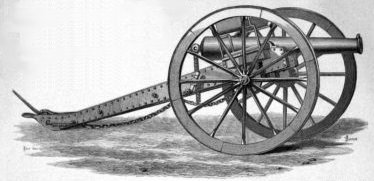
Questions Raised by Lunenburg’s Cannon

Yesterday’s posting, thanks to Eileen O’Brien, quoted from the town records of Lunenburg as its citizens voted to mount a nine-pounder cannon and then offer it to the provincial army.

Of course, the town didn’t make that offer until after 13 June 1775, almost two months after the war began. The gun might not have been fully mounted and equipped until then; the effort didn’t start until March. But the records imply that Lunenburg didn’t even alert the Massachusetts Provincial Congress that it might have a cannon until June.

The man given the most responsibility for managing this cannon was Abijah Stearns (1724-1783). He was put on the committee to collect money to mount the cannon, and he was in charge of the guard that trucked it to Cambridge in the summer of 1775.

That makes sense because Stearns had been one of Lunenburg’s representatives to the first Provincial Congress in October 1774, and he became a colonel in the state militia in 1776. His gravestone, complete with rhyming verse, appears above.

During the months when Lunenburg was discussing the cannon, however, the town’s sole representative to the second and third Provincial Congresses was Dr. John Taylor. He wasn’t linked to the gun directly, but he was the medical mentor of Dr. Abraham Haskell, who was added to the cannon committee on the same day as Stearns. So Taylor probably knew about the gun.

In early June 1775, shortly before the decision to turn over the cannon, Dr. Taylor convinced the Provincial Congress that Lunenburg should be allowed to deliver half a barrel of gunpowder instead of the one or two barrels the congress had asked for. Was that arrangement related to the cannon?

As for Lunenburg’s request to the Massachusetts General Court to pay for the cannon, I haven’t found a record of that payment coming through. (The legislature did compensate the town for some costs from April 1775.) If the Continental Army had taken that nine-pounder down to New York in the spring of 1776, the state probably passed Lunenburg’s bill on to the Continental Congress.

Thursday, June 29, 2017

A Cannon in Lunenburg

Eileen O’Brien kindly shared the following extracts from the records of the Lunenburg town meeting. They add Lunenburg to the list of Massachusetts towns which in the months before the Revolutionary War officially began were discussing how to arm themselves with artillery—the focus of my book, The Road to Concord. Thanks, Eileen!

In the “Town of Lunenburg Minute & Report 1763-1796” (which is unpublished) are the following entries:
At a Legal annual Town meeting on monday ye 6th of March 1775 being Legally assembled at the publick meeting house in Lunenburg

Voted to open a Subscribtion to mount the Cannon now in town

Voted & Choose Capt Aaron Willard Lt Philip Goodridge & Mr Zebulon Dodge a Committe to forward sd Subscribtion & to See to the mounting [of] sd cannon . . .

March ye 9th: the town being meet agreeable to the adjournment—

Voted that Capt Abijah Stearns & Docr. Abraham Haskel be added to the Committe that was Choosen to open a Subscribtion for mounting the Cannon and that the Sd Committe Receve any article in the Subscribtion and turn the Same to the best advantage for Sd purpos . . .

At a Legal town meeting at the meeting hous in Lunenburg on Tusday the thirteenth Day of June 1775...

Voted that whereas there is a peace of ordnance viz a cannon carrying a Shot of 9# well mounted & fit for Service now in the town of Lunenburg the property of sd town which the Said town are willing Should be made use of for the Defence of the province or otherwise as the Committe of Safty or Congress for Sd province Shall think proper, & will convey the Same to Cambridge on there Desire or order, and also that the Select men of the Sd. town give proper notice that their is Such a peice of ordinance now at Lunenburg fit for Service, to the Said Congress or Committe of Safty for Sd province

Voted that Capt. Abijah Stearns be an officer of four men for a gard & a teamster to See that the Cannon be Safely Conveyd as above prescribed

Voted that if Capn Stearns Delivers Said Cannon that he take a proper Recipt . . .

the town being [met] December ye 11th: 1775 agreeable to the adjornment

Voted that the Selectmen be a Committe to petition the General assembley for the Chargeses of procuring & mounting a Canon for the Continential army
As Eileen O’Brien noted, the men of Lunenburg were very careful to get a receipt for their property and to ask for payment. After all, cannon don’t grow on trees, and town meetings don’t like to spend money.

TOMORROW: Some observations and questions about this situation.

Friday, June 20, 2014

The Memory of Peter Brown after Bunker Hill

Coming back to the Battle of Bunker Hill, one of our very best accounts of the event comes from an American soldier from a Westford company named Peter Brown. On 25 June 1775 Brown sent a detailed description of that fight to his mother. That document is now at the Massachusetts Historical Society, which offers a digitized version for everyone.

I quoted from Peter Brown’s letter in 2011, adding (based on the M.H.S.’s page about him) that we have few other details of his life beyond this document.

In February of this year a commenter dubbed lifford gave me a pointer to a history of Lunenburg which has more to say about Peter Brown. So I used that tip, and of course Google Books, to get beyond the common name “Peter Brown” and find more information.

It appears that Brown’s letter first appeared in print in the June 1875 issue of Potter’s American Monthly. A correspondent from Belfast, Maine, named John L. Locke prefaced the document this way:
The original of the following letter, rusty with age and worn by frequent handling, has the following address on its back: Mrs. Sarah Brown, Newport, Rhode-Island. The writer of the letter was Peter Brown, son of Wm. Brown, of Newport, R.I. He was married to Miss Olive Dinsmore, of Boylston, Mass., Oct. 24, 1781. At the close of the Revolution, in 1783, Mr. and Mrs. Brown went to Lunenburg, Mass., and in the locality known as “Flat Hill” commenced house-keeping operations. His grandson, Wm. Lifford Brown, now occupies the place. Of their 8 children, 4 were sons, and 4 were daughters. Mr. Brown died in Lunenburg, July 15, 1829, aged 76 years. He and all his family except one who died in Boston, were buried in the South Cemetery in Lunenburg.

The original letter, of which this is an exact copy, is now in possession of Mrs. Charlotte Lewis, of Lunenburg, who is a lineal descendant of Peter Brown, the writer.
Later that year the New England Historical Genealogical Society reprinted Brown’s letter and Locke’s preface in an appendix to a collection of Centennial Orations Commemorative of the Opening Events of the American Revolution. That publication was mostly a reprint from the society’s Register in 1875, but the Brown letter was added to the appendix late and therefore never got included or indexed with the Register volumes. Only 275 copies of the standalone collection with the letter were printed.

Then we come to lifford’s source, George A. Cunningham’s “History of the Town of Lunenburg.” Cunningham died in 1875, so he must have prepared that genealogical study before the publications above, but his work was never published. Until recently it appears to have existed only as a typescript at the Lunenburg Historical Society.

Then a grant allowed the society to digitize the document, and it’s now available (with a poor O.C.R. transcription) through archive.org. As pages 97-98 show, Brown served in various town and church offices in Lunenburg after the war. He and his wife Olive had eight children (the youngest of which I see was named Lifford).

Finally, Find-a-Grave has catalogued Peter and Olive Brown’s grave, as shown above. Its inscription reads:
In memory of
Mr. Peter Brown,
who died July 15, 1829,
Æt. 76.

In memory of
Mrs. Olive,
wife of Mr. Peter Brown,
who died April 20, 1828,
Æt. 70.

He was a soldier in the revolution,
was one of those who persued
the British in their retreat from
Concord to Boston, was in the
Battle on Bunker’s Hill. He was an
honest man and a devoted Christian.

She was a faithful wife,
an affectionate Mother,
and a sincere Christian.

Their surviving children, William & Mary,
have erected this stone to the memory
of their Parents.