J. L. BELL is a Massachusetts writer who specializes in (among other things) the start of the American Revolution in and around Boston. He is particularly interested in the experiences of children in 1765-75. He has published scholarly papers and popular articles for both children and adults. He was consultant for an episode of History Detectives, and contributed to a display at Minute Man National Historic Park.

Subscribe thru Follow.it


•••••••••••••••••


Showing posts with label Lemuel Haynes. Show all posts

Wednesday, July 23, 2025

Call for Papers on “Freedom, Slavery, and Race in the American Revolution”

The Sons of the American Revolution is sponsoring a scholarly conference at Wake Forest University in Winston-Salem, North Carolina, on 29–31 May 2026 on the topic “Freedom, Slavery, and Race in the American Revolution.”

Here’s the call for papers:
The conference will examine the experiences of African American people and the ideologies of freedom, slavery, and race in the War for American Independence and the founding of the United States.

In his 1776 essay Liberty Further Extended, Lemuel Haynes denied that “Liberty is so contracted a principle as to be Confin’d to any nation under Heaven; nay, I think it not hyperbolical to affirm, that Even an African, has Equally as good a right to his Liberty in common with Englishmen.” This Black patriot and soldier connected freedom, citizenship, and nation. How actors in the American Revolution experienced, articulated, or contested these ideas is the question that drives this conference.

The conference intends to examine perspectives from Black and White men and women aligned with the Patriots or Loyalists. We also invite comparisons between the young United States and the broader revolutionary Atlantic World.

The S.A.R. invites proposals based on new research from graduate students, established scholars, and public history practitioners. Proposals should include a 250-word abstract introducing the author’s research and how their topic advances the field, and a two-page vita.

Submit proposals by October 1, 2025, to John Ruddiman, Department of History, Wake Forest University at Ruddimja@wfu.edu with the subject line “2026 SAR Conference.” Acceptances will be sent by early December 2025.

The S.A.R. anticipates publication of the accepted, revised papers in an edited volume. To facilitate that, participants will submit their papers (approximately 5,000–6,000 words) for pre-circulation by May 1, 2026.
The society will offer cover presenters’ travel and lodging expenses and pay each a $500 honorarium.

Thursday, April 20, 2023

Sons of Freedom join to sing…”

Yesterday I shared the first twenty-two verses of Lemuel Haynes’s poem ”The Battle of Lexington.”

First published in the William & Mary Quarterly in 1985, this poem has been partially reprinted in some textbooks. However, I’ve found the whole thing in only one anthology and no websites. So, in the interest of completeness, here are the remaining verses.
23
Altho our Numbers were but few
And they a Num’rous Throng
Yet we their Armies do pursue
And drive their Hosts along
24
One Son of Freedom could annoy
A Thousand Tyrant Fiends
And their despotick Tribe destroy
And chace them to their Dens
25
Thus did the Sons of Brittain’s King
Recieve a sore Disgrace
Whilst Sons of Freedom join to sing
The Vict’ry they Imbrace
26
Oh! Brittain how art thou become
Infamous in our Eye
Nearly allied to antient Rome
That Seat of Popery
27
Our Fathers, tho a feeble Band
Did leave their native Place
Exiled to a desert Land
This howling Wilderness
28
A Num’rous Train of savage Brood
Did then attack them round
But still they trusted in their God
Who did their Foes confound
29
Our Fathers Blood did freely flow
To buy our Freedom here
Nor will we let our freedom go
The Price was much too dear
30
Freedom & Life, O precious Sounds
yet Freedome does excell
and we will bleed upon the ground
or keep our Freedom still
31
But oh! how can we draw the Sword
Against our native kin
Nature recoils at such a Word
And fain wd. quit the Scene
32
We feel compassion in our Hearts
That captivating Thing
Nor shall Compassion once depart
While Life retains her String
33
Oh England let thy Fury cease
At this convulsive Hour
Consult those Things that make for Peace
Nor foster haughty Power
34
Let Brittain’s king call home his Band
of Soldiers arm’d to fight
To see a Tyrant in our Land
Is not a pleasing Sight
35
Allegiance to our King we own
And will due Homage pay
As does become his royal Throne
Yet in a legal Way
36
Oh Earth prepare for solemn Things
Behold an angry God
Beware to meet the King of Kings
Arm’d with an awefull Rod
37
Sin is the Cause of all our Woe
That sweet deluding ill
And till we let this darling go
There's greater Trouble still
This poem survived as a manuscript in Haynes’s handwriting. A lot of words are crossed out. One whole verse was composed, shifted, and finally rewritten for another place in the poem. (Except for the introductory line yesterday, I didn’t indicate the earlier language, but it all appears in the William & Mary Quarterly.) Thus, this was almost certainly Haynes’s working manuscript.

In her article on the first publication, Ruth Bogin deduced that Haynes wrote the poem in the spring of 1775 because he complained about the regulars’ actions in the Battle of Lexington and Concord but didn’t mention the greater destruction of Bunker Hill.

The poem also matches the political situtation early in the war, when American colonists still proclaimed their loyalty to King George III and appealed to him to reverse his ministers’ policies.

As we should expect from a future minister raised in a rural New England deacon’s household, these lines reflect a Congregationalist outlook on the conflict, fusing the current political crisis with the Last Judgment. In metre and length, the poem echoes common hymns.

That outlook is why Haynes described the royal government as “Nearly allied to…That Seat of Popery,” as if all oppression stemmed from Rome. Three years later, the U.S. of A. would sign a treaty with Catholic France, making that sentiment less tenable.

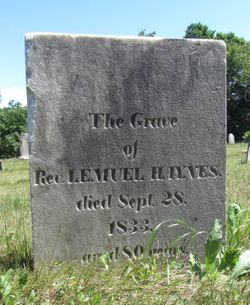
(The photo above shows the Rev. Lemuel Haynes’s grave in Granville, New York, courtesy of Find a Grave.)

Wednesday, April 19, 2023

“At Lexington they did appear Array’d in hostile Form”

Lemuel Haynes was born in West Hartford, Connecticut, in 1753. His father was African, his mother a white New Englander who abandoned her baby after five months.

David Rose, a deacon in Granville, Massachusetts, and his wife Elizabeth took the baby into their home under indenture. Worshipping with the family, Lemuel learned to read at the local school.

(Some recent profiles of Haynes say David Rose was blind and little Lemuel read to him, but there’s no mention of such a disability in Timothy Mather Cooley’s 1837 biography.)

In 1774 Haynes came of age as a free man. He was in the Granville militia company when it marched east at the start of the Revolutionary War. In the fall of 1776, Haynes enlisted for short service and marched to Fort Ticonderoga, only to catch typhus and have to return home.

In 1779 Haynes started to pursue a religious career, working for Connecticut ministers in exchange for training. He was ordained in 1785, and three years later took a permanent post as minister in Rutland, Vermont. Well, it was permanent until 1818, when that congregation dismissed him, but then he moved on to Manchester, Vermont, and Granville, New York.

During his lifetime Haynes published sermons and poetry. More manuscripts came to light in the 1980s, including this poem.
The Battle of Lexington

A Poem on the inhuman Tragedy perpetrated on the 19th of April 1775 by a Number of the Ministerial Brittish Troops under the Command of Thomas Gage, which Parricides and Ravages are shocking Displays of ministerial & tyrannic Vengeance composed by Lemuel a young Mollatto Man Mollato who obtained what little knowledge he possesses, by his own Application to Letters.

1
Some Seraph now my Breast inspire
whilst my Urania sings
while She would try her solemn Lyre
Upon poetic Strings.
2
Some gloomy Vale or gloomy Seat
where Sable veils the sky
Become that Tongue that wd. repeat
The dreadfull Tragedy
3
The Nineteenth Day of April last
We ever shall retain
As monumental of the past
most bloody shocking Scene
4
Then Tyrants fill’d wth. horrid Rage
A fatal Journey went
& Unmolested to engage
And slay the innocent
5
Then did we see old Bonner rise
And, borrowing Spite from Hell
They stride along with magic Eyes
where Sons of Freedom dwell
For those not raised on John Foxe’s Book of Martyrs, Bishop Edmund Bonner oversaw the burning of Protestants under Queen Mary, two centuries before.
6
At Lexington they did appear
Array’d in hostile Form
And tho our Friends were peacefull there
Yet on them fell the Storm
7
Eight most unhappy Victims fell
Into the Arms of Death
Unpitied by those Tribes of Hell
Who curs’d them wth. their Breath
8
The Savage Band still march along
For Concord they were bound
While Oaths & Curses from their Tongue
Accent with hellish Sound
9
To prosecute their fell Desire
At Concord they unite
Two Sons of Freedom there expire
By their tyrannic Spite
10
Thus did our Friends endure their Rage
Without a murm’ring Word
Till die they must or else engage
And join with one Accord
11
Such Pity did their Breath inspire
That long they bore the Rod
And with Reluctance they conspire
To shed the human Blood
12
But Pity could no longer sway
Tho’ ’t is a pow’rfull Band
For Liberty now bleeding lay
And calld them to withstand
13
The Awfull Conflict now begun
To rage with furious Pride
And Blood in great Effusion run
From many a wounded Side
14
For Liberty, each Freeman Strives
As its a Gift of God
And for it willing yield their Lives
And Seal it with their Blood
15
Thrice happy they who thus resign
Into the peacefull Grave
Much better there, in Death Confin’d
Than a Surviving Slave
16
This Motto may adorn their Tombs,
(Let tyrants come and view)
“We rather seek these silent Rooms
Than live as Slaves to You”

17
Now let us view our Foes awhile
who thus for Blood did thirst
See: stately Buildings fall a Spoil
To their unstoick Lust
18
Many whom Sickness did compel
To seek some Safe Retreat
Were dragged from their sheltering Cell
And mangled in the Street
19
Nor were our aged Gransires free
From their vindictive Pow’r
On yonder Ground lo: there you see
Them weltering in their Gore
20
Mothers with helpless Infants strive
T’ avoid the tragic Sight
All fearfull wether yet alive
Remain’d their Soul’s delight
21
Such awefull Scenes have not had Vent
Since Phillip’s War begun
Nay sure a Phillip would relent [?]
And such vile Deeds would shun
22
But Stop and see the Pow’r of God
Who lifts his Banner high
Jehovah now extends his Rod
And makes our Foes to fly
TOMORROW: Fifteen more verses.


Thursday, February 04, 2021

The Records of Congregationalists of Color

Under the project title of “New England’s Hidden Histories,” the Congregational Library and Archives has been digitizing the records of early churches and related documents.

The library has just announced the publication of a finding aid for material across that digitized collection which illuminate the religious lives of people of African and indigenous descent.

The introductory text by Prof. Richard J. Boles of Oklahoma State University explains:
Though historians have long recognized that the early Congregationalists’ missionary impulse led them to establish Native American “praying towns,” and that some Congregational churches included Black, Native, and mixed-race parishioners, including people enslaved by white parishioners and clergy, the experiences of these underrepresented populations have received relatively scant scholarly attention. In fact, the participation of Black and Indigenous people in early American Congregational churches was both significant and longstanding, as were their contributions to Congregationalism as church members, lay preachers, and ordained ministers. . . .

During the colonial era, African Americans and American Indians participated in numerous predominantly-white Congregational churches through baptism, communion, public worship, singing, catechism classes, and other shared religious activities. Their participation was usually in the context of colonization and enslavement or bonded servitude, but some Black and Indigenous peoples had spiritual as well as practical reasons (such as access to education) for affiliating with these churches.

During the widespread religious revivals of the early 1740s, some Narragansett, Pequot, Mohegan, Niantic, Wampanoag, and other Indigenous peoples attended and participated in majority-white Congregational churches. Additionally, many Black people, enslaved and free, affiliated with both evangelical-leaning and more traditional Congregational churches throughout the eighteenth century. The manuscript church records digitized by New England’s Hidden Histories are essential for understanding the religious affiliations of Black and Indigenous peoples because published vital records and nineteenth-century church directories commonly omitted information about eighteenth-century Black and Indian church members.

Partly because they faced prejudice from white Christians, including segregated seating and proscriptions against voting and holding leadership positions, Black and Indigenous people in New England increasingly began to form their own Congregational churches. For example, dozens of Narragansett men and women in the early 1740s joined Joseph Park’s Congregational church in Westerly, Rhode Island, but about 1749, most of them left this church and founded their own congregation under the leadership of Samuel Niles (Narragansett). African Americans slowly grained freedom from slavery in New England after the 1780s, and in the early nineteenth century, they founded Congregational churches in Newport, RI, Portland, ME, and New Haven, CT.
The guide is divided into six categories:
  • Firsthand Writings by BIPOC (Black, Indigenous, and other people of color), including the Rev. Lemuel Haynes, shown above.
  • BIPOC Churches and Institutions
  • Indigenous-Focused Records
  • BIPOC in Majority-White Church Records
  • Antislavery and Abolitionist Materials
  • Further Reading
These documents have not been transcribed but can be read on the “New England’s Hidden Histories” website.